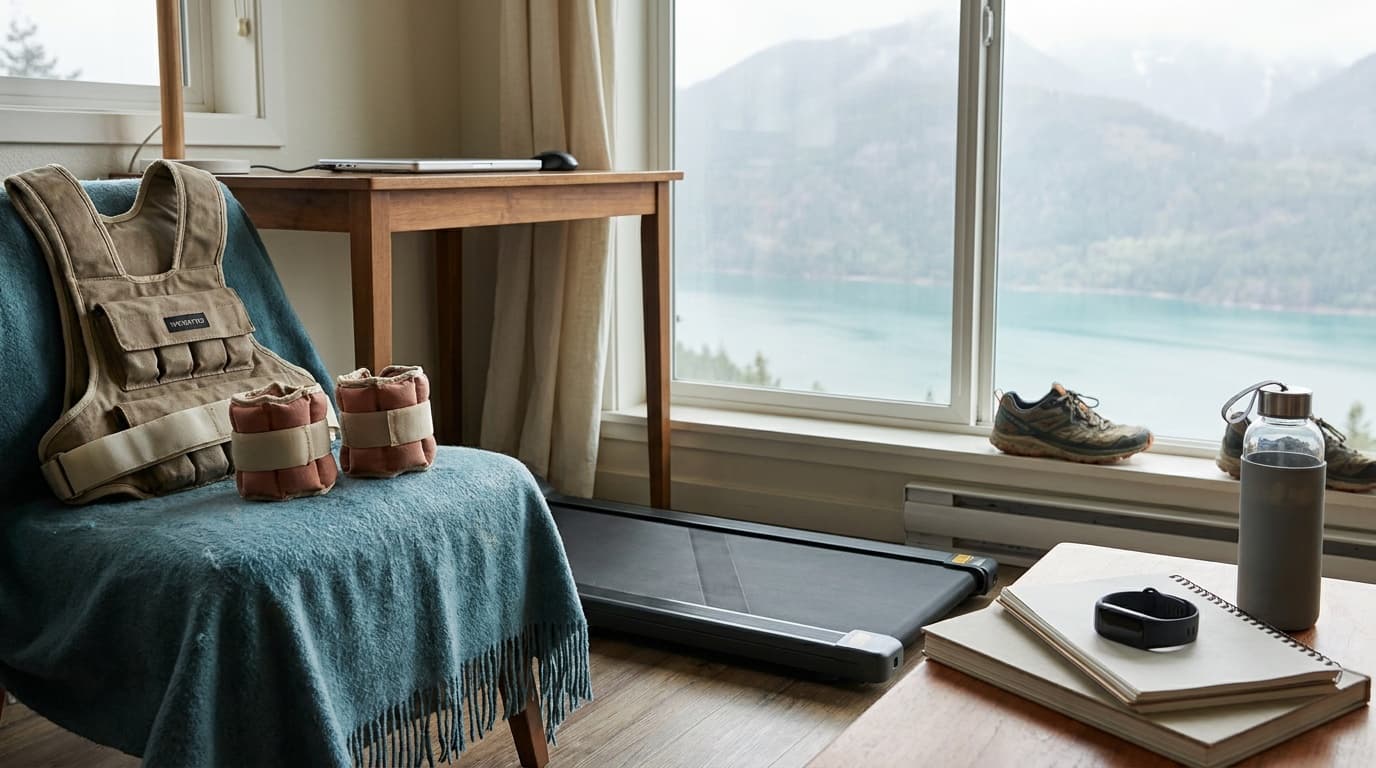
Start with 1 to 2 lb per ankle. That is enough for most beginners doing leg raises, Pilates, or light walking, and it leaves room to progress in small steps: Harvard Health recommends ankle cuffs that take ½-pound weight inserts and hold at least 5 pounds per leg. For walking, keep it light, because research on leg loading shows weight at the lower leg and foot raises the energy cost of every stride more than the same weight at the waist. If you want room to progress, compare our best ankle weights before buying a fixed pair.
Buy the adjustment range, not the heaviest pair
- You want one light setting for Pilates or barre: choose the BAGAIL fixed weights in the weight you already know you use. The lower profile is useful when you do not need progression.
- You are starting at 1 to 2 lb and expect to progress: choose the APEXUP modular weights. Small adjustments matter more than a high maximum.
- Your main activity is walking: skip ankle weights. Use the weighted-vest calculator to consider a torso-loaded option that does not place weight at the end of the leg.
- You need more than 5 lb for a controlled strength exercise: check whether a cable, resistance band, or standard weight gives you a more stable progression before buying a heavier ankle model.
Our quick picks
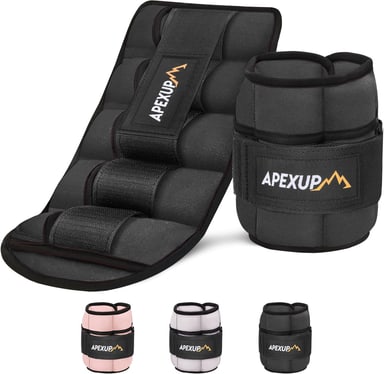
APEXUP Adjustable Ankle Weights
Discrete 1-lb modules produce clean, precise load steps with no shifting or sloshing during movement
Best for: Structured progressive training programs where precise load tracking matters, and for users who run warm and want a non-neoprene sleeve.
Buy on Amazon →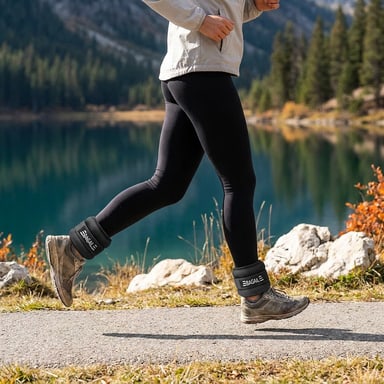
BAGAIL Ankle and Wrist Weights
Three-layer Lycra-SBR fabric manages moisture better than single-layer neoprene and resists odor at this price tier
Best for: Budget-conscious beginners who want a single fixed-weight pair for daily walks or beginner physical therapy exercises without a modular system.
Buy on Amazon →Why beginners should start lighter than they think
Ankle weights attach at the end of a long lever arm, your leg. Even a modest weight creates real torque at the knee and hip, because it sits two to three feet from the joint doing the work. A 2 lb dumbbell curl feels trivial; a 2 lb ankle weight during a straight-leg raise asks a lot from your hip flexors and loads the knee through that long lever.
For most beginners, 1–2 lb per ankle is the right entry point. It feels almost too easy in the first rep but accumulates quickly over a full set of donkey kicks, clamshells, or leg raises. If you can complete 3 sets of 15 reps with clean form and no joint discomfort, then move up. If your hips hike, your lower back arches, or your knee tracks inward, the weight is already too heavy.
Progressing for leg strength
Once you have a base, progression follows the same logic as any resistance training: add load only when you can complete your target reps and sets with full control. The increments should be small. Jumping from 2 lb to 5 lb is a 150 percent load increase; for isolation exercises that is a large jump.
Ankle weight progression ladder
Week 1–2
Start at 1–2 lb; focus on form, full range of motion, and no compensations
Week 3–4
If 3 x 15 feels controlled and joints feel good, add 0.5–1 lb
Month 2
Work toward 3–5 lb for exercises like side-lying leg raises and donkey kicks
Month 3 and beyond
Advanced users can reach 5–10 lb for targeted glute and hip work
Ongoing
Deload by 20–30 percent whenever form degrades or joint soreness appears
In rehab, your physical therapist sets the pace, and it is usually slower than a gym progression, because tendons and connective tissue adapt more slowly than muscle.
Why heavier is not better for walking
Adding ankle weights to your daily walk feels like an efficient shortcut. In practice, the trade-off is poor. In a 2007 study in Medicine & Science in Sports & Exercise, the energy cost of walking rose with added mass and rose more the farther down the leg it sat; loads on the feet also increased the work of the muscles that start each leg swing, while the same mass at the waist cost far less. Loads strapped to the shank, up to 4 kg (about 9 lb) in that study, did not measurably change walking kinematics, so the case against heavy ankle weights is about swinging a heavy lever thousands of times, not proven injury.
The muscles you want to strengthen for walking fitness, the glutes and hip extensors, are better loaded through your center of mass or with controlled strength exercises than by a weight swinging at the end of your leg. If you want to make walking harder, a weighted vest or a loaded pack distributes load over your center of mass and does not disrupt your gait; Ruck Authority's rucking vs. walking comparison quantifies what that load does to effort and calorie burn. Reserve ankle weights for controlled, low-velocity exercises where the lever-arm effect is the point.
For walking, a weighted vest challenges your cardiovascular system without the joint trade-offs that ankle weights introduce.
Matching weight to the exercise type
Not all ankle weight exercises ask the same thing of your body. A Pilates inner-thigh pulse and a weighted straight-leg deadlift are completely different movement demands.
Pilates, barre, and yoga-adjacent moves: These exercises emphasize endurance, stability, and mind-muscle connection over raw load. The ranges of motion are small and the tempo is slow. Stay in the 1–3 lb range. Going heavier breaks the precision that makes these movements effective.
Rehabilitation and physical therapy exercises: Hip abductions, clamshells, terminal knee extensions, and side-lying leg series are the workhorses of PT. These start at 1–2 lb and progress slowly, often capped at 3–5 lb even in later stages. The goal is neuromuscular re-education and tendon loading, not maximum strength.
Targeted lower-body strength moves: Donkey kicks, fire hydrants, and prone hip extensions can accommodate more load once your form is solid. Intermediate to advanced users work in the 5–10 lb range here.
Adjustable vs fixed: which to buy for progression
Fixed-weight ankle weights are inexpensive and simple, but they force large jumps between sizes: you buy a 2 lb pair, then a 5 lb pair, then perhaps a 8 lb pair. That is three purchases and three jumps in load.
Adjustable ankle weights like the APEXUP Adjustable Ankle Weights use removable iron-sand modules so one product covers a range. The 10 lb pair holds five 1 lb modules per cuff, adjusting from 1 to 5 lb per ankle; the 5 lb pair tops out at 2.5 lb per ankle in smaller steps. Harvard Health's advice is to prefer ½-pound inserts, so if fine steps matter most, the 5 lb pair or a cuff with ½ lb bars is the better fit.
One practical exception: if you already know you will live at a single weight for a specific use (say, 2 lb for your Pilates class), a fixed pair like the BAGAIL Ankle and Wrist Weights is lighter, lower-profile, and simpler to put on and take off.
Where these numbers come from
| Claim | Source | Checked |
|---|---|---|
| Buy ankle cuffs with ½-pound weight inserts that hold at least 5 lb per leg so you can progress | Harvard Health, what you need to get started with strength and power training | 2026-09-25 |
| Walking energy cost rises with added leg mass and more distal placement; foot loads raised swing-muscle activity; waist, thigh and shank loads left kinematics similar | Browning et al., Med Sci Sports Exerc 2007;39(3):515-25 | 2026-09-25 |
| Adults: muscle-strengthening activity at least 2 days a week, including legs and hips | CDC, adult activity guidelines | 2026-09-25 |
| APEXUP: 10 lb pair has five 1 lb modules per cuff (1 to 5 lb each); 5 lb pair (2.5 lb each) also sold | Amazon listing B09T981811 | 2026-09-25 |
| BAGAIL: fixed-weight cuffs in sizes labeled 1 to 10 lb (the 1 lb option is 1 lb per cuff); iron sand fill; Velcro with metal D-ring | Amazon listing B0FPQDQJW4 | 2026-09-25 |
The starting weights in this guide are a conservative synthesis of those sources, not a clinical prescription. If you have a joint injury, your physical therapist's numbers come first.
Frequently asked questions
Can ankle weights cause knee damage?
Used correctly for low-velocity exercises at appropriate weights, ankle weights are generally safe. The risk rises when you use them for high-impact activity, walk or run with them at weights above 1–2 lb, or progress too quickly. The lever-arm physics mean the knee absorbs significant torque even from modest loads. If you have existing knee or hip pathology, check with a physical therapist before adding ankle weights to your routine.
How often should I use ankle weights?
Treat ankle weight exercises like any resistance training. The CDC recommends muscle-strengthening activity on at least 2 days a week, covering the major muscle groups including the legs and hips, so two or three sessions a week with a rest day between them is a sensible starting point. Tendons and connective tissue adapt more slowly than muscle, so soreness in the knee or hip is a signal to back off, not push through.
Do ankle weights burn more calories when walking?
A little. In a lab study of leg loading, walking with weight on the lower leg or foot raised the energy cost of walking more than the same weight carried at the waist, because the leg has to accelerate that mass on every stride. At the 1 to 2 lb most people should use, the increase is small. If more calorie burn is the goal, walking faster, adding hills, or wearing a weighted vest adds more load with less strain on the swinging leg.
What weight is right for ankle weights used in physical therapy?
Usually light: 1 to 2 lb is a common start for hip and glute exercises, progressing in small increments, and many home programs never go past 5 lb. Your physical therapist will set specific targets based on your condition. If you are self-directing a home program, err on the lighter side and prioritize the quality of movement over the amount of weight on your ankle.
For specific picks across weight ranges and use cases, see our guide to the best ankle weights. Browse all fitness guides or read how we research and rate gear.
Recommended gear
Our current top picks from the Best ankle weights for walking and workouts (2026) guide, if you are ready to buy.
SPORTNEER
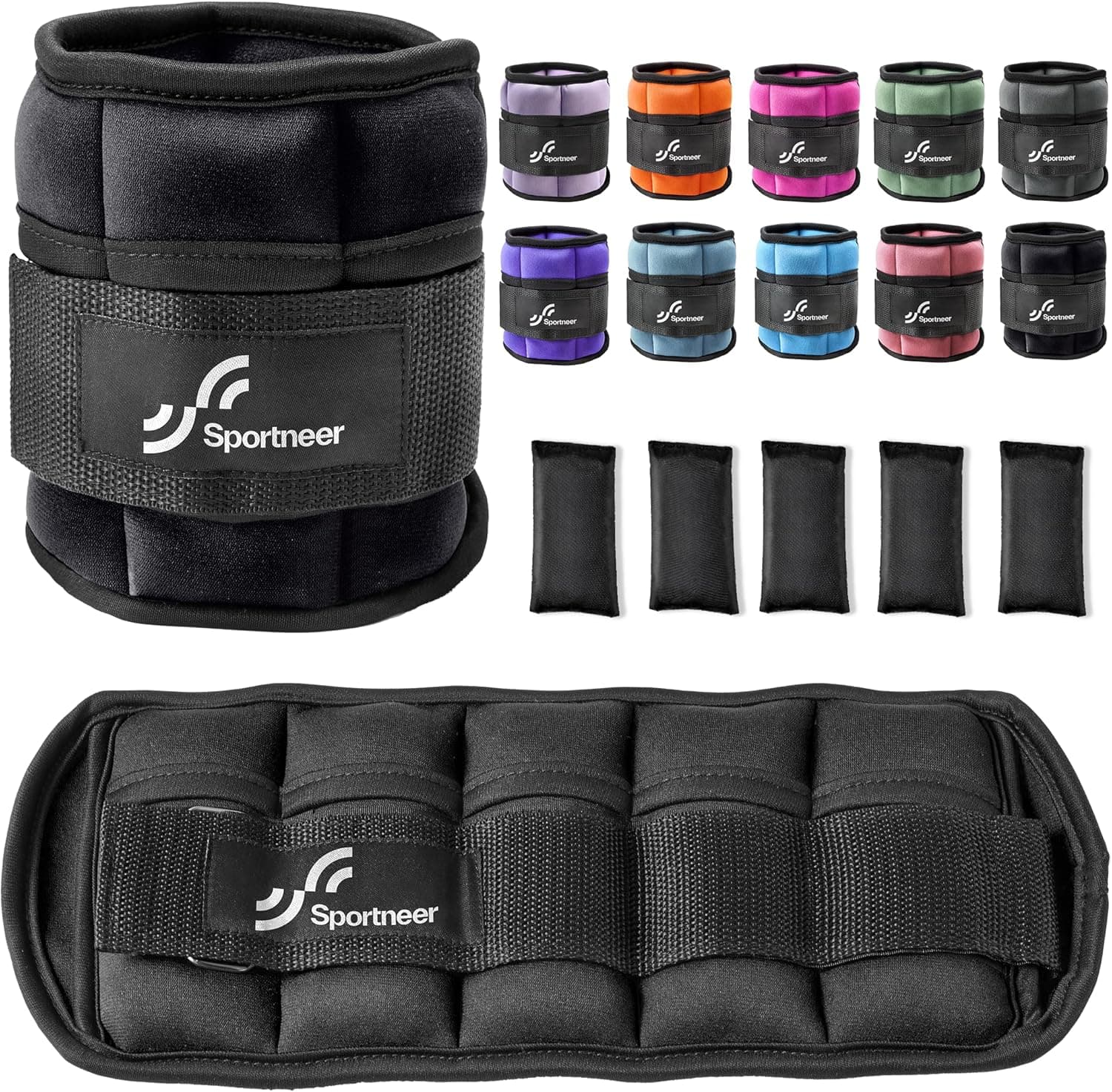
Sportneer Adjustable Ankle Weights Set
Best Overall
Kit Score 8.8/10
$33.99 Price checked Oct 23, 4:16 PM CDT
Best for: Walkers and home-gym users who want one pair that grows with their fitness level, from 1 lb warm-up walks to 5 lb leg raise sets.
- Wide 1–5 lb per cuff range supports progressive overload from first walk to more demanding leg work
- Sandbags take a few sessions to load and unload smoothly, especially at first
- Weight range
- 1–5 lb per cuff (2–10 lb per pair)
- Adjustability
- 5 removable iron-sand sandbags (1 lb each) per cuff
- Fill material
- Double-bagged iron sand
- Exterior
- Neoprene with reinforced stitching
- Strap
- Adjustable Velcro with stainless steel D-ring
- Fit range
- 7.5–12.5 in. ankle circumference
About this pick
A documented top seller with over 24,000 Amazon ratings, the Sportneer pair covers the full beginner-to-intermediate weight band in a single purchase. Five removable 1-lb sandbags per cuff let you step up load in manageable increments, and a stainless steel D-ring keeps the strap locked during movement.
Strengths
- Wide 1–5 lb per cuff range supports progressive overload from first walk to more demanding leg work
- Moisture-absorbing neoprene interior stays comfortable during longer sessions and resists odor
- D-ring closure system holds position reliably through side shuffles and stair climbs
Weaknesses
- Sandbags take a few sessions to load and unload smoothly, especially at first
- Velcro shows wear before the neoprene does under daily heavy use
Kit Score breakdown
APEXUP
APEXUP Adjustable Ankle Weights
Editor's Choice
Kit Score 8.3/10
$26.96 Price checked Oct 23, 4:16 PM CDT
Best for: Structured progressive training programs where precise load tracking matters, and for users who run warm and want a non-neoprene sleeve.
- Discrete 1-lb modules produce clean, precise load steps with no shifting or sloshing during movement
- Fabric exterior shows dirt more visibly than darker neoprene alternatives
- Weight range
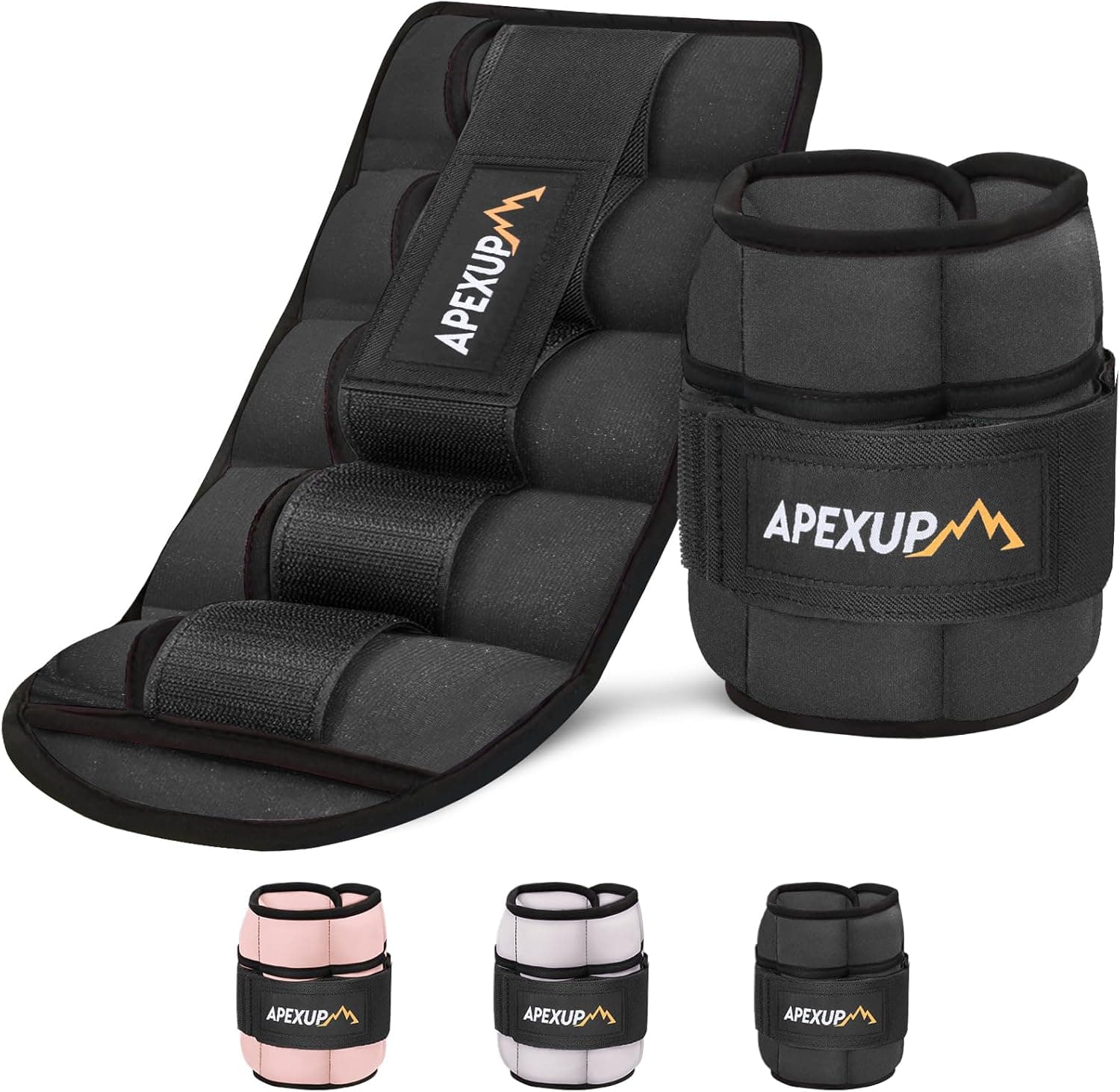
- Up to 2.5 lb per cuff (5 lb pair version); 1–5 lb per cuff in 1 lb modules (10 lb pair version)
- Adjustability
- 5 removable modular iron-sand pockets per cuff (10 lb version)
- Fill material
- Iron sand in individual sealed modules
- Exterior
- Soft breathable fabric sleeve
- Strap
- Adjustable Velcro, one-size-fits-all
- Colors available
- Black, purple, pink, gray, orange, green, blue, yellow
About this pick
APEXUP's modular design keeps each weight increment in its own sealed iron-sand pocket, so you're adding discrete units rather than loose sandbags. The listing family covers a 5 lb pair and a 10 lb pair variant; each gives 1-lb steps per cuff with a breathable fabric sleeve that wears comfortably through longer sessions. Over 7,800 Amazon ratings at 4.5 stars (September 2026).
Strengths
- Discrete 1-lb modules produce clean, precise load steps with no shifting or sloshing during movement
- Breathable fabric sleeve is cooler against skin than traditional neoprene during extended walking sessions
- Available in multiple color options and backed by a 30-day return and lifetime warranty
Weaknesses
- Fabric exterior shows dirt more visibly than darker neoprene alternatives
- Velcro closure is not reinforced with a D-ring, so strap security under heavy lateral movement is slightly lower than D-ring designs
Kit Score breakdown
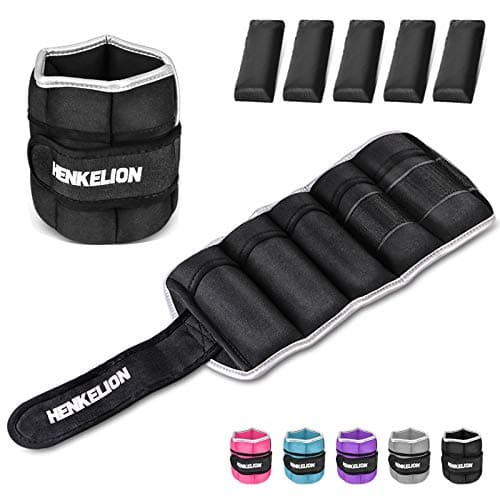
Best for: Daily walkers who want a comfortable, breathable cuff for 30–60 minute sessions at a fixed light-to-moderate load without paying a premium.
- Mercerized cotton exterior breathes better than neoprene and resists odor buildup over extended daily wear
- Elongated design leaves excess strap on ankles under roughly 8 inches in circumference, which can catch on clothing
- Weight range
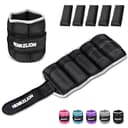
- 2 lb per pair (1 lb each); also available in 3 lb, 5 lb, 8 lb, and 10 lb pairs
- Adjustability
- Removable weight bags; Velcro strap
- Fill material
- Iron sand in individual bags
- Exterior
- Mercerized cotton blend, moisture-wicking
- Strap
- Velcro with metal D-ring loop
- Fit range
- Elongated design; fits most adult ankle sizes
About this pick
Henkelion's mercerized cotton construction is the standout difference here: the softer, more breathable fabric is especially comfortable for low-to-moderate walking loads worn over longer periods. With 14,800+ Amazon ratings at 4.6 stars across multiple weight variants, it has one of the largest verified review pools in the category.
Strengths
- Mercerized cotton exterior breathes better than neoprene and resists odor buildup over extended daily wear
- 14,800+ Amazon ratings at 4.6 stars across multiple weight variants represents a high-confidence owner satisfaction signal
- Metal D-ring keeps the strap firmly anchored; works equally well on wrists and ankles for combined routines
Weaknesses
- Elongated design leaves excess strap on ankles under roughly 8 inches in circumference, which can catch on clothing
- Fixed-weight-per-bag increments are coarser than the modular 1-lb steps on the Sportneer or APEXUP designs
Kit Score breakdown
See all picks in Best ankle weights for walking and workouts (2026)
Keep going
Researched, not hands-on tested
Updated Sep 25, 2026Our recommendations draw on manufacturer documentation, retailer listings, owner feedback, and comparisons with alternatives.
As an Amazon Associate I earn from qualifying purchases. We may earn a commission from links here, at no extra cost to you. How we research →