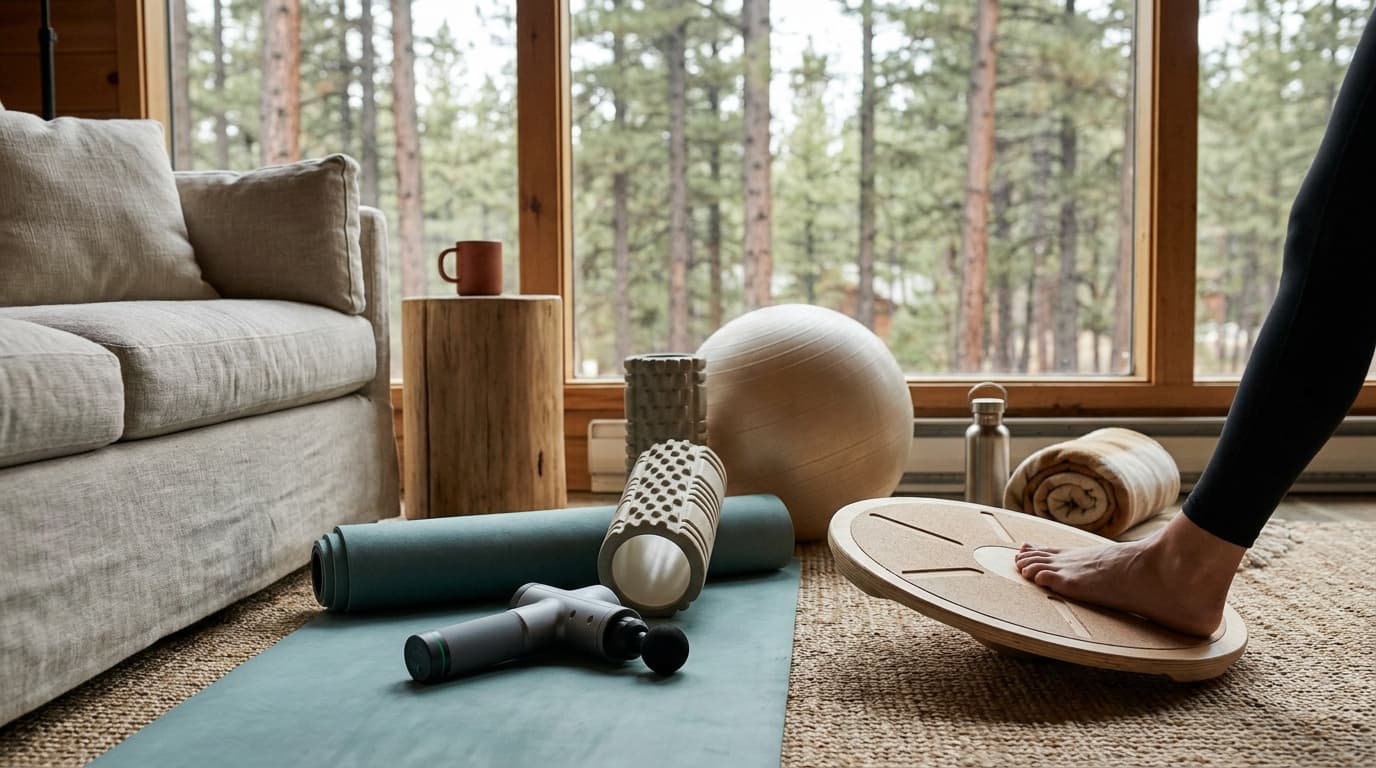
A balance board is useful only when the challenge is high enough to require control and low enough that you can practice without repeatedly bailing. Start with the room, the support, and the board type before adding exercises.
Set up the room
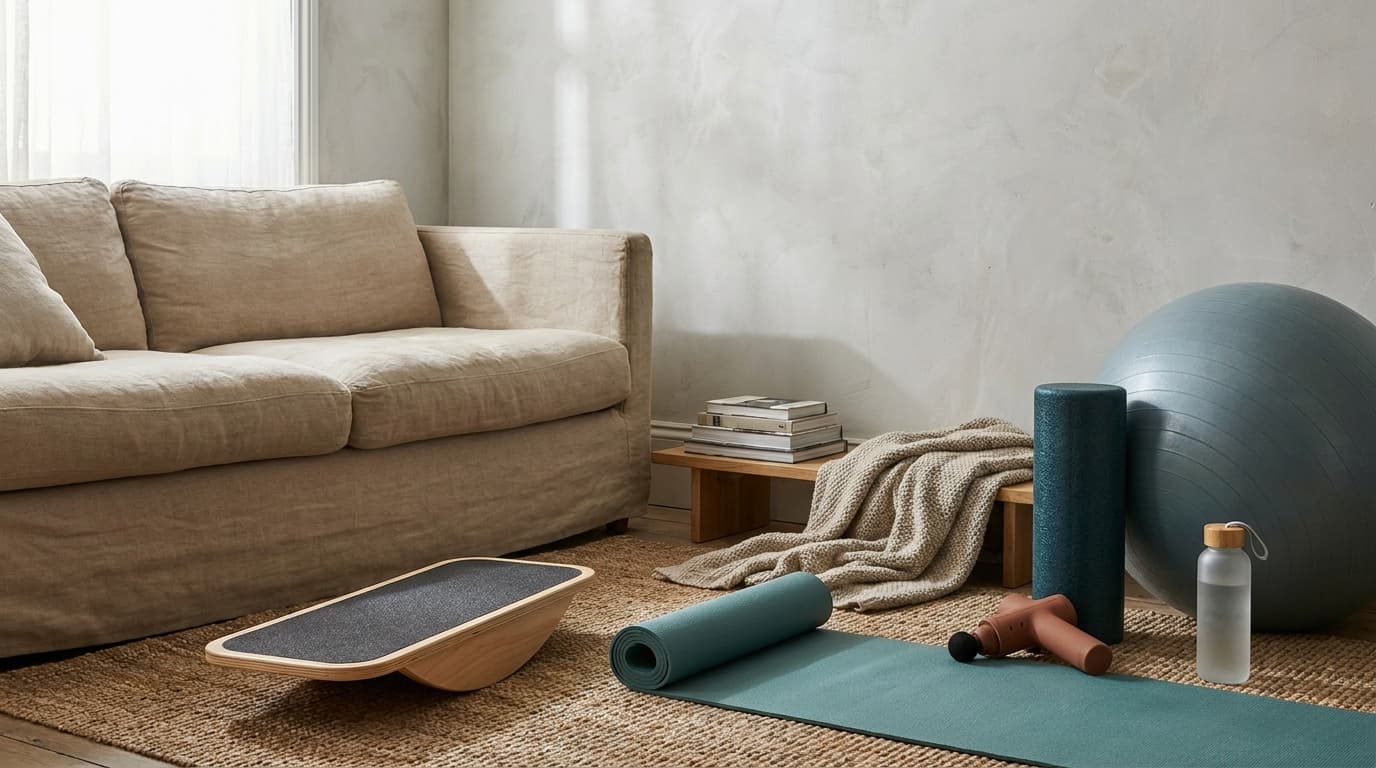
Give yourself room to step forward, backward, and to either side. Move coffee tables, dumbbells, and sharp-edged furniture out of the fall zone. A wall is useful for orientation, but a counter or fixed rail is better because you can hold it without leaning your full body into it.
Follow the board maker's surface guidance. Most fixed-base boards work well on a thin non-slip mat. Roller and hard-pivot boards need a surface that protects the floor without letting the roller or pivots dig in unexpectedly. Avoid a thick, soft pad that changes the mechanism unless the manufacturer specifically recommends it.
Wear flat, secure footwear for the first sessions unless the board is designed for barefoot use. Socks on a slick deck are a poor starting setup. Check the traction surface, base, stops, and roller before every session.
Learn the step-on and step-off first
Put the board in its most stable orientation and place one hand lightly on your support. Set one foot near the outer third of the deck, bring the second foot up, and center your weight between them. Keep your knees soft and your hips stacked over your feet.
Practice stepping off deliberately before trying to hold a long balance. On a fixed-base board, step one foot to the floor and let the deck settle under the other. On a roller board, reduce the travel with its stops if available and step toward the lower deck edge rather than jumping over the cylinder.
Your first controlled session
Mount
Step on with one hand on a fixed support and find a hip-width stance.
Settle
Keep both knees soft and let the board move through a small range.
Shift
Move pressure slowly from left to right, then heel to toe.
Recover
Touch the support before the movement becomes a scramble.
Dismount
Step down one foot at a time under control.
Use an athletic stance
Your feet should sit wide enough that you can control the board without locking your knees. Keep your chest quiet, hips relaxed, and gaze on a fixed point ahead. Do not chase a perfectly still deck; the goal is to make small corrections without panic.
If your toes are gripping hard, your shoulders are rising, or you are holding your breath, reduce the range or use more support. Those compensations usually mean the drill is too difficult for useful practice.
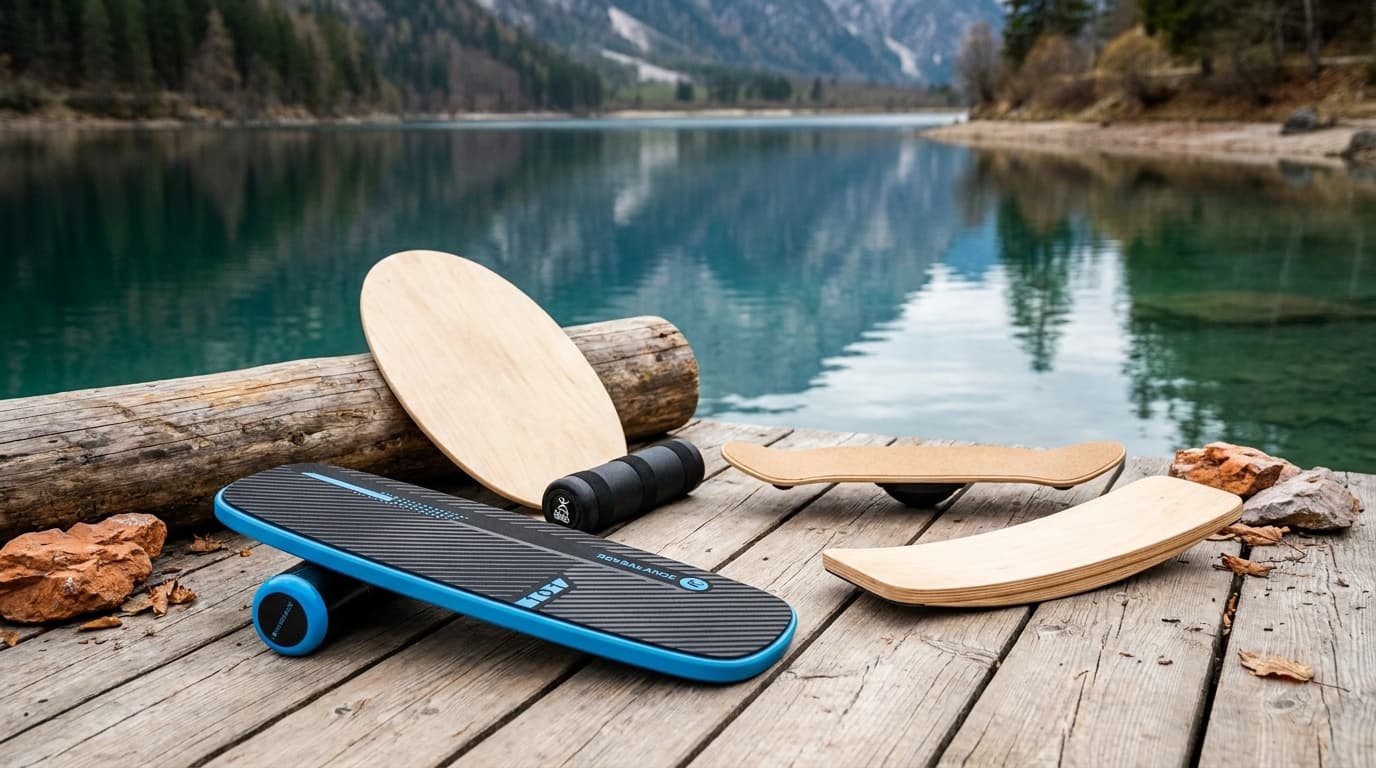
Progress rocker, then wobble, then roller or spinning
The safest general progression moves from constrained motion to less predictable motion.
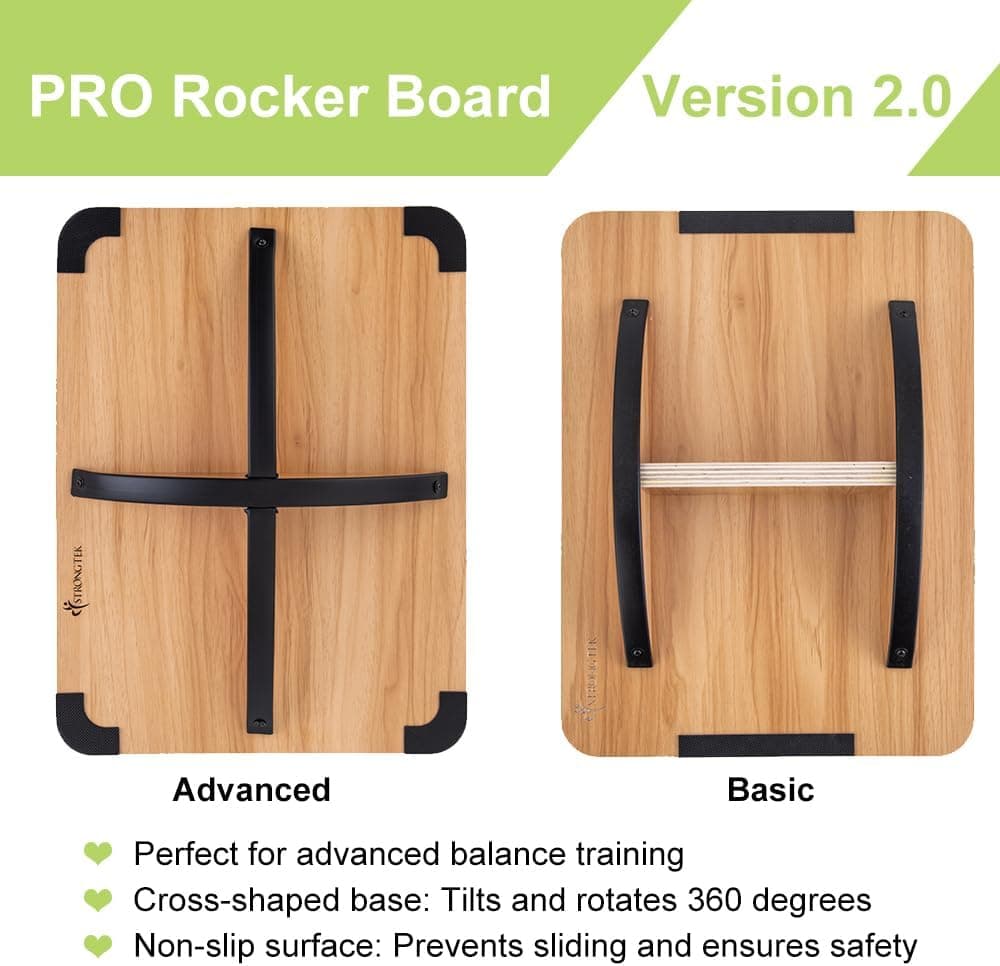
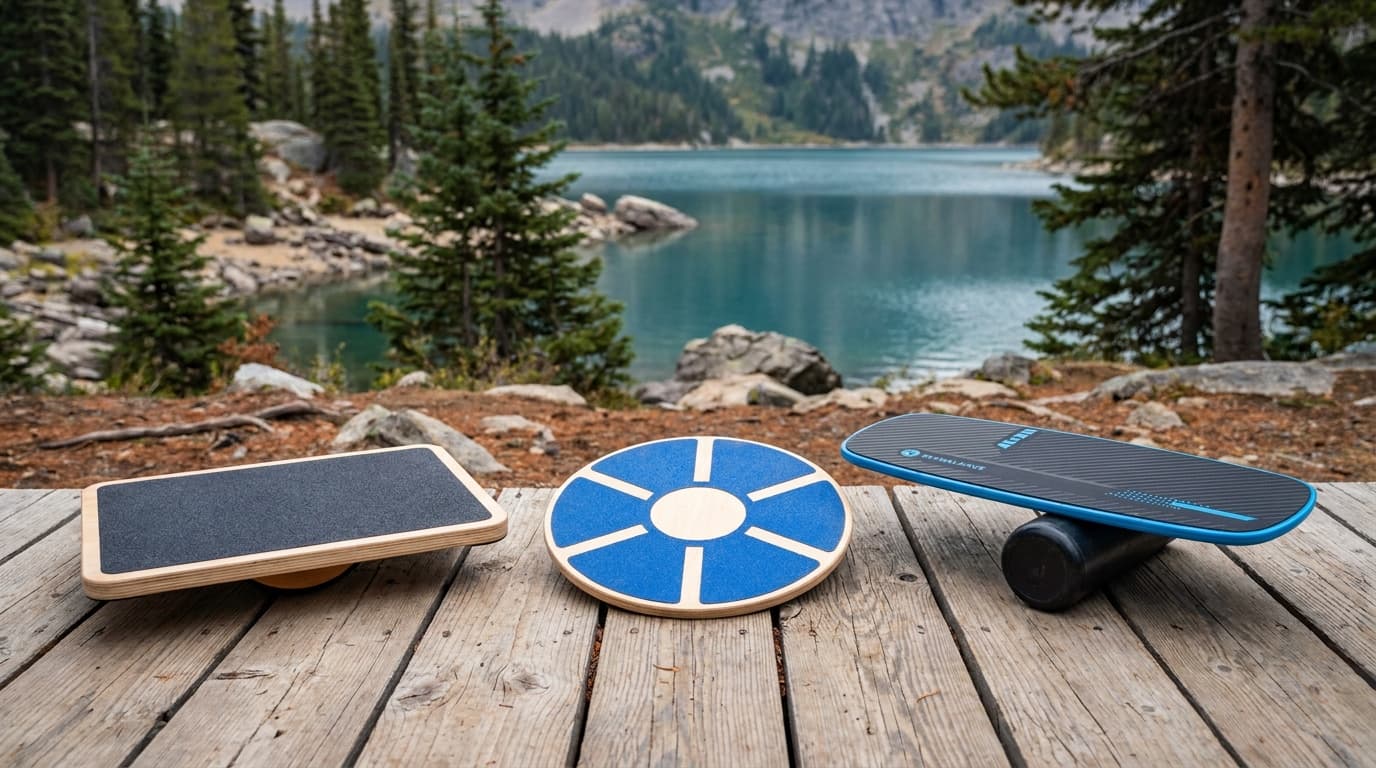
1. Rocker-style board. Start on a fixed, bounded base such as the StrongTek crossed-base board. Learn mounting, dismounting, static stance, and intentional weight shifts. The attached base cannot travel across the floor.
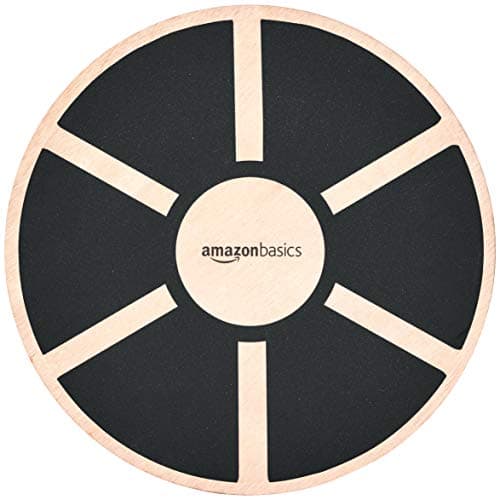
2. Wobble board. A central dome adds movement in every direction. Use a compact model such as the Amazon Basics wood wobble board from our best balance boards guide. Repeat the same basic skills before adding single-leg work.
3. Roller board. A loose cylinder creates lateral travel and a larger consequence for a missed correction. The Revbalance 101 v2 uses magnetic stops to shorten that travel while you learn. The Indo Board Original uses fixed stops on a wider deck.
4. Spinning or multi-pivot board. A board such as the Whirly Sport 360 adds transfers and rotation. Learn its center balance before using the end pivots or attempting a spin.
This is a general skill progression for healthy users, not a rehabilitation protocol. A clinician may choose different exercises, surfaces, or sequencing for a specific injury.
Use milestones instead of a calendar
Move to a harder board or drill when the current task is controlled across more than one session. Useful checkpoints include:
- You can mount and dismount without jumping or pulling on the support.
- You can hold a relaxed two-foot stance while breathing normally.
- You can shift pressure in each available direction without slamming the deck edge down.
- You can recover from a small wobble with your feet and hips rather than a large arm swing.
- You finish the session without pain, swelling, or a loss of control from fatigue.
There is no universal four-week or six-week deadline. Balance gains are specific to the task you practice, and people begin with different strength, injury histories, and movement experience.
Beginner drills that scale
Build difficulty one variable at a time
Two-foot hold
Keep the deck near level while using fingertip support as needed.
Slow weight shifts
Move left to right and heel to toe without letting an edge crash down.
Controlled touches
Let one edge touch lightly, then return to center without rushing.
Small knee bend
Add a shallow bend only when the deck stays controlled.
Reach and return
Reach one hand forward or sideways while keeping both feet planted.
Single-leg work
Add only on a fixed or wobble board after two-foot control is reliable.
Change one variable at a time. Do not combine closed eyes, single-leg stance, a moving roller, and an external load in the same jump. Removing vision sharply changes the task and is not a necessary beginner milestone.
How much practice?
Begin with a few short sets and enough rest that each one looks similar. Twenty to thirty seconds can be plenty for an unfamiliar board. Add time only while your stance and step-off remain controlled.
Frequency matters less than quality and recovery. Mild muscular effort around the feet, calves, hips, and trunk can occur with a new task. Sharp pain, joint pain, swelling, numbness, or symptoms that worsen after the session are reasons to stop and seek appropriate guidance.
Balance boards and ankle rehab
The 2021 clinical practice guideline for lateral ankle sprains includes structured exercise, balance, and neuromuscular work within rehabilitation, but it does not make a retail balance board appropriate at every stage (JOSPT guideline). Load tolerance, range of motion, strength, swelling, and recurrence history all affect the plan.
Do not use a roller or spinning board as a shortcut through early rehab. If an ankle is injured, unstable, or recently operated on, ask a physical therapist when an unstable surface is appropriate and what support, range, and volume to use.
Frequently asked questions
Which type of balance board should a beginner use first?
A fixed rocker-style board is the most predictable starting point. Its attached base limits the movement and cannot roll away. A wobble board is the next step because it adds multi-directional motion. Roller and spinning boards come later unless they include a beginner limiter and you have a stable support.
Should I use a balance board barefoot?
That depends on the deck and your environment. Bare feet can provide more direct surface feedback on a clean, non-abrasive deck, while flat shoes offer protection and predictable traction. Avoid loose footwear and slick socks. Follow the manufacturer's guidance and choose the option that lets you step off securely.
Should the board stay perfectly level?
No. Small movement is part of the task. Aim for quiet, controlled corrections rather than a frozen deck. If the edge repeatedly slams down or a roller reaches its stop hard, reduce the difficulty or use more support.
When can I try a roller balance board?
Try a roller after you can mount, shift, recover, and dismount on a fixed or wobble board without uncontrolled step-offs. Start beside a fixed support and use adjustable stops when available. Read our roller and wobble comparison before choosing a model.
Compare current models in the best balance boards guide, then choose the easiest version of the movement you want to learn.
Recommended gear
Our current top picks from the Best balance boards: rehab, desk, tricks, circus training guide, if you are ready to buy.
Best for: Athletes training for board sports or anyone who wants one board that can grow from beginner ankle rehab to advanced sport-specific balance work.
- Magnetic stops make difficulty progression genuinely seamless, no extra purchases required
- Roller boards carry a real fall risk for first-timers, so a spotter or nearby wall is advisable on day one
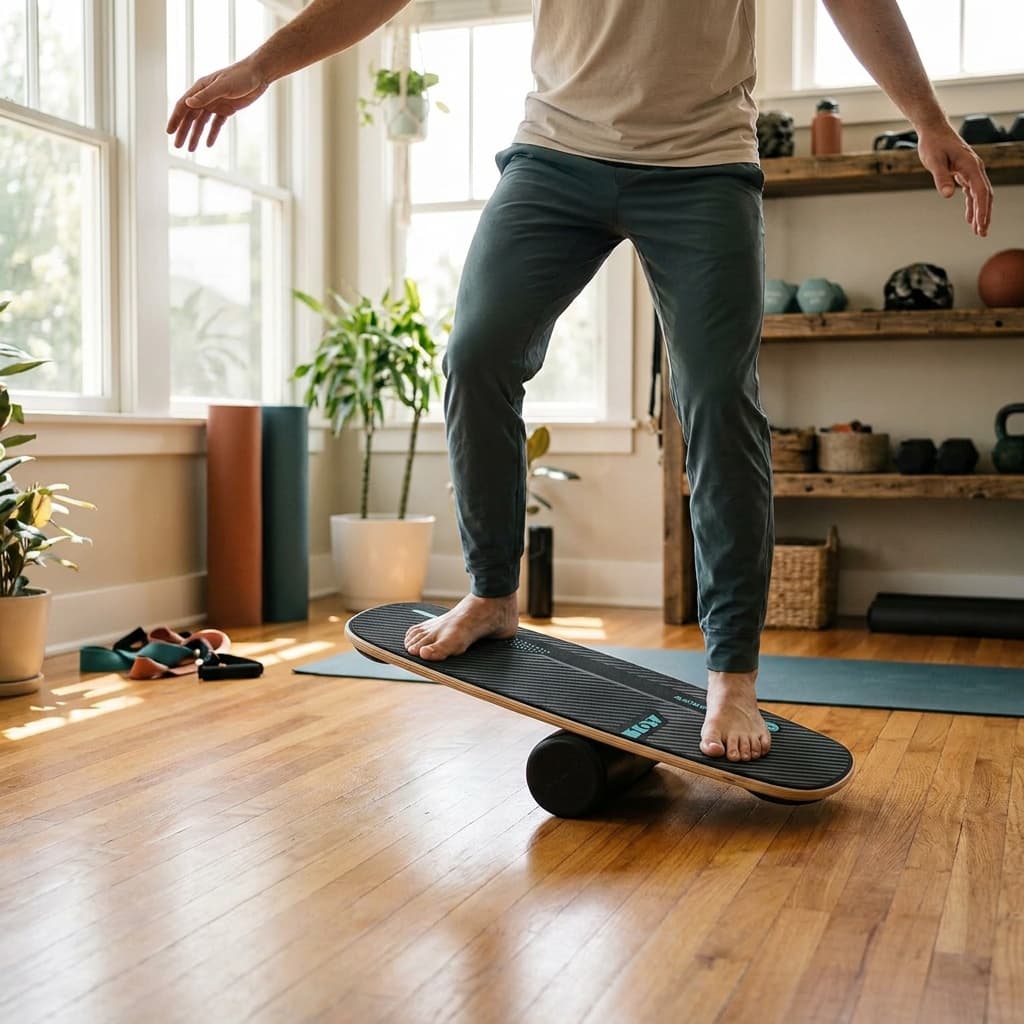
- Board dimensions
- 30 in x 12 in
- Type
- Roller board with adjustable magnetic stops
- Deck surface
- DuraSoft traction (no grip tape)
- Weight capacity
- 400 lbs
- Difficulty range
- Beginner to advanced (stops remove for full roll)
- Origin
- Made in USA, lifetime warranty
About this pick
A roller-style board with a tool-free magnetic stop system that adjusts the rolling arc in seconds, letting one board serve beginners doing ankle rehab drills and advanced athletes simulating surf and snowboard carves. The DuraSoft deck is comfortable barefoot and floor-safe.
Strengths
- Magnetic stops make difficulty progression genuinely seamless, no extra purchases required
- 400 lb rated capacity and heavy-duty USA construction back up the lifetime-use claim from most owners
- Roller motion closely mimics the heel-to-toe weight shift used in surfing, skateboarding, and snowboarding
Weaknesses
- Roller boards carry a real fall risk for first-timers, so a spotter or nearby wall is advisable on day one
- Not suited for standing-desk use: the rolling arc needs open floor space and active attention
Kit Score breakdown
STRONGTEK
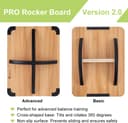
StrongTek Advanced Wooden Balance Board, Cross Base (Standard)
Best Value
Kit Score 8.2/10
$38.99 Price checked Oct 23, 4:16 PM CDT
Best for: Standing-desk workers and early-stage rehab users who want multi-directional challenge without the steep learning curve or fall risk of a roller board.
- Cross base enables 360-degree tilt so users can work all planes without the unpredictability of a free-pivot wobble dome
- Single-material tilt still has a ceiling for progression: advanced athletes will outgrow it before competitive riders do
- Board dimensions
- 17.5 x 13.5 x 3 in (standard size, the linked listing)
- Type
- Rocker board with crossed hardwood base, 360-degree tilt
- Deck material
- Lauan hardwood plywood, textured non-slip top
- Base construction
- Cross-shaped wooden base, 360-degree tilt
- Weight capacity
- 350 lbs
- Board weight
- 2.23 kg (about 4.9 lb)
About this pick
A rocker-style board with a cross-shaped wooden base that allows multi-directional tilt instead of a single-axis rock, bridging the gap between beginner rocker boards and full wobble boards. The linked standard size has a 17.5 x 13.5-inch deck, roomier than a 15.75-inch wobble disc for standing-desk intervals and rehab exercises.
More specifications
- Best use
- Standing desk, rehab, core training, squat/push-up work
Strengths
- Cross base enables 360-degree tilt so users can work all planes without the unpredictability of a free-pivot wobble dome
- The 17.5 x 13.5-inch rectangular deck gives more stance room than a round wobble disc for standing-desk intervals
- At around $40 it delivers a meaningful step up from round wobble discs at a fraction of roller-board prices
Weaknesses
- Single-material tilt still has a ceiling for progression: advanced athletes will outgrow it before competitive riders do
- Board can shift on polished hard floors if the base feet move
- StrongTek's extra-large 24 x 16.5-inch version had no seller offer on Amazon on 2026-09-25, so wide-stance users are limited to the standard deck
Kit Score breakdown
AMAZON BASICS
Amazon Basics Wood Wobble Balance Trainer Board
Best Budget
Kit Score 8.1/10
$23.99 Price checked Oct 23, 4:16 PM CDT
Best for: Budget buyers who want a compact, well-proven wobble board for short balance drills before committing to a pricier board.
- One of the most reviewed wobble boards on Amazon: 4.6 stars across nearly 16,000 ratings
- 265 lb capacity is lower than the 300 to 400 lb ratings of the other picks
- Diameter
- 15.75 in round
- Height
- 3.15 in
- Type
- Wobble board, central dome
- Deck material
- Solid wood top with non-slip surface
- Weight capacity
- 265 lbs
- Weight
- 3.4 lbs
About this pick
A plain 15.75-inch wooden wobble board with a non-slip top over a central dome, sized for short balance drills, push-up and plank holds, and ankle and core work. It weighs about 3.4 lb, supports up to 265 lb, and carries a 1-year Amazon Basics limited warranty.
More specifications
- Warranty
- 1-year Amazon Basics limited warranty
Strengths
- One of the most reviewed wobble boards on Amazon: 4.6 stars across nearly 16,000 ratings
- About $19, the cheapest way to add multi-directional balance work
- Light enough at 3.4 lb to slide under a desk or carry to another room
Weaknesses
- 265 lb capacity is lower than the 300 to 400 lb ratings of the other picks
- 15.75-inch deck is tight for larger feet, and the fixed tilt cannot get harder as you improve
- Amazon Basics warns against use on wet or smooth floors, so plan on a mat for hardwood or tile
Kit Score breakdown
See all picks in Best balance boards: rehab, desk, tricks, circus training
Keep going
Researched, not hands-on tested
Updated Sep 25, 2026Our recommendations draw on manufacturer documentation, retailer listings, owner feedback, and comparisons with alternatives.
As an Amazon Associate I earn from qualifying purchases. We may earn a commission from links here, at no extra cost to you. How we research →