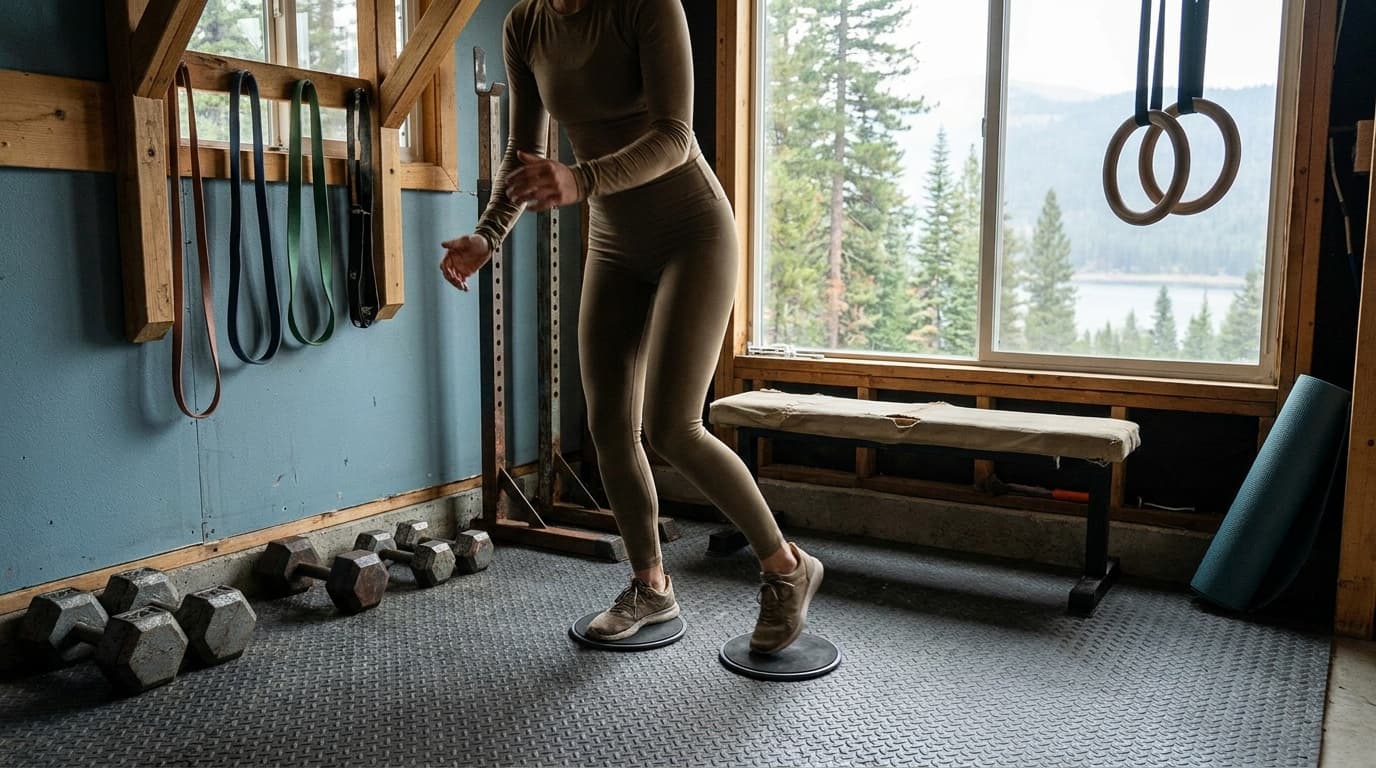
Core sliders are a surprisingly demanding tool: a few dollars of plastic or foam that turns ordinary floor moves into continuous-tension challenges your core cannot escape.
What core sliders actually train
Most ab exercises have a dead spot. At the top of a crunch, at the bottom of a leg raise, there is a moment of relative relief. Sliders remove that. When your hands or feet are on the discs, your core has to resist movement at every point in the rep, not just at peak effort.
The two main qualities this develops are anti-extension stability (resisting the spine being pulled into an arch) and anti-rotation stability (resisting the torso twisting under asymmetric load). These are not flashy qualities, but they are precisely what research on low-back health and athletic performance has repeatedly pointed to as the foundation of functional core strength.
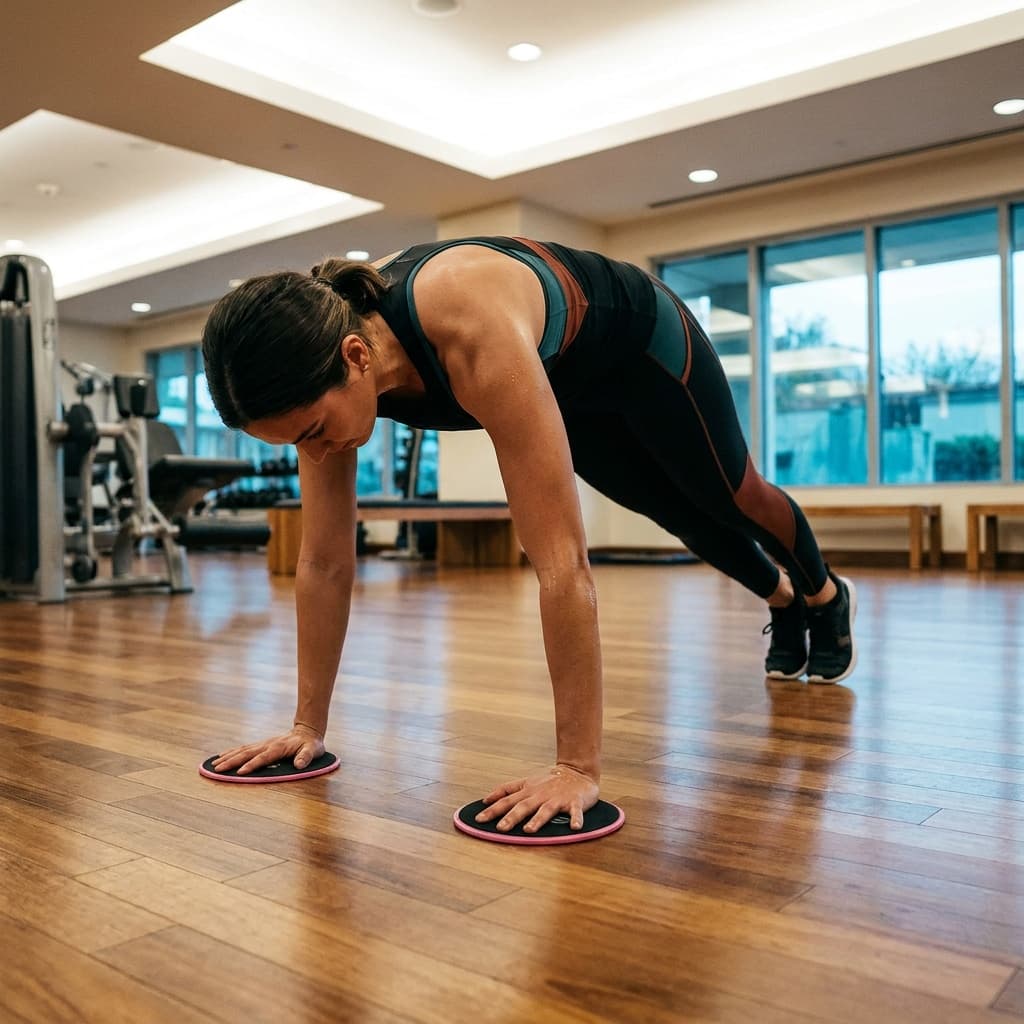
Exercises like the slider rollout and the pike directly challenge anti-extension. The body-saw plank, where you slide your forearms forward and back on the discs, is one of the most demanding anti-extension drills you can do without equipment. Lateral slides and single-arm reaches add the anti-rotation demand.
The full-body range you might not expect
Sliders are not just a core tool. Because the discs reduce friction on smooth floors, you can load your legs and hips in ways that feel completely different from conventional bodyweight training.
Core slider exercises by primary target
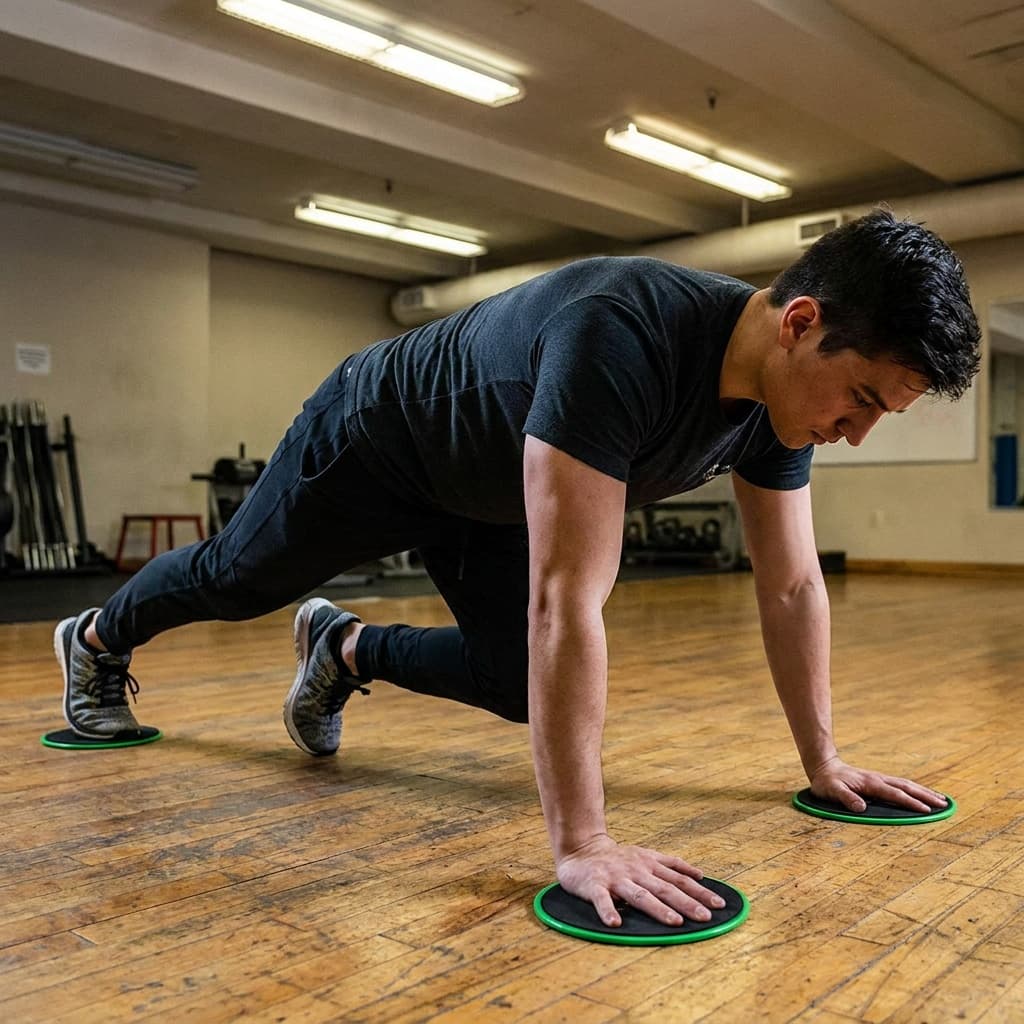
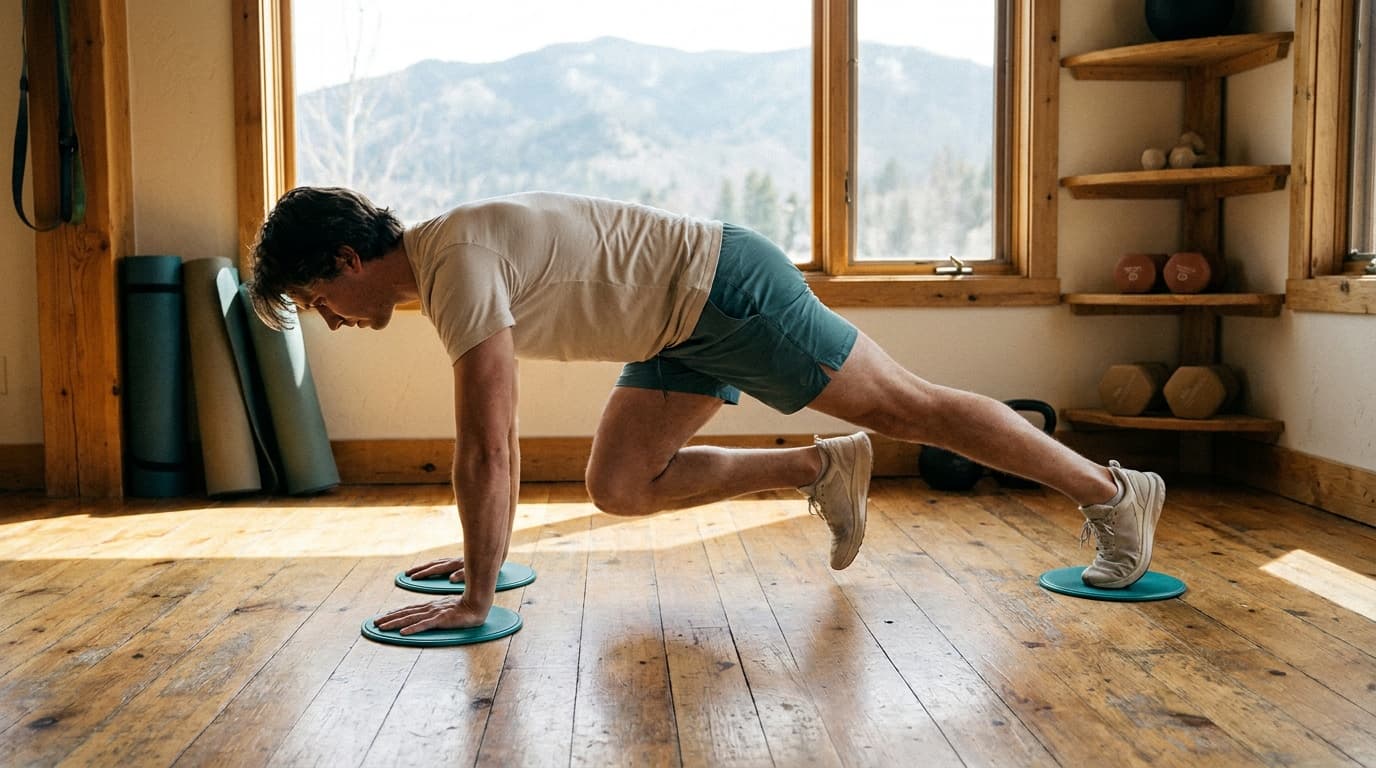
Mountain climbers
hip flexors and shoulders under sustained core bracing
Slider pikes
upper abs and anti-extension through a long lever arm
Hamstring curls
posterior chain, comparable to a stability-ball curl
Reverse lunge to knee drive
single-leg balance, glutes, and hip stability
Lateral lunge slide
adductors and hip abductors under eccentric load
The constant tension effect applies here too. In a slider hamstring curl, the hamstring cannot release at the bottom of the rep the way it can when your foot is planted. That sustained demand is why many people find slider leg exercises much harder than they look.
Why the constant tension matters
The slider's real advantage is not the exercise itself but the environment: a surface that never lets the working muscles fully rest.
Time under tension is a well-established driver of muscular endurance and hypertrophy. Sliders extend it almost automatically. A standard plank hold might involve passive rest when technique drifts; a body-saw variation turns the same time into active anti-extension work at every second.
For core endurance specifically, this matters. The muscles of the trunk (rectus abdominis, obliques, transverse abdominis, erector spinae) function primarily as stabilizers during athletic and daily movement. Training them under sustained, low-level load, rather than peak-effort crunches, mirrors how they actually work.
Who benefits most
Beginners and intermediates get the clearest return. If you have not built a consistent core training habit, sliders such as the Gaiam Core Sliding Discs introduce genuine challenge with very low injury risk and no load on the spine. The rollout progression, starting from a kneeling position and extending only as far as you can maintain neutral spine, is one of the best anti-extension progressions available at any fitness level.
Advanced trainees can use sliders for high-rep metabolic circuits, active recovery sessions, or travel training where a barbell is not available. They are also genuinely useful for people rehabbing from low-back issues, because the exercises are largely compressive-load-free, though anyone with an active injury should work with a physiotherapist before adding new movements.
Limitations and realistic expectations
Sliders will not build maximal strength. They are an endurance and stability tool. If your goal is a heavier squat or deadlift, you still need to load those patterns with progressive resistance. Sliders complement that work; they do not replace it.
Surface dependency is a real constraint. Sliders work on smooth hardwood, tile, or laminate. On carpet, the friction is too high for most movements to work properly. Some dual-sided discs, like the Synergee Core Sliders, come with fabric on one side for carpet use, but the feel is different and the tension effect is reduced.
They also require baseline shoulder stability for hand-on-disc movements. If your shoulders fatigue before your core, regress to foot-on-disc exercises first.
Finally, progression requires intentionality. Unlike a barbell where you add five pounds, slider progression comes from extending range of motion, slowing the tempo, or combining movements. You have to plan those jumps or the stimulus plateaus quickly.
Frequently asked questions
Can I use core sliders on carpet?
Some sliders have a fabric side designed for carpet use, but the glide is noticeably stiffer and the constant-tension effect is reduced. If you train primarily on carpet, a furniture mover pad or a smooth tile area will give you a better experience. Hard floors remain the ideal surface.
How often should I train with sliders?
Two to three sessions per week is a solid starting point. The core musculature recovers faster than larger muscle groups, but high-effort slider work, especially rollouts and pikes, creates real fatigue. Give yourself at least one rest day between sessions focused on anti-extension work.
Are sliders safe for people with lower back pain?
For many people, yes, because slider exercises avoid compressive spinal loading. However, rollouts and pikes place significant anti-extension demand on the lumbar spine and should be approached carefully. If you have an active injury or a diagnosed disc issue, consult a physiotherapist before adding slider work to your routine.
For specific picks and what to look for when buying, see our guide to the best core sliders. Browse all fitness guides or read how we research and rate gear.
Recommended gear
Our current top picks from the Best core sliders for ab and full-body workouts (2026) guide, if you are ready to buy.
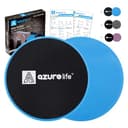
A AZURELIFE
A AZURELIFE Exercise Core Sliders
Best Overall
Kit Score 8.5/10
$7.12 Price checked Oct 24, 5:42 AM CDT
Best for: Home trainees who want a high-confidence first set backed by one of the deepest owner review pools in the category.
- Over 6,400 owner ratings supporting a 4.4-star aggregate, with Amazon's Choice designation in the Core Sliders category
- Some owners note the plastic side can feel sticky on low-pile carpet depending on pile density
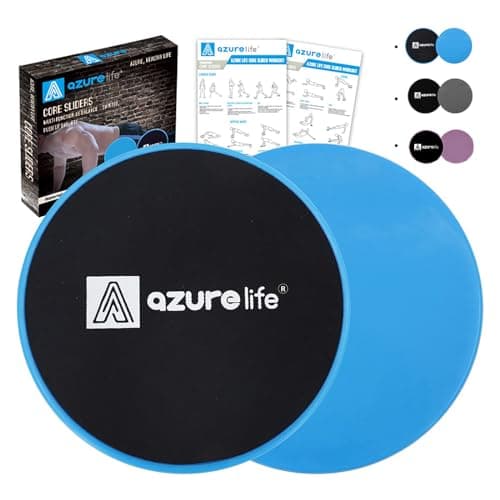
- Diameter
- 7 inches
- Sides
- Dual-sided: foam for hard floors, plastic for carpet
- Set size
- 2 discs
- Included guide
- 12-exercise illustrated workout guide
- Weight
- Lightweight, travel-ready
About this pick
One of the top-selling sets in the category with over 6,400 owner ratings, A AZURELIFE's 7-inch dual-sided discs use a foam underside on hardwood and tile and a smooth plastic underside on carpet, covering both training environments with one set. The included 12-exercise guide covers mountain climbers, pikes, reverse lunges, and lateral slides.
Strengths
- Over 6,400 owner ratings supporting a 4.4-star aggregate, with Amazon's Choice designation in the Core Sliders category
- 12-exercise guide gives beginners a concrete starting point for mountain climbers, pikes, and core circuits
- Foam side protects hardwood and reduces scratch risk during high-rep sets
Weaknesses
- Some owners note the plastic side can feel sticky on low-pile carpet depending on pile density
- No carry bag included, which limits pack-and-travel convenience
Kit Score breakdown
LIMM
Limm Core Sliders for Working Out
Best Value
Kit Score 7.9/10
$6.99 Price checked Oct 24, 5:42 AM CDT
Best for: Beginners or frequent travelers who want workout guidance and portability for under $10.
- Best-in-class content bundle for the price, including online videos and printable tracking sheets that support progressive training
- Disc construction feels slightly lighter than the Synergee or Gaiam options, which may matter for heavier athletes
- Diameter
- 7 inches
- Sides
- Dual-sided: fabric for hard floors, plastic for carpet and grass
- Set size
- 2 discs
- Extras
- Limm bundles have included a carry bag, workout ebook, and online tutorial videos; check the current listing
- Warranty
- Money-back satisfaction guarantee
About this pick
Limm packs more support material into this set than most competitors at the same price: a carry bag, printed manual, downloadable workout sheets, and access to online exercise videos. The 7-inch dual-sided discs use a fabric surface against hard floors and smooth plastic against carpet. The set carries Amazon's Choice status with a 4.3-star average across 572 ratings.
Strengths
- Best-in-class content bundle for the price, including online videos and printable tracking sheets that support progressive training
- Fabric underside is gentler on hardwood and reduces slip on tile compared to bare plastic
- Mesh carry bag makes it the most travel-ready pick in the budget tier
Weaknesses
- Disc construction feels slightly lighter than the Synergee or Gaiam options, which may matter for heavier athletes
- Some owners report the plastic side grabs too aggressively on thick-pile carpet
Kit Score breakdown
Best for: Athletes who prioritize smooth, consistent glide on hardwood for high-rep mountain climbers and pike progressions.
- Foam underside delivers consistent glide on hardwood and tile, noted in trainer-facing review sources
- Exercise manual covers only 5 exercises, less comprehensive than Limm's digital bundle
- Diameter
- 7 inches
- Sides
- Dual-sided: foam for hard floors, smooth plastic for carpet
- Set size
- 2 discs
- Included guide
- Color-printed exercise manual with 5 exercises
- Colors available
- Black, Green, Pink, Red, Yellow
About this pick
Synergee's 7-inch discs use foam on hard surfaces and a polished plastic face on carpet, a material pairing that review aggregators consistently flag for smooth glide on hardwood. The brand supplies a color-printed manual covering five core exercises, and the set is frequently cited by personal trainers as a reliable recommendation for clients training at home or on the road. The full product family carries over 16,900 ratings at 4.5 stars.
Strengths
- Foam underside delivers consistent glide on hardwood and tile, noted in trainer-facing review sources
- Available in five colors, useful for gym environments where equipment sharing and identification matter
- Compact 7-inch diameter and light weight per disc make this set easy to slip into a day bag
Weaknesses
- Exercise manual covers only 5 exercises, less comprehensive than Limm's digital bundle
- No carry bag included
Kit Score breakdown
See all picks in Best core sliders for ab and full-body workouts (2026)
Keep going
Researched, not hands-on tested
Updated Jun 4, 2026Our recommendations draw on manufacturer documentation, retailer listings, owner feedback, and comparisons with alternatives.
As an Amazon Associate I earn from qualifying purchases. We may earn a commission from links here, at no extra cost to you. How we research →