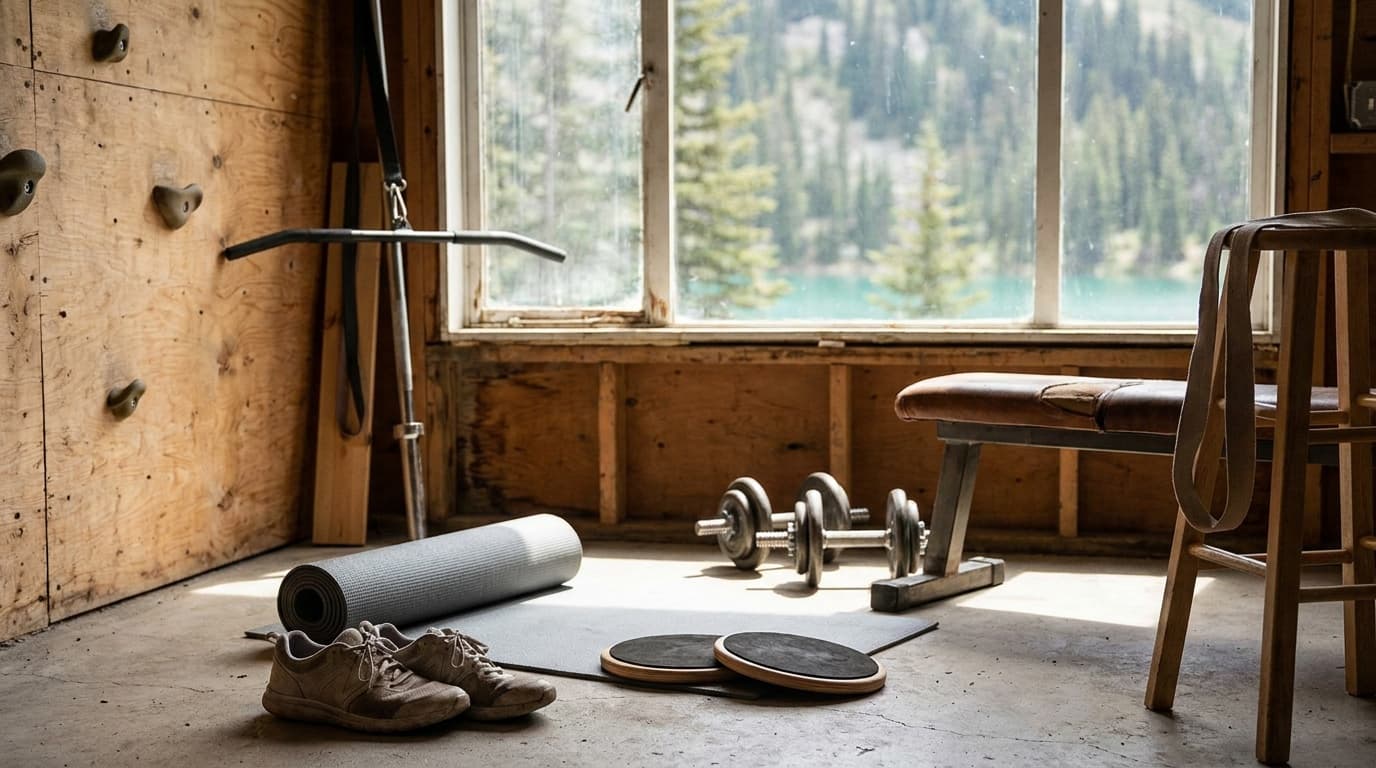
Core sliders turn a flat surface into a full-body stability challenge. Because every move forces you to resist unwanted motion, you build genuine anti-rotation and anti-extension strength, not just the appearance of it.
The five foundational moves
These five exercises cover flexion, extension, and single-leg stability. Master them before adding load or speed.
Five beginner slider moves
Mountain climbers
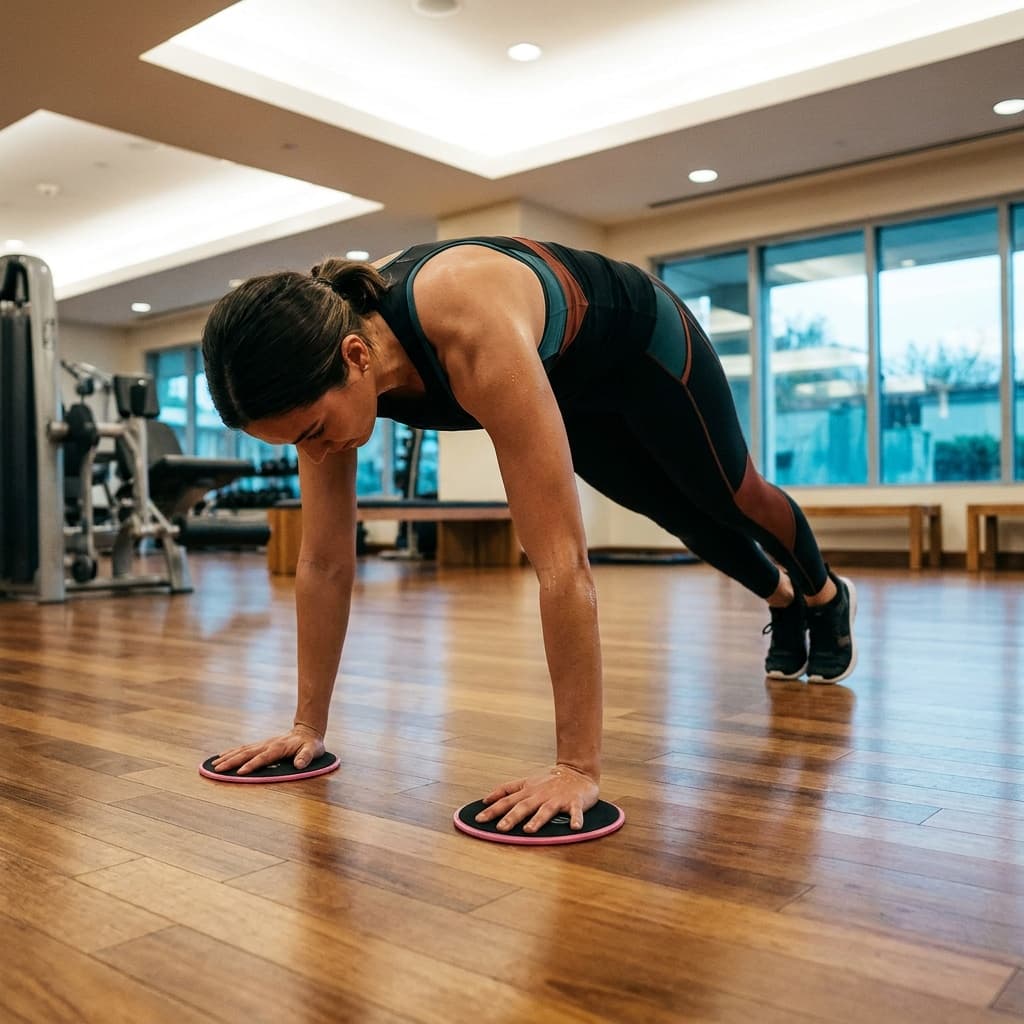
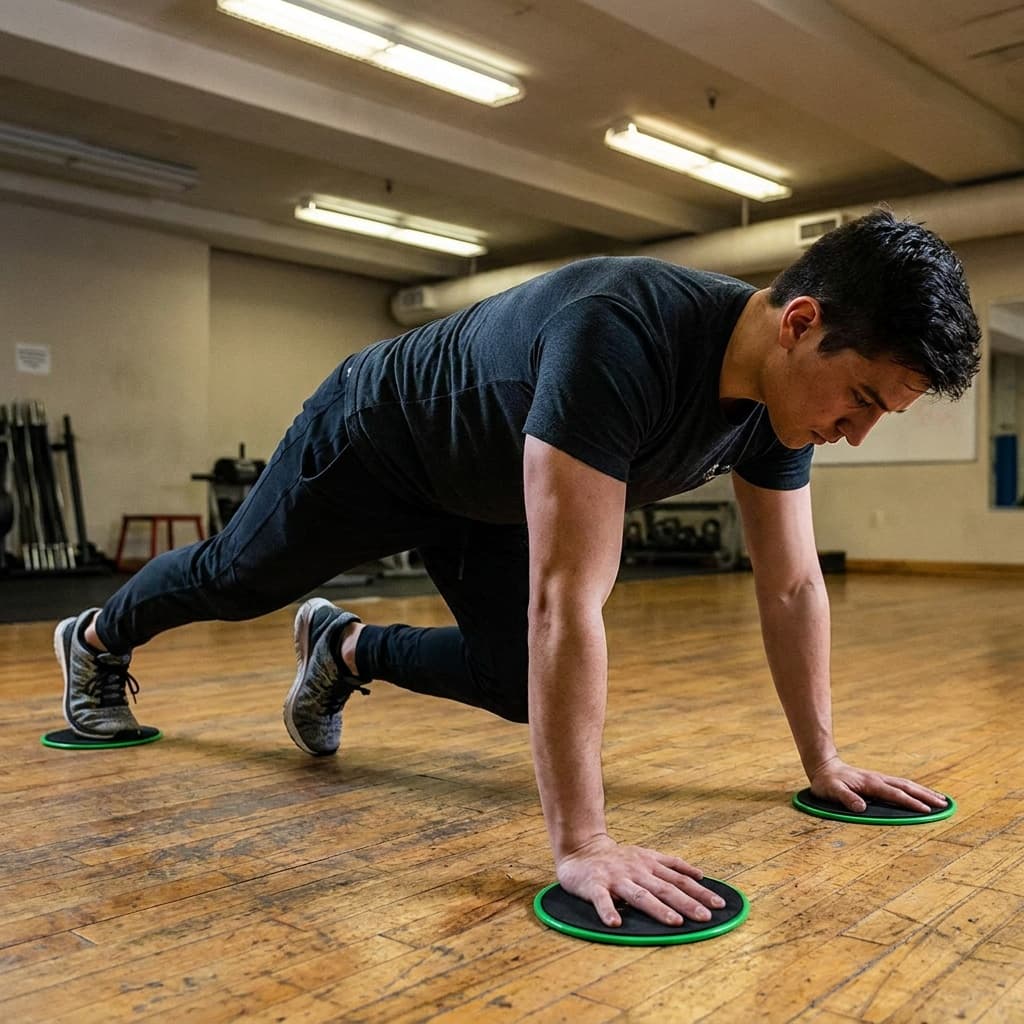
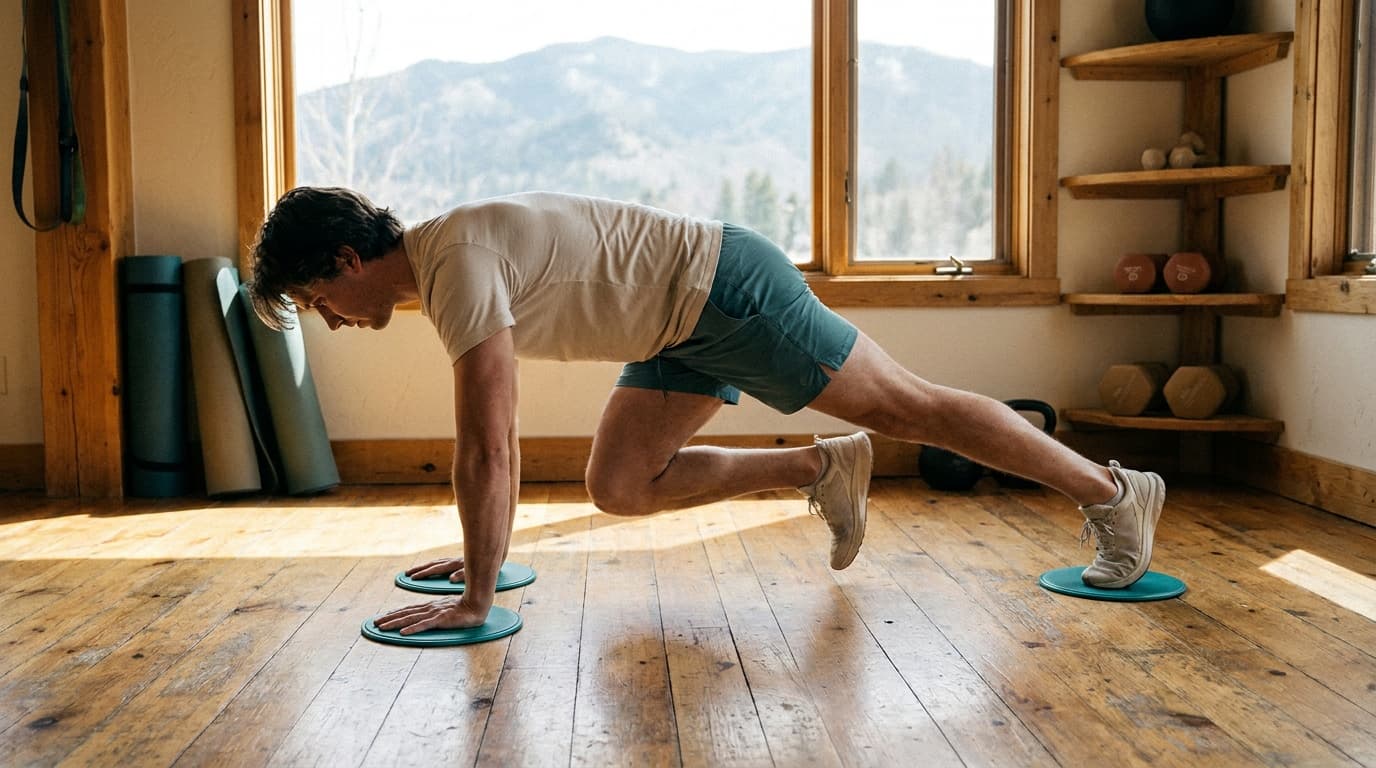
Start in a high plank, both feet on sliders. Drive one knee toward your chest while keeping hips level, then slide it back. Alternate legs with control.
Knee tucks
High plank, both feet on sliders. Pull both knees toward your chest simultaneously, pause for one second, then slide back to plank. Do not let hips rise before you initiate.
Pikes
High plank, both feet on sliders. Keep legs straight and use your hip flexors to pull your hips up and over, forming an inverted V. Slide back under control.
Slider lunges
Stand with one foot on a slider. Push that foot back into a reverse lunge, keeping the front knee tracking over your second toe. Drive through your front heel to return.
Body saw
Forearm plank, both feet on sliders. Push your forearms forward, sliding your body back so your head moves away from your hands, then pull back to start. Keep your hips locked the entire time.
How to brace and why it matters
Slider exercises expose a weakness that machines hide: most people stop bracing the moment a movement gets difficult. The body saw and pike are the clearest tests. If your lower back arches during a body saw, your anterior core gave out before your arms did.
Practice the brace in isolation first. Lie on your back, knees bent, feet flat. Exhale and press your lower back gently toward the floor. Hold that tension and breathe shallowly. That is the position you recreate in every plank-based slider move. Once you can maintain it for 30 seconds lying down, carry it into your plank.
For lunges, the same rule applies from the hip. Keep your pelvis neutral, not tilted forward, as your slider leg travels back. A common sign of a lost brace is the lower back arching and the front knee caving inward at the same time.
The slider does not create core strength. Resisting the slider does.
Surface tips: carpet side vs. hard-floor side
Most dual-sided sliders, like the Limm Core Sliders, have one smooth plastic side for carpet and one felt or fabric side for hard floors. The felt side on carpet creates so much friction it is nearly unusable. Get the surface pairing right or the discs feel broken.
If you only have one surface, a folded paper plate or a furniture slider from a hardware store works on carpet. A small hand towel works on a hardwood or tile floor. The physics are identical.
A simple beginner circuit
This circuit uses all five moves and takes roughly 15 minutes including rest. Run it two to three times per week with at least one rest day between sessions.
Circuit format: 3 rounds, minimal equipment, no warmup equipment needed beyond 5 minutes of light walking or dynamic stretching.
| Move | Reps or time | Rest |
|---|---|---|
| Mountain climbers | 8 per side | 20 sec |
| Knee tucks | 8 reps | 20 sec |
| Pikes | 6 reps | 30 sec |
| Slider lunges | 8 per side | 30 sec |
| Body saw | 8 reps | 45 sec |
After completing all five, rest 90 seconds and repeat. Three rounds totals roughly 45 working sets of core tension per session.
Scaling each move up or down
Every move has a simpler and a harder version. Match your current capacity, not your ego.
Mountain climbers: Slow the tempo to a 2-second drive and 2-second return if your hips are swaying. To progress, increase tempo or add a cross-body drive (knee to opposite elbow).
Knee tucks and pikes: If you cannot hold plank for 20 seconds without sagging, substitute a dead bug until you build that base. To progress pikes, combine a tuck and a pike in one continuous rep.
Slider lunges: Shorten the range of motion (smaller slide, shallower lunge) to reduce demand on the hip flexor and glute. To progress, add a torso rotation toward the front leg at the bottom.
Body saw: Reduce the travel distance first. A 3-inch push-back is still a legitimate training stimulus if it keeps your hips locked. Progress by increasing travel distance, then by adding a slight pause at full extension.
Common mistakes that stall progress
Three patterns show up repeatedly in beginner slider work.
Letting the hips hike during mountain climbers. This turns a core exercise into a hip flexor exercise. Keep your hips level and imagine a glass of water sitting on your lower back.
Rushing pikes. The eccentric (lowering back to plank) is where much of the training stimulus lives. A rep that takes one second up and one second down leaves half the work on the table. Aim for two seconds back down.
Not tracking the front knee during lunges. The slider encourages a lazy return because the foot glides so easily. Drive through your heel and consciously pull your knee back into alignment as you return to standing.
Frequently asked questions
How many days per week should beginners use core sliders?
Two to three sessions per week with at least one rest day between them is the standard recommendation for beginners building core stability. The sliders create significant eccentric demand, particularly in the hip flexors, so recovery matters. More is not better until you can complete all three rounds without form breakdown.
Can I do slider exercises if I have lower back pain?
That depends entirely on the source and severity of your pain. Slider exercises that load the lumbar spine in extension (pikes, body saw) are inappropriate during an active flare. The slider lunge is generally lower risk because it is upright. If you have a diagnosed condition or current symptoms, check with a physical therapist before adding plank-based slider work. The bracing cue described above is protective, but it requires the user to apply it consistently.
What is the difference between core sliders and ab wheel rollouts?
Both train anti-extension, but sliders distribute load across both feet (or both arms) at once and allow a wider range of movement patterns including lateral and rotational work. An ab wheel rollout is a single-plane, high-intensity exercise that most beginners cannot execute safely until they have built baseline plank endurance. Sliders are typically the more accessible starting point and are more versatile for lower-body work.
For specific picks, see our guide to the best core sliders. Browse all fitness guides or read how we research and rate gear.
Recommended gear
Our current top picks from the Best core sliders for ab and full-body workouts (2026) guide, if you are ready to buy.
A AZURELIFE
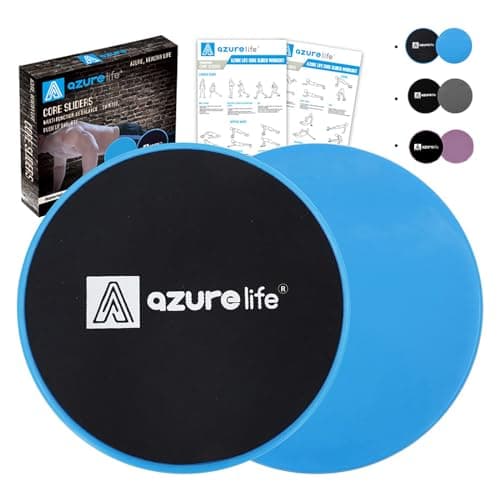
A AZURELIFE Exercise Core Sliders
Best Overall
Kit Score 8.5/10
$7.12 Price checked Oct 23, 4:16 PM CDT
Best for: Home trainees who want a high-confidence first set backed by one of the deepest owner review pools in the category.
- Over 6,400 owner ratings supporting a 4.4-star aggregate, with Amazon's Choice designation in the Core Sliders category
- Some owners note the plastic side can feel sticky on low-pile carpet depending on pile density
- Diameter
- 7 inches
- Sides
- Dual-sided: foam for hard floors, plastic for carpet
- Set size
- 2 discs
- Included guide
- 12-exercise illustrated workout guide
- Weight
- Lightweight, travel-ready
About this pick
One of the top-selling sets in the category with over 6,400 owner ratings, A AZURELIFE's 7-inch dual-sided discs use a foam underside on hardwood and tile and a smooth plastic underside on carpet, covering both training environments with one set. The included 12-exercise guide covers mountain climbers, pikes, reverse lunges, and lateral slides.
Strengths
- Over 6,400 owner ratings supporting a 4.4-star aggregate, with Amazon's Choice designation in the Core Sliders category
- 12-exercise guide gives beginners a concrete starting point for mountain climbers, pikes, and core circuits
- Foam side protects hardwood and reduces scratch risk during high-rep sets
Weaknesses
- Some owners note the plastic side can feel sticky on low-pile carpet depending on pile density
- No carry bag included, which limits pack-and-travel convenience
Kit Score breakdown
LIMM
Limm Core Sliders for Working Out
Best Value
Kit Score 7.9/10
$6.99 Price checked Oct 23, 4:16 PM CDT
Best for: Beginners or frequent travelers who want workout guidance and portability for under $10.
- Best-in-class content bundle for the price, including online videos and printable tracking sheets that support progressive training
- Disc construction feels slightly lighter than the Synergee or Gaiam options, which may matter for heavier athletes
- Diameter
- 7 inches
- Sides
- Dual-sided: fabric for hard floors, plastic for carpet and grass
- Set size
- 2 discs
- Extras
- Limm bundles have included a carry bag, workout ebook, and online tutorial videos; check the current listing
- Warranty
- Money-back satisfaction guarantee
About this pick
Limm packs more support material into this set than most competitors at the same price: a carry bag, printed manual, downloadable workout sheets, and access to online exercise videos. The 7-inch dual-sided discs use a fabric surface against hard floors and smooth plastic against carpet. The set carries Amazon's Choice status with a 4.3-star average across 572 ratings.
Strengths
- Best-in-class content bundle for the price, including online videos and printable tracking sheets that support progressive training
- Fabric underside is gentler on hardwood and reduces slip on tile compared to bare plastic
- Mesh carry bag makes it the most travel-ready pick in the budget tier
Weaknesses
- Disc construction feels slightly lighter than the Synergee or Gaiam options, which may matter for heavier athletes
- Some owners report the plastic side grabs too aggressively on thick-pile carpet
Kit Score breakdown
Best for: Athletes who prioritize smooth, consistent glide on hardwood for high-rep mountain climbers and pike progressions.
- Foam underside delivers consistent glide on hardwood and tile, noted in trainer-facing review sources
- Exercise manual covers only 5 exercises, less comprehensive than Limm's digital bundle
- Diameter
- 7 inches
- Sides
- Dual-sided: foam for hard floors, smooth plastic for carpet
- Set size
- 2 discs
- Included guide
- Color-printed exercise manual with 5 exercises
- Colors available
- Black, Green, Pink, Red, Yellow
About this pick
Synergee's 7-inch discs use foam on hard surfaces and a polished plastic face on carpet, a material pairing that review aggregators consistently flag for smooth glide on hardwood. The brand supplies a color-printed manual covering five core exercises, and the set is frequently cited by personal trainers as a reliable recommendation for clients training at home or on the road. The full product family carries over 16,900 ratings at 4.5 stars.
Strengths
- Foam underside delivers consistent glide on hardwood and tile, noted in trainer-facing review sources
- Available in five colors, useful for gym environments where equipment sharing and identification matter
- Compact 7-inch diameter and light weight per disc make this set easy to slip into a day bag
Weaknesses
- Exercise manual covers only 5 exercises, less comprehensive than Limm's digital bundle
- No carry bag included
Kit Score breakdown
See all picks in Best core sliders for ab and full-body workouts (2026)
Keep going
Researched, not hands-on tested
Updated Jun 4, 2026Our recommendations draw on manufacturer documentation, retailer listings, owner feedback, and comparisons with alternatives.
As an Amazon Associate I earn from qualifying purchases. We may earn a commission from links here, at no extra cost to you. How we research →