
The Wallaby Emergency Mylar Sleeping Bag is sensible as a small backup for a car, day pack, or household emergency kit. It is not a substitute for an insulated sleeping bag, and it does not have a standardized temperature rating. The value is compact protection from wind and radiant heat loss when an overnight was never part of the plan.
EMERGENCY BACKUP
Wallaby Emergency Mylar Sleeping Bag 2-Pack
Best for: Drivers, day hikers, campers, and households building compact emergency kits, as a backup layer rather than planned overnight sleep gear.
- Two individually packed bags are easy to split between a car kit and day pack
- No insulation or standardized temperature rating
Kit Score 7.9/10 · $16.99 Price checked Oct 18, 5:46 AM CDT · how we score gear
Buy on AmazonProduct details
A compact Mylar emergency bag for a vehicle kit, go-bag, or day pack. It can slow radiant and convective heat loss while blocking wind, but it does not replace an insulated sleeping bag, ground insulation, shelter, dry layers, or emergency help.
- Use
- Emergency heat-loss reduction
- Construction
- Reflective Mylar
- Quantity
- 2 bags with nylon storage pouches
- Included
- Whistle pull, paracord, carabiners, survival guide
- Temperature rating
- None published
- Primary limitation
- No insulation; condensation and tears are possible
More strengths
- Full-body bag shape is easier to keep wrapped than a loose emergency blanket
- Included whistle and cord add useful signaling and kit-organizing functions
Other tradeoffs
- Non-breathable Mylar can trap condensation and may tear on rough surfaces
- Limited independent product-specific testing
What you actually get
Wallaby sells this as a two-pack. Each reflective Mylar bag has a nylon storage pouch, and the bundle includes a whistle pull, paracord with carabiners, and a pocket survival guide. Wallaby offers orange and green versions. The current Amazon campaign listing is ASIN B0GC8VL12J for green.
The bag encloses the body more reliably than a loose rectangular emergency blanket. Mylar can reflect radiant heat and block wind, but it does not create heat and does not contain the lofted insulation found in a regular sleeping bag. Wallaby does not publish a standardized temperature rating, material thickness, or independent tear-test result for this model.
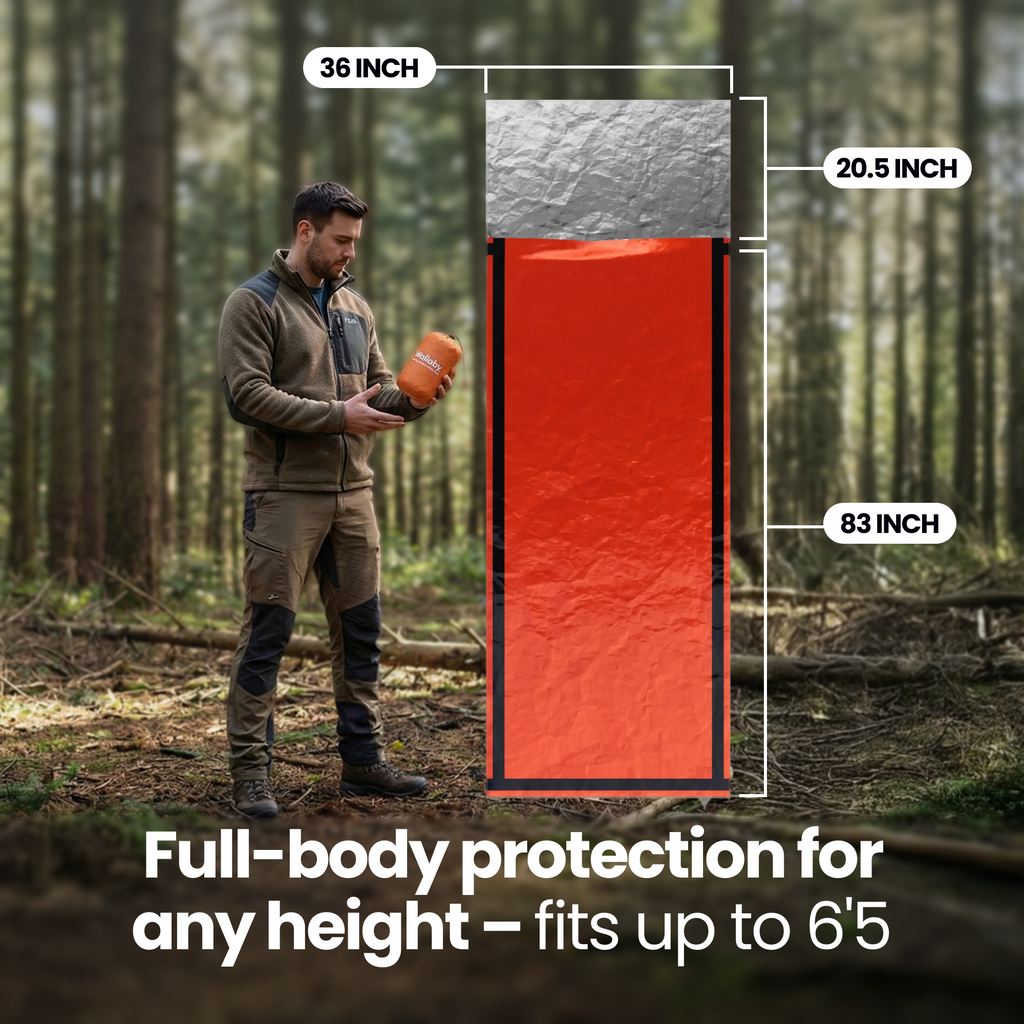
Emergency bag vs. regular sleeping bag
| Question | Wallaby Mylar emergency bag | Insulated camping sleeping bag |
|---|---|---|
| Primary job | Slow heat loss in an emergency | Provide planned overnight insulation and comfort |
| Insulation | None | Down or synthetic loft |
| Temperature standard | None published | ISO results on some models |
| Wind and water | Mylar blocks wind and resists water | Depends on shell and construction |
| Ground insulation | None | Still requires a suitable sleeping pad |
| Moisture inside | Condensation is likely because Mylar does not breathe | Usually managed by breathable fabrics |
| Durability | Vulnerable to punctures and tears | Designed for repeated nights and washing |
The Wallaby bag complements a real sleeping bag; it does not compete with one. For planned camping, start with our best sleeping bags for camping and the sleeping bag warmth calculator.
Where it makes sense
Four reasonable places to keep one
Winter vehicle kit
The American Red Cross includes an emergency Mylar sleeping bag among useful cold-weather car supplies.
Day-hike pack
It adds a compact wind barrier if an injury, navigation error, or sudden storm delays your return.
Household go-bag
Two individually packed bags can cover two people without taking the space of regular sleeping bags.
Boat or RV emergency bin
Water-resistant, compact gear is useful as backup, provided it stays protected from sharp objects.
The important limitations
Condensation is the first tradeoff. Mylar does not breathe, so perspiration can collect inside. That can wet clothing and complicate a longer exposure. The second issue is conductive heat loss. Cold ground or a vehicle floor can pull heat away even when reflective material surrounds you. The National Park Service recommends placing insulating material under a person during a cold emergency.
Tearing is the third concern. Wallaby describes the material as tear-resistant and reusable with careful handling, but it does not publish the film thickness or an independent durability result. Keep the pouch away from sharp tools, inspect it after use, and replace a punctured bag.
A Mylar bag can slow heat loss. It cannot turn an unplanned cold night into a safe camping plan.
How to use it more safely
- Contact emergency services or share your location as soon as the situation requires it.
- Get out of wind and precipitation if shelter is available.
- Replace wet clothing with dry layers when possible.
- Put a sleeping pad, pack, dry clothing, seat cushion, or other insulating material beneath you.
- Enter the bag carefully and protect it from rocks, branches, hardware, and footwear edges.
- Vent deliberately if condensation becomes severe, while preserving protection from wind.
- Treat confusion, slurred speech, loss of coordination, and unusual drowsiness as possible hypothermia and seek urgent medical care.
Do not rely on unsourced claims that a Mylar liner can turn a 20F sleeping bag into a 0F system. No standardized test for this Wallaby product supports that conversion, and condensation can reduce the usefulness of surrounding insulation.
Our verdict
At under $25 for two, the Wallaby bundle is an easy addition to a winter car kit or day pack. The compact format, full-body enclosure, and included whistle and cord are practical. The missing material specification, lack of a temperature rating, and limited independent product-specific testing keep it from earning a stronger recommendation.
Buy it as backup equipment. For any planned overnight, carry a real insulated bag, a pad with enough R-value, weather protection, dry layers, and a trip plan that does not depend on emergency foil.
Sources
- Wallaby Emergency Mylar Sleeping Bag product specifications
- American Red Cross car emergency kit guidance
- American Red Cross winter-storm preparedness
- National Park Service hypothermia guidance
Is a Wallaby emergency sleeping bag reusable?
Wallaby says it can be reused with careful handling. Inspect it for punctures or seam damage after opening, keep it dry before repacking, and replace it if the enclosure can no longer block wind.
Can the Wallaby bag replace a 20F sleeping bag?
No. It has no lofted insulation and no standardized temperature rating. A 20F sleeping bag and an emergency Mylar bag perform different jobs. Use the Wallaby as a backup layer, not as proof that your sleep system is adequate for a colder forecast.
Should Mylar go inside or outside a sleeping bag?
There is no single arrangement that safely adds a predictable number of degrees. Inside placement can trap perspiration near the body, while outside placement can trap moisture in the bag's insulation. Treat Mylar as emergency protection, monitor moisture, and do not use it to justify taking an under-rated bag into remote cold.
What else belongs with it in a car kit?
The American Red Cross recommends warm clothing, blankets, first-aid supplies, food, water, lighting, and other vehicle emergency gear. Add ground insulation, a charged power bank, and location-appropriate tools rather than treating one reflective bag as the whole kit.
Continue with the camp gear library or read how Kit Authority researches and scores products.
Keep going
Related buying guideBest sleeping bags for camping in 2026Related guides
 Complete camp loadoutCamp sleep systemBuild the complete kit
Researched, not hands-on tested
Updated Sep 3, 2026Our recommendations draw on manufacturer documentation, retailer listings, owner feedback, and comparisons with alternatives.
As an Amazon Associate I earn from qualifying purchases. We may earn a commission from links here, at no extra cost to you. How we research →
In this review
Related buying guide
Best sleeping bags for camping in 2026