We may earn a commission from links on this page, at no extra cost to you.
The best spin bikes share four traits: magnetic resistance, a belt drive, a rigid frame, and a fit that adjusts in all four directions. Everything else, including the touchscreen, is preference.
Spin bike vs upright vs recumbent: make sure you want a spin bike
A spin bike (indoor cycle) puts you in a road-bike position: weight forward, hands loaded on the handlebars, hips high, able to stand and climb. That geometry is what makes sprint intervals and out-of-saddle work possible, and it is also what makes spin bikes less comfortable for casual pedaling than an upright bike with a wider saddle and a more vertical posture.
If you want to ride hard, follow studio-style classes, or train like a cyclist, a spin bike is the right machine. If you want comfortable steady-state cardio while watching TV, an upright or recumbent may fit better; our comparison of upright vs recumbent exercise bikes covers that decision, and the broader guide on how to choose an exercise bike maps all three styles to use cases.
Resistance: magnetic vs friction
This is the biggest quality fork in the market.
Friction resistance presses a felt or leather pad against the flywheel. It is cheap, offers effectively unlimited resistance, and is why $200 spin bikes exist. The costs: the pad wears and needs replacing, resistance levels are unmarked and unrepeatable (today's half turn of the knob is not last week's), and the pad adds a faint constant shush that grows with wear.
Magnetic resistance moves magnets closer to or farther from the flywheel, so nothing touches. It is near-silent, wear-free, and delivers marked, repeatable levels, which matters enormously once you follow structured workouts. Expect to pay from roughly $400 for a good magnetic bike.
For a bike you plan to ride for years, magnetic is worth the step up. The Schwinn IC4 is the common midrange recommendation for exactly this reason: 100 marked micro-adjustable magnetic levels, a belt drive, and dual-sided pedals.
Flywheel weight: heavier is not automatically better
Traditional advice says a heavy flywheel (30–50 lbs) smooths the pedal stroke, and that holds for friction bikes, where spinning mass carries the crank through dead spots. Marketing has turned it into a spec race, though, and the reality is more nuanced: magnetic bikes with gearing that spins a lighter, perimeter-weighted flywheel faster can feel as smooth as a heavy wheel. Judge smoothness by owner and reviewer reports on the specific model, not the raw number. As a floor, be skeptical of friction bikes with flywheels under about 25 lbs, which tend to feel choppy at low cadence.
Drive: belt vs chain
Belt drives are quieter, smoother, and maintenance-free. Chain drives feel marginally more like an outdoor bike and can be serviced forever, but they click, they stretch, and they need periodic adjustment. For a home where someone sleeps, works, or watches TV near the bike, buy a belt. This is the least controversial choice in the category, and nearly every current bike worth buying has already made it for you.
Fit: four-way adjustment and Q-factor
Fit determines whether your knees survive the habit. The non-negotiables:
- Four-way adjustability. Seat height, seat fore-aft, handlebar height, and ideally handlebar fore-aft. Budget bikes often skip seat fore-aft, which is the adjustment that positions your knee over the pedal spindle correctly.
- Q-factor, the lateral distance between the pedals. Road bikes sit around 150 mm; spin bikes range from about 155 mm to over 220 mm. A wide Q-factor splays your knees outward on every stroke, which riders with knee or hip history feel within a week. Under about 180 mm is a good target, and cyclists matching an outdoor position should aim closer to 160 mm.
- Rider height range. Check the stated inseam or height range if you are under 5'2" or over 6'2"; frame geometry limits both ends.
- Weight capacity and stability. A rating of 300 lbs or more generally correlates with a frame that stays planted during standing sprints.
Pedals: clipless, cages, or both
Studio-style riding eventually pulls most people toward clipping in: cycling shoes with SPD (two-bolt) or Delta (three-bolt) cleats lock the foot in place, keep pressure through the whole stroke, and eliminate slipping during standing work. Dual-sided pedals (SPD clip on one face, toe cage on the other) are the flexible answer, letting guests in sneakers ride the same bike. If a bike ships with pedals that do not match your shoes, replacements cost $40–$60 and pedal threads are a standard 9/16", so swaps take five minutes with a wrench.
Connected bikes vs dumb bikes
The real question is whether you want a subscription. Fully connected bikes bundle a touchscreen and live or on-demand classes with a monthly fee, typically $24–$44. Bluetooth-enabled bikes broadcast cadence and effort metrics to apps like Zwift, Kinomap, or Peloton's app tier on your own tablet, usually for less money. Dumb bikes just spin, and a cheap cadence sensor plus a tablet mount closes most of the gap.
The budget-connected path has matured fast: the Echelon EX-15 pairs a magnetic-resistance bike with app-streamed classes on your own device at an entry-level price, a sensible way to test whether class-led riding actually keeps you on the bike before committing four figures.
Two rules protect you here. First, confirm the bike remains fully rideable if the subscription lapses; most are, but some connected models lock resistance control behind the app. Second, count the subscription in the price: $39 per month is $936 over two years, often more than the bike itself.
Noise, footprint, and the boring practicalities
A magnetic belt-drive bike is quiet enough for an apartment: the dominant sounds become your breathing and the fan. Friction and chain bikes are not. Beyond noise, check the footprint (most spin bikes run roughly 4 feet by 2 feet), confirm transport wheels if you will move it to ride, and put a mat under it regardless: sweat is corrosive, and the mat protects both the floor and the frame. Monthly bolt checks and a wipe-down after hard rides are the entire maintenance schedule for a belt-drive magnetic bike.
What to spend
- Under $300: friction resistance, chain or basic belt drive, limited adjustability. Works as a trial run; expect compromises and eventual pad replacement.
- $400–$800: the value zone. Magnetic resistance, belt drive, four-way fit, Bluetooth broadcast, and stable frames. Most buyers should land here.
- $1,000–$2,500: integrated screens, auto-adjusting resistance, subscription ecosystems, premium build. Worth it if classes are what get you riding five days a week.
Our roundup of the best exercise bikes ranks specific models across these tiers, including the spin-style picks mentioned above.
FAQ
What flywheel weight should a spin bike have?
For friction-resistance bikes, 30 lbs or more keeps the pedal stroke smooth through the dead spots, and under 25 lbs tends to feel choppy. For magnetic bikes the number matters less: geared designs spin lighter flywheels faster to create the same inertia, so judge the specific model's reported ride feel rather than the raw weight. Do not pay a premium for flywheel weight alone.
Is a magnetic or friction spin bike better for home use?
Magnetic, for almost everyone. It is near-silent, has no wear parts, and offers marked, repeatable resistance levels that make structured training possible. Friction bikes cost less up front and offer unlimited resistance, but the pads wear out, the resistance setting is unrepeatable, and noise grows over time. Friction only makes sense at the lowest budgets.
What is Q-factor on a spin bike and why does it matter?
Q-factor is the lateral distance between the two pedals. Road bikes measure around 150 mm, while spin bikes range from about 155 mm to more than 220 mm. A wide stance forces your knees to track outward with every pedal stroke, which stresses knees and hips over thousands of revolutions per ride. Aim for under 180 mm, or closer to 160 mm if you also ride outdoors and want a matching position.
Do I need a subscription to use a connected spin bike?
Usually not for basic riding, but check before you buy: most connected bikes still pedal and adjust resistance without an active subscription, while a few lock resistance control or metrics behind the app. If you skip the subscription entirely, a Bluetooth cadence sensor and a free or cheap app on your own tablet recreate most of the guided experience on any quiet bike.
How much should I spend on a home spin bike?
The $400–$800 range buys the combination that lasts: magnetic resistance, belt drive, four-way adjustability, and a stable frame. Below $300 you are accepting friction resistance and fit compromises, fine for testing the habit. Above $1,000 you are mostly paying for screens and class ecosystems, which are worth it only if they are what keep you riding.
For specific models by budget and style, see the best exercise bikes. Browse more fitness gear guides, or read how we research and rate.
Recommended gear
Our current top picks from the Best exercise bikes for home cardio (2026) guide, if you are ready to buy.
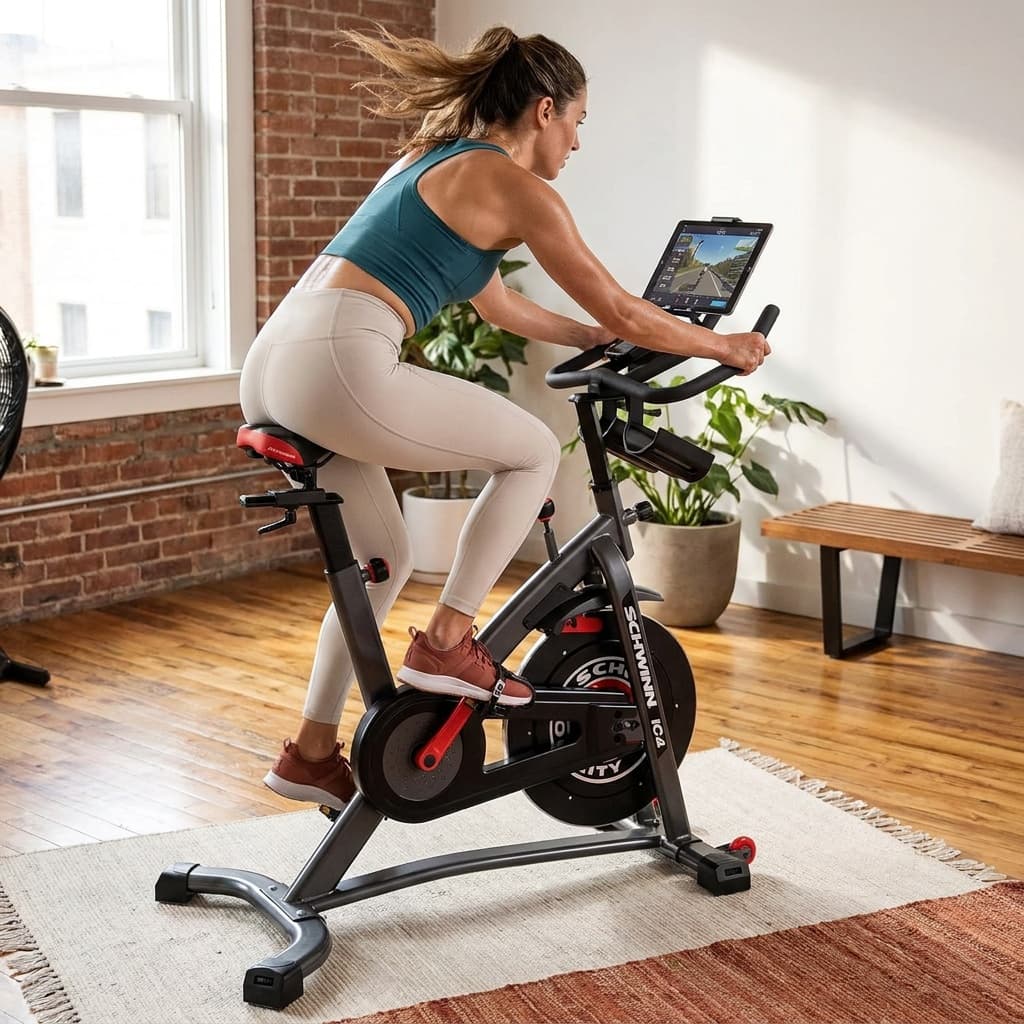
The IC4 pairs 100 levels of quiet magnetic resistance with dual-sided SPD and toe-cage pedals and Bluetooth (Schwinn calls it partial FTMS) that Schwinn lists as working with JRNY, Peloton, Zwift, Kinomap, and Explore the World. It includes a heart rate armband, a media holder, a USB charging station, and a pair of 3 lb dumbbells, so you get a near-complete studio setup without a mandatory subscription.
Best for: Riders who want a serious cardio and cycling training tool that connects to their preferred app without paying for a proprietary screen.
- Belt drive with magnetic resistance runs quietly; BowFlex lists a 40 lb flywheel for the identical C6 (Schwinn does not publish one)
- Bluetooth pairs with JRNY, Peloton, Zwift, Kinomap, and Explore the World, so you are not locked into one ecosystem
- Stock saddle is narrow and firm; most serious riders swap it out or add a cover
- Flywheel
- Not published by Schwinn; BowFlex lists 40 lb for the C6, which Wirecutter calls the same bike
- Resistance
- 100 magnetic levels (manual)
- Max user weight
- 330 lb
- Seat/handlebar adjust
- 4-way (vertical + horizontal)
- App compatibility
- JRNY, Peloton, Zwift, Kinomap, Explore the World, Apple Health, Google Fit; Schwinn lists Bluetooth as 'Partial FTMS'; includes Bluetooth HR armband and pair of 3 lb dumbbells
- Dimensions
- 54.6" D x 30.7" W x 51.8" H
The Cross Training Bike+ is Peloton's top bike. Its resistance changes automatically to match the instructor's cues, the 23.8-inch screen swivels for floor classes, and a movement-tracking camera counts reps and suggests weights in strength workouts. It fits riders from 4 ft 11 in to 6 ft 5 in and up to 297 lb. Like the standard bike, it needs the All-Access Membership.
Best for: Peloton households that ride most days and will use the off-bike strength classes the camera supports.
- Auto-resistance follows the class, so you never reach for the knob
- Largest screen here, and it swivels for strength and yoga
- The most expensive bike in this guide, before the membership
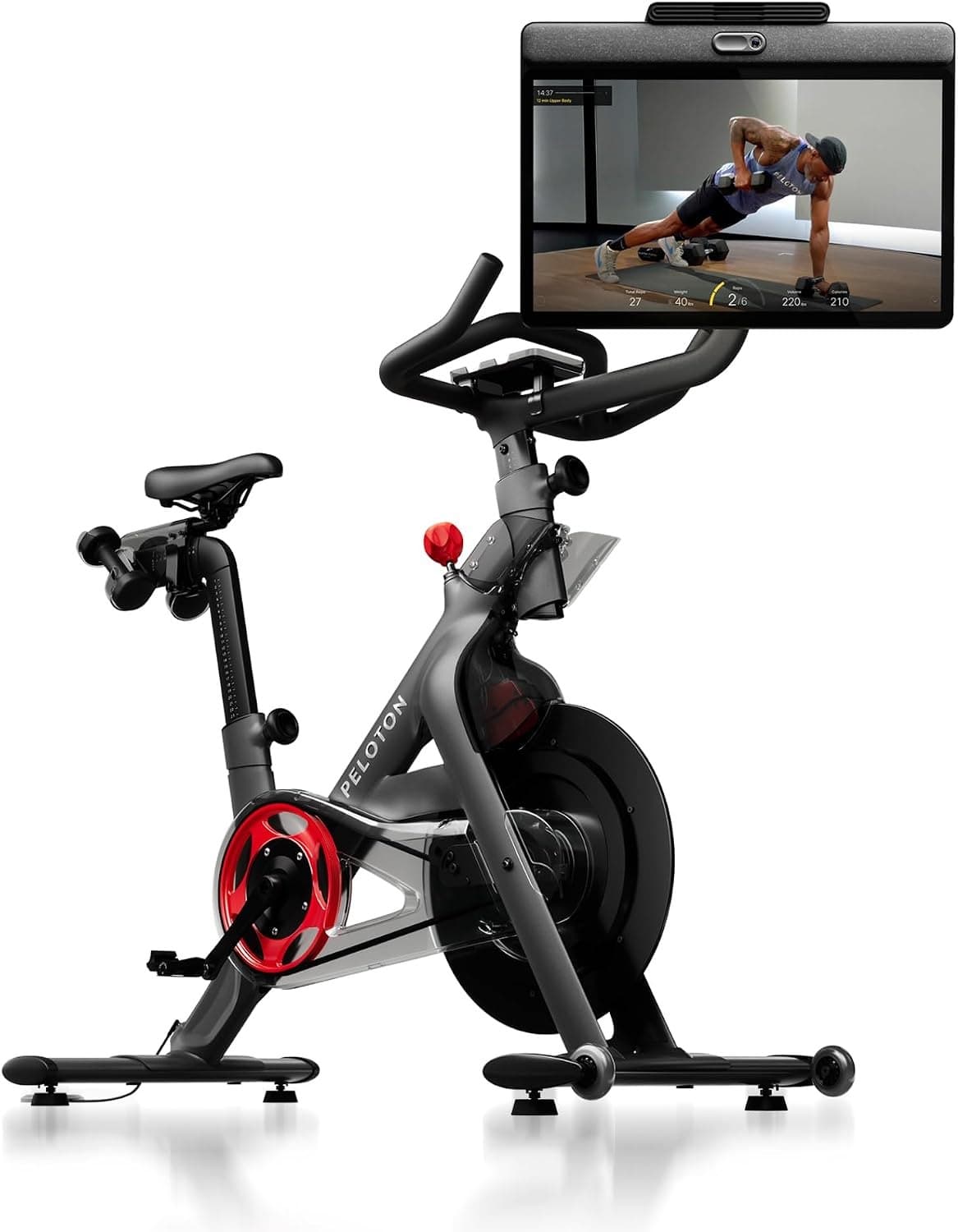
- Resistance
- Magnetic, digital, with auto-resistance that follows class cues
- Max user weight
- 297 lb
- Rider height
- 4 ft 11 in to 6 ft 5 in
- Dimensions
- 54" L x 22" W x 60" H; 144 lb (Peloton)
- Screen and membership
- 23.8" HD swivel touchscreen with movement-tracking camera; paid All-Access Membership required
- Pedals
- Delta-compatible clip-in pedals
Peloton's Cross Training Bike replaced the original Peloton Bike in October 2025. It keeps the manual resistance knob but adds a 21.5-inch HD touchscreen that swivels, so the same screen runs strength, yoga, and Pilates classes off the bike. Peloton fits it to riders from 4 ft 11 in to 6 ft 5 in and up to 297 lb on a 54 by 23 inch footprint. Classes need the All-Access Membership.
Best for: Riders who will actually take classes and want Peloton's instructors, without paying for auto-resistance.
- Peloton's class library, with a swivel screen for off-bike workouts
- Compact footprint: about 4 by 2 feet
- The membership is required for Peloton content and costs as much per year as a budget bike
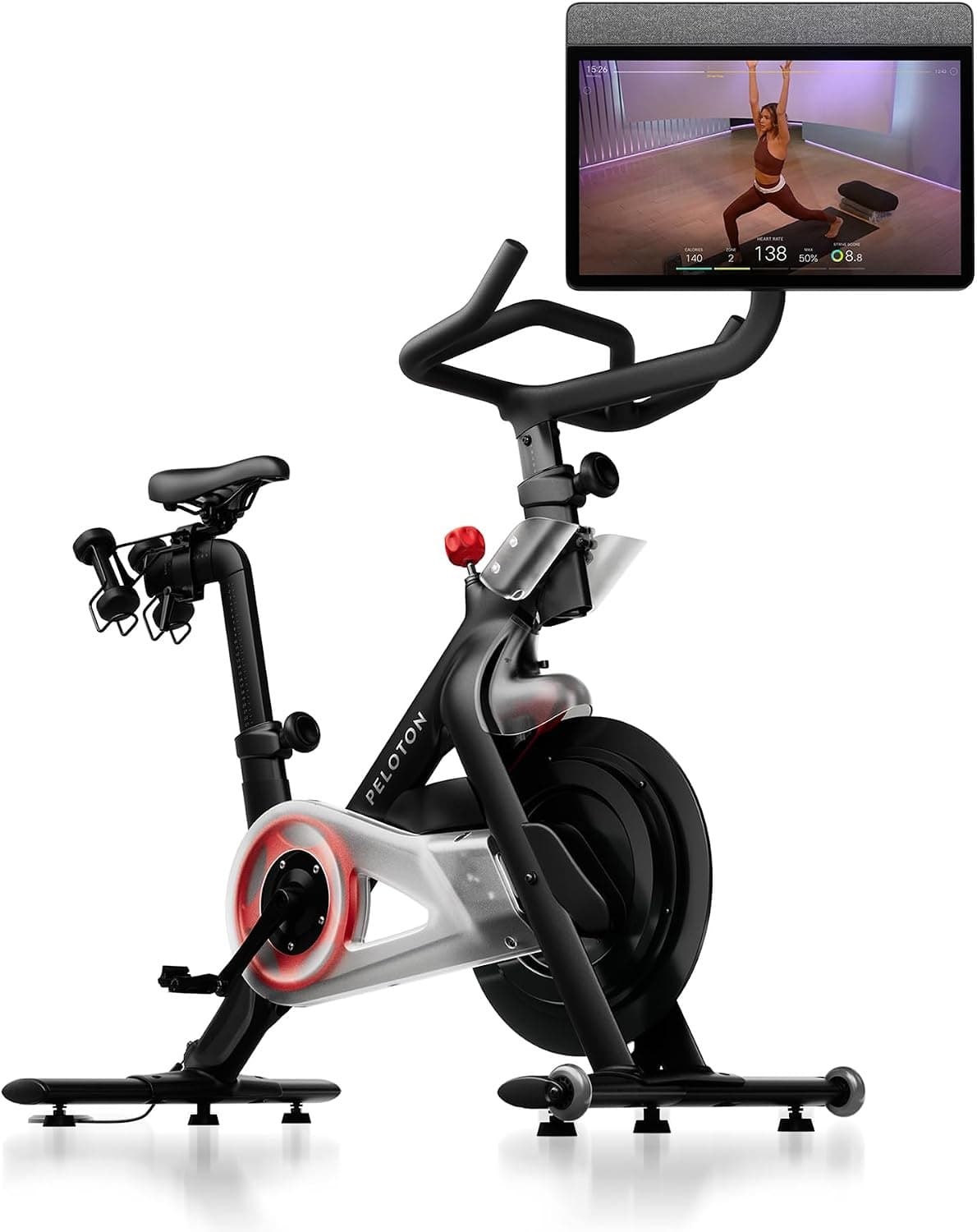
- Resistance
- Magnetic, manual resistance knob
- Max user weight
- 297 lb
- Rider height
- 4 ft 11 in to 6 ft 5 in
- Dimensions
- 54" L x 23" W x 61" H; 129 lb (Peloton)
- Screen and membership
- 21.5" HD swivel touchscreen; paid All-Access Membership required for Peloton content
- Pedals
- Delta-compatible clip-in pedals
Keep going
Free toolHome Cardio Space CheckerWill a rowing machine, exercise bike, or walking pad fit your room?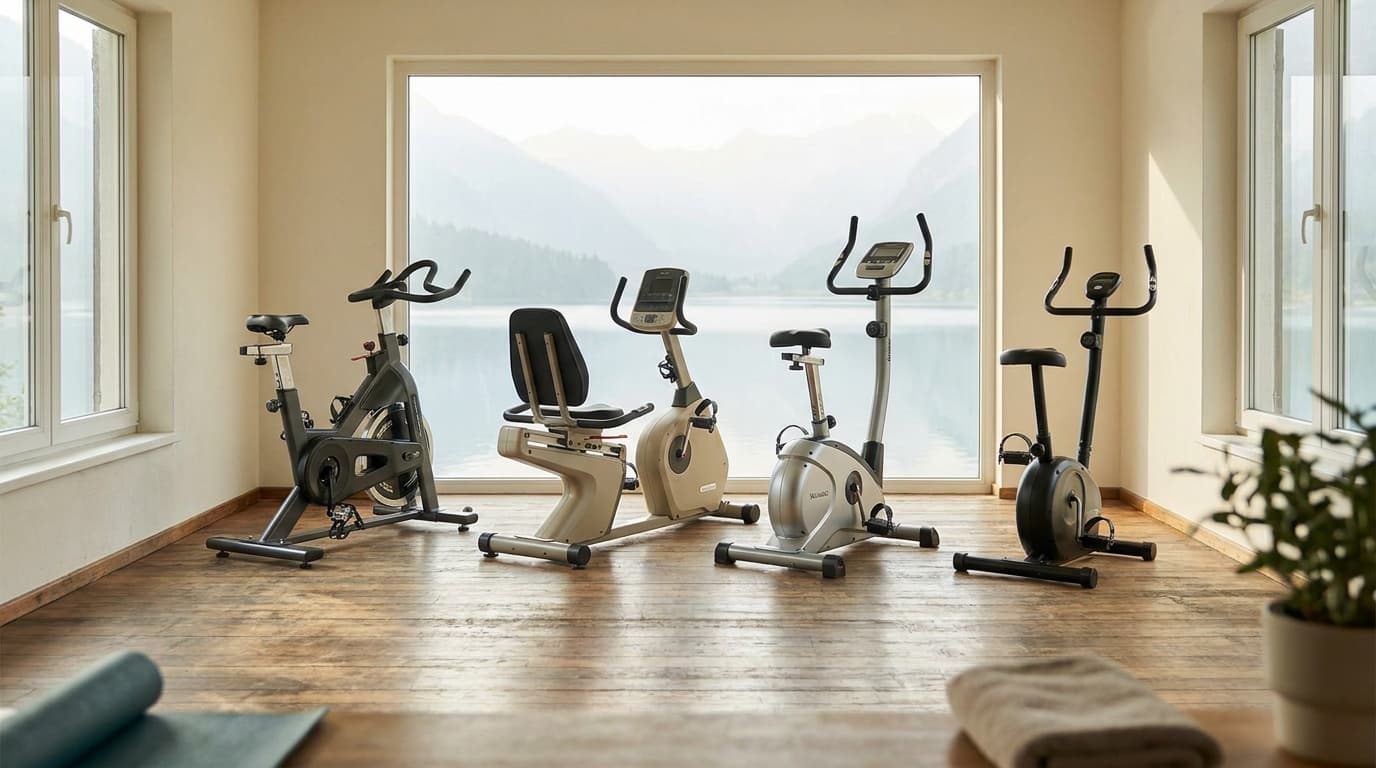
Researched, not hands-on tested
Updated Jul 7, 2026Our recommendations draw on manufacturer documentation, retailer listings, owner feedback, and comparisons with alternatives.
As an Amazon Associate I earn from qualifying purchases. We may earn a commission from links here, at no extra cost to you. How we research →