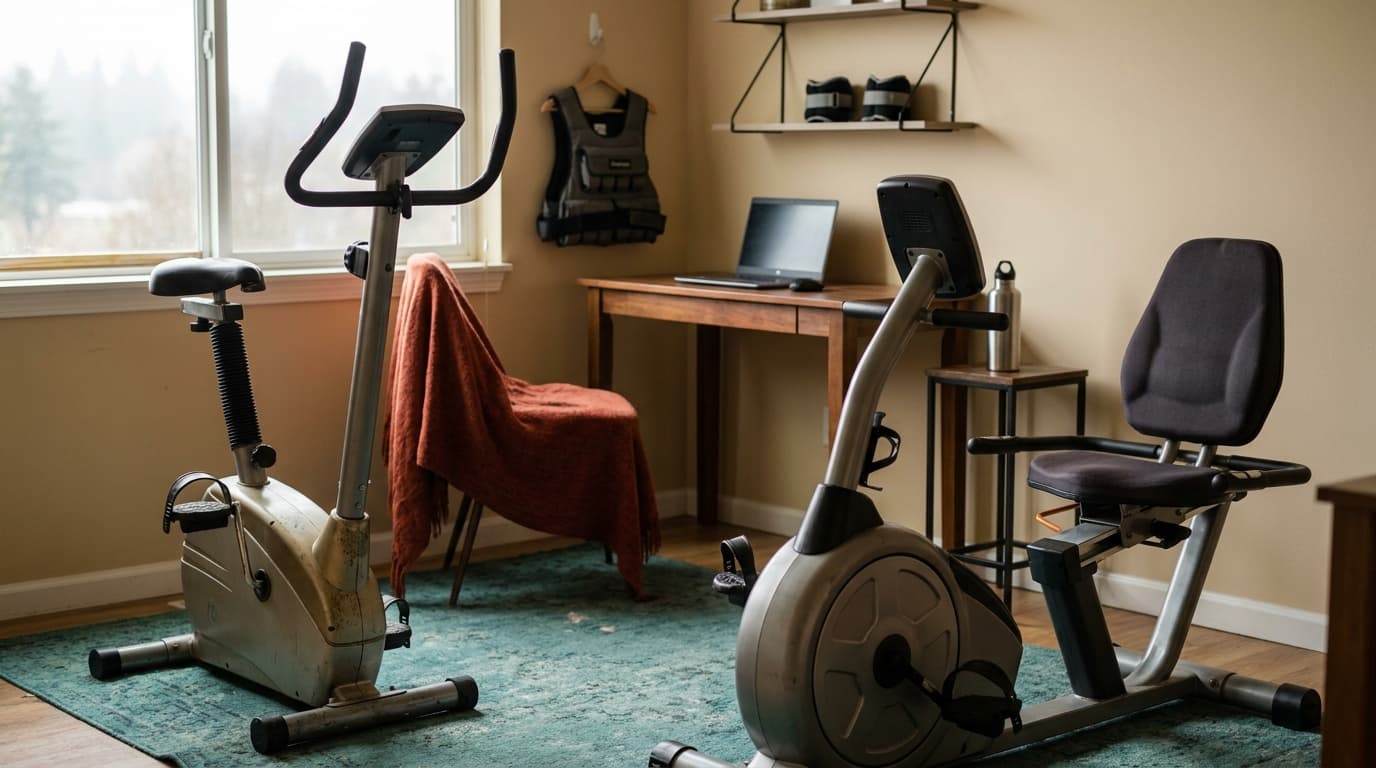
Choosing between an upright and a recumbent exercise bike comes down to one question: what does your body need from cardio today, not in some ideal future where you never have back pain or tight hips?
How each bike positions your body
The fundamental difference is seat angle and pedal position. On an upright bike you sit over the pedals, much like a road bike, with your torso angled forward or upright and your core lightly engaged to stabilize. On a recumbent, you sit back in a bucket seat with your legs extended in front of you and your lumbar spine supported by the backrest.
The recumbent's open hip angle reduces compression on the lumbar spine and takes load off the hip flexors. That matters for anyone with disc issues, stenosis, or post-surgical rehab. The upright's position recruits the core and glutes more actively and mimics the muscle pattern of riding outside.
Back support and joint comfort
Recumbent bikes have a genuine clinical track record in cardiac and orthopedic rehab. The backrest transfers torso weight away from the spine, and the reclined angle means no weight through the wrists or shoulders. If you have chronic lower back pain, arthritis in the hips or knees, or you are recovering from a lower-body procedure, the recumbent lets you accumulate aerobic minutes that would be impossible or painful on an upright.
Uprights are not inherently hard on joints, but form matters. A seat that is too low compresses the knee at the bottom of the stroke. Proper fit (slight bend in the knee at full extension, roughly 25–35 degrees) largely eliminates that issue. Wrist and shoulder discomfort is common when the handlebar is set too low, forcing a hunched position.
The recumbent does not make you work less; it just removes back and joint discomfort as a limiting factor so you can work longer.
Calorie burn and cardio output
Both bikes are aerobic tools and both can drive meaningful cardiovascular adaptations. Studies comparing the two at matched heart rates show similar oxygen consumption, which means similar calorie burn when intensity is controlled. The oft-cited claim that uprights burn significantly more calories is mostly a product of people working harder on them because the position is less comfortable to coast in.
A 155 lb person cycling at moderate effort burns approximately 260–300 calories in 30 minutes on either style. Increase resistance or cadence and those numbers climb on both. The bike style is not the bottleneck; sustained effort is.
Matching effort on either bike
Set a target heart rate
aim for 65–75% of max for steady cardio, 80–90% for intervals
Use resistance, not speed
spinning fast at low resistance inflates RPM without raising heart rate meaningfully
Time in zone matters
20–40 minutes at moderate intensity outperforms 10 minutes of hard effort most days
Check perceived exertion
you should be able to speak in short sentences but not hold a full conversation
Who picks which
Recumbent is the right call if: you have lower back pain, hip or knee arthritis, balance concerns, significant deconditioning, or you are in a supervised rehab program. Older adults often find the step-through frame on models like the Schwinn 230 easier to mount. The seated position also makes it easier to read or watch something for long sessions, which helps with adherence.
Upright is the right call if: you want to cross-train for outdoor cycling, you have limited floor space, or you want more full-body muscle recruitment. Uprights like the Marcy NS-1201U also tend to cost less at equivalent quality tiers and take up roughly 30–40% less floor space than a recumbent of the same caliber.
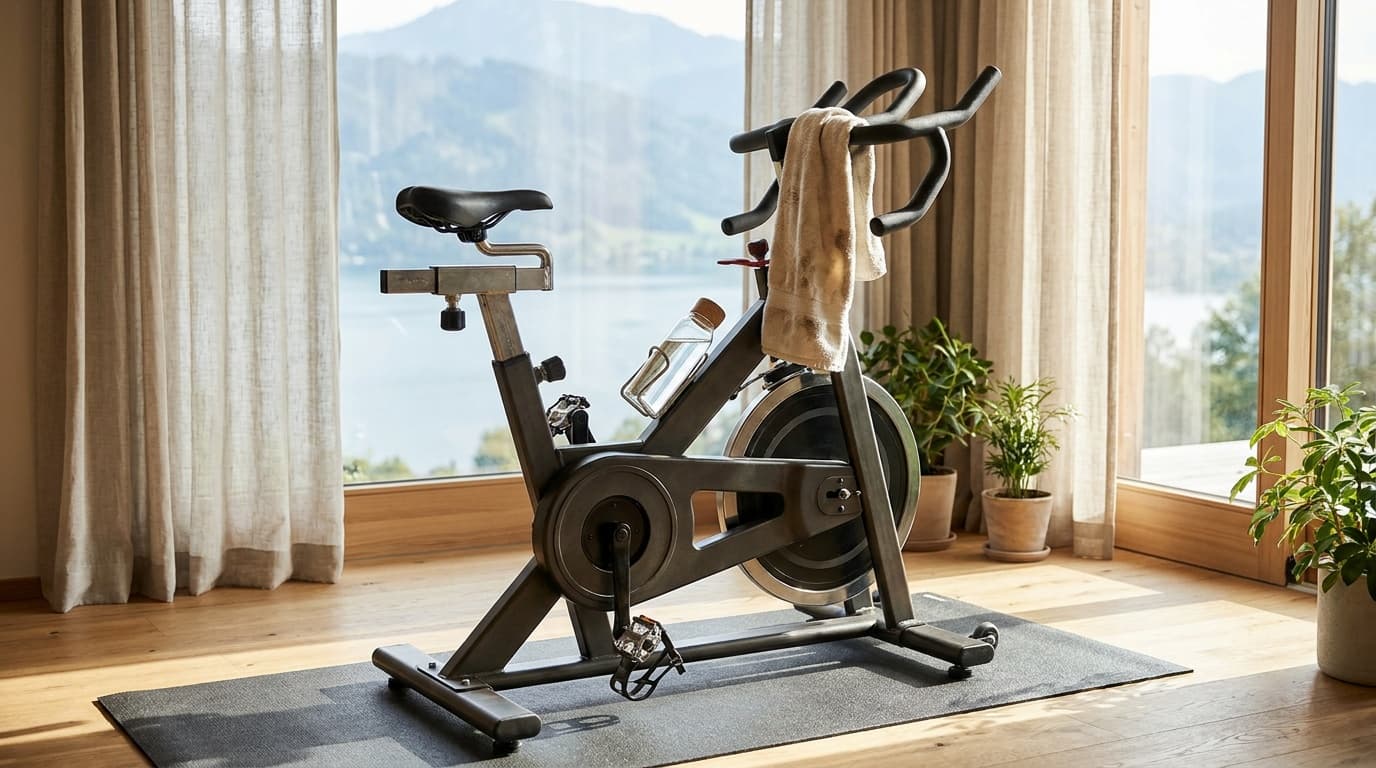
Spin bikes (also called indoor cycles) belong in a third category. They use a heavy flywheel, a road-style saddle, and a forward riding position. They are built for high-intensity interval work, standing climbs, and cadence drills. They have no backrest, minimal padding, and no recline. They are not suitable for rehab or low-impact sessions. If your goal is structured HIIT, following virtual classes, or training for outdoor cycling events, a spin bike is worth the specificity. For general daily cardio, the comfort gap versus an upright is significant.
The verdict
Buy a recumbent if joint pain, back support, or long comfortable sessions are your priority. Buy an upright if space, budget, or outdoor-cycling crossover matters more. Buy a spin bike only if you are specifically chasing intensity and can tolerate the aggressive position. Any of the three, used consistently at the right effort level, will deliver real cardiovascular benefit.
Frequently asked questions
Is a recumbent bike easier than an upright?
At the same resistance and cadence, the cardiovascular demand is nearly identical. The recumbent feels easier for many people because back and joint discomfort is removed as a distraction, not because the heart and lungs are working less. At matched heart rates, both bikes produce similar calorie burn and aerobic adaptation.
Can I build muscle on an exercise bike?
Both upright and recumbent bikes develop muscular endurance in the quads, hamstrings, and glutes, particularly at higher resistance. They are not a substitute for progressive resistance training if hypertrophy is a goal, but they do maintain and modestly develop lower body muscle, especially for beginners or anyone returning from a layoff.
Which bike is better for seniors?
The recumbent is generally the better fit for older adults. The step-through frame is easier to mount, the backrest reduces spinal load, and the open hip angle is more comfortable for people with hip replacements or arthritis. That said, a properly fitted upright is still a good option for seniors who have no joint limitations and prefer the more engaged riding position.
For specific picks, see our guide to the best exercise bikes. Browse all fitness guides or read how we research and rate gear.
Recommended gear
Our current top picks from the Best exercise bikes for home cardio (2026) guide, if you are ready to buy.
SCHWINN
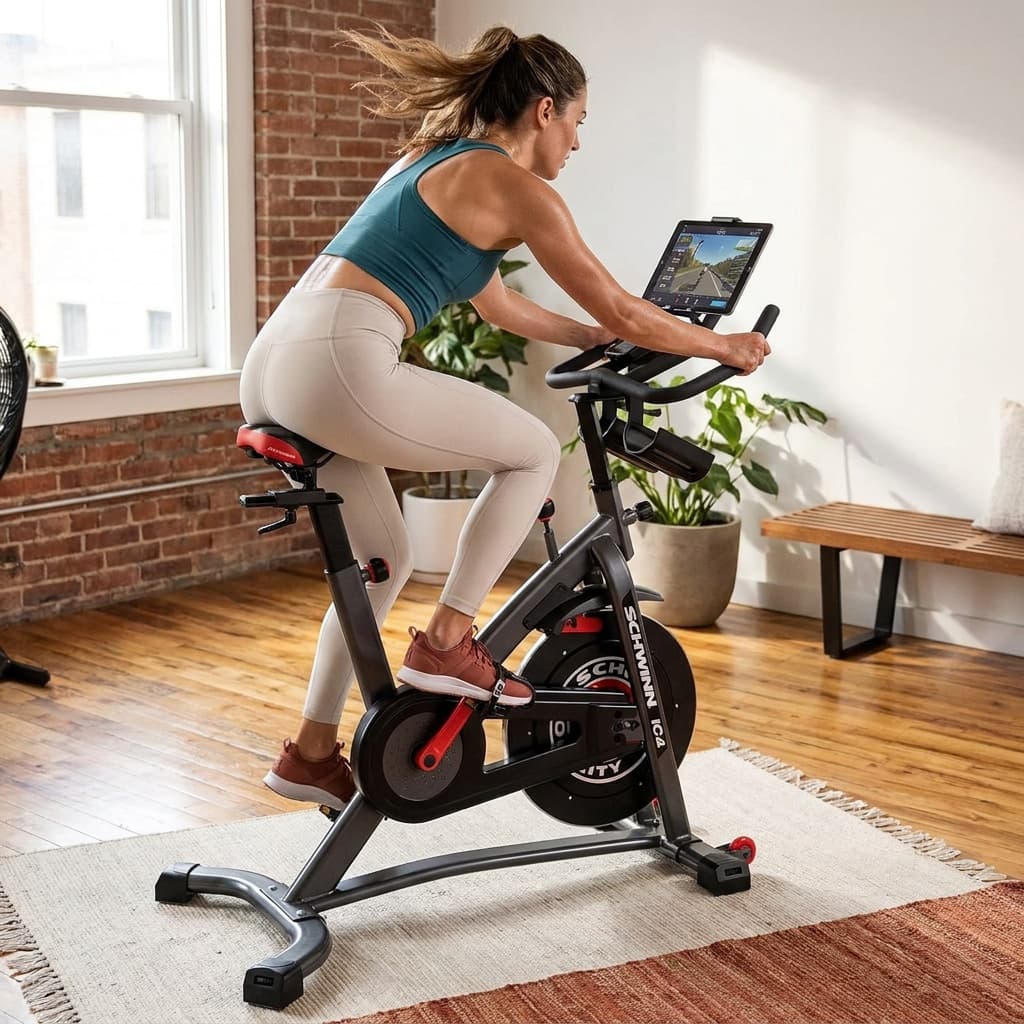
Schwinn IC4 Indoor Cycling Bike
BEST OVERALL
Kit Score 8.5/10
$899.00 Price checked Oct 24, 5:42 AM CDT
Best for: Riders who want a serious cardio and cycling training tool that connects to their preferred app without paying for a proprietary screen.
- Belt drive with magnetic resistance runs quietly; BowFlex lists a 40 lb flywheel for the identical C6 (Schwinn does not publish one)
- Stock saddle is narrow and firm; most serious riders swap it out or add a cover
- Flywheel
- Not published by Schwinn; BowFlex lists 40 lb for the C6, which Wirecutter calls the same bike
- Resistance
- 100 magnetic levels (manual)
- Max user weight
- 330 lb
- Seat/handlebar adjust
- 4-way (vertical + horizontal)
- App compatibility
- JRNY, Peloton, Zwift, Kinomap, Explore the World, Apple Health, Google Fit; Schwinn lists Bluetooth as 'Partial FTMS'; includes Bluetooth HR armband and pair of 3 lb dumbbells
- Dimensions
- 54.6" D x 30.7" W x 51.8" H
About this pick
The IC4 pairs 100 levels of quiet magnetic resistance with dual-sided SPD and toe-cage pedals and Bluetooth (Schwinn calls it partial FTMS) that Schwinn lists as working with JRNY, Peloton, Zwift, Kinomap, and Explore the World. It includes a heart rate armband, a media holder, a USB charging station, and a pair of 3 lb dumbbells, so you get a near-complete studio setup without a mandatory subscription.
Strengths
- Belt drive with magnetic resistance runs quietly; BowFlex lists a 40 lb flywheel for the identical C6 (Schwinn does not publish one)
- Bluetooth pairs with JRNY, Peloton, Zwift, Kinomap, and Explore the World, so you are not locked into one ecosystem
- 4-way adjustable seat and handlebars fit a wide rider range; dual-sided pedals suit both cycling shoes and trainers
Weaknesses
- Stock saddle is narrow and firm; most serious riders swap it out or add a cover
- Manual resistance control means apps cannot auto-adjust intensity mid-workout
Kit Score breakdown
PELOTON
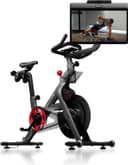
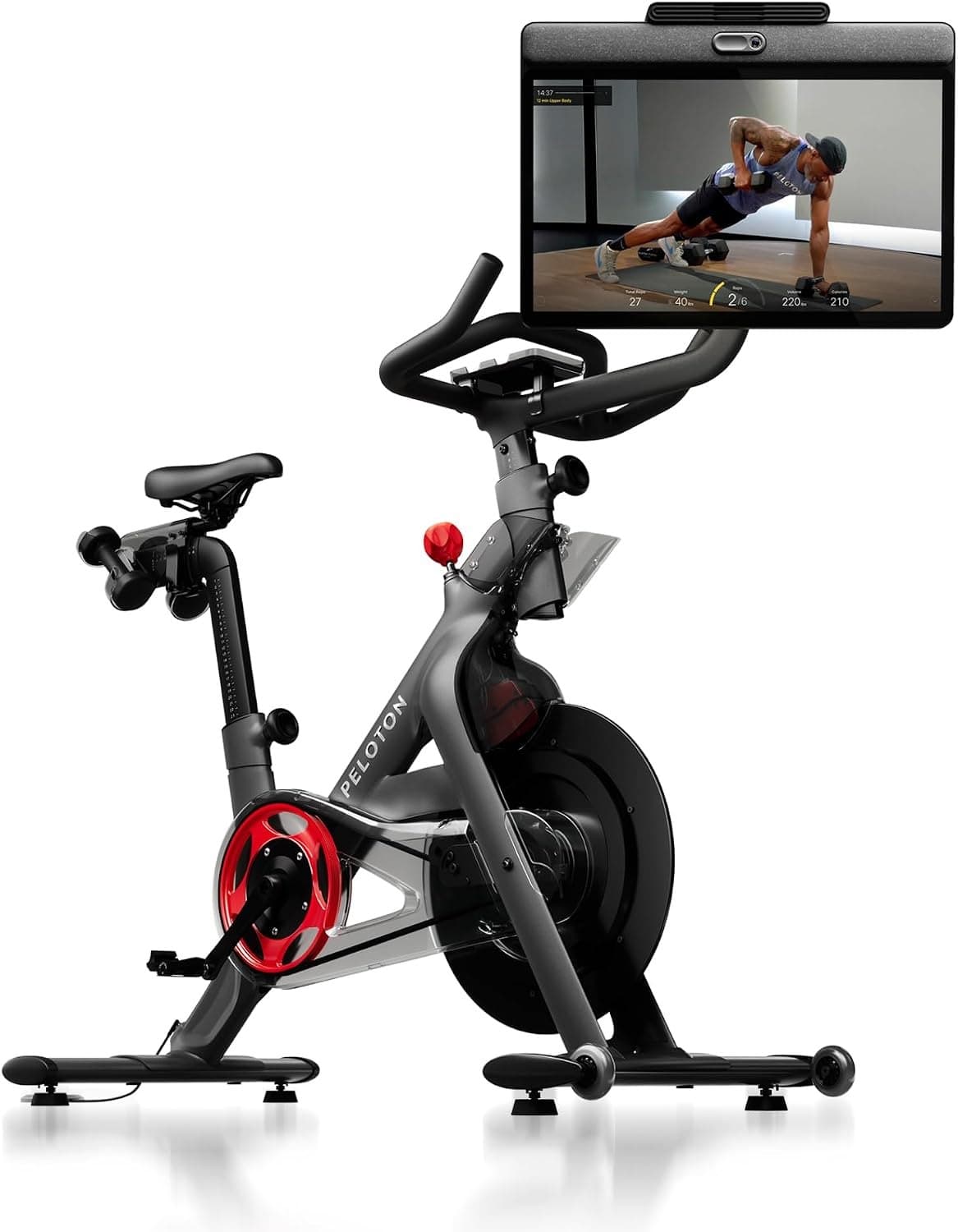
Peloton Cross Training Bike+
BEST CONNECTED
Kit Score 7.7/10
$2,695.00 Price checked Oct 24, 5:42 AM CDT
Best for: Peloton households that ride most days and will use the off-bike strength classes the camera supports.
- Auto-resistance follows the class, so you never reach for the knob
- The most expensive bike in this guide, before the membership
- Resistance
- Magnetic, digital, with auto-resistance that follows class cues
- Max user weight
- 297 lb
- Rider height
- 4 ft 11 in to 6 ft 5 in
- Dimensions
- 54" L x 22" W x 60" H; 144 lb (Peloton)
- Screen and membership
- 23.8" HD swivel touchscreen with movement-tracking camera; paid All-Access Membership required
- Pedals
- Delta-compatible clip-in pedals
About this pick
The Cross Training Bike+ is Peloton's top bike. Its resistance changes automatically to match the instructor's cues, the 23.8-inch screen swivels for floor classes, and a movement-tracking camera counts reps and suggests weights in strength workouts. It fits riders from 4 ft 11 in to 6 ft 5 in and up to 297 lb. Like the standard bike, it needs the All-Access Membership.
More specifications
- Warranty
- 5-year frame, 12 months touchscreen and components
Strengths
- Auto-resistance follows the class, so you never reach for the knob
- Largest screen here, and it swivels for strength and yoga
- Movement-tracking camera and built-in fan
Weaknesses
- The most expensive bike in this guide, before the membership
- 297 lb rider limit and Delta-only pedals
Kit Score breakdown
PELOTON
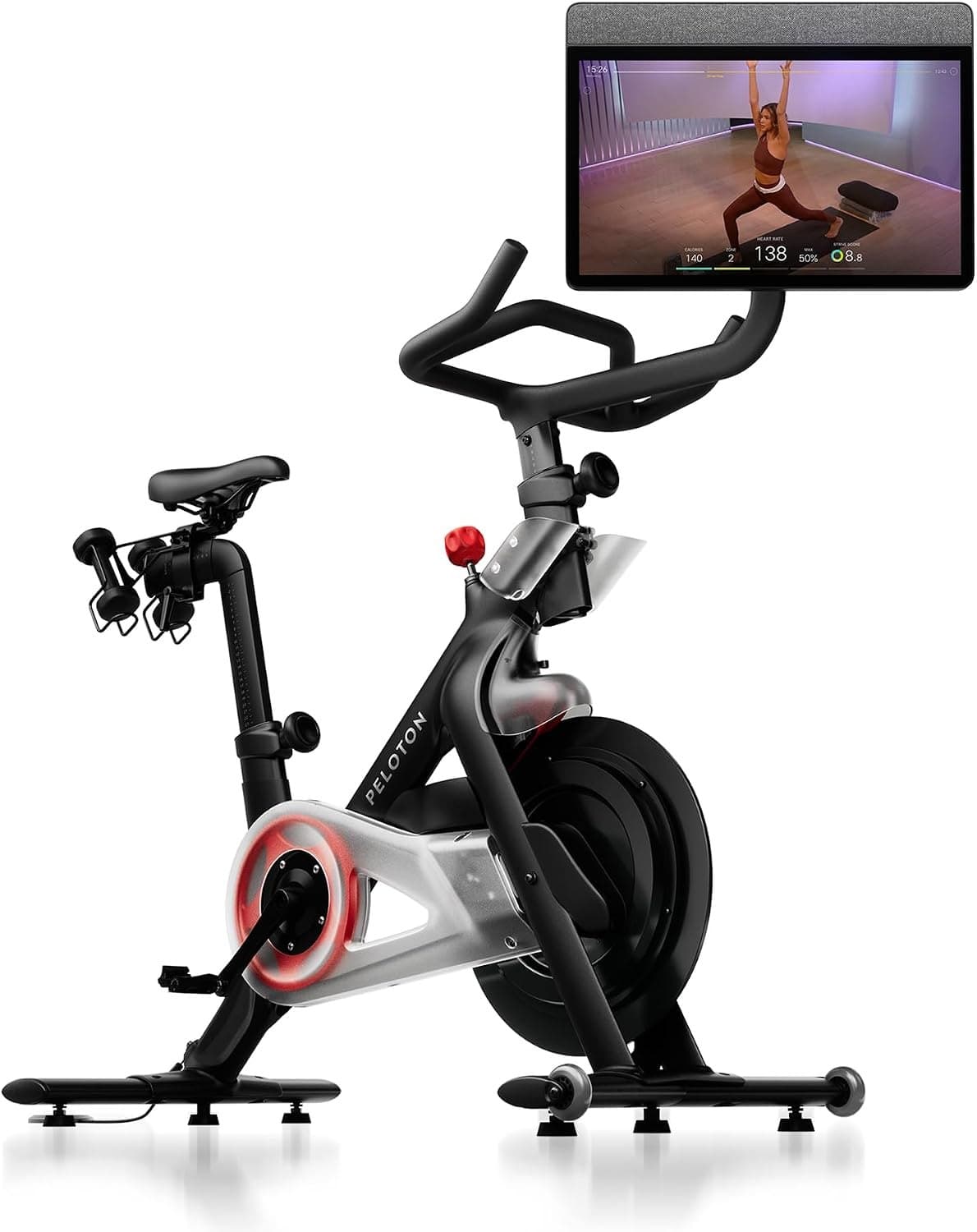
Peloton Cross Training Bike
BEST FOR CLASSES
Kit Score 7.9/10
$1,695.00 Price checked Oct 24, 5:42 AM CDT
Best for: Riders who will actually take classes and want Peloton's instructors, without paying for auto-resistance.
- Peloton's class library, with a swivel screen for off-bike workouts
- The membership is required for Peloton content and costs as much per year as a budget bike
- Resistance
- Magnetic, manual resistance knob
- Max user weight
- 297 lb
- Rider height
- 4 ft 11 in to 6 ft 5 in
- Dimensions
- 54" L x 23" W x 61" H; 129 lb (Peloton)
- Screen and membership
- 21.5" HD swivel touchscreen; paid All-Access Membership required for Peloton content
- Pedals
- Delta-compatible clip-in pedals
About this pick
Peloton's Cross Training Bike replaced the original Peloton Bike in October 2025. It keeps the manual resistance knob but adds a 21.5-inch HD touchscreen that swivels, so the same screen runs strength, yoga, and Pilates classes off the bike. Peloton fits it to riders from 4 ft 11 in to 6 ft 5 in and up to 297 lb on a 54 by 23 inch footprint. Classes need the All-Access Membership.
More specifications
- Warranty
- 5-year frame, 12 months touchscreen and components
Strengths
- Peloton's class library, with a swivel screen for off-bike workouts
- Compact footprint: about 4 by 2 feet
- Sold and shipped by Amazon, with Peloton's 5-year frame warranty
Weaknesses
- The membership is required for Peloton content and costs as much per year as a budget bike
- Delta-compatible pedals mean cycling shoes with Delta cleats, and the 297 lb limit is lower than the Schwinn IC4's 330 lb
Kit Score breakdown
Keep going
Free toolHome Cardio Space CheckerWill a rowing machine, exercise bike, or walking pad fit your room?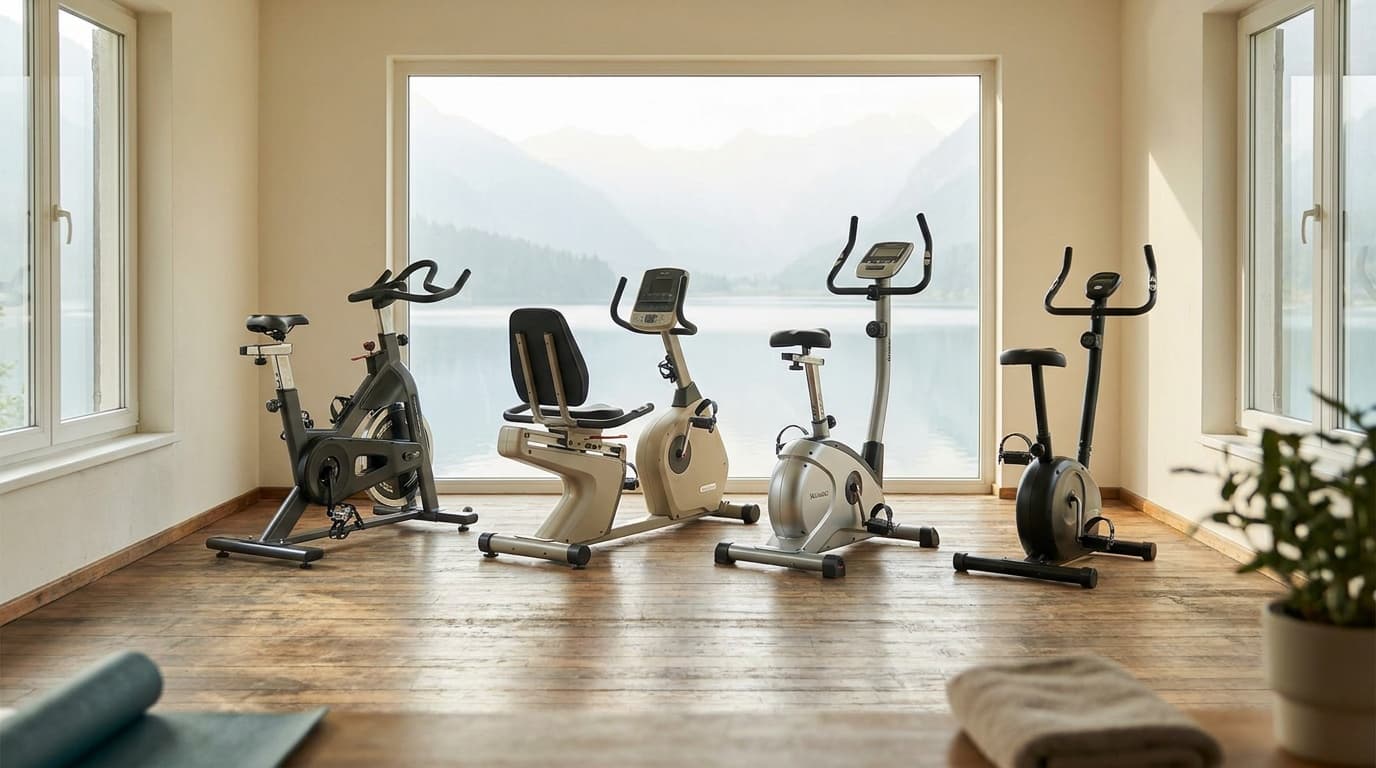
Researched, not hands-on tested
Updated Jun 4, 2026Our recommendations draw on manufacturer documentation, retailer listings, owner feedback, and comparisons with alternatives.
As an Amazon Associate I earn from qualifying purchases. We may earn a commission from links here, at no extra cost to you. How we research →