The Schwinn IC4 is the best exercise bike for most homes: Wirecutter names it (and its twin, the BowFlex C6) its top pick, Schwinn rates it for 330 lb with 100 magnetic resistance levels, and its Bluetooth works with Peloton, Zwift, and other apps without a required subscription. If you want classes on a built-in screen, the Peloton Cross Training Bike and Bike+ are the connected picks. For back support, choose the Horizon 5.0R or Schwinn 230 recumbent; for a small budget, the MERACH S36 or Marcy NS-1201U.
Our quick picks
How we picked
Every bike is scored with our Kit Score: resistance range and feel, rider weight and height limits, footprint, connectivity and membership cost, seat comfort and adjustability, and build and warranty. We started from the 2026 picks of Wirecutter, Garage Gym Reviews, BarBend, Verywell Fit, and Tom's Guide, checked every spec on the maker's own page, and confirmed each bike is in stock on Amazon from Amazon or the maker's store. We did not ride these bikes ourselves; the sources table at the end lists where each number comes from.
The picks
Best overall: Schwinn IC4
BEST OVERALL
Schwinn IC4 Indoor Cycling Bike
Best for: Riders who want a serious cardio and cycling training tool that connects to their preferred app without paying for a proprietary screen.
- Belt drive with magnetic resistance runs quietly; BowFlex lists a 40 lb flywheel for the identical C6 (Schwinn does not publish one)
- Stock saddle is narrow and firm; most serious riders swap it out or add a cover
Kit Score 8.5/10 · $899.00 Price checked Oct 23, 4:16 PM CDT · how we score gear
Buy on AmazonProduct details
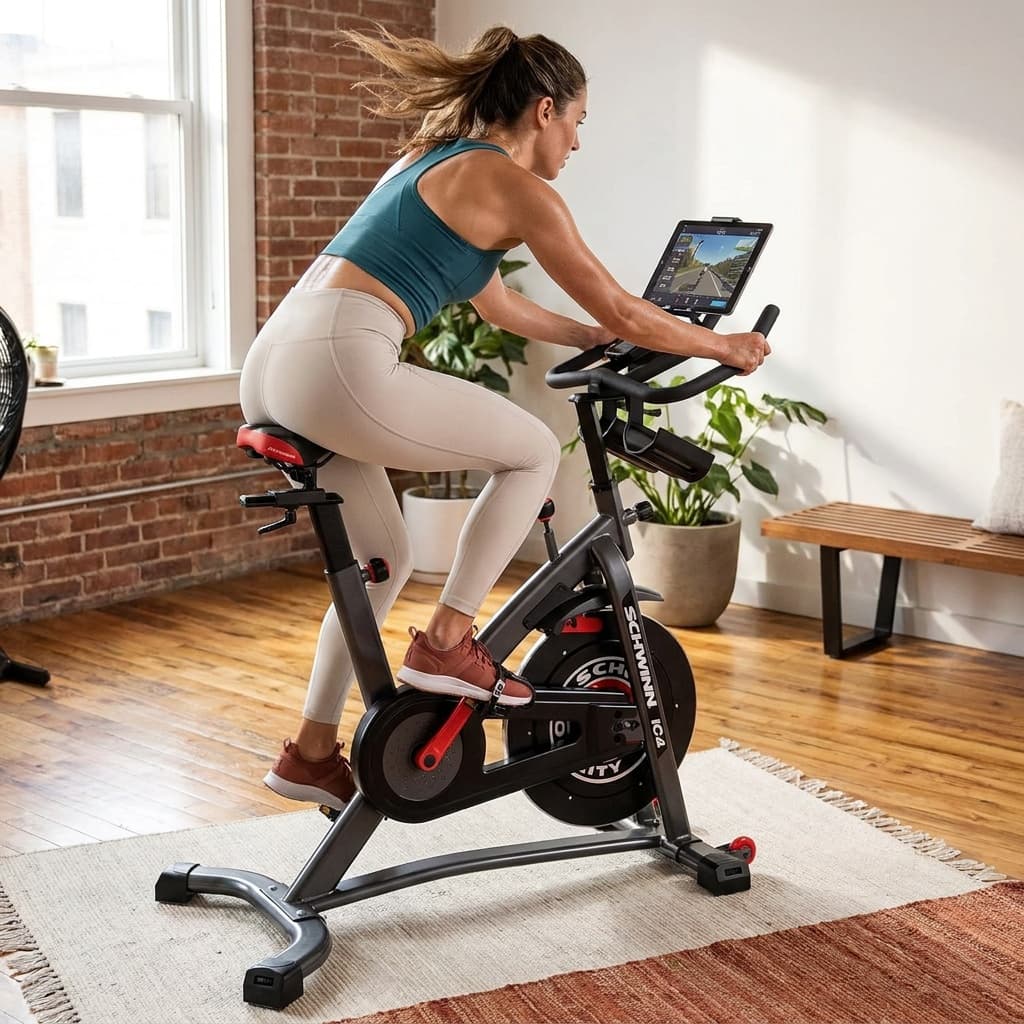
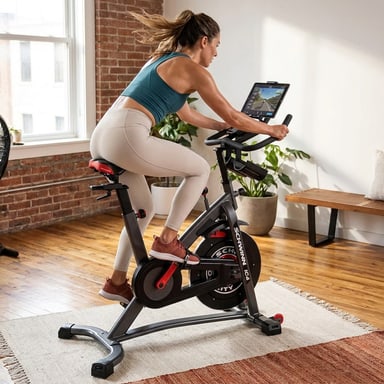
The IC4 pairs 100 levels of quiet magnetic resistance with dual-sided SPD and toe-cage pedals and Bluetooth (Schwinn calls it partial FTMS) that Schwinn lists as working with JRNY, Peloton, Zwift, Kinomap, and Explore the World. It includes a heart rate armband, a media holder, a USB charging station, and a pair of 3 lb dumbbells, so you get a near-complete studio setup without a mandatory subscription.
- Flywheel
- Not published by Schwinn; BowFlex lists 40 lb for the C6, which Wirecutter calls the same bike
- Resistance
- 100 magnetic levels (manual)
- Max user weight
- 330 lb
- Seat/handlebar adjust
- 4-way (vertical + horizontal)
- App compatibility
- JRNY, Peloton, Zwift, Kinomap, Explore the World, Apple Health, Google Fit; Schwinn lists Bluetooth as 'Partial FTMS'; includes Bluetooth HR armband and pair of 3 lb dumbbells
- Dimensions
- 54.6" D x 30.7" W x 51.8" H
More strengths
- Bluetooth pairs with JRNY, Peloton, Zwift, Kinomap, and Explore the World, so you are not locked into one ecosystem
- 4-way adjustable seat and handlebars fit a wide rider range; dual-sided pedals suit both cycling shoes and trainers
Other tradeoffs
- Manual resistance control means apps cannot auto-adjust intensity mid-workout
The IC4 is the bike that fits into whatever training you already do. Wirecutter calls it and the BowFlex C6 the same bike under different names and makes it its top pick; BarBend names it the best bike for beginners. Schwinn lists Bluetooth compatibility with JRNY, Peloton, Zwift, Kinomap, and Explore the World (it calls the connection "partial FTMS"), so you are not locked into a subscription. Schwinn's own JRNY app is optional.
The 100-level magnetic resistance spans easy recovery spins up to hard intervals, and the dual-sided pedals take SPD cleats on one side and sneakers in the toe cage on the other. Schwinn does not publish a flywheel weight, but BowFlex lists 40 lb for the C6. Schwinn rates it for 330 lb and riders from 5 ft 1 in to 6 ft 4 in (a 29 to 39 inch inseam), on a 54.6 by 30.7 inch footprint. It includes a Bluetooth heart rate armband, a media holder, a USB charging station, and a pair of 3 lb dumbbells. The warranty runs 10 years on the frame and 3 years on parts and electronics.
Resistance: magnetic, 100 levels | Max user: 330 lb | Rider: 5 ft 1 in to 6 ft 4 in | Footprint: 54.6 x 30.7 in
Best connected: Peloton Cross Training Bike+
BEST CONNECTED
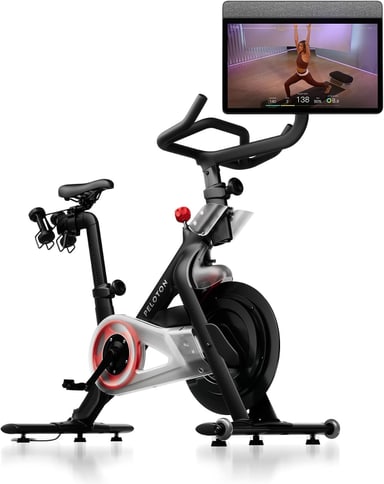
Peloton Cross Training Bike+
Best for: Peloton households that ride most days and will use the off-bike strength classes the camera supports.
- Auto-resistance follows the class, so you never reach for the knob
- The most expensive bike in this guide, before the membership
Kit Score 7.7/10 · $2,695.00 Price checked Oct 23, 4:16 PM CDT · how we score gear
Buy on AmazonProduct details
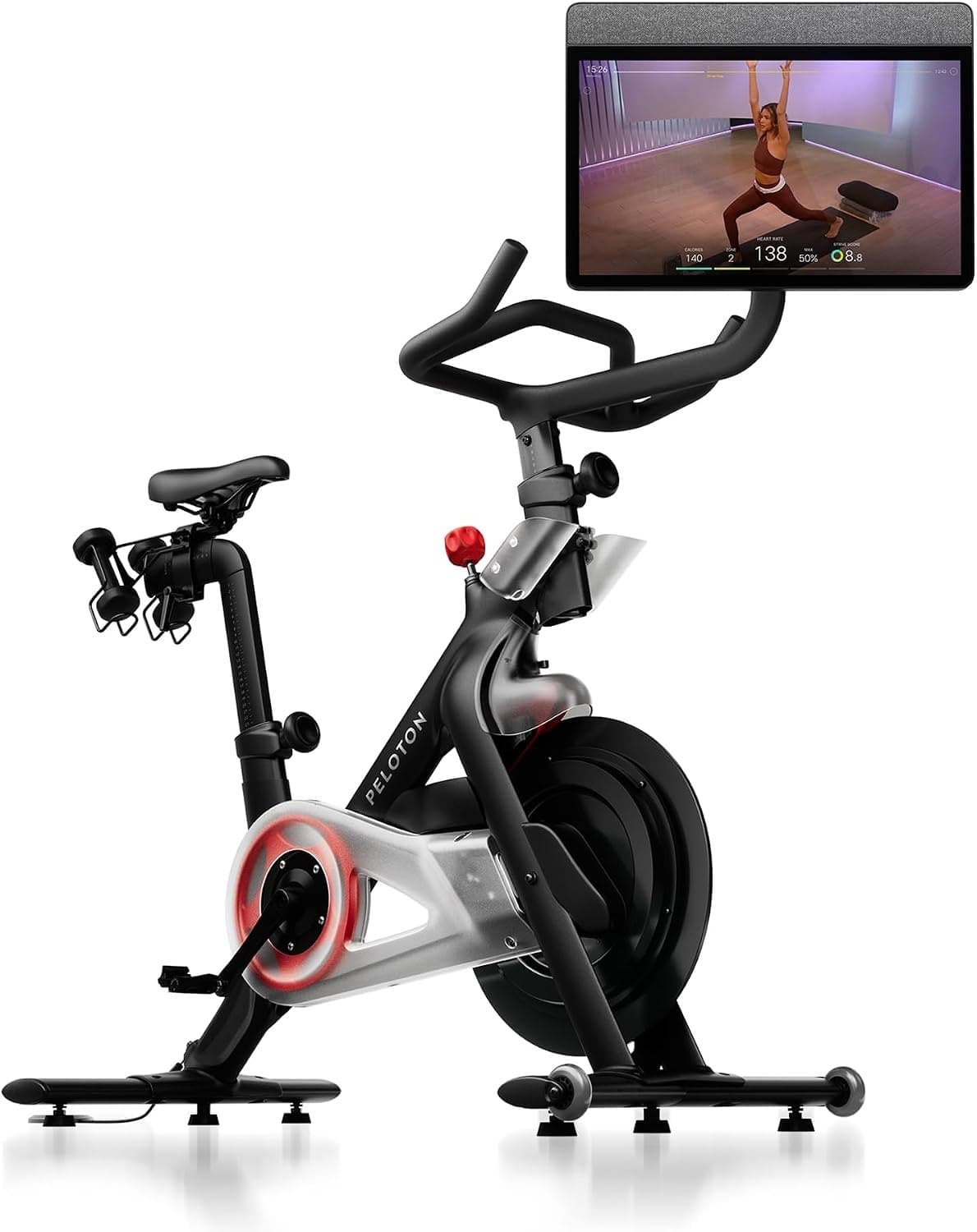
The Cross Training Bike+ is Peloton's top bike. Its resistance changes automatically to match the instructor's cues, the 23.8-inch screen swivels for floor classes, and a movement-tracking camera counts reps and suggests weights in strength workouts. It fits riders from 4 ft 11 in to 6 ft 5 in and up to 297 lb. Like the standard bike, it needs the All-Access Membership.
- Resistance
- Magnetic, digital, with auto-resistance that follows class cues
- Max user weight
- 297 lb
- Rider height
- 4 ft 11 in to 6 ft 5 in
- Dimensions
- 54" L x 22" W x 60" H; 144 lb (Peloton)
- Screen and membership
- 23.8" HD swivel touchscreen with movement-tracking camera; paid All-Access Membership required
- Pedals
- Delta-compatible clip-in pedals
- Warranty
- 5-year frame, 12 months touchscreen and components
More strengths
- Largest screen here, and it swivels for strength and yoga
- Movement-tracking camera and built-in fan
Other tradeoffs
- 297 lb rider limit and Delta-only pedals
Peloton replaced the original Bike and Bike+ in October 2025 with the Cross Training Bike and Cross Training Bike+, and the originals are now sold only refurbished. Wirecutter makes the Bike+ its upgrade pick. Its resistance changes automatically to follow the instructor's cues, the 23.8-inch HD screen swivels so you can turn it toward a floor workout, and a movement-tracking camera counts reps and suggests weights in strength classes. It also has a built-in fan.
Peloton fits both bikes to riders from 4 ft 11 in to 6 ft 5 in and up to 297 lb, lower than the IC4. The Bike+ is 54 by 22 inches and 144 lb. The pedals are Delta-compatible, so you need Delta cleats, and Peloton's content requires its All-Access Membership, a monthly cost on top of the bike. Peloton covers the frame for 5 years and the touchscreen and components for 12 months.
Resistance: magnetic, auto | Max user: 297 lb | Screen: 23.8 in swivel | Footprint: 54 x 22 in
Best for classes: Peloton Cross Training Bike
BEST FOR CLASSES
Peloton Cross Training Bike
Best for: Riders who will actually take classes and want Peloton's instructors, without paying for auto-resistance.
- Peloton's class library, with a swivel screen for off-bike workouts
- The membership is required for Peloton content and costs as much per year as a budget bike
Kit Score 7.9/10 · $1,695.00 Price checked Oct 23, 4:16 PM CDT · how we score gear
Buy on AmazonProduct details
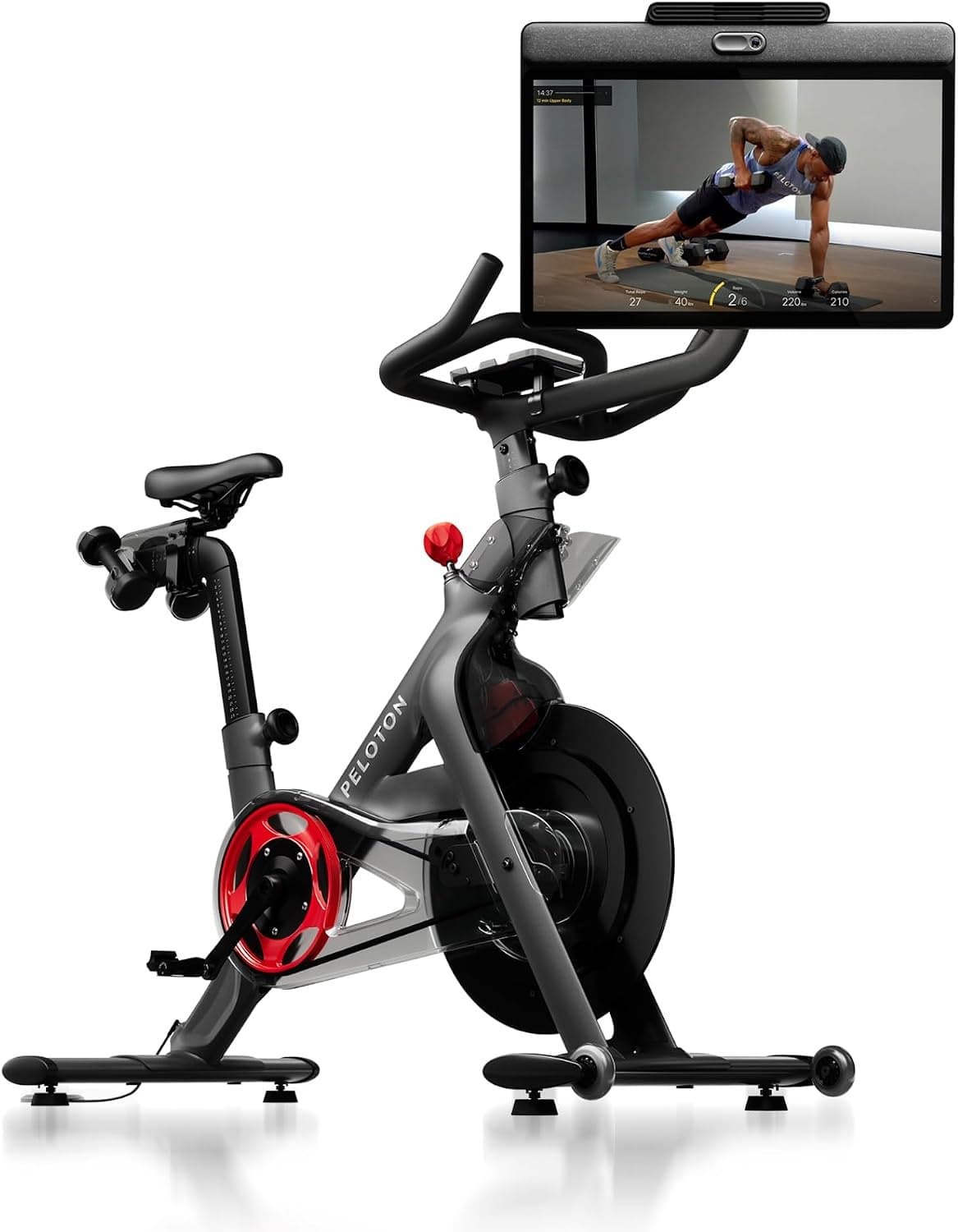
Peloton's Cross Training Bike replaced the original Peloton Bike in October 2025. It keeps the manual resistance knob but adds a 21.5-inch HD touchscreen that swivels, so the same screen runs strength, yoga, and Pilates classes off the bike. Peloton fits it to riders from 4 ft 11 in to 6 ft 5 in and up to 297 lb on a 54 by 23 inch footprint. Classes need the All-Access Membership.
- Resistance
- Magnetic, manual resistance knob
- Max user weight
- 297 lb
- Rider height
- 4 ft 11 in to 6 ft 5 in
- Dimensions
- 54" L x 23" W x 61" H; 129 lb (Peloton)
- Screen and membership
- 21.5" HD swivel touchscreen; paid All-Access Membership required for Peloton content
- Pedals
- Delta-compatible clip-in pedals
- Warranty
- 5-year frame, 12 months touchscreen and components
More strengths
- Compact footprint: about 4 by 2 feet
- Sold and shipped by Amazon, with Peloton's 5-year frame warranty
Other tradeoffs
- Delta-compatible pedals mean cycling shoes with Delta cleats, and the 297 lb limit is lower than the Schwinn IC4's 330 lb
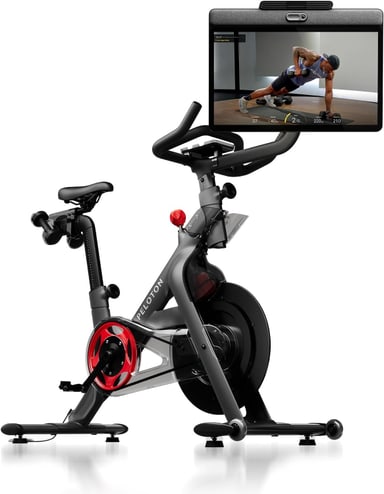
The standard Cross Training Bike gets you the same Peloton classes for a lower price. Garage Gym Reviews names it the best bike for streaming, and BarBend picks Peloton for live classes. You turn a knob to change resistance rather than having it change for you, and the 21.5-inch screen also swivels for off-bike classes. There is no camera.
It has the same 297 lb and 4 ft 11 in to 6 ft 5 in limits as the Bike+, a 54 by 23 inch footprint, and the same Delta-compatible pedals and warranty. The All-Access Membership is still required for Peloton content. If you mostly want to ride along with instructors, this is the one to buy; if you want the bike to adjust itself and plan to use the strength classes, step up to the Bike+.
Resistance: magnetic, manual knob | Max user: 297 lb | Screen: 21.5 in swivel | Footprint: 54 x 23 in
Best recumbent: Horizon Fitness 5.0R
BEST RECUMBENT
Horizon Fitness 5.0R Recumbent Bike
Best for: Riders who want back support and an easy step-through, with app support and a long frame warranty.
- Step-through frame makes getting on and off easy for stiff hips and knees
- At 66 inches long it is the largest bike here
Kit Score 8.3/10 · Check current price · how we score gear
Buy on AmazonProduct details
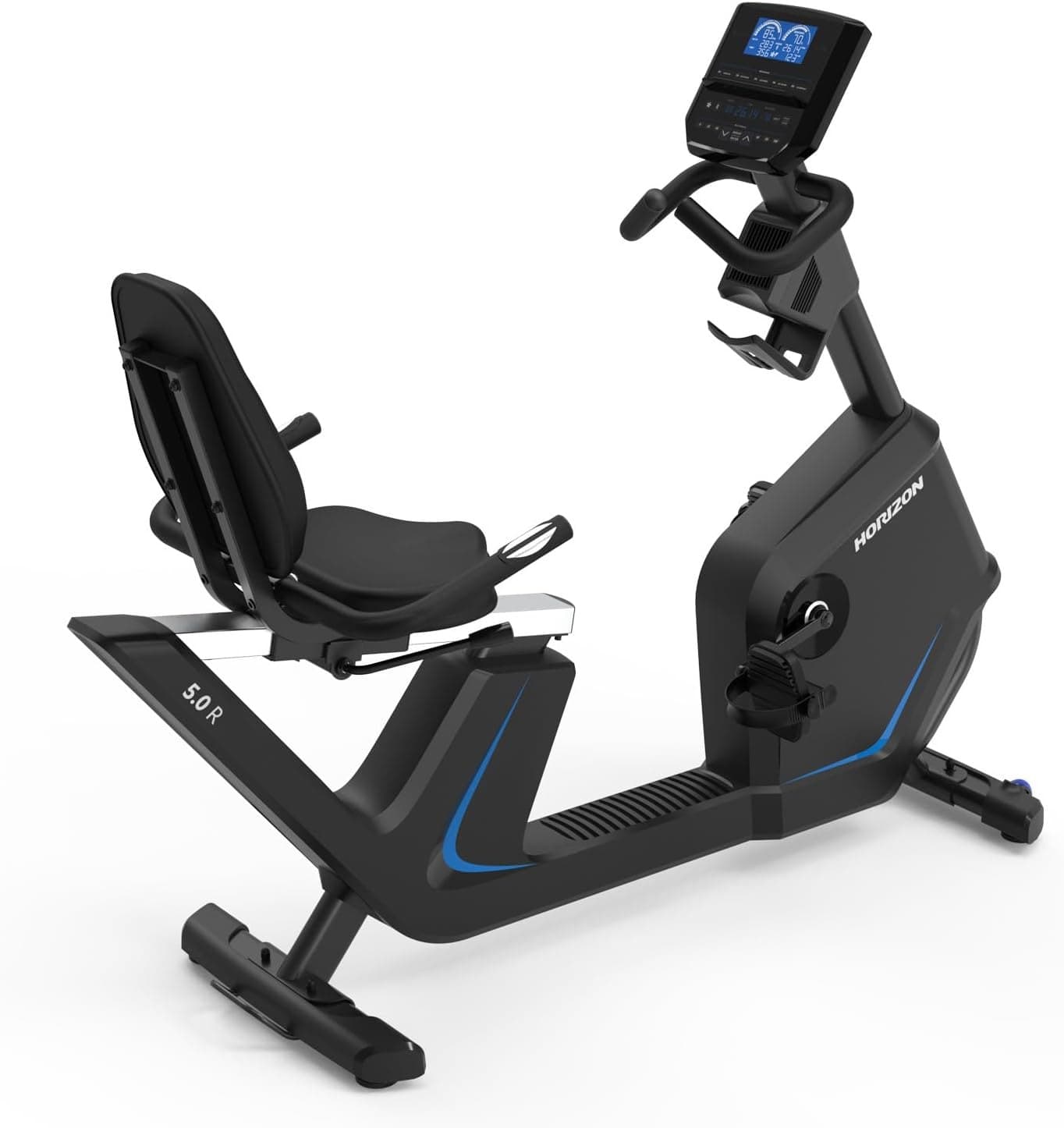
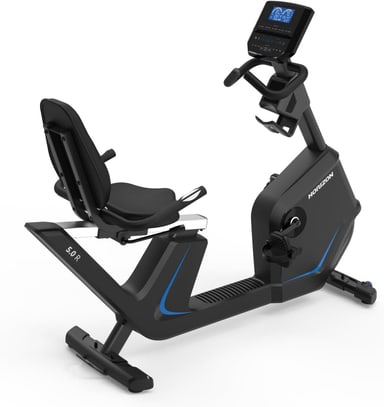
The Horizon 5.0R is a recumbent with a low step-through frame, an extra-large seat with lumbar support on an aluminum rail, and electronic magnetic resistance from 0 to 100. The console runs five programs and a 3-speed fan, and Bluetooth FTMS lets it work with apps such as Peloton, Zwift, and Kinomap. Horizon covers the frame for life.
- Resistance
- Electronic magnetic brake, levels 0 to 100
- Flywheel
- 15.4 lb
- Max user weight
- 300 lb per Horizon (the Amazon listing says 350 lb)
- Dimensions
- 66" L x 25.2" W x 52.2" H; 123 lb
- Console
- LCD with 5 programs, 3-speed fan, Bluetooth FTMS (Peloton, Zwift, Kinomap)
- Warranty
- Lifetime frame, 1-year parts and labor
More strengths
- 100 resistance levels and open Bluetooth FTMS for apps
- Lifetime frame warranty and a built-in fan
Other tradeoffs
- Horizon's 300 lb limit is lower than the 350 lb in the Amazon listing; plan on 300 lb
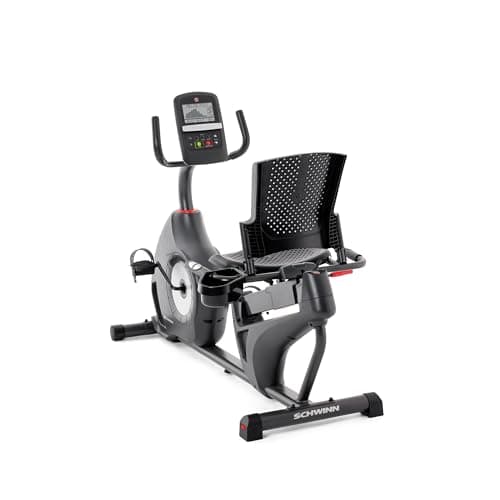
Recumbent bikes put the seat behind the pedals with a backrest, which takes load off the lower back and is easier on stiff hips and knees. Wirecutter picks the Horizon 5.0R for reclined riding, and Verywell Fit and BarBend name it for seniors and beginners. Its low step-through frame means you do not have to swing a leg over a bar to get on.
Horizon lists 0 to 100 levels of electronic magnetic resistance, a 15.4 lb flywheel, an extra-large seat with lumbar support on an aluminum rail, five programs, and a 3-speed fan. Bluetooth FTMS lets it work with apps such as Peloton, Zwift, and Kinomap. Horizon rates it for 300 lb (the Amazon listing says 350 lb, so plan on 300) and covers the frame for life, with 1 year on parts and labor. At 66 by 25.2 inches it is the largest bike here.
Resistance: magnetic, 0 to 100 | Max user: 300 lb | Footprint: 66 x 25.2 in | Warranty: lifetime frame
Best for seniors: Schwinn 230 Recumbent Bike
BEST FOR SENIORS
Schwinn 230 Recumbent Bike
Best for: Home cardio users who prioritize back support, joint comfort, or are returning from injury, and want a capable console without a subscription.
- Reclined, back-supported seating position reduces lumbar stress, making it well suited to rehabilitation and low-impact daily cardio
- Footprint is large (over 5 ft long) and the bike does not fold, so dedicated floor space is required
Kit Score 8.0/10 · Check current price · how we score gear
Buy on AmazonProduct details
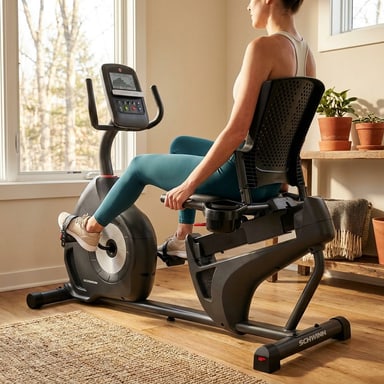
The Schwinn 230 is the entry recumbent in Schwinn's current lineup. It has a contoured seat with a large vented back and lumbar support, 16 levels of magnetic resistance, 13 preset programs, contact-grip heart rate, and Bluetooth (partial FTMS) for apps such as Zwift and Explore the World. Schwinn lists no USB charging port.
- Resistance
- 16 levels magnetic
- Flywheel
- High-speed, high-inertia perimeter-weighted
- Max user weight
- 300 lb
- Workout programs
- 13 preset programs
- Console
- LCD console, Bluetooth (partial FTMS), contact-grip plus Bluetooth heart rate (strap not included). Schwinn lists USB charging port: No; fan and speakers not listed
- Dimensions
- 64" L x 27.7" W x 44" H; 81.6 lb assembled
More strengths
- Capable console at this price: 13 programs, contact-grip heart rate, and Bluetooth for app tracking
- Quiet magnetic resistance and smooth pedal stroke praised consistently by long-term owners
Other tradeoffs
- 16 resistance levels and no USB port, fan, or speakers; riders who want more should look up the range
BarBend names the Schwinn 230 its best exercise bike for seniors. It has 16 levels of magnetic resistance, 13 workout programs, and a contoured seat with a large vented back and lumbar support. Heart rate comes from contact grips or a Bluetooth chest strap (not included), and its Bluetooth exports rides to apps such as Zwift and Explore the World.
Schwinn rates it for 300 lb, on a 64 by 27.7 inch footprint at 81.6 lb. It is simpler than the Horizon: Schwinn lists no USB charging port, fan, or speakers. The frame is covered for 10 years, mechanical parts for 2, and electronics for 1. When we checked, Amazon was taking orders with a future ship date while Schwinn's own site showed it shipping within days.
Resistance: magnetic, 16 levels | Max user: 300 lb | Footprint: 64 x 27.7 in | Programs: 13
Best upright: Schwinn 130 Upright Bike
BEST UPRIGHT
Schwinn 130 Upright Bike
Best for: Riders who want a simple, quiet upright bike with programs in a small corner.
- Small upright footprint, about 41 by 21 inches
- Short 90-day labor warranty
Kit Score 7.3/10 · $412.12 Price checked Oct 23, 4:16 PM CDT · how we score gear
Buy on AmazonProduct details
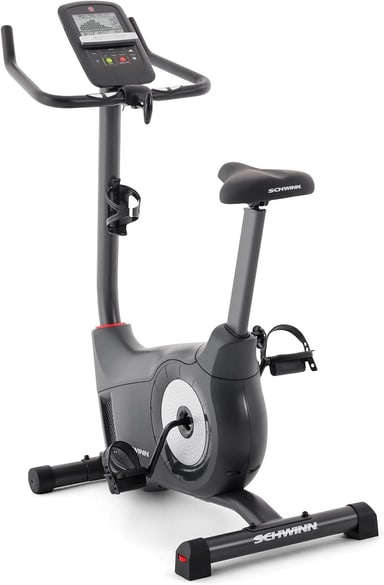
The Schwinn 130 is a compact upright bike with 16 levels of magnetic resistance, 13 programs on a 5.5-inch LCD, grip heart rate, and Bluetooth for apps such as Zwift and Explore the World. Schwinn lists it at 41.3 by 21.4 inches and 300 lb, with a 10-year frame warranty.
- Resistance
- Magnetic, 16 levels
- Max user weight
- 300 lb
- Dimensions
- 41.3" L x 21.4" W x 54.5" H; 58.4 lb
- Console
- 5.5" LCD, 13 programs, grip and telemetry heart rate
- Apps
- Bluetooth to Explore the World and Zwift (separate subscriptions)
- Warranty
- 10-year frame, 2-year mechanical, 1-year electronics, 90-day labor
More strengths
- 13 programs and grip heart rate without any subscription
- Bluetooth for Zwift and Explore the World if you want them
Other tradeoffs
- Upright seat is less supportive than a recumbent for long rides
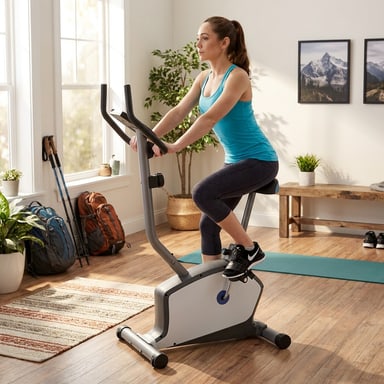
Upright bikes keep a sit-up-straight position with the pedals under you, which suits steady cardio and takes less floor than a recumbent. The Schwinn 130 has 16 levels of magnetic resistance, 13 programs on a 5.5-inch LCD, grip heart rate, and Bluetooth for Zwift and Explore the World. Schwinn lists it at 41.3 by 21.4 inches, 58.4 lb, and 300 lb.
Verywell Fit's upright pick is its bigger sibling, the Schwinn 190, which adds more resistance levels and a higher weight limit for more money. The 130 is the value version, with a 10-year frame warranty but only 90 days on labor.
Resistance: magnetic, 16 levels | Max user: 300 lb | Footprint: 41.3 x 21.4 in | Programs: 13
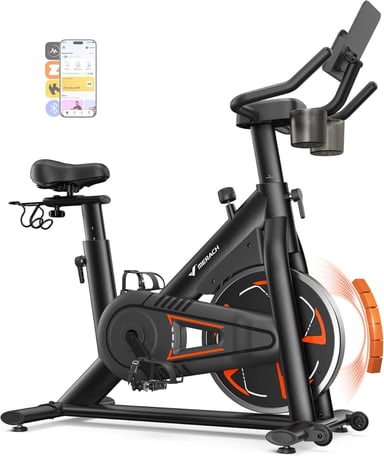
Best budget spin bike: MERACH S36
BEST BUDGET SPIN BIKE
MERACH S36 Magnetic Exercise Bike
Best for: First-time spin riders in apartments who want quiet magnetic resistance for the least money.
- 330 lb rating and a quiet magnetic brake at a budget price
- No built-in readout of resistance level; you need the app to see it
Kit Score 7.4/10 · $259.99 Price checked Oct 23, 4:16 PM CDT · how we score gear
Buy on AmazonProduct details
The MERACH S36 is a budget spin-style bike with a quiet magnetic brake, a 330 lb rating, and a 4-way adjustable seat that MERACH says fits riders from 4 ft 8 in to 6 ft 4 in. Resistance runs on a knob from 0 to 100%, and the MERACH app shows it as 8 levels and logs rides to Apple Health or Google Fit. Garage Gym Reviews names it the best budget exercise bike.
- Resistance
- Magnetic, 0 to 100% knob (8 levels shown in the MERACH app)
- Max user weight
- 330 lb
- Rider height
- 4 ft 8 in to 6 ft 4 in
- Dimensions
- About 43" L x 19" W x 51" H; 66 lb
- Noise
- Under 25 dB (MERACH)
- Apps
- MERACH app, syncs to Apple Health and Google Fit
More strengths
- Small footprint for a spin-style bike, about 43 by 19 inches
- Free MERACH app with no required subscription
Other tradeoffs
- Toe-cage pedals only, and a far shorter track record than the Schwinn IC4
Garage Gym Reviews names the S36 its best budget exercise bike. It is a spin-style bike with a quiet magnetic brake (MERACH says under 25 dB), a 330 lb rating that matches the IC4, and a 4-way adjustable seat that MERACH says fits riders from 4 ft 8 in to 6 ft 4 in. Resistance runs on a knob from 0 to 100%; the MERACH app shows it as 8 levels and syncs rides to Apple Health or Google Fit.
It is small for a spin bike, about 43 by 19 inches. The trade-offs are the ones you would expect at this price: toe-cage pedals only, no built-in resistance readout, and a much shorter track record than Schwinn.
Resistance: magnetic, 0 to 100% | Max user: 330 lb | Rider: 4 ft 8 in to 6 ft 4 in | Footprint: about 43 x 19 in
Best budget upright: Marcy NS-1201U
BEST BUDGET
Marcy NS-1201U Magnetic Upright Exercise Bike
Best for: First-time home gym buyers or casual cardio users who want a quiet, dependable upright bike without spending more than $200.
- Under $200 with a 300 lb weight capacity and a steel frame that owners consistently describe as sturdy and stable
- Only 8 resistance levels with a lighter flywheel; advanced fitness users will find progression limited compared to mid-range bikes
Kit Score 7.1/10 · $196.87 Price checked Oct 23, 4:16 PM CDT · how we score gear
Buy on AmazonProduct details
The Marcy NS-1201U is a stripped-back magnetic upright bike that does one thing well: quiet, reliable daily cardio at a price point under $200. Eight resistance levels, a basic LCD console, foam-padded handlebars, and a 300 lb weight capacity cover the basics with nothing to subscribe to.
- Resistance
- 8 magnetic levels (manual)
- Max user weight
- 300 lb
- Console
- LCD: time, speed, distance, calories, odometer, scan
- Frame
- 2" 14-gauge steel, 45 lb assembled weight
- Seat adjust
- Vertical only (Marcy does not publish a rider height range)
- Dimensions
- 33" L x 20" W x 52" H
More strengths
- Belt-driven magnetic resistance is nearly silent, a notable plus for apartment use or shared living spaces
- Compact footprint (33" long) and lightweight (45 lb) with built-in transport wheels
Other tradeoffs
- No pulse monitoring, no tablet holder, and vertical-only seat adjustment; this is a basics-only build
The Marcy NS-1201U is not trying to be a cycling trainer. It is a compact, quiet, magnetic upright bike for steady daily cardio without setup or ongoing costs. Eight resistance levels, an LCD for time, speed, distance, odometer, and calories, a foam seat, and weighted pedals with straps cover the basics.
Marcy rates it for 300 lb on a 2 inch, 14-gauge steel frame that measures 33 by 20 by 52 inches, the smallest bike here. It has no Bluetooth, the seat adjusts only up and down, and the flywheel feel is lighter than a spin bike. Stock on Amazon was low when we checked.
Resistance: magnetic, 8 levels | Max user: 300 lb | Footprint: 33 x 20 in
The bike that gets used is always better than the bike with the longest spec sheet sitting unused in a corner.
Compare the picks
| Spec | Schwinn IC4 | Peloton Bike+ | Peloton Bike | Horizon 5.0R | Schwinn 230 | Schwinn 130 | MERACH S36 | Marcy NS-1201U |
|---|---|---|---|---|---|---|---|---|
| Kit Score | 8.5/10 | 7.7/10 | 7.9/10 | 8.3/10 | 8.0/10 | 7.3/10 | 7.4/10 | 7.1/10 |
| Price | $899.00 Price checked Oct 23, 4:16 PM CDT | $2,695.00 Price checked Oct 23, 4:16 PM CDT | $1,695.00 Price checked Oct 23, 4:16 PM CDT | Check current price | Check current price | $412.12 Price checked Oct 23, 4:16 PM CDT | $259.99 Price checked Oct 23, 4:16 PM CDT | $196.87 Price checked Oct 23, 4:16 PM CDT |
| Best for | Riders who want a serious cardio and cycling training tool that connects to their preferred app without paying for a proprietary screen. | Peloton households that ride most days and will use the off-bike strength classes the camera supports. | Riders who will actually take classes and want Peloton's instructors, without paying for auto-resistance. | Riders who want back support and an easy step-through, with app support and a long frame warranty. | Home cardio users who prioritize back support, joint comfort, or are returning from injury, and want a capable console without a subscription. | Riders who want a simple, quiet upright bike with programs in a small corner. | First-time spin riders in apartments who want quiet magnetic resistance for the least money. | First-time home gym buyers or casual cardio users who want a quiet, dependable upright bike without spending more than $200. |
| Why it stands out | Belt drive with magnetic resistance runs quietly; BowFlex lists a 40 lb flywheel for the identical C6 (Schwinn does not publish one) | Auto-resistance follows the class, so you never reach for the knob | Peloton's class library, with a swivel screen for off-bike workouts | Step-through frame makes getting on and off easy for stiff hips and knees | Reclined, back-supported seating position reduces lumbar stress, making it well suited to rehabilitation and low-impact daily cardio | Small upright footprint, about 41 by 21 inches | 330 lb rating and a quiet magnetic brake at a budget price | Under $200 with a 300 lb weight capacity and a steel frame that owners consistently describe as sturdy and stable |
| Tradeoff | Stock saddle is narrow and firm; most serious riders swap it out or add a cover | The most expensive bike in this guide, before the membership | The membership is required for Peloton content and costs as much per year as a budget bike | At 66 inches long it is the largest bike here | Footprint is large (over 5 ft long) and the bike does not fold, so dedicated floor space is required | Short 90-day labor warranty | No built-in readout of resistance level; you need the app to see it | Only 8 resistance levels with a lighter flywheel; advanced fitness users will find progression limited compared to mid-range bikes |
| Type | Spin | Spin, connected | Spin, connected | Recumbent | Recumbent | Upright | Spin | Upright |
| Resistance | Magnetic, 100 levels | Magnetic, auto | Magnetic, knob | Magnetic, 0 to 100 | Magnetic, 16 levels | Magnetic, 16 levels | Magnetic, 0 to 100% | Magnetic, 8 levels |
| Max user weight | 330 lb | 297 lb | 297 lb | 300 lb | 300 lb | 300 lb | 330 lb | 300 lb |
| Rider height | 5 ft 1 in to 6 ft 4 in | 4 ft 11 in to 6 ft 5 in | 4 ft 11 in to 6 ft 5 in | Not published | Not published | Not published | 4 ft 8 in to 6 ft 4 in | Not published |
| Footprint (L x W) | 54.6 x 30.7 in | 54 x 22 in | 54 x 23 in | 66 x 25.2 in | 64 x 27.7 in | 41.3 x 21.4 in | About 43 x 19 in | 33 x 20 in |
| Membership needed | No | Yes | Yes | No | No | No | No | No |
| Frame warranty | 10 years | 5 years | 5 years | Lifetime | 10 years | 10 years | Not published | Not published |
How to choose an exercise bike
The numbers that matter
Ride position
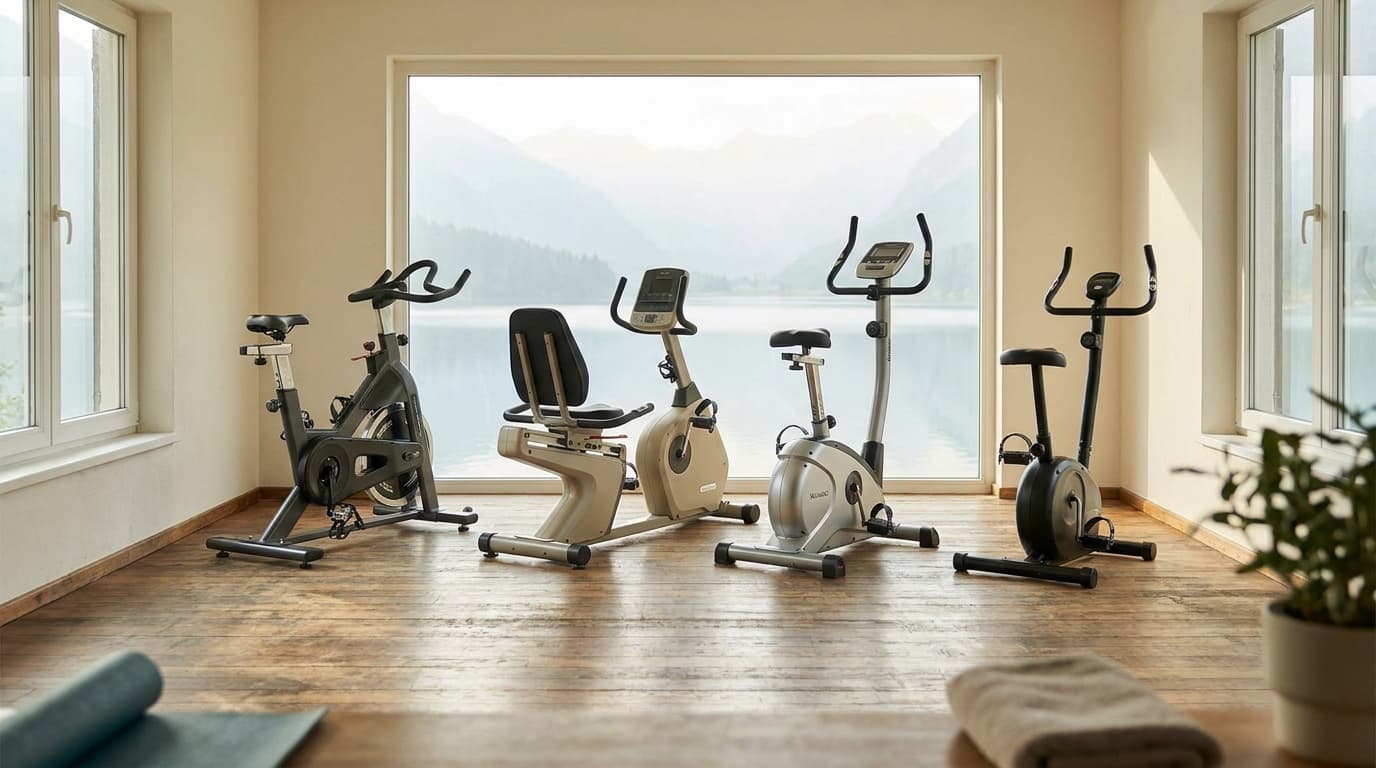
Spin bikes (IC4, Peloton, MERACH S36) mimic a road bike and let you stand to sprint. Upright bikes (Schwinn 130, Marcy) keep you sitting up for steady cardio. Recumbents (Horizon, Schwinn 230) add a backrest and are the easiest on the lower back and joints. Our [upright vs recumbent guide](/fitness/upright-vs-recumbent-exercise-bike) covers the trade-offs.
Resistance and noise
Every pick here uses magnetic resistance, which is quiet and has no pads to wear out, so all of them suit apartments. For shared floors, a belt drive and a mat under the bike matter more than the brand.
Rider weight and height
Leave a margin under the rated limit. The IC4 and MERACH S36 are rated for 330 lb, the Pelotons for 297 lb. If you are under 5 ft 1 in or over 6 ft 4 in, check the maker's rider range before you buy.
Footprint
Spin and upright bikes take about 3.5 to 4.5 feet of length; recumbents take more than 5 feet. Peloton also asks for 24 inches of clearance around the bike and an 8 foot ceiling. Our [home cardio space checker](/tools/home-gym-space) tests every bike here against your room.
Apps and membership
The IC4, Horizon, and Schwinn 130 and 230 work with third-party apps and need no subscription. The Pelotons need Peloton's All-Access Membership for classes, a yearly cost that can exceed the price of a budget bike. See [how to choose a spin bike](/fitness/how-to-choose-a-spin-bike) for flywheel, pedals, and fit.
For a deeper walkthrough of bike types, budgets, and console features, read how to choose an exercise bike.
Frequently asked questions
What is the best exercise bike for home use in 2026?
The Schwinn IC4 is the best for most people. Wirecutter names it its top pick, Schwinn rates it for 330 lb with 100 magnetic resistance levels, and it works with Peloton, Zwift, and other apps without a required subscription. If you want a built-in screen and classes, choose a Peloton Cross Training Bike; if you want back support, choose the Horizon 5.0R recumbent.
Do I need a Peloton subscription to use the Schwinn IC4?
No. The IC4 connects over Bluetooth, which Schwinn lists as compatible with JRNY, Peloton, Zwift, Kinomap, and Explore the World. Resistance, cadence, and heart rate all work without any app, so a subscription is optional and your choice of platform.
What happened to the original Peloton Bike and Bike+?
Peloton replaced them in October 2025 with the Cross Training Bike and Cross Training Bike+, which add swivel screens for off-bike workouts. Peloton now sells the originals only refurbished. Both new bikes are sold by Amazon as well as by Peloton.
What is the difference between a spin bike and an upright exercise bike?
A spin bike (like the IC4, the Pelotons, and the MERACH S36) uses a heavy flywheel and a forward-leaning position like a road bike, so you can stand to sprint. An upright bike (like the Schwinn 130 or Marcy NS-1201U) has a more relaxed seated posture and is designed for steady cardio rather than cycling-specific training.
Is a recumbent bike as good a workout as an upright or spin bike?
Yes, with context. At a matched effort, the cardio work is comparable. Recumbent bikes lean more on the glutes and hamstrings, while upright and spin bikes engage the core and hip flexors more. For heart health, calorie burn, and general fitness, either position works; for cycling-specific training, the spin position transfers better to riding outdoors.
Where these numbers come from
| Claim | Source | Checked |
|---|---|---|
| Schwinn IC4: 100 magnetic levels, 330 lb, 54.6 x 30.7 x 51.8 in, 113.6 lb, 5 ft 1 in to 6 ft 4 in (29 to 39 in inseam), SPD and toe-cage pedals, USB charging, partial FTMS Bluetooth for JRNY, Peloton, Zwift, Kinomap, Explore the World; 10-year frame, 3-year parts and electronics warranty; no published flywheel weight | Schwinn IC4 | 2026-10-03 |
| BowFlex C6 (same bike as the IC4): 40 lb flywheel | BowFlex C6 | 2026-10-03 |
| Peloton Cross Training Bike and Bike+: 54 x 23 x 61 in / 54 x 22 x 60 in, 129 lb / 144 lb, 4 ft 11 in to 6 ft 5 in, 297 lb, 21.5 in / 23.8 in swivel screens, Bike+ auto-resistance; originals sold refurbished only | Peloton exercise bikes | 2026-10-03 |
| Peloton warranty: 5-year frame, 12 months touchscreen and components; All-Access Membership required for content | Peloton Bike and Peloton shop | 2026-10-03 |
| Peloton Bike+ movement-tracking camera and fan; Delta-compatible pedals; 24 in clearance and 8 ft ceiling; sold and shipped by Amazon | Peloton's Amazon listings B0FLQNCDJK and B0FLQNKJMN | 2026-10-03 |
| Horizon 5.0R: 0 to 100 levels electronic magnetic resistance, 15.4 lb flywheel, 300 lb, 66 x 25.2 x 52.2 in, 123 lb, lumbar-support seat on an aluminum rail, 5 programs, 3-speed fan, Bluetooth FTMS for Peloton, Zwift, Kinomap; lifetime frame, 1-year parts and labor | Horizon 5.0 R | 2026-10-03 |
| Horizon 5.0R listed at 350 lb max user | Amazon listing B0C6NF4CJD | 2026-10-03 |
| Schwinn 230: 16 magnetic levels, 13 programs, 300 lb, 64 x 27.7 x 44 in, 81.6 lb, contact-grip and Bluetooth heart rate (strap not included), partial FTMS Bluetooth, no USB charging port; 10-year frame, 2-year mechanical, 1-year electronics, 90-day labor | Schwinn 230 | 2026-10-03 |
| Schwinn 130: 16 magnetic levels, 300 lb, 41.3 x 21.4 x 54.5 in, 58.4 lb, 5.5 in LCD, 13 programs, Explore the World and Zwift; 10-year frame, 2-year mechanical, 1-year electronics, 90-day labor | Schwinn 130 | 2026-10-03 |
| MERACH S36: 330 lb, 4 ft 8 in to 6 ft 4 in, 0 to 100% magnetic resistance shown as 8 levels in the app, under 25 dB, about 43 x 19 x 51 in, 66 lb, Apple Health and Google Fit sync | Amazon listing B0DXK9KQJ2 | 2026-10-03 |
| Marcy NS-1201U: 8 levels, 300 lb, 33 x 20 x 52 in, 2 in 14-gauge steel tubing, LCD with scan, speed, distance, time, odometer, calories, weighted pedals with straps | Marcy NS-1201U | 2026-10-03 |
| Awards: Wirecutter (IC4 and C6 top pick, Horizon 5.0R for reclined riding, Peloton Cross Training Bike+ upgrade pick); Garage Gym Reviews (Peloton Cross Training Bike best for streaming, MERACH S36 best budget); BarBend (IC4 best for beginners, Schwinn 230 best for seniors, Peloton for live classes); Verywell Fit (Schwinn 190 best upright; Horizon 5.0R best recumbent for seniors); BarBend recumbent roundup (Horizon 5.0R best for beginners) | Wirecutter, Garage Gym Reviews, BarBend, Verywell Fit, Verywell Fit recumbents, BarBend recumbents | 2026-10-03 |
We did not ride these bikes ourselves. Capacity, footprint, and resistance figures are the makers' published specs; where a maker does not publish a number, we say so rather than fill it in.
The right indoor bike makes your cardio training weatherproof and schedule-proof. Browse more gear in the fitness hub, or learn more about how we research and rate every pick on this site.
Keep going
Free toolHome Cardio Space CheckerWill a rowing machine, exercise bike, or walking pad fit your room?
Our recommendations draw on manufacturer documentation, retailer listings, owner feedback, and comparisons with alternatives.
As an Amazon Associate I earn from qualifying purchases. We may earn a commission from links here, at no extra cost to you. How we research →