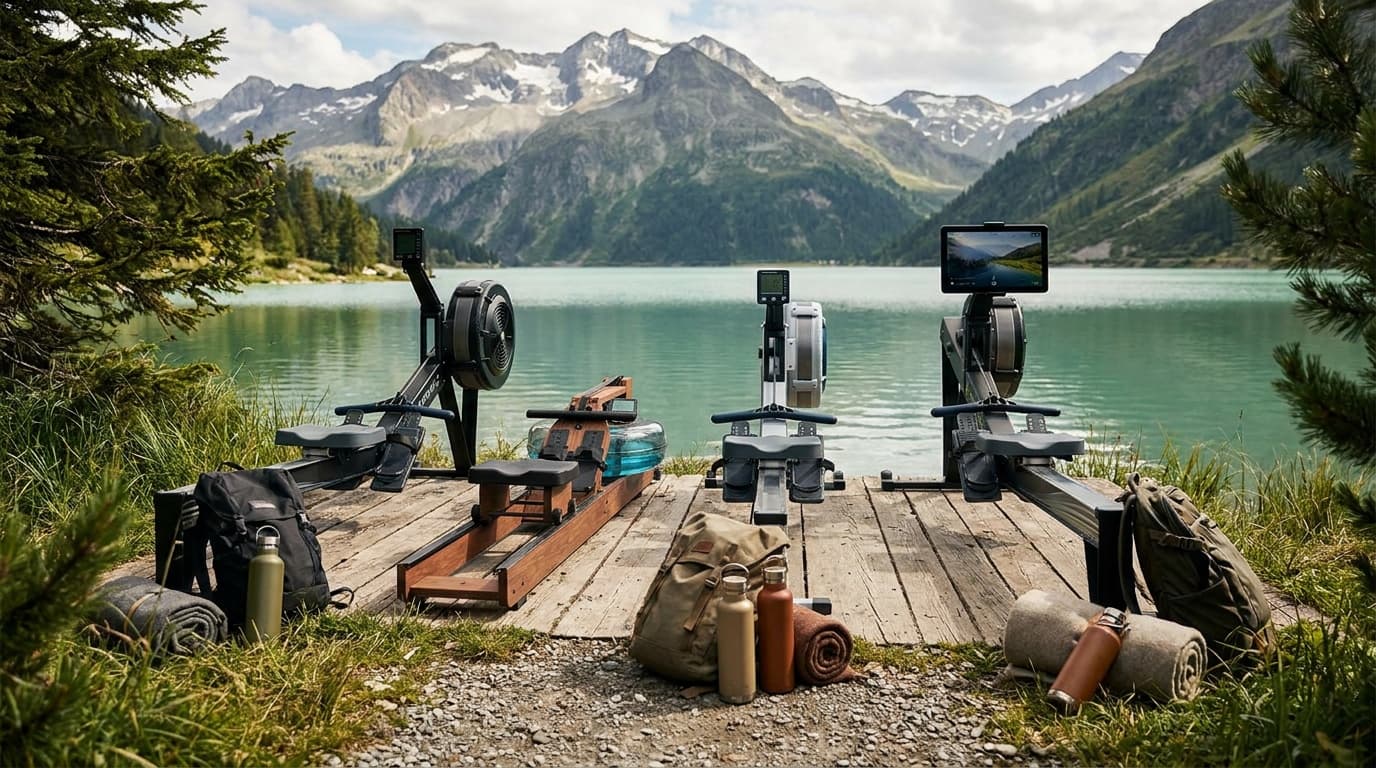
The Concept2 RowErg is the best rowing machine for most homes: Wirecutter and Men's Health both name it their top pick, Concept2 rates it for 500 lb, and its PM5 monitor shows the same numbers as the machines in gyms and clubs. Pick the MERACH Q1S if you need quiet and cheap, the WaterRower if you want a water stroke and a machine that looks like furniture, the Hydrow Wave or Aviron Strong Series for coached or game-style workouts, or the MERACH 950 or Echelon Row-s if it has to fold. Rowing works your legs, core, back, and arms in every stroke, at low impact.
Our quick picks
How we picked
Every pick is scored with the Kit Score: resistance feel and range, monitor and app support, noise, user weight and height limits, footprint and storage, build and warranty, and price against rowers of the same type. We started from the 2026 picks of Wirecutter, Garage Gym Reviews, BarBend, Men's Health, and CNN Underscored, checked every spec on the maker's own page, and confirmed each machine is in stock on Amazon from Amazon or the maker's store. Kit Authority has not rowed these machines; the sources table at the end lists where each number comes from.
The picks
Best overall: Concept2 RowErg
BEST OVERALL
Concept2 RowErg Indoor Rowing Machine
Best for: Anyone who wants a proven, maintenance-tolerant machine that performs at every fitness level and holds resale value for years.
- Exceptional 500 lb weight capacity and commercial-grade durability for well under the price of connected rowers
- Hard plastic seat becomes uncomfortable for sessions over 30 minutes without a seat pad
Kit Score 9.4/10 · $990.00 Price checked Oct 23, 4:16 PM CDT · how we score gear
Buy on AmazonProduct details
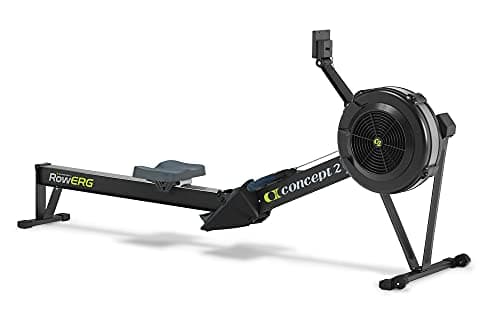
The Concept2 RowErg is the benchmark for indoor rowing, used by Olympic teams and CrossFit facilities worldwide. Air resistance self-adjusts to effort level, so the harder you pull, the more resistance you feel, with no resistance cap for elite athletes.
- Resistance type
- Air (adjustable damper, settings 1–10)
- Max user weight
- 500 lb (227 kg)
- Dimensions (in use)
- 96" L x 24" W (8 x 2 ft); 9 x 4 ft recommended for use
- Monitor
- PM5 LCD with Bluetooth and ANT+
- Foldable
- Separates into two pieces for storage
- Frame warranty
- 5 years (2 years on moving parts and monitor)
More strengths
- PM5 monitor tracks pace, watts, calories, and heart rate; connects via Bluetooth to apps like ErgData and the Concept2 Logbook
- Outstanding owner approval: 4.9/5 stars across 13,000+ Amazon ratings, with negative reviews almost entirely about shipping rather than the machine
Other tradeoffs
- Chain drive requires light oiling roughly every 50 hours and produces moderate mechanical noise
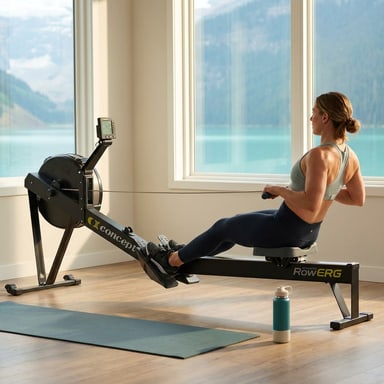
The RowErg is the reference machine for indoor rowing, and it tops the lists at Wirecutter and Men's Health while Garage Gym Reviews calls it the best budget rower. The air flywheel gets harder the harder you pull, so it suits a casual 20-minute row and a race-pace interval session equally. The damper lever changes how much air reaches the flywheel, which changes the feel from a light boat to a heavy one.
The PM5 monitor is the reason serious rowers buy it. It shows split time, stroke rate, watts, and calories, connects to heart rate straps over Bluetooth and ANT+, and works with Concept2's free ErgData app with no subscription. Concept2 rates the RowErg for 500 lb in its own testing, fits inseams up to 38 inches, and sells an extra-long monorail for longer legs. The standard seat sits 14 inches off the floor; the tall-leg version raises it to 20 inches for anyone with stiff knees or hips.
It is 8 by 2 feet assembled, and Concept2 recommends a 9 by 4 foot area to row. It separates into two pieces and rolls on caster wheels for storage. The frame carries a 5-year warranty. The trade-off is noise: the fan makes a steady rushing sound at hard efforts.
Resistance: air | Max user: 500 lb | Fit: 38 in inseam | In use: 96 x 24 in
Best budget: MERACH Q1S Magnetic Rowing Machine
BEST BUDGET
MERACH Q1S Magnetic Rowing Machine
Best for: Home rowers who want a stable, quiet magnetic machine under $200 with room to grow from beginner to moderate intensity workouts.
- In stock with a 4.4-star average across 2,355 Amazon ratings (September 2026)
- At 42 lb it is heavier than ultra-compact budget rowers, so the built-in wheels help but stairs are awkward
Kit Score 8.0/10 · $189.99 Price checked Oct 23, 4:16 PM CDT · how we score gear
Buy on AmazonProduct details
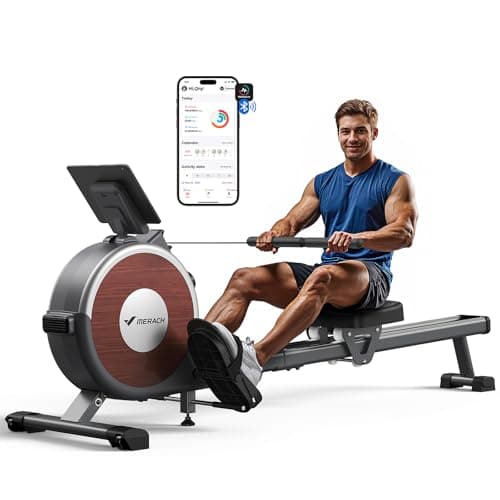
The MERACH Q1S is a best-selling magnetic rower on Amazon. Its dual slide rail, modeled after wood-rower geometry, adds lateral stability that single-rail budget rowers lack, and 16 magnetic resistance levels give beginners to intermediate rowers genuine room to progress. The LCD monitor tracks time, strokes, calories, and distance, while Bluetooth pairing with the MERACH or Kinomap app opens structured workouts without a subscription requirement. Assembly is partial out of the box and takes most users under 30 minutes. At 42 lb and with integrated base wheels, it is manageable to reposition, and the upright fold-and-store profile reclaims most of its floor space between sessions.
- Resistance type
- Magnetic, 16 levels
- Rail system
- Dual slide rail (aluminum alloy)
- Max user weight
- 350 lb
- Machine weight
- 42 lb
- In-use footprint
- 65 x 19.3 x 24.8 in
- Storage footprint
- 19.3 x 24.8 in (folds upright)
- Max user height
- 6 ft 5 in per the Amazon listing (MERACH's own page says 6 ft 7 in)
- App compatibility
- MERACH app + Kinomap
More strengths
- Dual slide rail design reduces seat wobble and lateral tip risk compared to single-rail competitors at the same price
- 16 resistance levels plus free app compatibility (MERACH and Kinomap) give structured workout options without an ongoing subscription
Other tradeoffs
- LCD monitor tracks only basic metrics; users who want split-pace or watt output will need to rely on the paired app rather than the console
The Q1S is the quiet, low-cost pick. Magnetic resistance makes almost no noise and does not change with stroke speed, which suits apartments and early mornings. Sixteen levels run from a light warm-up to a firm pull for beginners and moderate exercisers, and a dual slide rail keeps the seat steadier than single-rail budget rowers. The frame is rated for 350 lb; the Amazon listing fits riders up to 6 ft 5 in, while MERACH's own page says 6 ft 7 in.
Storage is the other reason to buy it. It weighs about 42 lb, rolls on built-in wheels, and stands upright in about 1.6 by 2.1 feet, against roughly 5.4 by 1.6 feet in use. The LCD shows time, strokes, distance, and calories, and it pairs with the free MERACH app or Kinomap. The limit is the ceiling: fit rowers will outgrow the hardest setting, and Wirecutter tested the Q1S Pro without picking it.
Resistance: magnetic, 16 levels | Max user: 350 lb | Stored: stands upright | Apps: MERACH, Kinomap
Best water rower: WaterRower Walnut with S4 Monitor
BEST WATER ROWER
WaterRower Walnut Rowing Machine with S4 BLE Monitor
Best for: Rowers who prioritize a quiet, natural stroke feel and furniture-grade aesthetics, and who do not need a connected screen or class library.
- Water resistance creates a stroke that closely mirrors on-water rowing: smooth, self-regulating, and quiet with a calming water sound rather than mechanical noise
- S4 monitor is functional but basic: Bluetooth pairing, but no touchscreen or guided classes
Kit Score 8.6/10 · $2,049.00 Price checked Oct 23, 4:16 PM CDT · how we score gear
Buy on AmazonProduct details
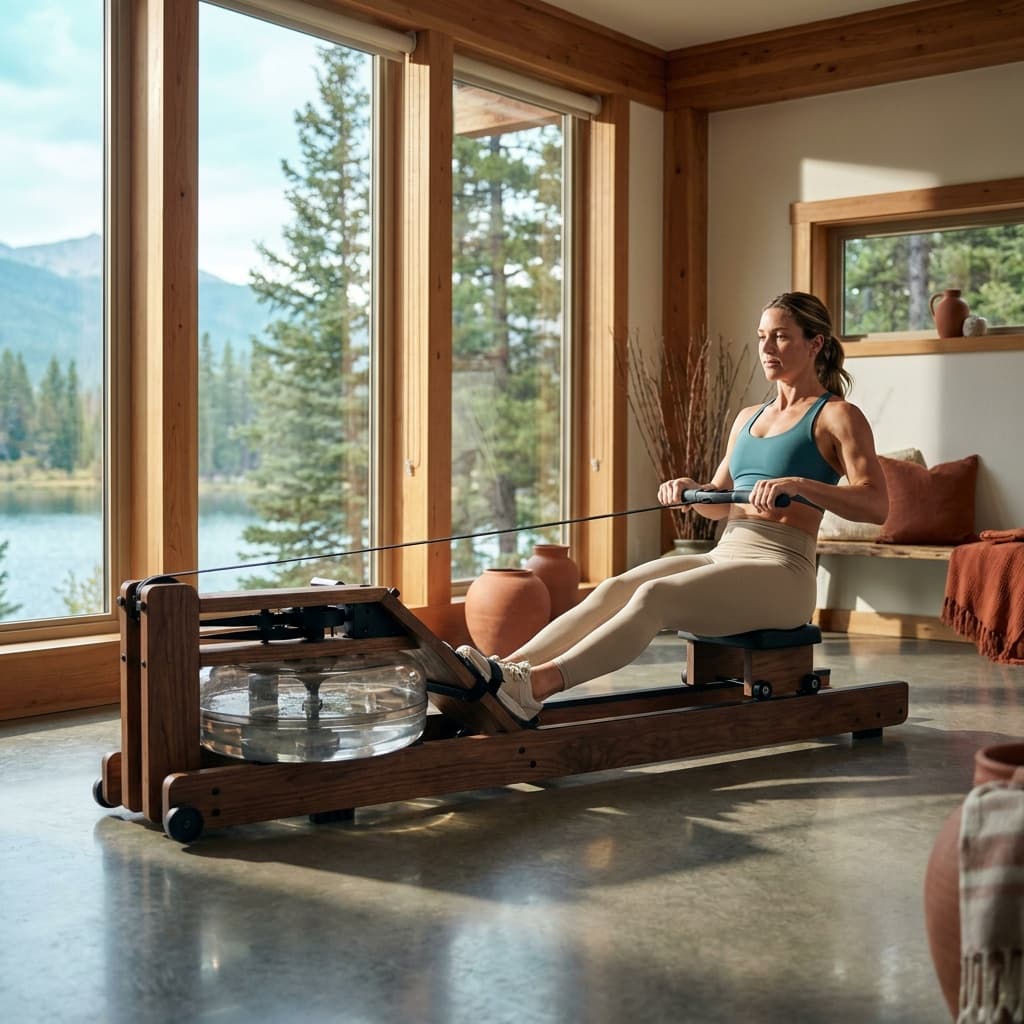
The WaterRower Walnut is a handcrafted solid-wood rower built in Rhode Island, with a water-filled flywheel that produces resistance scaling naturally with your effort. The result is one of the smoothest, quietest strokes available in home rowing, along with a machine that doubles as living-room furniture.
- Resistance type
- Water flywheel (resistance scales with rowing speed)
- Max user weight
- 700 lb per WaterRower's US product details (its technical summary shows 330 lb / 150 kg; Amazon's spec table says 300 lb)
- Dimensions (in use)
- 82" L x 22" W x 20" H
- Monitor
- S4 BLE (Bluetooth; stroke rate, distance, time, intensity)
- Storage
- Stands on end; 103.5 lb with water
- Construction
- Hand-built American Black Walnut, made in Rhode Island
- Warranty
- 5-year frame, 3-year parts (per WaterRower)
More strengths
- Solid walnut frame at 103.5 lb (with water) feels planted, with few owner reports of flex even under hard rowing
- Stands on end for storage, making it viable for apartments and smaller rooms
Other tradeoffs
- Water purification tablet is needed every 3–6 months and the tank requires occasional draining for long-term storage or moving
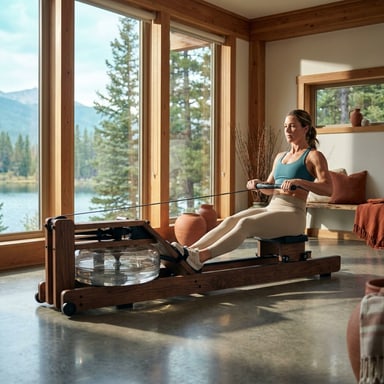
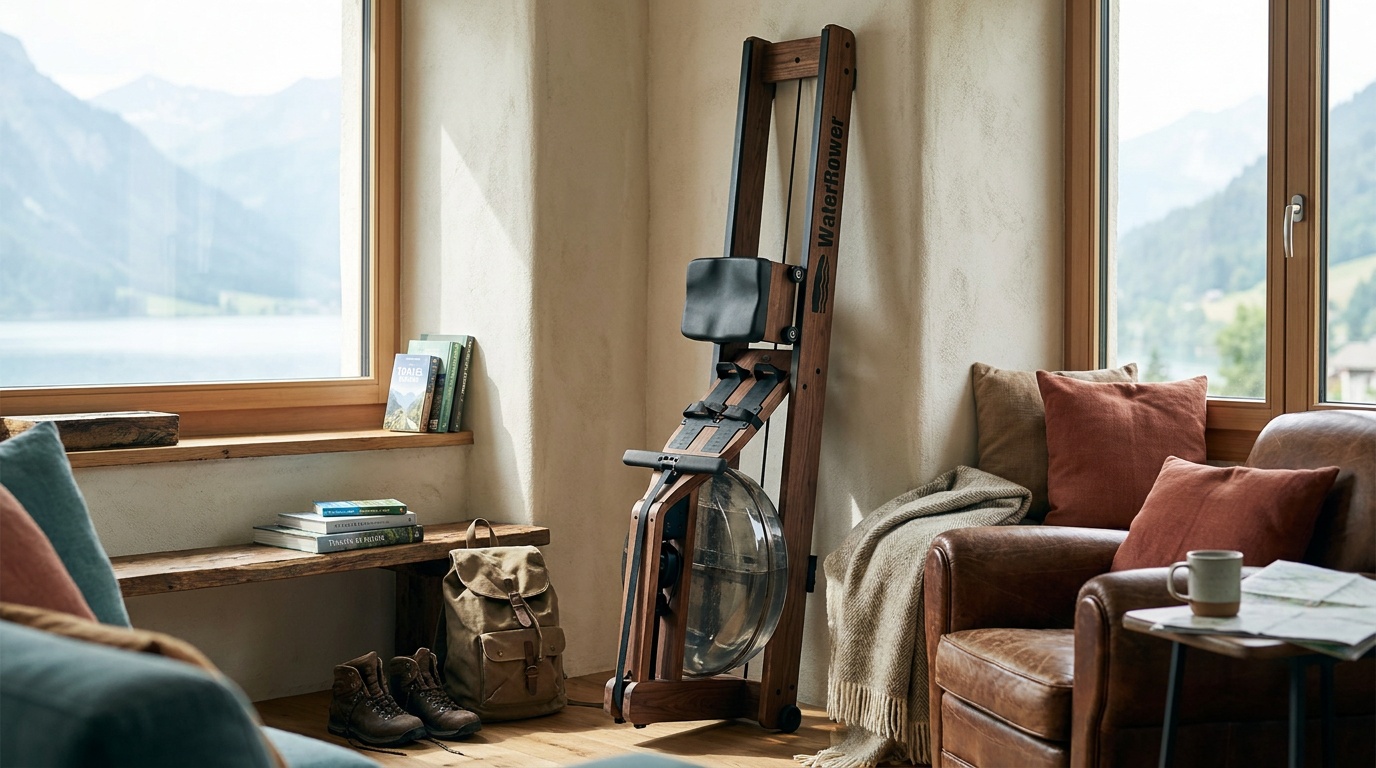
WaterRower is the water rower reviewers keep picking: Wirecutter names the WaterRower Oak its pick for a peaceful row, BarBend names WaterRower its best water rower, and Men's Health picks the Club. This is the walnut version, hand-built in Rhode Island and designed to look like furniture. The paddle in the tank meets more resistance the harder you pull, and the sound is a low swish rather than a fan.
WaterRower's US page lists both a 700 lb and a 330 lb user weight, and the Amazon listing says 300 lb, so if you weigh more than 300 lb, ask WaterRower to confirm. WaterRower backs the frame for 5 years and parts for 3, and recommends its XL rails for users over 2 meters tall. It is 82 by 22 inches in use, weighs 103.5 lb with water, and stands on end for storage. The S4 monitor tracks stroke rate, distance, time, and intensity, and this BLE version pairs over Bluetooth.
One buying note: WaterRower's own US product pages showed the machines as not available for purchase when we checked, and the Amazon listing is from a third-party fitness retailer with limited stock. Check the seller before you order.
Resistance: water | Max user: 300 to 700 lb depending on source | In use: 82 x 22 in | Stored: on end
Best for small spaces: Hydrow Wave
BEST FOR SMALL SPACES
Hydrow Wave Rowing Machine
Best for: Home rowers who want an immersive class-driven workout in a compact footprint and are comfortable with a subscription model.
- Guided rowing classes led by on-water athletes make technique accessible for beginners while keeping advanced rowers engaged
- The touchscreen, stats, and class library all require the paid monthly membership, a real yearly cost on top of the machine
Kit Score 7.9/10 · $2,295.00 Price checked Oct 23, 4:16 PM CDT · how we score gear
Buy on AmazonProduct details
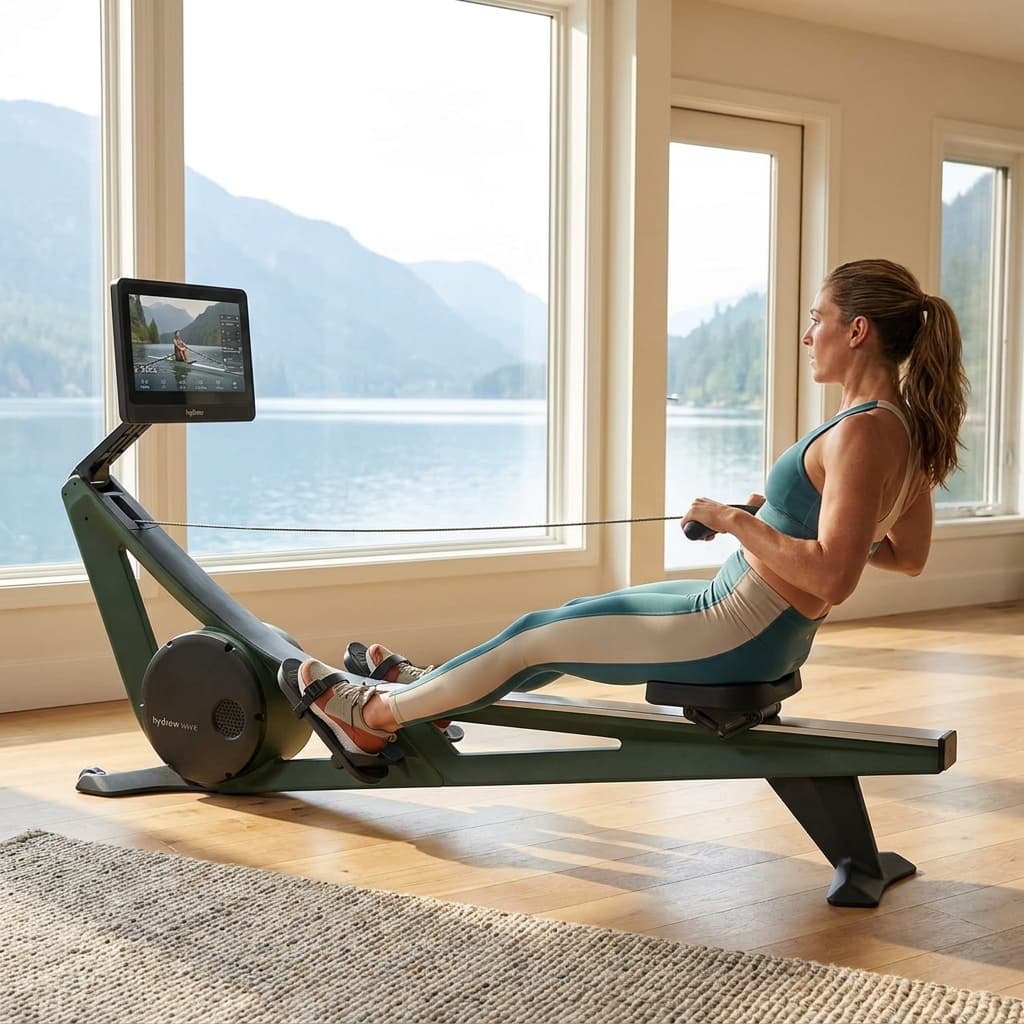
The Hydrow Wave is a compact connected rower with a 16-inch HD touchscreen and software-driven electromagnetic resistance that mimics the feel of rowing on water. It is 30 percent smaller than the original Hydrow and includes a 30-day membership trial.
- Resistance type
- Electromagnetic drag (software-controlled, simulates water pull)
- Max user weight
- 375 lb (170 kg)
- Dimensions (in use)
- 80" L x 19" W x 43" H
- Monitor
- 16" HD touchscreen (1920x1080), built-in speakers
- Content library
- 6,000+ live and on-demand workouts (paid monthly membership after a 30-day trial)
- Weight and fit
- 102 lb; inseam up to 36 in
- Warranty
- 5-year frame, 12 months components, screen, and labor (Hydrow US warranty page; the Amazon listing says 1 year)
More strengths
- Near-silent electromagnetic resistance and a narrow 19-inch width suit apartment use and shared spaces
- Pairs with Apple Watch, heart rate monitors, and wireless headphones over Bluetooth
Other tradeoffs
- Upright storage kit is sold separately; without it the 80-inch footprint stays on the floor
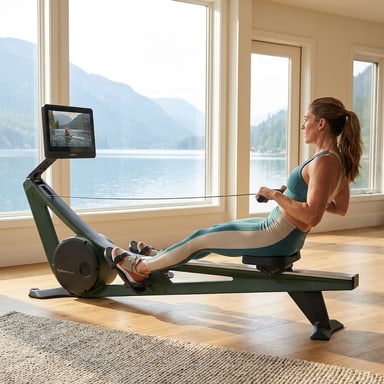
The Wave is the compact connected rower. Hydrow says it is 30% smaller than its original rower: 80 by 19 inches in use, 102 lb, with a 16-inch HD touchscreen that streams thousands of live and on-demand classes, many filmed on open water. Wirecutter calls it another rower worth considering, Garage Gym Reviews names it the best smart rower, and Men's Health picks it for small spaces.
Hydrow's electromagnetic drag is quiet and adjusts to your effort. The Wave is rated for 375 lb and inseams up to 36 inches, so very tall rowers should look at the Concept2 or Aviron. It stands upright only with Hydrow's storage anchor, sold separately. The touchscreen, stats, and class library all need Hydrow's monthly membership; without one you can row, but without the connected features.
Resistance: electromagnetic | Max user: 375 lb | Fit: 36 in inseam | In use: 80 x 19 in
Best for tall rowers: Aviron Strong Series
BEST FOR TALL ROWERS
Aviron Strong Series Rower
Best for: Tall or heavy rowers, and anyone who stays motivated by games and races more than by coached classes.
- 507 lb and about 6 ft 8 in user limits, the highest here
- Most interactive content needs the membership, and the hardware alone is a large outlay
Kit Score 8.4/10 · $1,999.00 Price checked Oct 23, 4:16 PM CDT · how we score gear
Buy on AmazonProduct details
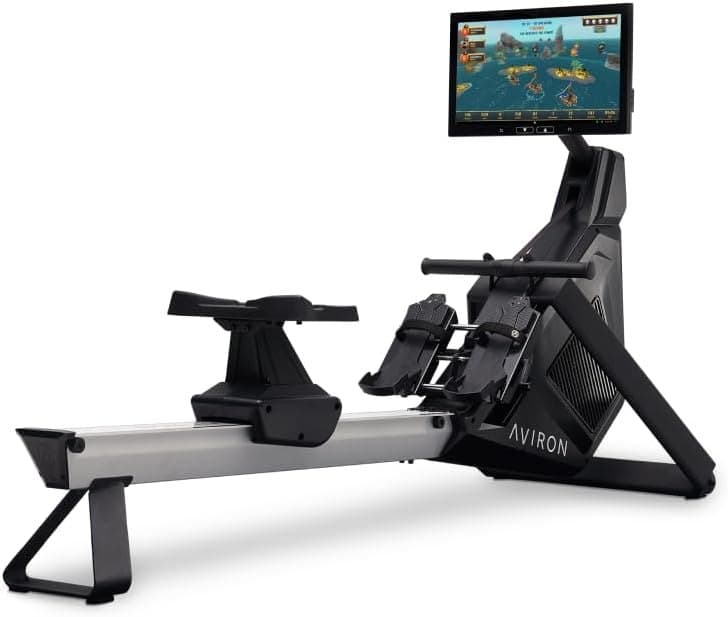
The Aviron Strong Series combines air and magnetic resistance (up to 100 lb of pull), a 22-inch touchscreen, and a library of game-style workouts, races, and streaming apps. Aviron rates it for users up to 507 lb and about 6 ft 8 in, the highest limits in this guide, and it stands upright on its own for storage. The membership is optional.
- Resistance type
- Dual air and magnetic, up to 100 lb; cardio levels 10 to 100, strength levels 110 to 160
- Max user weight
- 507 lb
- Max user height
- About 6 ft 8 in
- Dimensions (in use)
- 84" L x 27" W x 48" H; 114 lb
- Storage
- Stands upright without a wall mount: 35" L x 27" W x 83" H
- Screen and membership
- 22" HD touchscreen that pivots and rotates; membership optional
- Warranty
- 10-year frame, 1-year parts (20-year parts coverage only for direct purchases with an active membership)
More strengths
- Game-based workouts and races keep sessions from feeling repetitive; streaming apps run on the same screen
- Stands upright without a wall anchor
Other tradeoffs
- At 84 inches long and 114 lb it needs a dedicated floor lane while in use
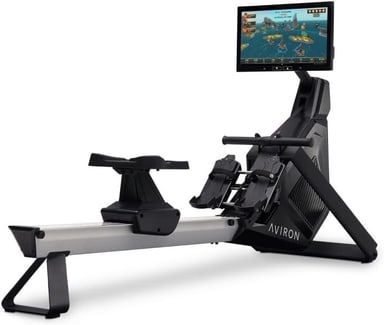
Aviron rates the Strong Series for users up to 507 lb and about 6 ft 8 in, the highest limits in this guide. It combines air and magnetic resistance for up to 100 lb of pull, with cardio levels and separate strength levels, and a 22-inch touchscreen that pivots and rotates. Garage Gym Reviews names it the best high-end rower, BarBend its best magnetic rower, and Men's Health its best for beginners.
The workouts are the hook: Aviron leans on games, races, and streaming apps rather than coached classes alone. Aviron's membership is optional, but most of that content sits behind it. It is 84 by 27 inches in use, weighs 114 lb, and stands upright on its own without a wall mount. Bought on Amazon, it carries Aviron's 10-year frame and 1-year parts warranty.
Resistance: air and magnetic | Max user: 507 lb | Fit: about 6 ft 8 in | In use: 84 x 27 in
Best big screen: NordicTrack RW900
BEST BIG SCREEN
NordicTrack RW900 Rower
Best for: Households already on iFIT, or anyone who wants the biggest screen and trainer-controlled resistance.
- Largest screen in this guide, and it pivots for floor workouts
- 300 lb user limit is lower than the Concept2, Hydrow, or Aviron
Kit Score 7.4/10 · $1,999.00 Price checked Oct 23, 4:16 PM CDT · how we score gear
Buy on AmazonProduct details
The RW900 is NordicTrack's flagship rower: quiet magnetic resistance with 26 digital levels and a 24-inch touchscreen that pivots so you can follow off-rower strength and yoga classes. With an iFIT membership, trainers can change the resistance for you during a class. NordicTrack rates it for 300 lb, and it stands on end for storage rather than folding.
- Resistance type
- Magnetic, 26 digital levels (auto-adjusting with iFIT)
- Max user weight
- 300 lb
- Dimensions (in use)
- 80.1" L x 21.8" W x 52.7" H
- Storage
- Does not fold; can stand vertically (NordicTrack)
- Screen and membership
- 24" pivoting touchscreen; paid iFIT Pro membership required for classes and connected features
- Warranty
- 10-year frame, 2-year parts, 1-year labor
More strengths
- 26 magnetic levels that iFIT classes can adjust automatically
- Long frame warranty for a connected rower
Other tradeoffs
- Classes and auto-adjust need the paid iFIT membership; check NordicTrack's own price before buying on Amazon
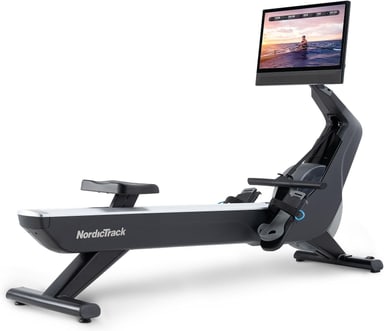
The RW900 has the largest screen here, a 24-inch touchscreen that pivots so you can follow strength and yoga classes off the rower. Its magnetic resistance has 26 digital levels, and with an iFIT membership trainers can change the resistance for you during a class. Garage Gym Reviews names it the best magnetic rower; Wirecutter tested it and did not pick it.
NordicTrack rates it for 300 lb, lower than most picks here, and lists it at 80.1 by 21.8 inches. It does not fold but can stand vertically. The warranty is long for a connected rower: 10 years on the frame, 2 on parts, 1 on labor. Classes and auto-adjust need the paid iFIT membership. NordicTrack's own price has run below Amazon's, so compare before you buy.
Resistance: magnetic, 26 levels | Max user: 300 lb | Screen: 24 in | Warranty: 10 years frame
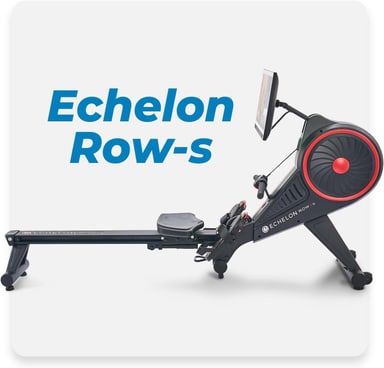
Best folding smart rower: Echelon Row-s
BEST FOLDING SMART ROWER
Echelon Row-s Smart Rower
Best for: Small homes that want a built-in screen and classes but need the rower to fold away after each session.
- Folds to 48 inches long, unusual for a rower with a built-in screen
- Echelon's classes need the paid membership, and the screen is locked to Echelon's app
Kit Score 7.5/10 · $799.00 Price checked Oct 23, 4:16 PM CDT · how we score gear
Buy on AmazonProduct details
The Echelon Row-s is a connected magnetic rower that folds in half. Echelon lists 32 electronic resistance levels that you change with buttons on the handle, a 22-inch touchscreen that swivels for floor workouts, and a folded footprint of 48 by 24 inches. Classes require an Echelon membership.
- Resistance type
- Magnetic, 32 electronic levels with handlebar controls
- Max user weight
- 350 lb per Echelon's spec sheet (the Amazon listing says 300 lb)
- Dimensions (in use)
- 85" L x 24" W x 45" H; 108 lb
- Storage
- Folds to 48" L x 24" W x 69" H
- Screen and membership
- 22" HD touchscreen with 90 degree swivel; paid Echelon membership required for classes
- Max user height
- Not published by Echelon
More strengths
- Resistance buttons on the handlebar, so you can change levels mid-stroke
- Usually far cheaper than Hydrow, Aviron, or NordicTrack
Other tradeoffs
- Echelon's site and the Amazon listing disagree on the weight limit (350 lb vs 300 lb), and Echelon does not publish a height range
Most rowers with a built-in screen take a permanent lane of floor. The Row-s folds to 48 by 24 inches, according to Echelon, and rolls on wheels. It has 32 levels of magnetic resistance that you change with buttons on the handle, and a 22-inch touchscreen that swivels for floor workouts. CNN Underscored names it its best budget rower.
Echelon lists a 350 lb limit on its own spec sheet, while the Amazon listing says 300 lb, and Echelon does not publish a height range. In use it is 85 by 24 inches and 108 lb. Echelon's classes need its paid membership, and the screen runs Echelon's app.
Resistance: magnetic, 32 levels | Max user: 300 to 350 lb depending on source | Folded: 48 x 24 in
Best folding water rower: MERACH 950
BEST FOLDING WATER ROWER
MERACH 950 Foldable Water and Magnetic Rowing Machine
Best for: Rowers who want water-rower sound and feel in a machine that folds away, without a premium budget.
- Water feel with 16 magnetic levels on top, so resistance does not depend on stroke speed alone
- Needs a power adapter for the electromagnetic brake
Kit Score 7.7/10 · $539.99 Price checked Oct 23, 4:16 PM CDT · how we score gear
Buy on AmazonProduct details
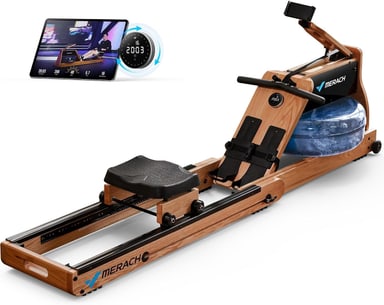
MERACH's 950 pairs a water tank with a 16-level electromagnetic brake in a wooden frame, so you get the swish of a water rower plus a dial for extra resistance. MERACH rates it for 348 lb and riders from 3 ft 11 in to 6 ft 7 in, and the rail folds so the machine stands about 49 inches tall in storage. The monitor pairs with the MERACH app and Kinomap.
- Resistance type
- Water (6 levels) plus electromagnetic (16 levels)
- Max user weight
- 348 lb (158 kg)
- User height
- 3 ft 11 in to 6 ft 7 in
- Dimensions (in use)
- 78.3" L x 20.5" W x 18.9" H (1990 x 520 x 480 mm); 68 lb
- Storage
- Folds to about 49.4" long and stands upright
- Monitor
- LCD (time, distance, calories, strokes, SPM, watts); Bluetooth to the MERACH app and Kinomap; needs a 9V adapter
More strengths
- Folds and stands upright, unlike most wooden water rowers
- Fits riders up to 6 ft 7 in
Other tradeoffs
- A newer model with a much shorter track record than WaterRower
BarBend's best foldable rower pairs a water tank with a 16-level electromagnetic brake in a wooden frame. You get the swish of a water rower, plus a dial that adds resistance without rowing faster. MERACH rates it for 348 lb and riders from 3 ft 11 in to 6 ft 7 in, and the frame folds to about 49 inches so it can stand upright.
It is 78.3 by 20.5 inches in use and about 68 lb. The LCD shows time, distance, strokes, stroke rate, and watts, and it pairs with the MERACH app and Kinomap. It needs a power adapter for the magnetic brake, and it has a much shorter track record than a WaterRower.
Resistance: water plus magnetic | Max user: 348 lb | Fit: up to 6 ft 7 in | Folded: about 49 in
The most under-rated spec on a rowing machine is seat height: at 14 inches the Concept2 is easy for most adults to get on and off, and its 20-inch tall-leg version helps anyone with knee or hip limitations.
Compare the picks
| Spec | Concept2 RowErg | MERACH Q1S | WaterRower Walnut | Hydrow Wave | Aviron Strong | NordicTrack RW900 | Echelon Row-s | MERACH 950 |
|---|---|---|---|---|---|---|---|---|
| Kit Score | 9.4/10 | 8.0/10 | 8.6/10 | 7.9/10 | 8.4/10 | 7.4/10 | 7.5/10 | 7.7/10 |
| Price | $990.00 Price checked Oct 23, 4:16 PM CDT | $189.99 Price checked Oct 23, 4:16 PM CDT | $2,049.00 Price checked Oct 23, 4:16 PM CDT | $2,295.00 Price checked Oct 23, 4:16 PM CDT | $1,999.00 Price checked Oct 23, 4:16 PM CDT | $1,999.00 Price checked Oct 23, 4:16 PM CDT | $799.00 Price checked Oct 23, 4:16 PM CDT | $539.99 Price checked Oct 23, 4:16 PM CDT |
| Best for | Anyone who wants a proven, maintenance-tolerant machine that performs at every fitness level and holds resale value for years. | Home rowers who want a stable, quiet magnetic machine under $200 with room to grow from beginner to moderate intensity workouts. | Rowers who prioritize a quiet, natural stroke feel and furniture-grade aesthetics, and who do not need a connected screen or class library. | Home rowers who want an immersive class-driven workout in a compact footprint and are comfortable with a subscription model. | Tall or heavy rowers, and anyone who stays motivated by games and races more than by coached classes. | Households already on iFIT, or anyone who wants the biggest screen and trainer-controlled resistance. | Small homes that want a built-in screen and classes but need the rower to fold away after each session. | Rowers who want water-rower sound and feel in a machine that folds away, without a premium budget. |
| Why it stands out | Exceptional 500 lb weight capacity and commercial-grade durability for well under the price of connected rowers | In stock with a 4.4-star average across 2,355 Amazon ratings (September 2026) | Water resistance creates a stroke that closely mirrors on-water rowing: smooth, self-regulating, and quiet with a calming water sound rather than mechanical noise | Guided rowing classes led by on-water athletes make technique accessible for beginners while keeping advanced rowers engaged | 507 lb and about 6 ft 8 in user limits, the highest here | Largest screen in this guide, and it pivots for floor workouts | Folds to 48 inches long, unusual for a rower with a built-in screen | Water feel with 16 magnetic levels on top, so resistance does not depend on stroke speed alone |
| Tradeoff | Hard plastic seat becomes uncomfortable for sessions over 30 minutes without a seat pad | At 42 lb it is heavier than ultra-compact budget rowers, so the built-in wheels help but stairs are awkward | S4 monitor is functional but basic: Bluetooth pairing, but no touchscreen or guided classes | The touchscreen, stats, and class library all require the paid monthly membership, a real yearly cost on top of the machine | Most interactive content needs the membership, and the hardware alone is a large outlay | 300 lb user limit is lower than the Concept2, Hydrow, or Aviron | Echelon's classes need the paid membership, and the screen is locked to Echelon's app | Needs a power adapter for the electromagnetic brake |
| Resistance | Air | Magnetic, 16 levels | Water | Electromagnetic | Air and magnetic | Magnetic, 26 levels | Magnetic, 32 levels | Water plus magnetic |
| Max user weight | 500 lb | 350 lb | 300 lb (Amazon) to 700 lb (WaterRower) | 375 lb | 507 lb | 300 lb | 300 to 350 lb | 348 lb |
| Height or inseam | 38 in inseam | 6 ft 5 to 6 ft 7 in | XL rails over 2 m | 36 in inseam | About 6 ft 8 in | Not published | Not published | Up to 6 ft 7 in |
| In use (L x W) | 96 x 24 in | 65 x 19.3 in | 82 x 22 in | 80 x 19 in | 84 x 27 in | 80.1 x 21.8 in | 85 x 24 in | 78.3 x 20.5 in |
| Storage | Splits in two | Stands upright | Stands on end | Upright with add-on kit | Stands upright | Stands vertically | Folds to 48 in | Folds to about 49 in |
| Screen or monitor | PM5 | LCD plus app | S4 monitor | 16 in touchscreen | 22 in touchscreen | 24 in touchscreen | 22 in touchscreen | LCD plus app |
| Membership needed for classes | No | No | No | Yes | Optional | Yes | Yes | No |
How to choose a rowing machine
The numbers that matter
Resistance type
Air (Concept2) gets harder the harder you pull and has no real ceiling, but the fan is the loudest. Magnetic (MERACH Q1S, RW900, Row-s) is the quietest and steady at a set level. Water (WaterRower, MERACH 950) rises with effort and makes a low swish. Our [resistance types guide](/fitness/rowing-machine-resistance-types-explained) goes deeper.
Footprint
The rowers here run about 5.5 to 8 feet long and about 2 feet wide, and Concept2 recommends a 9 by 4 foot area so you can move and step off. If the machine must disappear between sessions, check the storage figure: the MERACH Q1S, Aviron, and WaterRower stand upright; the Row-s and MERACH 950 fold.
User weight
Hard strokes load the frame more than sitting still. Leave a margin under the rated limit, and when the maker and the retailer disagree (WaterRower, Echelon), go by the lower number or ask the maker.
Height and inseam
Tall rowers need rail length. Concept2 fits a 38 inch inseam, Aviron about 6 ft 8 in, and the MERACH 950 up to 6 ft 7 in; the Hydrow Wave stops at a 36 inch inseam.
Noise
For shared walls, magnetic and water are the safer bets. An air rower at a hard pace is audible in the next room.
Membership
Hydrow, NordicTrack, and Echelon need a paid membership for their classes, which adds a yearly cost on top of the machine. The Concept2, WaterRower, MERACH, and Aviron (optional membership) work without one.
New to the stroke? Read how to use a rowing machine for the leg, body, arm sequence, and how to choose a rowing machine for budget tiers and monitor features.
Frequently asked questions
What is the best rowing machine for home use in 2026?
The Concept2 RowErg is the best for most homes. Wirecutter and Men's Health both name it their top pick, it is rated for 500 lb, and its PM5 monitor works with free apps and no subscription. For a quiet budget rower, choose the MERACH Q1S; for coached classes in a small space, the Hydrow Wave; for a water stroke, the WaterRower.
What is the best rowing machine for tall people?
The Aviron Strong Series and the Concept2 RowErg. Aviron rates its rower for users up to about 6 ft 8 in and 507 lb. Concept2 fits inseams up to 38 inches and sells an extra-long monorail for longer legs. The MERACH 950 fits riders up to 6 ft 7 in. The Hydrow Wave is the most limited here, with a 36 inch inseam.
Is a magnetic or an air rowing machine better for home use?
Magnetic if noise and space are the priority, air if you want to train hard and compare numbers. An air rower like the Concept2 gets harder the harder you pull and has no practical ceiling, but the fan makes a steady rushing sound. A magnetic rower like the MERACH Q1S is much quieter and cheaper and stands upright, but its hardest setting is a ceiling that fit rowers will reach. Water rowers sit between the two.
Do I need a rowing machine membership or subscription?
Only for some connected machines. The Hydrow Wave, NordicTrack RW900, and Echelon Row-s need a paid monthly membership for their classes and most connected features. Aviron's membership is optional. The Concept2's PM5 works on its own with the free ErgData app, the WaterRower's S4 monitor works on its own, and the MERACH rowers pair with the free MERACH app or Kinomap.
How much space does a rowing machine need?
The machines here run from about 5.4 feet (MERACH Q1S) to 8 feet (Concept2) long and about 2 feet wide. Concept2 recommends a 9 by 4 foot area for use, which leaves room to move and to step on and off. For storage, the Q1S, Aviron, and WaterRower stand upright, the Echelon Row-s folds to 48 inches long, and the MERACH 950 folds to about 49 inches. To test a specific room, enter it in our home cardio space checker, which adds the clearance to each rower here.
Is rowing a good workout for weight loss?
It can be. Harvard Health estimates that a 155-pound person burns about 252 calories in 30 minutes of moderate stationary rowing and 369 in 30 minutes of vigorous rowing, because each stroke drives the large leg muscles along with the back, core, and arms. Consistent sessions combined with appropriate nutrition support fat loss over time, and the low impact makes rowing sustainable for people who cannot tolerate running or jumping.
Where these numbers come from
| Claim | Source | Checked |
|---|---|---|
| Concept2 RowErg: 500 lb max user (Concept2 testing), 96 x 24 in, 9 x 4 ft for use, 57 lb, 14 in seat (20 in tall legs), 38 in inseam with an extra-long monorail available, splits in two for storage, PM5 with Bluetooth and ANT+, free ErgData app, 5-year frame warranty | Concept2 RowErg and Concept2 PM5 | 2026-10-03 |
| MERACH Q1S: 16 levels, dual slide rail, 350 lb, fits up to 6 ft 5 in, 42 lb, 65 x 19.3 x 24.8 in, 1.6 x 2.1 ft stored, MERACH app and Kinomap | Amazon listing B0B2P23DBS | 2026-10-03 |
| MERACH Q1S fits users up to 6 ft 7 in, stores upright | MERACH Q1S | 2026-10-03 |
| WaterRower Walnut S4 BLE: hand-built in Rhode Island, 82 x 22 x 20 in, 103.5 lb with water, stores on end; spec table lists 300 lb max user | Amazon listing B01N4JL4Q0 | 2026-10-03 |
| WaterRower: 700 lb and 330 lb (150 kg) user weight both listed, S4 Bluetooth monitor, made in the USA, 5-year frame and 3-year parts warranty, XL rails for users over 2 m | WaterRower Original Walnut and WaterRower Original Oak | 2026-10-03 |
| Hydrow Wave: 375 lb, 36 in inseam, 80 x 19 x 43 in, 102 lb, 16 in screen, upright storage needs the Vertical Anchor | Hydrow Wave hardware specs | 2026-10-03 |
| Hydrow warranty: 5 years frame, 12 months components, screen, and labor; connected features require a membership | Hydrow home-use warranty and Hydrow's Amazon listing B0CMR44PFF | 2026-10-03 |
| Aviron Strong Series: air and magnetic resistance up to 100 lb, 507 lb, about 6 ft 8 in, 84 x 27 x 48 in, 35 x 27 x 83 in upright, 114 lb, 22 in touchscreen, optional membership, 10-year frame and 1-year parts warranty outside Aviron's store | Aviron Strong Series | 2026-10-03 |
| NordicTrack RW900: 26 levels, 300 lb, 80.1 x 21.8 x 52.7 in, stands vertically but does not fold, 24 in pivoting screen, 10-year frame, 2-year parts, 1-year labor warranty; iFIT membership required for connected features | NordicTrack RW900 and iFIT membership | 2026-10-03 |
| Echelon Row-s: 32 levels with handlebar controls, 350 lb, 85 x 24 x 45 in, folds to 48 x 24 x 69 in, 108 lb, 22 in swivel screen, membership required | Echelon Row-s | 2026-10-03 |
| Echelon Row-s weight limit listed as 300 lb | Amazon listing B08BQS7PKY | 2026-10-03 |
| MERACH 950: 6 water and 16 magnetic levels, 348 lb (158 kg), 3 ft 11 in to 6 ft 7 in, 1990 x 520 x 480 mm in use, 1255 mm folded, 31 kg, LCD with Bluetooth to MERACH and Kinomap, 9V adapter | MERACH NovaRow 950 | 2026-10-03 |
| Awards: Wirecutter (Concept2 top pick, WaterRower Oak for a peaceful row, Hydrow Wave worth considering; Q1S Pro and RW900 tested, not picked); Garage Gym Reviews (Aviron best high-end, Concept2 best budget, RW900 best magnetic, Hydrow Wave best smart); BarBend (Aviron best magnetic, WaterRower best water, MERACH 950 best foldable); Men's Health (Concept2 best overall, Hydrow Wave small spaces, Aviron beginners, WaterRower Club water); CNN Underscored (Echelon Row-s best budget) | Wirecutter, Garage Gym Reviews, BarBend, Men's Health, CNN Underscored | 2026-10-03 |
| 155 lb person: 252 kcal (moderate) and 369 kcal (vigorous) per 30 min of stationary rowing | Harvard Health, calories burned in 30 minutes | 2026-09-25 |
Every figure is the maker's or retailer's published number; none is a Kit Authority measurement.
Explore more gear and training guides in fitness, or learn about how we research and rate every pick we publish.
Keep going
Free toolHome Cardio Space CheckerWill a rowing machine, exercise bike, or walking pad fit your room?
Our recommendations draw on manufacturer documentation, retailer listings, owner feedback, and comparisons with alternatives.
As an Amazon Associate I earn from qualifying purchases. We may earn a commission from links here, at no extra cost to you. How we research →