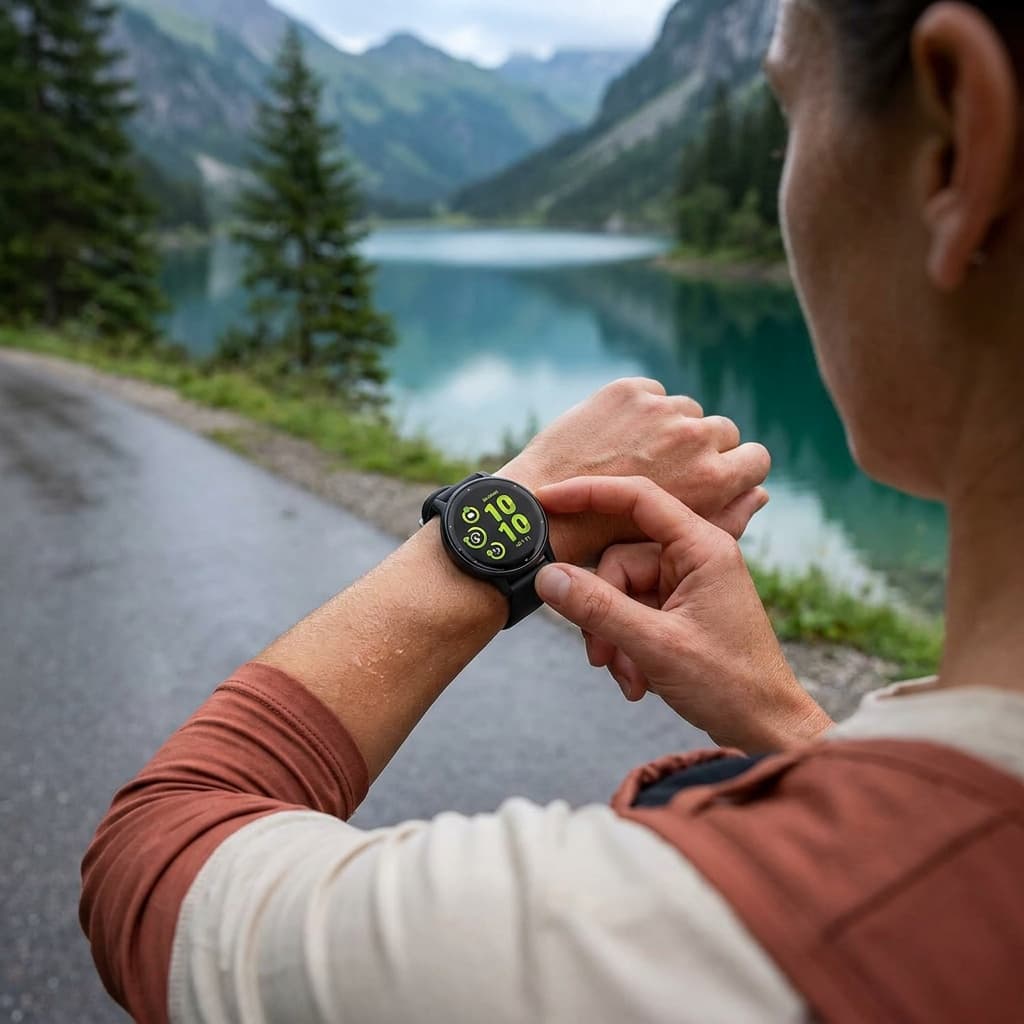
We may earn a commission from links on this page, at no extra cost to you.
The Garmin Vivoactive 5 is the best fitness watch for most walkers who want built-in GPS without flagship-watch pricing. It combines up to 11 days of battery, a bright AMOLED display, phone-free route mapping, and strong walking accuracy, but omits a barometric altimeter. This review covers the specifications and where it wins or loses against cheaper bands in our best fitness trackers for walking guide.
BEST OVERALL
Garmin Vivoactive 5
Best for: Walkers who want a true GPS route map, long battery, and a proven data platform without paying flagship watch prices.
Kit Score 8.4/10 · Check current price
- Best-in-class step and GPS accuracy for the price
- 11-day battery handles a full week-plus without thinking about charging
- No barometric altimeter, so stair-climb counts are not tracked
Who it is for
This watch fits one buyer especially well: someone who walks for fitness and wants a single device that maps routes, tracks health, and lasts a full week-plus between charges. The built-in GPS records distance, pace, and a real route map without your phone in your pocket, which is the feature that separates it from every band in this group. Researchers consistently rank its step accuracy at the top of comparison testing, and its GPS distance tracked within 0.05 miles of control routes, so the numbers you see are numbers you can trust.
It is also a strong pick if you do more than walk. With over 30 built-in sports apps, a 5 ATM water rating for swimming, and a full sleep and health suite, it grows with you if your routine expands beyond daily steps.
It is less ideal if you only want a slim, set-and-forget step counter and you already carry a phone on every walk. In that case you are paying for GPS and a platform you may not use. It also has no barometric altimeter, so it does not track stair-climb counts, and that is worth knowing if floors-climbed is a metric you care about.
Full specifications
| Spec | Detail |
|---|---|
| Kit Score | 8.4 / 10 (researched, not lab-tested) |
| Display | 1.2 in. AMOLED, 390x390, Gorilla Glass 3 |
| Battery life | Up to 11 days in smartwatch mode |
| GPS | Built-in GPS, GLONASS, Galileo |
| Water resistance | 5 ATM |
| Sports modes | 30+ built-in apps |
| Weight | Approx. 33 g with band |
| Build | Aluminum bezel, Gorilla Glass 3 |
| Price | $180 – $230 (often below $200) |
The spec that matters most for walkers is the built-in GPS. Unlike the bands it competes with, the Vivoactive 5 logs distance, pace, and a route map on its own, so you can leave the phone at home and still get accurate, mappable walk data.
Pros and cons
What it does well:
- Best-in-class step and GPS accuracy for the price, ranked at or near the top in independent comparison testing.
- Up to 11 days of battery means a full week-plus without thinking about charging.
- Light, compact 33 g design that disappears on the wrist during long walks.
- Built-in GPS maps routes without a phone, plus a deep sleep and health platform and 30+ sports modes.
- Aluminum bezel and Gorilla Glass 3 hold up in daily and swim use.
Where it falls short:
- No barometric altimeter, so stair-climb and floors-climbed counts are not tracked.
- The magnetic charger can be knocked loose easily, so confirm it is seated before you walk away.
- It costs more than the simple bands, which is wasted money if you never use the GPS or the wider sports features.
How it compares
Against the Fitbit Inspire 3, the trade is capability versus simplicity and price. The Inspire 3 is the lightest band in this group at around 20 g, posts excellent step accuracy, and sells for $70 to $100, which makes it the practical daily-walker pick. But it relies on connected GPS, meaning it needs your phone to map a route, and its deeper health insights sit behind a $9.99 per month Premium subscription. The Vivoactive 5 costs more, yet it maps routes on its own, lasts about as long on a charge, and gives you the full Garmin platform without a paywall.
Against the Amazfit Band 7, the gap is wider. The Band 7 is the budget champion at roughly $40 to $60, with an 18-day battery and a large screen that are hard to beat on raw spec-to-dollar value. The catch is accuracy: its GPS-based distance tracking lags behind in comparison testing, and the plastic build and clasp feel budget-level. If your goal is a reliable daily step count and you do not need a trustworthy route map, the Band 7 overdelivers for the money. If you want the distance and pace numbers to actually be right, the Vivoactive 5 is the safer call.
The pattern is clear: the cheaper bands win on price and on raw battery, but both depend on your phone for GPS. The Vivoactive 5 is the do-everything pick for walkers who want a real onboard GPS, long battery, and a proven data platform in one watch. If you are still deciding how to build a walking habit around the data, our how to start walking for fitness guide is a good place to begin.
Frequently asked questions
How long does the Garmin Vivoactive 5 battery last?
Garmin rates it at up to 11 days in smartwatch mode, which holds up well in everyday use for most walkers. Heavy GPS use shortens that, but for daily step tracking with the occasional mapped walk you can comfortably go a full week-plus between charges. That is one of the main reasons it earns our best overall slot.
Is the Garmin Vivoactive 5 good for walking?
Yes, it is our top pick for walkers. It ranks at or near the top of independent step accuracy testing, its GPS tracked within 0.05 miles of control distances, and its built-in GPS maps your route without a phone. Add the long battery and a clear health platform and it covers everything a walker needs.
Does the Garmin Vivoactive 5 have built-in GPS?
Yes. It has true onboard GPS with GLONASS and Galileo support, so it records distance, pace, and a route map on its own. You do not need to carry your phone to get accurate walk data, which is the key feature that separates it from the cheaper bands in this category.
Is the Garmin Vivoactive 5 worth it?
For most walkers who want one watch that does everything, yes. It earns a Kit Score of 8.4 because it combines top-tier accuracy, up to 11 days of battery, built-in GPS, and a deep health platform, usually for under $200. The main reasons to spend less are if you only want a simple step counter and always carry your phone, in which case the Fitbit Inspire 3 covers the basics for less.
Does the Garmin Vivoactive 5 track stairs climbed?
No. It has no barometric altimeter, so it does not track stair-climb or floors-climbed counts. It tracks steps, distance, pace, heart rate, sleep, and the usual health metrics accurately, but if floors climbed is a number you rely on, that is the one notable gap to know about before you buy.
For the full field, including the budget bands and other options scored the same way, see our best fitness trackers for walking guide.
Related buying guide
Best fitness trackers for walking: 3 picks by phone and GPSRelated guides

Field guide
Are fitness tracker step counts accurate?
Wrist trackers are accurate at normal speeds but miss 35–95% of steps when you push a cart or walk slowly. Here is what the research shows and how to get better numbers.
Read guide
Field guide
How many steps a day to lose weight
The science behind 7,000 to 10,000 steps, how many calories walking actually burns, and how to pair daily steps with diet for real, lasting weight loss.
Read guide
Buying guide
The best weighted vests for walking, from beginner to budget
The best weighted vests for walking, ranked on fit, comfort, and value, plus a conservative framework for choosing and progressing the load.
Read guide
Buying guide
Best walking shoes for women: cushion, support, and daily miles
Four women's walking shoes for daily mileage, sorted by what your feet are asking for: dependable neutral cushion, max cushion for aching joints, or a low-cost start.
Read guideResearch-based review
Updated Aug 14, 2026Our recommendations draw on manufacturer documentation, retailer listings, owner feedback, and comparisons with alternatives.
As an Amazon Associate I earn from qualifying purchases. We may earn a commission from links here, at no extra cost to you. How we research →
Top picks
Related buying guide
Best fitness trackers for walking: 3 picks by phone and GPS