We may earn a commission from links on this page, at no extra cost to you.
The Anker 737 PowerCore 24K is the bank we recommend first in our best travel power banks guide, and it is the one most travelers carrying a laptop should look at before anything smaller. This review covers exactly what you get, the spec that matters most for flying, and where it wins or loses against the alternatives.
BEST OVERALL
Anker 737 PowerCore 24K
Kit Score 8.8/10 · Check current price
Buy on AmazonBest for: Travelers who carry a USB-C laptop and want high output, a live power display, and substantial capacity below the common 100Wh threshold.
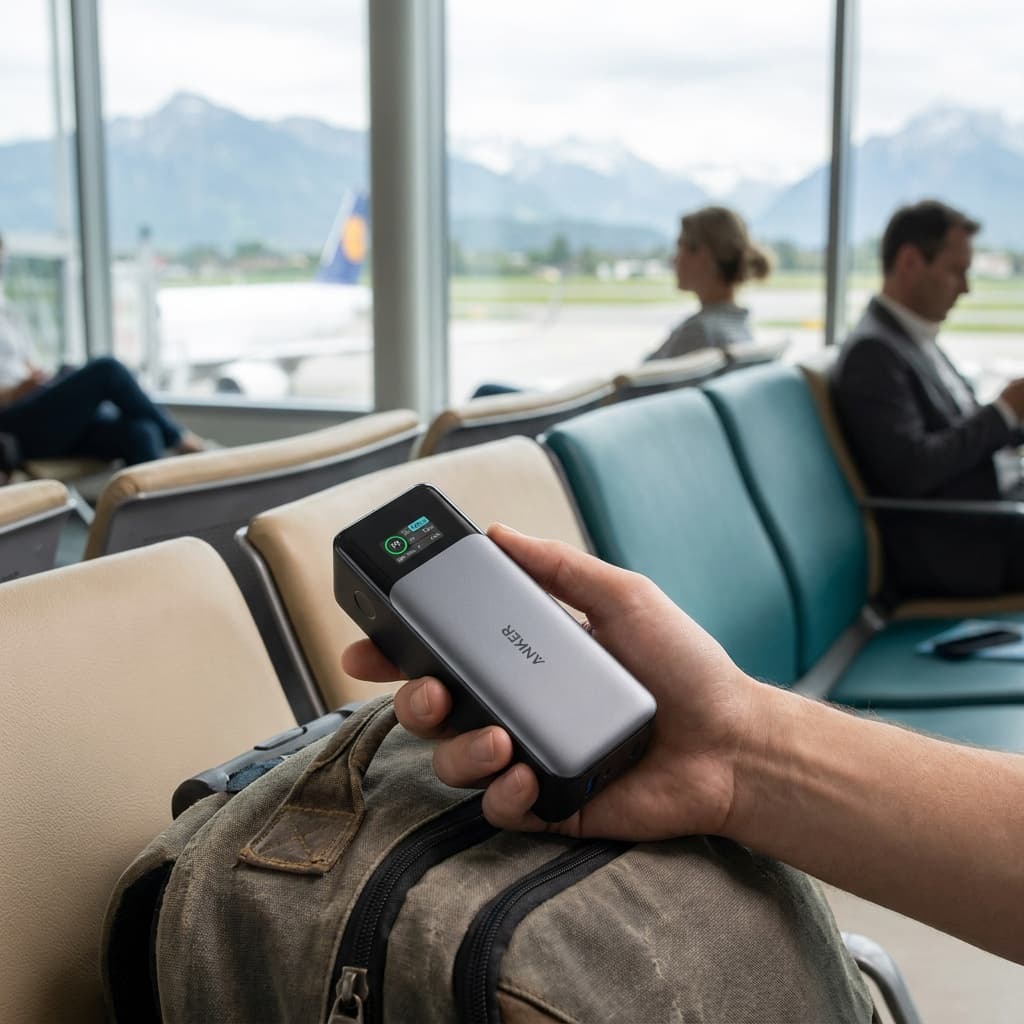
- Smart digital display shows exact battery percentage, input/output wattage in real time
- 140W PD 3.1 output is fast enough for most laptops at full speed
- At 1.39 lb it is noticeably heavier than phone-only banks, not a featherlight day-trip option
Who it is for
This bank fits one buyer especially well: the traveler who carries a USB-C laptop and wants one battery with a high output ceiling. The 140W maximum is meaningful only when the device and cable both support USB-C PD 3.1; otherwise, charging negotiates a lower rate. Delivered energy also varies with voltage conversion, cable losses, device use, and battery condition, so the 24,000mAh label should not be read as a guaranteed number of laptop or phone charges.
Anker's technical specifications list a 140W input ceiling and about a one-hour refill with a suitable 140W wall charger. A 96W charger takes roughly 1.5 to 2 hours. The wall charger is a separate purchase. The cable in the box depends on where you buy: the current Amazon listing includes a 140W USB-C-to-C cable, while Anker's support page lists a short USB-A-to-C cable.
It is less ideal if you only carry a phone and want something that disappears into a pocket. At 1.39 lb, it is a deliberate brick sized for capacity rather than featherweight convenience. If your only device is a phone and you take short trips, a slimmer bank covers you with far less weight. If you are still deciding how much capacity you need, read our one bag travel kit guide first: matching battery size to your actual device load keeps your bag lighter.
Full specifications
| Spec | Detail |
|---|---|
| Kit Score | 8.8 / 10 (researched, not lab-tested) |
| Capacity | 24,000mAh (86.4Wh) |
| Max output | 140W (USB-C PD 3.1) |
| Ports | 2× USB-C, 1× USB-A |
| Recharge input | Up to 140W; Anker says about 1 hour with a compatible 140W charger and cable |
| Display | Real-time digital readout: remaining charge, live input/output wattage, recharge time estimate |
| Weight | 1.39 lb (630g) |
| Dimensions | 6.13 × 2.15 × 1.95 in |
| Flight-rule context | 86.4Wh; below the common 100Wh threshold, carrier rules still apply |
| Price | $100–$130 typical range; check retailer |
The single spec that matters most for flying is the printed 86.4Wh rating. Under the U.S. FAA baseline, that is below the 100Wh capacity threshold and does not require capacity-based airline approval. Power banks still travel in carry-on baggage only, and carriers can impose stricter count, storage, visibility, or onboard-use rules. Our airline power-bank rules checker separates those rules by carrier.
Pros and cons
What it does well:
- The smart digital display shows exact battery percentage and live input/output wattage, so you always know how much charge is left and how fast a device is pulling.
- The 140W PD 3.1 output is fast enough to charge most laptops at full speed, not the slow trickle smaller banks deliver.
- Its printed 86.4Wh rating leaves 13.6Wh of headroom below the common 100Wh threshold.
- Two USB-C ports and one USB-A port can serve three devices, although the 140W ceiling is shared across simultaneous outputs.
Where it falls short:
- At 1.39 lb it is noticeably heavier than phone-only banks, so it is not a featherlight day-trip option.
- There is no built-in cable, and the boxed cable varies by seller: Anker's support page lists a short USB-A-to-C cable, while the current Amazon listing includes a 140W USB-C-to-C cable. Check before you rely on it for 140W.
How it compares
Against the Anker 10K power bank, the trade is capacity versus pocketability. The 10,000mAh bank is 0.61 inches thin and 8.6 oz per its Amazon listing, and costs a fraction as much, which makes it the better phone-only and short-trip bank. But it holds well under half the energy and is sized for phones, not laptops, so it runs dry far sooner. The 737 gives up that slimness to be the do-everything bank: laptop-capable output, multi-device capacity, and the live display.
Against the Baseus Blade 100W, the trade is output and headroom versus price. The Blade is flatter and undercuts the 737 on cost while still delivering laptop-class 100W from its 20,000mAh, which makes it a strong value pick. The 737 answers with more capacity (24,000mAh vs the Blade's 20,000mAh), higher 140W output, and faster recharging (140W input vs the Blade's 65W). Both have a digital display. If you want the most capable single bank, the 737 is worth the step up; if you want laptop charging for less, the Blade is the call.
For the full field, including pocketable and premium alternatives scored the same way, our best travel power banks guide goes deeper, and the 737 is our top pick there too.
Frequently asked questions
Is the Anker 737 PowerCore 24K allowed on planes?
Under the U.S. FAA capacity baseline, yes: its printed 86.4Wh rating is below 100Wh. It must travel in carry-on baggage, and the operating airline may impose a stricter quantity, storage, or onboard-use rule. Check the airline in our power-bank flight checker before departure.
Can the Anker 737 charge a laptop at full speed?
For compatible laptops, it can deliver up to 140W through USB-C PD 3.1. The actual rate is negotiated by the laptop, port, and cable, so many devices will draw less. You need a PD 3.1-compatible 5A USB-C cable and a device that accepts that input to reach the ceiling.
How many phone charges does the Anker 737 hold?
There is no honest universal number. The bank's 24,000mAh rating is measured at its internal cell voltage; usable output is lower after voltage conversion and normal efficiency losses. Divide the bank's 86.4Wh rating by your device battery's Wh rating, then allow a margin for conversion losses and using the device while it charges.
Does the Anker 737 come with a cable?
It depends on the seller. Anker's support page lists a short USB-A-to-USB-C cable, which cannot carry 140W; the current Amazon listing says the box includes a 140W USB-C-to-USB-C cable and a travel pouch. To reach the maximum input or output you need a 5A USB-C-to-USB-C cable either way, and the wall charger is sold separately.
Anker 737 vs Baseus Blade 100W: which should I buy?
The Baseus Blade is flatter and usually cheaper while still delivering laptop-class 100W output, which makes it the value pick when it is in stock. The Anker 737 carries more capacity, pushes a higher 140W, and recharges itself faster (140W input vs 65W). Both have digital displays. Choose the Blade for a flatter laptop bank, or the 737 if you want the most capable single bank.
Where these numbers come from
| Claim | Source | Checked |
|---|---|---|
| 24,000mAh; up to 140W per USB-C port and 140W total; 140W input; about 1 hr recharge on a 140W charger, 1.5 to 2 hr on 96W; 2 ft USB-A-to-C cable in the box | Anker Support, Introduction to the Anker 737 Power Bank 24K (A1289) | Sep 2026 |
| Two USB-C and one USB-A port, 630 g, 6.13 × 2.15 × 1.95 in | Anker, 737 Power Bank (PowerCore 24K) | Sep 2026 |
| 86.4Wh rating | StorageReview, Anker 737 Power Bank review | Sep 2026 |
| Display shows input/output power and recharge time; box includes a 140W USB-C-to-C cable and travel pouch | Anker listing on Amazon, ASIN B09VPHVT2Z | Sep 2026 |
| 100Wh per-battery limit without airline approval; spare lithium batteries carry-on only; airlines may be stricter | FAA, PackSafe lithium batteries | Sep 2026 |
| Power banks not allowed in checked bags | TSA, power banks | Sep 2026 |
| Baseus Blade: 20,000mAh, 100W max output, 65W max input, digital display | Baseus, Blade laptop power bank 100W | Sep 2026 |
Specs are Anker's and Baseus's published ratings; nothing here is a Kit Authority measurement.
For the full field, including budget and premium alternatives scored the same way, see our best travel power banks guide.
Keep going
Related buying guideThe best travel power banks: carry-on approved picks that fast-chargeRelated guides


 Complete travel loadoutCarry-on travel kitBuild the complete kit
Researched, not hands-on tested
Updated Sep 25, 2026Our recommendations draw on manufacturer documentation, retailer listings, owner feedback, and comparisons with alternatives.
As an Amazon Associate I earn from qualifying purchases. We may earn a commission from links here, at no extra cost to you. How we research →
In this review
Related buying guide
The best travel power banks: carry-on approved picks that fast-charge