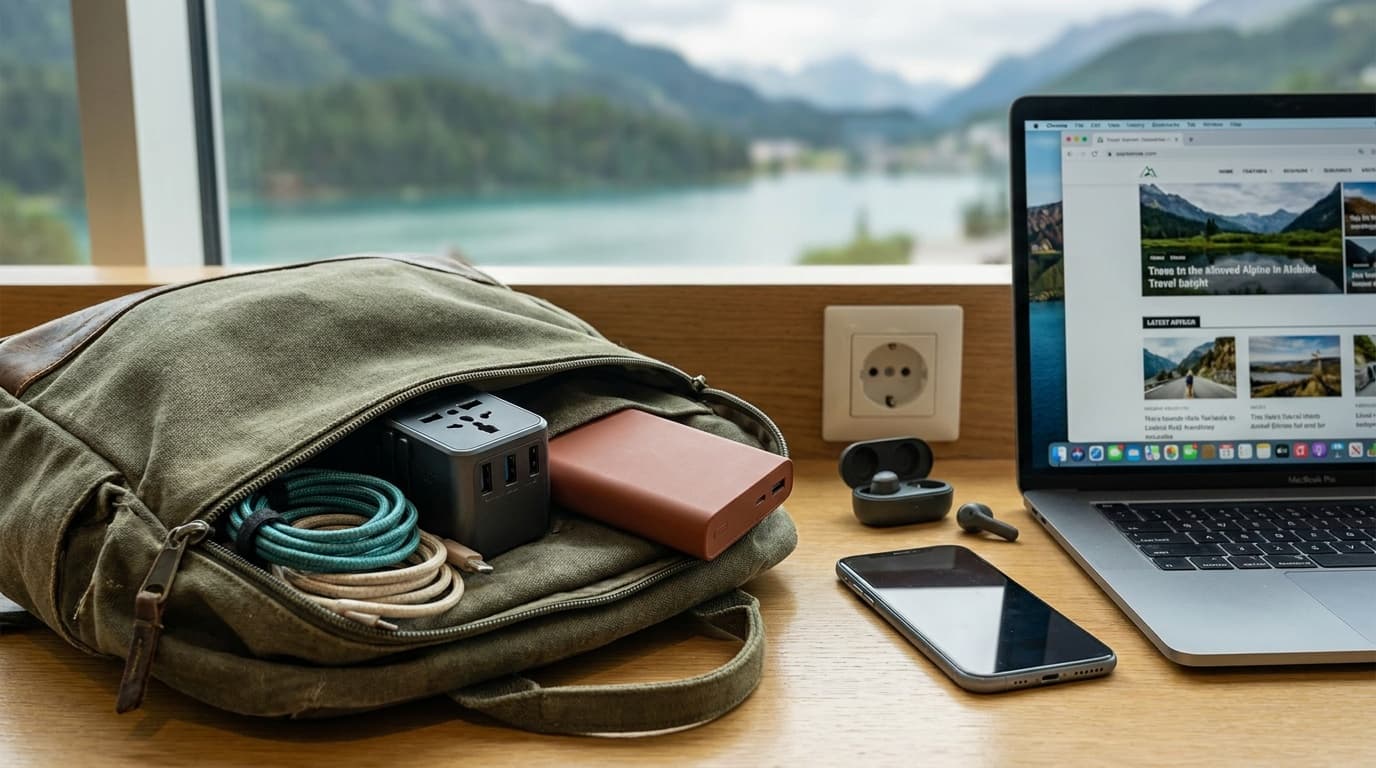
Power banks are allowed on most passenger flights, but they must stay in the cabin. Capacity, quantity, storage, and onboard use are separate rules, and the operating airline can be stricter than the regulator.
Use the power-bank flight checker to convert mAh to watt-hours and compare your bank with the current published rule for your airline. Flying to a trailhead? Every rated pick in our best ultralight power banks for hiking guide is under 40Wh, and the Nitecore NB10000 Gen4 review covers the lightest of them.
The capacity rule
Airlines regulate lithium-ion batteries in watt-hours (Wh), not milliamp-hours (mAh). The FAA's current passenger guidance uses three capacity bands.
The FAA PackSafe guidance says power banks up to 100Wh are allowed for personal use. Banks above 100Wh through 160Wh require airline approval and are limited to two. The FAA does not set a fixed quantity limit for personal-use batteries below 100Wh, but it explicitly warns that airlines may impose stricter limits.
Convert mAh to watt-hours
Use the nominal battery voltage printed on the bank:
Wh = (mAh / 1,000) x voltage
A 20,000mAh bank at 3.7V is 74Wh. A 27,000mAh bank at 3.7V is 99.9Wh, close enough to the ceiling that the manufacturer's printed Wh rating should decide the answer. A 30,000mAh bank at 3.7V is 111Wh and enters the approval or prohibition range.
What changed on March 27, 2026
ICAO amended its international dangerous-goods instructions for power banks. The accompanying IATA implementation guidance separates power banks from ordinary spare batteries and states that personal power banks:
- Must be carried in carry-on baggage
- Must not be recharged onboard the aircraft
- Should not be used to recharge another portable electronic device onboard
- Are limited to two per person
- Must be protected from short circuit while not in use
The wording matters. ICAO prohibits recharging the power bank from aircraft power. IATA separately says passengers should not use the bank to charge another device. That second point is a recommendation in the international baseline, although individual airlines can make it a prohibition.
ICAO's change did not instantly create identical passenger rules everywhere. IATA says enforceability depends on each state's adoption process. Use the international baseline for planning, then follow the operating carrier's published policy.
The overhead-bin rule is airline-specific
There is no single FAA sentence banning every under-100Wh power bank from every overhead bin. However, several airlines now require banks to remain accessible because cabin crew can respond faster if a battery overheats.
- American Airlines permits two banks up to 100Wh and says to keep them under the seat or in the seatback pocket, not overhead.
- Delta permits two banks of up to 100Wh each, kept under the seat or in the seatback pocket, not overhead.
- United permits two portable chargers, kept on you or in your personal item, never in an overhead bin.
- JetBlue permits two banks up to 100Wh and bars them from overhead compartments.
- British Airways permits two banks up to 100Wh, stored in the seat pocket or a bag under the seat in front.
- Southwest permits one bank up to 100Wh, kept under the seat and visible while in use.
- Emirates permits one bank under 100Wh, bans all onboard use, and requires under-seat or seat-pocket storage.
- Qatar Airways permits two banks, each no more than 100Wh, and says a bank charging a device must not sit inside a bag or the overhead bin.
Airline power bank rules at a glance
Each row below was read on the airline's or regulator's own page on the date shown. The same rows power the power-bank flight checker and its downloadable CSV, so the table and the tool always agree. Scroll sideways on a phone to see every column.
| Rule set | Capacity | How many | Where it rides | Onboard use | Source | Checked |
|---|---|---|---|---|---|---|
| U.S. FAA baseline | Up to 100Wh allowed; over 100Wh through 160Wh needs airline approval | No fixed limit under 100Wh for personal use; larger spares are limited to two; airlines may set stricter power-bank counts | Carry-on only; remove from any gate-checked bag and keep it in the cabin | FAA leaves stricter quantity, storage, and use rules to the airline | FAA PackSafe: lithium batteries | Oct 3, 2026 |
| ICAO / IATA 2026 baseline | Up to 100Wh allowed; 100Wh through 160Wh may need operator approval through Dec 31, 2026, then is forbidden | Maximum two power banks per person | Carry-on only; protect each bank from short circuit when not in use | Do not recharge the bank onboard; IATA recommends not using it to charge a device | IATA 2026 power-bank operator guidance | Oct 3, 2026 |
| American Airlines | Each portable charger must not exceed 100Wh; large portable power stations are not allowed | Maximum two portable chargers per passenger | Carry-on only; under the seat or in the seatback pocket, not in overhead bins | Keep it within reach and visible while in use; do not recharge it from seat power | American Airlines restricted items | Oct 3, 2026 |
| Delta Air Lines | Each power bank must not exceed 100Wh, with no exceptions | Maximum two power banks per person (within Delta's 20 spare batteries total) | Carry-on only; under the seat or in the seatback pocket, not overhead | Do not recharge the bank onboard; do not use it to charge a device during taxi, takeoff, or landing | Delta battery and fuel-powered items | Oct 3, 2026 |
| United Airlines | Lithium-ion batteries up to 100Wh; United allows two 100-160Wh lithium batteries in carry-on but does not single out power banks, so confirm first | Maximum two portable chargers per passenger | Carry-on only; on you or in your personal item, not in overhead bins | Do not recharge it from aircraft power; keep it within reach | United electronic devices and batteries | Oct 3, 2026 |
| Southwest Airlines | Power bank must not exceed 100Wh | Maximum one power bank per passenger | Carry-on only; under the seat, not overhead; visible while in use | May be used while visible; do not recharge it from in-seat power | Southwest lithium batteries and chargers | Oct 3, 2026 |
| JetBlue | Non-mobility lithium-ion devices and power banks are limited to 100Wh | Maximum two power banks per customer | Carry-on only; not in overhead compartments; remove from any gate-checked bag | Do not recharge it from in-seat power; JetBlue says not to use it to charge other devices in flight | JetBlue battery requirements | Oct 3, 2026 |
| British Airways | Power banks must not exceed 100Wh and must show a capacity rating; 100-160Wh approval does not cover power banks | Maximum two power banks per person, within four spare batteries total | Carry-on only; in the seat pocket or a bag under the seat in front | Do not recharge the bank from seat power | British Airways restricted items | Oct 3, 2026 |
| Emirates | Power bank must be under 100Wh with the capacity visibly marked | Maximum one power bank per passenger | Carry-on only; seat pocket or under the seat, never overhead | Do not use it to charge a device and do not recharge the bank onboard | Emirates power-bank safety rules | Oct 3, 2026 |
| Qatar Airways | Each power bank must not exceed 100Wh; larger banks are not allowed | Maximum two power banks per passenger | Carry-on only; while charging a device, not inside a bag or in the overhead bin | Never recharge the bank onboard; it may charge a device outside critical phases of flight under your direct supervision | Qatar Airways restricted baggage | Oct 3, 2026 |
The direction of travel is clear: across the carriers checked, the common rule is now 100Wh at most, two banks at most, nothing in the overhead bin, and no recharging the bank onboard.
How to pack a power bank
Five checks before you leave
Read the label
Confirm the Wh rating is visible. Photograph it in case the print is hard to read at the gate.
Check the operating airline
Codeshare tickets can involve a different carrier with a stricter rule.
Protect the terminals
Use the original packaging, a battery sleeve, or an individual protective pouch so metal cannot short the contacts.
Keep it in your personal item
This prevents an overhead-bin problem and makes removal easy if your roller bag is gate checked.
Inspect the case
Do not fly with a swollen, damaged, defective, or recalled bank.
If a carry-on is taken at the gate and placed in the hold, remove every power bank first. The FAA specifically requires spare lithium batteries and portable rechargers to remain with the passenger in the cabin.
Which travel power banks stay below 100Wh
Most phone-sized banks are comfortably below the common limit. The Anker 10K power bank is labeled 37Wh. The laptop-capable Anker 737 PowerCore 24K is labeled 86.4Wh, leaving 13.6Wh of headroom below 100Wh.
Capacity alone does not make a bank legal on every itinerary. A carrier that permits only one bank still permits only one, even if both units are 37Wh. Compare charging speed, weight, and use case in our guide to the best travel power banks.
Source and update policy
This guide was checked against first-party regulator and airline policies on October 3, 2026. Changes since the July 15, 2026 check: Delta, JetBlue, and British Airways now cap passengers at two power banks, British Airways applies that limit on every flight rather than selected Asia routes, United publishes a two-charger limit, and IATA confirmed the 100-160Wh approval route for power banks ends January 1, 2027. We record what the source actually distinguishes: carrying, storing, recharging the bank, and using the bank are not interchangeable actions. If a policy is silent, we say it is silent rather than filling the gap with a general rule.
Where these numbers come from
- FAA PackSafe lithium-battery rules
- FAA airline passenger battery guidance
- ICAO announcement of the March 2026 amendment
- IATA 2026 implementation guidance
- Airline policies for American, Delta, United, Southwest, JetBlue, British Airways, Emirates, and Qatar Airways, linked row by row in the table above (checked October 3, 2026)
FAQ
Can I put a power bank in checked luggage?
No. A power bank is a spare lithium battery and must remain in the cabin. Remove it if your carry-on is gate checked and protect it from damage and short circuit.
Is a 20,000mAh power bank allowed on a plane?
Usually. At 3.7V, 20,000mAh equals 74Wh, below the common 100Wh limit. The printed rating, quantity, storage, and onboard-use rules of the operating airline still apply.
Can I charge my phone from a power bank during a flight?
It depends on the airline. The 2026 ICAO rule prohibits recharging the power bank from aircraft power, while IATA recommends not using the bank to recharge another device. Some carriers allow visible use outside taxi, takeoff, and landing; Emirates prohibits it entirely.
Are power banks banned from overhead bins?
Not by one universal FAA rule, but American, Delta, United, Southwest, JetBlue, British Airways, Emirates, and other carriers keep power banks out of overhead bins. Follow the operating airline's policy.
See more travel gear, check the carry-on size rules, or read how we research and rate.
Recommended gear
Our current top picks from the The best travel power banks: carry-on approved picks that fast-charge guide, if you are ready to buy.
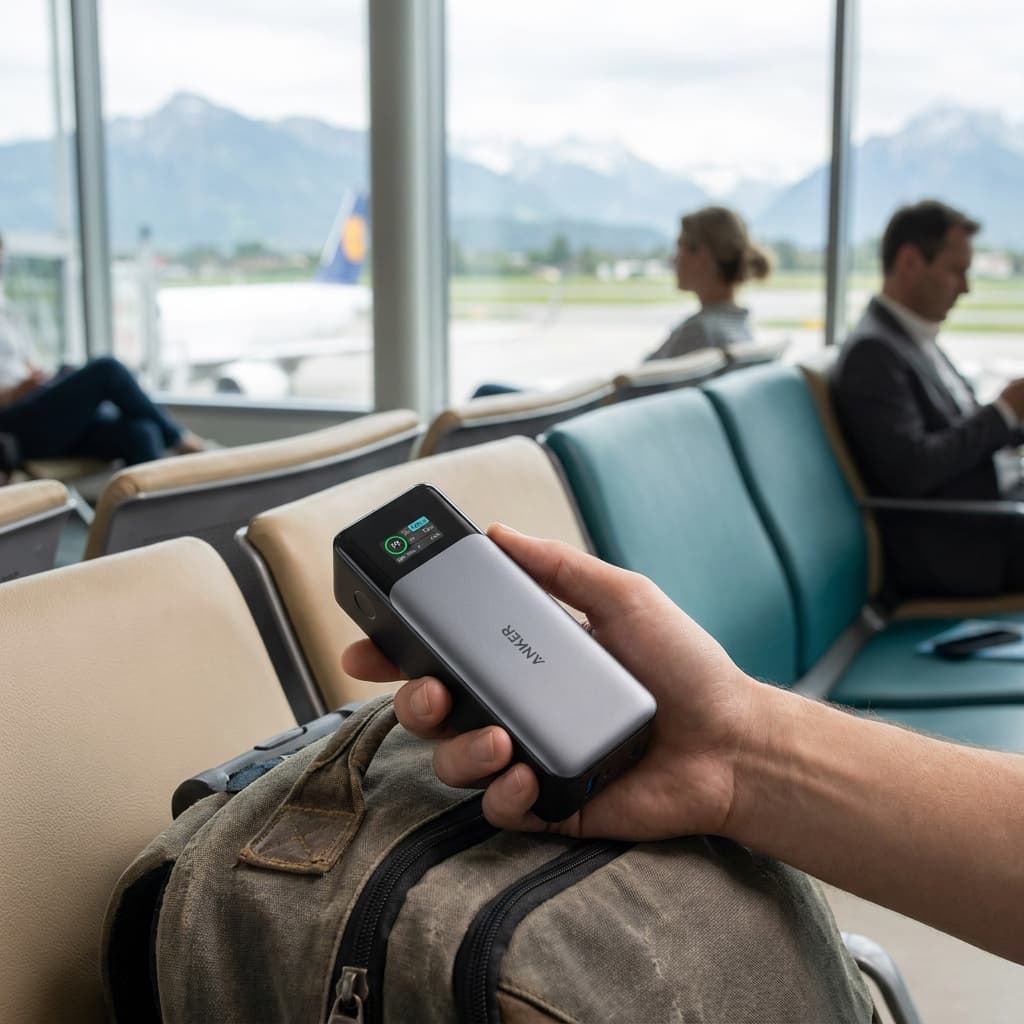
Best for: Travelers who carry a USB-C laptop and want high output, a live power display, and substantial capacity below the common 100Wh threshold.
- Smart digital display shows exact battery percentage, input/output wattage in real time
- At 1.39 lb it is noticeably heavier than phone-only banks, not a featherlight day-trip option
- Capacity
- 24,000mAh (86.4Wh)
- Max Output
- 140W (USB-C PD 3.1)
- Ports
- 2× USB-C, 1× USB-A
- Weight
- 1.39 lb (630g)
- Dimensions
- 6.13 × 2.15 × 1.95 in
- Airline Status
- 86.4Wh; below the common 100Wh limit
About this pick
The Anker 737 combines a printed 86.4Wh rating, up to 140W USB-C PD 3.1 output, three ports, and a real-time smart display. Its capacity sits below the common 100Wh threshold, while airline count, storage, and onboard-use rules still apply.
Strengths
- Smart digital display shows exact battery percentage, input/output wattage in real time
- 140W PD 3.1 output is fast enough for most laptops at full speed
- Its printed 86.4Wh rating leaves 13.6Wh of headroom below the common 100Wh threshold
- Two USB-C ports and one USB-A port can serve three devices within the 140W total-output ceiling
Weaknesses
- At 1.39 lb it is noticeably heavier than phone-only banks, not a featherlight day-trip option
- No built-in cable, and the boxed cable varies by seller (Amazon listing: 140W USB-C to C; Anker support page: short USB-A to C)
Kit Score breakdown
ANKER
Anker 10K Power Bank (PowerIQ, USB-C)
Best Budget
Kit Score 8.5/10
$25.99 Price checked Oct 23, 4:16 PM CDT
Best for: Budget-conscious travelers who need a slim, lightweight phone-charging backup for day trips and short flights without the bulk of a high-capacity bank.
- Exceptionally slim at 0.61 inches thick, fits a shirt pocket or flat in a travel organizer
- 15W output is standard speed, no fast-charging for phones that support 20W+ PD
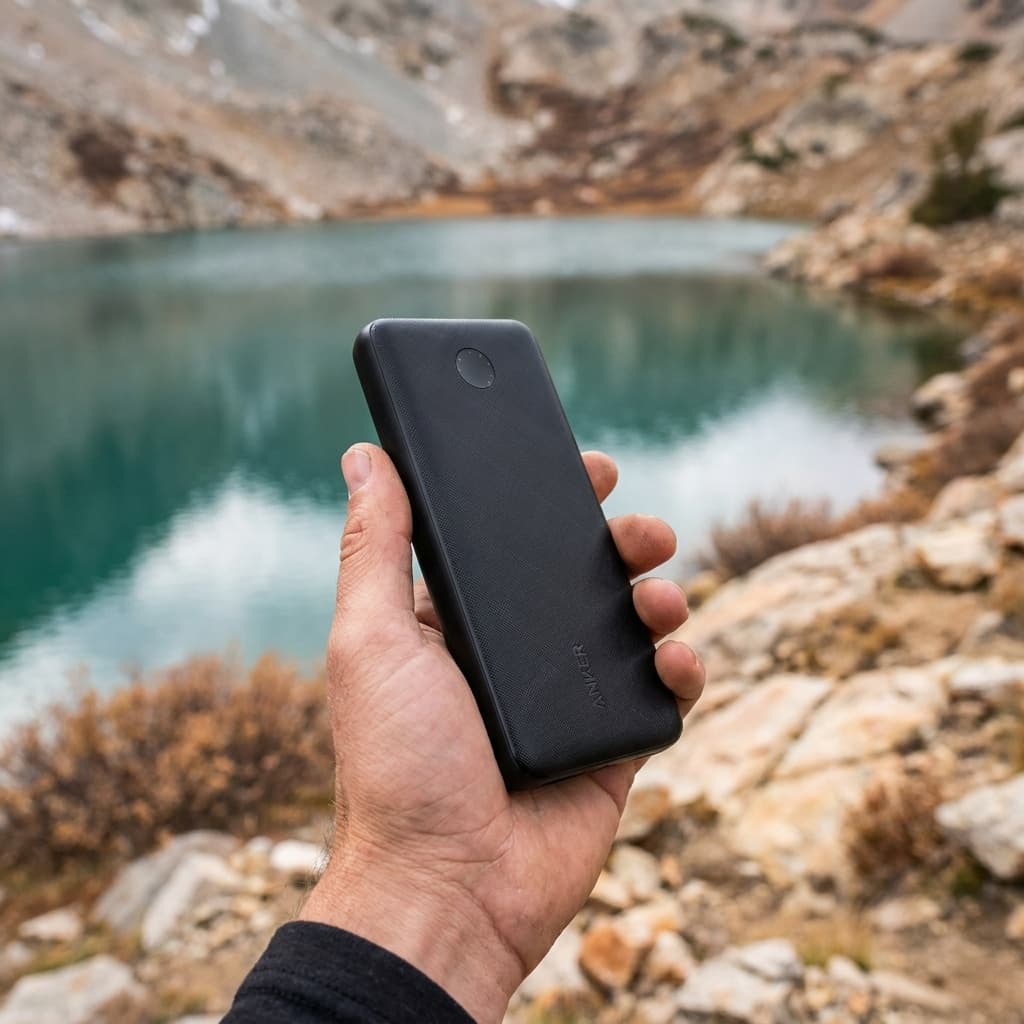
- Capacity
- 10,000mAh (37Wh)
- Max Output
- 15W (5V/3A)
- Ports
- 1× USB-C, 1× USB-A
- Weight
- 8.6 oz (Amazon listing)
- Dimensions
- 5.99 × 2.81 × 0.61 in
- Airline Status
- 37Wh; below the common 100Wh limit
About this pick
Anker's 10,000mAh PowerIQ bank is one of the slimmest carry-on power banks at under two-thirds of an inch thick, delivering roughly 1.3 to 1.6 charges of a typical phone, the no-fuss travel backup that disappears into a bag and just works.
Strengths
- Exceptionally slim at 0.61 inches thick, fits a shirt pocket or flat in a travel organizer
- Under $26 makes it a low-risk addition to any travel kit
- Overcharge and overload protection included
Weaknesses
- 15W output is standard speed, no fast-charging for phones that support 20W+ PD
- Cannot charge laptops or tablets meaningfully
- One port active at a time limits multi-device use
Kit Score breakdown

Best for: Value-focused travelers who want laptop-grade 100W charging and generous 20,000mAh capacity without paying premium-brand prices.
- 100W USB-C PD output charges most laptops at a meaningful rate, rare at this price
- Newer product with fewer reviews than Anker or Belkin alternatives; long-term durability less proven
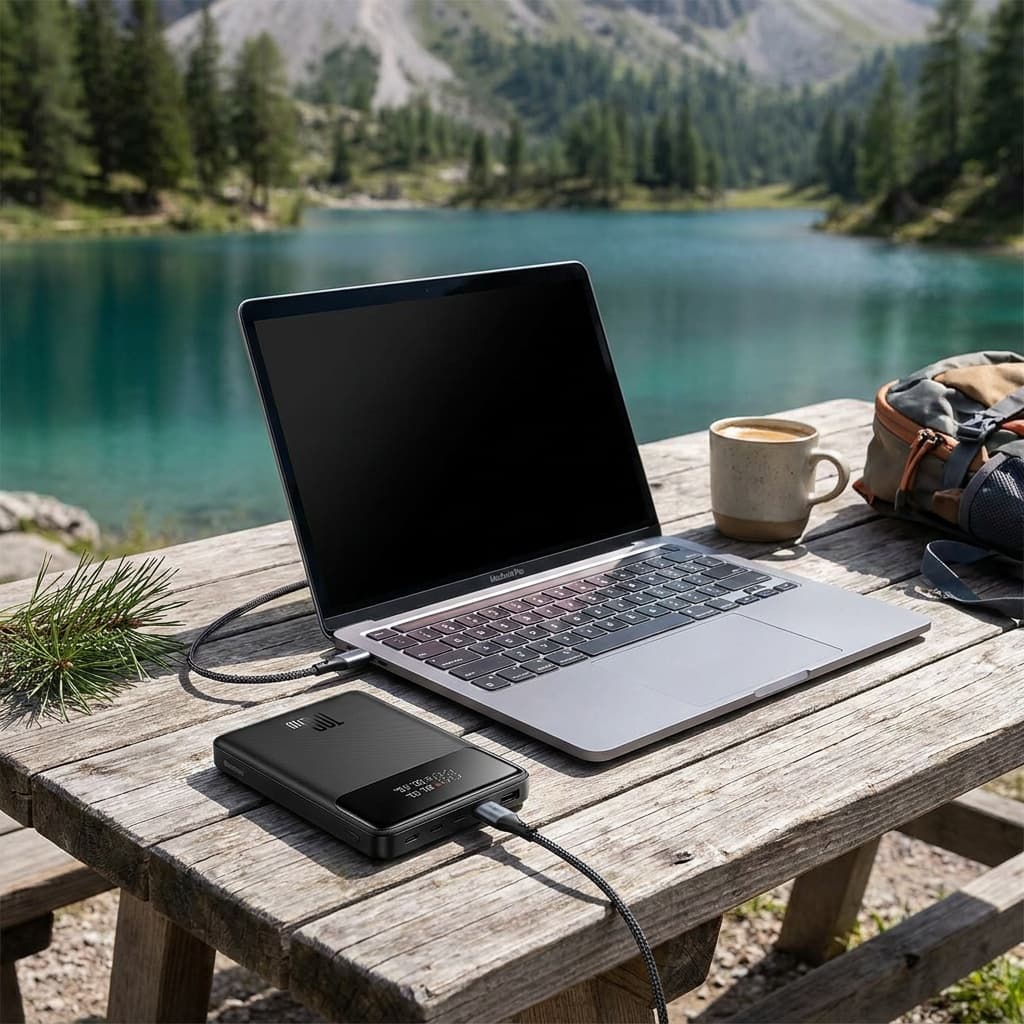
- Capacity
- 20,000mAh (74Wh)
- Max Output
- 100W (USB-C PD)
- Ports
- 2× USB-C, 2× USB-A
- Weight
- 0.98 lb (444g)
- Dimensions
- 5.27 × 5.27 × 0.78 in
- Airline Status
- 74Wh; under the common 100Wh limit
About this pick
The Baseus Blade delivers 100W USB-C PD and 20,000mAh of capacity in an unusually flat profile for around $54, offering laptop-charging performance at a price that undercuts the competition by a wide margin while staying comfortably within airline carry-on rules.
Strengths
- 100W USB-C PD output charges most laptops at a meaningful rate, rare at this price
- Flat blade design at 0.78 inches slides neatly into a laptop sleeve or flat compartment
- Four total ports means charging phone, laptop, earbuds, and a second device simultaneously
- At 74Wh it has 26Wh of headroom under the common 100Wh airline carry-on ceiling
Weaknesses
- Newer product with fewer reviews than Anker or Belkin alternatives; long-term durability less proven
- No digital display, only LED indicator lights for battery level
- Square form factor is less conventional than the typical rectangular bank
Kit Score breakdown
See all picks in The best travel power banks: carry-on approved picks that fast-charge
Keep going
Complete loadoutCarry-on travel kitA one-week suitcase system with the bag, organization, laundry, toiletries, security, scale, and power.Free tool: Power Bank Size Calculator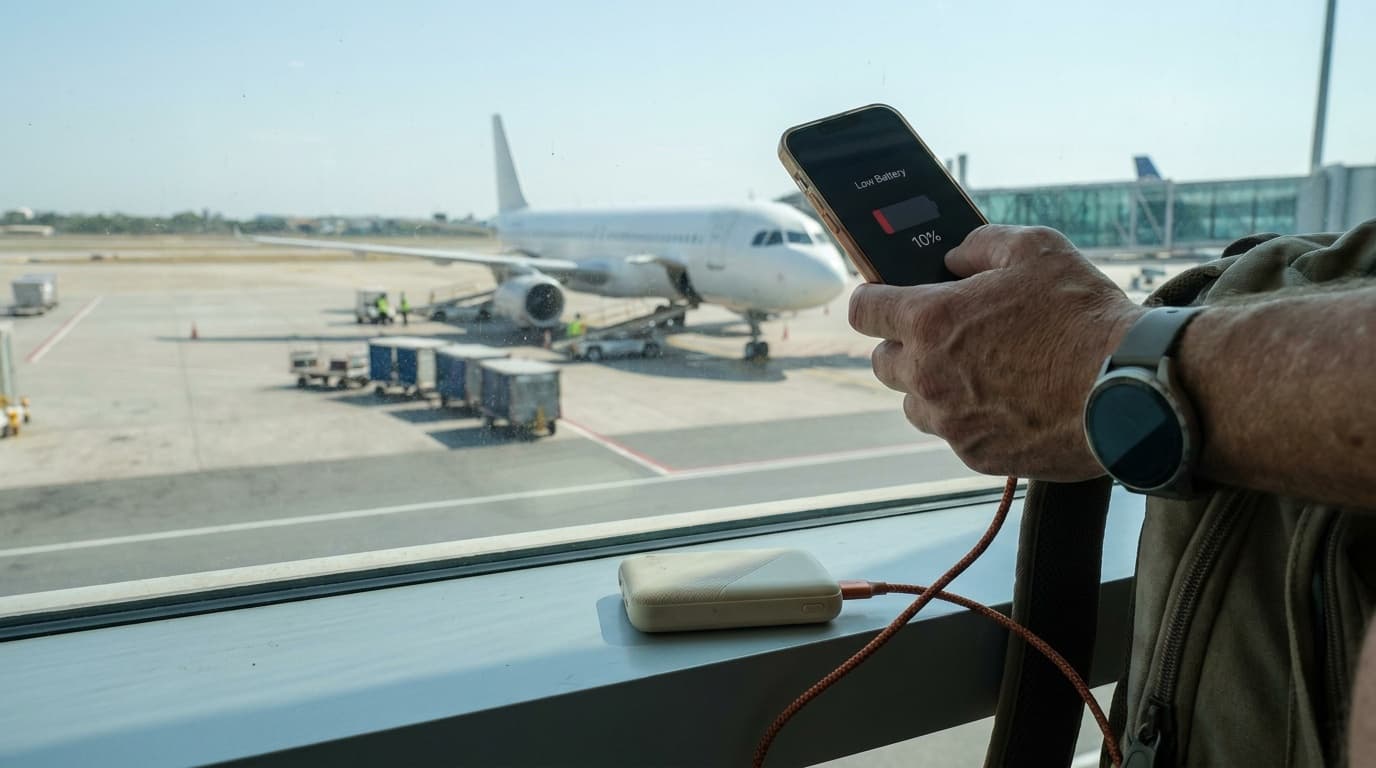
Researched, not hands-on tested
Updated Oct 3, 2026Our recommendations draw on manufacturer documentation, retailer listings, owner feedback, and comparisons with alternatives.
As an Amazon Associate I earn from qualifying purchases. We may earn a commission from links here, at no extra cost to you. How we research →