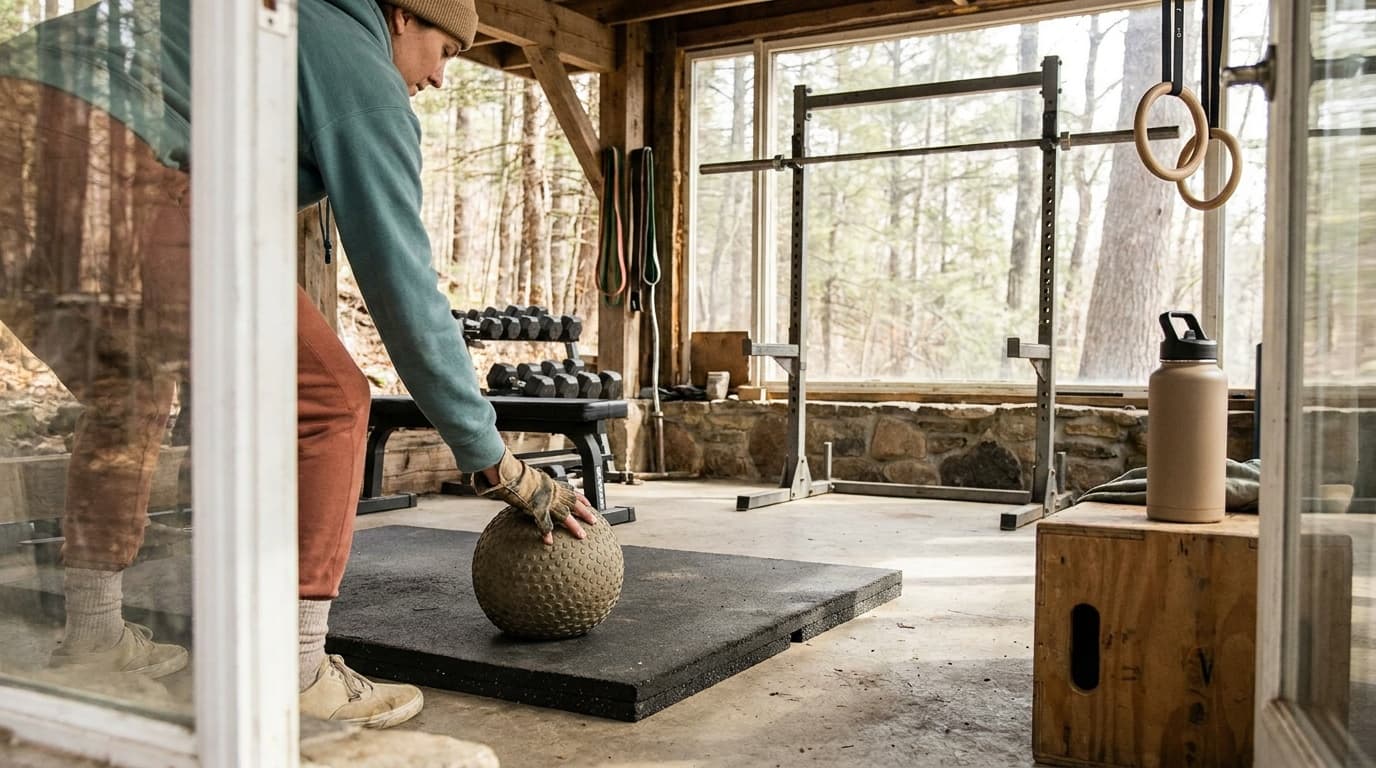
Picking the wrong weight turns a great movement into a bad habit. Get this choice right and slam balls become one of the most effective tools you own.
Why starting weight matters more than you think
Slam ball training looks simple. Pick it up, slam it down. But the movement pattern demands more from your core, hips, and shoulder girdle than it appears, especially in the catch and reset phase. Going too heavy too soon means your lower back absorbs what your hips should handle, and your form breaks down before you build any useful power.
The right starting weight keeps your speed high. Slam training is about violent hip extension and a fast overhead pull, not grinding through a heavy load. A ball you can slam with full commitment every rep is worth far more than one you struggle to get overhead.
Beginner starting points: what the numbers actually mean
For most people who are new to slam balls, 10 lb is the honest floor and 15 lb is the right starting point if you have any background in lifting or sport. A 10 lb ball like the Yes4All Slam Ball feels light when you hold it, but 20 full-speed slams in a conditioning circuit will change that opinion quickly.
If you have been lifting consistently for a year or more and your deadlift or hip hinge pattern is solid, you can start at 15–20 lb. The hinge strength you already own transfers directly to the slam.
Avoid the temptation to grab a 25 lb ball because it feels appropriately hard when you pick it up off the floor. That is not the test. The test is whether you can drive it overhead with full extension and control the drop at rep 15 of a 20-rep set.
The ball that keeps your speed honest is the right ball.
Women vs men: ranges and why goal matters more than gender
General ranges exist for a reason, but treat them as starting points, not assignments. Women new to slam training typically find their working weight in the 10–20 lb range. Men typically land between 15–30 lb. Those ranges reflect average differences in upper body strength and total body power output.
What shifts those numbers more than gender is what you are training for. If your goal is cardiovascular conditioning and you are doing circuits with short rest, you want a ball you can move fast for 12–20 reps. Go to the lighter end of your range. If your goal is developing explosive power and you are treating each slam like a max-effort movement with full recovery between reps, move to the heavier end and give yourself time to reset.
A competitive female CrossFit athlete may use a 20–25 lb ball for power slams. A man just returning to training after time off should start at 15 lb and earn the jump to 20 lb. The range is a guide, not a cap.
Conditioning vs power: two different weight strategies
This is the most overlooked variable in slam ball selection, and it is the main reason experienced athletes end up owning two balls.
For conditioning work (AMRAP circuits, Tabata intervals, metabolic finishers), you want a weight that lets you sustain quality movement under fatigue. That typically means a ball 10–20 percent lighter than your power slam weight. Your heart rate, not your muscles, should be the limiter.
For power development (treating each slam as an explosive single or double, full recovery between sets), you want a heavier ball that demands real hip drive to get overhead. This is where men often work in the 25–40 lb range and women in the 15–25 lb range; heavier lines like the Titan Fitness Rubber Slam Ball cover those weights.
The two goals are not interchangeable. Trying to do conditioning work with a power weight slows you down and turns the movement into a grind. Trying to develop power with a conditioning weight removes the overload stimulus that builds explosiveness.
How to find your working weight
Start light
Use 10–15 lb for your first two sessions regardless of fitness level.
Test your speed
If you can slam continuously at full effort for 15 reps, you have the right conditioning weight.
Test your power
For power sets, choose a weight where rep 5 still demands full commitment to get overhead.
Add load methodically
Jump by 5 lb increments only when you can complete full sets with unbroken form.
Buy your second ball
Once your conditioning weight is dialed in, add a ball 10 lb heavier for power work.
You control the throw, not the catch: why you can go heavier than a dumbbell
With a dumbbell or kettlebell, you manage the load in both directions. The eccentric (lowering) phase is where most muscle damage and fatigue accumulate. With a slam ball, you release the ball. The floor handles the catch.
This means your muscles only work concentrically on the slam itself, and you reset from a dead stop each rep. The practical result is that you can work with a slam ball that is noticeably heavier than what you would use for a comparable dumbbell movement, and your joints and connective tissue take less eccentric stress.
This is not a license to go reckless. Form still breaks at the hips and core when the load is too high. But it is a reason not to be too conservative when you are selecting your working weight, especially if you already train with free weights.
Frequently asked questions
Can I use a medicine ball instead of a slam ball?
Medicine balls and slam balls are designed for different things. A traditional medicine ball has a hard shell and is not built to absorb repeated ground impact. Slamming a medicine ball will damage it quickly and can create an unpredictable bounce. Slam balls have a thick rubber shell filled with sand or iron shot that absorbs impact and stays put when it hits the ground. If slamming is part of your training, use a slam ball.
How often should I go up in weight?
There is no fixed timeline, but a practical rule is to add 5 lb when you can complete your target reps with full hip extension and speed on every rep, not just the first few. For conditioning work that might take two to four weeks. For power development it could take longer, because the adaptation you are chasing is neuromuscular and shows up as speed and explosiveness, not just the ability to finish the set.
Is a 20 lb slam ball too heavy to start?
For most beginners, yes. Twenty pounds is not dangerous, but it is enough load to mask poor hip hinge mechanics. When the ball is heavy enough that you are struggling to get it overhead, your lower back tends to compensate for weak or slow hips. Starting at 10–15 lb lets you groove the pattern with speed, and speed is what makes the movement work. You can always add weight once the pattern is clean.
For specific picks at every weight and budget, see our guide to the best slam balls. Browse all fitness guides or read how we research and rate gear.
Recommended gear
Our current top picks from the Best slam balls for conditioning (2026) guide, if you are ready to buy.
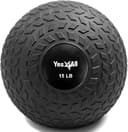
Best for: Beginners and intermediate athletes building a conditioning base who want a proven, affordable dead-bounce slam ball delivered fast.
- True dead bounce: sand-filled core keeps the ball planted on impact, letting you focus on rep quality
- Capped at 40 lb, so advanced athletes training heavy will outgrow it
- Shell
- PVC (textured tread)
- Fill
- Sand
- Weight range
- 10–40 lb
- Grip texture
- Raised tread pattern, non-slip
- Bounce
- Dead bounce (no bounce or roll)
- Warranty
- 1 year
About this pick
Yes4All's slam ball is one of the most widely reviewed slam balls on Amazon, with a sand-filled dead-bounce design that stays put after each slam. It ships Prime-eligible in seven weight options and covers the full beginner-to-intermediate range.
Strengths
- True dead bounce: sand-filled core keeps the ball planted on impact, letting you focus on rep quality
- Tread grip pattern holds through sweaty sessions without aggressive texture
- Prime-eligible across the full 10–40 lb range
Weaknesses
- Capped at 40 lb, so advanced athletes training heavy will outgrow it
- PVC shell is not as durable as rubber over years of daily commercial use
Kit Score breakdown
REP FITNESS
REP Weighted Slam Balls
BEST VALUE
Kit Score 8.1/10
$24.99 Price checked Oct 24, 5:42 AM CDT
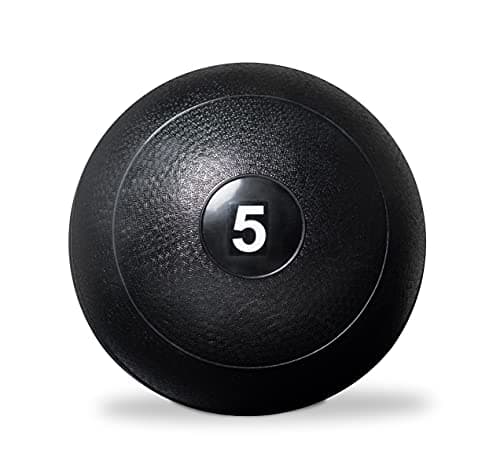
Best for: Athletes who want a durable, grippy no-bounce slam ball from a reputable specialty fitness brand, available in a full weight progression.
- Confirmed in stock across the weight range, sold directly by Rep Fitness on Amazon
- 250 total ratings is a modest review count compared to some competitors
- Shell material
- Textured rubber, sand-filled
- Bounce
- Non-bounce (dead weight)
- Available weights
- 5, 10, 15, 20, 25, 30, 35, 40, 45, 50, 60, 70 lb
- Diameter (5 lb)
- 9 inches
- Amazon rating
- 4.6 out of 5 stars (250 ratings)
- Best Sellers Rank
- #18 in Strength Training Medicine Balls
About this pick
The REP Fitness slam ball pairs a rugged, textured rubber shell with a sand-filled dead-weight core that kills the bounce on every throw. The surface grip holds through sweaty hands, and the range spans 5 to 70 lb so one model covers a full spectrum from beginners to advanced athletes.
Strengths
- Confirmed in stock across the weight range, sold directly by Rep Fitness on Amazon
- Textured rubber shell provides secure grip even when wet or sweaty, per multiple buyer reviews
- Wide weight selection (5 to 70 lb) supports progressive overload without switching products
Weaknesses
- 250 total ratings is a modest review count compared to some competitors
- Price per pound is moderate, not a budget pick for heavier weights
Kit Score breakdown

TITAN FITNESS
Titan Fitness Rubber Slam Ball
EDITOR'S CHOICE
Kit Score 8.5/10
$44.64 Price checked Oct 24, 5:42 AM CDT
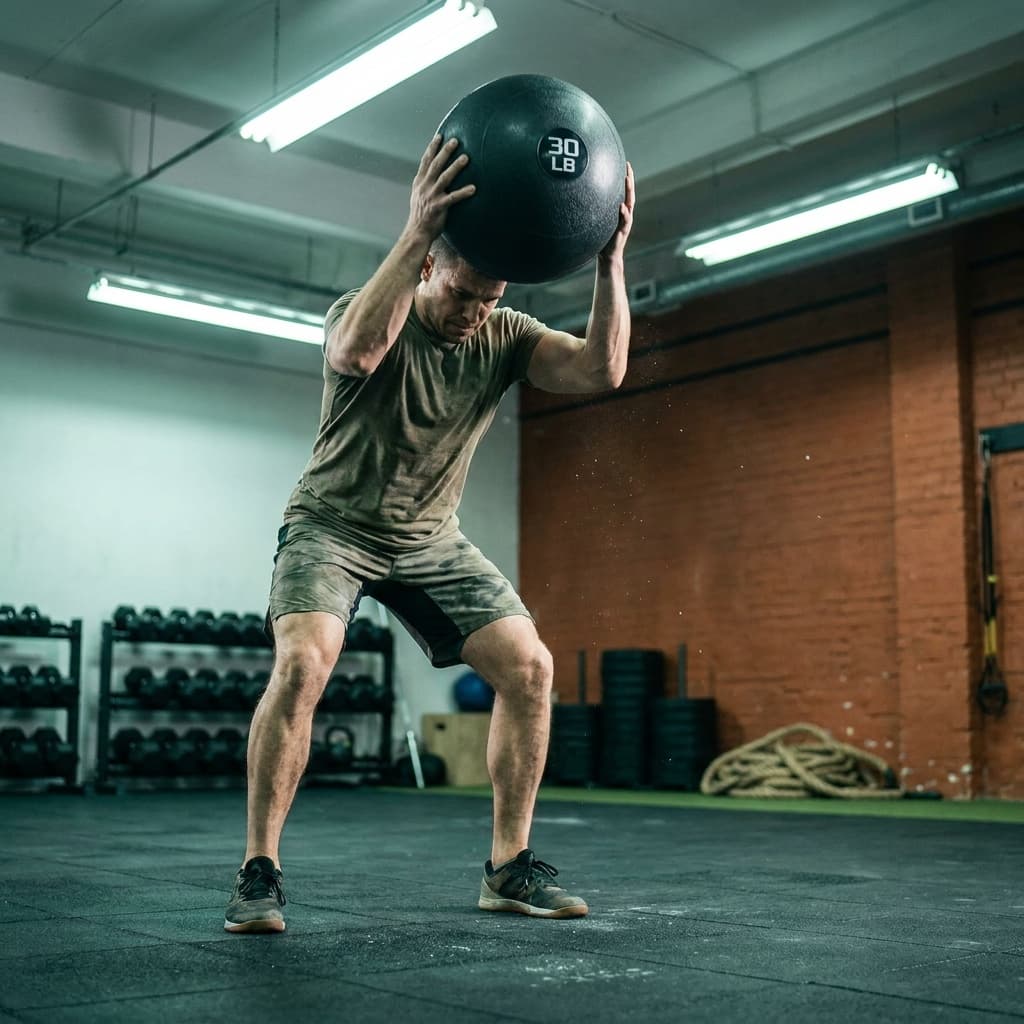
Best for: Intermediate to advanced athletes who need a durable, blowout-resistant slam ball they can grow into as training weight increases.
- Hard rubber shell is specifically engineered to resist blowouts, holding up under daily commercial-intensity slam sessions
- A small subset of owner reviews note slight bounce on heavier weight options rather than full dead bounce
- Shell
- Heavy-duty rubber, blowout-resistant
- Fill
- Sand
- Bounce
- Minimal bounce (dead weight, absorbs impact)
- Weight range
- 10–60 lb
- Grip texture
- Textured rubber surface
- Warranty
- 1 year (Mulberry extension available)
About this pick
Titan Fitness builds this slam ball around a hard rubber shell engineered to prevent blowouts under repeated high-force slamming, with a sand-filled dead-weight core for true no-bounce performance. Available in 10 weight options from 10 to 60 lb, it covers intermediate and advanced training loads.
Strengths
- Hard rubber shell is specifically engineered to resist blowouts, holding up under daily commercial-intensity slam sessions
- Weight range extends to 60 lb, covering advanced athletes in 10 increments (10, 15, 20, 25, 35, 40, 45, 50, 55, 60 lb)
- Priced well below premium brands at equivalent weights while delivering comparable build quality
Weaknesses
- A small subset of owner reviews note slight bounce on heavier weight options rather than full dead bounce
- Rigid rubber texture can feel rough on hands compared to softer PVC alternatives
Kit Score breakdown
Keep going
Researched, not hands-on tested
Updated Jul 8, 2026Our recommendations draw on manufacturer documentation, retailer listings, owner feedback, and comparisons with alternatives.
As an Amazon Associate I earn from qualifying purchases. We may earn a commission from links here, at no extra cost to you. How we research →