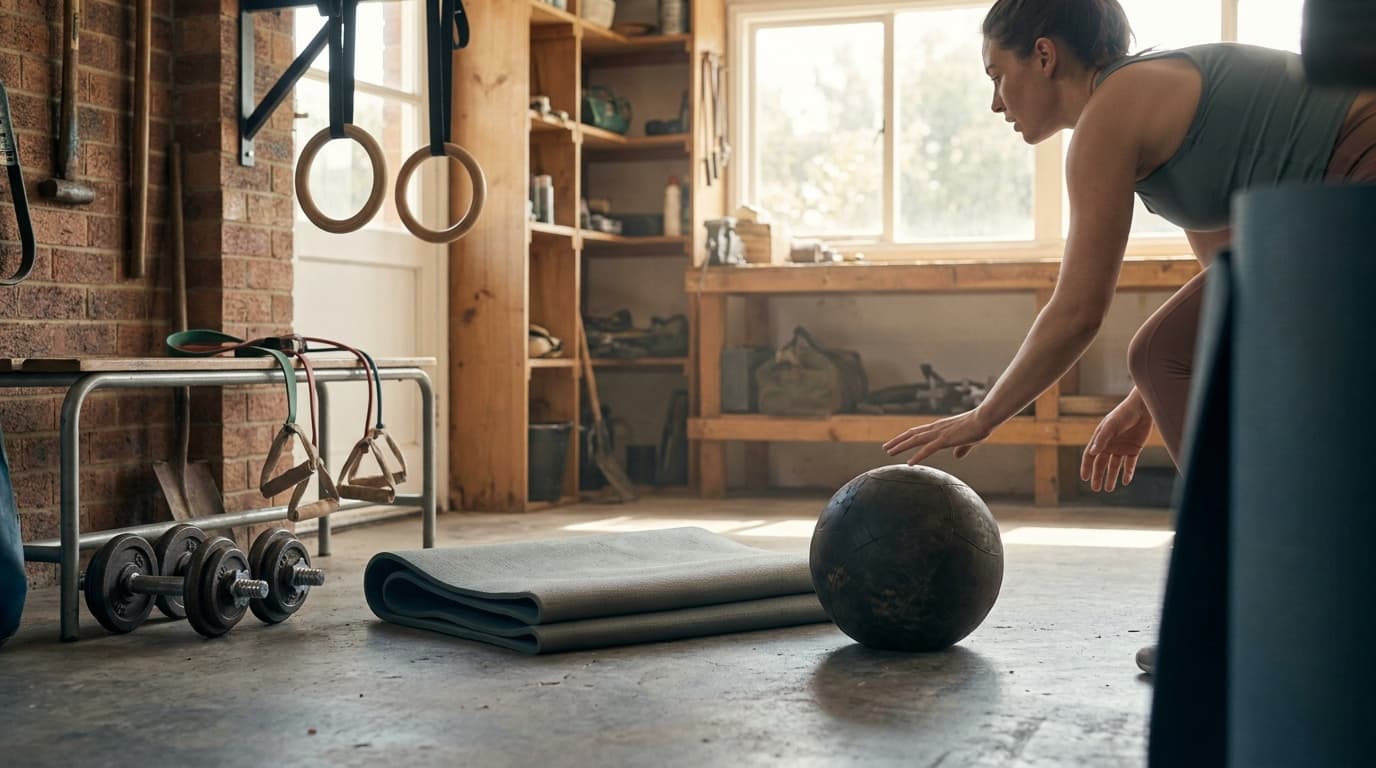
Slam balls are one of the most honest tools in the gym: they reward full-body effort and expose half-measures immediately. If you have never touched one, the learning curve is short and the payoff is real.
The hip-hinge mechanic: why it matters
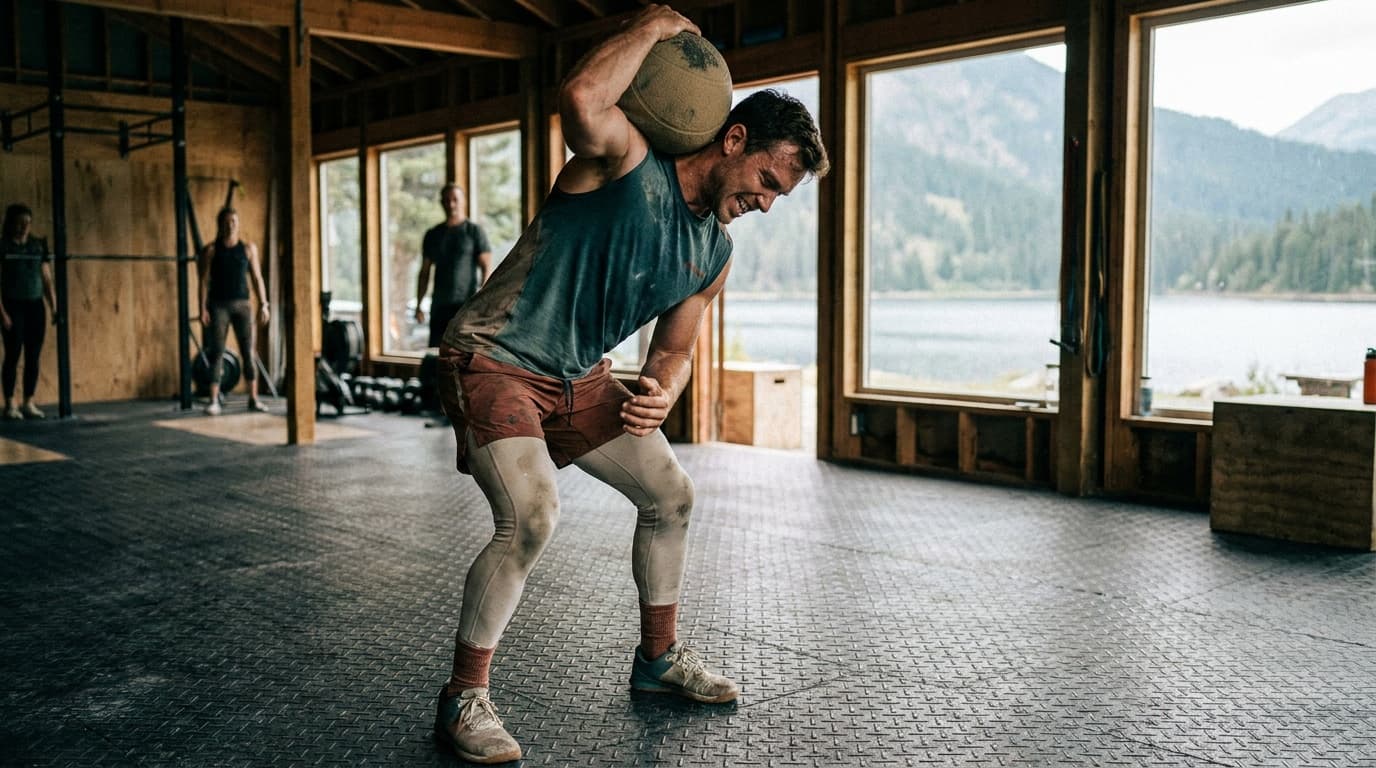
Before you pick up a slam ball, understand what drives the movement. A slam is not an arm exercise. Power flows from the ground up: feet drive into the floor, hips hinge and then extend aggressively, the core transfers that force, and the arms finish the throw. The hip hinge is the foundation of every move in this guide.
To drill it without any weight: stand with feet hip-width apart, soft bend in the knees, and push your hips back until you feel tension in your hamstrings. Your spine stays neutral, not rounded. From that loaded position, squeeze your glutes and drive your hips forward. That snap is what launches the ball.
The slam ball only goes as hard as your hip extension lets it.
Once the hinge feels natural at bodyweight, you are ready to load it.
Picking your starting weight
Choosing a weight that is too light makes the workout too easy to be useful. Too heavy, and form collapses on the third rep. Balls sold in 5 lb increments, like the REP Weighted Slam Balls, make the eventual step up simple.
For overhead slams, err lighter than you think. The ball accelerates over a long path, and controlling the catch or letting it drop safely requires coordination you build over time. For rotational slams, the leverage angle is shorter, so you can handle slightly more weight once your core control is solid.
A simple test: if your lower back rounds noticeably at the top of the overhead lift, drop 5 lb.
The four foundational moves
Four foundational slam ball moves
Overhead slam
Stand hip-width, hinge to pick up the ball, drive hips forward, press the ball overhead, and accelerate it straight down into the floor in front of your feet. Let it bounce or pick it up controlled.
Rotational slam
Hold the ball at hip height, rotate your torso away from the target wall or floor spot, load the back hip, then rotate hard through and release. Targets the obliques and transverse chain.
Squat to slam
Hold the ball at chest height, sit into a full squat with an upright torso, drive through your heels to stand, and transition into an overhead slam at the top of the rise. Combines lower-body strength with power.
Ball clean
From a hip-hinge position with the ball on the floor, drive through the hips and pull the ball in a tight arc to a front-rack position at chest height. Builds the pulling and receiving mechanics that carry over to barbell training.
Learn them in this order. The overhead slam teaches the basic hinge-and-extend. The rotational slam adds the transverse plane. The squat-to-slam chains lower body and upper body. The ball clean introduces a more technical catch, so save it until the first three feel automatic.
Breathing and core engagement
Breathing on explosive movements is not instinctive at first. The pattern is simple: inhale during the load phase (hinging back, reaching overhead), exhale sharply on the throw or slam. That sharp exhale is an active brace, not a passive breath release. Think of it as a short, forceful "ha" sound as the ball leaves your hands.
This matters because the intra-abdominal pressure created by a controlled exhale stabilizes your lumbar spine under load. Holding your breath entirely (Valsalva) works for single maximal lifts but is not appropriate for the repeated efforts in a conditioning circuit. Exhale on effort, inhale on the reset.
A simple beginner conditioning circuit
This circuit uses all four moves at a manageable pace. Rest is generous because the goal is clean reps, not cardiovascular distress.
Beginner slam ball circuit
Warm-up
5 minutes of light movement: hip circles, bodyweight squats, arm swings, and 5 practice hip hinges with no weight.
Round 1
8 overhead slams, rest 60 seconds, 8 rotational slams per side, rest 60 seconds.
Round 2
6 squat-to-slams, rest 60 seconds, 6 ball cleans, rest 90 seconds.
Repeat
Complete 2–3 total rounds. Stop a set early if your lower back rounds or your throws go short and sloppy.
Cool-down
5 minutes of walking and hip flexor stretching.
Three sessions per week with at least one rest day between is a solid starting cadence. Most beginners see noticeable improvement in power output and coordination within four weeks.
Common form mistakes (and the fixes)
Four errors show up in almost every beginner's first session.
Rounding the lower back on the hinge: the fix is to brace the core before you initiate the hip push, not after. Think "tall spine" at the top of the setup.
Slamming with the arms only: if the ball is landing softly despite your effort, your hips are not engaging. Slow down, reset the hinge position, and focus on feeling the glute squeeze before the arms accelerate.
Letting the ball bounce unpredictably: true slam balls are dead-weight and do not bounce much. If yours is bouncing hard, you may be using a medicine ball designed for wall work. Use a dead-bounce slam ball like the Yes4All Slam Ball for floor slams.
Holding tension after the catch: between reps, take a full reset breath. Continuous tension without reset breathing leads to early fatigue and the sloppy reps that cause tweaks.
Frequently asked questions
How heavy should a slam ball be for a beginner?
For most adults new to slam ball training, 10–15 lb is the right starting range. This is light enough to maintain proper hip-hinge mechanics and controlled deceleration through the full range of motion, but heavy enough to provide real resistance. Move up to 20 lb once you can complete three rounds of 8 overhead slams with consistently neutral spine and strong hip extension on every rep.
Can I use a regular medicine ball for slam ball exercises?
Not for floor slams. Standard medicine balls have a harder shell designed for wall throws and are not filled to absorb ground impact, so they bounce back unpredictably and can cause injury. Slam balls have a thick rubber shell and a dead-weight fill (sand or similar) that absorbs the impact and stays where it lands. For wall-facing rotational work, a medicine ball is fine; for overhead or floor slams, use an actual slam ball.
How often should a beginner do slam ball training?
Two to three sessions per week with at least one full rest day between each session is appropriate for beginners. Slam ball work is high-intensity and stresses the posterior chain, core, and shoulders simultaneously. More is not better early on. Consistent two-day-per-week practice will build the movement patterns and power base you need to add volume or weight safely after four to six weeks.
For specific picks matched to beginner needs and budget, see our guide to the best slam balls. Browse all fitness guides or read how we research and rate gear.
Recommended gear
Our current top picks from the Best slam balls for conditioning (2026) guide, if you are ready to buy.
Best for: Beginners and intermediate athletes building a conditioning base who want a proven, affordable dead-bounce slam ball delivered fast.
- True dead bounce: sand-filled core keeps the ball planted on impact, letting you focus on rep quality
- Capped at 40 lb, so advanced athletes training heavy will outgrow it
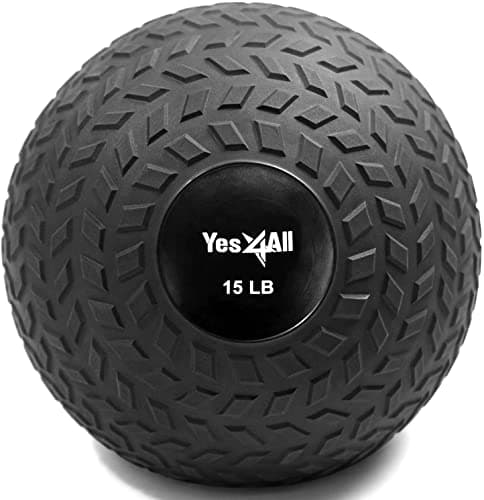
- Shell
- PVC (textured tread)
- Fill
- Sand
- Weight range
- 10–40 lb
- Grip texture
- Raised tread pattern, non-slip
- Bounce
- Dead bounce (no bounce or roll)
- Warranty
- 1 year
About this pick
Yes4All's slam ball is one of the most widely reviewed slam balls on Amazon, with a sand-filled dead-bounce design that stays put after each slam. It ships Prime-eligible in seven weight options and covers the full beginner-to-intermediate range.
Strengths
- True dead bounce: sand-filled core keeps the ball planted on impact, letting you focus on rep quality
- Tread grip pattern holds through sweaty sessions without aggressive texture
- Prime-eligible across the full 10–40 lb range
Weaknesses
- Capped at 40 lb, so advanced athletes training heavy will outgrow it
- PVC shell is not as durable as rubber over years of daily commercial use
Kit Score breakdown
REP FITNESS
REP Weighted Slam Balls
BEST VALUE
Kit Score 8.1/10
$24.99 Price checked Oct 24, 5:42 AM CDT
Best for: Athletes who want a durable, grippy no-bounce slam ball from a reputable specialty fitness brand, available in a full weight progression.
- Confirmed in stock across the weight range, sold directly by Rep Fitness on Amazon
- 250 total ratings is a modest review count compared to some competitors
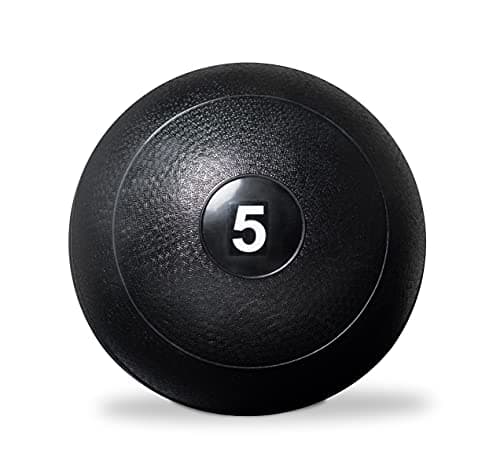
- Shell material
- Textured rubber, sand-filled
- Bounce
- Non-bounce (dead weight)
- Available weights
- 5, 10, 15, 20, 25, 30, 35, 40, 45, 50, 60, 70 lb
- Diameter (5 lb)
- 9 inches
- Amazon rating
- 4.6 out of 5 stars (250 ratings)
- Best Sellers Rank
- #18 in Strength Training Medicine Balls
About this pick
The REP Fitness slam ball pairs a rugged, textured rubber shell with a sand-filled dead-weight core that kills the bounce on every throw. The surface grip holds through sweaty hands, and the range spans 5 to 70 lb so one model covers a full spectrum from beginners to advanced athletes.
Strengths
- Confirmed in stock across the weight range, sold directly by Rep Fitness on Amazon
- Textured rubber shell provides secure grip even when wet or sweaty, per multiple buyer reviews
- Wide weight selection (5 to 70 lb) supports progressive overload without switching products
Weaknesses
- 250 total ratings is a modest review count compared to some competitors
- Price per pound is moderate, not a budget pick for heavier weights
Kit Score breakdown

TITAN FITNESS
Titan Fitness Rubber Slam Ball
EDITOR'S CHOICE
Kit Score 8.5/10
$44.64 Price checked Oct 24, 5:42 AM CDT
Best for: Intermediate to advanced athletes who need a durable, blowout-resistant slam ball they can grow into as training weight increases.
- Hard rubber shell is specifically engineered to resist blowouts, holding up under daily commercial-intensity slam sessions
- A small subset of owner reviews note slight bounce on heavier weight options rather than full dead bounce
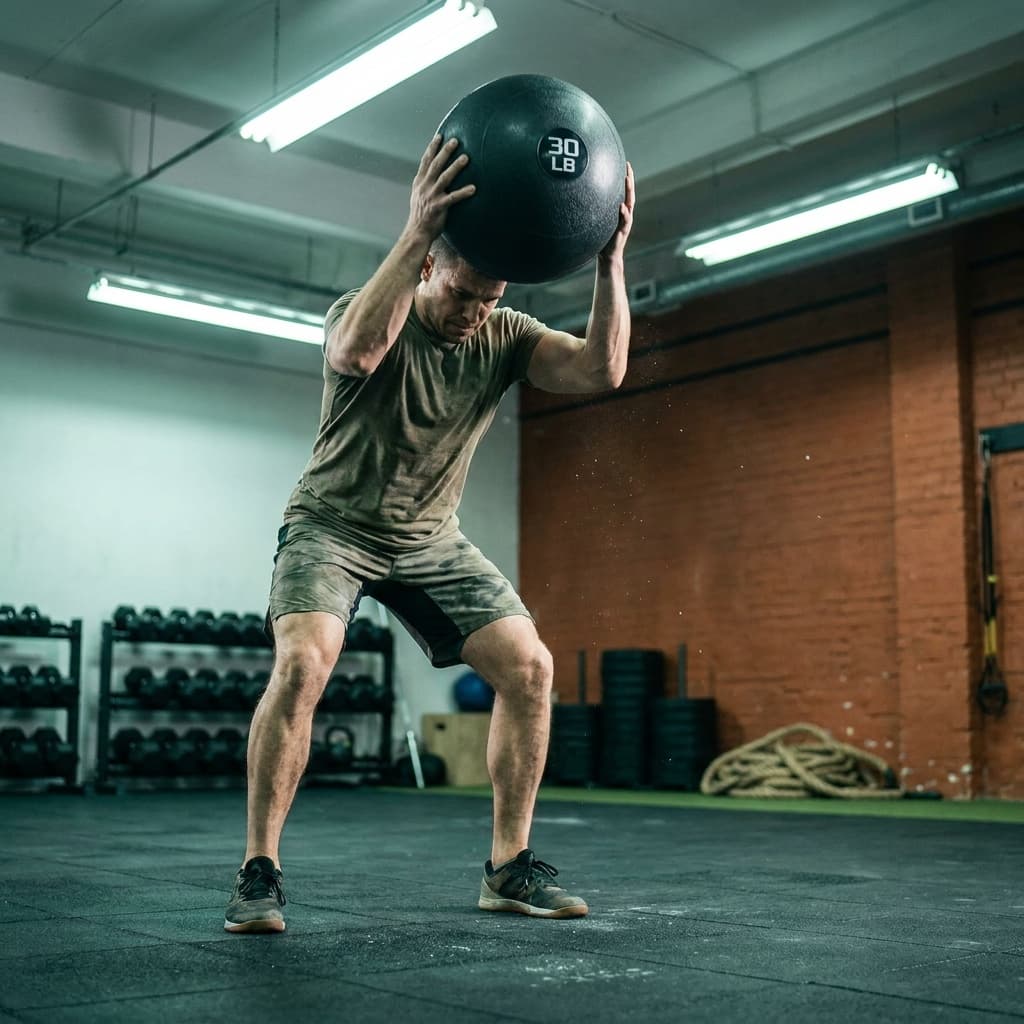
- Shell
- Heavy-duty rubber, blowout-resistant
- Fill
- Sand
- Bounce
- Minimal bounce (dead weight, absorbs impact)
- Weight range
- 10–60 lb
- Grip texture
- Textured rubber surface
- Warranty
- 1 year (Mulberry extension available)
About this pick
Titan Fitness builds this slam ball around a hard rubber shell engineered to prevent blowouts under repeated high-force slamming, with a sand-filled dead-weight core for true no-bounce performance. Available in 10 weight options from 10 to 60 lb, it covers intermediate and advanced training loads.
Strengths
- Hard rubber shell is specifically engineered to resist blowouts, holding up under daily commercial-intensity slam sessions
- Weight range extends to 60 lb, covering advanced athletes in 10 increments (10, 15, 20, 25, 35, 40, 45, 50, 55, 60 lb)
- Priced well below premium brands at equivalent weights while delivering comparable build quality
Weaknesses
- A small subset of owner reviews note slight bounce on heavier weight options rather than full dead bounce
- Rigid rubber texture can feel rough on hands compared to softer PVC alternatives
Kit Score breakdown
Keep going
Researched, not hands-on tested
Updated Jun 4, 2026Our recommendations draw on manufacturer documentation, retailer listings, owner feedback, and comparisons with alternatives.
As an Amazon Associate I earn from qualifying purchases. We may earn a commission from links here, at no extra cost to you. How we research →