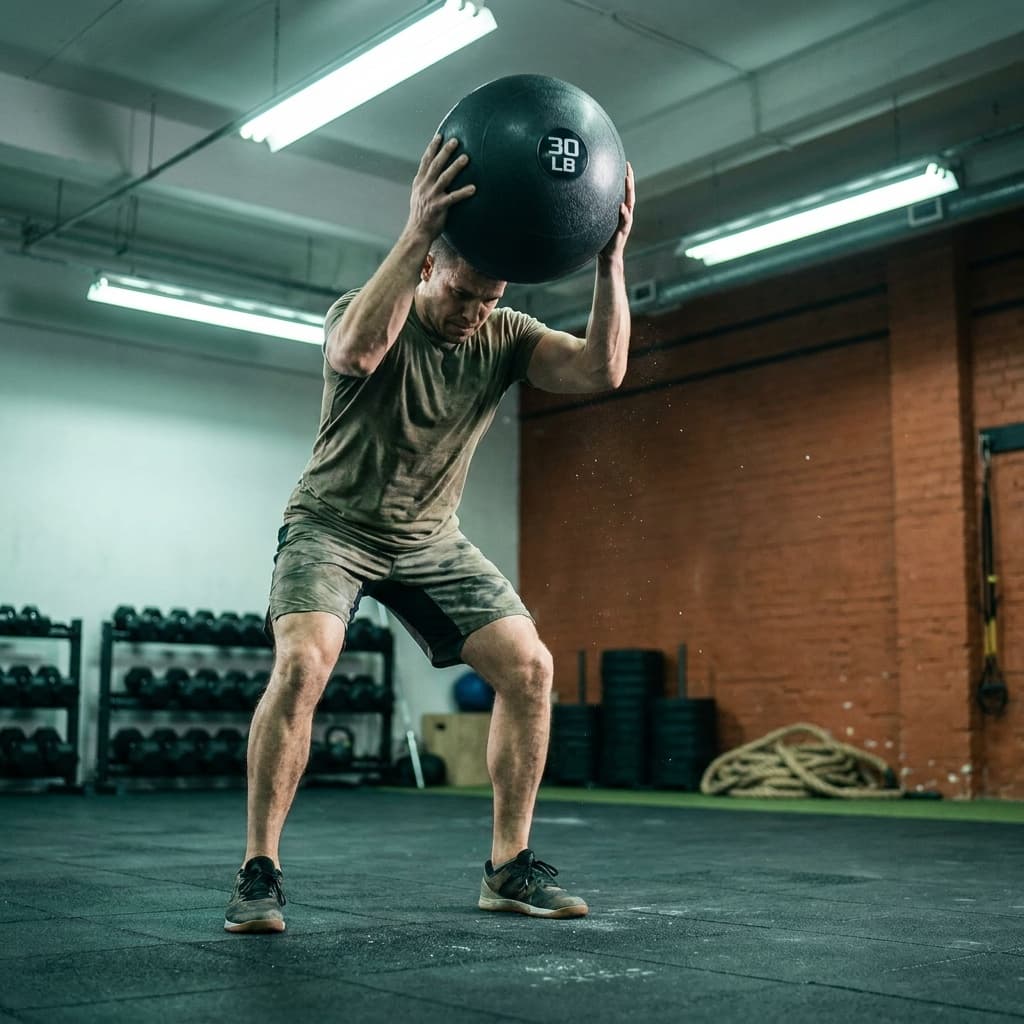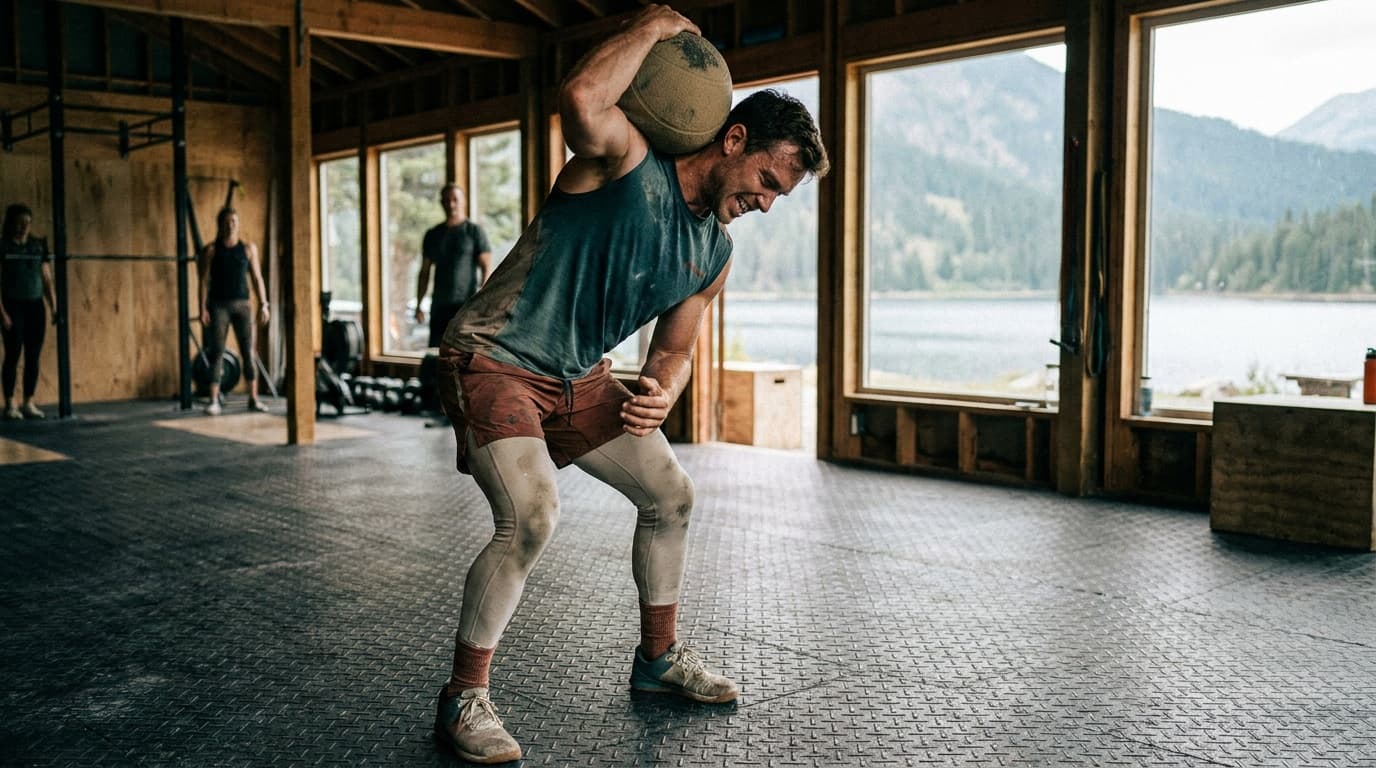
Slam balls are purpose-built for ground impact: thick rubber shells, sand-and-rubber fill that kills the rebound, and a surface grippy enough to hold when your hands are damp. Unlike wall balls, which are designed to bounce back off a target, a slam ball just stops, forcing you to hinge, reset, and generate power all over again.
Our quick picks
How we picked
Every pick here was evaluated against the Kit Score: shell construction and seam integrity (the most common failure point in reviews), grip texture, weight accuracy, fill consistency, and verified-owner durability across extended use. We read hundreds of owner reports and cross-referenced manufacturer specs to narrow the field.
Slam balls vs. wall balls: what actually matters
Slam balls and wall balls share a weight and a roughly spherical shape, but they are built for opposite trajectories. Wall balls are lightly filled and designed to have some give so they can absorb contact with a target and be caught on the rebound. Slam balls are densely packed with sand or a sand-rubber blend, which collapses on impact instead of bouncing. Trying to use a wall ball for repeated ground slams shreds the seam; trying to use a slam ball for catch-and-throw drills with a partner is awkward because it barely comes back to you.
The construction also changes how the weight distributes in your hands. A sand-filled slam ball has a shifting, slightly dead feel when you lift it, which engages stabilizing muscles differently than a fixed-fill kettlebell or dumbbell. That shift is part of the training stimulus, not a defect.

Choosing the right weight
Most beginners underestimate how quickly slam ball fatigue arrives and start too heavy. A useful starting point: if you can perform 15 clean overhead slams in a row without losing hip hinge form, you can move up. For most adults starting conditioning work, 10 to 15 lbs is the entry range. Intermediate athletes with some power-training background typically work in the 20 to 30 lb zone. Advanced athletes doing strength-focused conditioning sets often go 40 lbs and above, where ball diameter also grows and grip mechanics change.
Building a set of two weights, one moderate and one heavier, covers most conditioning circuits without requiring a large investment.
The picks
Yes4All Slam Ball
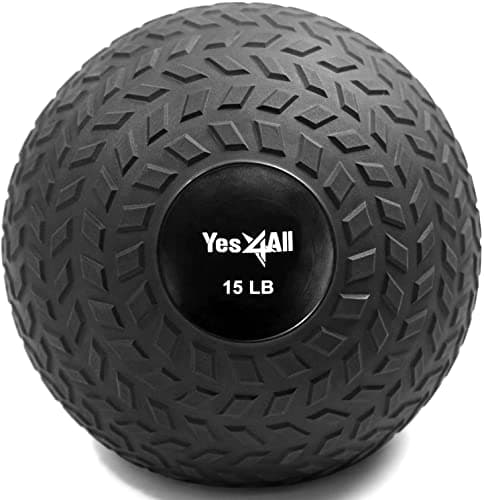
The Yes4All Slam Ball is the most widely reviewed slam ball in this category, and the pattern across verified owner accounts is consistent: the shell holds up under daily gym use, the weight markings are accurate, and the surface grip is adequate for moderate sweating. The ball is made from a thick rubber shell over a sand-and-rubber crumb fill, which produces a genuine no-bounce response on hard gym floors and rubber matting alike.
Weight range runs from 10 to 50 lbs, which makes it practical for building a full conditioning set without switching brands. The 10 and 15 lb versions are the right starting point for beginners learning overhead slam mechanics; the 30 to 50 lb range serves strength-focused conditioning work. The diameter increases as weight increases, which is standard for the category and changes how the ball sits in your hands at heavier loads.
Seam construction is the variable most scrutinized in owner reviews, and the Yes4All generally holds across light to moderate training frequency. High-volume athletes doing multiple daily sessions report more wear over time than casual users, which is true across the category. At this price point, the durability-to-cost ratio is well regarded.
BEST OVERALL
Yes4All Slam Ball
Best for: Beginners and intermediate athletes building a conditioning base who want a proven, affordable dead-bounce slam ball delivered fast.
- True dead bounce: sand-filled core keeps the ball planted on impact, letting you focus on rep quality
- Capped at 40 lb, so advanced athletes training heavy will outgrow it
Kit Score 8.7/10 · $28.25 Price checked Oct 23, 4:16 PM CDT · how we score gear
Buy on AmazonProduct details
Yes4All's slam ball is one of the most widely reviewed slam balls on Amazon, with a sand-filled dead-bounce design that stays put after each slam. It ships Prime-eligible in seven weight options and covers the full beginner-to-intermediate range.
- Shell
- PVC (textured tread)
- Fill
- Sand
- Weight range
- 10–40 lb
- Grip texture
- Raised tread pattern, non-slip
- Bounce
- Dead bounce (no bounce or roll)
- Warranty
- 1 year
More strengths
- Tread grip pattern holds through sweaty sessions without aggressive texture
- Prime-eligible across the full 10–40 lb range
Other tradeoffs
- PVC shell is not as durable as rubber over years of daily commercial use
REP Weighted Slam Balls
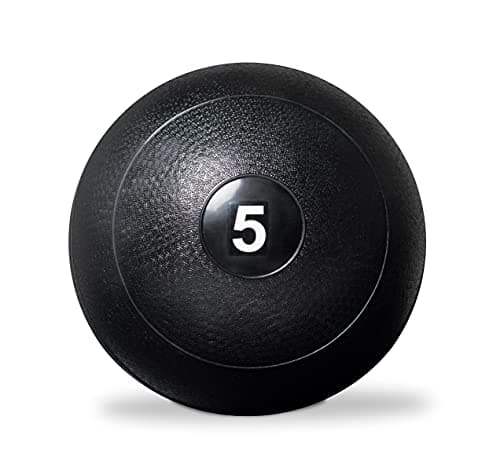
The REP Fitness slam ball distinguishes itself primarily through surface texture. Where many rubber slam balls have a relatively smooth or lightly pebbled exterior, the REP version uses a more deeply textured grip pattern that holds in conditions where hands become sweaty. That is not a trivial detail: grip security matters most at the moment of overhead loading, and dropping a 30 lb ball from overhead is a real injury risk.
REP sources its balls with a sand-rubber blend fill that produces the dead-weight feel the category is known for. Weight options span from 10 to 50 lbs in graduated increments, which covers the full progression a committed athlete would need. Verified owner reviews specifically call out the grip and the weight accuracy as strengths, and the brand's reputation for quality control across its broader product line is reflected in how the slam balls are received.
The price sits modestly above the Yes4All tier, which reflects both the brand positioning and the grip surface specification. For athletes who train in warm or humid conditions, the added grip security is worth the delta.
BEST VALUE
REP Weighted Slam Balls
Best for: Athletes who want a durable, grippy no-bounce slam ball from a reputable specialty fitness brand, available in a full weight progression.
- Confirmed in stock across the weight range, sold directly by Rep Fitness on Amazon
- 250 total ratings is a modest review count compared to some competitors
Kit Score 8.1/10 · $24.99 Price checked Oct 23, 4:16 PM CDT · how we score gear
Buy on AmazonProduct details
The REP Fitness slam ball pairs a rugged, textured rubber shell with a sand-filled dead-weight core that kills the bounce on every throw. The surface grip holds through sweaty hands, and the range spans 5 to 70 lb so one model covers a full spectrum from beginners to advanced athletes.
- Shell material
- Textured rubber, sand-filled
- Bounce
- Non-bounce (dead weight)
- Available weights
- 5, 10, 15, 20, 25, 30, 35, 40, 45, 50, 60, 70 lb
- Diameter (5 lb)
- 9 inches
- Amazon rating
- 4.6 out of 5 stars (250 ratings)
- Best Sellers Rank
- #18 in Strength Training Medicine Balls
More strengths
- Textured rubber shell provides secure grip even when wet or sweaty, per multiple buyer reviews
- Wide weight selection (5 to 70 lb) supports progressive overload without switching products
Other tradeoffs
- Price per pound is moderate, not a budget pick for heavier weights
Titan Fitness Rubber Slam Ball
Titan Fitness positions its slam ball toward the upper weight range of the category, and the shell construction reflects that intent. Owner reports on the heavier variants (30 lbs and above) consistently note that the rubber shell feels denser and more resistant to deformation than comparably priced competitors. For heavy-throw conditioning, specifically slam patterns involving maximum force production, that shell integrity is the specification that matters most.
The available weight range extends to 50 lbs across the lineup. The ball surface is textured rubber, sufficient for dry conditions; athletes who train in high-humidity environments may want to use chalk or choose the REP version for its grip advantage. Seam construction on the Titan holds well under heavy use based on the volume of long-term owner reports available.
The Titan is a better fit for athletes who have already established their conditioning base and are working in heavier ranges than for beginners, where the Yes4All's price advantage is harder to argue against.
EDITOR'S CHOICE
Titan Fitness Rubber Slam Ball
Best for: Intermediate to advanced athletes who need a durable, blowout-resistant slam ball they can grow into as training weight increases.
- Hard rubber shell is specifically engineered to resist blowouts, holding up under daily commercial-intensity slam sessions
- A small subset of owner reviews note slight bounce on heavier weight options rather than full dead bounce
Kit Score 8.5/10 · $46.99 Price checked Oct 23, 4:16 PM CDT · how we score gear
Buy on AmazonProduct details
Titan Fitness builds this slam ball around a hard rubber shell engineered to prevent blowouts under repeated high-force slamming, with a sand-filled dead-weight core for true no-bounce performance. Available in 10 weight options from 10 to 60 lb, it covers intermediate and advanced training loads.
- Shell
- Heavy-duty rubber, blowout-resistant
- Fill
- Sand
- Bounce
- Minimal bounce (dead weight, absorbs impact)
- Weight range
- 10–60 lb
- Grip texture
- Textured rubber surface
- Warranty
- 1 year (Mulberry extension available)
More strengths
- Weight range extends to 60 lb, covering advanced athletes in 10 increments (10, 15, 20, 25, 35, 40, 45, 50, 55, 60 lb)
- Priced well below premium brands at equivalent weights while delivering comparable build quality
Other tradeoffs
- Rigid rubber texture can feel rough on hands compared to softer PVC alternatives
SPRI Dead Weight Slam Ball
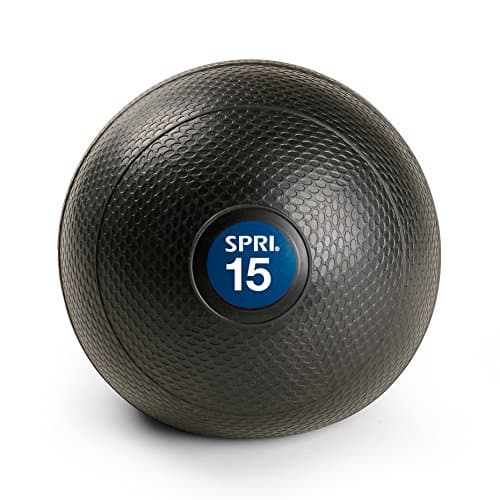
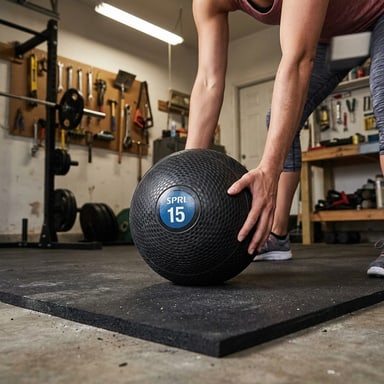
The SPRI Dead Weight Slam Ball takes a different approach to shell construction. Instead of a hard rubber exterior, it uses a softer, pliable outer layer that makes the ball easier to grip and more comfortable to hold for extended core work. The dead-weight name is accurate: the fill produces a completely inert, non-bouncing ball that is well suited to rotational exercises, Russian twists, single-arm work, and core circuits where you are controlling the ball rather than throwing it at the floor with maximum force.
The softer shell does mean it is not the right choice for high-force repeated slams on concrete or uncushioned surfaces. On rubber flooring, which is the appropriate surface for any slam ball work, it performs as intended. Weight range starts at lighter options than the other picks, making it the most accessible choice for rehabilitation contexts, older adults starting conditioning work, or anyone for whom the heavier rubber-shell balls feel unwieldy.
Pricing is competitive with the Yes4All, making it a reasonable addition to an existing set rather than a direct substitute for a primary training ball.
BEST PREMIUM
SPRI Dead Weight Slam Ball
Best for: Personal trainers, small gym owners, or serious home athletes who want a commercial-quality rubber slam ball with a comfortable tacky grip and a no-fuss dead bounce.
- Tacky rubber surface provides a natural, secure grip without an aggressive tread pattern that can irritate skin
- Only three weight options (15, 20, 30 lb) with 30 lb currently out of stock, limiting range for heavier athletes
Kit Score 8.4/10 · $58.99 Price checked Oct 23, 4:16 PM CDT · how we score gear
Buy on AmazonProduct details
SPRI's Dead Weight slam ball uses a thick-walled, pliable rubber shell that provides a secure grip without requiring aggressive tread. A commercial gym staple from a brand with broad institutional distribution, it delivers consistent no-bounce performance across its 15–30 lb range.
- Shell
- Heavy-duty rubber, thick-walled
- Fill
- Sand
- Grip texture
- Pliable tacky surface
- Weight range
- 15–30 lb (15, 20, 30 lb options)
- Bounce
- No bounce (dead weight)
- Extras
- Easy-to-read weight label
More strengths
- Thick-walled rubber construction is the same spec SPRI supplies to commercial gyms and PT facilities
- Dead-stop no-bounce performance stays consistent across the weight range
Other tradeoffs
- Lower Amazon review volume than the Yes4All and TRX options, making owner sentiment harder to gauge
| Product | Kit Score | Price | Best for |
|---|---|---|---|
| Yes4All Slam Ball | 8.7 | $28.25 Price checked Oct 23, 4:16 PM CDT | Best for: Beginners and intermediate athletes building a conditioning base who want a proven, affordable dead-bounce slam ball delivered fast. Why it stands out: True dead bounce: sand-filled core keeps the ball planted on impact, letting you focus on rep quality Tradeoff: Capped at 40 lb, so advanced athletes training heavy will outgrow it |
| REP Weighted Slam Balls | 8.1 | $24.99 Price checked Oct 23, 4:16 PM CDT | Best for: Athletes who want a durable, grippy no-bounce slam ball from a reputable specialty fitness brand, available in a full weight progression. Why it stands out: Confirmed in stock across the weight range, sold directly by Rep Fitness on Amazon Tradeoff: 250 total ratings is a modest review count compared to some competitors |
| Titan Fitness Rubber Slam Ball | 8.5 | $46.99 Price checked Oct 23, 4:16 PM CDT | Best for: Intermediate to advanced athletes who need a durable, blowout-resistant slam ball they can grow into as training weight increases. Why it stands out: Hard rubber shell is specifically engineered to resist blowouts, holding up under daily commercial-intensity slam sessions Tradeoff: A small subset of owner reviews note slight bounce on heavier weight options rather than full dead bounce |
| SPRI Dead Weight Slam Ball | 8.4 | $58.99 Price checked Oct 23, 4:16 PM CDT | Best for: Personal trainers, small gym owners, or serious home athletes who want a commercial-quality rubber slam ball with a comfortable tacky grip and a no-fuss dead bounce. Why it stands out: Tacky rubber surface provides a natural, secure grip without an aggressive tread pattern that can irritate skin Tradeoff: Only three weight options (15, 20, 30 lb) with 30 lb currently out of stock, limiting range for heavier athletes |
Yes4All Slam Ball
- Best for
- Beginners and intermediate athletes building a conditioning base who want a proven, affordable dead-bounce slam ball delivered fast.
- Why it stands out
- True dead bounce: sand-filled core keeps the ball planted on impact, letting you focus on rep quality
- Tradeoff
- Capped at 40 lb, so advanced athletes training heavy will outgrow it
REP Weighted Slam Balls
- Best for
- Athletes who want a durable, grippy no-bounce slam ball from a reputable specialty fitness brand, available in a full weight progression.
- Why it stands out
- Confirmed in stock across the weight range, sold directly by Rep Fitness on Amazon
- Tradeoff
- 250 total ratings is a modest review count compared to some competitors
Titan Fitness Rubber Slam Ball
- Best for
- Intermediate to advanced athletes who need a durable, blowout-resistant slam ball they can grow into as training weight increases.
- Why it stands out
- Hard rubber shell is specifically engineered to resist blowouts, holding up under daily commercial-intensity slam sessions
- Tradeoff
- A small subset of owner reviews note slight bounce on heavier weight options rather than full dead bounce
SPRI Dead Weight Slam Ball
- Best for
- Personal trainers, small gym owners, or serious home athletes who want a commercial-quality rubber slam ball with a comfortable tacky grip and a no-fuss dead bounce.
- Why it stands out
- Tacky rubber surface provides a natural, secure grip without an aggressive tread pattern that can irritate skin
- Tradeoff
- Only three weight options (15, 20, 30 lb) with 30 lb currently out of stock, limiting range for heavier athletes
How to choose a slam ball
How to choose the right slam ball
Start with weight, not brand
Pick a weight you can slam 15 times with clean overhead extension before your hips or grip give out. Most beginners land between 10 and 20 lbs. Starting too heavy shortens sets and builds bad mechanics.
Match shell to training intensity
High-force repeated slams on rubber flooring need a hard rubber shell (Yes4All, REP, Titan). Controlled core and rotational work tolerates and often benefits from a softer shell (SPRI). Don't use a soft-shell ball for maximal-force ground slams.
Prioritize grip if you train in heat
If your training space gets warm or you sweat heavily, a textured exterior (REP) or chalk use matters more than brand. Dropping a ball overhead is the primary injury risk in slam ball training.
Plan the weight progression before buying
Slam balls are not adjustable. If you expect to need two or three weights over the next year, buying them from the same manufacturer keeps texture and diameter consistent across the set, which makes transitions between exercises smoother.
The no-bounce response is not incidental: it means every rep demands the same explosive hip drive from a dead stop, which is why slam balls build power more reliably than medicine ball drills with rebound.
Frequently asked questions
What is the difference between a slam ball and a medicine ball?
The key difference is the fill and the shell. Medicine balls are typically made with a leather or soft rubber exterior and a fill designed to allow some rebound. Slam balls use a thick, hard rubber shell and a dense sand-based fill that absorbs impact instead of bouncing it back. That dead-bounce property is what makes slam balls safe to throw at the floor with maximum force; doing the same with a standard medicine ball risks shell failure and unpredictable rebounds.
Can beginners use slam balls, or are they only for advanced athletes?
Slam balls are accessible at any training level when the weight is matched to the individual. The movement pattern (hip hinge, overhead reach, downward drive) is teachable in a single session. Beginners should start at 10 lbs, focus on hip extension rather than arm strength as the power source, and treat the early sessions as technique work before adding weight. The limiting factor for beginners is usually coordination and hip-hinge mechanics, not raw strength.
How do you know when a slam ball needs to be replaced?
The most common signs are visible seam separation, a soft or mushy spot that was not present when the ball was new (indicating fill migration or shell compromise), and a change in the dead-bounce response where the ball starts to kick back slightly. A small amount of surface scuffing is cosmetic and normal. Seam separation is the failure mode to watch for, particularly on heavily used balls; it typically starts as a visible gap at the molding line before the shell opens further.
Explore more conditioning gear in the fitness hub, or see how every product in this roundup was evaluated at how we research and rate.
Keep going
Our recommendations draw on manufacturer documentation, retailer listings, owner feedback, and comparisons with alternatives.
As an Amazon Associate I earn from qualifying purchases. We may earn a commission from links here, at no extra cost to you. How we research →