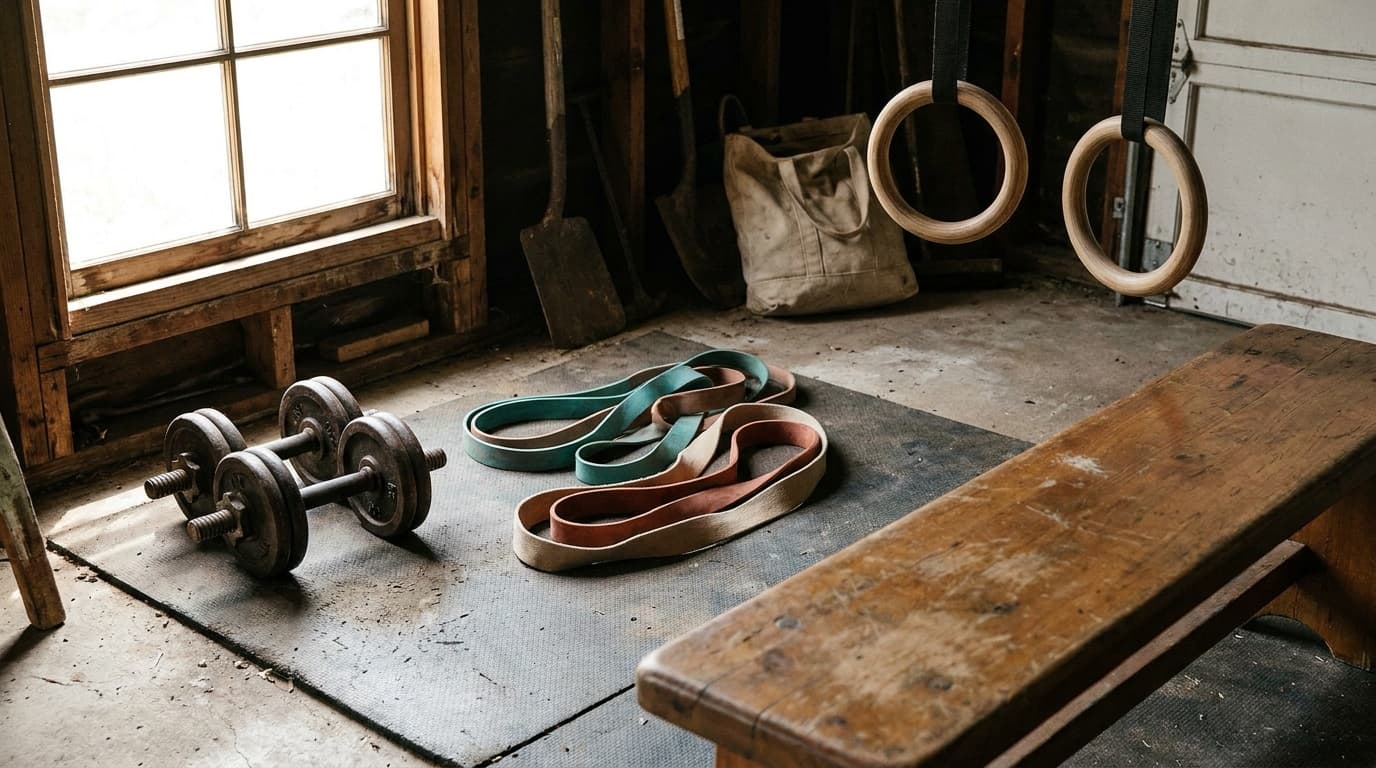
Both tools build real strength. The question is which one fits how you train, where you train, and what your body needs right now.
Strength outcomes: what the research actually shows
The biggest concern people bring to this comparison is whether bands can produce real strength gains, or whether they are a compromise. The evidence is clear: they are not a compromise.
A 2019 systematic review and meta-analysis by Lopes et al. (8 studies) found no significant difference in upper or lower limb strength gains between elastic resistance and conventional resistance training using dumbbells and machines. A 2010 study published in Physical Therapy put numbers on muscle activation directly: dumbbells produced 59–87% normalized EMG in prime movers, while elastic tubing produced 64–86%. Statistically equivalent.
The caveat that applies to both tools: progressive overload drives adaptation. Equipment only matters insofar as it helps or hinders your ability to apply progressive overload consistently.
The resistance curve: the most meaningful mechanical difference
This is where bands and dumbbells genuinely diverge, and understanding it changes how you use both.
Bands deliver ascending resistance: tension increases as the band stretches, peaking at end range. Dumbbells deliver constant resistance throughout the rep. These are not the same stimulus, even at matched loads.
With a dumbbell curl, the load is identical at the bottom, midpoint, and top. With a band curl, the tension is lowest at the start and highest when the band is fully stretched. This ascending curve happens to match the natural ascending strength curve of many pushing and squatting movements, where you are mechanically stronger as you extend. That alignment is why bands can feel smooth on squats and pressing patterns.
The tradeoff: the bottom of a band row or curl is relatively under-loaded. If you want to train the stretched position with meaningful tension, bands require deliberate anchor positioning or stacking.
How to work with the resistance curve
Squat and hinge patterns
Bands suit these well. Your strength ascends through the movement, and so does band tension. The bottom is loaded lighter, reducing compressive joint stress exactly where the joint is most vulnerable.
Curl and row patterns
Anchor height and body position matter. Adjust the setup so the band has pre-tension at the start of the movement, not just at peak contraction.
Press patterns
Bands under-load the bottom (most difficult) portion of a press. Combine with dumbbells for full-range stimulus, or use the band as a finisher after dumbbell sets.
Adding bands to dumbbell work
Wrap a looped band around both dumbbell handles for curls or rows. Research on powerlifting accessory work suggests 20–35% of total load from bands creates a resistance profile that matches the ascending strength curve effectively.
Progressive overload: where dumbbells have a real edge
Progressive overload is the mechanism behind all strength adaptation. The tool that makes it easier to apply consistently has a practical advantage.
Dumbbells allow 2.5-lb increments and exact, repeatable load tracking. If you hit 3 sets of 10 at 25 lbs, you know next week's target is 27.5 lbs. The math is simple and the feedback is clear.
Bands jump in large resistance steps, the actual load varies with how far you stretch the band and where you anchor it, and the heaviest bands top out around 150 lbs. This makes fine-grained progression harder to implement. Bands require rep-progression strategies (add reps before adding resistance), band-stacking (combining two bands), and careful attention to setup consistency.
Neither approach is wrong. Rep-based progression is valid and well-supported by research. But for anyone who thrives on measurable, week-to-week load tracking, dumbbells provide a cleaner system.
Joint-friendliness: a genuine band advantage
The ascending resistance curve that complicates band progression also reduces peak joint load at mechanically vulnerable positions. At the bottom of a squat, the hip and knee joints are under maximum compressive and shear stress. A band is lightest at that position. At lockout, where the joint is in its strongest, most stable position, the band is heaviest.
This is why physical therapists use elastic resistance in shoulder, knee, and lumbar rehabilitation. The 2010 Physical Therapy study demonstrating equivalent prime-muscle activation in rehab exercises is meaningful precisely because it shows bands reach a therapeutic stimulus without the peak compressive forces that free weights impose.
The 2025 systematic review and meta-analysis in Frontiers in Sports and Active Living (25 RCTs, 1,318 participants) found elastic band training significantly improved leg extension strength (SMD = 1.01) and chair stand performance (SMD = 2.04) in older adults, with programs over 12 weeks producing the most consistent results. For populations where joint load management matters, elastic resistance is not a compromise: it is often the appropriate tool.
Portability and cost: bands by a wide margin
A complete resistance band set with handles, like the WHATAFIT 17-piece resistance band set, costs under $40 and fits in a jacket pocket. A dumbbell set covering a comparable training range costs several hundred dollars and requires dedicated floor space. Adjustable dumbbell systems start at $100–$200 and go significantly higher for quality options like the BowFlex SelectTech 552.
For travel, small apartments, or anyone building a habit before investing in equipment, bands are the practical default. This is not a minor convenience difference: equipment you can actually use consistently is better than equipment you cannot access.
Who each suits
Matching the tool to the situation
Beginners building the habit
Bands lower the friction to starting. Low cost, no setup, joint-friendly, and sufficient to build a meaningful base.
People in rehabilitation or managing joint pain
Bands are the frequent clinical choice for good reason. Equivalent muscle activation, lower joint compressive load, and safer loading at vulnerable ranges.
Travelers and small-space trainers
Bands are the only realistic option. A full training stimulus in a bag that weighs ounces.
Anyone prioritizing measurable progression
Dumbbells. The ability to increment in 2.5-lb steps and track exact loads week to week is a meaningful long-term advantage for hypertrophy and strength programming.
Heavy compound work and advanced hypertrophy
Dumbbells. Once you exceed the band ceiling in key movements, free weights are required. Dumbbell presses, rows, and Romanian deadlifts scale to levels bands cannot match.
Experienced lifters wanting to refine stimulus
Both together. Adding band resistance to dumbbell movements creates a resistance profile that matches the natural ascending strength curve, a technique with a long track record in strength sports.
The combination is usually the answer
The framing of bands versus dumbbells implies you must choose. Most people who train consistently end up using both, intentionally or not. Bands fill in travel weeks, rehabilitation phases, and warm-up sequences. Dumbbells anchor progressive loading in the core compound movements. Used together, the ascending band curve and the constant dumbbell load complement each other across different exercises and training phases.
If you are starting with one: bands if cost, portability, or joint load management is the constraint. Dumbbells if measurable progression is the priority and you have the space and budget.
For specific band options across resistance levels and use cases, see our guide to the best resistance bands.
Can I build real muscle with resistance bands, or do I need dumbbells?
Yes, you can build muscle with bands. The 2019 Lopes meta-analysis found no significant difference in strength outcomes between elastic resistance and conventional resistance training. The key variable is progressive overload, not equipment. Bands require more creativity to progress (stacking bands, increasing rep targets, shortening rest), while dumbbells make load progression more straightforward. For most people focused on hypertrophy, dumbbells become the cleaner tool once a training base is established, but bands are a legitimate path to real results.
Why do resistance bands feel different at the top of a rep compared to the bottom?
Because bands create ascending resistance: the more you stretch the band, the more tension it generates. This means the load is lightest at the start of a movement and peaks at end range, the opposite of how free weights behave. This can be useful (matching the ascending strength curve of a squat or press, where you are mechanically stronger as you extend), but it also means the bottom of a band curl or row is relatively under-loaded. Dumbbells apply the same load throughout the entire range of motion.
Are resistance bands better for people with knee or shoulder pain?
Bands are often the preferred starting point in rehabilitation for good reason. The ascending resistance curve means lower joint load at the most vulnerable positions (bottom of a squat, the impingement zone in a shoulder press). A 2010 study published in Physical Therapy found that bands and dumbbells produced equivalent prime-muscle activation in controlled rehabilitation exercises, so bands let you reach a therapeutic stimulus without the peak compressive forces of free weights. That said, specific programming matters more than equipment choice. If you have a joint injury, work with a physical therapist to determine appropriate loads and movement patterns regardless of which tool you use.
Browse all fitness gear or read more about how we research and rate.
Recommended gear
Our current top picks from the Best resistance bands: top picks for home and travel guide, if you are ready to buy.
WHATAFIT
Whatafit Resistance Bands Set (11pcs)
Best Overall
Kit Score 8.3/10
$22.07 Price checked Oct 23, 6:22 AM CDT
Best for: Home gym users who want a single affordable kit that handles everything from shoulder rehab to heavy rows and pressing.
- Five stackable bands let you dial in resistance precisely and add load progressively over months
- The lightest band (10 lbs) can feel stiff for very light mobility or therapy work
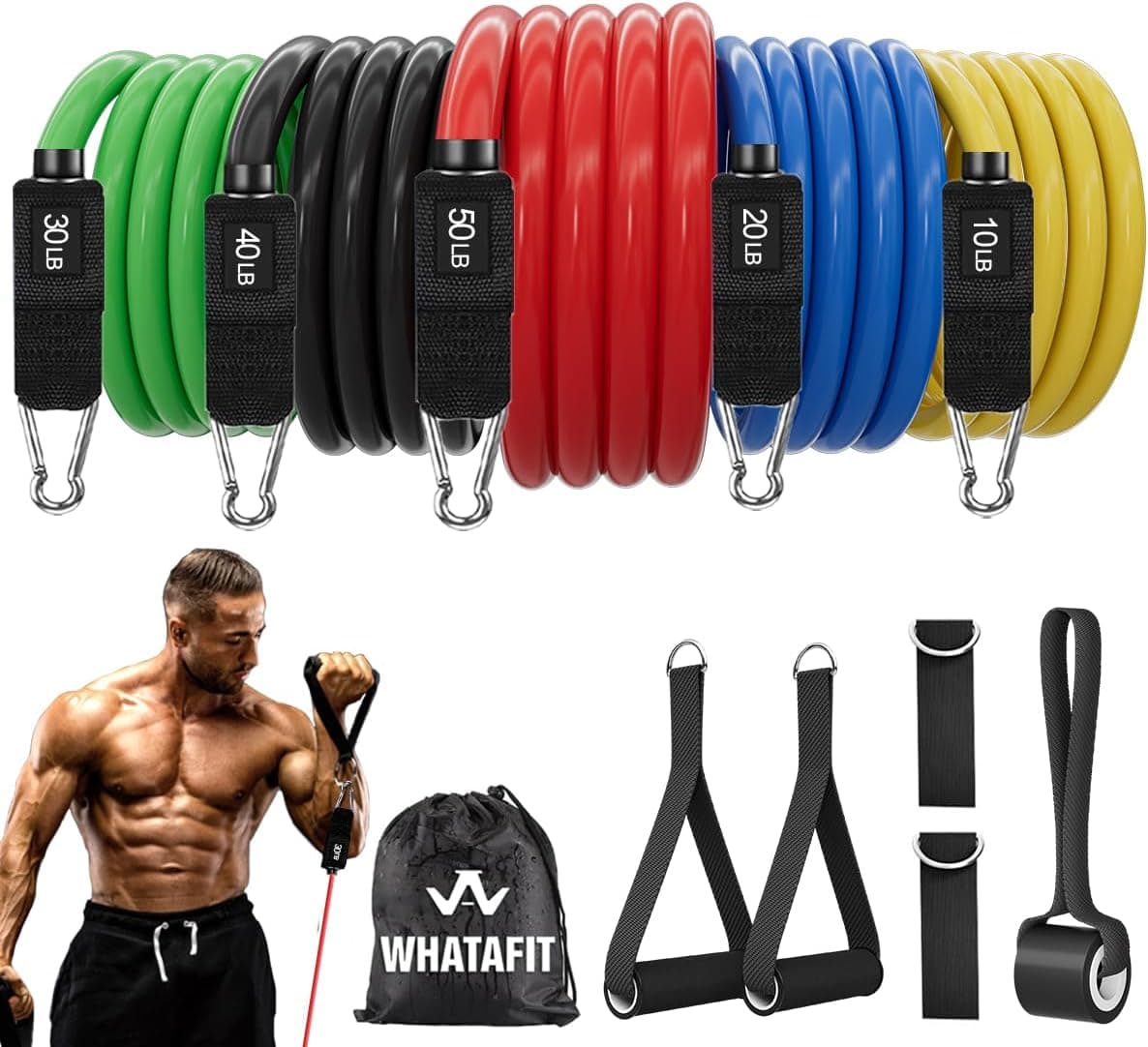
- Type
- Tube bands with handles
- Resistance levels
- 10, 20, 30, 40, 50 lbs (stackable to 150 lbs)
- Material
- 100% natural latex tubes, foam-wrapped handles
- Band length
- 36 inches
- Included accessories
- Door anchor, ankle straps, carry bag
- Pieces in set
- 11 (5 bands, 2 handles, 1 door anchor, 2 ankle straps, 1 carry bag)
About this pick
A complete tube-band kit covering the full resistance range from rehab-level pulls to heavy cable-substitute work. Five color-coded bands stack to 150 lbs, and the cushioned foam handles give a cable-machine feel for rows, presses, and curls at home or on the road.
Strengths
- Five stackable bands let you dial in resistance precisely and add load progressively over months
- Complete kit out of the box: door anchor and ankle straps expand exercise variety without extra purchases
- Natural latex tubes hold up notably better over time than TPE alternatives, with less skin irritation and odor
Weaknesses
- The lightest band (10 lbs) can feel stiff for very light mobility or therapy work
- Door anchor setup requires an inward-opening door; pull-through style mounting is less stable than a fixed cable station
Kit Score breakdown
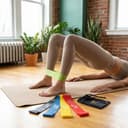
FIT SIMPLIFY
Fit Simplify Resistance Loop Exercise Bands, Set of 5
Best Budget
Kit Score 8.4/10
$9.98 Price checked Oct 23, 6:22 AM CDT
Best for: Anyone who wants a lightweight, always-in-the-bag kit for glute activation, mobility drills, physical therapy, or warm-up circuits at home or while traveling.
- Exceptional price-to-value ratio for a complete five-level loop set with carry bag included
- The lighter resistance loops can curl or bunch during fast lower-body movements
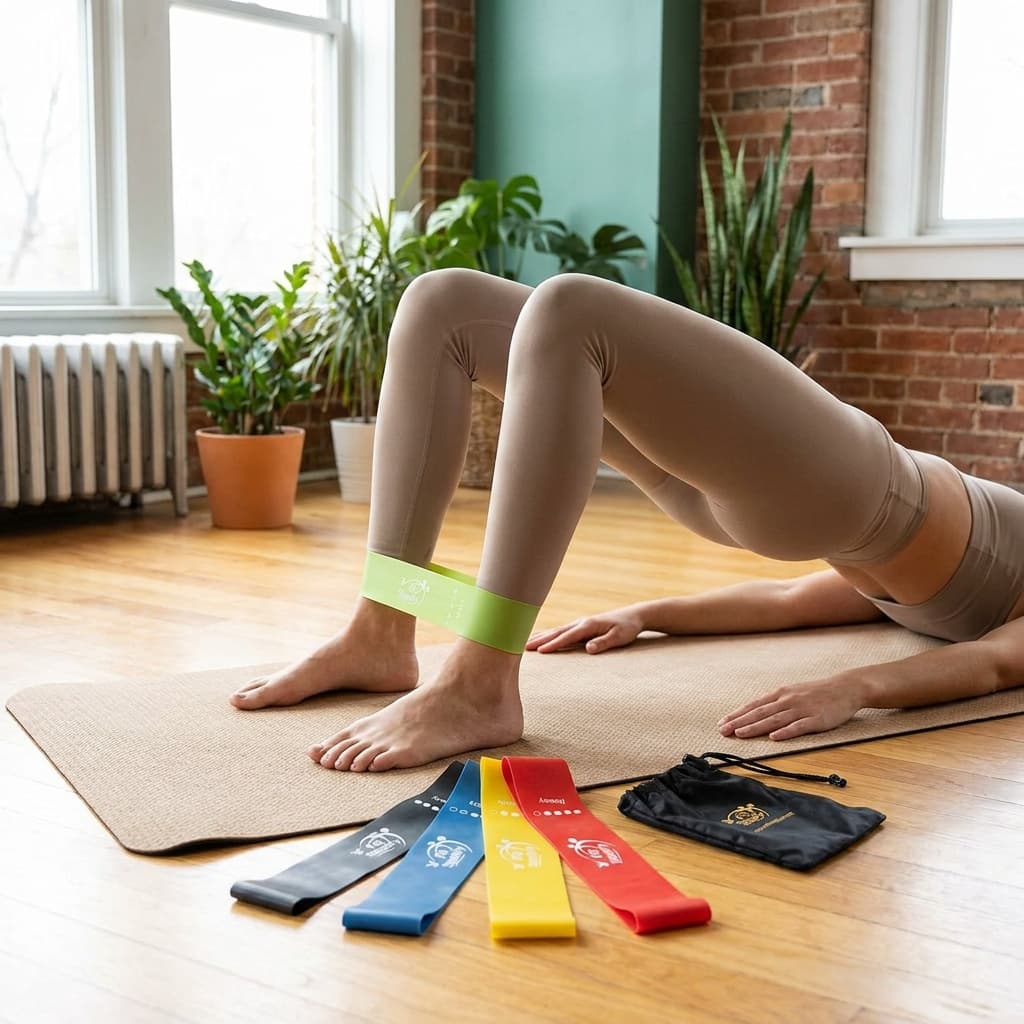
- Type
- Mini loop (flat, continuous)
- Dimensions
- 12 in. x 2 in. per band
- Resistance range
- Five levels, extra light through extra heavy (pound ratings not published)
- Material
- Latex loop, 12 x 2 in.
- Pieces in set
- 5 color-coded bands plus carry bag and instruction guide
- Included accessories
- Carry bag, illustrated exercise guide
About this pick
Five color-coded latex loops cover the full spectrum from gentle hip-activation warm-ups to loaded glute work and physical therapy progressions. The flat, no-roll design stays put around thighs and ankles better than round tube-style loops, and the set is small enough to live in a gym bag permanently.
Strengths
- Exceptional price-to-value ratio for a complete five-level loop set with carry bag included
- Flat band design resists rolling during lateral walks, clamshells, and hip hinges better than round alternatives
- Ultra-portable: the full set weighs under half a pound and fits in any luggage pocket
Weaknesses
- The lighter resistance loops can curl or bunch during fast lower-body movements
- Loop format limits upper-body pulling range and is not suitable as a standalone strength training system
Kit Score breakdown
BODYLASTICS
Bodylastics Patented Resistance Band Set with Snap Reduction Tech
Best Premium
Kit Score 8.6/10
$61.97 Price checked Oct 23, 6:22 AM CDT
Best for: Serious home gym users, frequent travelers, and anyone training at high resistance levels daily who wants the confidence of anti-snap safety tech and a lifetime band warranty.
- Patented internal anti-snap cord is a genuine safety differentiator, not marketing copy: it physically stops a failing tube from snapping back
- Higher price than budget tube-band sets for what is functionally a similar exercise experience
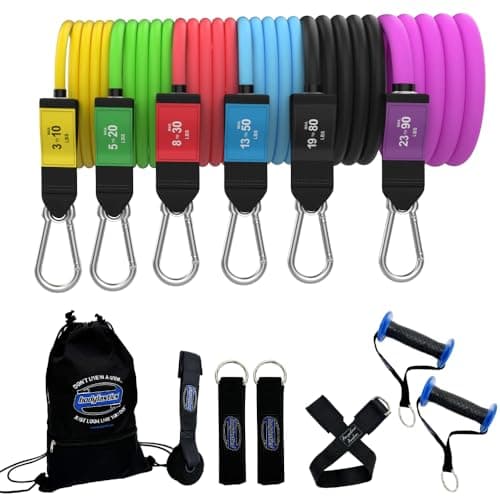
- Type
- Tube bands with handles, patented internal safety cord
- Resistance levels
- 3, 5, 8, 13, 19 lbs individually; stackable to 190 lbs
- Material
- Malaysian latex with internal nylon anti-snap cord
- Included accessories
- Handles, ankle straps, door anchor, carry bag
- Safety feature
- Patented internal cord shortens if a tube fails, containing the band
- Warranty
- Limited lifetime replacement guarantee on bands
About this pick
Bodylastics built its reputation on the patented snap-reduction inner cord: if a latex tube fails, the internal nylon cord stays intact and contains the band instead of letting it whip back. Five resistance levels spanning 3 to 19 lbs stack to 190 lbs total, and the limited lifetime replacement guarantee backs long-term daily use.
Strengths
- Patented internal anti-snap cord is a genuine safety differentiator, not marketing copy: it physically stops a failing tube from snapping back
- Five resistance levels spanning 3 to 19 lbs individually stack to 190 lbs, covering everything from light rehab to serious strength work
- Limited lifetime replacement guarantee on bands, and nearly two decades of market presence back the durability claim
Weaknesses
- Higher price than budget tube-band sets for what is functionally a similar exercise experience
- Handles wear faster than the bands themselves; some owners replace handles before bands
Kit Score breakdown
See all picks in Best resistance bands: top picks for home and travel
Keep going
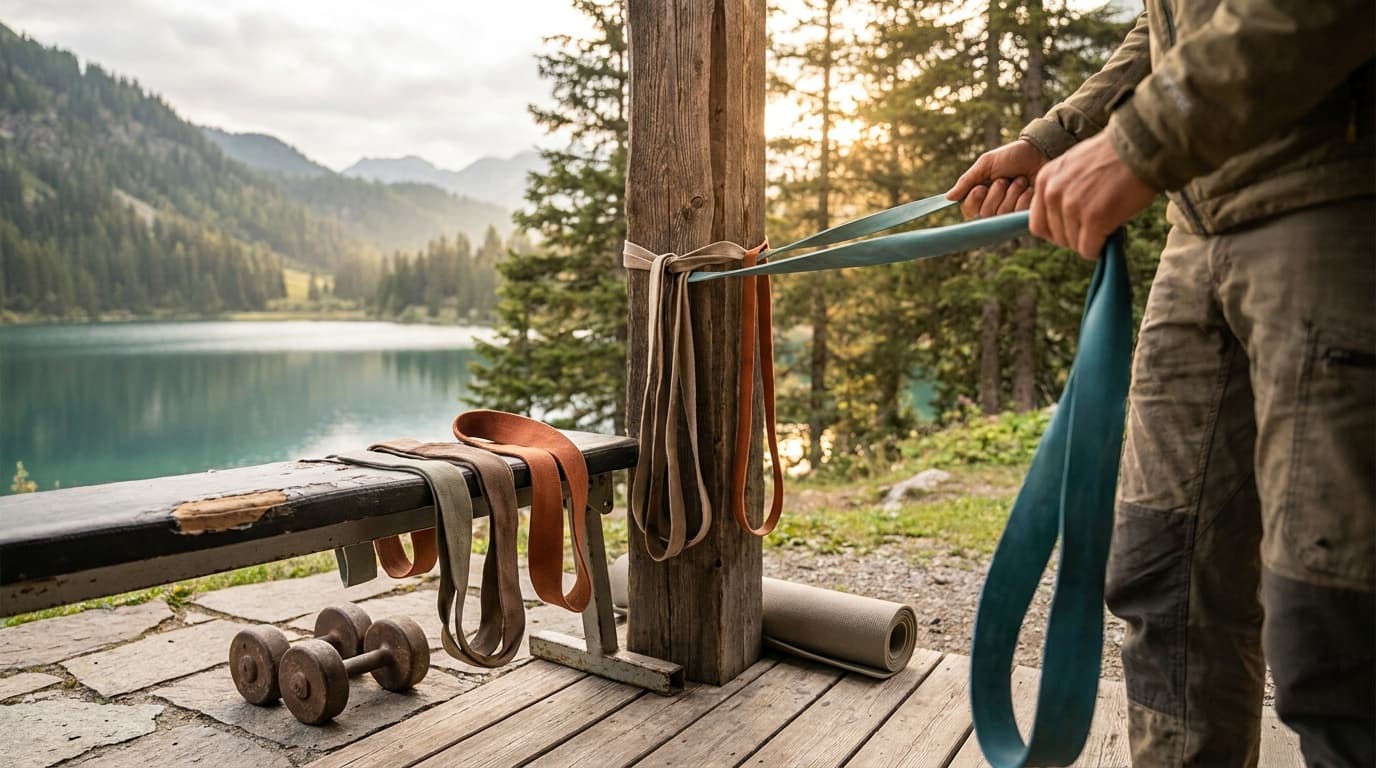
Complete loadoutHome calisthenics kitA compact strength and conditioning setup built around five tools that cover pushing, pulling, assistance, cardio, and floor work.

Researched, not hands-on tested
Updated Oct 10, 2026Our recommendations draw on manufacturer documentation, retailer listings, owner feedback, and comparisons with alternatives.
As an Amazon Associate I earn from qualifying purchases. We may earn a commission from links here, at no extra cost to you. How we research →