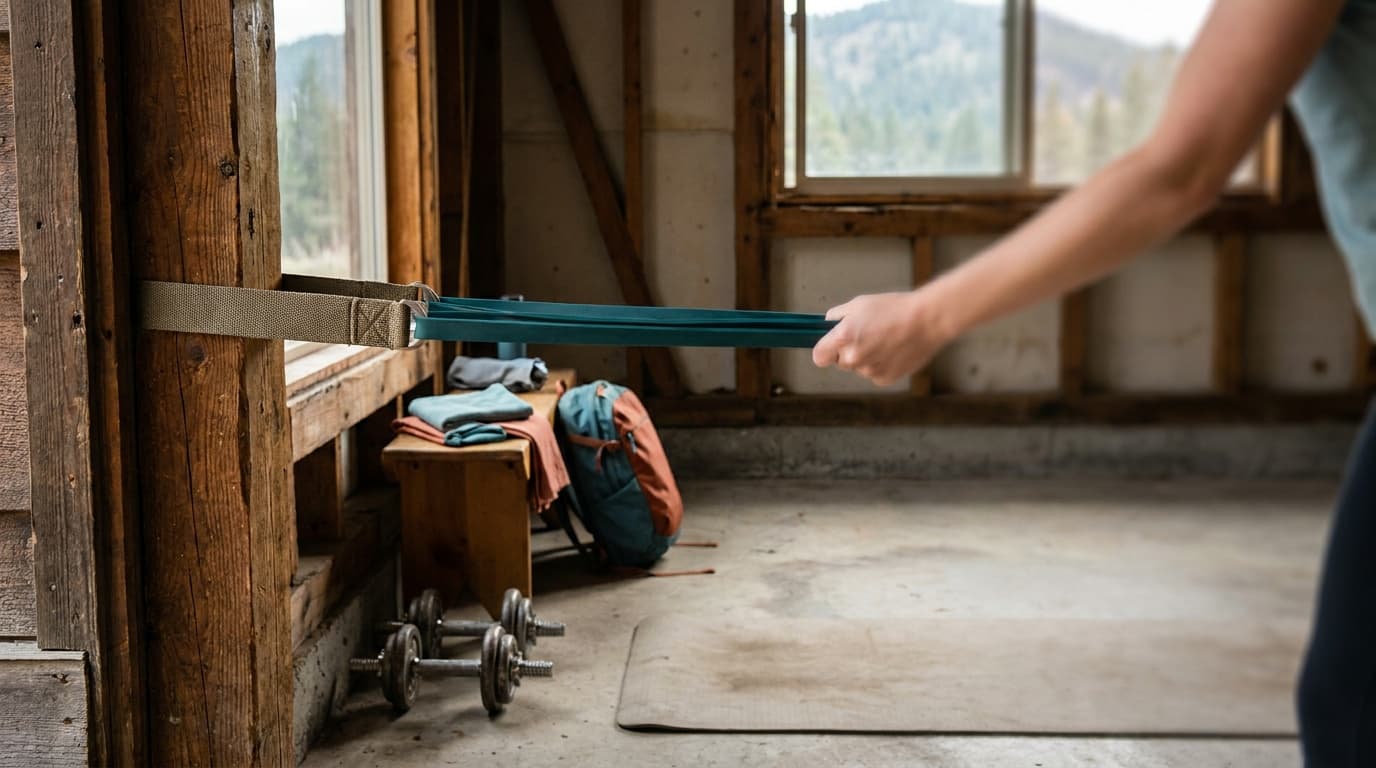
To anchor a resistance band, close a door anchor into a solid door, make sure the door is fully latched (locked if possible), and stand so your pull presses the door into its frame rather than pulling it open. Set the anchor low, middle, or high to match the exercise, and check the band for nicks and tears before every session, as TheraBand's instructions direct. It matters: an emergency-room case series found resistance bands can cause serious eye injuries when they snap back.
Why anchor choice matters
Resistance tubes store elastic energy. At peak stretch, a single handled tube can hold a lot of force: the Whatafit set's tubes are rated from 10 to 50 lb each, and up to 150 lb stacked. If the anchor point fails or the tube snaps, that energy releases instantly toward your face. Common causes include a door that opens under load, an aged or nicked tube, and an anchor point that was never meant to take the load.
Door anchors: placement and direction
A door anchor, included with most handled tube sets like the Whatafit Resistance Bands Set, is a foam or rubber strap with a loop on one end. You thread the loop through the gap at the top, middle, or bottom of a door, then close and latch the door so the knot sits on the far side. The door's weight and the latch hold the anchor in place.
Two rules that matter more than anything else here:
Pull so the door closes, not opens. Consider which way the door swings: the safer setup is one where your pull keeps the door seated in its frame rather than pulling it open, and your anchor's instructions may specify a side or position. If the door swings open while you are mid-pull, you lose resistance suddenly and can fall.
The door must be fully closed and latched before you load the band. This sounds obvious, but a door that is merely pushed shut without engaging the latch can pop open. If the door locks, lock it, so nobody opens it on you mid-set.
For height placement:
Anchor height by exercise
Bottom (near floor)
Rows, deadlift variations, bicep curls from low angle
Middle (handle height)
Chest press, standing rows, tricep pushdowns
Top (above head)
Lat pulldowns, overhead tricep extensions, face pulls
Always stand back far enough that the band has some tension before you begin your range of motion. Starting a row with zero pre-tension means the first few inches produce no resistance and you can yank the anchor loose.
Anchoring around posts and fixed structures
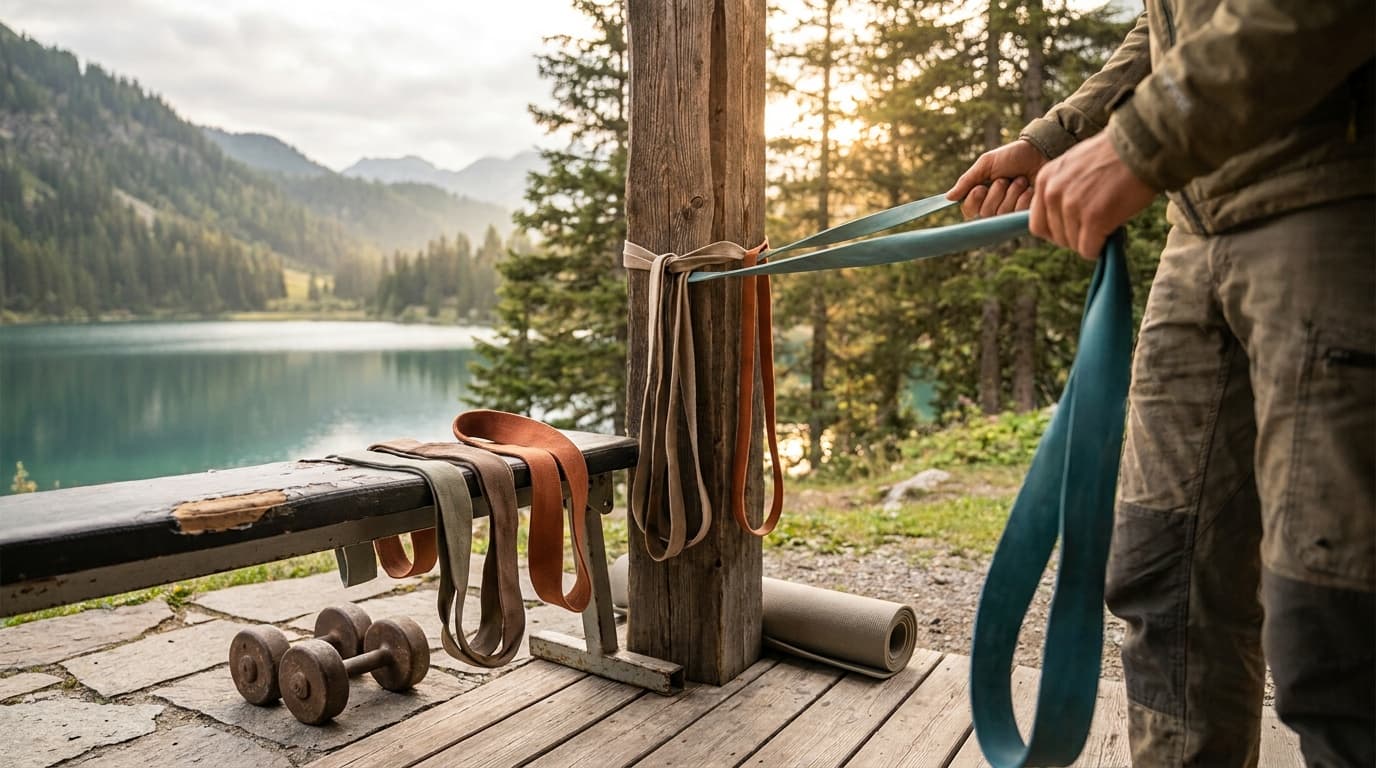
A squat rack upright, a sturdy metal fence post, or a power cage cross-bar are all solid anchor points. Thread the band directly around the post or use a loop-through method: pass one end of the band through the other so it cinches around the post rather than relying on friction alone.
Avoid furniture legs, door handles, and staircase balusters. Furniture can slide or tip, door handles are not built for a sideways pull, and balusters can be decorative rather than structural.
The anchor is only as strong as the structure it is attached to, so spend thirty seconds confirming the post or frame is fixed to the floor or wall before you load it.
For outdoor use, a solid, healthy tree trunk can work; thin branches and anything with rough bark that could nick the band cannot.
Ankle straps and lower-body work
Ankle straps clip to a D-ring at floor level and let you perform leg curls, kickbacks, and hip abduction. The strap itself is low-risk, but the attachment point deserves the same scrutiny as any door anchor. If you are using a cable machine attachment, confirm the carabiner gate is fully closed. If you are anchoring to a door at floor level, the door-closed-and-latched rule applies the same way.
For ankle work, keep the resistance level conservative. The hip and glute muscles are strong, but ankle straps that are too loose can slide up the leg under load, concentrating force on the Achilles tendon area. Strap should sit above the ankle bone, snug but not cutting off circulation.
Tube inspection: the two-minute check
Latex ages with sunlight, heat, sweat, and repeated stretching, which is why TheraBand tells you to store bands out of direct sunlight and away from extreme temperatures. A tube that looks fine from across the room can have small nicks that fail under load.
Before every session, hold the tube up to a light source and slowly run your fingers along the full length. You are looking for:
- Nicks, tears, or punctures: TheraBand's rule is to discard the band immediately; this is a retirement trigger, not a watch-and-see situation
- Surface cracks or thinning: fine cracks, often near the fittings
- Stickiness: TheraBand says to clean a sticky band with mild soap and water, dry it flat, and dust it with talc; retire it if it is also cracked or thinning
Also check where the tube meets the handle fitting. TheraBand specifically tells you to check connection points for wear. If the tube looks pinched, compressed, or is pulling away from the fitting, retire the band.
There is no fixed lifespan: how long a tube lasts depends on how often you train, how far you stretch it, and how you store it. Replace it on condition, not on a calendar.
Eye protection and face-height work
For any exercise where a snapped tube would travel toward your face, such as face pulls, overhead press, or chest fly variations, wear safety glasses or sports goggles. This is not overcautious: TheraBand's manual says to wear eye protection for exercises that could send the band toward your head, and a 2021 emergency-room case series of 11 patients found injuries ranging from iritis to internal eye bleeding, with a third of injured eyes left at 20/60 vision or worse.
If you do not want to wear eye protection every session, at minimum perform a visual inspection and a low-force test pull before loading to full resistance on face-height exercises.
Frequently asked questions
Can I anchor a resistance band to a car door or truck hitch?
A car door is not safe for resistance band anchoring. The door seal compresses unpredictably, the latch mechanism is not rated for repeated lateral tensile loads, and a car door can shift on uneven ground. A receiver hitch mounted to a truck or SUV frame is structurally solid and can work for low-to-mid resistance levels, but check it is secure and free of sharp edges that could nick the band.
How do I know if my door can handle the load?
There is no published load rating for household doors, so start light. A solid door that closes fully and latches normally is usually fine for light-to-moderate bands when your pull keeps it shut. For heavy stacked tubes, a wall-mounted anchor fixed into a stud, a power rack, or a cable station is the sturdier choice. Skip any door with loose hinges or a damaged frame. If the door frame shows any flex or creaking during a test pull, do not use it.
How often should I replace resistance bands?
Replace on condition, not on a calendar. TheraBand says to examine bands before every use and discard them as soon as you find nicks, tears, or punctures, and to check connection points for wear. Daily users and anyone storing bands in sunlight or heat should expect a shorter life.
Where these numbers come from
| Claim | Source | Checked |
|---|---|---|
| Inspect before every use for nicks, tears, or punctures; check connection points; store out of sunlight; clean sticky bands; wear eye protection for exercises that could send the band toward the head | TheraBand, resistance band and tubing instruction manual (PDF) | Sep 2026 |
| Pull so the door stays seated in its frame; follow the anchor's instructions; lock the door if you can | Balego, how to use a resistance band door anchor safely | Sep 2026 |
| ER case series: 11 patients, 14 eyes; iritis in all, hyphema in 82%; 33% of eyes at 20/60 or worse | Am J Emerg Med 2021, Ocular trauma secondary to exercise resistance bands, PubMed ID 33317864 | Sep 2026 |
| Whatafit: tubes rated 10 to 50 lb, up to 150 lb stacked, door anchor included | Whatafit listing on Amazon, ASIN B07DWSPQQY | Sep 2026 |
For specific picks, see our guide to the best resistance tubes with handles. Browse all fitness guides or read how we research and rate gear.
Recommended gear
Our current top picks from the Best resistance bands: top picks for home and travel guide, if you are ready to buy.
WHATAFIT
Whatafit Resistance Bands Set (11pcs)
Best Overall
Kit Score 8.3/10
$22.07 Price checked Oct 23, 4:16 PM CDT
Best for: Home gym users who want a single affordable kit that handles everything from shoulder rehab to heavy rows and pressing.
- Five stackable bands let you dial in resistance precisely and add load progressively over months
- The lightest band (10 lbs) can feel stiff for very light mobility or therapy work
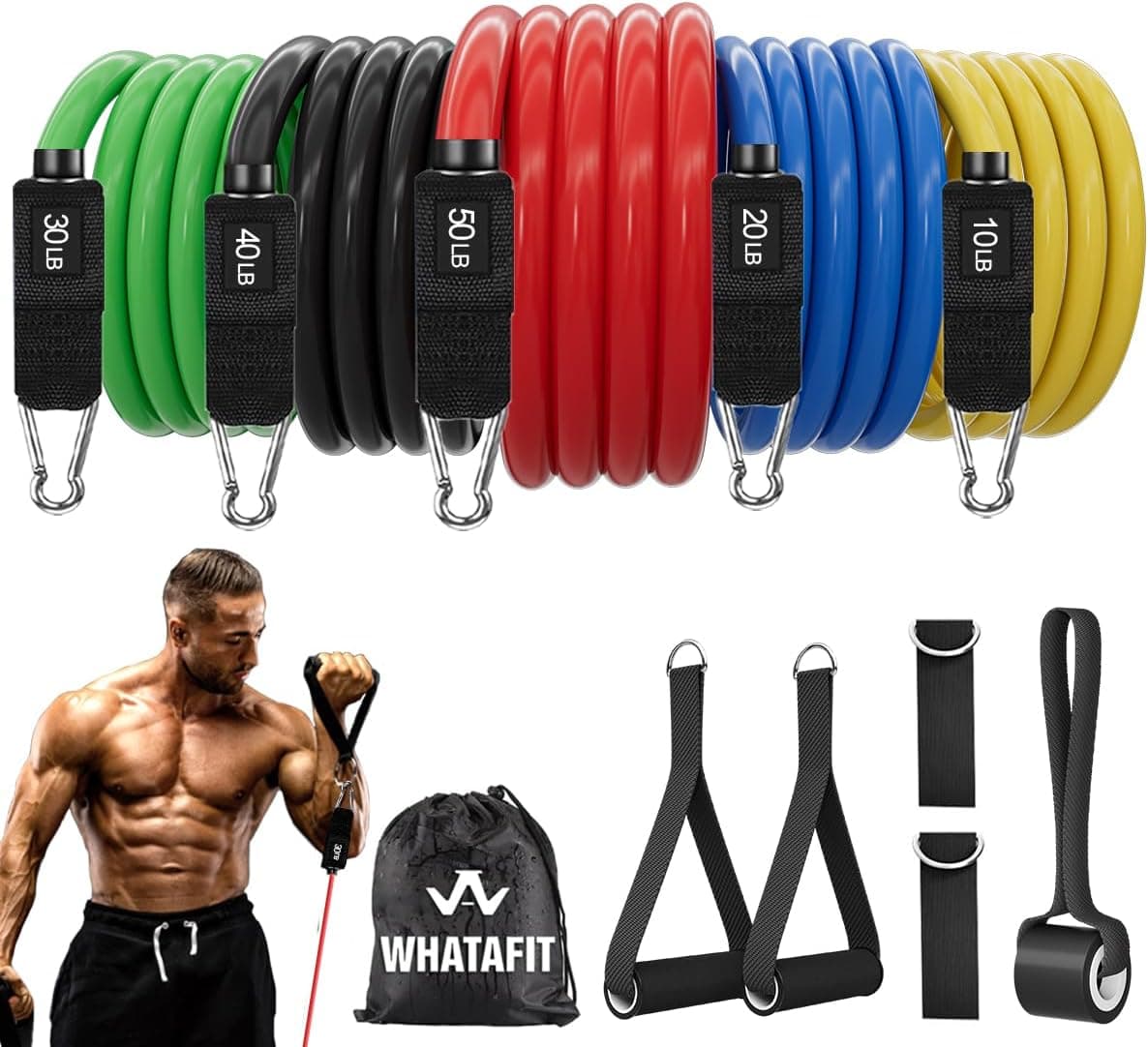
- Type
- Tube bands with handles
- Resistance levels
- 10, 20, 30, 40, 50 lbs (stackable to 150 lbs)
- Material
- 100% natural latex tubes, foam-wrapped handles
- Band length
- 36 inches
- Included accessories
- Door anchor, ankle straps, carry bag
- Pieces in set
- 11 (5 bands, 2 handles, 1 door anchor, 2 ankle straps, 1 carry bag)
About this pick
A complete tube-band kit covering the full resistance range from rehab-level pulls to heavy cable-substitute work. Five color-coded bands stack to 150 lbs, and the cushioned foam handles give a cable-machine feel for rows, presses, and curls at home or on the road.
Strengths
- Five stackable bands let you dial in resistance precisely and add load progressively over months
- Complete kit out of the box: door anchor and ankle straps expand exercise variety without extra purchases
- Natural latex tubes hold up notably better over time than TPE alternatives, with less skin irritation and odor
Weaknesses
- The lightest band (10 lbs) can feel stiff for very light mobility or therapy work
- Door anchor setup requires an inward-opening door; pull-through style mounting is less stable than a fixed cable station
Kit Score breakdown
FIT SIMPLIFY
Fit Simplify Resistance Loop Exercise Bands, Set of 5
Best Budget
Kit Score 8.4/10
$9.98 Price checked Oct 23, 4:16 PM CDT
Best for: Anyone who wants a lightweight, always-in-the-bag kit for glute activation, mobility drills, physical therapy, or warm-up circuits at home or while traveling.
- Exceptional price-to-value ratio for a complete five-level loop set with carry bag included
- The lighter resistance loops can curl or bunch during fast lower-body movements
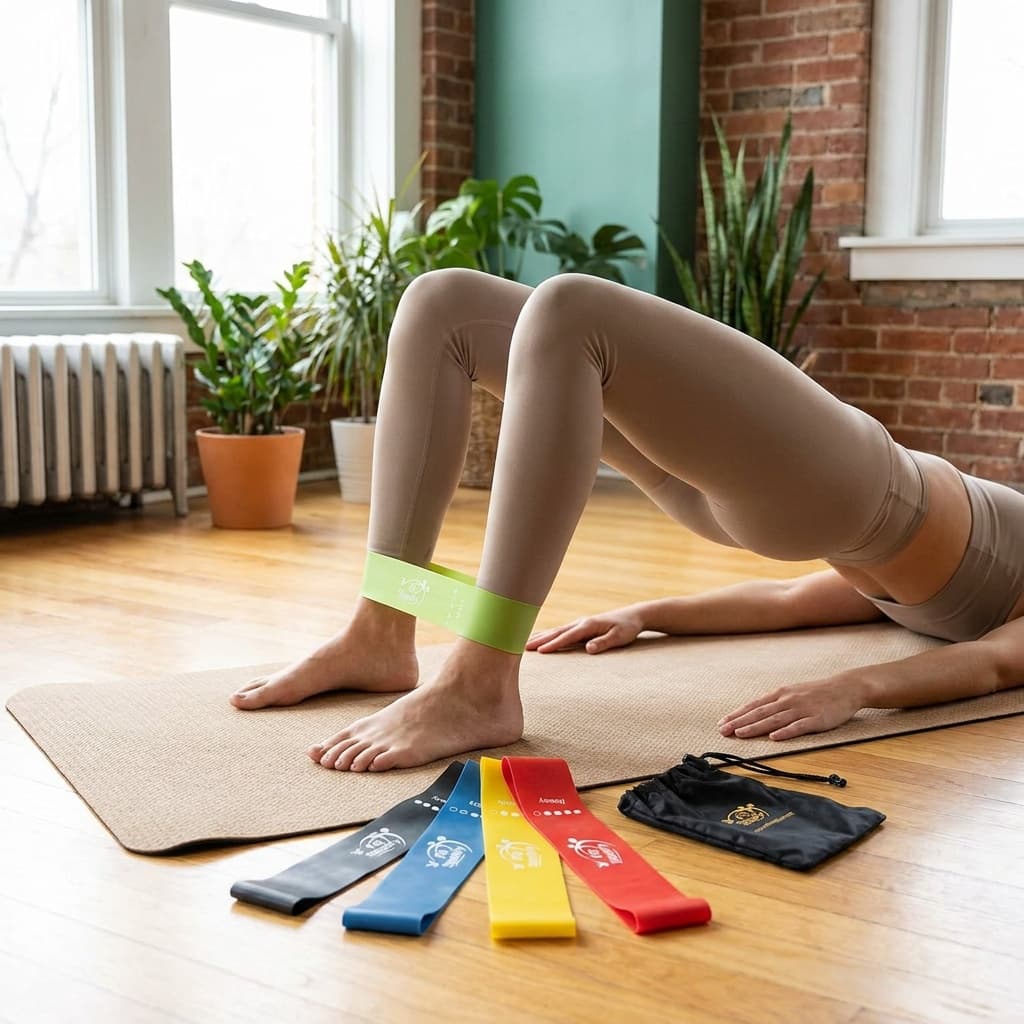
- Type
- Mini loop (flat, continuous)
- Dimensions
- 12 in. x 2 in. per band
- Resistance range
- Five levels, extra light through extra heavy (pound ratings not published)
- Material
- Latex loop, 12 x 2 in.
- Pieces in set
- 5 color-coded bands plus carry bag and instruction guide
- Included accessories
- Carry bag, illustrated exercise guide
About this pick
Five color-coded latex loops cover the full spectrum from gentle hip-activation warm-ups to loaded glute work and physical therapy progressions. The flat, no-roll design stays put around thighs and ankles better than round tube-style loops, and the set is small enough to live in a gym bag permanently.
Strengths
- Exceptional price-to-value ratio for a complete five-level loop set with carry bag included
- Flat band design resists rolling during lateral walks, clamshells, and hip hinges better than round alternatives
- Ultra-portable: the full set weighs under half a pound and fits in any luggage pocket
Weaknesses
- The lighter resistance loops can curl or bunch during fast lower-body movements
- Loop format limits upper-body pulling range and is not suitable as a standalone strength training system
Kit Score breakdown
BODYLASTICS
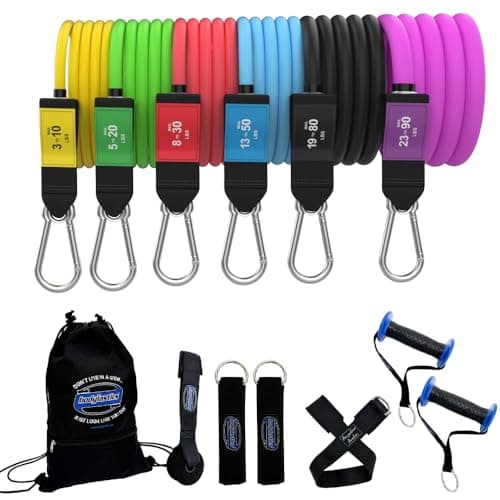
Bodylastics Patented Resistance Band Set with Snap Reduction Tech
Best Premium
Kit Score 8.6/10
$61.97 Price checked Oct 23, 4:16 PM CDT
Best for: Serious home gym users, frequent travelers, and anyone training at high resistance levels daily who wants the confidence of anti-snap safety tech and a lifetime band warranty.
- Patented internal anti-snap cord is a genuine safety differentiator, not marketing copy: it physically stops a failing tube from snapping back
- Higher price than budget tube-band sets for what is functionally a similar exercise experience
- Type
- Tube bands with handles, patented internal safety cord
- Resistance levels
- 3, 5, 8, 13, 19 lbs individually; stackable to 190 lbs
- Material
- Malaysian latex with internal nylon anti-snap cord
- Included accessories
- Handles, ankle straps, door anchor, carry bag
- Safety feature
- Patented internal cord shortens if a tube fails, containing the band
- Warranty
- Limited lifetime replacement guarantee on bands
About this pick
Bodylastics built its reputation on the patented snap-reduction inner cord: if a latex tube fails, the internal nylon cord stays intact and contains the band instead of letting it whip back. Five resistance levels spanning 3 to 19 lbs stack to 190 lbs total, and the limited lifetime replacement guarantee backs long-term daily use.
Strengths
- Patented internal anti-snap cord is a genuine safety differentiator, not marketing copy: it physically stops a failing tube from snapping back
- Five resistance levels spanning 3 to 19 lbs individually stack to 190 lbs, covering everything from light rehab to serious strength work
- Limited lifetime replacement guarantee on bands, and nearly two decades of market presence back the durability claim
Weaknesses
- Higher price than budget tube-band sets for what is functionally a similar exercise experience
- Handles wear faster than the bands themselves; some owners replace handles before bands
Kit Score breakdown
See all picks in Best resistance bands: top picks for home and travel
Keep going
Complete loadoutHome calisthenics kitA compact strength and conditioning setup built around five tools that cover pushing, pulling, assistance, cardio, and floor work.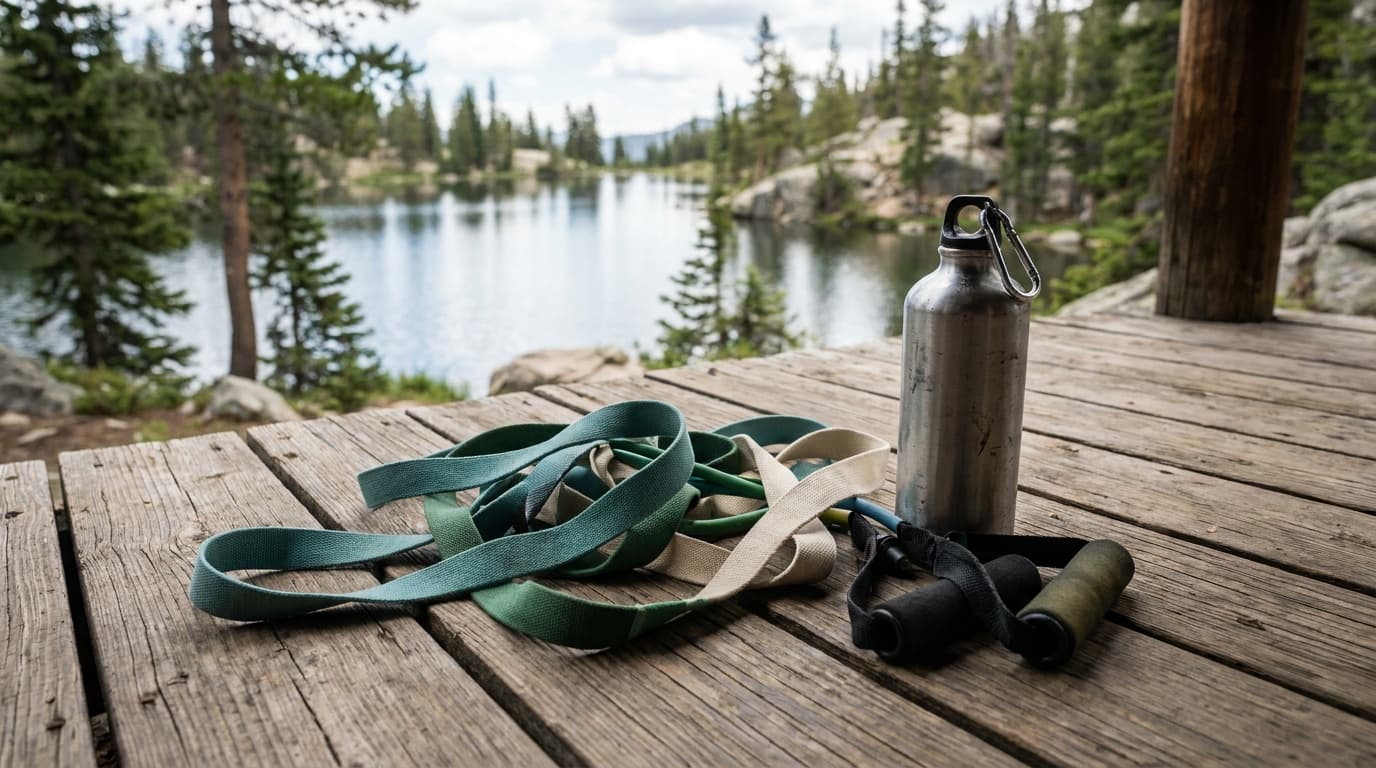
Researched, not hands-on tested
Updated Sep 25, 2026Our recommendations draw on manufacturer documentation, retailer listings, owner feedback, and comparisons with alternatives.
As an Amazon Associate I earn from qualifying purchases. We may earn a commission from links here, at no extra cost to you. How we research →