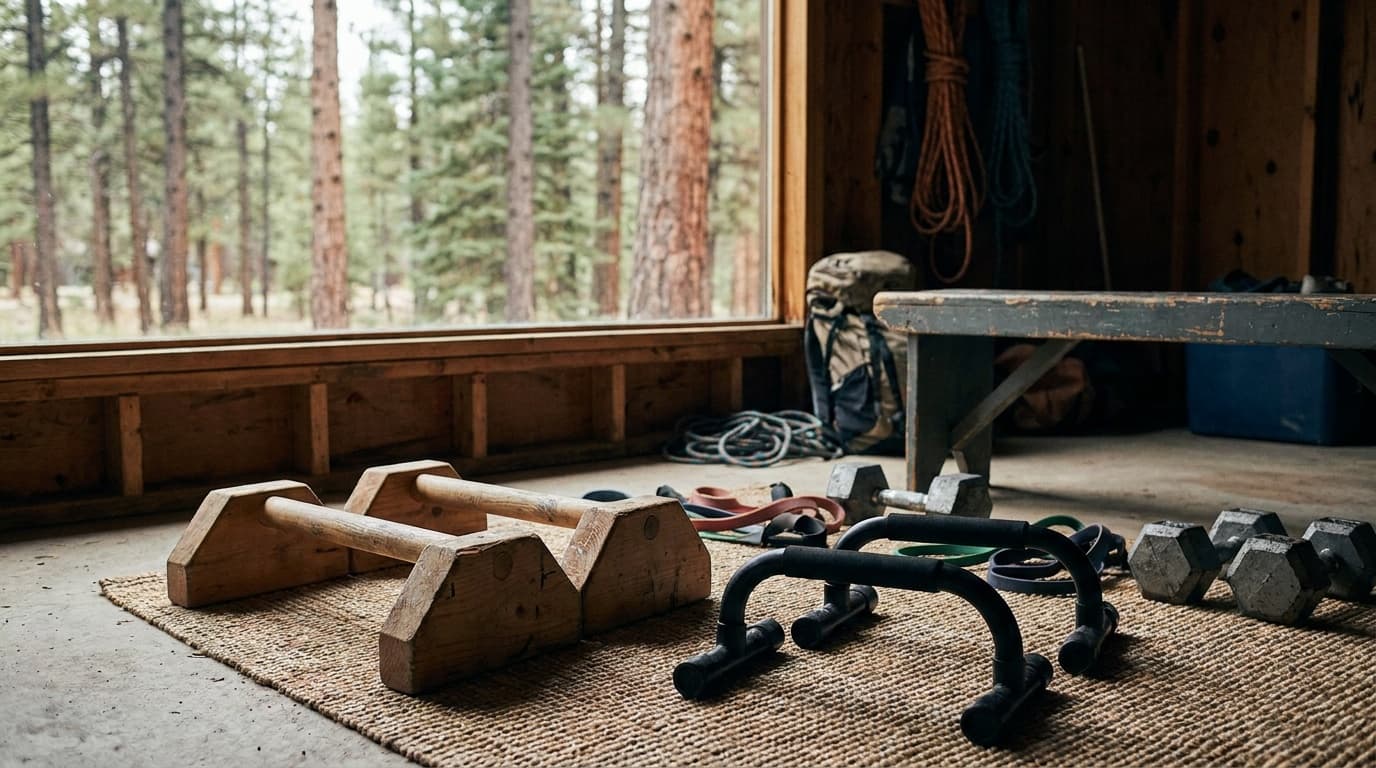
Buy push-up bars if push-ups are the whole plan; buy parallettes if you want L-sits, dips, or handstand work. Push-up bars like the Perfect Pushup Elite lift your hands a few inches for a neutral wrist and a deeper push-up. Parallettes run from about 6 inches (the airogym set is listed at 5.9) to 12 inches (the TABEKE), which is the clearance your hips need for a tuck L-sit and the height that makes handstand press entries comfortable. The three picks below were all in stock on Amazon when we rechecked them on October 3, 2026, and they currently sell for about the same, so price should not decide it. Your next skill should.
Choose for the next skill, not the equipment category
- You only want wrist-neutral push-ups and easier storage: choose the Perfect Fitness Perfect Pushup Elite. Taller parallettes add cost and floor space without improving that basic job.
- Your next goal is a tuck L-sit or low planche work: choose the airogym wood parallettes. The lower format gives useful clearance without committing to a tall setup.
- Your next goal is handstand pressing or maximum clearance: choose the TABEKE 12-inch parallettes. Height helps the skill work, but makes storage and travel worse.
- You have not started any floor-skill progression yet: do not buy parallettes just because they have a higher ceiling. Begin with the equipment your current program actually uses.
Our quick picks
Perfect Fitness Perfect Pushup Elite
Rotating handles allow a natural hand path through a push-up
Best for: Beginners and home exercisers who want wrist-neutral push-ups, deeper pressing range, and a stable dedicated tool without paying for parallette height.
Buy on Amazon →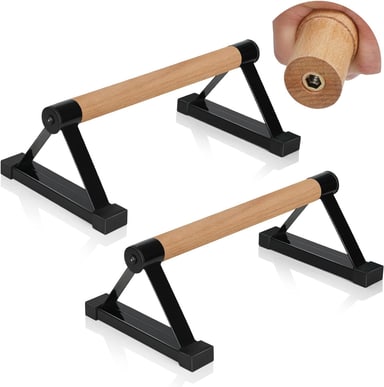
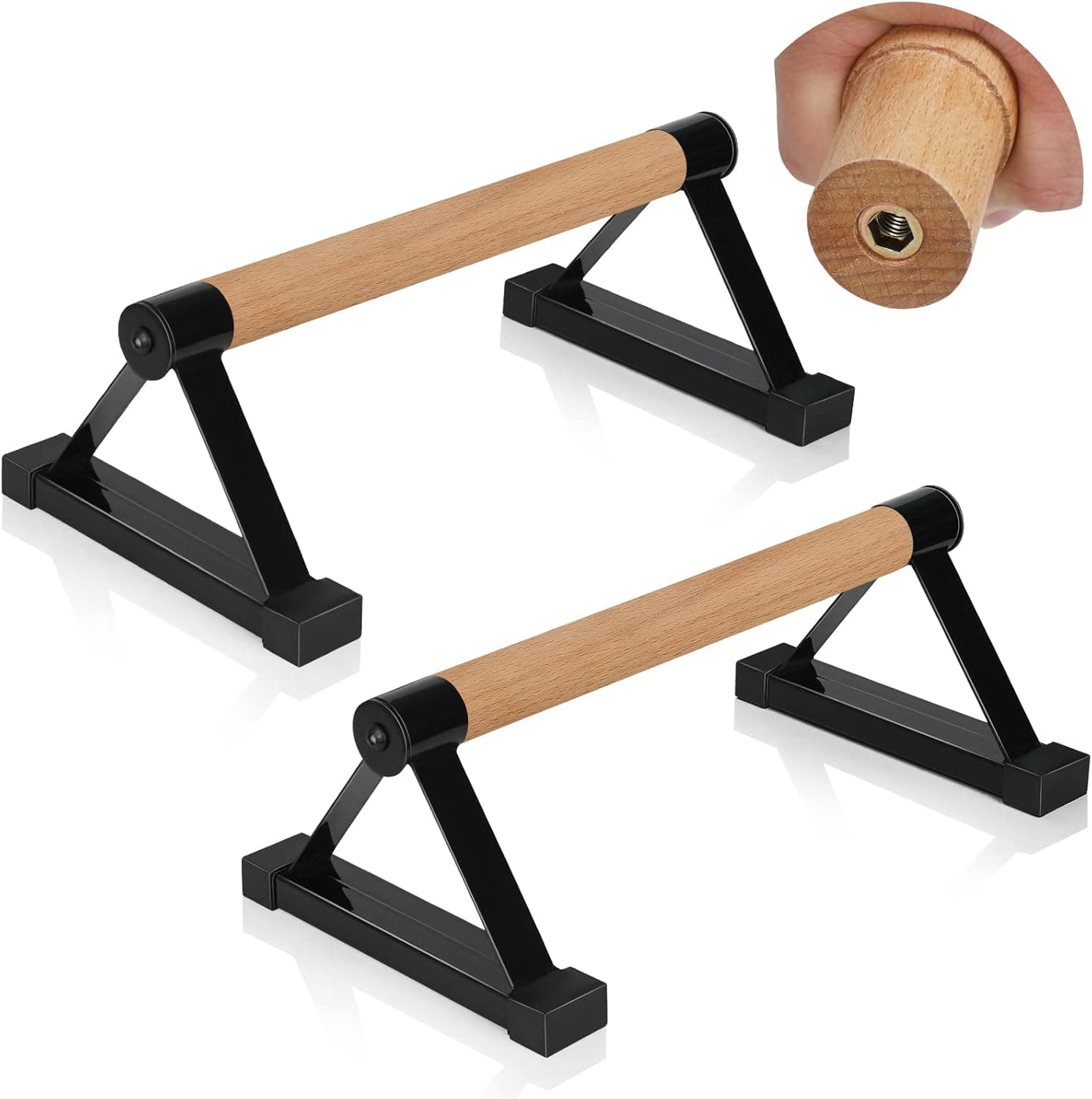
airogym Wood Parallettes Push Up Bars
Current 600 lb published capacity provides substantial headroom for ordinary bodyweight training
Best for: Beginners and intermediate trainees who want a sturdy, low-profile wood parallette set for push-ups, tuck L-sits, and planche leans on a budget.
Buy on Amazon →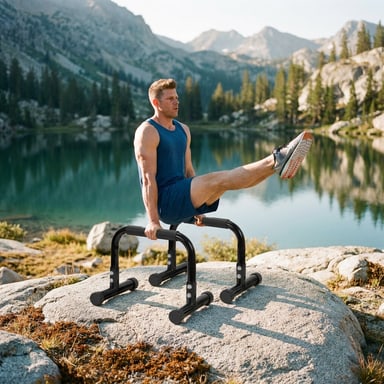
TABEKE 12-Inch High Parallettes Bars
12-inch height adds meaningful wrist clearance over standard low parallettes without the bulk of dip-bar stations
Best for: Athletes who want more wrist clearance than a low parallette provides and are training push-up depth, L-sits, and dips on a budget.
Buy on Amazon →What the height difference actually changes
Push-up bars raise your hands only a few inches off the floor. That is enough to get your wrists into a neutral grip and add a modest extra range of motion at the bottom of a push-up. It is not enough clearance to hold a tuck L-sit without your hips dragging the floor, and it is too low for any meaningful handstand press practice.
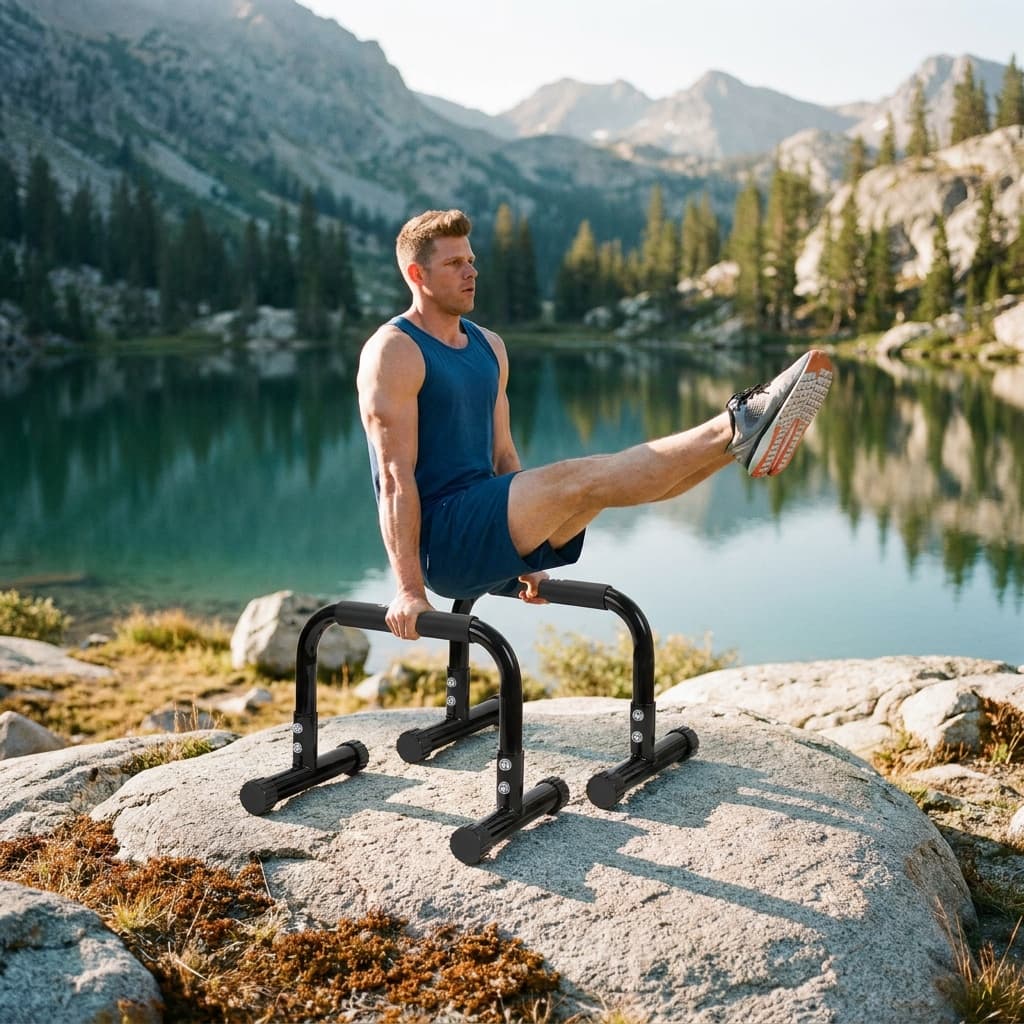
Parallettes start around 6 inches for low-profile pairs (the airogym Wood Parallettes are listed at 5.9 inches) and reach 9–12 inches for standard height. That extra clearance lets you compress your hips, pull your knees to your chest, and work the hip flexor and abdominal tension that gymnastics skill work demands. A 9-inch parallette lets you extend into a full L-sit; a 4-inch push-up bar does not.
Stability and load: where parallettes win on feel
Parallettes are built wider and heavier than push-up bars because they have to support isometric holds, not just vertical pressing force. A tuck planche shifts your center of mass forward dramatically; a push-up bar's narrow base would rock or slide under that load. Quality wood or steel parallettes use longer, wider bases and non-slip feet or pads designed for sustained pressure from odd angles.
Push-up bars are optimized for the vertical load of a push-up. They are lighter and narrower, which makes them easy to store but less stable the moment your weight shifts laterally or you attempt a slow eccentric that loads the handles unevenly.
For skills like the L-sit, the floor is your ceiling: you cannot tuck high enough without height clearance, no matter how strong you are.
What each tool enables (and what it does not)
Push-up bars are the right tool for:
- Wrist-neutral pressing (pushes, pike push-ups, decline push-ups)
- Slightly deeper chest range of motion at the bottom of a push-up
- Travel or minimal-storage situations
- Beginners whose primary goal is upper-body pressing volume
Parallettes are the right tool for:
- L-sits and tuck L-sits (requires 6+ inches of clearance)
- Tuck planche and planche lean progressions
- Handstand press entries and freestanding handstand practice
- Dip variations with full shoulder depression
- Any static hold that benefits from height and a stable, wide base
Neither replaces a pull-up bar or rings. They are pressing and skill-hold tools; pulling movements need a separate setup.
Choosing the right option for your training stage
Beginning pressing
Start with push-up bars; wrist neutrality matters before you need height clearance.
First isometric holds
Move to low parallettes (6–7 in) once you are chasing tuck L-sits or dip lockouts.
Gymnastics skill progression
Standard parallettes (9 in) give clearance for full L-sits and planche leans.
Handstand-focused work
Tall parallettes (10–12 in) allow more comfortable kick-up entries and press attempts.
Portability is the constraint
Push-up bars win; most parallettes are not practical for travel.
Footprint and portability
Push-up bars are small and light enough to slide under a bed or into a bag. The Perfect Pushup Elite pair is listed at 1.8 lb and fits in a backpack. If you travel with training equipment or live in a small space, that matters.
Parallettes do not travel well. A standard wood or steel pair is 12–18 inches long, several inches tall, and heavy enough that packing them is a real inconvenience. Some brands make knock-down parallettes with removable feet, which helps with storage but not with carry weight. Plan for them to live in one spot.
The exception is a low wood set designed to travel. The Xtenia Antlettes V2 put 35 mm beech handles on powder-coated steel bases at 10.5 cm (4.1 inches) high, which is push-up-bar height, and the pair weighs 1.1 kg (2.4 lb) and ships with a carry bag. That height is too low for a straight-leg L-sit for most adults, but it suits push-ups, planche leans, and tuck planche holds away from home. Our Xtenia Antlettes V2 review covers the specs and the independent SGS load test. The score is based on Xtenia's published specifications, that report, and store reviews: Xtenia is supplying Kit Authority a sample that we have not used yet, and we earn a commission on purchases through the Xtenia link.
BEST PORTABLE WOOD SET
Xtenia Antlettes V2 Wooden Parallettes
Best for: Athletes who prioritize a compact, backpack-friendly wooden set for push-ups, planche work, tuck holds, and travel over maximum L-sit clearance.
- The 1.1 kg pair weight and removable construction make this one of the most portable wood-handle options in the current field
- The 4.1-inch handle height offers less leg clearance for full L-sits and deep pressing than the 9.5- to 12-inch picks
Kit Score 8.5/10 · Check current price · how we score gear
Buy at XteniaProduct details
A compact low-profile wooden parallette set built around 35 mm beech handles and powder-coated steel bases. Xtenia publishes a 1.1 kg pair weight, large anti-slip pads, independent SGS compression-test documentation, and a lifetime structural guarantee. A supplied sample is scheduled for direct-use evaluation; the current score is based on verified specifications and owner feedback, not field testing.
- Handle height
- 10.5 cm (4.1 in)
- Handle length
- 23 cm (9.1 in)
- Handle diameter
- 35 mm (1.38 in)
- Pair weight
- 1.1 kg (2.4 lb)
- Materials
- Beech wood handles, powder-coated steel bases
- Verification
- SGS compression test, one bar: 12.55 kN peak (about 1,280 kgf); Xtenia daily rating 300 kg
More strengths
- SGS compression-test documentation and a lifetime structural guarantee provide stronger evidence than an unsupported marketplace load claim
- The 35 mm beech handle avoids foam wear and gives a compact, wrist-neutral platform for push-ups and planche progressions
Other tradeoffs
- The current owner-review pool is small, and Kit Authority has not completed its supplied-sample evaluation yet
- Orders ship from Spain, so US delivery cost and timing need to be checked at checkout
Who should buy which
Buy push-up bars if your training is primarily pressing-based, a neutral grip feels better than a flat palm, you travel frequently, or storage is tight. They are a focused alternative to floor pressing with little equipment learning curve.
Buy parallettes if you are working on any gymnastics skill, you want to develop L-sit and planche progressions seriously, or you have already maxed out the utility of push-up bars and want a stable platform for longer holds. The low beech airogym pair and the 12-inch painted-steel TABEKE currently cost about the same as the Perfect Pushup Elite, so the real cost is space: parallettes will take up a dedicated corner.
Where these numbers come from
| Claim | Source | Checked |
|---|---|---|
| Perfect Pushup Elite: rotating handles on steel ball bearings, 8 in base, 400 lb rating, pair listed at 1.8 lb | Perfect Pushup Elite listing on Amazon, ASIN B008DNAJ5M, read through the Amazon Creators API | Oct 3, 2026 |
| airogym wood parallettes: 5.9 in tall, 1.5 in beech bar, 600 lb (270 kg) rating | airogym listing on Amazon, ASIN B0BWRRR77D, read through the Amazon Creators API | Oct 3, 2026 |
| TABEKE: 12 in tall, 1.5 mm painted steel, 1.5 in foam handles, 660 lb rating | TABEKE listing on Amazon, ASIN B0D2XWGJRR, read through the Amazon Creators API | Oct 3, 2026 |
| All three Amazon picks in stock, at closely matched current prices | Amazon Creators API | Oct 3, 2026 |
| Xtenia Antlettes V2: 23 x 14 x 10.5 cm, 35 mm beech handles, powder-coated steel base, 1.1 kg pair, carry bag, 300 kg rating; SGS compression test peak 12.55 kN (Xtenia: tested to failure at 1,280 kg) | Xtenia, Antlettes V2 product page | Oct 3, 2026 |
| A wrist-extended push-up raised peak radioscaphoid pressure versus a neutral wrist (8 cadaver wrists) | Daly BT et al., Effect of push-up position on wrist joint pressures, Journal of Hand Surgery (American) 43(4), 2018 | Sep 2026 |
Heights and clearance guidance for L-sits are practical reasoning from these published dimensions, not a Kit Authority measurement.
Frequently asked questions
Can I use push-up bars for L-sits?
For most people, no. Standard push-up bars sit only a few inches off the floor. Unless you have unusually long arms, short legs, and excellent compression, your hips will contact the ground before you can achieve even a tuck L-sit. Parallettes with at least 6–7 inches of clearance are the correct tool for that skill progression.
Are wooden parallettes better than steel?
Neither is categorically better. Wood handles (the wood sets in this guide use beech) are slightly warmer to grip and naturally grippy when chalk is used. Steel or aluminum parallettes are more durable under heavy loads and easier to clean. The more important variables are base width, rubber foot quality, and handle diameter (the picks here run from 35 mm on the Xtenia to about 38 mm, or 1.5 in, on the steel and airogym sets). Both materials support serious skill work when built correctly.
Do parallettes change wrist position like push-up bars do?
Yes. Both tools let the hand grip a handle instead of pressing flat against the floor, which changes the wrist angle. A cadaver study of eight wrists found that a push-up with the wrist bent back produced significantly higher peak pressure in one part of the wrist joint (the radioscaphoid fossa) than a neutral wrist position (Daly et al., Journal of Hand Surgery, 2018). A neutral grip may feel more comfortable for some users, but equipment is not a diagnosis or treatment. Persistent or sharp pain deserves qualified medical guidance.
For specific picks across budgets and heights, see best parallettes, then compare low vs high and wood vs steel.
Keep going
Related buying guideBest parallettes for L-sits, handstands, and push-upsRelated guides
 Complete fitness loadoutHome calisthenics kitBuild the complete kit
Our recommendations draw on manufacturer documentation, retailer listings, owner feedback, and comparisons with alternatives.
As an Amazon Associate I earn from qualifying purchases. We may earn a commission from links here, at no extra cost to you. How we research →
Top picks
- BEST FOR PUSH-UPSPerfect Fitness Perfect Pushup Elite8.5/10
 BEST BUDGETairogym Wood Parallettes Push Up Bars8.5/10
 BEST VALUETABEKE 12-Inch High Parallettes Bars8.2/10
 Best Portable Wood SetXtenia Antlettes V2 Wooden Parallettes8.5/10
Related buying guide
Best parallettes for L-sits, handstands, and push-ups