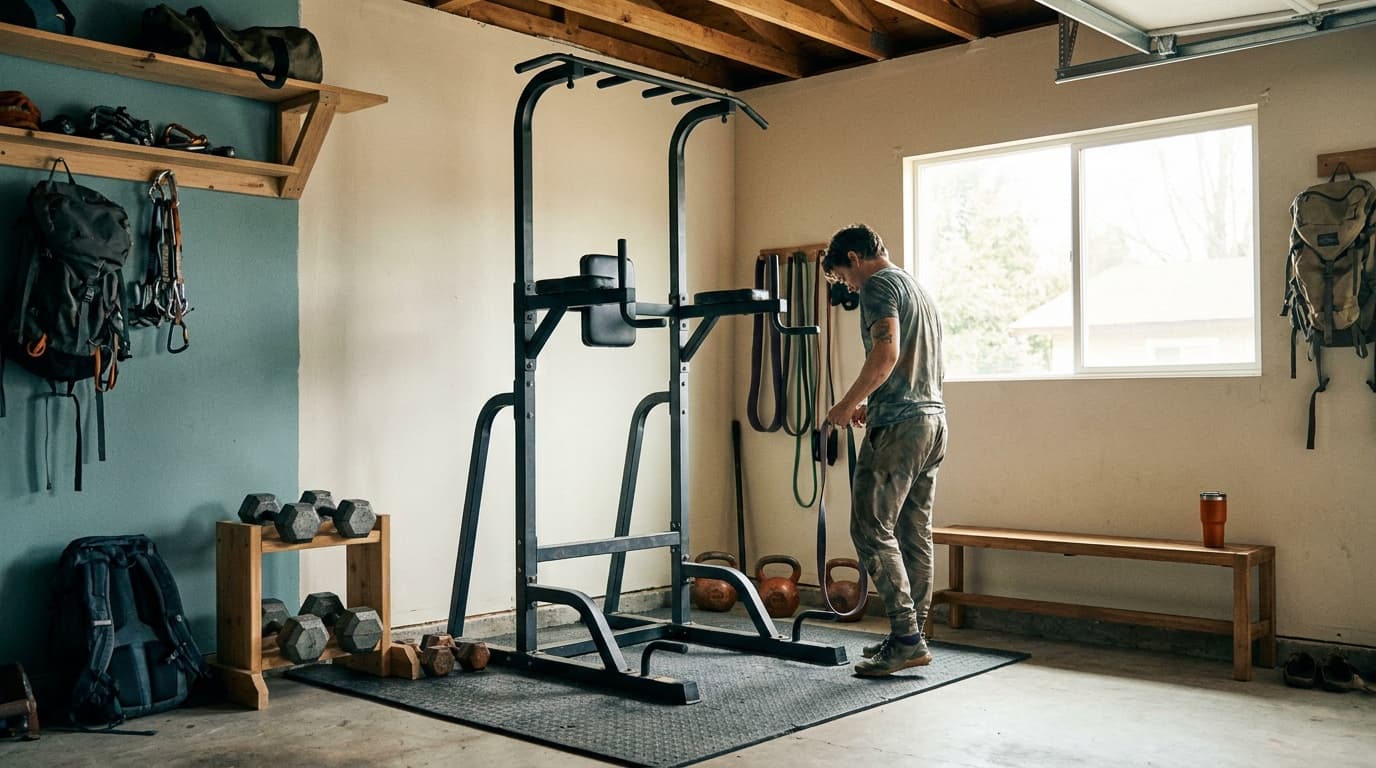
A power tower is worth it if you train pull-ups and dips several times a week and can give up a corner of floor: it combines a pull-up bar, dip station, and knee-raise station in one frame. Plan for real space, though. The Sportsroyals tower's base is 41.2 by 39.7 inches and its pull-up bar adjusts up to 88 inches, per its listing. If you only want pull-ups, a doorway bar does the job for far less.
What a power tower actually gives you
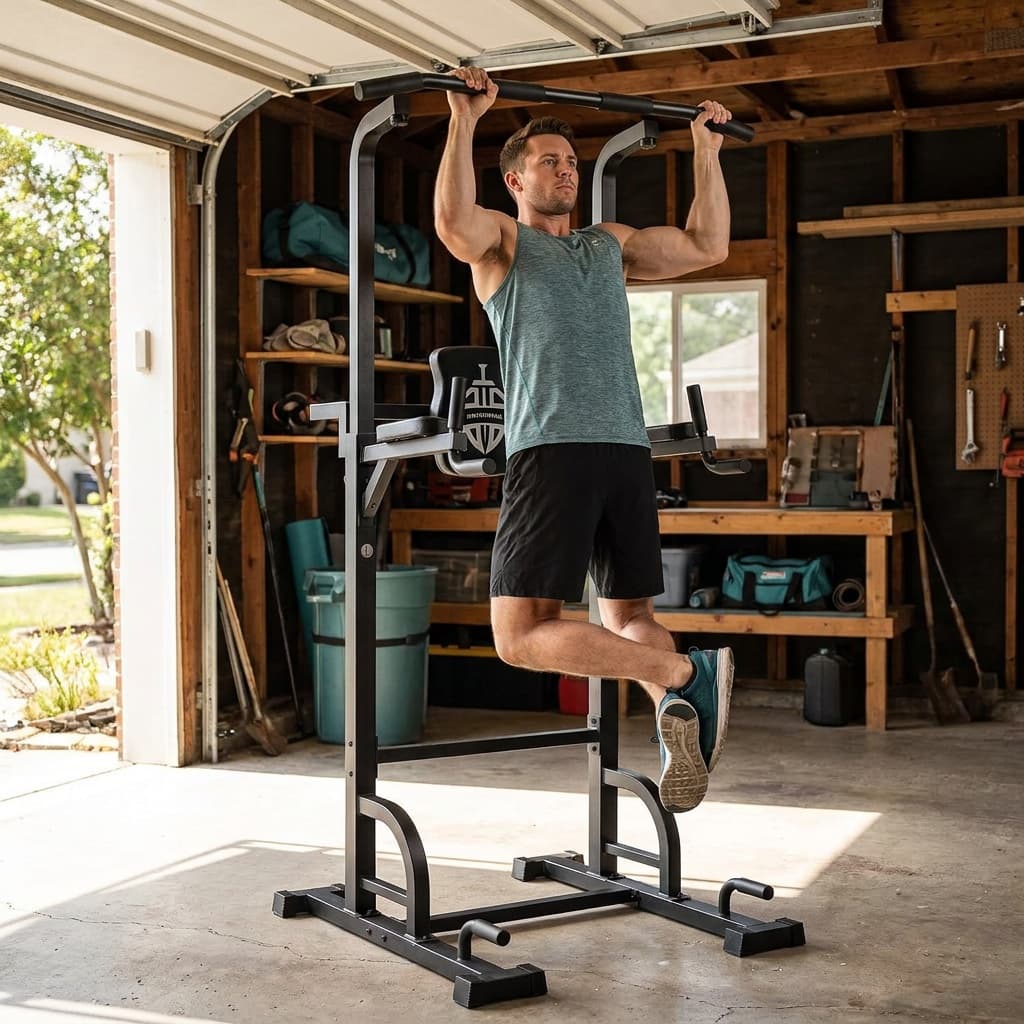
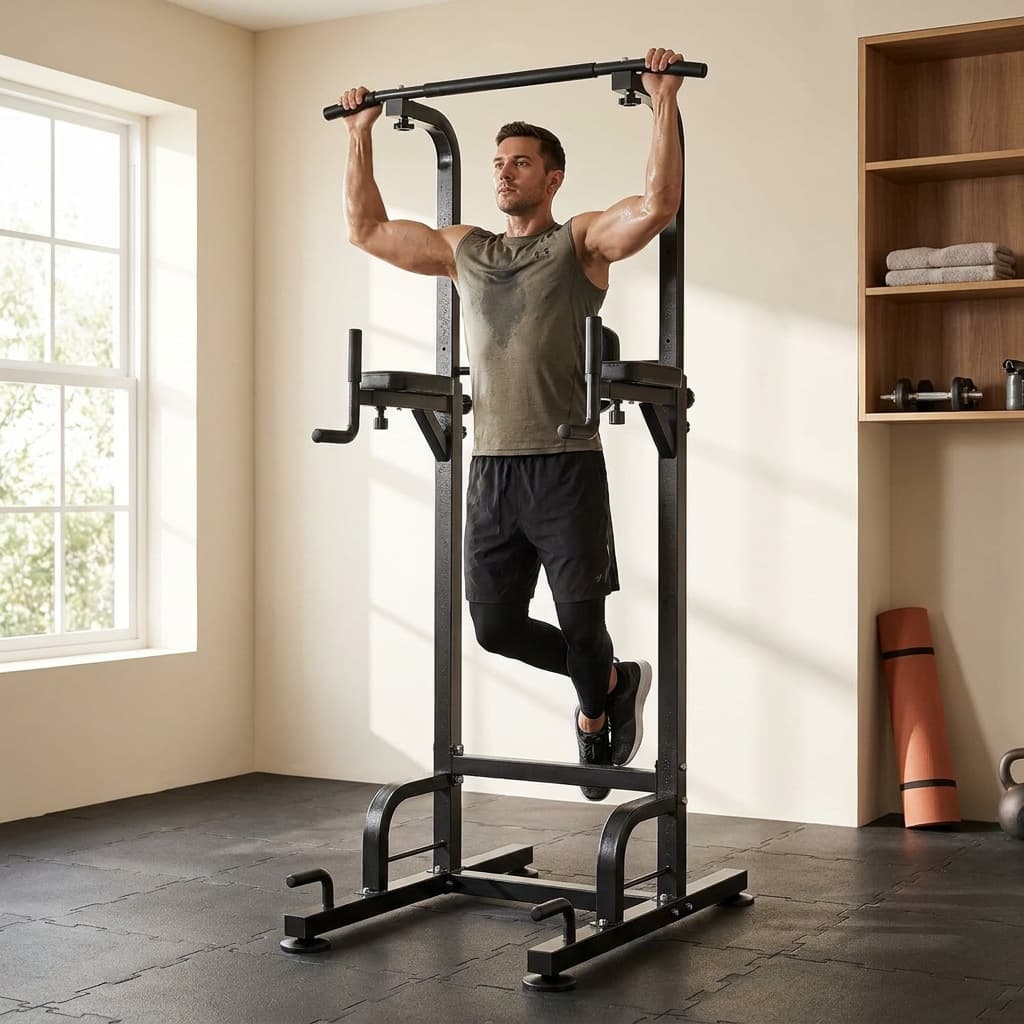
At its core, a power tower is a freestanding steel frame that stacks three movement patterns vertically. The top bar handles pull-ups and chin-ups. The side arms provide parallel bars for dips and push-ups. The padded backrest and forearm rests at mid-height turn the frame into a vertical knee-raise (VKR) or leg-raise station.
That combination covers a meaningful portion of upper-body calisthenics: vertical pulling (pull-ups), vertical pushing (dips), and anterior core work (hanging knee raises, leg raises, L-sits). For someone building a home gym around bodyweight training, that is a solid foundation without needing three separate standalone pieces.
Who actually benefits
Power towers make the most sense for a specific kind of home gym user: someone committed to calisthenics or upper-body bodyweight training who wants a single permanent station and has the space to leave it set up. If you train pull-ups and dips multiple times per week, the ergonomics of a dedicated station, stable footing, full range of motion, and consistent grip height, are worth the footprint premium over improvised setups.
They also work well as a complement to a barbell or cardio setup. A tower occupies dead corner space and adds pulling and dipping capacity without another rack or cable column.
They are less compelling if you rent, move frequently, train in a small bedroom, or only want pull-ups. In those cases, cheaper and more portable solutions solve the problem.
If you are already doing dips and pull-ups three or more times a week, a power tower is a tool you will actually use daily rather than a purchase you will rationalize.
Space and stability trade-offs
The footprint numbers above are for the base only. You also need clearance around the unit for dips and for stepping on and off, plus overhead room above the pull-up bar so your head clears the ceiling at the top of a rep. For a tower like the Fitness Reality X-Class (63.4 by 49 inches), plan on 25 square feet or more of usable floor.
Stability varies considerably by build quality. Budget towers often use thinner steel and shorter bases, and owners report more wobble during kipping pull-ups or explosive dips. Heavier-built towers from established brands, such as the Fitness Reality X-Class Power Tower (150 lb unit weight, 400 lb rated capacity), use a bigger base that absorbs movement better. Weight anchors or rubber floor mats help but do not fully compensate for a frame that flexes under load.
How to evaluate stability before you buy
Check the steel and unit weight
Look for a stated wall thickness (Sportsroyals lists 2 mm) and a heavier frame; light frames flex more under dynamic movement.
Measure the base width
Wider stance equals less tipping torque; compare base dimensions across models before deciding.
Look for floor anchor points
Pre-drilled holes or integrated anchors let you bolt to a rubber mat or concrete floor if needed.
Read reviews from heavier users
Stability complaints surface most clearly from users near the weight limit, not average-weight users.
Verify height adjustability
If multiple people use it, adjustable pull-up bars prevent the frame from being set up for one person and awkward for everyone else.
Weight capacity: the number most buyers overlook
Popular power towers are rated around 400 to 450 lb, but budget frames vary and makers rarely say how the rating was tested. Treat it as a ceiling for steady loads. Kipping pull-ups, explosive dips, and swinging leg raises add momentum, so the frame sees peak forces above your bodyweight.
If you are at or above 200 lb, prioritize towers rated at 300 lb or higher, like the 450 lb rated Sportsroyals Power Tower, and built with heavier-gauge steel. Leave a wide margin between your bodyweight and the rated capacity, especially on lighter frames.
Power tower vs. a doorway pull-up bar
A doorway pull-up bar costs a fraction of a tower, stores in a closet, and installs in seconds. If pull-ups are your only goal, it is hard to argue against one. The limitations are real though: no dips (you cannot dip safely in a doorframe), no vertical knee raises, and grip width is fixed to your door width, which is usually narrower than ideal for wide-grip pull-ups.
A power tower costs several times more, requires permanent floor space, and takes about an hour or more to assemble. What it adds is dips (one of the most effective upper-body pushing movements available without weights), the VKR station, and typically a wider, more comfortable pull-up grip.
If your training includes dips or you want the ab station, a power tower pays for itself in utility within a few months of consistent use. If you only want pull-ups, the doorway bar is the honest answer.
Frequently asked questions
How much space does a power tower really need?
Plan for the base plus clearance: popular towers have bases from about 41 by 40 inches (Sportsroyals) to 63 by 49 inches (Fitness Reality X-Class), so budget roughly 5 by 5 feet or more of clear floor. Their pull-up bars reach 83 to 88 inches at the top setting, so check the tower's maximum height against your ceiling; an 8-foot ceiling gives comfortable headroom if you use a lower bar setting.
Can beginners use a power tower?
Yes. Dips and pull-ups are both scalable: band-assisted pull-ups and bench-assisted dips work on any power tower, and the VKR station is accessible at any strength level. The learning curve is the exercises themselves, not the equipment.
Are cheap power towers unsafe?
Budget towers are not inherently dangerous if you stay well within their weight rating and limit dynamic loading. The real risk is using a tower near its rated capacity while doing explosive movements. If you are near the capacity limit, spend more or choose a heavier-duty model.
Where these numbers come from
| Claim | Source | Checked |
|---|---|---|
| Sportsroyals: 450 lb rating, 6 bar heights from 64.56 to 88.18 in, 41.2 x 39.7 in base, 62 lb, 2 mm steel, users 4'8" to 6'6" | Sportsroyals listing on Amazon, ASIN B07SM8VJ6P | Sep 2026 |
| Fitness Reality X-Class: 400 lb max user, 63.4 x 49 x 83 in, 150 lb unit weight, about an hour to assemble | GarageGymPro, Fitness Reality X-Class review | Sep 2026 |
Capacities and dimensions are the makers' published specs, not Kit Authority measurements.
For specific picks, see our guide to the best power towers. Browse all fitness guides or read how we research and rate gear.
Recommended gear
Our current top picks from the Best power towers for home bodyweight training (2026) guide, if you are ready to buy.
SPORTSROYALS
Sportsroyals Power Tower Pull Up Bar Station, 450LBS
Best Overall
Kit Score 8.5/10
$169.98 Price checked Oct 23, 4:16 PM CDT
Best for: Home gym users who want a stable, all-in-one bodyweight station at a mid-range price and plan to train with strict form.
- H-base eliminates lateral sway during strict pull-ups and dips, confirmed by owners training with added weight on a dip belt
- Slight lateral movement appears during kipping or explosive movements, so it is better suited to controlled reps
- Weight capacity
- 450 lb
- Height range
- 64.6" – 88.2" (6 positions)
- Base footprint
- 41.2" L x 39.7" W (Amazon listing)
- Frame
- 2 mm steel, H-base with 8 support points
- Padding
- Cushioned armrests, 7-position adjustable backrest
- Exercise stations
- Pull-up, dip, knee raise, push-up
About this pick
The Sportsroyals is one of the best-known freestanding power towers on Amazon, with a 450 lb rated frame and an elongated H-base that distributes load across eight contact points. Multi-grip pull-up bar, padded dip handles, and a captain's chair cover the full bodyweight toolkit in a compact footprint.
Strengths
- H-base eliminates lateral sway during strict pull-ups and dips, confirmed by owners training with added weight on a dip belt
- Six height settings and a 7-position adjustable backrest fit athletes from roughly 4'8" to 6'6"
- Cushioned armrests with a 10-degree inward tilt to keep elbows from slipping during leg raises
Weaknesses
- Slight lateral movement appears during kipping or explosive movements, so it is better suited to controlled reps
- Assembly runs 60 to 90 minutes and the instructions rely on line drawings rather than photos
Kit Score breakdown
RELIFE
RELIFE REBUILD YOUR LIFE Power Tower Pull Up Bar Dip Station
Best Value
Kit Score 8.0/10
$132.98 Price checked Oct 23, 4:16 PM CDT
Best for: Lighter or intermediate bodyweight trainees who want the most height adjustability for the money and train primarily with controlled form.
- Nine height positions cover the widest range in this price bracket, fitting users from 5'3" up to about 6'2"
- Owners above 180 lb report front-to-back sway of roughly 0.5 inches during dynamic movements; wall placement is recommended above 200 lb
- Weight capacity
- 450 lb
- Height range
- 56" – 86" (9 positions)
- Base footprint
- 34" L x 26.4" W (Amazon listing)
- Frame
- 14-gauge steel, powder-coat finish
- Stability features
- Safety locknuts, 4 suction cup feet
- Exercise stations
- Pull-up, dip, knee raise, push-up
About this pick
The RELIFE tower offers the widest height adjustment range in its class (9 positions, from 56 to 86 inches) and a 450 lb rating, for roughly $20 to $30 less than most direct competitors. Suction cup feet and safety locknuts add reassurance for solo training.
Strengths
- Nine height positions cover the widest range in this price bracket, fitting users from 5'3" up to about 6'2"
- Safety locknuts at each adjustment joint keep the tower quiet and prevent height creep during sets
- Strong price-to-capacity ratio: 450 lb rating at a sub-$145 street price is difficult to beat
Weaknesses
- Owners above 180 lb report front-to-back sway of roughly 0.5 inches during dynamic movements; wall placement is recommended above 200 lb
- Armrest padding compresses noticeably within three to four months of frequent use
Kit Score breakdown
See all picks in Best power towers for home bodyweight training (2026)
Keep going
Researched, not hands-on tested
Updated Sep 25, 2026Our recommendations draw on manufacturer documentation, retailer listings, owner feedback, and comparisons with alternatives.
As an Amazon Associate I earn from qualifying purchases. We may earn a commission from links here, at no extra cost to you. How we research →