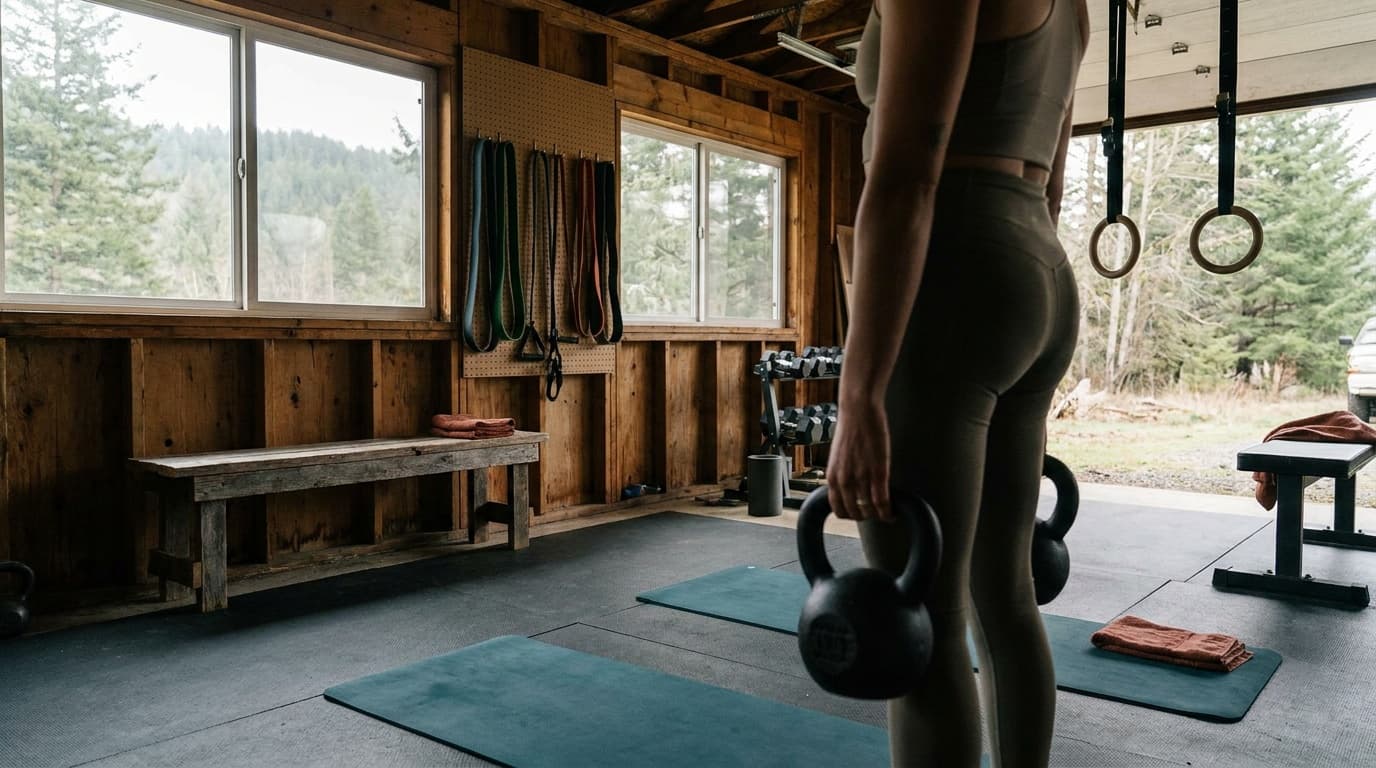
Kettlebells reward patience at the start. Get the movement patterns right with a sensible weight and you will build strength, conditioning, and mobility together, which is a combination most equipment cannot match.
Why kettlebells work
The design forces your whole body to cooperate. A fixed load offset from the handle demands that your core, hips, and shoulders stabilize together, not in isolation.
The research backs this up. An ACE-commissioned study at the University of Wisconsin-La Crosse found that 8 weeks of twice-weekly kettlebell training increased aerobic capacity (VO2max) by 13.8 percent and boosted abdominal core strength by 70 percent in participants ages 19–25. Leg press strength in the kettlebell group improved by 41.7 kg over that same period versus only 5.4 kg in controls, and dynamic balance improved by up to 8.6 cm.
That is not a specialized result. That is what happens when you train hip-hinge patterns, braced carries, and loaded squatting movements together over a consistent 8-week block.
A 2024 systematic review across five rehabilitation studies (261 participants) found kettlebell training produced pain reductions of approximately 30–40 percent and strength improvements of 10–25 percent in musculoskeletal outcomes, suggesting the tool is as useful for building resilience as it is for raw performance.
The four foundational moves
StrongFirst, founded by Pavel Tsatsouline who popularized kettlebells in the West, names the swing, goblet squat, and get-up as the core exercises for new practitioners. For a beginner routine focused on building the hinge and squat patterns safely, the deadlift comes before the swing and the goblet squat comes before anything overhead. Learn them in this sequence.
Four moves, in learning order
Kettlebell deadlift
Stand over the bell with feet hip-width apart, bell centered between your heels. Hinge at the hips (push them back, not down), grip the handle, brace your core and lats, then stand by driving your heels through the floor. Lower under control. This is the hip-hinge pattern the swing is built on. Master this before you swing.
Goblet squat
Hold the bell by the horns close to your sternum, elbows pointing down. Squat until your elbows track inside your knees, keeping your chest upright throughout. If the bell drifts away from your body it immediately shifts load to your lower back. Squeeze the floor with your feet on the way up.
Two-handed swing
Hike the bell back between your legs, then snap your hips forward explosively to drive it to chest height. The power comes from your hips and glutes, not your arms or lower back. At the top you should be standing tall with glutes squeezed, not leaning back. This is a hip hinge, not a squat: excessive knee bend is the most common beginner error.
Overhead press
Clean the bell to the rack position (bell resting on your forearm, elbow close to your body, fist at chin height). Press straight up until your arm is locked out overhead, bicep near your ear. Do not let your wrist collapse or bend backward under the load. Lower slowly back to rack.
The swing is a hip hinge, not a squat. Power comes from snapping the hips forward. If your lower back feels the work instead of your glutes and hamstrings, the pattern is off.
Choosing your starting weight
Most beginner women do well starting at 8–12 kg (18–26 lb). Most beginner men start at 12–16 kg (26–35 lb). If you already have a strength training background, start at the higher end of those ranges.
The practical test: you should be able to complete 8 clean reps with the weight feeling genuinely challenging on reps 6–8. If you cannot complete 5 reps without your form breaking down, drop one size. If you can hit 20 reps without effort, move up one size.
One bell is enough to start. Buy a second, heavier bell when you can consistently complete 15–20 clean reps on your main movements with the first, or begin with an adjustable model like the REP Fitness Adjustable Kettlebell and skip the second purchase entirely.
Safety basics
The moves that cause the most beginner injuries are usually not the result of lifting too heavy but of a small mechanical error repeated hundreds of times.
A simple beginner routine
The structure below follows the most consistent recommendations across kettlebell coaches and programming resources: 2–3 sessions per week, 2–3 sets of 8–12 reps per exercise, sessions running 30–45 minutes including a brief warm-up and cool-down.
The session (3 days per week, e.g. Monday/Wednesday/Friday):
- Two-handed swing: 3 sets of 10
- Goblet squat: 3 sets of 8
- Single-leg deadlift or Romanian deadlift: 3 sets of 8 per side
- Press: 3 sets of 6–8 per side
Rest 60–90 seconds between sets. Keep total session time under 40 minutes.
Progression over the first 6 weeks:
- Weeks 1–2: use a weight that feels almost too light. Focus entirely on movement quality. The hip-hinge pattern is a new motor skill and the body needs repetitions, not load, to groove it.
- Weeks 3–4: add reps until you reach the top of the 8–12 range across all sets with clean form.
- Weeks 5–6: if all sets are clean and the top rep range feels manageable, add one set or move up 2 kg. Not both at once.
Complete novices can start with two sessions per week and add the third session after 3–4 weeks once recovery feels manageable.
Gear: what you actually need
You need one kettlebell to start, and a basic powder-coated bell like the Yes4All Powder Coated Kettlebell covers everything in this routine. For brand and budget guidance on which bells are worth buying, see our guide to the best kettlebells.
Beyond the bell: a non-slip surface or a rubber gym mat protects the floor and gives your feet grip during swings. That is the full list for a beginner. Chalk, straps, and specialized footwear are not a beginner concern.
What weight kettlebell should a beginner buy?
Most beginner women do well starting at 8–12 kg (18–26 lb). Most beginner men start at 12–16 kg (26–35 lb). If you already have a strength training background, start at the higher end of those ranges. The goal is a weight that feels genuinely challenging for the last 2–3 reps of a set but does not force you to break form. One bell is enough to start; buy a second, heavier one when you can consistently hit 15–20 clean reps on your main movements.
How often should beginners train with kettlebells?
Two to three sessions per week, with at least one rest day between sessions, is the standard starting point. Complete novices can begin with two sessions per week and add a third after 3–4 weeks once recovery feels manageable. Each session should run 30–40 minutes including a warm-up. More is not better early on: the swing and deadlift pattern are new motor skills, and the body needs time between sessions to consolidate them.
Is it safe to learn kettlebells on your own, or do you need a coach?
The deadlift and goblet squat are generally safe to learn from quality instructional resources if you start light and prioritize form. The swing is more technical: the hip-hinge pattern is counterintuitive for many people, and errors like squatting the bell or rounding the lower back can cause injury at higher weights. If you have access to a certified kettlebell instructor (look for StrongFirst or RKC credentials), even one or two sessions to verify your swing mechanics is worth the investment. If you are self-taught, film yourself from the side and compare your mechanics against clear instructional cues.
Browse all fitness gear reviews, or see how we research and rate every piece of equipment we cover.
Recommended gear
Our current top picks from the Best kettlebells for home workouts: cast iron, competition, and adjustable guide, if you are ready to buy.
Best for: Home gym owners who want a durable, versatile cast iron bell with room to build a rack of matched weights over time.
- Grip holds up through high-rep sessions without chalk, even with sweaty hands
- The 39 mm handle diameter can feel thick for lifters with smaller hands, particularly on lighter weights
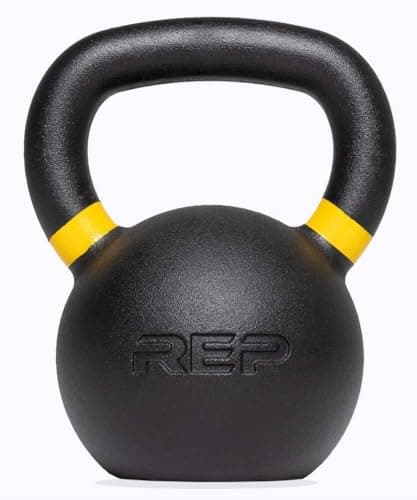
- Type
- Cast iron, gravity die-cast
- Weight range
- 4 – 48 kg (9 – 106 lb)
- Handle diameter
- 39 mm
- Coating
- Matte black powder coat, chip-resistant
- Base
- Machine-finished flat bottom
- Markings
- Dual kg/lb stamps, color-coded handle rings
About this pick
A gravity die-cast bell with a matte powder-coat finish that provides reliable grip without chalk. The wide weight range and consistent manufacturing quality make it a strong single-bell or build-a-set choice for most home gyms.
Strengths
- Grip holds up through high-rep sessions without chalk, even with sweaty hands
- Color-coded handle rings and dual kg/lb markings make weight identification instant
- Available from 4 kg to 48 kg, so you can add bells as you progress without switching brands
Weaknesses
- The 39 mm handle diameter can feel thick for lifters with smaller hands, particularly on lighter weights
- Cast iron requires occasional wipe-down in humid environments to prevent surface rust
Kit Score breakdown
YES4ALL
Yes4All Powder Coated Kettlebell
Best Value
Kit Score 8.2/10
$64.81 Price checked Oct 23, 6:22 AM CDT
Best for: Beginners or budget-focused buyers who want a functional cast iron bell for swings, goblet squats, and presses without committing to a premium price.
- Lowest per-pound cost among quality powder-coated options on Amazon, making it easy to build a starter set
- Quality control is less consistent than premium brands: some owners report minor seam lines or uneven coating on isolated units
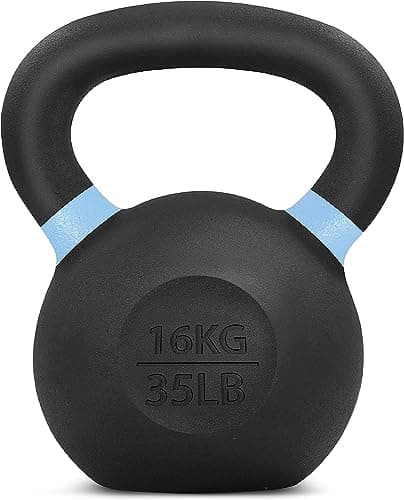
- Type
- Cast iron, single-piece no-weld construction
- Weight options
- 9 lb to 80 lb (13 options)
- Handle
- Smooth, slightly textured; chalk-optional
- Coating
- Powder coat, corrosion-resistant
- Base
- Flat bottom for upright storage
- Accuracy
- Weight within 2% of stated
About this pick
A no-frills cast iron bell with a powder coat finish that delivers honest build quality at a price per pound that is hard to beat on Amazon. The slightly textured handle provides grip without being abrasive, and the flat base handles renegade rows cleanly.
Strengths
- Lowest per-pound cost among quality powder-coated options on Amazon, making it easy to build a starter set
- Flat bottom is a practical feature at this price point, enabling push-up and renegade row variations
- Color-coded handle bands make quick weight identification easy in a multi-bell setup
Weaknesses
- Quality control is less consistent than premium brands: some owners report minor seam lines or uneven coating on isolated units
- Handle finish can feel slightly rougher than polished competitors, which matters more on high-rep snatch sets than on swings
Kit Score breakdown
REP FITNESS
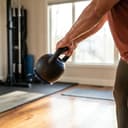
REP Fitness Adjustable Kettlebell
Best for Small Spaces
Kit Score 8.1/10
$219.99 Price checked Oct 23, 6:22 AM CDT
Best for: Home gym owners with limited storage who want a genuine cast iron feel and need one or two bells that cover a full beginner-to-intermediate weight progression.
- Replaces five separate kettlebells, a major advantage in apartments or small home gyms with limited floor space
- 24 kg (53 lb) maximum weight is not enough for advanced lifters who press or deadlift heavier
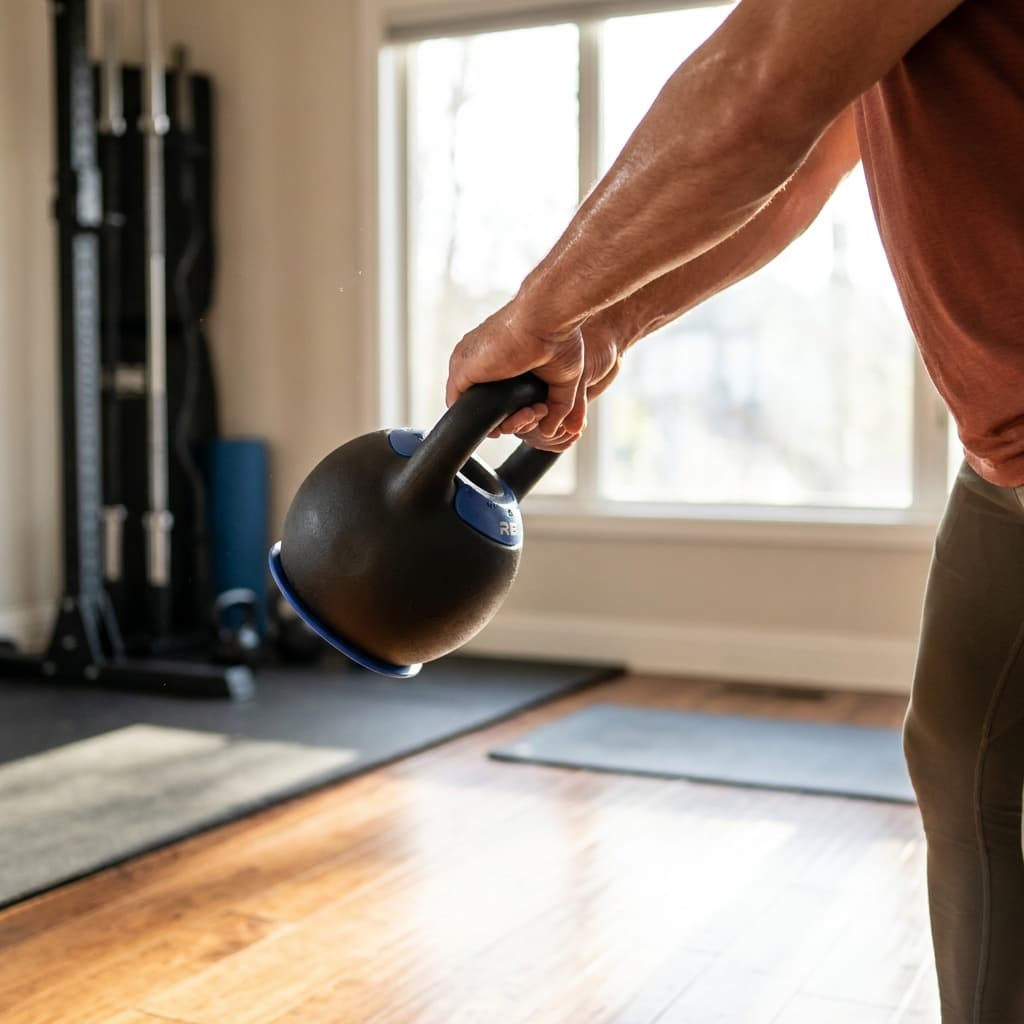
- Type
- Adjustable, cast iron shell with powder coat
- Weight range
- 8–16 kg or 16–24 kg (5 settings per bell)
- Increments
- 2 kg steps
- Handle diameter
- 34.6 – 35 mm
- Adjustment
- Push-down and twist dial; nylon thermoplastic locking plates
- Base
- Rubber-padded, floor-protective
About this pick
Five kettlebell weights in one bell footprint: push down and twist to change from 8 kg to 16 kg (or 16 kg to 24 kg) in under five seconds. Cast iron shell and matte powder coat give it a feel closer to a traditional kettlebell than any plastic-shell adjustable.
Strengths
- Replaces five separate kettlebells, a major advantage in apartments or small home gyms with limited floor space
- Cast iron construction and matte powder coat feel authentic through swings and presses, unlike cheaper adjustables with plastic bodies
- Minimal plate rattle during dynamic movements due to nylon thermoplastic locking mechanism
Weaknesses
- 24 kg (53 lb) maximum weight is not enough for advanced lifters who press or deadlift heavier
- Plastic adjustment dial is the one component that could fail with rough use; treat it as a precision mechanism, not a gym floor throw
Kit Score breakdown
See all picks in Best kettlebells for home workouts: cast iron, competition, and adjustable
Keep going
Researched, not hands-on tested
Updated Jun 3, 2026Our recommendations draw on manufacturer documentation, retailer listings, owner feedback, and comparisons with alternatives.
As an Amazon Associate I earn from qualifying purchases. We may earn a commission from links here, at no extra cost to you. How we research →