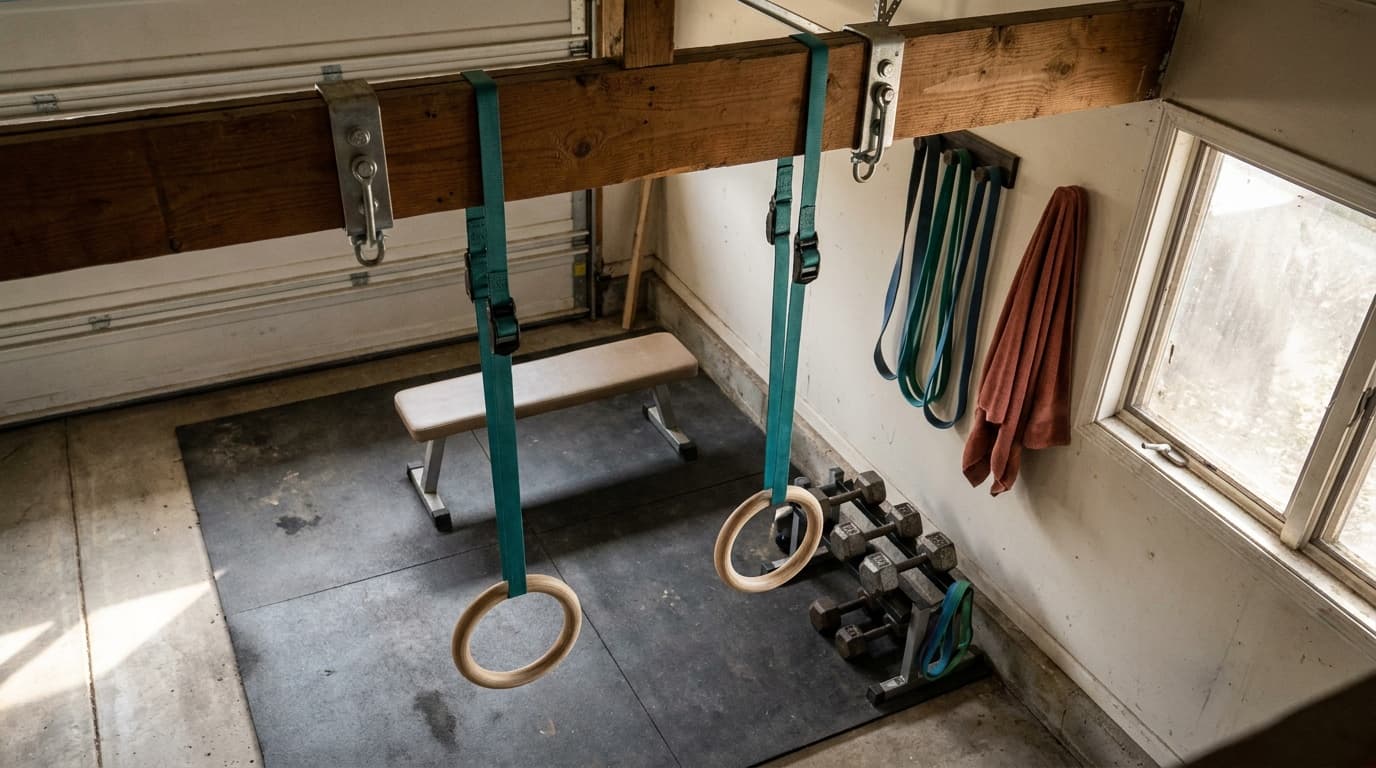
Gymnastic rings reward you in proportion to how solidly you hang them: a reliable anchor turns them into one of the most versatile tools in training, and a poor one turns every rep into a liability.
Anchor options: what works and what to avoid
The best anchor is one that is structurally tied to your building or a living tree, not clamped to a finished surface.
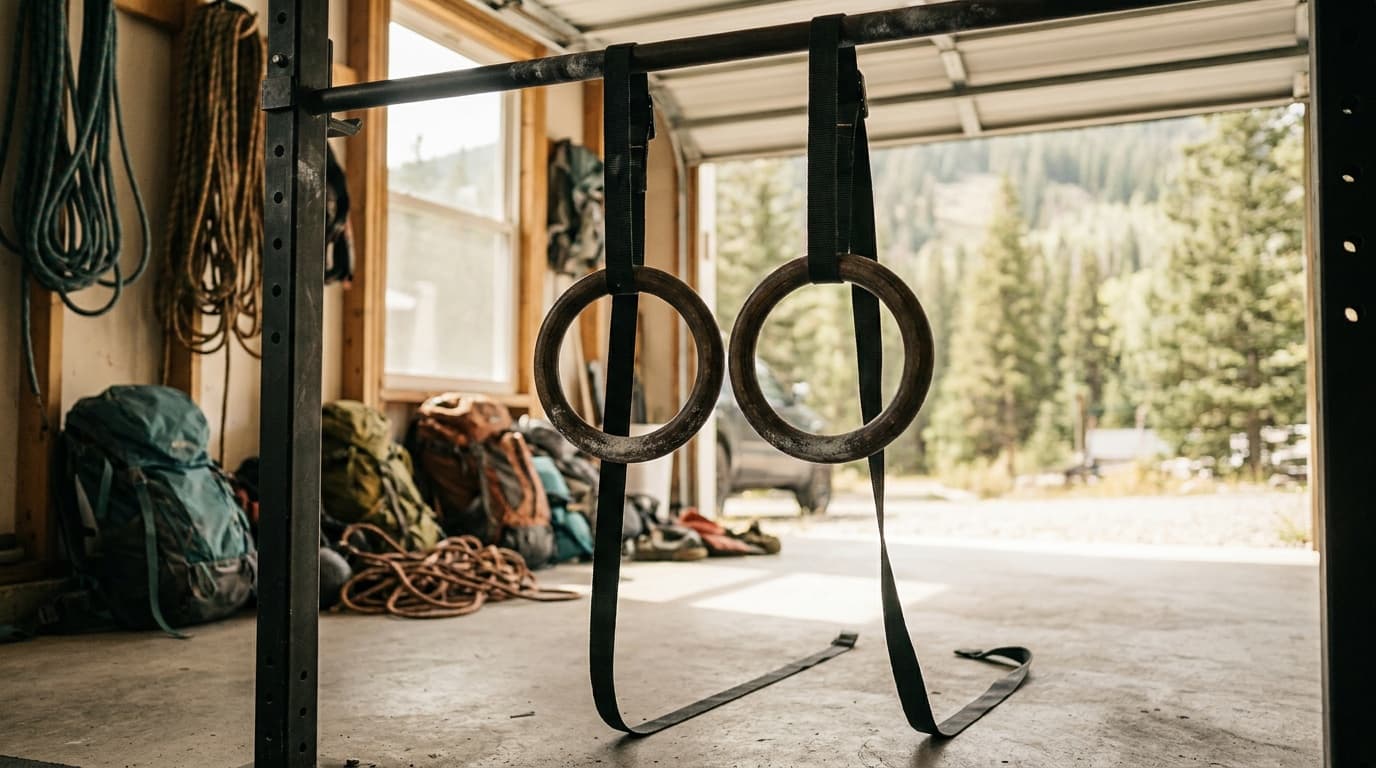
Pull-up bar (freestanding or wall-mounted): The most common starting point. A heavy-duty pull-up bar rated for 300 lb+ will handle static holds and ring rows comfortably. For kipping, muscle-ups, or anything dynamic, check the manufacturer's dynamic load rating separately. Wall-mounted pull-up bars bolted into studs are more stable than pressure-mounted doorway bars for ring work.
Ceiling joist with eye bolts: The most permanent and trustworthy indoor option. Locate a joist with a stud finder, drill a pilot hole, and thread in a forged eye bolt (not stamped sheet metal) of at least 3/8 in. diameter. Use a washer and nut on the far side if you have attic access. A single joist eye bolt setup with proper hardware is typically rated for several hundred pounds of working load. Space the two eye bolts 20–24 in. apart to match shoulder-width ring spacing.
Exposed beam: Functionally identical to a ceiling joist but visible and accessible. Loop the ring straps directly over the beam rather than threading through eye bolts when the beam is 3–6 in. thick. Wider beams may require an extension strap to keep the rings hanging vertically.
Tree branch: A legitimate outdoor option if the branch is alive, at least 4 in. diameter, and horizontal. Dead or angled branches are not safe anchor points. Wrap the strap over the branch and run the ring strap through itself (a girth hitch) rather than using eye bolts. Check the branch for cracks, bark separation, and soft spots before every session.
Doorway pull-up bar (pressure-mounted): Workable for ring rows and light bodyweight work only. These bars are not designed for the rotational and lateral forces that full ring training generates. If this is your only option, limit use to horizontal pulling movements and keep your feet on the ground as a partial spotter.
Weight rating: understanding the math
Dynamic loading multiplies your bodyweight significantly. The rule of thumb used in gymnastic coaching is to design for 3x your bodyweight for any swinging or kipping movement. A 200 lb athlete should treat the anchor as a 600 lb load. For this reason, eye bolts and straps rated at a working load of 600 lb are the practical floor, not a conservative recommendation.
Check every component in the chain: the anchor point, the eye bolt or bar, the strap webbing, and the cam buckle. The weakest link determines the actual rating.
Strap setup and cam buckles
Setting up ring straps
Thread the strap
Pass the webbing end up through the ring buckle from underneath, then back through the cam.
Route to your anchor
Loop over a pull-up bar or beam, or clip through your eye bolt carabiner (rated, locking carabiner only).
Set initial height
Pull the free end until the ring face sits at the height you want, typically shoulder height for dips or hip height for ring rows.
Snug the cam
Press the cam lever to lock. Tug firmly downward to confirm the buckle grabs and does not slip.
Match heights
Measure ring height from the floor with a tape measure on both sides before loading.
Cam buckles, like those on the PACEARTH Wooden Gymnastics Rings, are the industry standard on gymnastic ring straps because they hold reliably under load, release cleanly, and let you adjust height mid-session without tools. Avoid ratchet straps (too bulky, designed for cargo), bungee cords (stretch under load), and rope (slips unless you know knots well).
Safe height and clearance
For most ring training, anchor height of 7.5–9 ft allows a full hang without the feet touching the floor (assuming a ceiling of 10 ft or higher). Specific guidelines:
- Ring rows and assisted dips: rings at hip to shoulder height
- Free hanging, pull-ups, dips with feet clear: rings at 8–9 ft
- Muscle-ups: rings at 8.5–9.5 ft to complete the transition without hitting the ceiling
- Front and back levers, skin-the-cat: 9 ft minimum with at least 12 in. clearance on all sides
Clearance matters laterally, not just vertically. Allow at least 3 ft of open space around each ring for arm extension and rotational movement. Check your ceiling fan, light fixtures, and shelving before the first session.
Even height matching: why it matters and how to do it
An uneven hang shifts loading asymmetrically. Over time, this creates compensatory movement patterns and increases injury risk to the shoulder and elbow. Even a 1 cm difference in ring height is detectable in high-skill movements.
Measure ring height from the floor to the bottom of the wood ring face, not to the strap, and match both sides to the centimeter before every session if you have adjusted the straps.
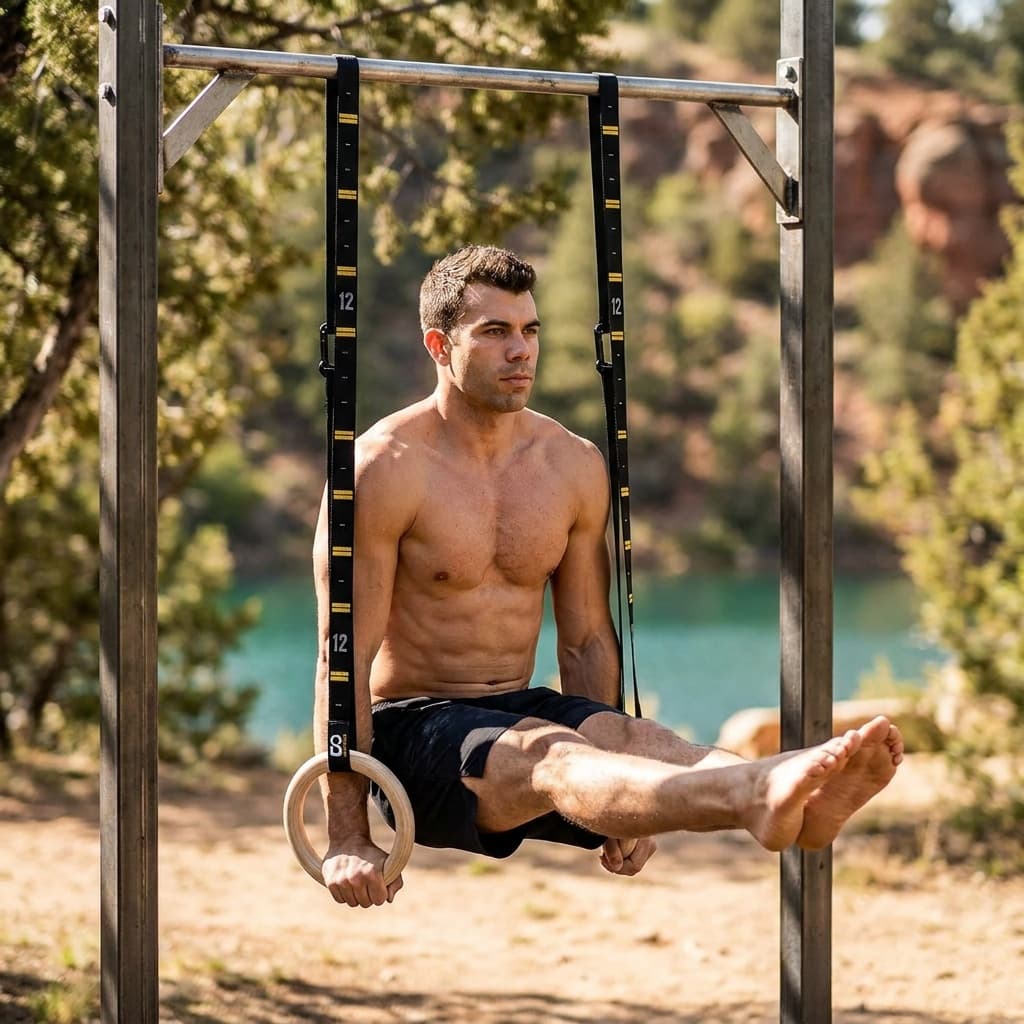
The most reliable method: measure from the floor to the ring face on both sides with the same tape, record the number, adjust, and re-measure. Do not eyeball it. If you are using eye bolts spaced identically in a joist, you can mark the strap at a fixed setting and rely on the marks rather than re-measuring daily (rings with numbered straps, like the Double Circle Wood Gymnastics Rings, build this in).
Frequently asked questions
Can I hang gymnastic rings from a doorway pull-up bar?
You can use a pressure-mounted doorway bar for ring rows and static holds with your feet partially supporting your weight. For free-hanging ring work, dynamic loading, or any pulling movement where your full bodyweight is suspended, use a stud-mounted wall bar, ceiling joist eye bolt, or freestanding rig rated for at least 600 lb. Doorway bars are designed for straight-down pull-up loading, not the lateral and rotational forces rings produce.
How far apart should gymnastic rings be spaced?
The standard is shoulder-width, roughly 20–24 in. between the ring centers for most people. Wider spacing increases the stabilization demand on the shoulder and is useful for advanced training; narrower spacing is easier for beginners. Match your eye bolt or strap anchor points to your preferred spacing and keep it consistent.
What is the minimum ceiling height to use gymnastic rings?
For basic ring rows and dips with feet on the floor, an 8 ft ceiling is workable. For free-hanging work including pull-ups and muscle-ups, you need at least 10 ft so the rings can be set at 8.5–9 ft and you still have clearance at the top of the movement. Rooms with lower ceilings are best reserved for floor-based ring work only.
For specific equipment picks, see our guide to the best gymnastic rings. Browse all fitness guides or read how we research and rate gear.
Recommended gear
Our current top picks from the Best gymnastic rings 2026: 4 scored picks for home training guide, if you are ready to buy.
PACEARTH
PACEARTH Gymnastics Rings Wooden Olympic Rings with Adjustable Cam Buckle 14.76ft Long Straps
Best Overall
Kit Score 8.5/10
$28.99 Price checked Oct 23, 4:16 PM CDT
Best for: Home or garage gym athletes who want one set that handles the full calisthenics progression: dips, rows, ring support work, and muscle-up training, with quick height changes between sets.
- Scale markings on 14.76 ft straps allow fast, repeatable height matching across both rings
- Newer listing with a smaller review base compared to category veterans
- Ring diameter
- 32mm (1.25 in)
- Material
- Birch wood
- Strap length
- 14.76 ft each
- Weight capacity
- 1,500 lb
- Buckle system
- Cam buckle with serrated contact surface and scale markings
- Includes
- 2 rings, 2 cam buckle straps, 2 rolls grip tape
About this pick
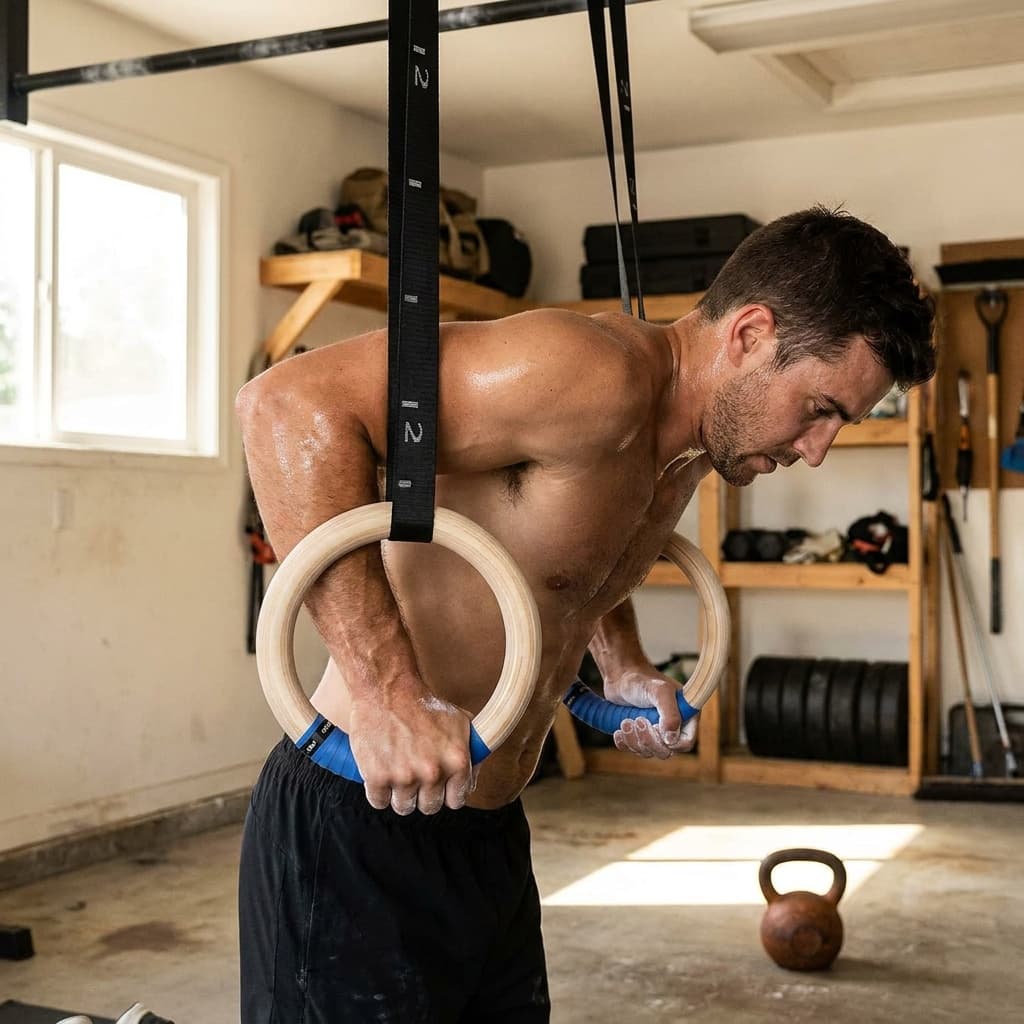
Birch wood rings at 32mm, paired with extra-long scaled straps and serrated cam buckles that lock securely and let you reproduce the same ring height every session. The 32mm diameter suits dips, rows, ring support holds, and muscle-up progressions without the grip fatigue that thinner rings create.
Strengths
- Scale markings on 14.76 ft straps allow fast, repeatable height matching across both rings
- Birch wood absorbs sweat and stays grippy without chalk, unlike plastic surfaces
- 1,500 lb rated capacity well above any realistic load for home or gym use
Weaknesses
- Newer listing with a smaller review base compared to category veterans
- Wood requires occasional light sanding and oiling if used outdoors in wet conditions
Kit Score breakdown
DOUBLE CIRCLE
Double Circle Wood Gymnastics Rings with Quick Adjust Numbered Straps and Exercise Videos Guide
Best Value
Kit Score 8.5/10
$47.97 Price checked Oct 23, 4:16 PM CDT
Best for: Athletes who rotate frequently between exercises and want a strap system that makes matching ring height fast and foolproof without eyeballing or counting slots.
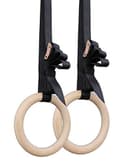
- Numbered carabiner strap system eliminates guesswork when transitioning between dips, rows, and ring support holds
- 9.2 ft straps limit maximum hang height compared to sets with 14–16 ft straps
- Ring diameter
- 32mm (1.25 in)
- Material
- Wood
- Strap length
- 9.2 ft (assembled)
- Weight capacity
- Not published on the current listing
- Buckle system
- Numbered straps with dual metal carabiners
- Includes
- 2 rings, numbered nylon straps, exercise video guide, travel case
About this pick
Wood rings at 32mm with a numbered strap system that clips into anchor slots so both rings land at exactly the same height every time. The carabiner-based numbered design allows 4-inch adjustments, and Double Circle also sells a 28mm (1.1 in) variant for athletes who want the FIG competition diameter.
Strengths
- Numbered carabiner strap system eliminates guesswork when transitioning between dips, rows, and ring support holds
- Wood grain grips progressively better as hands sweat, a real advantage in longer strength sessions
- Travel case included for portability
Weaknesses
- 9.2 ft straps limit maximum hang height compared to sets with 14–16 ft straps
- Newer parent listing (B097C1V3P2) has a smaller review base than the legacy ASIN it replaced
Kit Score breakdown
TITAN FITNESS
Titan Fitness 28mm Gymnastics Rings, Non-Slip Wooden Rings with 16 FT Nylon Straps
Editor's Choice
Kit Score 8.1/10
$49.99 Price checked Oct 23, 4:16 PM CDT
Best for: Intermediate to advanced calisthenics athletes who train specifically for muscle-ups, ring handstands, or strict ring strength work and want the FIG-standard 28mm diameter to build grip and technique.
- 28mm FIG standard develops grip strength faster than 32mm, a deliberate training advantage for skill-focused athletes
- 600 lb weight rating is lower than competing wood sets, though sufficient for bodyweight training
- Ring diameter
- 28mm (1.11 in, FIG competition standard)
- Material
- Solid wood
- Strap length
- 16 ft
- Weight capacity
- 600 lb
- Buckle system
- Cam buckle system
- Strap width
- 1.5 in nylon
About this pick
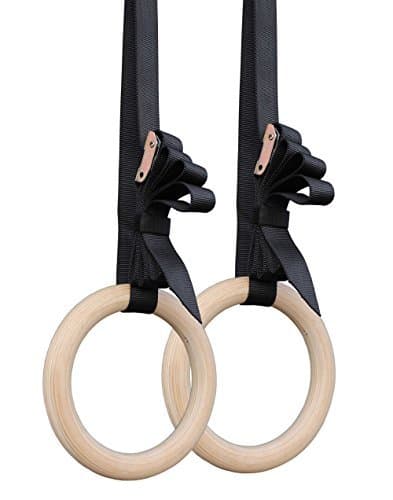
FIG-standard 28mm solid wood rings from Titan Fitness, with 16 ft straps, among the longest in this roundup, and a cam buckle system built for fast height changes. The 28mm diameter makes grip training harder, which is exactly the point for athletes working toward strict muscle-ups, ring handstands, or advanced calisthenics skills.
Strengths
- 28mm FIG standard develops grip strength faster than 32mm, a deliberate training advantage for skill-focused athletes
- 16 ft straps cover the widest range of anchor heights, from pull-up bar to high beam
- Solid wood with natural non-slip surface works with or without chalk across dips, rows, and ring support
Weaknesses
- 600 lb weight rating is lower than competing wood sets, though sufficient for bodyweight training
- 28mm diameter is less comfortable for high-rep ring dips and rows compared to 32mm
Kit Score breakdown
See all picks in Best gymnastic rings 2026: 4 scored picks for home training
Keep going
Researched, not hands-on tested
Updated Jul 8, 2026Our recommendations draw on manufacturer documentation, retailer listings, owner feedback, and comparisons with alternatives.
As an Amazon Associate I earn from qualifying purchases. We may earn a commission from links here, at no extra cost to you. How we research →