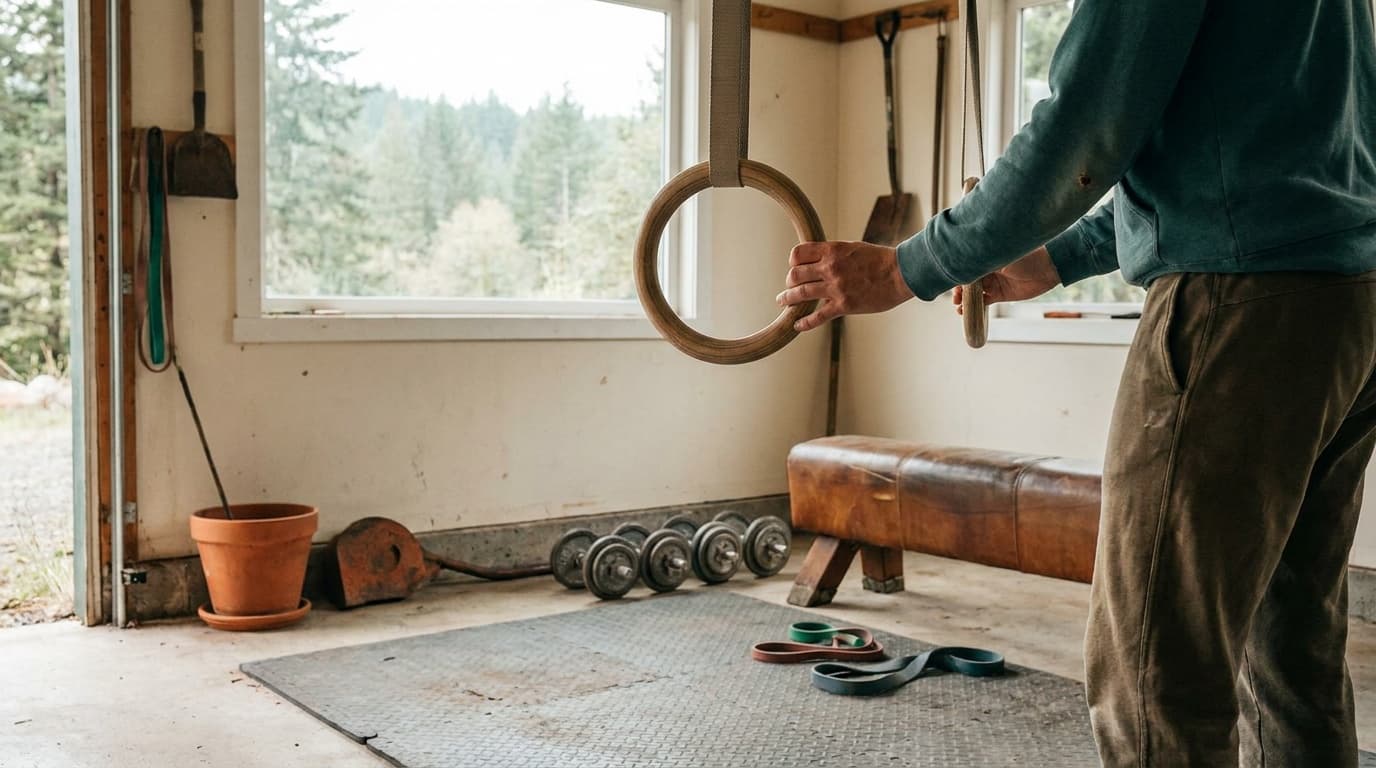
Gymnastic rings look intimidating, but the skill ceiling that makes them hard for advanced athletes is exactly what makes them honest teachers for beginners: every shaky rep tells you what to fix.
Setting strap height for your first sessions
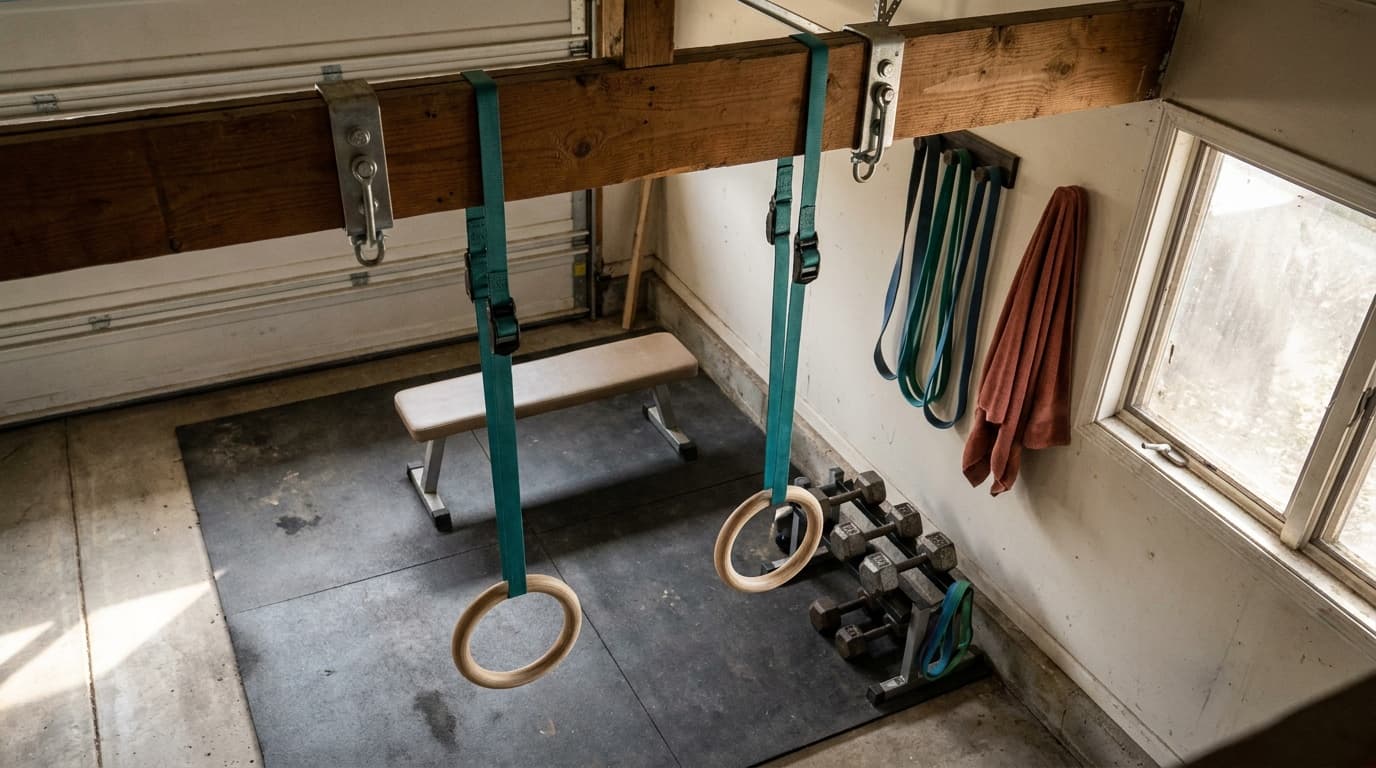
Before you touch a movement, get the setup right. For most beginner work, anchor the straps so the rings hang at hip height when you stand underneath them; rings with numbered straps, like the Double Circle Wood Gymnastics Rings, make matching heights much faster. This gives you a foot-supported position for ring rows and ring push-ups, which dramatically reduces the load and lets you learn the movement pattern before adding bodyweight.
For ring dips and the support hold, raise the rings so they sit just above hip height when you are standing, enough clearance that your feet clear the ground when your arms lock out. A good rule: with arms straight and hands on the rings at your sides, your feet should be able to hang with 2–4 inches of clearance.
Strap setup in order
Anchor point
Use a pull-up bar, beam, or dedicated ring stand rated for dynamic loading, at minimum 300 lb capacity.
Set ring height
Hip height for rows and push-up scales; just above hip height for dips and support work.
Even the rings
Hold both rings at arm's length and compare, uneven rings rotate your body and build asymmetry.
Check strap buckles
Tug each strap firmly before loading. Metal buckles are more reliable than plastic for regular training.
Test with a dead hang
Hang passively for 5 seconds before your first working set to confirm anchor integrity.
The ring support hold: your most important skill
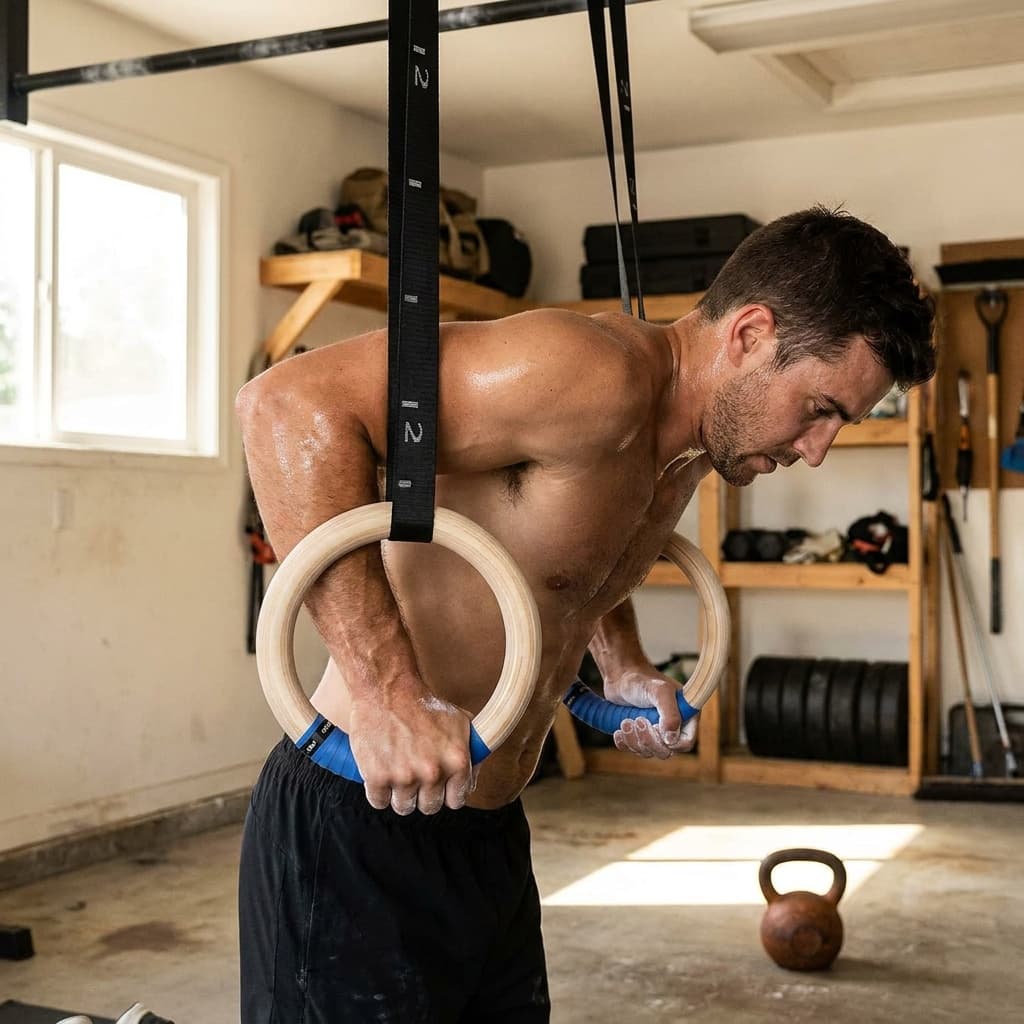
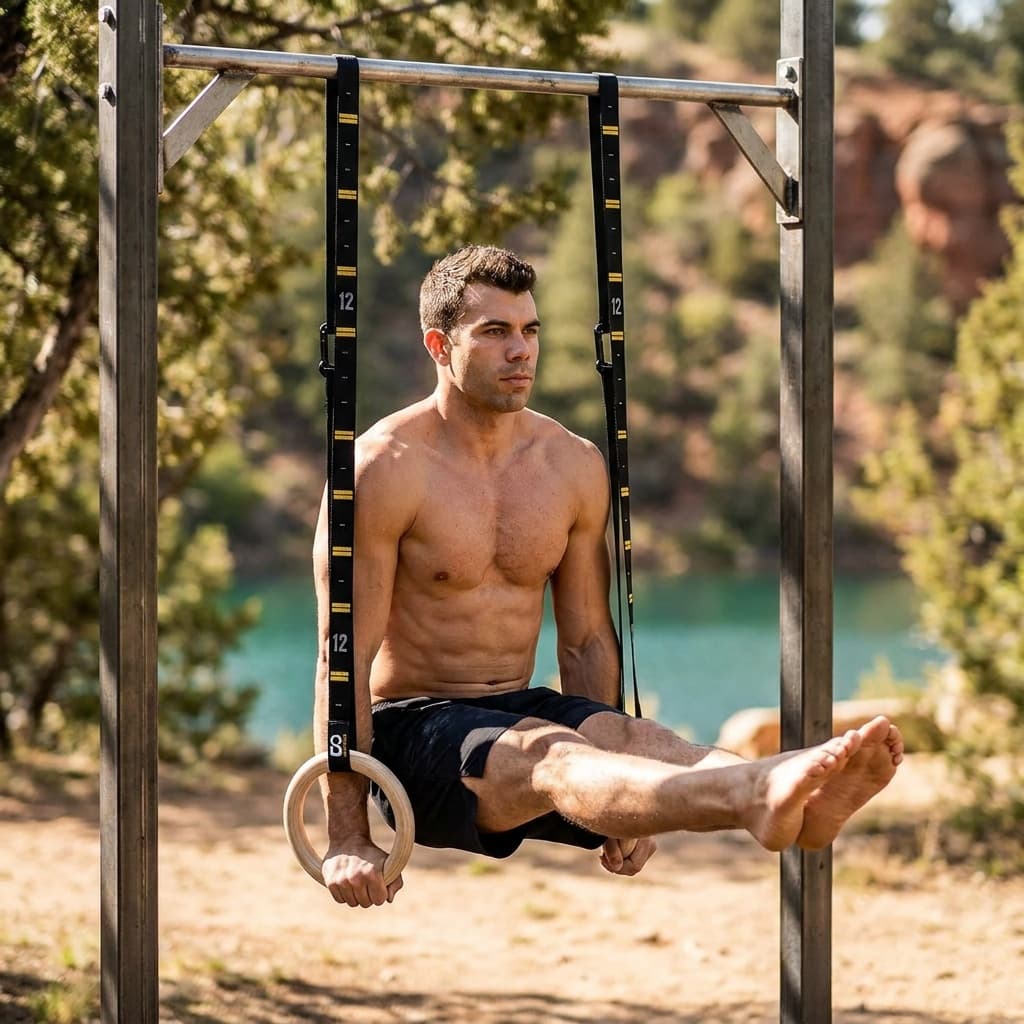
The support hold is simply holding yourself up on the rings with arms locked, rings at hip level, body upright. It looks easy. It is not.
The rings want to rotate outward. Keeping them stable requires active engagement from your shoulders, triceps, and the small stabilizer muscles that a barbell never loads. Most beginners can hold a support for 5–10 seconds the first time. A solid foundation is 3 sets of 20–30 seconds before you progress to dips.
Form cues: depress and retract your scapulae (shoulder blades down and back), lock your elbows fully, and turn the rings slightly outward so your knuckles face forward. That rotation is ring turn-out (RTO), and it is the single technique detail that separates ring training from bar training.
If your support hold shakes uncontrollably after 5 seconds, that is your body telling you exactly what needs work before you add dip reps.
Progressions for ring rows, dips, and push-ups
Ring rows are the entry pull movement. Set rings at hip height, walk your feet forward until your body is at roughly a 45-degree angle, and row your chest to the rings. The further forward your feet, the harder the row. Keep your body rigid, rings amplify any core wobble into a visible sway.
Ring push-ups with feet on the floor teach you the pressing pattern and RTO without the balance demand of a full support. Set up in a push-up position with hands on the rings, lower with control, and as you press up, actively rotate the rings outward at the top so your knuckles face away from your body at lockout.
Ring dips come after you own the support hold. Lower until your upper arms are parallel to the floor, no deeper until you have the shoulder stability to support a greater range. Keep elbows tracking back, not flaring wide.
Ring turn-out (RTO) explained
RTO means rotating the rings so the knuckles face outward at the top of a press or in the support hold. This externally rotates the shoulder joint, which loads the rotator cuff in a way that builds stability over time rather than accumulating impingement stress.
For beginners, partial turn-out is fine. Full RTO, where the knuckles face directly to the sides, requires shoulder mobility and stability that takes weeks to build. Chase it gradually. A good cue: think about trying to bend the rings apart (they won't bend, but the intention creates the right rotation).
False grip and wrist prep: start here every session
The false grip places your wrist over the ring rather than under it, so the ring sits in the crook of your wrist. It is essential for muscle-up progressions later, and even if that is months away, introducing it early builds the wrist resilience you will need.
False grip is uncomfortable at first. Start by holding it in a dead hang for 10–15 seconds per set, 2–3 sets. Build to 30 seconds before using it in rows.
Wrist prep before every session should take 3–5 minutes: wrist circles (10 each direction), prayer stretch (palms together, elbows out, 30 seconds), reverse prayer stretch (backs of hands together), and knuckle push-ups on the floor to load the wrist in extension. Rings place the wrist in positions a barbell never does. Earn those positions with prep, not pain.
A simple starter routine
Do this 2–3 times per week with at least one rest day between sessions.
Beginner ring session
Wrist prep
3–5 minutes of circles, prayer stretches, and knuckle push-ups before touching the rings.
Ring support hold
3 sets of 10–20 seconds, 60 seconds rest. Focus on RTO and scapular depression.
Ring push-ups (feet on floor)
3 sets of 6–10 reps, full RTO at lockout, 90 seconds rest.
Ring rows
3 sets of 8–10 reps at a challenging angle, 90 seconds rest.
False grip hang
2 sets of 10–15 seconds, passive hang to build wrist tolerance.
Progress by extending support hold time, increasing row difficulty (lower body angle or feet elevated), and adding ring dip volume only after the support hold reaches 3 × 25 seconds.
Frequently asked questions
How long does it take to get a solid ring support hold?
Most beginners reach a stable 20-second support hold within 3–5 weeks of consistent training (2–3 sessions per week). The timeline depends heavily on your existing shoulder strength and body weight. If you are new to upper-body training generally, give it 6–8 weeks without frustration.
Can I use gymnastic rings if I have wrist pain?
Mild wrist discomfort from the new range of motion is common and usually resolves with consistent prep work over a few weeks. Sharp pain, pain that persists after training, or pain that worsens session to session are reasons to stop and consult a physiotherapist before continuing. Do not train through structural pain.
What is the difference between wood and plastic rings?
Wood rings grip better when your hands sweat and are gentler on skin for high-rep sessions. Plastic (usually acrylic or hard resin) rings are more durable outdoors and easier to wipe down. For indoor beginner training, wood rings like the Titan Fitness 28mm Gymnastics Rings are the standard recommendation. Both work; the difference only becomes significant with volume.
For specific picks, see our guide to the best gymnastic rings. Browse all fitness guides or read how we research and rate gear.
Recommended gear
Our current top picks from the Best gymnastic rings 2026: 4 scored picks for home training guide, if you are ready to buy.

PACEARTH
PACEARTH Gymnastics Rings Wooden Olympic Rings with Adjustable Cam Buckle 14.76ft Long Straps
Best Overall
Kit Score 8.5/10
$28.99 Price checked Oct 23, 4:16 PM CDT
Best for: Home or garage gym athletes who want one set that handles the full calisthenics progression: dips, rows, ring support work, and muscle-up training, with quick height changes between sets.
- Scale markings on 14.76 ft straps allow fast, repeatable height matching across both rings
- Newer listing with a smaller review base compared to category veterans
- Ring diameter
- 32mm (1.25 in)
- Material
- Birch wood
- Strap length
- 14.76 ft each
- Weight capacity
- 1,500 lb
- Buckle system
- Cam buckle with serrated contact surface and scale markings
- Includes
- 2 rings, 2 cam buckle straps, 2 rolls grip tape
About this pick
Birch wood rings at 32mm, paired with extra-long scaled straps and serrated cam buckles that lock securely and let you reproduce the same ring height every session. The 32mm diameter suits dips, rows, ring support holds, and muscle-up progressions without the grip fatigue that thinner rings create.
Strengths
- Scale markings on 14.76 ft straps allow fast, repeatable height matching across both rings
- Birch wood absorbs sweat and stays grippy without chalk, unlike plastic surfaces
- 1,500 lb rated capacity well above any realistic load for home or gym use
Weaknesses
- Newer listing with a smaller review base compared to category veterans
- Wood requires occasional light sanding and oiling if used outdoors in wet conditions
Kit Score breakdown
DOUBLE CIRCLE
Double Circle Wood Gymnastics Rings with Quick Adjust Numbered Straps and Exercise Videos Guide
Best Value
Kit Score 8.5/10
$47.97 Price checked Oct 23, 4:16 PM CDT
Best for: Athletes who rotate frequently between exercises and want a strap system that makes matching ring height fast and foolproof without eyeballing or counting slots.
- Numbered carabiner strap system eliminates guesswork when transitioning between dips, rows, and ring support holds
- 9.2 ft straps limit maximum hang height compared to sets with 14–16 ft straps
- Ring diameter
- 32mm (1.25 in)
- Material
- Wood
- Strap length
- 9.2 ft (assembled)
- Weight capacity
- Not published on the current listing
- Buckle system
- Numbered straps with dual metal carabiners
- Includes
- 2 rings, numbered nylon straps, exercise video guide, travel case
About this pick
Wood rings at 32mm with a numbered strap system that clips into anchor slots so both rings land at exactly the same height every time. The carabiner-based numbered design allows 4-inch adjustments, and Double Circle also sells a 28mm (1.1 in) variant for athletes who want the FIG competition diameter.
Strengths
- Numbered carabiner strap system eliminates guesswork when transitioning between dips, rows, and ring support holds
- Wood grain grips progressively better as hands sweat, a real advantage in longer strength sessions
- Travel case included for portability
Weaknesses
- 9.2 ft straps limit maximum hang height compared to sets with 14–16 ft straps
- Newer parent listing (B097C1V3P2) has a smaller review base than the legacy ASIN it replaced
Kit Score breakdown
TITAN FITNESS
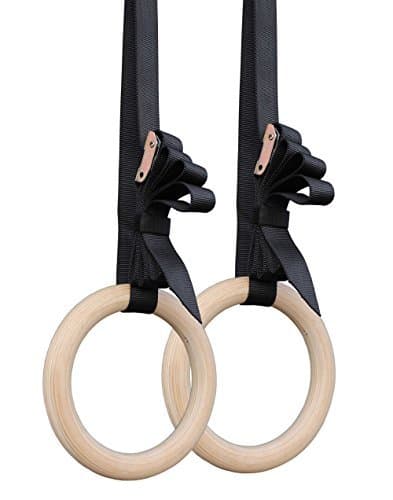
Titan Fitness 28mm Gymnastics Rings, Non-Slip Wooden Rings with 16 FT Nylon Straps
Editor's Choice
Kit Score 8.1/10
$49.99 Price checked Oct 23, 4:16 PM CDT
Best for: Intermediate to advanced calisthenics athletes who train specifically for muscle-ups, ring handstands, or strict ring strength work and want the FIG-standard 28mm diameter to build grip and technique.
- 28mm FIG standard develops grip strength faster than 32mm, a deliberate training advantage for skill-focused athletes
- 600 lb weight rating is lower than competing wood sets, though sufficient for bodyweight training
- Ring diameter
- 28mm (1.11 in, FIG competition standard)
- Material
- Solid wood
- Strap length
- 16 ft
- Weight capacity
- 600 lb
- Buckle system
- Cam buckle system
- Strap width
- 1.5 in nylon
About this pick
FIG-standard 28mm solid wood rings from Titan Fitness, with 16 ft straps, among the longest in this roundup, and a cam buckle system built for fast height changes. The 28mm diameter makes grip training harder, which is exactly the point for athletes working toward strict muscle-ups, ring handstands, or advanced calisthenics skills.
Strengths
- 28mm FIG standard develops grip strength faster than 32mm, a deliberate training advantage for skill-focused athletes
- 16 ft straps cover the widest range of anchor heights, from pull-up bar to high beam
- Solid wood with natural non-slip surface works with or without chalk across dips, rows, and ring support
Weaknesses
- 600 lb weight rating is lower than competing wood sets, though sufficient for bodyweight training
- 28mm diameter is less comfortable for high-rep ring dips and rows compared to 32mm
Kit Score breakdown
See all picks in Best gymnastic rings 2026: 4 scored picks for home training
Keep going
Researched, not hands-on tested
Updated Jun 4, 2026Our recommendations draw on manufacturer documentation, retailer listings, owner feedback, and comparisons with alternatives.
As an Amazon Associate I earn from qualifying purchases. We may earn a commission from links here, at no extra cost to you. How we research →