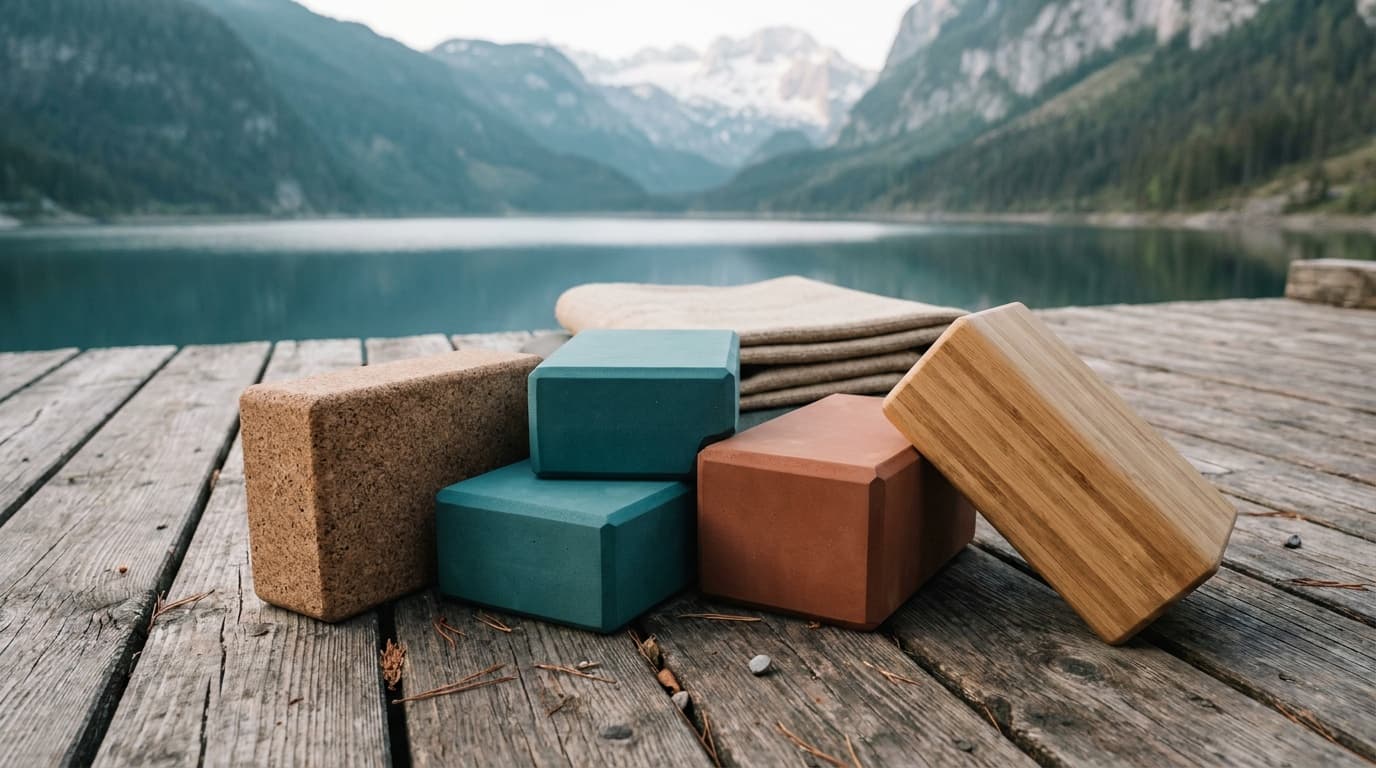
A yoga block is one of the simplest pieces of kit you can own, and one of the most useful: it brings the floor closer, deepens a stretch, and makes restorative poses accessible at any level. The options range from budget foam pairs to premium bamboo, and the right choice depends less on price than on how firm, heavy and grippy you need your support to be.
Our quick picks
How we picked
Each block below was evaluated using the Kit Score, which weighs material durability, grip performance, firmness (critical for supporting body weight versus cushioning for comfort), size spec relative to a standard 9 x 6 x 4 inch footprint, and real-world price-to-value ratio across the category.
The picks
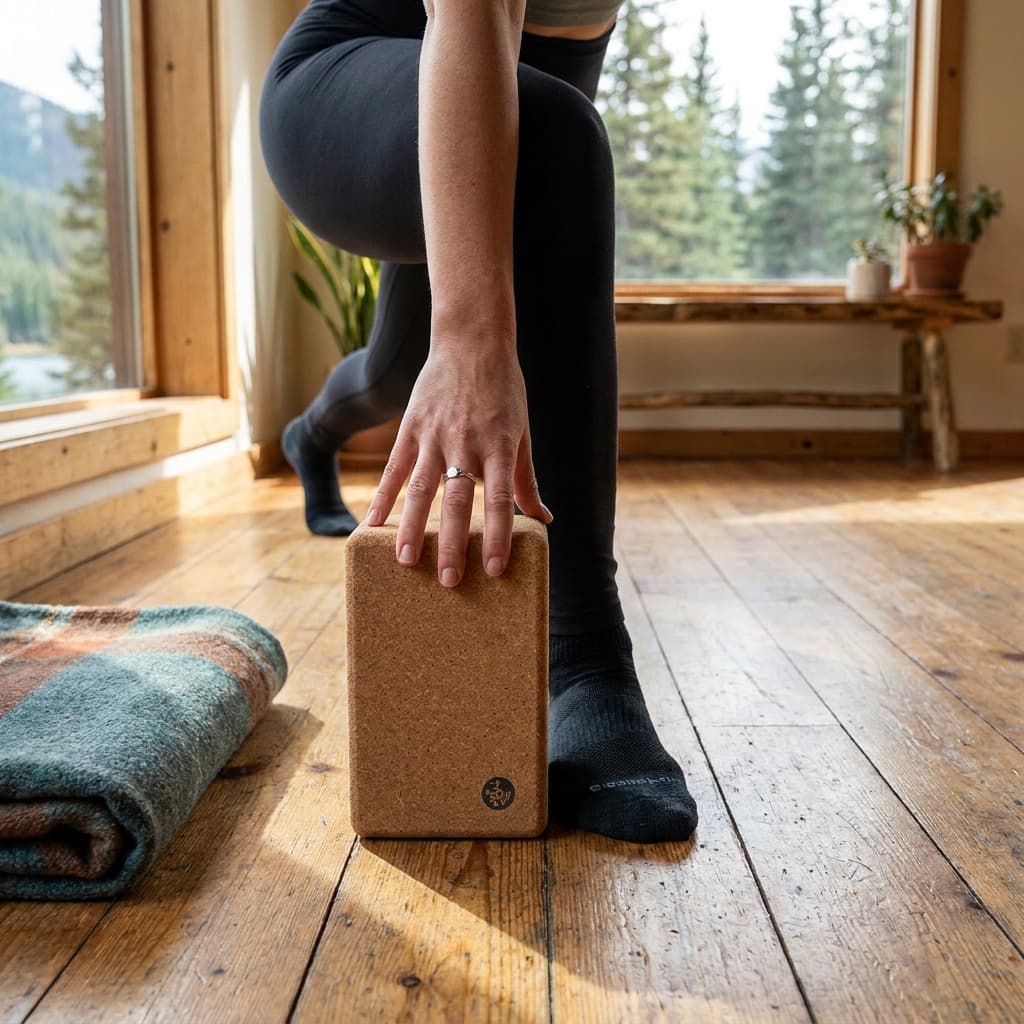
Manduka Cork Yoga Block
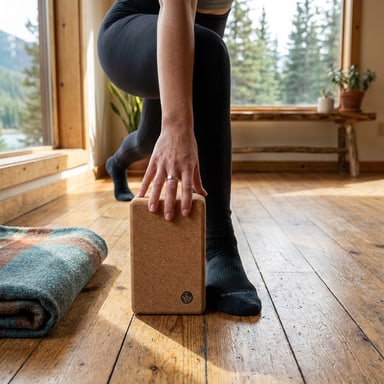
Cork is the material most experienced yoga teachers reach for, and the Manduka Cork Yoga Block is the category benchmark. It is cut from natural compressed cork, which gives it a firm, unyielding surface that genuinely supports body weight in standing balances and deep hip openers where a foam block can compress and shift. The 9 x 6 x 4 inch dimensions match the standard sizing, and the slightly textured surface grips both dry and slightly damp hands without a sticky-mat feel.
Durability is the other major argument for this block. Cork does not dent under sustained pressure the way EVA foam does, and the Manduka version in particular is noted across the category for holding its shape over years of daily practice. The edges stay crisp and the surface does not peel or flake with regular use.
The trade-off is weight. At around 12 ounces per block, cork blocks are noticeably heavier than foam, which matters if you travel with your kit. The price range of $24 to $32 per block also means buying a pair costs more than a budget foam set, though most practitioners find one cork block sufficient alongside existing kit.
For anyone who practices regularly and wants a block that handles both active support and long restorative holds with equal confidence, this is the straightforward recommendation.
BEST OVERALL
Manduka Cork Yoga Block
Best for: Practitioners at any level who want a single durable block that handles both reach support and sweaty grip for advanced poses.
- Cork grip improves with moisture, unlike foam that can become slick
- 2.2 lb weight is heavier than foam blocks, which matters if you carry several props to class
Kit Score 8.6/10 · $26.00 Price checked Oct 23, 4:16 PM CDT · how we score gear
Buy on AmazonProduct details
Dense solid cork gives this block the firmness and grip that foam cannot match, making it the go-to choice for arm balances, inversions, and any pose where you need a surface that stays put when your hands get damp. The fine-grain texture grips better as hands sweat, the opposite of foam.
- Material
- Solid fine-grain cork (sustainably sourced)
- Dimensions
- 9" x 6" x 4"
- Weight
- 2.2 lb
- Quantity
- 1 block
- Surface
- Natural cork texture, antimicrobial
- Edge finish
- Contoured, comfortable
More strengths
- Solid construction does not compress under body weight, giving a true stable base for arm balances and advanced poses
- Antimicrobial cork surface cleans easily and resists sweat stains in moderate conditions
Other tradeoffs
- Firm surface is less comfortable for extended restorative lying poses compared to soft foam
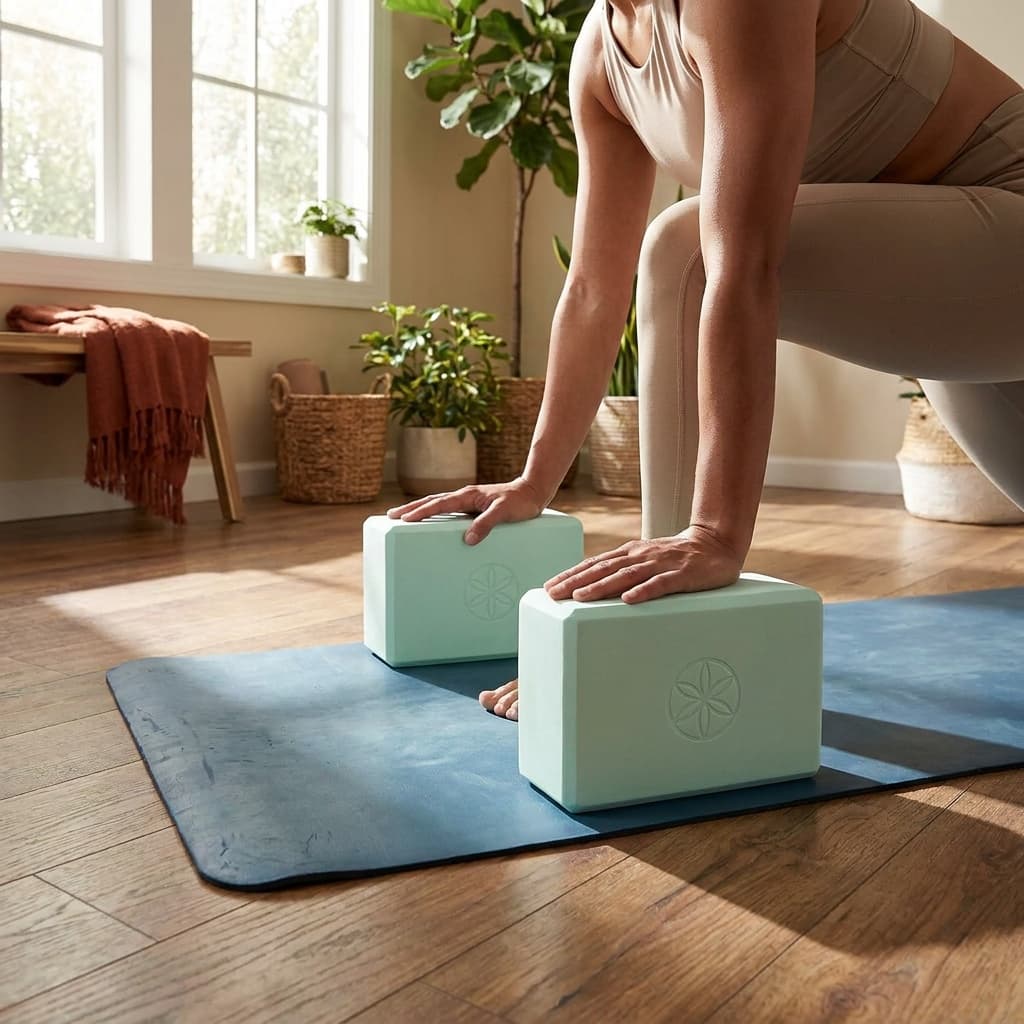
Gaiam Essentials Yoga Block (Set of 2)
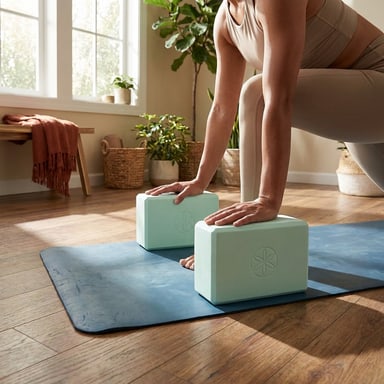
The most common frustration for new practitioners is discovering that one block is not enough. Many standing and restorative sequences use both hands or require blocks at different heights simultaneously. The Gaiam Essentials set addresses that directly by packaging two EVA foam blocks together at a price point that stays under $20 in most retail windows.
EVA foam at this density is soft enough to be comfortable under knees and forearms in restorative poses, while still firm enough to function as a height prop in standing flows. The standard 9 x 6 x 4 inch sizing means there is no guesswork about compatibility with tutorials or class instruction. The blocks come in a wide range of solid colors, which matters less functionally but helps when a second block gets borrowed.
Foam does compress over time under repeated body-weight loading, and the Gaiam Essentials blocks are not exempt from that. For a practitioner doing daily vigorous flows, the support life is shorter than cork or bamboo. But for a beginner building a home practice, learning alignment, or doing primarily gentle and restorative work, the compression timeline is well beyond the learning curve.
At this price, buying a pair rather than a single block is a genuinely good decision, and this set is the most accessible way to do that.
BEST VALUE
Gaiam Essentials Yoga Block Set of 2
Best for: Beginners who want two blocks to build reach support and bridge poses without spending much.
- Two blocks at a budget price covers most beginner setups without buying twice
- Some buyers note an initial chemical smell that takes a day or two to air out
Kit Score 8.0/10 · $15.85 Price checked Oct 23, 4:16 PM CDT · how we score gear
Buy on AmazonProduct details
Gaiam's best-selling 2-pack covers the most common beginner need: two blocks at once for symmetrical support, bridge pose, and seated forward folds. The EVA foam is soft enough for restorative lying poses yet dense enough to hold its shape under body weight.
- Material
- EVA foam (50% denser than standard)
- Dimensions (each)
- 9" x 6" x 4"
- Weight (pair)
- 10.4 oz
- Quantity
- 2 blocks
- Surface
- Non-slip, beveled edges
- Latex free
- Yes
More strengths
- Lightweight pair makes these easy to carry to a studio or shift mid-flow
- Non-slip beveled edges grip reliably in dry conditions and moderate sweat
Other tradeoffs
- Less stable than cork for arm balances or inversions where a firmer base matters
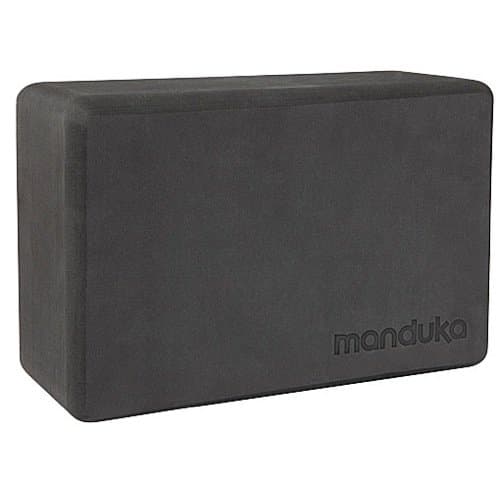
Manduka Recycled Foam Yoga Block
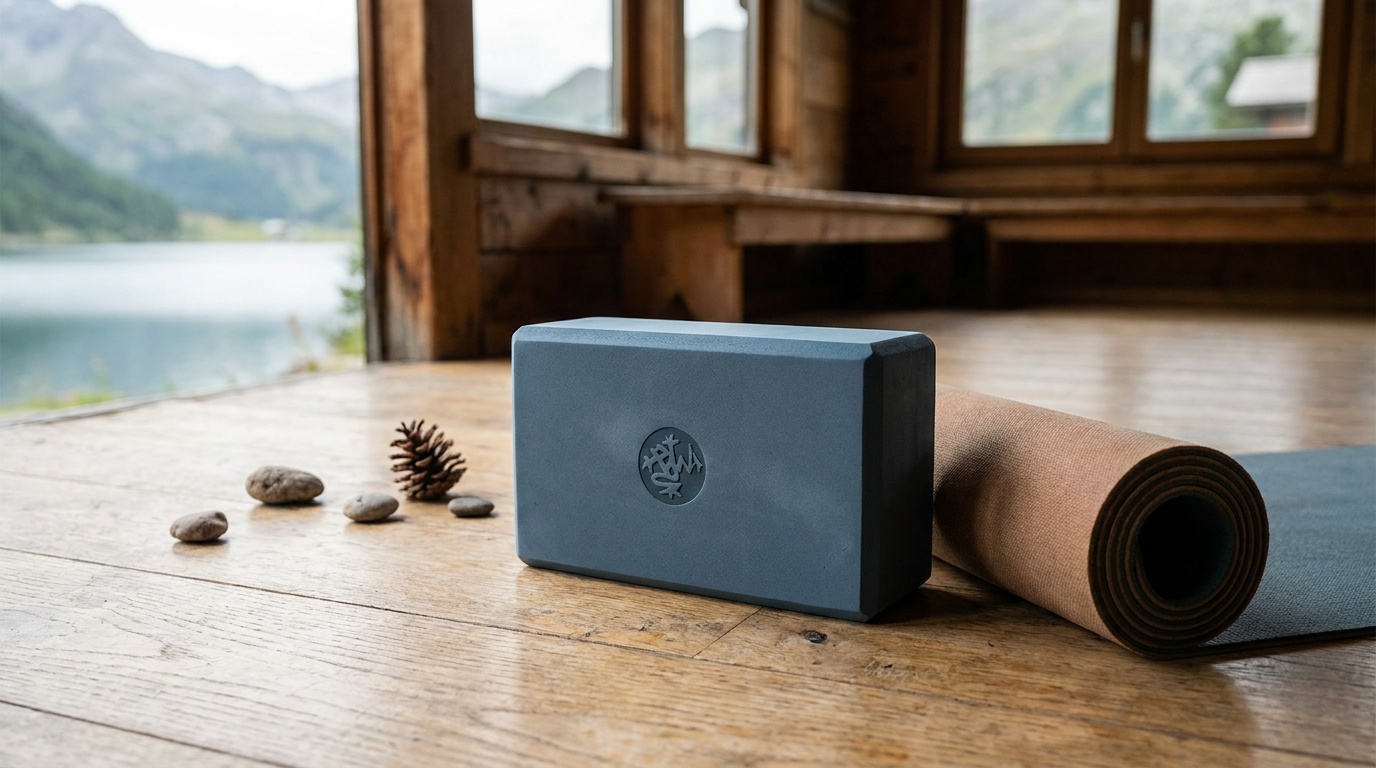
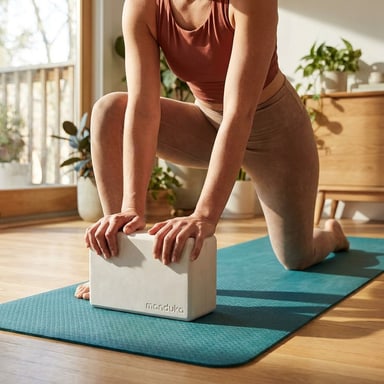
The recycled foam category used to mean accepting compromises on density or finish quality. Manduka's version resists that pattern. The block is made from recycled EVA foam and matches the firm density of the brand's standard foam line, which is notably denser than entry-level EVA foam sold under store-brand labels. The result is a block that resists compression better than the category average and maintains its shape through sustained use.
The case for choosing this over the cork version is straightforward for practitioners who prioritize a lighter block: at roughly 4 ounces it travels easily, and the softer surface is more comfortable for extended restorative holds where the block presses against the spine, sacrum or ribs. The price at $26 sits above the Gaiam set but below the cork, which reflects a genuine performance middle ground rather than a marketing positioning exercise.
Color availability is wider than almost any block in the category, which is a minor point functionally but reflects the production investment Manduka has made in this line. For practitioners who want foam performance with a lower environmental footprint and are not yet ready to move to cork, this is the block to buy.
EDITOR'S CHOICE
Manduka Recycled Foam Yoga Block
Best for: Yogis who want an eco-conscious foam block with proven durability and wide color availability, without moving up to the weight and price of cork.
- Recycled EVA foam construction puts sustainability credentials on par with cork alternatives, without the weight penalty
- Sold as a single block at $26, so a two-block setup costs $52 compared to foam two-packs that run $15–$20 total
Kit Score 8.4/10 · $26.00 Price checked Oct 23, 4:16 PM CDT · how we score gear
Buy on AmazonProduct details
The Manduka Recycled Foam Yoga Block delivers firm, stable support for extending reach and deepening poses, built from high-density EVA foam with 50–75% recycled post-industrial and post-consumer content. Its closed-cell surface resists moisture and wipes clean easily, making it practical for both studio and home use. Contoured edges sit comfortably against the body during supported poses. With nearly 4,000 Amazon ratings averaging 4.8 out of 5, it has earned a strong reputation among beginners and experienced practitioners as a reliable, eco-conscious prop at a mid-range price.
- Dimensions
- 9" x 6" x 4" (23 cm x 15 cm x 10 cm)
- Weight
- 1 lb (0.45 kg)
- Material
- High-density recycled EVA foam (50–75% post-industrial and post-consumer recycled content)
- Surface
- Closed-cell, moisture-resistant, wipe-clean
- Edges
- Contoured rounded edges for body contact comfort
- Colors available
- Thunder (grey), Midnight (blue), Sage, Linen
More strengths
- Nearly 4,000 Amazon ratings at 4.8 stars reflects consistent real-world satisfaction across a wide range of users
- Closed-cell surface is easy to wipe down and holds up to repeated studio use without absorbing sweat or odor
Other tradeoffs
- Foam blocks at this density are not quite as rigid as cork under sustained load in advanced inversions
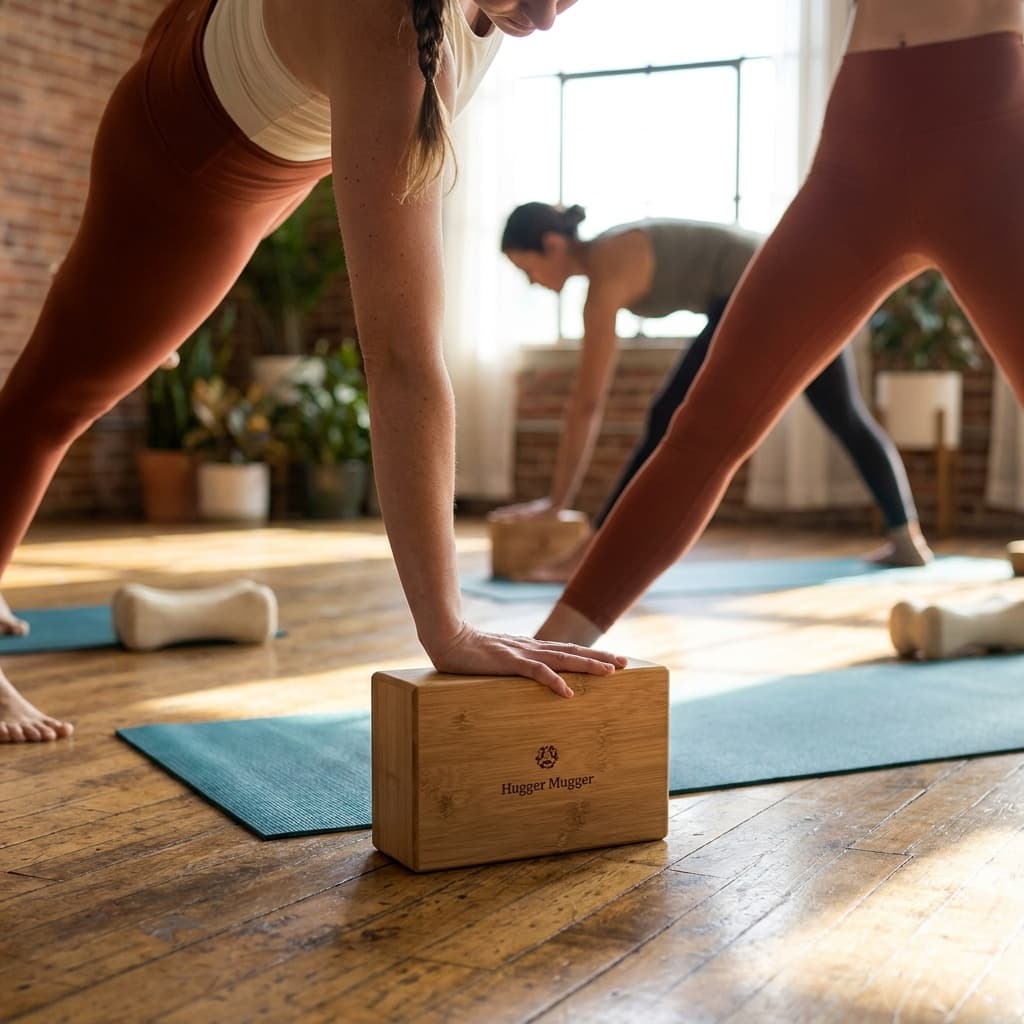
Hugger Mugger Bamboo Yoga Block
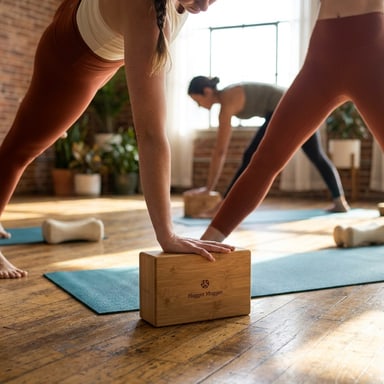
Bamboo sits at the firm end of the material spectrum, firmer than cork and considerably firmer than any foam. The Hugger Mugger Bamboo Yoga Block is built from laminated bamboo strips and finished with smooth rounded edges. The surface is harder underfoot and under hand than cork, which some practitioners find ideal for standing balance work where they want a stable, unyielding platform and others find uncomfortable in restorative positions where the block contacts soft tissue directly.
The sustainability argument for bamboo is genuine: bamboo is one of the fastest-regenerating plant materials in commercial use, and Hugger Mugger's production line is oriented around responsible sourcing. For practitioners for whom that provenance matters, the bamboo block delivers it without asking them to accept a design compromise.
At $35 to $40 per block this is the highest price point in the lineup, and it is a single block rather than a set. The weight is comparable to cork. The argument for this over the Manduka Cork is primarily about longevity and material preference: bamboo will not chip, dent, or degrade under any normal yoga use case within a practical ownership window.
This is a block for a practitioner who has already identified their preferences, wants one tool that outlasts everything else in their kit, and values the sustainability story behind it.
BEST PREMIUM
Hugger Mugger Bamboo Yoga Block
Best for: Eco-conscious practitioners who want a durable long-term block for dry-environment practice and want the wider 10-inch base for stability.
- Extra 10-inch length broadens the support footprint for standing and balance poses, a genuine structural advantage
- Bamboo surface becomes slippery when wet, making it a poor choice for heated yoga or heavy sweating
Kit Score 7.9/10 · $40.00 Price checked Oct 23, 4:16 PM CDT · how we score gear
Buy on AmazonProduct details
At 10 inches long (one inch longer than standard), this bamboo block gives a broader support base than most yoga blocks. The hollow core keeps weight manageable while bamboo's natural surface provides firm, grounded stability for standing poses and inversions.
- Material
- Solid bamboo (hollow core)
- Dimensions
- 10" x 6" x 4"
- Weight
- 2.2 lb
- Quantity
- 1 block
- Edge finish
- Rounded, comfortable for restorative poses
- Construction
- Hollow core to reduce weight; free of toxic glues and stains
More strengths
- Bamboo is one of the fastest-growing renewable materials, and the block is free of toxic adhesives
- Rounded edges are comfortable for supported restorative poses, unlike most hard-wood blocks
Other tradeoffs
- At $37 per block, building a matching pair is the most expensive option in this roundup
How the picks compare
| Product | Kit Score | Price | Best for |
|---|---|---|---|
| Manduka Cork Yoga Block | 8.6 | $26.00 Price checked Oct 23, 4:16 PM CDT | Best for: Practitioners at any level who want a single durable block that handles both reach support and sweaty grip for advanced poses. Why it stands out: Cork grip improves with moisture, unlike foam that can become slick Tradeoff: 2.2 lb weight is heavier than foam blocks, which matters if you carry several props to class |
| Gaiam Essentials Yoga Block Set of 2 | 8.0 | $15.85 Price checked Oct 23, 4:16 PM CDT | Best for: Beginners who want two blocks to build reach support and bridge poses without spending much. Why it stands out: Two blocks at a budget price covers most beginner setups without buying twice Tradeoff: Some buyers note an initial chemical smell that takes a day or two to air out |
| Manduka Recycled Foam Yoga Block | 8.4 | $26.00 Price checked Oct 23, 4:16 PM CDT | Best for: Yogis who want an eco-conscious foam block with proven durability and wide color availability, without moving up to the weight and price of cork. Why it stands out: Recycled EVA foam construction puts sustainability credentials on par with cork alternatives, without the weight penalty Tradeoff: Sold as a single block at $26, so a two-block setup costs $52 compared to foam two-packs that run $15–$20 total |
| Hugger Mugger Bamboo Yoga Block | 7.9 | $40.00 Price checked Oct 23, 4:16 PM CDT | Best for: Eco-conscious practitioners who want a durable long-term block for dry-environment practice and want the wider 10-inch base for stability. Why it stands out: Extra 10-inch length broadens the support footprint for standing and balance poses, a genuine structural advantage Tradeoff: Bamboo surface becomes slippery when wet, making it a poor choice for heated yoga or heavy sweating |
Manduka Cork Yoga Block
- Best for
- Practitioners at any level who want a single durable block that handles both reach support and sweaty grip for advanced poses.
- Why it stands out
- Cork grip improves with moisture, unlike foam that can become slick
- Tradeoff
- 2.2 lb weight is heavier than foam blocks, which matters if you carry several props to class
Gaiam Essentials Yoga Block Set of 2
- Best for
- Beginners who want two blocks to build reach support and bridge poses without spending much.
- Why it stands out
- Two blocks at a budget price covers most beginner setups without buying twice
- Tradeoff
- Some buyers note an initial chemical smell that takes a day or two to air out
Manduka Recycled Foam Yoga Block
- Best for
- Yogis who want an eco-conscious foam block with proven durability and wide color availability, without moving up to the weight and price of cork.
- Why it stands out
- Recycled EVA foam construction puts sustainability credentials on par with cork alternatives, without the weight penalty
- Tradeoff
- Sold as a single block at $26, so a two-block setup costs $52 compared to foam two-packs that run $15–$20 total
Hugger Mugger Bamboo Yoga Block
- Best for
- Eco-conscious practitioners who want a durable long-term block for dry-environment practice and want the wider 10-inch base for stability.
- Why it stands out
- Extra 10-inch length broadens the support footprint for standing and balance poses, a genuine structural advantage
- Tradeoff
- Bamboo surface becomes slippery when wet, making it a poor choice for heated yoga or heavy sweating
How to choose the right yoga block
Choosing the right yoga block for your practice
Identify your primary use
Restorative and gentle poses favor softer foam for comfort; active flow and standing balances favor firm cork or bamboo for stable support. A block that does both adequately is cork.
Count what you need
Beginners and anyone doing restorative work should start with two blocks. A single block suits practitioners who already have one and are buying an upgrade.
Factor in weight
Foam blocks weigh roughly 4 oz each; cork and bamboo weigh around 12 oz. If you carry your kit to class regularly, the weight difference adds up across a bag.
Match material to budget
EVA foam pairs cover the entry tier ($13–$17 for two). Recycled foam and cork sit in the $24–$32 range per block. Bamboo sits at the premium end ($35–$40). Buy the firmest material your budget allows, since firm blocks hold their shape longer.
Two blocks are almost always more useful than one: the second block unlocks half the restorative sequence library that a single block leaves inaccessible.
Frequently asked questions
What is the standard size for a yoga block?
The industry standard is 9 x 6 x 4 inches. Most blocks from established brands match this footprint, which matters because online tutorials and class instruction typically assume it. A block that is shallower than 4 inches in depth provides meaningfully less height adjustment in forward folds and standing poses where the full height is needed.
Is cork or foam better for beginners?
For most beginners, foam is the better starting point: it is lighter, less expensive, and the softer surface is more comfortable in restorative and floor-based poses where the block contacts the body directly. Cork becomes the better choice once a practitioner is doing regular standing balance work where a firm, non-compressing surface gives more confident support. Buying a foam pair first and upgrading one block to cork later is a practical sequence.
Do I need one yoga block or two?
Two blocks are strongly recommended for anyone doing restorative yoga or following beginner sequences. A large portion of restorative poses (supported bridge, reclined bound angle, supported fish) use blocks under different body parts simultaneously, and many alignment-focused sequences use two blocks in tandem. One block is adequate for a limited set of standing-pose height adjustments, but the second block unlocks significantly more of the practice.
Yoga blocks are a small investment with outsized returns for both beginners building body awareness and experienced practitioners refining alignment. Browse more gear picks in fitness, or learn about how we research and rate every product we recommend.
Keep going
Our recommendations draw on manufacturer documentation, retailer listings, owner feedback, and comparisons with alternatives.
As an Amazon Associate I earn from qualifying purchases. We may earn a commission from links here, at no extra cost to you. How we research →