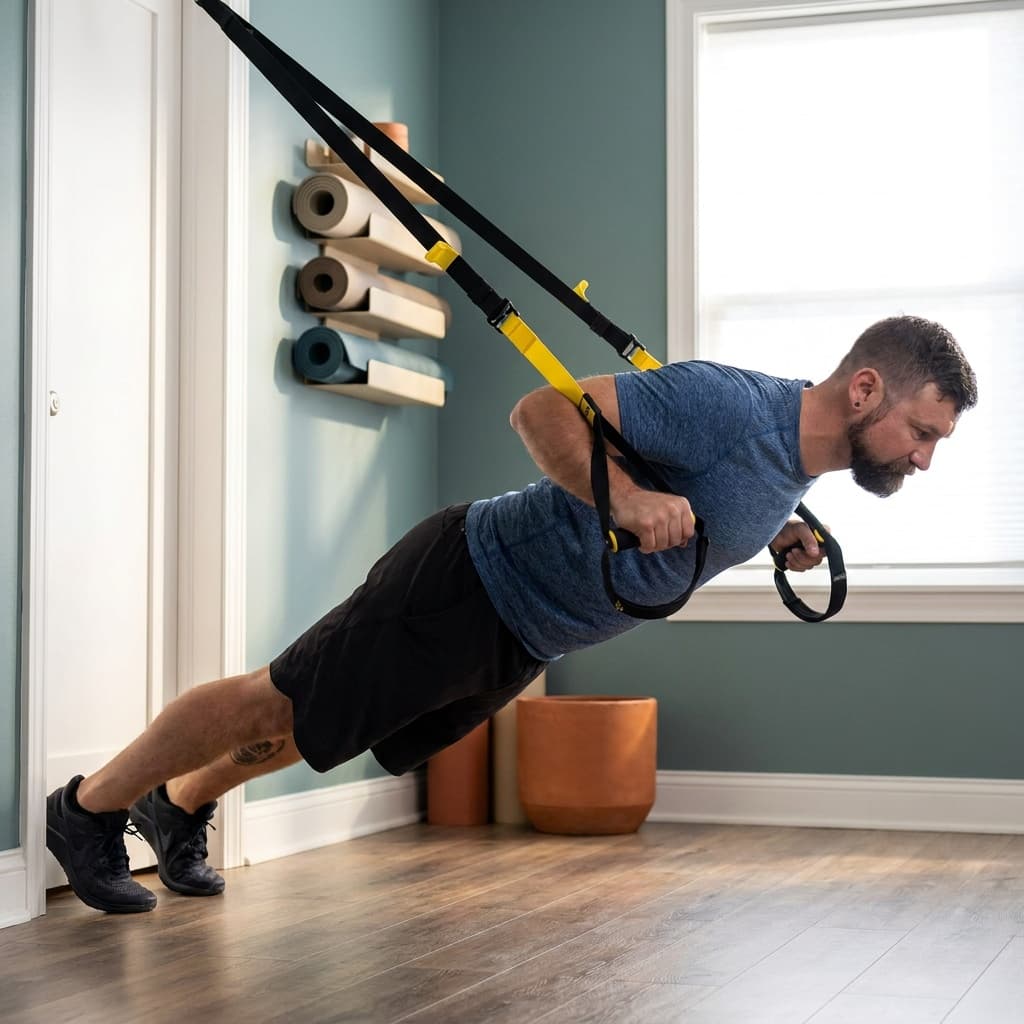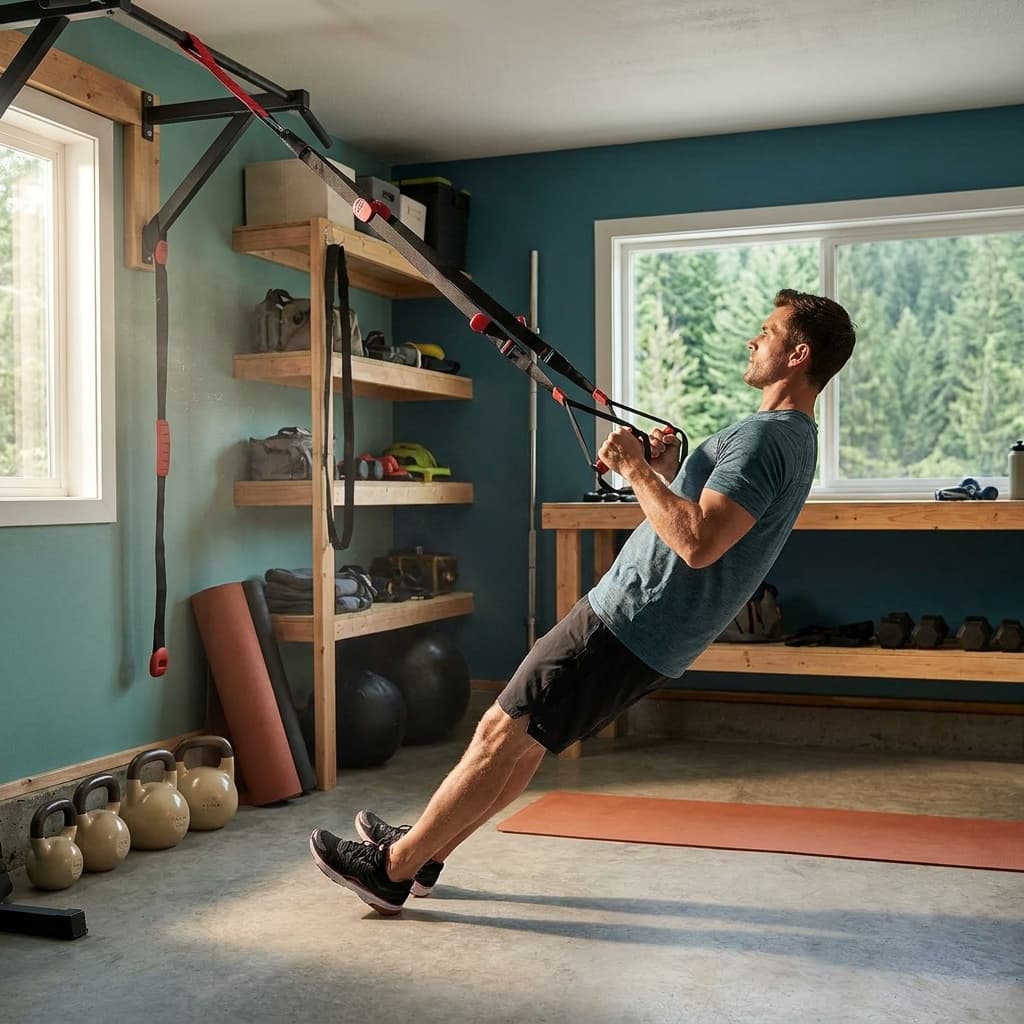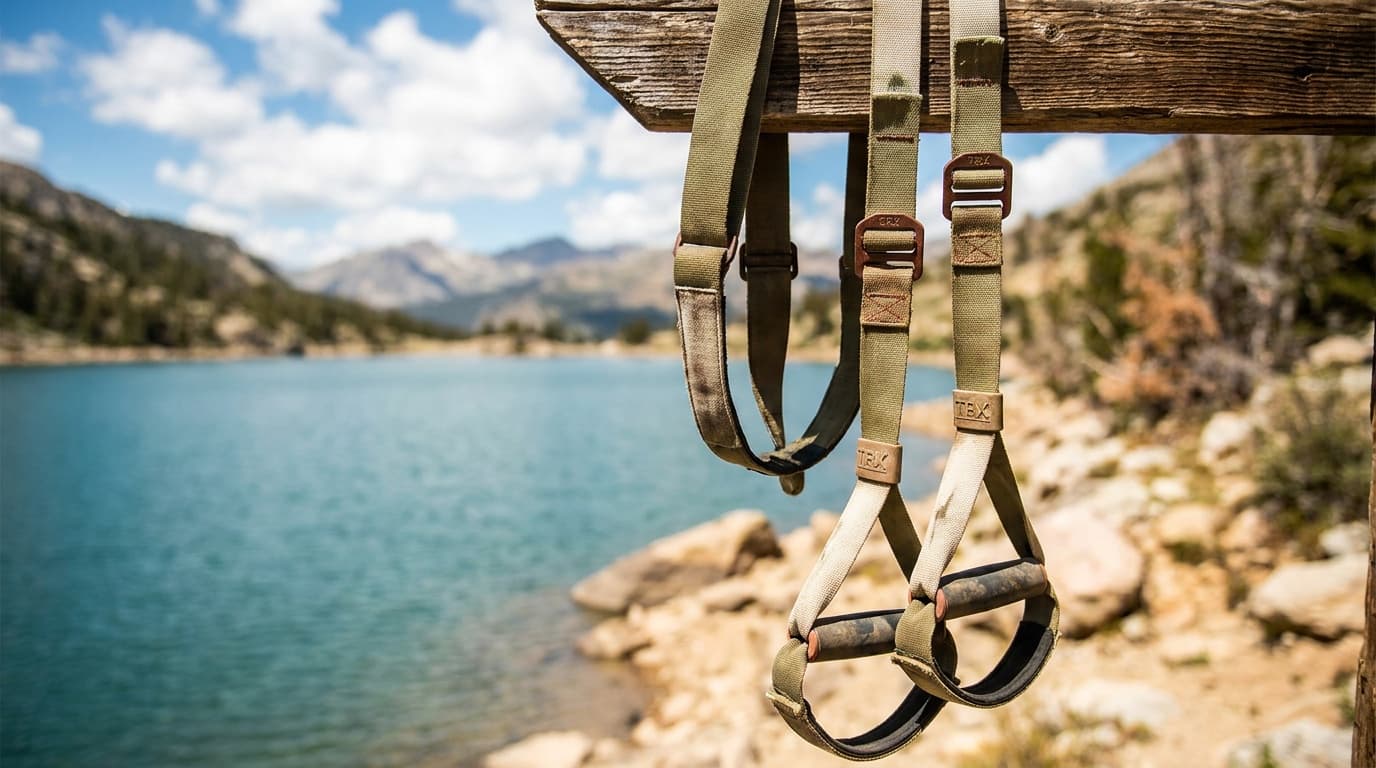
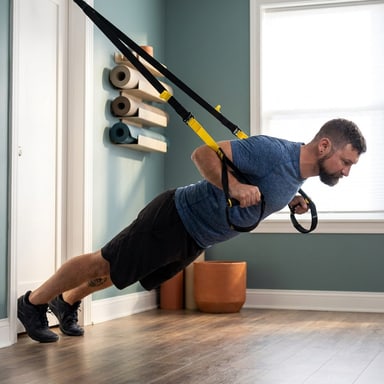
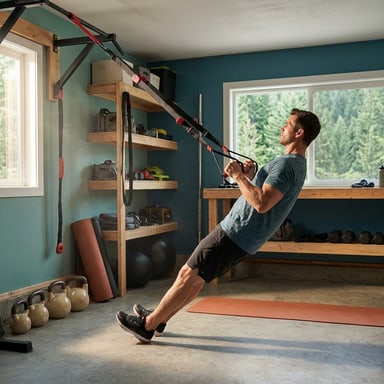
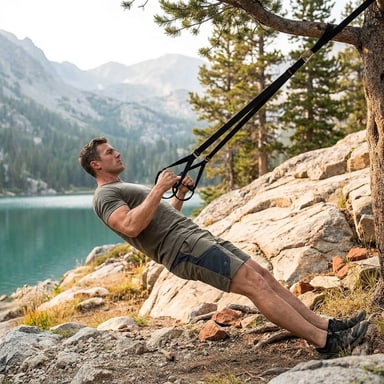
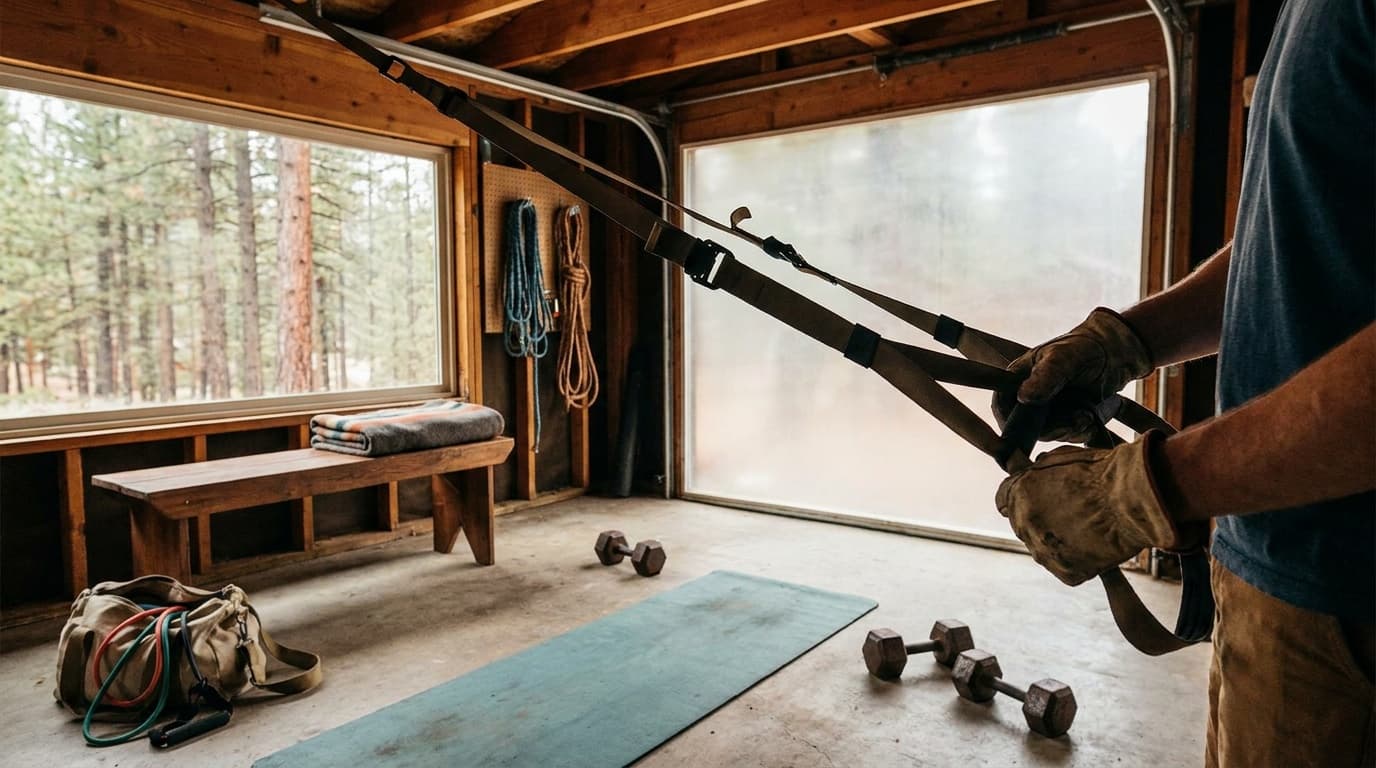
Suspension trainers turn a single anchor point into a full gym: pull, push, hinge, squat, and core in one compact kit. Whether you're rigging to a door, a pull-up bar, or a tree branch, the right system makes the difference between a workout you'll skip and one you'll actually do.
Our quick picks
How we picked
Every pick is evaluated against our Kit Score: we aggregate verified owner reviews, published stress tests, manufacturer specs, and expert sourcing to score each system on strap durability, adjustability, anchor versatility, handle and foot-cradle comfort, and weight capacity. No single sponsor influences placement.
Best overall
TRX All-In-One Suspension Training System
BEST OVERALL
TRX All-In-One Suspension Training System
Best for: Anyone who wants a proven, all-environment system that works straight out of the box without extra anchors or accessories.
- Highest owner confidence in the category (4.7 stars across nearly 7,000 reviews) with consistent praise for strap durability and buckle reliability
- Single-strap (Y-shaped) design limits independent arm movement, which some experienced users prefer for unilateral exercises
Kit Score 8.8/10 · $189.95 Price checked Oct 23, 6:22 AM CDT · how we score gear
Buy on AmazonProduct details
The TRX All-In-One is the benchmark suspension trainer: a single-strap system with both door and outdoor anchors included, 700 lb rated construction, and access to TRX on-demand workouts through the TRX app (30-day free trial included). It sets up in under 60 seconds and works equally well looped over a door, beam, or tree branch.
- Weight capacity
- 700 lbs
- System weight
- 1.7 lbs
- Anchor options
- Door anchor + outdoor suspension anchor (both included)
- Handle material
- Thermoplastic rubber over hard plastic
- Strap material
- Nylon webbing with steel hardware
- Warranty
- 2 years
More strengths
- Both indoor door anchor and outdoor suspension anchor included in the box, so there is no separate purchase needed for travel or backyard use
- 700 lb rated construction and 2-year warranty give long-term peace of mind at a mid-range price
Other tradeoffs
- TRX app subscription required to unlock the full workout library after the included 30-day free trial
The All-In-One is where most buyers should start. The strap system is reinforced nylon webbing rated to 350 lb, the adjustable buckle moves smoothly under load, and the rubber handles resist slipping even in a humid garage or on a sweaty travel session. What sets it apart from cheaper systems is the anchor kit: door anchor, suspension anchor for beams and frames, and a mesh bag for storage are all included. You do not need to source extras before your first workout.
The foot cradles have just enough give to hold a plank position comfortably without letting the ankle roll, and the single-anchor design (both handles share one central point) gives you stable, predictable movement for rows, push-ups, and lunges. For anyone training in multiple environments across the week, that versatility is the product.
Best for: Anyone who wants a proven, all-environment system that works straight out of the box without extra anchors or accessories.
Editor's choice
Lifeline Jungle Gym XT Suspension Trainer
EDITOR'S CHOICE
Lifeline Jungle Gym XT Suspension Trainer
Best for: Intermediate and advanced trainees who want independent strap movement for unilateral pressing, chest flies, and asymmetric lower-body work.
- Split-anchor design allows independent arm and leg movement, enabling narrow, neutral, and wide grip variations for up to three times the exercise range of single-anchor systems
- Larger packed footprint than single-strap systems, so it takes up more bag space when traveling
Kit Score 8.8/10 · $81.99 Price checked Oct 23, 6:22 AM CDT · how we score gear
Buy on AmazonProduct details
The Jungle Gym XT uses a patented split-anchor design that lets each arm move independently, opening up unilateral pressing, rowing, and chest-fly variations that a fixed Y-strap cannot replicate. Molded foot cradles retain shape under load, and two door anchors are included so you can anchor to a door frame or swing the system over a pull-up bar or beam without additional hardware.
- Strap configuration
- Split anchor (two independent straps)
- Strap length
- 8 ft per strap
- Anchor options
- Two non-scuff door anchors (included) plus Duro-Link for overhead bars
- Foot cradles
- Molded Easy-In foot cradles (shape-retaining)
- Adjustment
- Inline cam buckles with measurement markings
- Weight
- 2.9 lbs packed
More strengths
- Shape-retaining molded foot cradles stay in position during lower-body and core work, reducing fumbling mid-set
- Industrial-strength webbing rated for commercial gym use with inline buckles and measurement markings for rapid, repeatable adjustments
Other tradeoffs
- No training app or guided workout program included in the box
The Jungle Gym XT does something the TRX All-In-One does not: it uses two fully independent straps. Each strap hangs from its own anchor point, which means the handles can move apart or together during a rep. For chest flies, single-arm rows, Bulgarian split squats, and unilateral pressing, that independent motion creates a training stimulus that a shared-anchor system physically cannot replicate.
The straps are 1.5-inch webbing with a rated load of 300 lb per strap. Adjustment is handle-side rather than anchor-side, which some users prefer for quick mid-set tweaks. The door anchor is included; outdoor anchors are sold separately, worth noting if you train primarily at home. Grip comfort is solid for the price, though the handles are less padded than TRX's rubber-overmold design.
If you already have foundational suspension training experience and want to progress into asymmetric and unilateral loading, the Jungle Gym XT is the tool for that.
Best for: Intermediate and advanced trainees who want independent strap movement for unilateral pressing, chest flies, and asymmetric lower-body work.
Best budget
NOSSK TNT Pro Suspension Fitness Trainer
BEST BUDGET
NOSSK TNT Pro Suspension Fitness Trainer
Best for: Budget-focused buyers and travelers who want solid military-grade construction for full-body suspension training without paying for a brand name.
- First-grade US military webbing (1,500 lb rated) and latex-free rubber grips deliver durability that owners consistently describe as equivalent to trainers costing two to three times the price
- Metal Fit-Link connector introduces deliberate instability to increase core demand, which can be disorienting for beginners still learning movement patterns
Kit Score 8.7/10 · $65.95 Price checked Oct 23, 6:22 AM CDT · how we score gear
Buy on AmazonProduct details
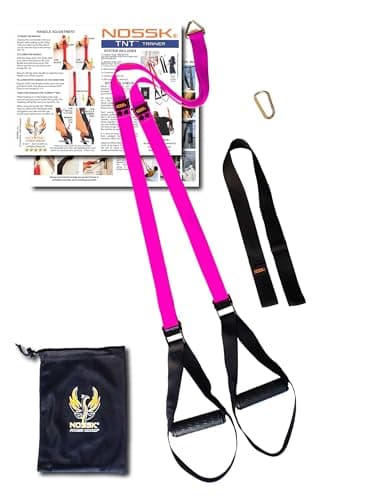
The NOSSK TNT Pro is made in the USA from first-grade military webbing rated to 1,500 lbs and comes with a built-in door anchor and metal Fit-Link connector. At around $55, it covers every foundational suspension training movement, including push, pull, row, squat, and core work, without the premium brand markup.
- Weight capacity
- 400 lbs
- Strap length
- 9.5 ft total
- Strap width
- 1.5 in (US military-grade webbing, 1,500 lb rated)
- Anchor options
- 3 ft anchor strap with built-in door anchor (included)
- Handles
- Lay-flat webbing design with latex-free rubber grips
- Foot loops
- Integrated soft non-marring foot loops
More strengths
- Lay-flat handle design prevents the strap from digging into wrists during rows and curls, a comfort advantage over rounded-handle competitors
- Compact single-strap system with integrated anchor packs into a small drawstring bag, making it one of the lightest options for travel use
Other tradeoffs
- Only one anchor strap in the box; no outdoor suspension anchor included for tree or beam mounting without an additional purchase
The TNT Pro is built on 1,000-lb-test military-spec nylon webbing, which is a meaningfully higher raw material spec than several systems priced two or three times higher. Verified owners consistently note that the stitching and cam-buckle hardware hold up to heavy use without fraying or slipping, which is the failure point on cheaper suspension trainers.
The handles are foam-wrapped rather than rubber-overmolded, so they compress slightly during high-rep holds. That is the main comfort concession versus premium systems. Adjustment requires sliding the cam buckle at the top of each strap rather than at handle height, which adds a few seconds between exercises in circuit-style training. For dedicated workout blocks rather than AMRAP-style quick switching, it is a non-issue.
The packed size is small enough for a carry-on or a gym bag side pocket, which makes it the default travel pick at this price. Door anchor and a carry bag are included.
Best for: Budget-focused buyers and travelers who want solid military-grade construction for full-body suspension training without paying for a brand name.
Best premium
How to choose
Anchor environment first
Before comparing handles or price, decide where you will actually train. A door anchor fits virtually every interior door, requires no hardware, and works for most exercises. A beam or pull-up bar anchor gives you higher mounting height, which improves the angle on rows and inverted presses. Outdoor anchors (tree wrap or carabiner) add flexibility for travel or park workouts. The TRX All-In-One and Home2 cover all three out of the box. The Jungle Gym XT and TNT Pro include door anchors; outdoor setups require an inexpensive add-on anchor strap.
Single anchor vs. dual anchor
Single-anchor systems (TRX models, NOSSK TNT Pro) mount both handles to one point. Movement is coupled: both handles move together. This is stable and predictable for most push, pull, and hinge patterns. Dual-anchor systems (Lifeline Jungle Gym XT) let each handle move independently, which adds range and instability for unilateral and fly-type exercises. Single anchor is better for beginners and for door-only setups where two anchor points are not practical.
Adjustability method
Most systems adjust via cam buckle at the anchor end (you reach up and slide the buckle). Some adjust at handle height. Handle-side adjustment is faster for circuit training where you change strap length between exercises. Anchor-side adjustment is adequate for steady-state strength workouts. Neither is a dealbreaker; it is a workflow preference.
Weight capacity and strap construction
All four picks handle standard adult training loads. Pay attention to strap material: nylon webbing is standard and durable; lower-cost systems sometimes use polypropylene webbing that degrades faster with UV exposure and sweat. The TNT Pro's 1,000-lb-test military nylon is the standout spec at its price point.
Handle and foot-cradle comfort
Handles see the most wear. Rubber-overmolded handles (TRX All-In-One) resist slipping and maintain grip feel when wet. Foam handles (NOSSK TNT Pro, Lifeline Jungle Gym XT) are comfortable dry but can compress and degrade with heavy long-term use. Foot cradles are mostly similar across picks; look for enough width to hold the instep without ankle roll during suspended plank and hamstring curl work.
| Product | Kit Score | Price | Best for |
|---|---|---|---|
| TRX All-In-One Suspension Training System | 8.8 | $189.95 Price checked Oct 23, 6:22 AM CDT | Best for: Anyone who wants a proven, all-environment system that works straight out of the box without extra anchors or accessories. Why it stands out: Highest owner confidence in the category (4.7 stars across nearly 7,000 reviews) with consistent praise for strap durability and buckle reliability Tradeoff: Single-strap (Y-shaped) design limits independent arm movement, which some experienced users prefer for unilateral exercises |
| Lifeline Jungle Gym XT Suspension Trainer | 8.8 | $81.99 Price checked Oct 23, 6:22 AM CDT | Best for: Intermediate and advanced trainees who want independent strap movement for unilateral pressing, chest flies, and asymmetric lower-body work. Why it stands out: Split-anchor design allows independent arm and leg movement, enabling narrow, neutral, and wide grip variations for up to three times the exercise range of single-anchor systems Tradeoff: Larger packed footprint than single-strap systems, so it takes up more bag space when traveling |
| NOSSK TNT Pro Suspension Fitness Trainer | 8.7 | $65.95 Price checked Oct 23, 6:22 AM CDT | Best for: Budget-focused buyers and travelers who want solid military-grade construction for full-body suspension training without paying for a brand name. Why it stands out: First-grade US military webbing (1,500 lb rated) and latex-free rubber grips deliver durability that owners consistently describe as equivalent to trainers costing two to three times the price Tradeoff: Metal Fit-Link connector introduces deliberate instability to increase core demand, which can be disorienting for beginners still learning movement patterns |
TRX All-In-One Suspension Training System
- Best for
- Anyone who wants a proven, all-environment system that works straight out of the box without extra anchors or accessories.
- Why it stands out
- Highest owner confidence in the category (4.7 stars across nearly 7,000 reviews) with consistent praise for strap durability and buckle reliability
- Tradeoff
- Single-strap (Y-shaped) design limits independent arm movement, which some experienced users prefer for unilateral exercises
Lifeline Jungle Gym XT Suspension Trainer
- Best for
- Intermediate and advanced trainees who want independent strap movement for unilateral pressing, chest flies, and asymmetric lower-body work.
- Why it stands out
- Split-anchor design allows independent arm and leg movement, enabling narrow, neutral, and wide grip variations for up to three times the exercise range of single-anchor systems
- Tradeoff
- Larger packed footprint than single-strap systems, so it takes up more bag space when traveling
NOSSK TNT Pro Suspension Fitness Trainer
- Best for
- Budget-focused buyers and travelers who want solid military-grade construction for full-body suspension training without paying for a brand name.
- Why it stands out
- First-grade US military webbing (1,500 lb rated) and latex-free rubber grips deliver durability that owners consistently describe as equivalent to trainers costing two to three times the price
- Tradeoff
- Metal Fit-Link connector introduces deliberate instability to increase core demand, which can be disorienting for beginners still learning movement patterns
Setting up for the first time
First suspension trainer setup
Choose your anchor point
Pick door, beam, or outdoor anchor based on your space. Door anchors close in the door frame (not the hinge side); beam anchors loop over any horizontal bar rated to hold your body weight.
Set strap length for your first exercise
For rows, start with straps at waist height and body at roughly 45 degrees. Shorter straps increase difficulty. Adjust in small increments.
Check the anchor before full load
Give the handles a firm pull before committing your full body weight. The anchor should not shift or creak under tension.
Learn the adjustment system
Run through a few adjustments before your workout so you know the direction and resistance of the cam buckle. Cold buckles can be stiff.
Start with stable patterns
Rows, push-ups, and bodyweight squats before adding instability. Build familiarity with how the straps move before attempting single-leg or fly exercises.
The anchor point matters more than the brand on the strap: a well-placed door anchor gives you a better workout than a premium system hung at the wrong height.
Frequently asked questions
Can I use a suspension trainer without a pull-up bar or beam?
Yes. All four picks include a door anchor that wedges into the top of a closed door frame. You do not need a bar, a beam, or any installed hardware. The door anchor holds securely when the door is fully closed and you pull toward the anchor point. Avoid hollow-core doors for high-load exercises; solid-core and metal doors are reliable.
What is the difference between a single-anchor and a dual-anchor suspension trainer?
A single-anchor system threads both handles through one central attachment point, so the handles move together as a coupled unit. A dual-anchor system (like the Lifeline Jungle Gym XT) has two independent attachment points, one per handle, allowing each side to move separately. Single-anchor setups are more stable and simpler to rig. Dual-anchor systems allow chest flies, unilateral presses, and asymmetric movements that a single-anchor design cannot replicate with the same range of motion.
How much space do I need to use a suspension trainer at home?
A cleared area roughly 6 feet wide and 7 feet long covers most exercises. You need enough room to extend arms and legs fully while the straps are under tension. For inverted rows (body close to horizontal), you need horizontal clearance behind you; for standing exercises, vertical clearance is the limiting factor. Most standard rooms with a door or a squat rack anchor point are sufficient.
Suspension trainers are one of the most travel-friendly, space-efficient tools in home fitness, and any of these four will serve you well once you understand the trade-offs. Explore more gear guidance in the fitness hub, or see how we research and rate every product we cover.
Keep going
Our recommendations draw on manufacturer documentation, retailer listings, owner feedback, and comparisons with alternatives.
As an Amazon Associate I earn from qualifying purchases. We may earn a commission from links here, at no extra cost to you. How we research →