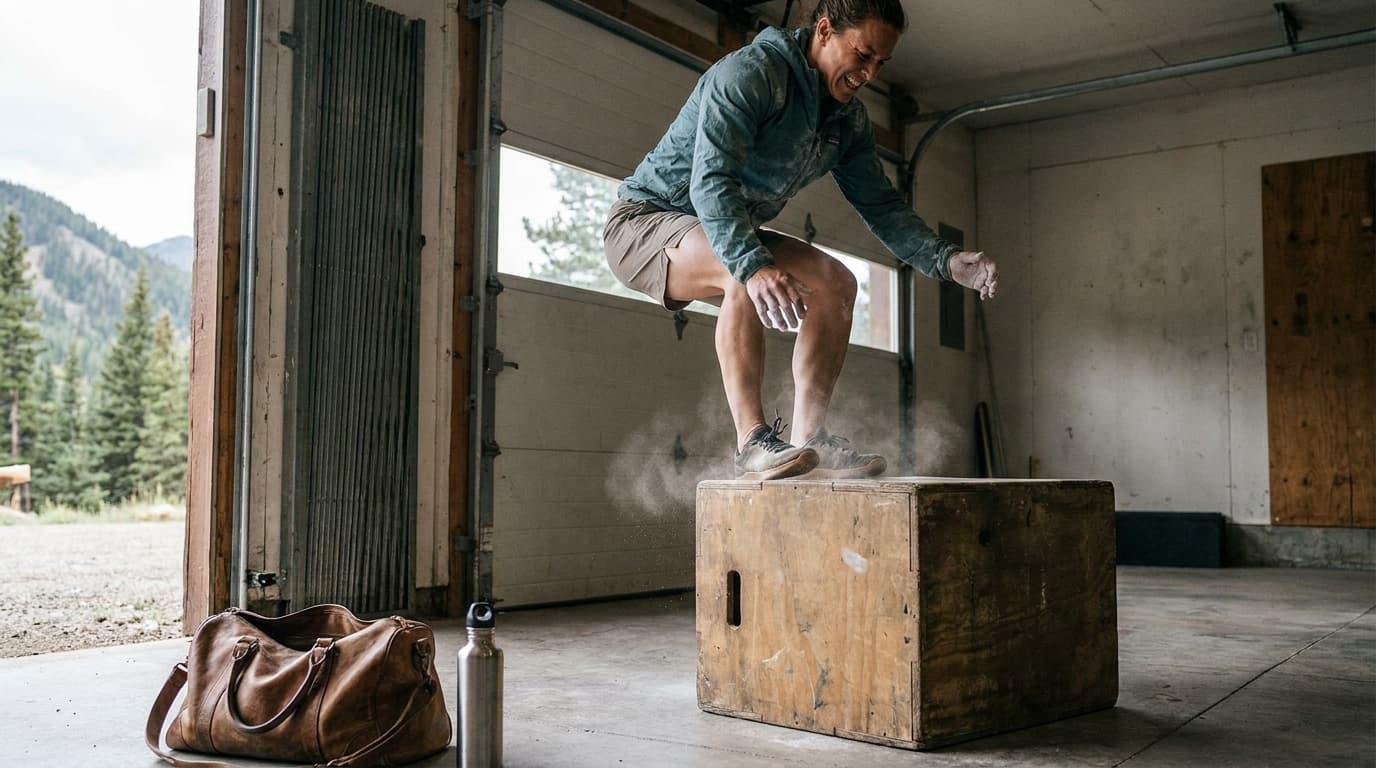
A plyo box is a deceptively simple piece of equipment. It is a platform you jump onto, step down from, and do it again. But the wrong surface sends you off sideways on a sweaty rep, the wrong material turns a missed jump into a shin wound, and the wrong height locks you out of progressing. Getting those three variables right is what separates a box that trains you from one that injures you.
Our quick picks
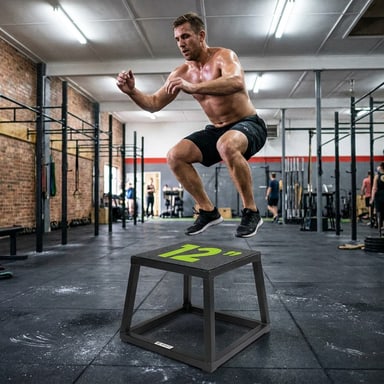
How we picked
Every box here was evaluated against our Kit Score: surface traction and stability, height options and adjustability, weight capacity, material safety (particularly shin protection on missed jumps), assembly complexity, footprint, and value. Scores draw from verified owner reviews, manufacturer specifications, and fitness equipment research from sources including Garage Gym Reviews, BarBend, and Breaking Muscle. We do not invent first-hand results.
The numbers worth knowing before you shop
These figures set realistic expectations for the category before you compare individual boxes.
Best overall: Synergee Non-Slip 3-in-1 Wood Plyometric Box
BEST OVERALL
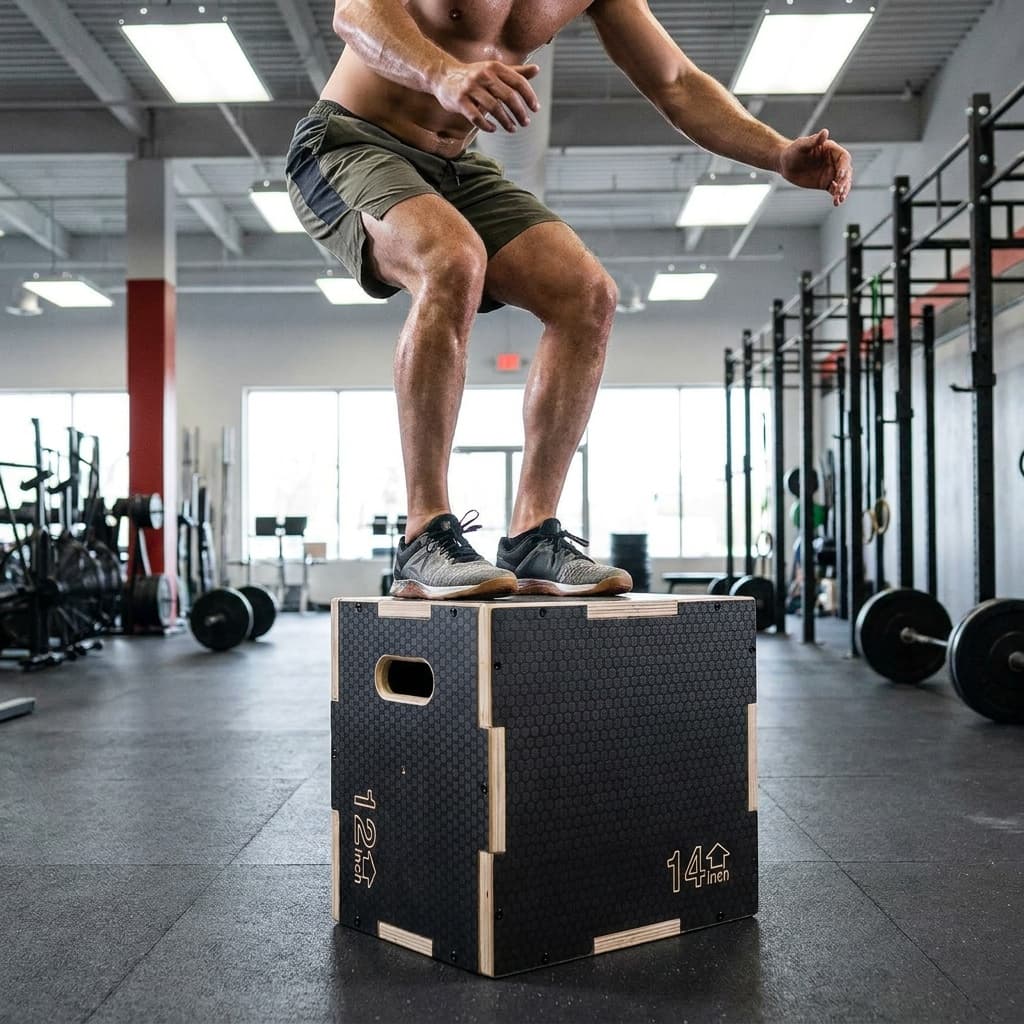
Synergee Non-Slip 3-in-1 Wood Plyometric Box
Best for: Serious jump trainers who do high-rep box work in a garage or basement gym where sweat on a plain wood surface would otherwise be a hazard.
- Hex PVC coating provides measurably better traction than raw plywood, which matters on bare-feet or socked-feet training days
- Some owners report minor chipping of the PVC surface layer with heavy or prolonged use
Kit Score 8.3/10 · $99.95 Price checked Oct 23, 4:16 PM CDT · how we score gear
Buy on AmazonProduct details
The same structural wood construction as a basic 3-in-1 box, with a PVC hexagonal surface coating that adds real grip and channels sweat away from the landing area. The result is a box that stays put under fast box-jump reps in a way smooth plywood cannot match.
- Height options
- 20 / 18 / 16 in (standard); 16 / 14 / 12 in (smaller model)
- Weight capacity
- 450 lb
- Surface
- 3/4 in plywood with PVC hexagonal non-slip coating
- Hex pattern
- Channels moisture away from landing surface
- Assembly
- Screwdriver or drill required, 10 to 15 min
- Available sizes
- 2 options: 20/18/16 in and 16/14/12 in
More strengths
- 450 lb capacity with internal supports gives it genuine strength for loaded conditioning work
- Built-in carry handles make moving it between workout stations straightforward
Other tradeoffs
- Only two size options (20/18/16 and 16/14/12); no 30/24/20 variant available in this line
The Synergee earns the top spot for one practical reason: it solves the biggest real-world problem with wood plyo boxes. Plain wood surfaces become hazardous once any moisture is present. The Synergee ships with a textured non-slip coating on all three landing surfaces, which means high-rep box work in a warm garage or basement gym does not gradually become a traction gamble.
The 3-in-1 format means the box flips to three heights: 20 inches, 24 inches, and 30 inches depending on which face you land on. For most athletes that covers the full working range from step-up drills and entry-level box jumps through competitive-height training. The box ships flat and assembles with hardware included, typically in under 30 minutes.
At $80–$110, the Synergee sits in the middle of the wood box market and delivers more than its price suggests. The construction is void-free plywood rather than particle board, which matters for long-term durability under repeated impact loads. Verified owner reviews consistently flag the non-slip surface and the solid feel underfoot as the box's clearest strengths.
Best for: serious jump trainers who do high-rep box work in a garage or basement gym where sweat on a plain wood surface would otherwise be a hazard.
Editor's choice: Yes4All 3-in-1 Soft-Padded Plyometric Box
EDITOR'S CHOICE
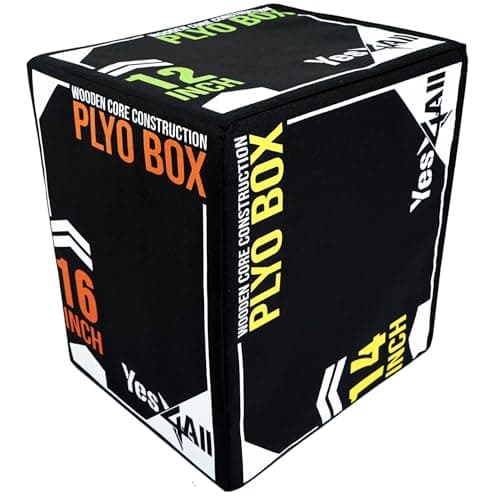
Yes4All 3-in-1 Soft-Padded Plyometric Box
Best for: Athletes who are building confidence on box jumps, returning from lower-body injury, or training solo where a missed jump could mean a scraped shin with no one around to help.
- EVA foam outer shell absorbs the impact of grazed shins on missed box jumps, reducing the bruising that bare plywood causes
- Softer landing feel gives less positional feedback than a wood or steel surface, which some athletes prefer for training precision
Kit Score 8.0/10 · $69.80 Price checked Oct 23, 4:16 PM CDT · how we score gear
Buy on AmazonProduct details
A wood-core box wrapped in EVA foam and a non-slip vinyl cover that protects shins on missed jumps and softens repeated landings. It ships fully assembled and ready to train within minutes, making it the practical choice for athletes who prioritize safety margins over the firm feel of raw wood.
- Height options
- 16 / 14 / 12 in (standard model); larger sizes available
- Weight capacity
- 440 lb
- Construction
- Solid wood core, EVA foam layer, PVC vinyl cover
- Assembly
- None required; ships ready to use
- Surface feel
- Cushioned, forgiving on missed reps
- Available sizes
- Multiple options from 16/14/12 in to 20/18/16 in and larger
More strengths
- No assembly required and lightweight design makes it easy to move, store, or rotate surfaces
- PVC vinyl grip is more reliable underfoot than smooth wood, particularly during conditioning circuits where form degrades with fatigue
Other tradeoffs
- 440 lb capacity is slightly lower than wood competitors, though more than adequate for most training scenarios
The Yes4All soft-padded box is the one pick in this roundup that most changes the risk calculus of box-jump training. A missed box jump on a wood or steel surface typically means a shin impact on a hard edge. The soft-padded box replaces that hard edge with a 2–3 inch foam collar over a wood core, which compresses on contact rather than cutting.
That single design decision broadens who can train productively on a plyo box. Athletes returning from a lower-body injury, athletes building confidence on bigger jumps, and anyone training solo in a home gym without backup all benefit from the reduced consequence of a failed rep. The box still has a rigid wood core, so the landing surface itself is firm and stable under load.
The 3-in-1 format covers the same 20, 24, and 30 inch heights as a standard wood box. The foam cladding adds a few inches to the overall profile but does not change the usable heights. At $70–$120 it is competitively priced given the added safety feature, and the vinyl cover wipes clean.
The soft-padded box does not make box jumps easier. It makes a missed jump survivable, which is what lets you keep training.
Best for: athletes who are building confidence on box jumps, returning from lower-body injury, or training solo where a missed jump could mean a scraped shin with no one around to help.

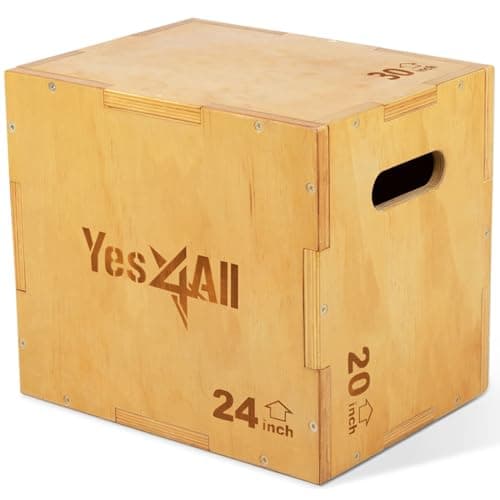
Best value: Yes4All 3-in-1 Wooden Plyometric Box
BEST VALUE
Yes4All 3-in-1 Wooden Plyometric Box
Best for: Garage gym owners who want a reliable wood 3-in-1 at a fair price and don't mind a short assembly session.
- 450 lb rated with internal bracing on larger sizes, handles loaded step-up work without any flex
- Bare plywood top has no added texture or grip layer, so sweat or rubber-soled shoes can shift on landing
Kit Score 8.2/10 · $145.00 Price checked Oct 23, 4:16 PM CDT · how we score gear
Buy on AmazonProduct details
A three-height wood box that rotates to give you three jump heights from one piece of equipment. The sanded edges and built-in carry handles make it a practical garage-gym staple, and the 450 lb rating means it handles loaded step-up work without any flex.
- Height options
- 16 / 14 / 12 in (small); 24 / 20 / 16 in (medium); 30 / 24 / 20 in (large)
- Weight capacity
- 450 lb
- Material
- 3/4 in plywood with sanded edges
- Carry handles
- Built-in wide handles
- Assembly
- Tool-free puzzle joints, pre-drilled holes
- Available sizes
- 3 options: 16/14/12, 24/20/16, 30/24/20 in
More strengths
- Sanded edges and smooth top reduce the skin-tear risk that unfinished wood boxes carry
- Three size options let you match the box to your current jump height and add taller versions later
Other tradeoffs
- Requires assembly (10 to 15 minutes); puzzle joints are well-designed but not for anyone who wants to train the same day it arrives
The Yes4All wood 3-in-1 is the default starting point for athletes who want a capable plyo box without the non-slip coating premium or the soft-padded safety margin. It covers the same 20, 24, and 30 inch heights, uses a plywood construction, and ships at $80–$160 depending on size tier.
The value case is simple: you get a structurally sound 3-in-1 wood box from a brand with a wide parts and replacement support network, at a price point where buying two sizes for different phases of training is still reasonable. Yes4All's customer service history, documented across thousands of Amazon and retailer reviews, is a genuine differentiator for a garage-gym purchase.
The one honest limitation: the plain wood surface is untreated. It is fine when dry. In a warm garage with any humidity or sweat, grip decreases measurably over a training session. If your gym environment runs warm or you are doing metabolic conditioning that involves box work between other exercises, the Synergee's non-slip surface justifies the price difference. If you train in a climate-controlled space or do lower volumes, the Yes4All wood box is an excellent buy.
Assembly takes 30–45 minutes from flat-pack with the included hardware.
Best for: garage gym owners who want a reliable wood 3-in-1 at a fair price and do not mind a short assembly session.
Best premium: Rage Fitness Steel Plyo Box
BEST PREMIUM
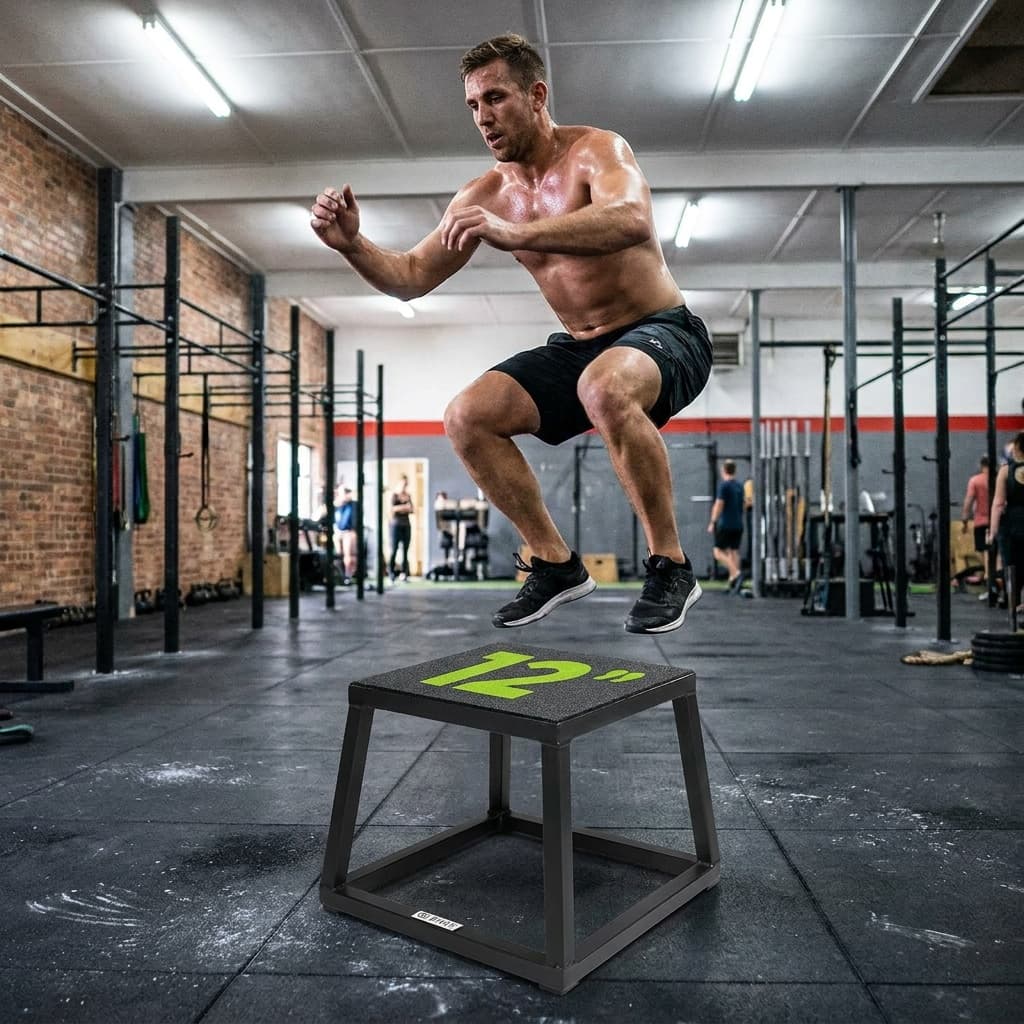
Rage Fitness Steel Plyo Box
Best for: Strength and conditioning athletes who train at a dedicated height and want maximum stability, a 560 lb load rating, and a box that ships ready to use with no assembly.
- 560 lb weight capacity is the highest in this category, with a wider base profile that makes tip-over nearly impossible during standard box-jump landings
- Single fixed height per unit means buying multiple boxes if you want height variety, which raises the total cost
Kit Score 8.4/10 · $48.68 Price checked Oct 23, 4:16 PM CDT · how we score gear
Buy on AmazonProduct details
A fully welded steel-frame box with a wider base than top that physically resists tipping during aggressive box jumps and lateral step-overs. With a 560 lb capacity and rubber landing surface, it handles loaded carries, weighted step-ups, and high-frequency training sessions that would eventually wear a wood box down.
- Available heights
- 12, 18, and 24 in (each sold separately at the same price)
- Weight capacity
- 560 lb (12 in); 550 lb (18 in)
- Frame
- Heavy-gauge tubular steel, wider base than top for anti-tip stability
- Landing surface
- Rubber top and rubber feet
- Assembly
- Ships fully assembled and ready to use
- Anti-slip
- Rubber top and bottom prevent surface and floor movement
More strengths
- Ships fully assembled with no setup required; rubber top and rubber feet protect both the athlete and the floor
- Hollow steel frame is stackable when multiple heights are purchased, saving floor space in a garage gym
Other tradeoffs
- Top landing area is smaller than wood 3-in-1 alternatives, leaving less margin for imprecise landings
The Rage Fitness steel box is the outlier in this roundup: it ships at a single fixed height, requires zero assembly, and is rated for 560 lb. For athletes who train at one working height and want a box that cannot flex, tip, wobble, or fatigue under load, steel is the right answer.
The 560 lb load rating is meaningfully higher than the typical 300–400 lb rating on wood boxes, which matters less for body weight and more for the safety margin on weighted box work (step-ups with a barbell, weighted vest box jumps) or when two athletes are swapping on one box without resetting between sets.
At $55–$65, the Rage Fitness steel box is actually the least expensive box in this roundup by unit, which makes the "premium" label about performance rather than price. The trade-off is lack of height versatility: you buy one box at one height. Athletes who train at 24 inches year-round, or who are adding a second box to supplement a wood 3-in-1, get the most from this pick.
The rubber feet keep the box planted on concrete or rubber flooring. The textured steel surface provides reasonable grip, though it does run warmer in temperature-variable garages.
Best for: strength and conditioning athletes who train at a dedicated height and want maximum stability, a 560 lb load rating, and a box that ships ready to use with no assembly.
How they compare
| Product | Kit Score | Price | Best for |
|---|---|---|---|
| Synergee Non-Slip 3-in-1 Wood Plyometric Box | 8.3 | $99.95 Price checked Oct 23, 4:16 PM CDT | Best for: Serious jump trainers who do high-rep box work in a garage or basement gym where sweat on a plain wood surface would otherwise be a hazard. Why it stands out: Hex PVC coating provides measurably better traction than raw plywood, which matters on bare-feet or socked-feet training days Tradeoff: Some owners report minor chipping of the PVC surface layer with heavy or prolonged use |
| Yes4All 3-in-1 Soft-Padded Plyometric Box | 8.0 | $69.80 Price checked Oct 23, 4:16 PM CDT | Best for: Athletes who are building confidence on box jumps, returning from lower-body injury, or training solo where a missed jump could mean a scraped shin with no one around to help. Why it stands out: EVA foam outer shell absorbs the impact of grazed shins on missed box jumps, reducing the bruising that bare plywood causes Tradeoff: Softer landing feel gives less positional feedback than a wood or steel surface, which some athletes prefer for training precision |
| Yes4All 3-in-1 Wooden Plyometric Box | 8.2 | $145.00 Price checked Oct 23, 4:16 PM CDT | Best for: Garage gym owners who want a reliable wood 3-in-1 at a fair price and don't mind a short assembly session. Why it stands out: 450 lb rated with internal bracing on larger sizes, handles loaded step-up work without any flex Tradeoff: Bare plywood top has no added texture or grip layer, so sweat or rubber-soled shoes can shift on landing |
| Rage Fitness Steel Plyo Box | 8.4 | $48.68 Price checked Oct 23, 4:16 PM CDT | Best for: Strength and conditioning athletes who train at a dedicated height and want maximum stability, a 560 lb load rating, and a box that ships ready to use with no assembly. Why it stands out: 560 lb weight capacity is the highest in this category, with a wider base profile that makes tip-over nearly impossible during standard box-jump landings Tradeoff: Single fixed height per unit means buying multiple boxes if you want height variety, which raises the total cost |
Synergee Non-Slip 3-in-1 Wood Plyometric Box
- Best for
- Serious jump trainers who do high-rep box work in a garage or basement gym where sweat on a plain wood surface would otherwise be a hazard.
- Why it stands out
- Hex PVC coating provides measurably better traction than raw plywood, which matters on bare-feet or socked-feet training days
- Tradeoff
- Some owners report minor chipping of the PVC surface layer with heavy or prolonged use
Yes4All 3-in-1 Soft-Padded Plyometric Box
- Best for
- Athletes who are building confidence on box jumps, returning from lower-body injury, or training solo where a missed jump could mean a scraped shin with no one around to help.
- Why it stands out
- EVA foam outer shell absorbs the impact of grazed shins on missed box jumps, reducing the bruising that bare plywood causes
- Tradeoff
- Softer landing feel gives less positional feedback than a wood or steel surface, which some athletes prefer for training precision
Yes4All 3-in-1 Wooden Plyometric Box
- Best for
- Garage gym owners who want a reliable wood 3-in-1 at a fair price and don't mind a short assembly session.
- Why it stands out
- 450 lb rated with internal bracing on larger sizes, handles loaded step-up work without any flex
- Tradeoff
- Bare plywood top has no added texture or grip layer, so sweat or rubber-soled shoes can shift on landing
Rage Fitness Steel Plyo Box
- Best for
- Strength and conditioning athletes who train at a dedicated height and want maximum stability, a 560 lb load rating, and a box that ships ready to use with no assembly.
- Why it stands out
- 560 lb weight capacity is the highest in this category, with a wider base profile that makes tip-over nearly impossible during standard box-jump landings
- Tradeoff
- Single fixed height per unit means buying multiple boxes if you want height variety, which raises the total cost
How to choose the right plyo box
The material decision is the one most buyers get wrong by defaulting to whatever looks most "serious."
Five questions to narrow your choice
What is your training environment?
A temperature-controlled home gym is fine with plain wood. A warm garage gym, especially in summer, needs the Synergee's non-slip surface or a soft box. Steel handles any environment and is the most weather-tolerant.
Are you training solo or with supervision?
Solo garage-gym athletes benefit most from the soft-padded box: a missed jump in an empty space with no one to help is a different situation than missing a jump in a coached class. The foam collar substantially reduces the risk of a shin laceration.
Do you need multiple heights?
If you are actively progressing through jump heights or sharing the box between athletes of different ability levels, the 3-in-1 format pays off immediately. If you have established your working height, the steel box's stability advantage is worth the fixed height.
What is the weight capacity for your intended use?
Body-weight box jumps sit well under even the lowest-rated box here. Weighted vest or loaded step-ups shift the calculation: for anything above 300 lb combined weight, prioritize the Rage Fitness steel box.
How much floor space do you have?
A 3-in-1 wood box at its 20-inch height has a large footprint (roughly 24 x 20 inches). The steel box has a smaller footprint but cannot flip for height adjustment. Measure your training area before you buy.
FAQ
Is a soft foam plyo box or a wood plyo box better for beginners?
For beginners and anyone building confidence on box jumps, a soft-padded box is the better starting point. The foam collar reduces the injury severity of a missed jump from a potential laceration to a bump, which matters when you are still learning the technique for a controlled landing. Once your jump mechanics are consistent and reliable, a wood or steel box adds the firmness and predictability that experienced athletes prefer.
What height plyo box should I start with?
Most beginners start productively with a 20-inch box. It is high enough to require real hip drive but low enough that the step-down is manageable while you build confidence. Athletes with a solid squat base (bodyweight squat well below parallel) often progress to 24 inches within a few weeks. The 30-inch height is a legitimate athletic test, not a starting point. A 3-in-1 box lets you work through all three stages without buying separate equipment.
Can I use a plyo box for step-ups, not just jumps?
Yes, and for many athletes step-ups deliver more training value per session than box jumps. Step-ups under load (dumbbell, barbell, or weighted vest) build single-leg strength and hip stability with lower peak joint stress than repeated max-effort jumps. The same surface traction and stability criteria apply: a non-slip surface matters more for slow loaded step-ups than for fast box jumps, because you are on the surface longer per rep. The Synergee's non-slip coating and the steel box's rigidity both make them strong choices for heavy step-up work.
Jump training is one piece of a broader fitness picture. See more fitness gear, or read how we research and rate.
Keep going
Our recommendations draw on manufacturer documentation, retailer listings, owner feedback, and comparisons with alternatives.
As an Amazon Associate I earn from qualifying purchases. We may earn a commission from links here, at no extra cost to you. How we research →