A jump rope is one of the highest-value pieces of fitness equipment you can own: portable, cheap (or not, if you want), and capable of driving serious cardio conditioning, footwork, and coordination. The problem is that the wrong rope for your goal turns a five-minute warm-up into a frustrating tangle.
Our quick picks

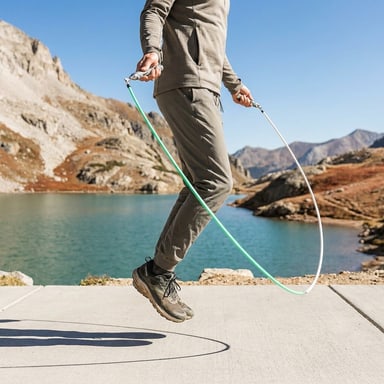
How we picked
Every pick is scored against the Kit Score: a weighted rubric covering performance specs, verified-owner review patterns, price-to-value ratio, and surface and use-case fit. We aggregate manufacturer data, verified purchaser feedback across multiple retail platforms, and published coaching sources. We do not fabricate specifications or ratings.
Best overall: WOD Nation Adjustable Speed Rope
BEST OVERALL
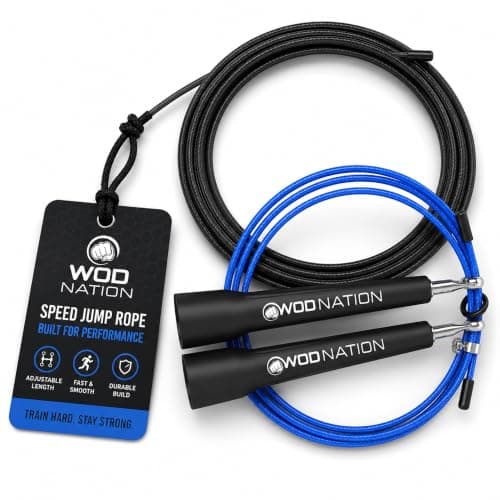
WOD Nation Adjustable Speed Jump Rope
Best for: CrossFit conditioning, boxing footwork drills, double-under practice, and anyone who wants a proven speed rope without the premium price tag.
- Consistently rated across a large verified-owner base: 4.5 stars from 14,000-plus ratings
- Coated steel cable frays on concrete within 2 to 3 months of regular outdoor use
Kit Score 8.7/10 · $16.79 Price checked Oct 23, 4:16 PM CDT · how we score gear
Buy on AmazonProduct details
The WOD Nation speed rope has held a 4.5-star average across 14,000-plus Amazon ratings, which is a rare combination of volume and consistency at this price. The adjustable alloy steel cable handles speed work and double-under practice reliably without the premium price tag.
- Cable
- UNVERIFIED on maker site: wodnationgear.com returned HTTP 402 and wodnation.com failed TLS; listing/reviewer figures are 2.5 mm coated steel cable, ball-bearing handles
- Handles
- ABS plastic
- Adjustability
- Cut to length; accommodates a wide height range
- Use case
- Speed work, boxing, MMA, CrossFit conditioning
More strengths
- Adjustable steel cable supports speed work and double-unders at this price tier
- Exceptional value for CrossFit-level conditioning under $20
Other tradeoffs
- Plastic handles lack the grip feel of knurled aluminum at premium price points
The WOD Nation speed rope sits at the intersection of every criterion that matters for most athletes: ball-bearing handles, a thin 2.5 mm coated steel cable, and a simple crimp-and-cut adjustment system. The plastic handles are slim enough to keep wrist rotation natural, and the cable's low mass means the rope accelerates quickly. Those figures come from the listing and from reviewers who have measured the rope; WOD Nation's own site refused our fetch, so we could not confirm them at the source.
Owners consistently note it holds up to concrete and asphalt better than its price suggests, though the coating on any thin cable scuffs on rough ground and shortens cable life. For indoor box flooring or a garage with rubber tiles, it will last for years of daily use. For outside on sidewalk, budget for a replacement cable after a season.
The case for buying this before anything else: it works well enough for learning double-unders from scratch, it does not punish beginner mis-timing with painful whip-backs the way heavier cables do, and the sub-$20 price means a damaged or lost rope is not a meaningful loss. Most athletes who eventually upgrade to a premium rope still keep this one as a backup.
Best for: CrossFit conditioning, boxing footwork drills, double-under practice, and anyone who wants a proven speed rope without the premium price tag.
Editor's choice: Elite Jumps Do Hard Things Beaded Jump Rope
EDITOR'S CHOICE
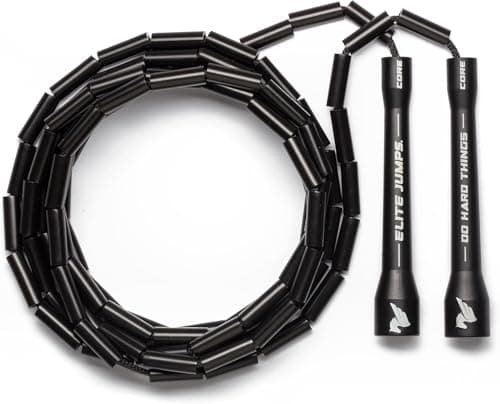
Elite Jumps Do Hard Things Beaded Jump Rope
Best for: Outdoor training on rough surfaces, beginner technique development, boxing footwork rhythms, and anyone building freestyle skills who needs auditory timing feedback.
- Bead-on-polycord construction works on concrete, asphalt, gym floors, and outdoor surfaces where cable ropes fail
- Not suitable for double-unders or high-speed conditioning: slower rotation by design
Kit Score 8.8/10 · $22.99 Price checked Oct 23, 4:16 PM CDT · how we score gear
Buy on AmazonProduct details
The Do Hard Things is the standard beaded rope recommended by competitive jump rope coaches for developing rhythm and learning advanced skills. The shatterproof 1-inch beads hold their arc on any surface, give clear auditory feedback on timing, and outlast PVC cable ropes on abrasive concrete or asphalt. Available direct at elitejumps.co.
- Beads
- 1 in shatterproof plastic on 3 mm polycord
- Handles
- Unbreakable polymer, 5 in
- Rope Length
- 10 ft adjustable; fits jumpers up to 6'4"
- Weight
- ~100 g (3.5 oz)
- Surface
- Indoor and outdoor, including rough surfaces
- Origin
- Made in USA (Wenatchee, WA)
More strengths
- Auditory feedback from the beads is a genuine training aid for rhythm development and learning tricks
- Shatterproof beads and unbreakable handles make this the most durable rope under $30
Other tradeoffs
- Beads need to be removed and cord trimmed to adjust length, which requires more effort than a screw-adjust cable rope
Beaded ropes are underrated in fitness circles. The "Do Hard Things" rope threads 1-inch shatterproof plastic beads on a 3 mm black polycord, 10 feet long and about 100 g (3.5 oz) before you trim it, with 5-inch unbreakable polymer handles, and Elite Jumps makes it in the USA. The beads hold their shape in the air, making it dramatically more forgiving on rough surfaces than any bare steel cable. Asphalt, concrete, brick, and packed dirt are all fine. The cable equivalent of this rope would need replacement after a few outdoor sessions; the beaded version shrugs them off.
The weight of the beads (more than a speed cable, less than a weighted rope) provides consistent tactile and auditory feedback with every rotation. That rhythm is why beaded ropes are the standard in boxing gyms: you hear each pass, which ingrains timing in a way that silent speed ropes do not. For footwork drills and beginner technique development, auditory feedback is a genuine coaching assist.
The limitation is speed: beaded ropes are slower than speed cables, and double-unders are harder to achieve with them. They are not the right tool if fast double-unders are the goal. Sizing is also more work: Elite Jumps says the rope fits anyone up to 6 feet 4, and you shorten it by loosening the tie at one handle, removing beads, and cutting the excess cord. For general cardio, outdoor use, or building rhythm and footwork, they are the right tool and nothing else does the job quite as well. Elite Jumps sells it direct for $22.99.
Best for: Outdoor training on rough surfaces, beginner technique development, boxing footwork rhythms, and anyone building freestyle skills who needs auditory timing feedback.
Best value set: Crossrope Get Lean Set
BEST VALUE
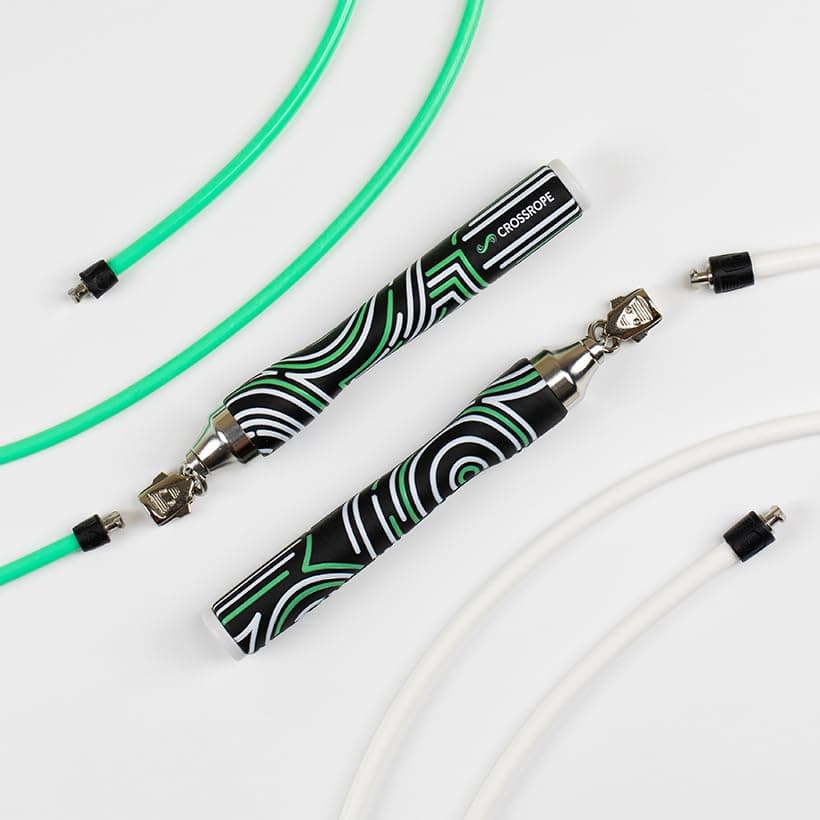
Crossrope Get Lean Set
Best for: Cardio-focused training and fat-loss programs where rope weight feedback accelerates learning and the weighted resistance adds upper-body demand to every set.
- Two-rope system at 1/4 lb and 1/2 lb covers both endurance HIIT and foundational cardio in one purchase
- App subscription required to access full workout library beyond the 30-day trial, adding recurring cost
Kit Score 8.6/10 · $129.00 Price checked Oct 23, 4:16 PM CDT · how we score gear
Buy on AmazonProduct details
The Crossrope Get Lean Set pairs two weighted cable ropes with ceramic-bearing handles and a fast-clip system that lets you swap rope weight mid-session. The 1/2 lb rope slows rotation enough to feel each revolution clearly, making it one of the most useful tools for building jump rope cardio from scratch or transitioning beginners toward higher-cadence work.
- Ropes Included
- 1/4 lb (endurance/HIIT) and 1/2 lb (cardio/beginner)
- Handles
- Slim aluminum, fast-clip connection system
- Bearings
- UNVERIFIED: Crossrope's Get Lean Set page does not mention ceramic bearings; it lists Slim handles, Fast Clip connection, lifetime handle warranty, XS-XL sizes (7'6" to 9'6" ropes), $129
- Length
- Adjustable; available in XS through XL sizes
- App
- Crossrope app (30-day free trial included)
- Warranty
- Lifetime handle warranty
More strengths
- Ceramic bearing handles deliver noticeably smoother rotation than most steel-bearing ropes in this price range
- Lifetime handle warranty and fast-clip interchangeability make handles a one-time buy
Other tradeoffs
- Price is high relative to single-rope alternatives; harder to justify for pure speed or double-under training
The Crossrope Get Lean Set includes two weighted ropes (1/4 lb and 1/2 lb) on the same Slim handles with Crossrope's Fast Clip connection, which is the key to its value proposition. Rotating between rope weights within a workout creates metabolic variety and adds genuine upper-body demand to sets that a bare speed cable cannot replicate.
The 1/4 lb rope is the daily driver: fast enough for technique work, heavy enough that beginners get clear feedback on where the rope is. The 1/2 lb rope adds a conditioning stimulus that is nothing like speed work. Verified owners consistently describe the 1/2 lb rope as "surprisingly difficult" for sustained sets, which matches the physics: sustained rotation against added resistance elevates heart rate faster than a lighter rope at the same cadence. Crossrope sells the set in five sizes by height, from XS to XL, with rope lengths from 7 feet 6 to 9 feet 6, and backs the handles with a lifetime warranty. It also warns that extended use on pavement wears the coating through to the steel cable faster, and recommends a mat.
The price is the legitimate objection. At $120–$135 (Crossrope's direct price is $129, which includes 30 days of its app membership in the US), you are buying a system, not just a rope. If you want a single rope for speed work, the WOD Nation is a better spend. If you want a structured progressive cardio tool that replaces two or three separate ropes, the Crossrope set makes sense and the Fast Clip system means you only ever need to add a heavier rope to the same handles.
Best for: Cardio-focused training and fat-loss programs where rope weight feedback accelerates learning and the weighted resistance adds upper-body demand to every set.
How every pick compares
| Product | Kit Score | Price | Best for |
|---|---|---|---|
| WOD Nation Adjustable Speed Jump Rope | 8.7 | $16.79 Price checked Oct 23, 4:16 PM CDT | Best for: CrossFit conditioning, boxing footwork drills, double-under practice, and anyone who wants a proven speed rope without the premium price tag. Why it stands out: Consistently rated across a large verified-owner base: 4.5 stars from 14,000-plus ratings Tradeoff: Coated steel cable frays on concrete within 2 to 3 months of regular outdoor use |
| Elite Jumps Do Hard Things Beaded Jump Rope | 8.8 | $22.99 Price checked Oct 23, 4:16 PM CDT | Best for: Outdoor training on rough surfaces, beginner technique development, boxing footwork rhythms, and anyone building freestyle skills who needs auditory timing feedback. Why it stands out: Bead-on-polycord construction works on concrete, asphalt, gym floors, and outdoor surfaces where cable ropes fail Tradeoff: Not suitable for double-unders or high-speed conditioning: slower rotation by design |
| Crossrope Get Lean Set | 8.6 | $129.00 Price checked Oct 23, 4:16 PM CDT | Best for: Cardio-focused training and fat-loss programs where rope weight feedback accelerates learning and the weighted resistance adds upper-body demand to every set. Why it stands out: Two-rope system at 1/4 lb and 1/2 lb covers both endurance HIIT and foundational cardio in one purchase Tradeoff: App subscription required to access full workout library beyond the 30-day trial, adding recurring cost |
WOD Nation Adjustable Speed Jump Rope
- Best for
- CrossFit conditioning, boxing footwork drills, double-under practice, and anyone who wants a proven speed rope without the premium price tag.
- Why it stands out
- Consistently rated across a large verified-owner base: 4.5 stars from 14,000-plus ratings
- Tradeoff
- Coated steel cable frays on concrete within 2 to 3 months of regular outdoor use
Elite Jumps Do Hard Things Beaded Jump Rope
- Best for
- Outdoor training on rough surfaces, beginner technique development, boxing footwork rhythms, and anyone building freestyle skills who needs auditory timing feedback.
- Why it stands out
- Bead-on-polycord construction works on concrete, asphalt, gym floors, and outdoor surfaces where cable ropes fail
- Tradeoff
- Not suitable for double-unders or high-speed conditioning: slower rotation by design
Crossrope Get Lean Set
- Best for
- Cardio-focused training and fat-loss programs where rope weight feedback accelerates learning and the weighted resistance adds upper-body demand to every set.
- Why it stands out
- Two-rope system at 1/4 lb and 1/2 lb covers both endurance HIIT and foundational cardio in one purchase
- Tradeoff
- App subscription required to access full workout library beyond the 30-day trial, adding recurring cost
How to choose the right jump rope
Matching rope type to your training goal
Identify your primary use
If double-unders and CrossFit metcons are the goal, start with a speed cable (WOD Nation). If cardio conditioning with added resistance is the goal, go weighted (Crossrope). If outdoor training or technique work is the goal, go beaded (Elite Jumps).
Check your surface
Bare steel cables wear fast on asphalt and concrete; even Crossrope says pavement wears its coated cables through faster. If you train outside more than once a week on hard surfaces, the beaded rope is not optional, it is the correct tool for the job.
Match rope weight to your experience
Beginners benefit from a heavier rope (weighted or beaded) because the feedback is clearer. Intermediate and advanced athletes chasing speed benefit from lighter cables and precision bearings.
Factor in adjustability
All three picks here are adjustable, but differently: the WOD Nation crimps and cuts, the Elite Jumps loses beads and trims cord, and Crossrope sells fixed lengths by height. Stand on the rope's midpoint, and the handles should reach roughly armpit height for general use, or hip height for faster double-under work.
Budget for cable replacement
Speed cables are consumables. A coated cable on rough surfaces may last one to two seasons of regular outdoor use. Factor that into the price comparison with a beaded rope, which lasts far longer on the same surfaces.
The rope you will actually train with consistently beats the technically superior rope that stays coiled in a bag because it is too precious to take outside.
Frequently asked questions
What is the difference between a speed rope and a weighted jump rope?
A speed rope uses a thin steel cable (the WOD Nation's is 2.5 mm) and bearings to minimize rotational drag, maximizing RPM. A weighted rope replaces the cable with a heavier cord or adds mass to the handles, increasing resistance per rotation; Crossrope's Get Lean ropes are 1/4 lb and 1/2 lb. Speed ropes are optimized for double-unders and fast rep counts; weighted ropes are optimized for cardiovascular load and upper-body conditioning stimulus. The two goals are different enough that many athletes eventually own both.
Can I use a speed rope on concrete or outdoor surfaces?
A bare steel cable will work on concrete, but expect accelerated wear. A coated cable used outdoors daily may need replacement in a single season rather than lasting multiple years on gym rubber, and Crossrope's own guidance is that pavement wears its coating through to the steel faster. Beaded ropes are the durable choice for regular outdoor use because the hard plastic beads absorb surface abrasion instead of the cord itself.
How do I know what rope length to start with?
The standard starting point: stand on the midpoint of the rope and pull the handles up. For general cardio and learning, handles reaching armpit height is a reliable starting guide. For double-under-focused training, many athletes shorten to hip height for a tighter, faster arc. The WOD Nation and Elite Jumps ropes ship long (Elite Jumps fits up to 6 feet 4) and cut down, so buy and tune during your first few sessions; Crossrope asks for your height up front and ships a fixed length.
Where these numbers come from
| Claim | Source | Checked |
|---|---|---|
| Elite Jumps Do Hard Things: 1 in shatterproof plastic beads on 3 mm black polycord, 5 in unbreakable polymer handles, 10 ft cord, about 100 g (3.5 oz), fits up to 6'4", adjusted by removing beads and cutting cord, made in the USA, $22.99 | Elite Jumps, Do Hard Things 1" Beaded Jump Rope | Sep 2026 |
| Crossrope Get Lean Set: 1/4 lb and 1/2 lb ropes, Slim handles with Fast Clip connection and lifetime handle warranty, sizes XS to XL (7'6" to 9'6" ropes), pavement wears the coating faster and a mat is recommended, 30-day app membership included in the US, $129 | Crossrope, Get Lean Jump Rope Set | Sep 2026 |
| WOD Nation: 2.5 mm coated steel cable, ball-bearing handles, plastic handles, crimp-and-cut adjustment, 4.5 stars on 14,000-plus ratings | Listing on Amazon, linked from the pick above (WOD Nation's site, wodnationgear.com, returned an HTTP 402 error on every attempt to check the spec sheet) | Sep 2026 |
| Street prices for all three | Listings on Amazon, linked from the picks above | Sep 2026 |
We did not jump these ropes ourselves. Cable diameters, bead sizes, and rope weights are the makers' published specs or the retail listing where the maker's site could not be reached; durability guidance summarizes owner reports and Crossrope's own care notes.
A jump rope has one of the best effort-to-result ratios in fitness equipment: ten minutes of serious rope work is demanding cardio that also trains coordination and footwork, and it packs into a gym bag pocket. Getting the rope type right for your surface and goal is the only variable that matters before you start.
See more training tool picks in the fitness hub, or read how we research and rate every recommendation on this site.
Keep going
Complete loadoutHome calisthenics kitA compact strength and conditioning setup built around five tools that cover pushing, pulling, assistance, cardio, and floor work.
Our recommendations draw on manufacturer documentation, retailer listings, owner feedback, and comparisons with alternatives.
As an Amazon Associate I earn from qualifying purchases. We may earn a commission from links here, at no extra cost to you. How we research →