
Box jumps are one of the most effective plyometric exercises you can do, and one of the most poorly coached. Get the mechanics right from the start and you build explosive power; skip the details and you risk the shin, the Achilles, and the ego.
Choosing a safe starting height
The number one mistake beginners make is going too high too soon. A box jump's height is not the goal; power production and clean mechanics are. Start at a height where you can land in a strong athletic position with your feet flat, knees tracking over your toes, and hips at or above parallel.
For most adults with no plyometric background, that means a 12-inch box. Trained athletes with a solid squat base often start comfortably at 18–20 inches. The rule of thumb: if you cannot land quietly and controlled, the box is too high.
Resist the urge to use the tallest box in the gym. A lower box with explosive intent (jumping as high as you can and landing on a short box) builds more power than a high box with a lazy jump and a hard landing.
The soft landing and quiet-knees mechanic
Every box jump landing should be quiet. If you can hear your feet slam the box, you are loading your joints instead of using your muscles to decelerate.
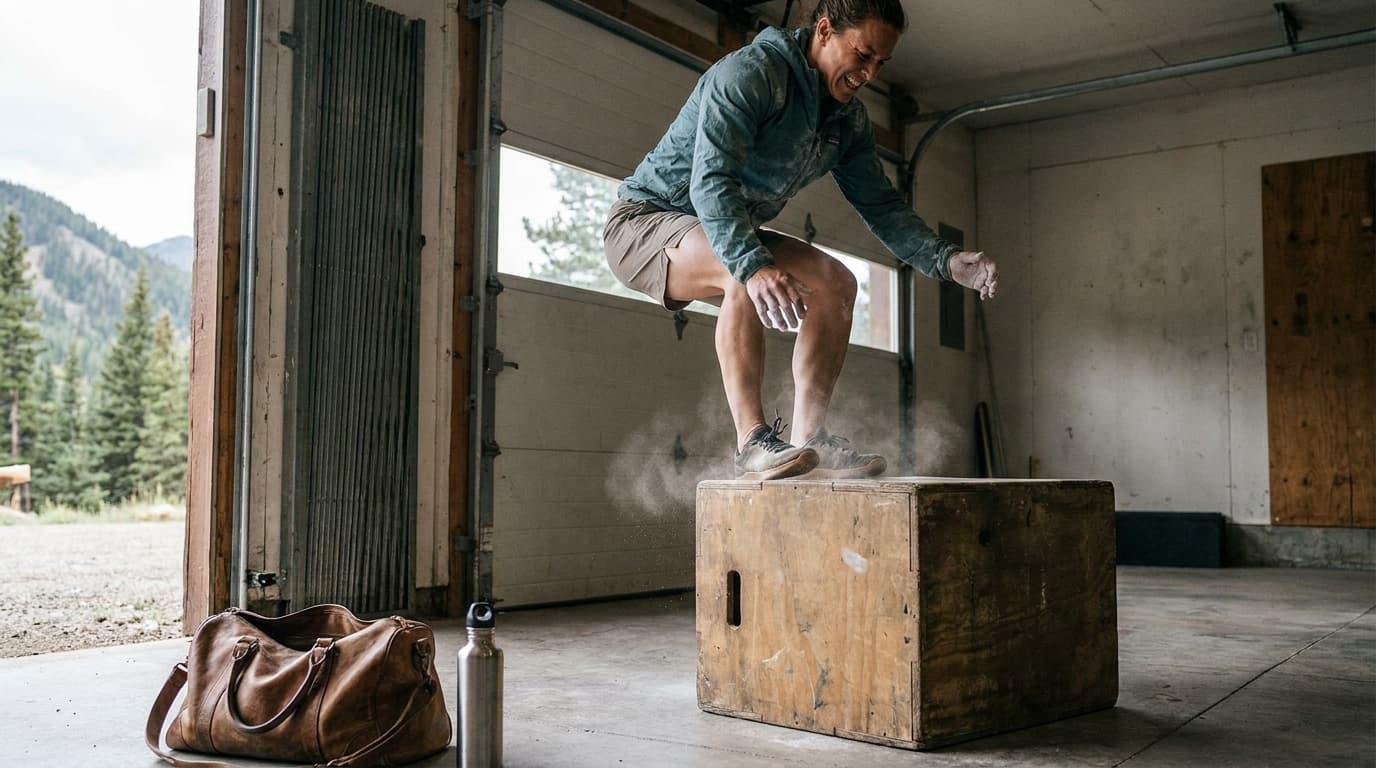
Here is how a proper landing works: you leave the ground by driving through your hips and swinging your arms, then pull your feet up actively so you clear the surface with room to spare. At contact, you land mid-foot (not heel), absorb immediately into a partial squat, and let your knees track out over your second and third toes. Your chest stays tall. The whole sequence should feel like a controlled athletic catch.
The soft landing sequence
Hinge and load
sit back slightly into a quarter squat, arms back, before you jump
Drive and swing
push through the floor explosively, swing arms up for momentum
Pull your feet up
actively dorsiflex (pull toes toward shins) so you clear the edge cleanly
Land mid-foot
contact the box through the ball of the foot, not the heel or flat-footed
Absorb through hips and knees
drop into a partial squat immediately on contact, knees out
If your landing is loud, your joints are doing the work your muscles should be doing.
Why you should always step down
Jumping down from the box is how Achilles tendon injuries happen. The stretch-shortening cycle that makes plyometrics powerful is also what makes a fast, uncontrolled descent dangerous. When you jump down, you load the Achilles under high velocity with no preparation. Over time or in a fatigued state, that is a recipe for tendinopathy or, in worst cases, rupture.
The fix is simple: step down one foot at a time, every rep, no exceptions. Step to the side of the box or directly in front. Reset your stance, take a breath, and then load for the next rep. This also gives your nervous system a reset between jumps, which keeps power output higher across the whole set.
The shin-scrape risk and how to avoid it
Shin scrapes are the most common box jump injury and almost entirely preventable. They happen in two scenarios: you misjudge the height on a first attempt, or your legs fatigue mid-set and you stop clearing the edge cleanly.
To avoid misjudging height, always start a session with a box lower than your max. Treat the first few reps as activation, not performance. If you are trying a new height, do a practice jump to a box that is clearly too low first so your body calibrates the distance.
To avoid fatigue-driven scrapes, keep sets short. Two to five reps per set is standard for true plyometric training. Box jumps are a power exercise, not a conditioning circuit. Once your jump height drops or your landing gets sloppy, the set is over. Full stop.
Wear long socks or shin guards if you are just learning, or train on a foam box like the Yes4All Soft-Padded Plyometric Box that gives on a missed rep instead of scraping. There is no ego in protecting your skin while your mechanics are still developing.
Warm-up before you jump
Cold muscles and stiff joints do not produce power cleanly. A focused five-minute warm-up makes a real difference in both performance and injury risk.
Start with two minutes of light cardio (jogging, jumping jacks, or a bike) to raise your core temperature. Then move through dynamic hip openers, leg swings, and bodyweight squats. Finish with two or three submaximal jumps to a low box or onto a padded surface before going near your working height.
Skipping this step because you feel warm from a previous exercise is a common shortcut that catches people off guard. Box jumps demand reactive neuromuscular readiness, not just general warmth.
Who should use step-ups instead
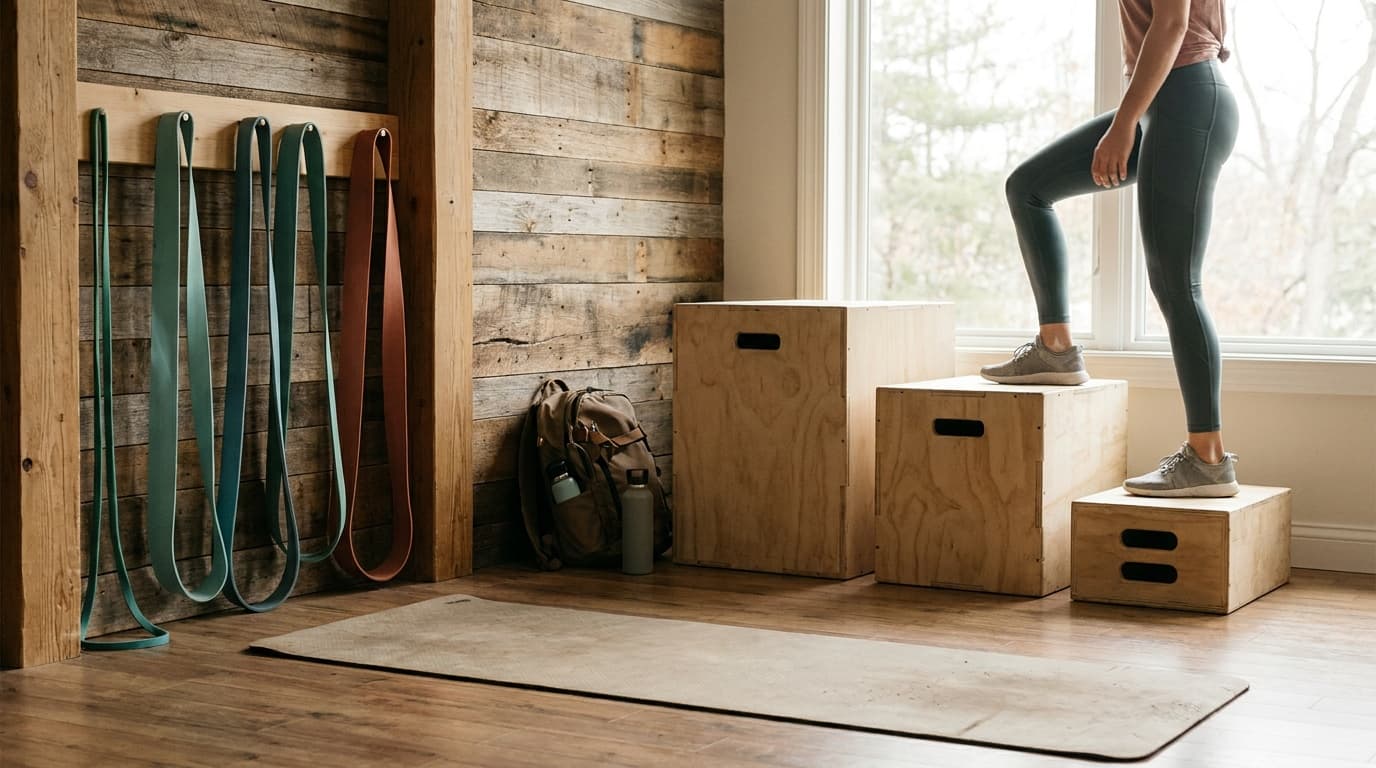
Box jumps are not the right tool for everyone on every day. Use weighted or unweighted step-ups instead if any of these apply:
- You are recovering from an Achilles, patellar, or ankle injury
- You have not yet built a solid base of strength (you cannot squat your bodyweight to parallel)
- You are in the later weeks of a high-volume training block and your legs are already fatigued
- You are new to any structured exercise program (step-ups build the same motor pattern more safely)
Step-ups are not a lesser exercise. They develop unilateral strength and hip stability that directly transfers to better jump mechanics once you are ready.
Frequently asked questions
How high should a box be for a beginner?
Start at 12 inches. The goal is to land with control, knees tracking out, and hips at or above parallel. If a 12-inch box feels too easy to clear, that is a good sign: now focus on jumping as explosively as possible and landing quietly, rather than raising the box height immediately.
How many box jump reps should I do per set?
Two to five reps is the standard range for plyometric training. Box jumps train your nervous system to produce maximum force quickly, and that quality degrades fast with fatigue. When your jump height drops or your landing mechanics slip, end the set. More reps at lower quality does not build power; it builds bad habits and raises injury risk.
Can I do box jumps every day?
No. Plyometric training stresses the neuromuscular system and connective tissue in ways that require recovery time. Two to three sessions per week with at least one full rest day between sessions is the recommended approach for most people. If you are also doing heavy strength work, program box jumps at the start of the session when your nervous system is fresh.
For specific picks, see our guide to the best plyo boxes. Browse all fitness guides or read how we research and rate gear.
Recommended gear
Our current top picks from the Best plyo boxes for jump training: wood, foam, and steel picks guide, if you are ready to buy.
YES4ALL
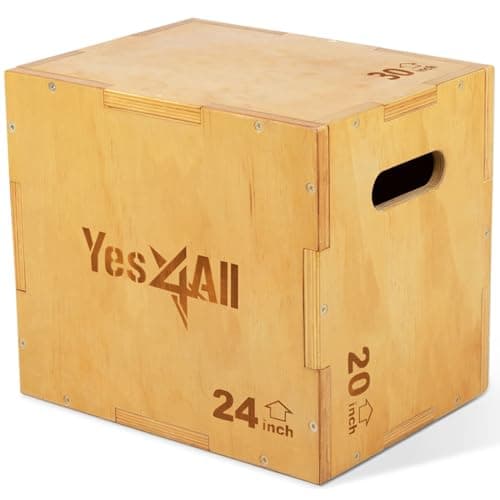
Yes4All 3-in-1 Wooden Plyometric Box
Best Value
Kit Score 8.2/10
$145.00 Price checked Oct 23, 4:16 PM CDT
Best for: Garage gym owners who want a reliable wood 3-in-1 at a fair price and don't mind a short assembly session.
- 450 lb rated with internal bracing on larger sizes, handles loaded step-up work without any flex
- Bare plywood top has no added texture or grip layer, so sweat or rubber-soled shoes can shift on landing
- Height options
- 16 / 14 / 12 in (small); 24 / 20 / 16 in (medium); 30 / 24 / 20 in (large)
- Weight capacity
- 450 lb
- Material
- 3/4 in plywood with sanded edges
- Carry handles
- Built-in wide handles
- Assembly
- Tool-free puzzle joints, pre-drilled holes
- Available sizes
- 3 options: 16/14/12, 24/20/16, 30/24/20 in
About this pick
A three-height wood box that rotates to give you three jump heights from one piece of equipment. The sanded edges and built-in carry handles make it a practical garage-gym staple, and the 450 lb rating means it handles loaded step-up work without any flex.
Strengths
- 450 lb rated with internal bracing on larger sizes, handles loaded step-up work without any flex
- Sanded edges and smooth top reduce the skin-tear risk that unfinished wood boxes carry
- Three size options let you match the box to your current jump height and add taller versions later
Weaknesses
- Bare plywood top has no added texture or grip layer, so sweat or rubber-soled shoes can shift on landing
- Requires assembly (10 to 15 minutes); puzzle joints are well-designed but not for anyone who wants to train the same day it arrives
Kit Score breakdown
SYNERGEE
Synergee Non-Slip 3-in-1 Wood Plyometric Box
Best Overall
Kit Score 8.3/10
$99.95 Price checked Oct 23, 4:16 PM CDT
Best for: Serious jump trainers who do high-rep box work in a garage or basement gym where sweat on a plain wood surface would otherwise be a hazard.
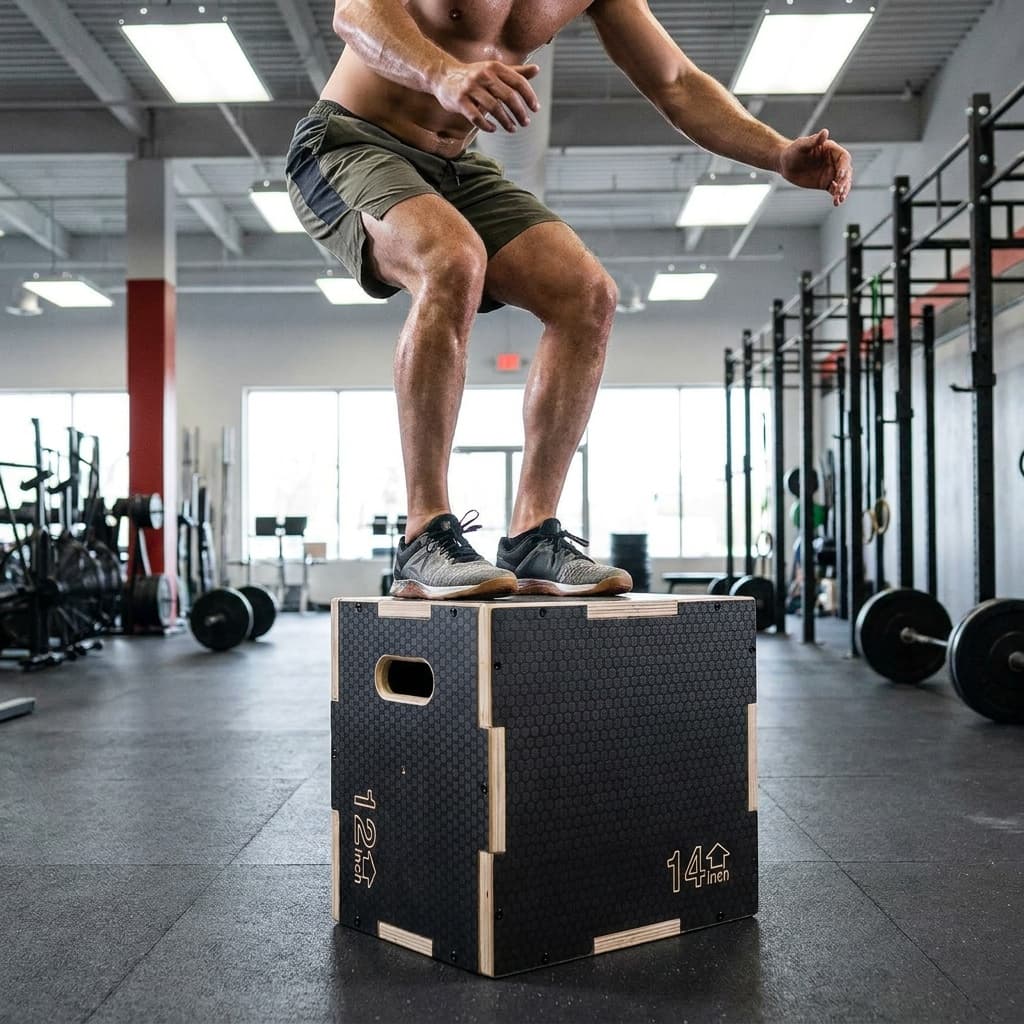
- Hex PVC coating provides measurably better traction than raw plywood, which matters on bare-feet or socked-feet training days
- Some owners report minor chipping of the PVC surface layer with heavy or prolonged use
- Height options
- 20 / 18 / 16 in (standard); 16 / 14 / 12 in (smaller model)
- Weight capacity
- 450 lb
- Surface
- 3/4 in plywood with PVC hexagonal non-slip coating
- Hex pattern
- Channels moisture away from landing surface
- Assembly
- Screwdriver or drill required, 10 to 15 min
- Available sizes
- 2 options: 20/18/16 in and 16/14/12 in
About this pick
The same structural wood construction as a basic 3-in-1 box, with a PVC hexagonal surface coating that adds real grip and channels sweat away from the landing area. The result is a box that stays put under fast box-jump reps in a way smooth plywood cannot match.
Strengths
- Hex PVC coating provides measurably better traction than raw plywood, which matters on bare-feet or socked-feet training days
- 450 lb capacity with internal supports gives it genuine strength for loaded conditioning work
- Built-in carry handles make moving it between workout stations straightforward
Weaknesses
- Some owners report minor chipping of the PVC surface layer with heavy or prolonged use
- Only two size options (20/18/16 and 16/14/12); no 30/24/20 variant available in this line
Kit Score breakdown
YES4ALL
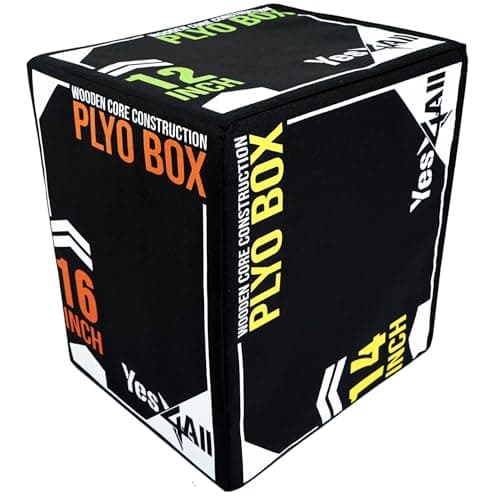
Yes4All 3-in-1 Soft-Padded Plyometric Box
Editor's Choice
Kit Score 8.0/10
$69.80 Price checked Oct 23, 4:16 PM CDT
Best for: Athletes who are building confidence on box jumps, returning from lower-body injury, or training solo where a missed jump could mean a scraped shin with no one around to help.
- EVA foam outer shell absorbs the impact of grazed shins on missed box jumps, reducing the bruising that bare plywood causes
- Softer landing feel gives less positional feedback than a wood or steel surface, which some athletes prefer for training precision
- Height options
- 16 / 14 / 12 in (standard model); larger sizes available
- Weight capacity
- 440 lb
- Construction
- Solid wood core, EVA foam layer, PVC vinyl cover
- Assembly
- None required; ships ready to use
- Surface feel
- Cushioned, forgiving on missed reps
- Available sizes
- Multiple options from 16/14/12 in to 20/18/16 in and larger
About this pick
A wood-core box wrapped in EVA foam and a non-slip vinyl cover that protects shins on missed jumps and softens repeated landings. It ships fully assembled and ready to train within minutes, making it the practical choice for athletes who prioritize safety margins over the firm feel of raw wood.
Strengths
- EVA foam outer shell absorbs the impact of grazed shins on missed box jumps, reducing the bruising that bare plywood causes
- No assembly required and lightweight design makes it easy to move, store, or rotate surfaces
- PVC vinyl grip is more reliable underfoot than smooth wood, particularly during conditioning circuits where form degrades with fatigue
Weaknesses
- Softer landing feel gives less positional feedback than a wood or steel surface, which some athletes prefer for training precision
- 440 lb capacity is slightly lower than wood competitors, though more than adequate for most training scenarios
Kit Score breakdown
See all picks in Best plyo boxes for jump training: wood, foam, and steel picks
Keep going

Researched, not hands-on tested
Updated Jun 4, 2026Our recommendations draw on manufacturer documentation, retailer listings, owner feedback, and comparisons with alternatives.
As an Amazon Associate I earn from qualifying purchases. We may earn a commission from links here, at no extra cost to you. How we research →