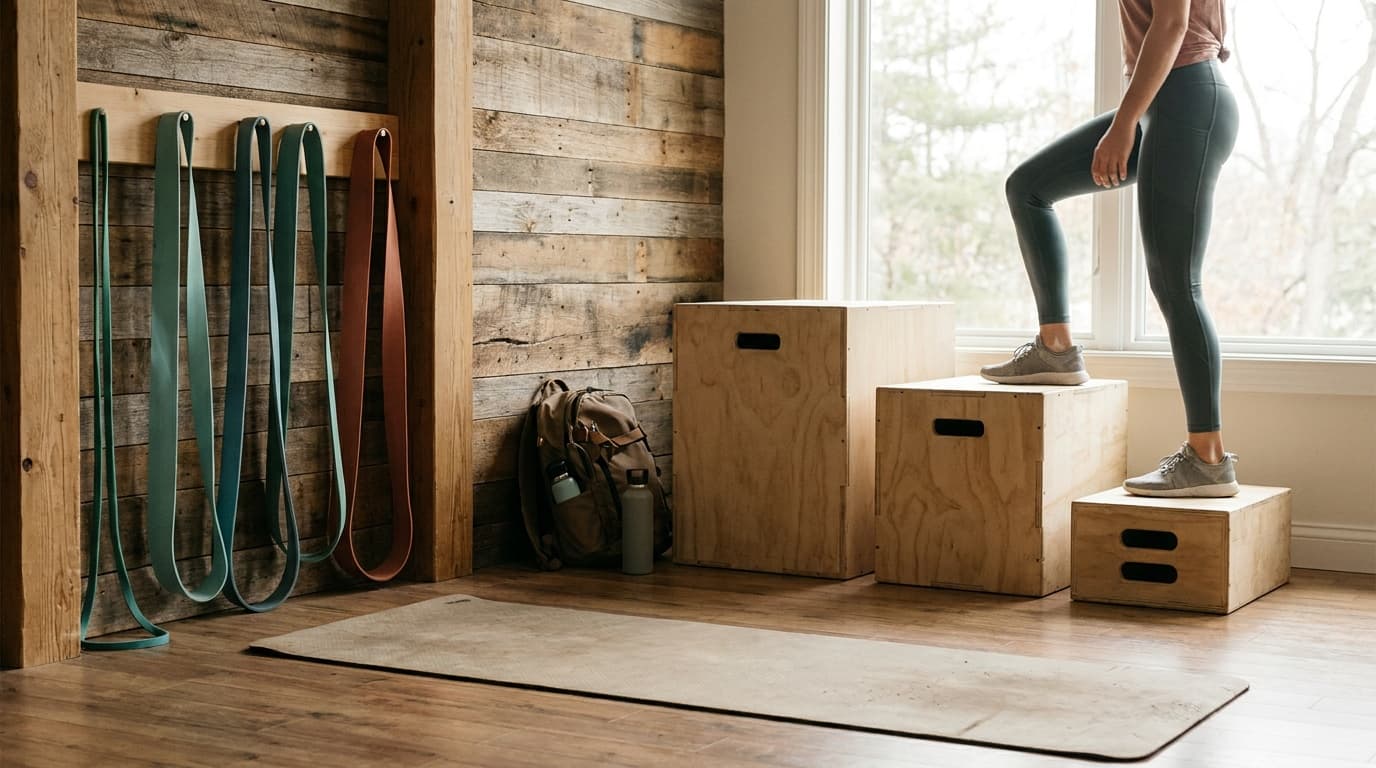
Start with a 12 to 18 inch box if you are new to box jumps. That is the beginner range the National Academy of Sports Medicine recommends, because it lets you land softly with bent knees and full control; move up only as your power and landing improve. Trained jumpers usually work at 20 to 24 inches (the CrossFit Open standards are 20 in for women and 24 in for men), and 30 inches is an advanced height, not a starting point.
Choose the surface and range before the maximum height
- You are learning box jumps or worried about missed landings: choose the Yes4All soft-padded box in its 12/14/16 in size. Padding reduces the consequence of a shin contact, but it does not make an excessive height safe.
- You already land consistently and want one box for several exercises: choose the Yes4All wooden 3-in-1 box, sold in 12/14/16, 16/20/24, and 20/24/30 in sizes. Pick the size whose lowest face already suits your current ability.
- You need a step-up surface below 20 inches: do not buy a 20/24/30 box and force the exercise to fit it. The 12/14/16 size of either Yes4All box covers most step-up heights.
- You cannot land quietly and consistently at the proposed height: lower the surface before buying. Maximum jump height is not the same as repeatable training height.
Our quick picks
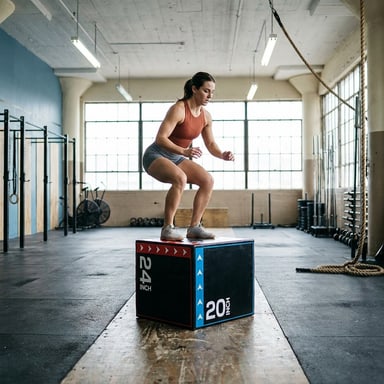
Yes4All 3-in-1 Soft-Padded Plyometric Box
EVA foam outer shell absorbs the impact of grazed shins on missed box jumps, reducing the bruising that bare plywood causes
Best for: Athletes who are building confidence on box jumps, returning from lower-body injury, or training solo where a missed jump could mean a scraped shin with no one around to help.
Buy on Amazon →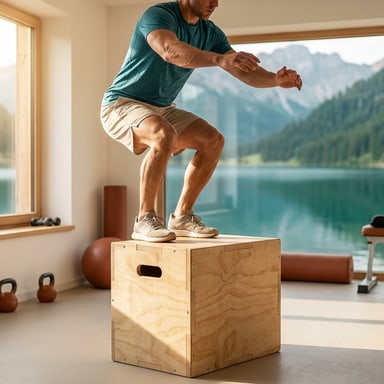
Yes4All 3-in-1 Wooden Plyometric Box
450 lb rated with internal bracing on larger sizes, handles loaded step-up work without any flex
Best for: Garage gym owners who want a reliable wood 3-in-1 at a fair price and don't mind a short assembly session.
Buy on Amazon →The standard sizes and what they mean
The most common gym box is a 20/24/30 inch 3-in-1, and many home boxes copy those faces. Two of those numbers come from CrossFit, whose Open workouts set the box jump at 24 inches for men and 20 inches for women, so a lot of published programming references them directly. Smaller 3-in-1 sizes (12/14/16 and 16/20/24) exist for beginners and step-ups.
A 20-inch box is a common first commercial height, but most beginners should start lower. The appropriate starting point is the lowest surface that still requires a deliberate jump while allowing a quiet, balanced landing. A 30-inch box requires substantially more power and body awareness; moving there before the landing pattern is repeatable raises the consequence of a miss.
Why a 3-in-1 box is the versatile default
A 3-in-1 foam or wood box like the Yes4All 3-in-1 Wooden Plyo Box gives you three heights in a single piece of equipment by flipping and rotating it. In the large size, stood on its tallest face it is 30 in, rotated 90 degrees it becomes 24 in, and laid flat it is 20 in. Buying the size whose lowest face matches your current level gives you two steps of progression built in.
One 3-in-1 box covers you from your first box jump to competition-level training without buying three pieces of equipment.
The trade-off is footprint and weight. The large Yes4All wood box measures 30 x 24 x 20 inches, weighs 50 lb, and is rated for 450 lb; the soft-padded box in its 12/14/16 size weighs 13.2 lb. If space is genuinely tight, a single-height box takes up less floor space and costs less. But for anyone with room for a barbell and plates, the 3-in-1 is the smarter long-term buy.
Height for beginners vs trained athletes
Beginners should treat height as a byproduct of good mechanics, not a goal in itself. A well-executed jump onto a 20-inch box is far more valuable than a scraped-shin attempt at 30 inches.
Choosing your starting height
New to plyometrics
Start at 12 to 18 in, the NASM beginner range. Use the lowest stable surface that lets you land quietly and repeatably.
Consistent gym-goer, some jumping
Test 20 in, then 24 in. You should land with both feet fully on the box, knees bent, and feel in control.
Competitive CrossFit or sport athlete
20 in (women) and 24 in (men) are the CrossFit Open standards; 30 in and above is advanced training that belongs under a coach's eye.
Returning from injury or long break
Do not infer readiness from the height you once used. Rebuild under qualified guidance when an injury is involved.
Kids and teens
Proportions, maturity, coaching, and landing control matter more than adult standard sizes. Use supervised programming rather than a universal height.
A useful self-test: do five jumps at the candidate height. If every landing is quiet, with both feet fully on the box and your knees bent and tracking over your toes, the height works for training. If any rep lands on your toes, on straight legs, or with a stumble, start lower.
Box jumps vs step-ups: different height logic
Box jumps and step-ups are not interchangeable exercises, and they do not want the same box height.
For box jumps, you want a height that challenges your power output while still allowing a confident, controlled landing. Train a few inches below the highest box you can land; jumping to the absolute limit of your ability every rep is a recipe for missed landings.
For step-ups, the goal is hip extension and glute load, not explosive power. A box that puts your thigh roughly parallel to the floor when your foot is on it (often 12 to 20 in, depending on your height) is a practical target. Go much higher and most people start pushing off the back leg or leaning forward to get up, which takes work away from the leg on the box.
Safety margin: the rule most people skip
The safest box training principle is simple: always have more height in reserve than you think you need. Fatigue, distraction, and slight technique breakdowns happen mid-workout. A box you can land on confidently at rep 10 when tired is the right training height.
Specific safety practices worth building in from day one:
- Step down, do not jump down. NASM gives this instruction specifically to reduce impact stress, and the drop adds load without adding to the jump.
- Keep reps low and stop before fatigue. NASM suggests 3 to 5 sets of 3 to 5 reps with full rest and warns never to take plyometrics to failure, because tired landings get sloppy.
- Check the surface. Foam boxes compress and shift; wooden boxes can be slick. Ensure the landing surface is secure before a high-intensity set.
- Leave shin-scraping height for when you have the mechanics wired. A missed jump that catches the shin is a common way people get hurt on a box, and training at an appropriate height makes it much less likely (a soft-sided option like the Yes4All Soft-Padded Plyo Box also takes the sting out of a miss).
- When programming max-effort jumps, warm up on a lower height first. Asking cold muscles to produce maximal power onto a 30-inch box is a setup for failure.
Where these numbers come from
| Claim | Source | Checked |
|---|---|---|
| Beginners start at 12 to 18 in; land with bent knees; step down, do not jump down; 3 to 5 sets of 3 to 5 reps, never to failure | NASM exercise library, box jumps | 2026-09-25 |
| CrossFit Open box jump: 24 in men's Rx, 20 in women's Rx | CrossFit Games, Open 20.4 men and women | 2026-09-25 |
| Wall-ball targets: 10 ft men, 9 ft women | CrossFit Games, Open 19.1 men and women | 2026-09-25 |
| Yes4All wood 3-in-1: 12/14/16, 16/20/24 and 20/24/30 in sizes; large 30 x 24 x 20 in, 50 lb, 450 lb rating | Amazon listing B073Z98YW4 | 2026-09-25 |
| Yes4All soft-padded box: wood core, EVA foam, vinyl cover; 12/14/16 in size weighs 13.2 lb; 440 lb rating | Amazon listing B084NTG92Y | 2026-09-25 |
Frequently asked questions
What height plyo box should a beginner start with?
Between 12 and 18 inches. That is the range the National Academy of Sports Medicine recommends for beginners, because it allows comfortable landings with proper control. Twenty inches is a common commercial size, but it is not right for every beginner. Move higher only after your current height is repeatable even when you are not fresh.
Is a 24-inch box good for women and a 30-inch box good for men?
Not quite. The CrossFit Open standards are 20 inches for women and 24 inches for men, and those are competition standards, not universal prescriptions. Many women train effectively at 24 inches or higher; many men are best served spending months at 20 inches first. Body proportions, training history, and goals matter far more than gender. Use the standards as reference points, not ceilings or floors.
How many box jumps should I do?
Fewer than most people think. NASM suggests 3 to 5 sets of 3 to 5 repetitions with complete rest between sets, and never taking plyometrics to failure. Box jumps train power, and power drops off quickly once you are tired, which is exactly when landings get sloppy and shins get scraped.
Can I use the same plyo box for both box jumps and Bulgarian split squats?
Yes, and this is one of the underrated reasons a 3-in-1 box earns its floor space. For Bulgarian split squats, a surface around knee height, often 16 to 20 inches, suits most adults (rear foot elevated, front shin roughly vertical). Taller athletes may prefer the next face up. Having multiple height options in one box means you are not hunting for a bench or stack of plates to get the angle right.
How tall should a plyo wall be, and is it the same as a plyo box?
They are two different things. A plyo box is a portable platform you jump onto, sized 12 to 30 inches for most training. A plyo wall, more often called a wall-ball target, is the mark on a wall you throw a medicine ball up to: the CrossFit Open standard is a 10-foot target for men and a 9-foot target for women. If you are building a home setup, mount the target at 9 or 10 feet depending on who trains, and make sure the ceiling sits well above it with clear floor space to catch the rebound. If you actually meant a box to jump on rather than a wall to throw against, size by the box-height guidance above, not by wall-target height.
For specific picks across foam, wood, and adjustable styles, see our guide to the best plyo boxes. Browse all fitness guides or read how we research and rate gear.
Recommended gear
Our current top picks from the Best plyo boxes for jump training: wood, foam, and steel picks guide, if you are ready to buy.
YES4ALL
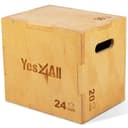
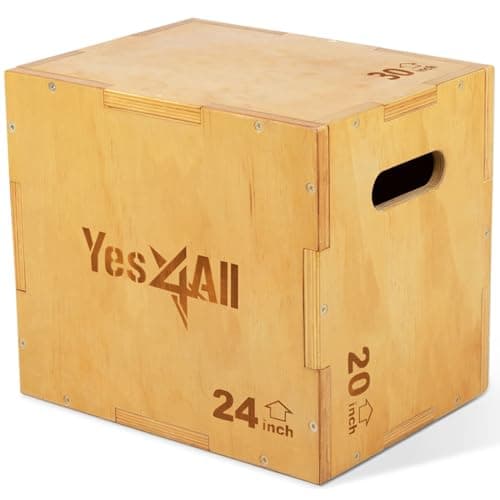
Yes4All 3-in-1 Wooden Plyometric Box
Best Value
Kit Score 8.2/10
$145.00 Price checked Oct 23, 4:16 PM CDT
Best for: Garage gym owners who want a reliable wood 3-in-1 at a fair price and don't mind a short assembly session.
- 450 lb rated with internal bracing on larger sizes, handles loaded step-up work without any flex
- Bare plywood top has no added texture or grip layer, so sweat or rubber-soled shoes can shift on landing
- Height options
- 16 / 14 / 12 in (small); 24 / 20 / 16 in (medium); 30 / 24 / 20 in (large)
- Weight capacity
- 450 lb
- Material
- 3/4 in plywood with sanded edges
- Carry handles
- Built-in wide handles
- Assembly
- Tool-free puzzle joints, pre-drilled holes
- Available sizes
- 3 options: 16/14/12, 24/20/16, 30/24/20 in
About this pick
A three-height wood box that rotates to give you three jump heights from one piece of equipment. The sanded edges and built-in carry handles make it a practical garage-gym staple, and the 450 lb rating means it handles loaded step-up work without any flex.
Strengths
- 450 lb rated with internal bracing on larger sizes, handles loaded step-up work without any flex
- Sanded edges and smooth top reduce the skin-tear risk that unfinished wood boxes carry
- Three size options let you match the box to your current jump height and add taller versions later
Weaknesses
- Bare plywood top has no added texture or grip layer, so sweat or rubber-soled shoes can shift on landing
- Requires assembly (10 to 15 minutes); puzzle joints are well-designed but not for anyone who wants to train the same day it arrives
Kit Score breakdown
SYNERGEE
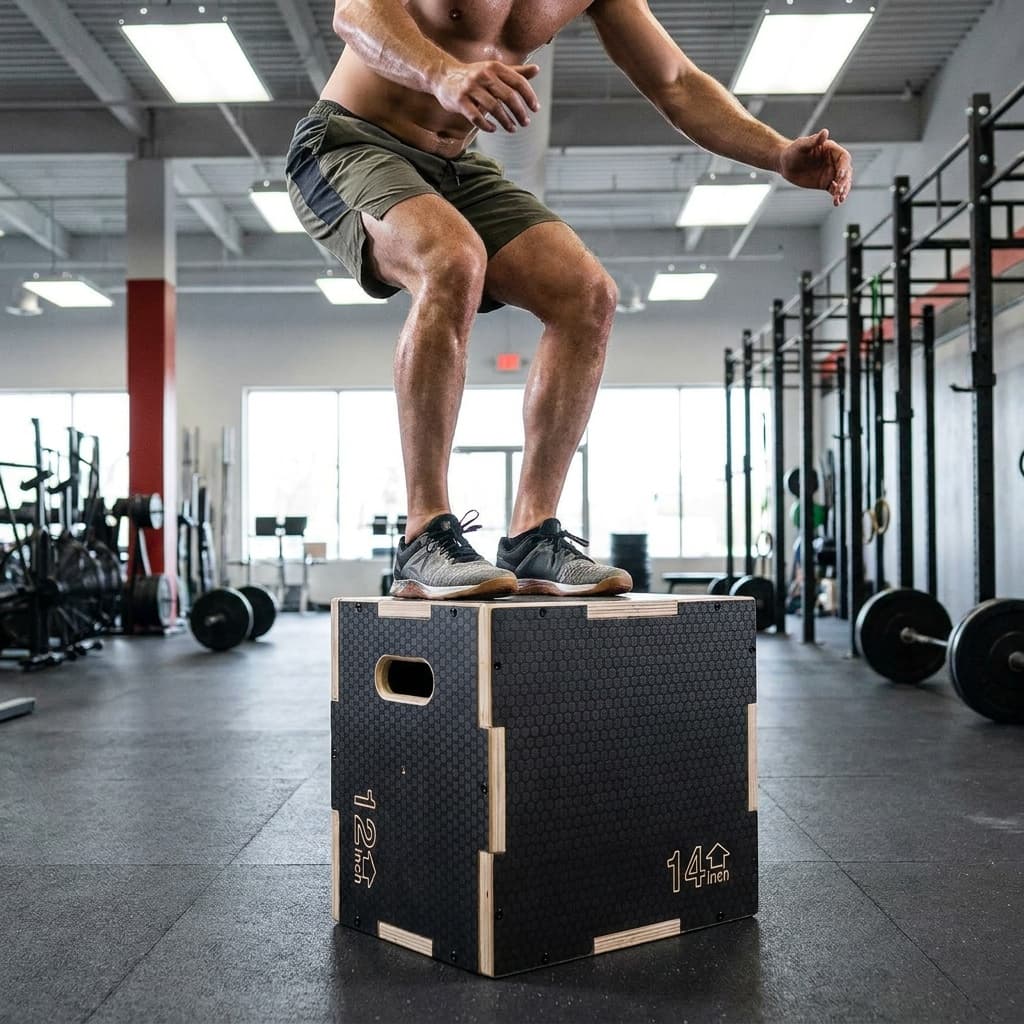
Synergee Non-Slip 3-in-1 Wood Plyometric Box
Best Overall
Kit Score 8.3/10
$99.95 Price checked Oct 23, 4:16 PM CDT
Best for: Serious jump trainers who do high-rep box work in a garage or basement gym where sweat on a plain wood surface would otherwise be a hazard.
- Hex PVC coating provides measurably better traction than raw plywood, which matters on bare-feet or socked-feet training days
- Some owners report minor chipping of the PVC surface layer with heavy or prolonged use
- Height options
- 20 / 18 / 16 in (standard); 16 / 14 / 12 in (smaller model)
- Weight capacity
- 450 lb
- Surface
- 3/4 in plywood with PVC hexagonal non-slip coating
- Hex pattern
- Channels moisture away from landing surface
- Assembly
- Screwdriver or drill required, 10 to 15 min
- Available sizes
- 2 options: 20/18/16 in and 16/14/12 in
About this pick
The same structural wood construction as a basic 3-in-1 box, with a PVC hexagonal surface coating that adds real grip and channels sweat away from the landing area. The result is a box that stays put under fast box-jump reps in a way smooth plywood cannot match.
Strengths
- Hex PVC coating provides measurably better traction than raw plywood, which matters on bare-feet or socked-feet training days
- 450 lb capacity with internal supports gives it genuine strength for loaded conditioning work
- Built-in carry handles make moving it between workout stations straightforward
Weaknesses
- Some owners report minor chipping of the PVC surface layer with heavy or prolonged use
- Only two size options (20/18/16 and 16/14/12); no 30/24/20 variant available in this line
Kit Score breakdown
YES4ALL
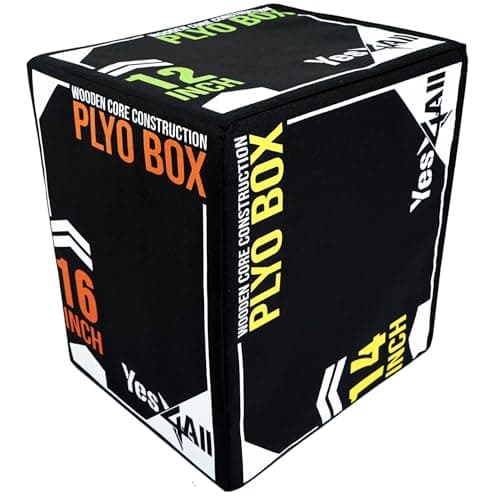
Yes4All 3-in-1 Soft-Padded Plyometric Box
Editor's Choice
Kit Score 8.0/10
$69.80 Price checked Oct 23, 4:16 PM CDT
Best for: Athletes who are building confidence on box jumps, returning from lower-body injury, or training solo where a missed jump could mean a scraped shin with no one around to help.
- EVA foam outer shell absorbs the impact of grazed shins on missed box jumps, reducing the bruising that bare plywood causes
- Softer landing feel gives less positional feedback than a wood or steel surface, which some athletes prefer for training precision
- Height options
- 16 / 14 / 12 in (standard model); larger sizes available
- Weight capacity
- 440 lb
- Construction
- Solid wood core, EVA foam layer, PVC vinyl cover
- Assembly
- None required; ships ready to use
- Surface feel
- Cushioned, forgiving on missed reps
- Available sizes
- Multiple options from 16/14/12 in to 20/18/16 in and larger
About this pick
A wood-core box wrapped in EVA foam and a non-slip vinyl cover that protects shins on missed jumps and softens repeated landings. It ships fully assembled and ready to train within minutes, making it the practical choice for athletes who prioritize safety margins over the firm feel of raw wood.
Strengths
- EVA foam outer shell absorbs the impact of grazed shins on missed box jumps, reducing the bruising that bare plywood causes
- No assembly required and lightweight design makes it easy to move, store, or rotate surfaces
- PVC vinyl grip is more reliable underfoot than smooth wood, particularly during conditioning circuits where form degrades with fatigue
Weaknesses
- Softer landing feel gives less positional feedback than a wood or steel surface, which some athletes prefer for training precision
- 440 lb capacity is slightly lower than wood competitors, though more than adequate for most training scenarios
Kit Score breakdown
See all picks in Best plyo boxes for jump training: wood, foam, and steel picks
Keep going
Researched, not hands-on tested
Updated Sep 25, 2026Our recommendations draw on manufacturer documentation, retailer listings, owner feedback, and comparisons with alternatives.
As an Amazon Associate I earn from qualifying purchases. We may earn a commission from links here, at no extra cost to you. How we research →