
Pick up a pair of binoculars marked "8x42" and you already know the two numbers that matter most. Everything else on the spec sheet flows from understanding what those digits mean and what trade-offs they represent.
Reading the numbers: magnification and objective
The first number in "8x42" is magnification. An 8x binocular makes a subject appear eight times closer than it does to the naked eye. The second number is the objective lens diameter in millimeters. That 42 mm front element gathers light and determines how bright the image looks in dim conditions.
Common configurations and what they suit:
The product of these two numbers is not arbitrary. As magnification goes up, the image gets brighter in theory but the physical steadiness you need to hold that image goes up faster. Most people can hand-hold 8x–10x comfortably. At 12x and above, every heartbeat shows.
Magnification, shake, and field of view
Magnification is the spec everyone fixates on, and it is also the one most often bought too high. Here is why.
Field of view (FOV) is the width of scene visible at 1,000 yards or meters. It narrows as magnification increases. An 8x42 might show 420 feet at 1,000 yards; a 10x42 from the same manufacturer typically narrows to around 330 feet. On a moving bird or a hiking trail where you want situational awareness, that difference is significant.
More magnification is only an advantage if you can hold the image steady enough to use it.
Image stabilization (IS) binoculars exist and work well, but they cost significantly more and add weight and batteries. For most hikers, an 8x like the Vortex Diamondback HD 8x42 is the more practical choice.
Objective size, weight, and low-light performance
The objective lens does two jobs: it sets the maximum brightness of the image and it determines a big chunk of the weight.
Brightness is partly described by exit pupil, which is objective diameter divided by magnification. An 8x42 has an exit pupil of 5.25 mm. Your eye's pupil dilates to roughly 5–7 mm in low light (less as you age), so a larger exit pupil means more of the available light actually enters your eye.
The weight cost of a larger objective is real. A quality 8x42 like the Nikon Monarch M5 8x42 runs roughly 600–750 g. A compact 8x25 cuts that to around 300 g. If you are counting grams on a long route, a compact pair plus bright midday light is a reasonable trade.
Prism type: roof vs porro
Prisms fold the light path inside the binoculars so the tube can be shorter than the optics require. Two designs dominate.
Roof vs porro prisms
Roof prism
Compact, straight-barreled, sealed easily for waterproofing. Requires tighter manufacturing tolerances to match porro brightness, so optical quality costs more per dollar.
Porro prism
Offset front lenses (the classic "Z" shape). Naturally good depth of field and contrast. Harder to make fully waterproof, but delivers strong optics at lower price points.
Phase coating
Applied to roof-prism binoculars to correct a light-phase shift caused by the prism design. A meaningful quality indicator: look for "phase-coated" in the spec sheet.
ED/HD glass
Extra-low dispersion glass reduces color fringing at high contrast edges; it is the HD in a [Vortex Viper HD 8x42](/api/go?product=vortex-viper-hd-8x42&retailer=vortex-optics&article=how-to-choose-binoculars). Useful in bright alpine or coastal light. Adds cost; not strictly necessary for casual hiking.
For a budget-conscious buyer, a quality porro-prism 8x42 often outperforms a no-name roof prism at the same price. For compact carry and durability, roof prisms are easier to seal.
Waterproof, fogproof, and eye relief
Two durability specs matter on trail:
Waterproof means the body is O-ring sealed against rain and brief submersion, typically rated to 1 m for 5 minutes (IPX7) or similar. For any use in the field, waterproofing is worth having.
Fogproof means the interior is purged with nitrogen or argon so moisture cannot condense on internal lenses when temperature changes. A fogproof binocular stays clear when you move from a cold camp into warm air or vice versa. Look for both specs together.
Eye relief is the distance in millimeters from the eyepiece lens to the point where your eye sees the full image. Eyeglass wearers need at least 15 mm of eye relief, preferably 16–18 mm, to see the full field of view with their glasses on. Twist-up or fold-down eyecups let you adjust this. Check this spec if you wear glasses.
Frequently asked questions
Is 8x42 or 10x42 better for hiking?
For most hikers, 8x42 is the stronger choice. It provides a wider field of view, is easier to hold steady without bracing, and performs well from dawn to dusk. A 10x42 earns its place on open terrain, long ridge walks, or alpine routes where you are regularly scanning across distance and have a moment to brace your elbows. If you are unsure, start with 8x.
Do I really need waterproof binoculars for hiking?
Yes, in almost every case. Trail conditions include rain, humidity, stream crossings, and condensation. Waterproof O-ring sealing also keeps dust and debris out of the body. The cost premium is small compared to the cost of a ruined optic or internal fogging you cannot fix.
What does exit pupil actually affect in practice?
Exit pupil affects how bright the image looks in low-light conditions. In full daylight your pupil is already small (2–3 mm), so exit pupil differences are invisible. At dawn, dusk, or in forest shade, a larger exit pupil (5 mm or more) means a noticeably brighter view. For pure daytime use, a compact pair with a smaller exit pupil is fine. If you watch birds at dawn or scan for wildlife at last light, prioritize exit pupil.
For specific picks across price ranges and use cases, see our guide to the best binoculars for hiking. Browse all hike guides or read how we research and rate gear.
Recommended gear
Our current top picks from the Best binoculars for hiking: birding, wildlife, and trail scenery guide, if you are ready to buy.
VORTEX OPTICS
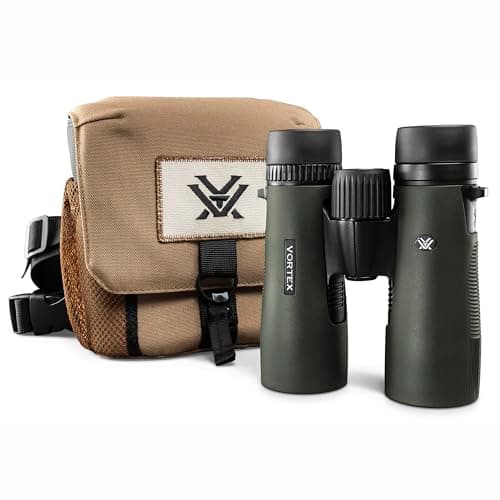
Vortex Diamondback HD 8x42 Binoculars
Best Value
Kit Score 9.0/10
$239.00 Price checked Oct 23, 4:16 PM CDT
Best for: Hikers and birders who want genuine HD optics and a class-leading warranty without paying mid-range prices.
- Exceptional brightness and contrast for the price: measured light transmission outperforms comparably priced models
- Some chromatic aberration visible at the edges of the field in high-contrast scenes
- Magnification
- 8x
- Objective lens
- 42 mm
- Weight
- 21.8 oz (618 g)
- Field of view
- 393 ft at 1,000 yds (7.5 deg)
- Eye relief
- 17 mm
- Waterproof / fogproof
- Yes, argon-purged, O-ring sealed
About this pick
The Diamondback HD delivers HD glass, dielectric and phase-corrected coatings, and a wide 393-foot field of view at a street price well below its MSRP. Reviewers and birders routinely note it performs like binoculars costing twice as much, and Vortex backs it with an unlimited, unconditional transferable warranty.
Strengths
- Exceptional brightness and contrast for the price: measured light transmission outperforms comparably priced models
- Wide field of view aids bird-finding and tracking fast-moving wildlife
- Vortex VIP warranty is unlimited and unconditional, no receipt required
Weaknesses
- Some chromatic aberration visible at the edges of the field in high-contrast scenes
- At 21.8 oz it is on the heavier end for ultralight backpackers
Kit Score breakdown

CELESTRON
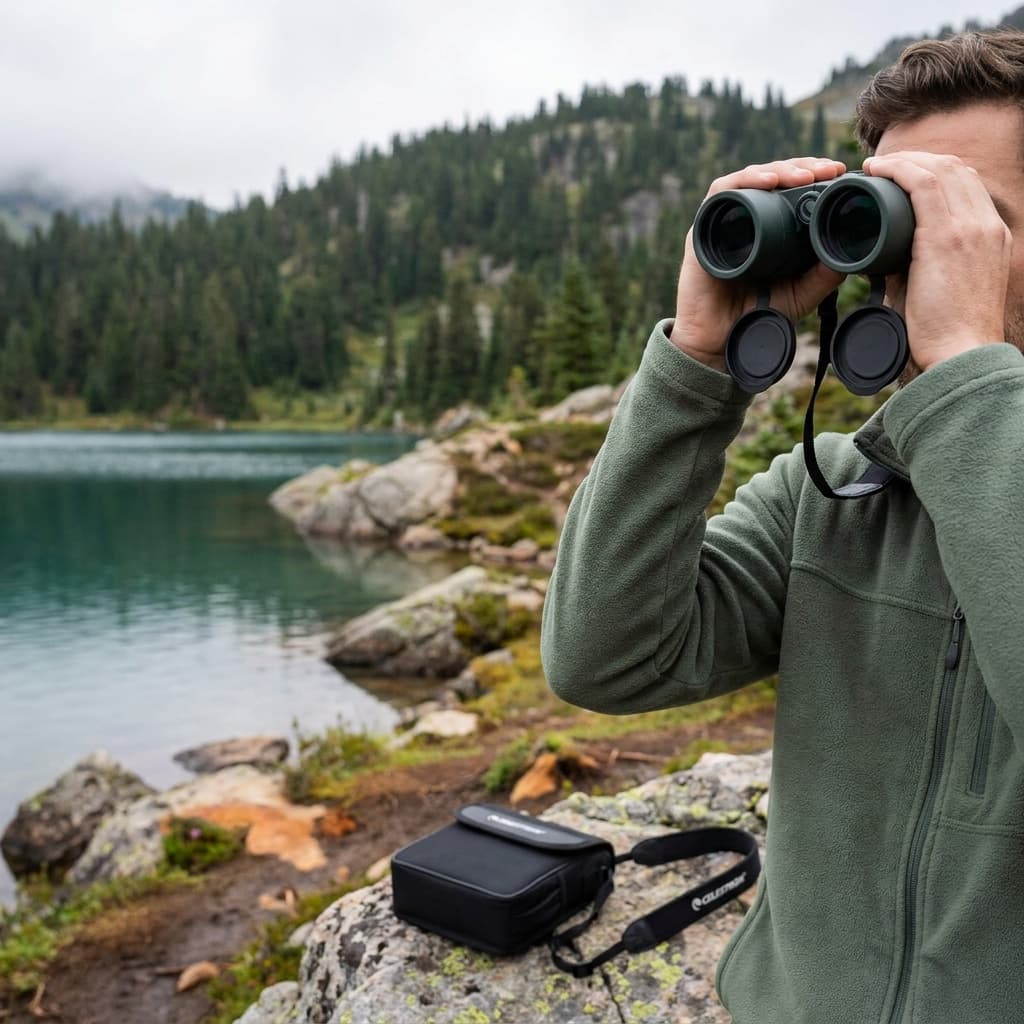
Celestron Nature DX 8x42 Binoculars
Best Budget
Kit Score 7.7/10
$148.97 Price checked Oct 23, 4:16 PM CDT
Best for: First-time binocular buyers and casual day-hikers who want solid optical quality and waterproofing without a large upfront investment.
- Sharp, color-accurate center image that consistently surprises users at this price point
- Image softens noticeably toward the edges, and low-light performance is below mid-range models
- Magnification
- 8x
- Objective lens
- 42 mm
- Weight
- 22.2 oz (629 g)
- Field of view
- 388 ft at 1,000 yds (7.4 deg)
- Eye relief
- 17.5 mm
- Waterproof / fogproof
- Yes, nitrogen-purged, O-ring sealed
About this pick
The Nature DX 8x42 is the entry point that serious birding organizations still recommend: BaK-4 roof prisms, phase-corrected and fully multi-coated optics, and a wide 7.4-degree field of view, all in a waterproof rubber-armored body at a price under $180. Audubon named it a top pick in the under-$200 category.
Strengths
- Sharp, color-accurate center image that consistently surprises users at this price point
- Wide field of view makes it easy to locate and follow birds in flight
- Phase-corrected BaK-4 prisms and fully multi-coated optics are usually found at higher price tiers
Weaknesses
- Image softens noticeably toward the edges, and low-light performance is below mid-range models
- Included neck strap is a basic, non-padded webbing strap
Kit Score breakdown
NIKON
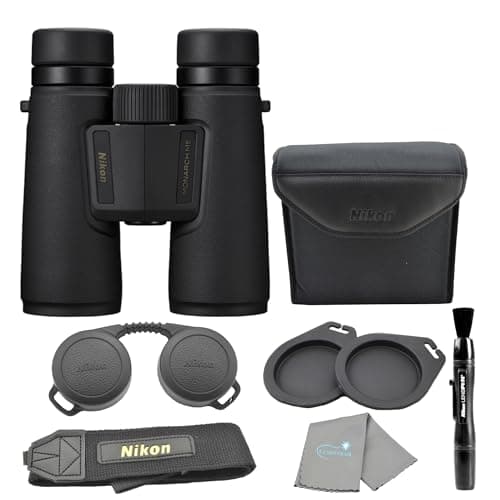
Nikon Monarch M5 8x42 Binoculars
Best Overall
Kit Score 8.5/10
$349.95 Price checked Oct 23, 4:16 PM CDT
Best for: Birders and hikers who prioritize optical clarity and eyeglass compatibility over the widest possible field of view.
- ED glass delivers vivid, high-contrast images with low chromatic aberration across most of the field
- Field of view (335 ft at 1,000 yds) is narrower than competing models at this price, which can make tracking fast birds harder
- Magnification
- 8x
- Objective lens
- 42 mm
- Weight
- 22.2 oz (629 g)
- Field of view
- 335 ft at 1,000 yds (6.4 deg)
- Eye relief
- 19.5 mm
- Waterproof / fogproof
- Yes, nitrogen-filled, O-ring sealed
About this pick
The Monarch M5 brings Nikon's ED (extra-low dispersion) glass, phase-corrected dielectric roof prisms, and a class-leading 19.5 mm eye relief into a lightweight 22-oz body. Color accuracy and contrast draw consistent praise from birders, and the long eye relief is a genuine advantage for glasses wearers on the trail.
Strengths
- ED glass delivers vivid, high-contrast images with low chromatic aberration across most of the field
- 19.5 mm eye relief is among the most generous at this price tier, comfortable for eyeglass wearers
- Lightweight at 22.2 oz for a full 42 mm objective optic with a premium glass package
Weaknesses
- Field of view (335 ft at 1,000 yds) is narrower than competing models at this price, which can make tracking fast birds harder
- Close focus distance of 8.2 ft limits close-range insect or butterfly observation
Kit Score breakdown
See all picks in Best binoculars for hiking: birding, wildlife, and trail scenery
Keep going
Related guides
 Complete hike loadoutDay hike kitBuild the complete kit
Researched, not hands-on tested
Updated Jun 4, 2026Our recommendations draw on manufacturer documentation, retailer listings, owner feedback, and comparisons with alternatives.
As an Amazon Associate I earn from qualifying purchases. We may earn a commission from links here, at no extra cost to you. How we research →