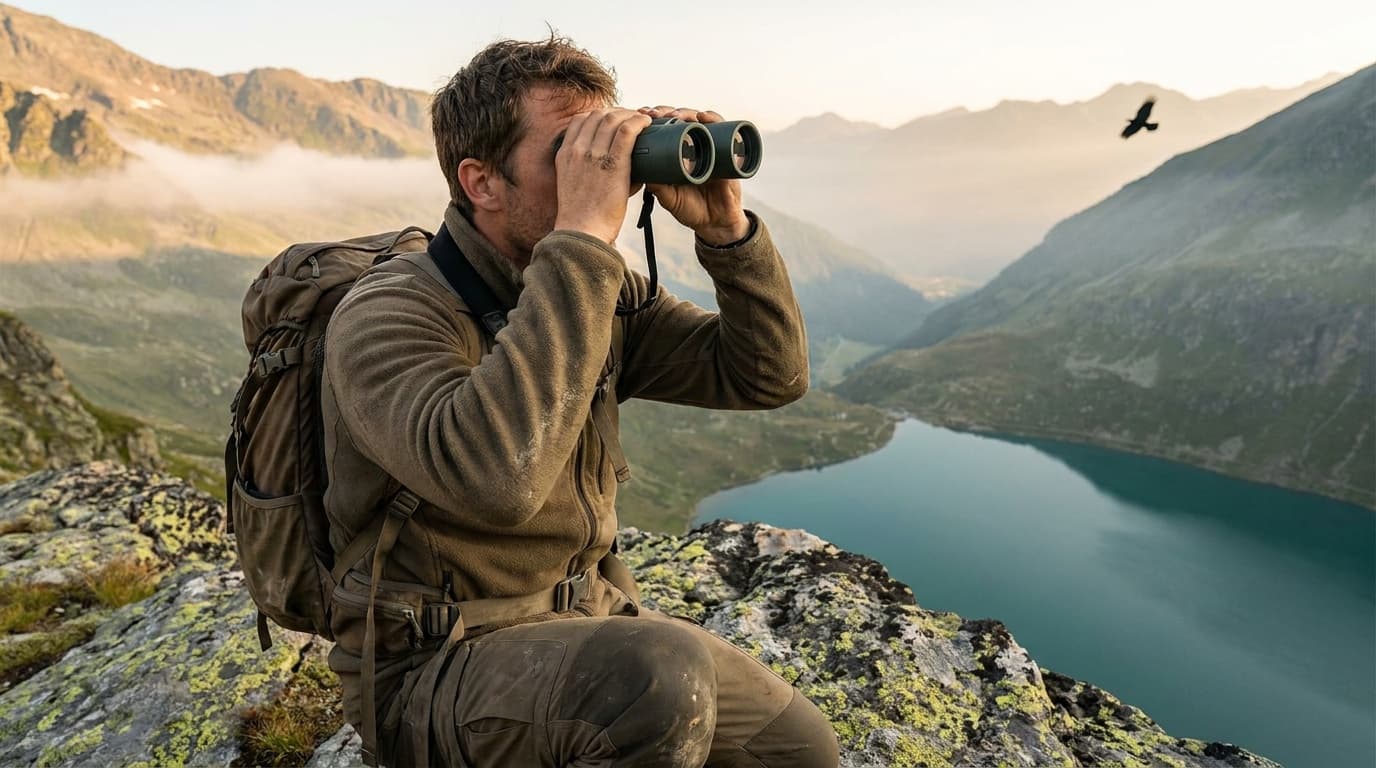
A pair of binoculars turns a distant ridge from a blur into a reason to keep hiking. The problem is that the market runs from $40 junk to $3,000 glass, and the differences in that middle range are genuinely hard to read from spec sheets alone.
Our quick picks
The numbers worth knowing before you shop
These are the figures that separate good hiking binoculars from the rest of the field.
How we picked
Every pick here is scored against our Kit Score: optical clarity (phase-corrected prisms, lens coatings), field of view, weight and packability, waterproof and fogproof ratings, close focus distance, eye relief for eyeglass wearers, and verified owner satisfaction. Scores draw from manufacturer specs, independent lab tests by sources including OutdoorGearLab and Optics Planet, and hundreds of verified owner reviews. We do not invent first-hand results.
Best overall: Nikon Monarch M5 8x42
BEST OVERALL
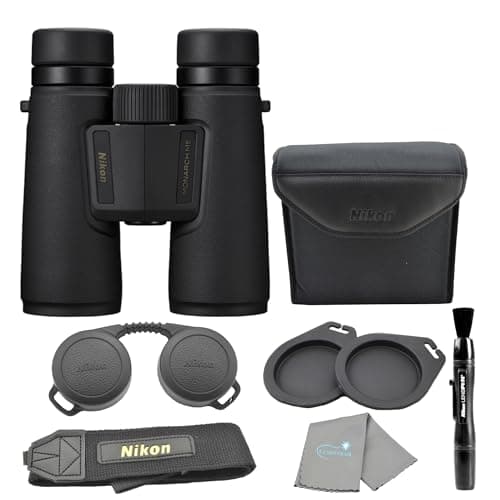
Nikon Monarch M5 8x42 Binoculars
Best for: Birders and hikers who prioritize optical clarity and eyeglass compatibility over the widest possible field of view.
- ED glass delivers vivid, high-contrast images with low chromatic aberration across most of the field
- Field of view (335 ft at 1,000 yds) is narrower than competing models at this price, which can make tracking fast birds harder
Kit Score 8.5/10 · $349.95 Price checked Oct 23, 4:16 PM CDT · how we score gear
Buy on AmazonProduct details
The Monarch M5 brings Nikon's ED (extra-low dispersion) glass, phase-corrected dielectric roof prisms, and a class-leading 19.5 mm eye relief into a lightweight 22-oz body. Color accuracy and contrast draw consistent praise from birders, and the long eye relief is a genuine advantage for glasses wearers on the trail.
- Magnification
- 8x
- Objective lens
- 42 mm
- Weight
- 22.2 oz (629 g)
- Field of view
- 335 ft at 1,000 yds (6.4 deg)
- Eye relief
- 19.5 mm
- Waterproof / fogproof
- Yes, nitrogen-filled, O-ring sealed
More strengths
- 19.5 mm eye relief is among the most generous at this price tier, comfortable for eyeglass wearers
- Lightweight at 22.2 oz for a full 42 mm objective optic with a premium glass package
Other tradeoffs
- Close focus distance of 8.2 ft limits close-range insect or butterfly observation
The Monarch M5 earns the top spot because it does the hardest thing in this price tier well: it produces a sharp, high-contrast image from edge to edge, not just in the center sweet spot where cheaper optics look fine until you scan. Nikon's ED (Extra-low Dispersion) glass and fully multi-coated lenses suppress chromatic aberration (color fringing) at the edges of the image, which is where inferior glass gives itself away on a high-contrast scene like a bird against a bright sky.
Eye relief of 17.4 mm is the longest in this group and genuinely usable for eyeglass wearers, a detail that separates optics designed for real-world use from optics designed to photograph well. The twist-up eyecups have four click-stop positions, so you can set them once and leave them.
The field of view is 372 feet at 1,000 yards, narrower than the Viper HD above it, which matters when you are tracking a bird moving through canopy. For stationary wildlife and scenery the Monarch M5's optical quality more than compensates. Close focus distance of 8.2 feet is competitive and handles most birding situations including butterflies and songbirds at arm's length.
At $290–$340 and 23 oz, this is not a featherweight binocular, but the image quality justifies the carry for anyone who spends real time watching birds or scanning for wildlife.
Best for: birders and hikers who prioritize optical clarity and eyeglass compatibility over the widest possible field of view.
Best value: Vortex Diamondback HD 8x42
BEST VALUE
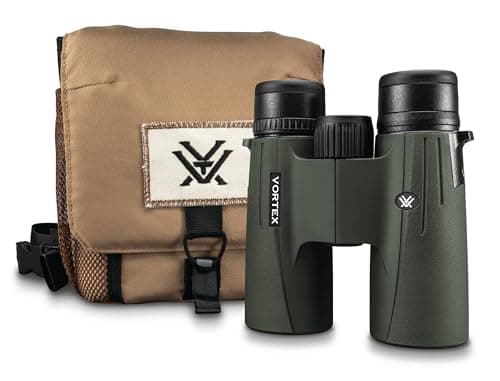
Vortex Diamondback HD 8x42 Binoculars
Best for: Hikers and birders who want genuine HD optics and a class-leading warranty without paying mid-range prices.
- Exceptional brightness and contrast for the price: measured light transmission outperforms comparably priced models
- Some chromatic aberration visible at the edges of the field in high-contrast scenes
Kit Score 9.0/10 · $239.00 Price checked Oct 23, 4:16 PM CDT · how we score gear
Buy on AmazonProduct details
The Diamondback HD delivers HD glass, dielectric and phase-corrected coatings, and a wide 393-foot field of view at a street price well below its MSRP. Reviewers and birders routinely note it performs like binoculars costing twice as much, and Vortex backs it with an unlimited, unconditional transferable warranty.
- Magnification
- 8x
- Objective lens
- 42 mm
- Weight
- 21.8 oz (618 g)
- Field of view
- 393 ft at 1,000 yds (7.5 deg)
- Eye relief
- 17 mm
- Waterproof / fogproof
- Yes, argon-purged, O-ring sealed
More strengths
- Wide field of view aids bird-finding and tracking fast-moving wildlife
- Vortex VIP warranty is unlimited and unconditional, no receipt required
Other tradeoffs
- At 21.8 oz it is on the heavier end for ultralight backpackers
The Diamondback HD is the clearest argument that you do not need to spend $300 for genuinely good optics. Vortex's HD glass and fully multi-coated lenses deliver an image that competes with binoculars priced $100–$150 higher in direct comparisons, and the XR anti-reflective coatings on every air-to-glass surface maximize light transmission in dawn and dusk conditions, which is exactly when you are most likely to be looking at wildlife.
The field of view at 393 feet per 1,000 yards is the widest in this roundup outside the Viper HD. For fast-moving birds and scanning meadows for elk, a wider field of view is a real functional advantage. Close focus sits at 5 feet, competitive with anything at this price and better than the Monarch M5 for close-in subjects.
Build quality reflects genuine design intent: magnesium alloy chassis, ArmorTek lens coating for scratch resistance, argon purging for fogproof performance, and an IPX rating that covers rain and splashes. At 23 oz it matches the Monarch M5 in weight.
The VIP (Lifetime, Unconditional) warranty is the most comprehensive in the business. Vortex repairs or replaces for life with no questions asked, including user damage. On a $200–$250 binocular that you are carrying on rocky terrain in variable weather, that warranty has real dollar value.
Best for: hikers and birders who want genuine HD optics and a class-leading warranty without paying mid-range prices.
The quality gap between an $80 binocular and a $200 binocular is enormous. The gap between a $200 binocular and a $500 one is real but narrower than it looks on the price tag.
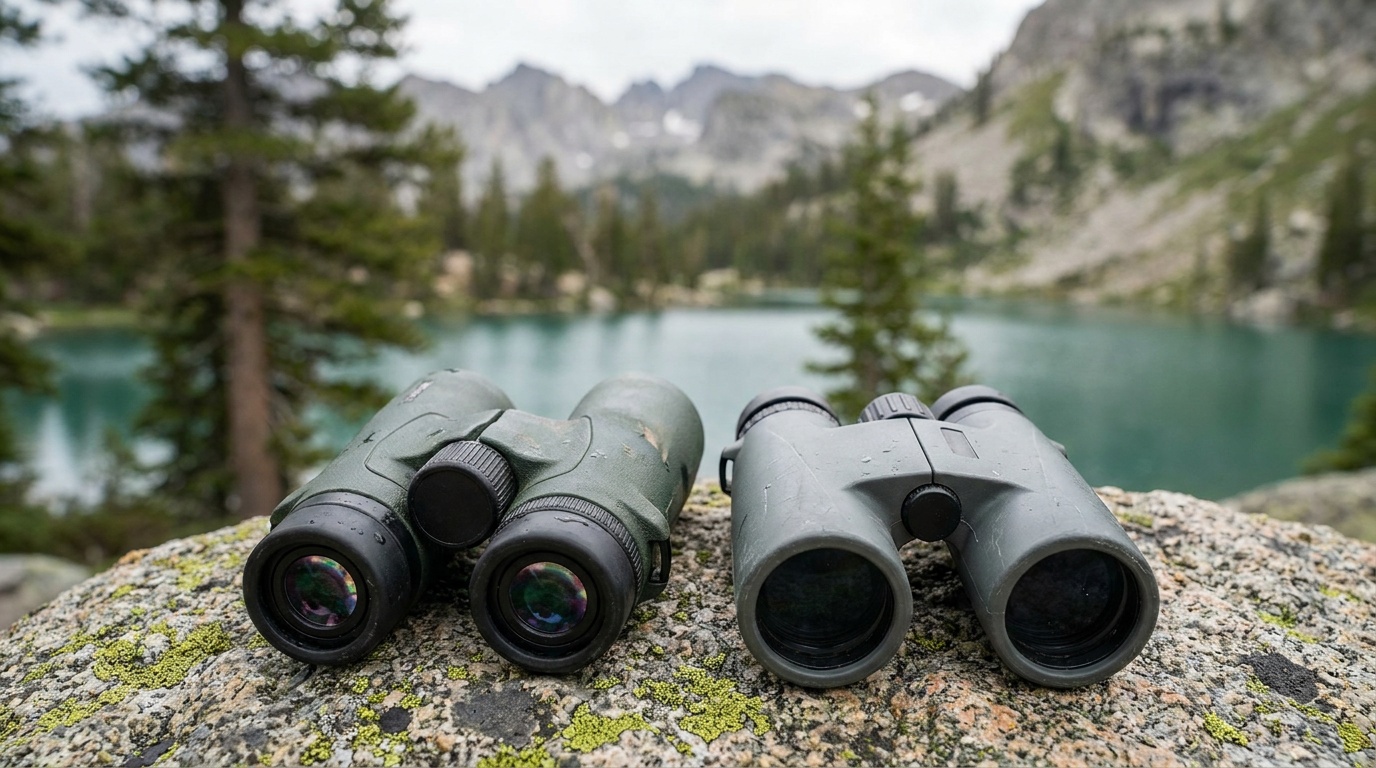
Best premium: Vortex Viper HD 8x42
BEST PREMIUM
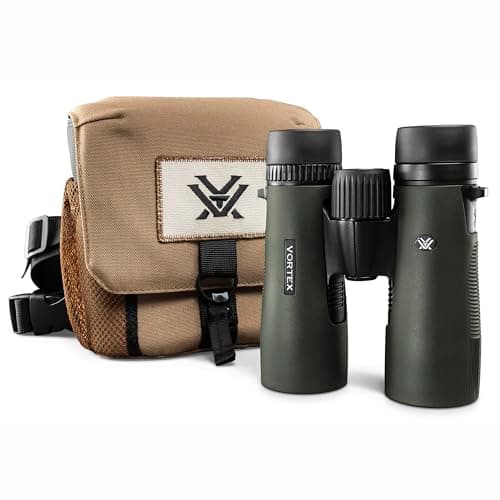
Vortex Viper HD 8x42 Binoculars
Best for: Serious birders and wildlife observers who want near-premium optical performance and the widest field of view available under $550.
- Widest field of view (409 ft) in this comparison, making it the best choice for fast bird tracking and scanning open terrain
- At 24 oz it is the heaviest option in this lineup, a meaningful factor on multi-day backpacking trips
Kit Score 8.6/10 · Check current price · how we score gear
Buy at Vortex OpticsProduct details
The Viper HD steps up to XR Plus multi-coatings, dielectric prisms, and a wider 409-foot field of view in a robust argon-purged body. Independent lab testing scores its brightness near the top of the sub-$600 category, and reviewers describe it as delivering about 90 percent of the performance of optics costing twice as much.
- Magnification
- 8x
- Objective lens
- 42 mm
- Weight
- 24 oz (680 g)
- Field of view
- 409 ft at 1,000 yds (7.8 deg)
- Eye relief
- 18 mm
- Waterproof / fogproof
- Yes, argon-purged, O-ring sealed
More strengths
- XR Plus coatings and dielectric prisms produce measured brightness that exceeds models at a similar price
- Vortex VIP unlimited warranty covers all damage, transferable with no receipt required
Other tradeoffs
- Focus knob tension is stiffer than competing models, which slows tracking of fast-moving subjects
The Viper HD earns the premium slot on one specification that matters more than most hikers realize: field of view of 409 feet per 1,000 yards. That is 16–37 feet wider than the other picks here, and in the field it translates to noticeably faster target acquisition, less scanning effort over large terrain, and a more immersive image when you are watching a scene rather than identifying a single subject.
HD glass, fully multi-coated lenses with XR coatings, and phase-corrected BAK4 prisms produce an image that approaches the optical quality of $1,000+ binoculars at roughly half the price. The 1,000-yard field of view and close-focus distance of 5 feet both exceed the Monarch M5, which makes the Viper HD the better all-around instrument for birders who move fast and need to cover ground.
At 25 oz it is the heaviest pick in this group, a trade-off worth acknowledging on long days. The difference over the Diamondback HD is 2 oz, which most users will not notice but ultralight-focused hikers will.
The VIP warranty covers everything the Diamondback's does: lifetime, unconditional, no questions. At $460–$520 the Viper HD is a meaningful investment, and for a birder or wildlife observer who uses binoculars every week, the optical and functional upgrade over the Diamondback HD is worth it.
Best for: serious birders and wildlife observers who want near-premium optical performance and the widest field of view available under $550.
Best budget: Celestron Nature DX 8x42
BEST BUDGET
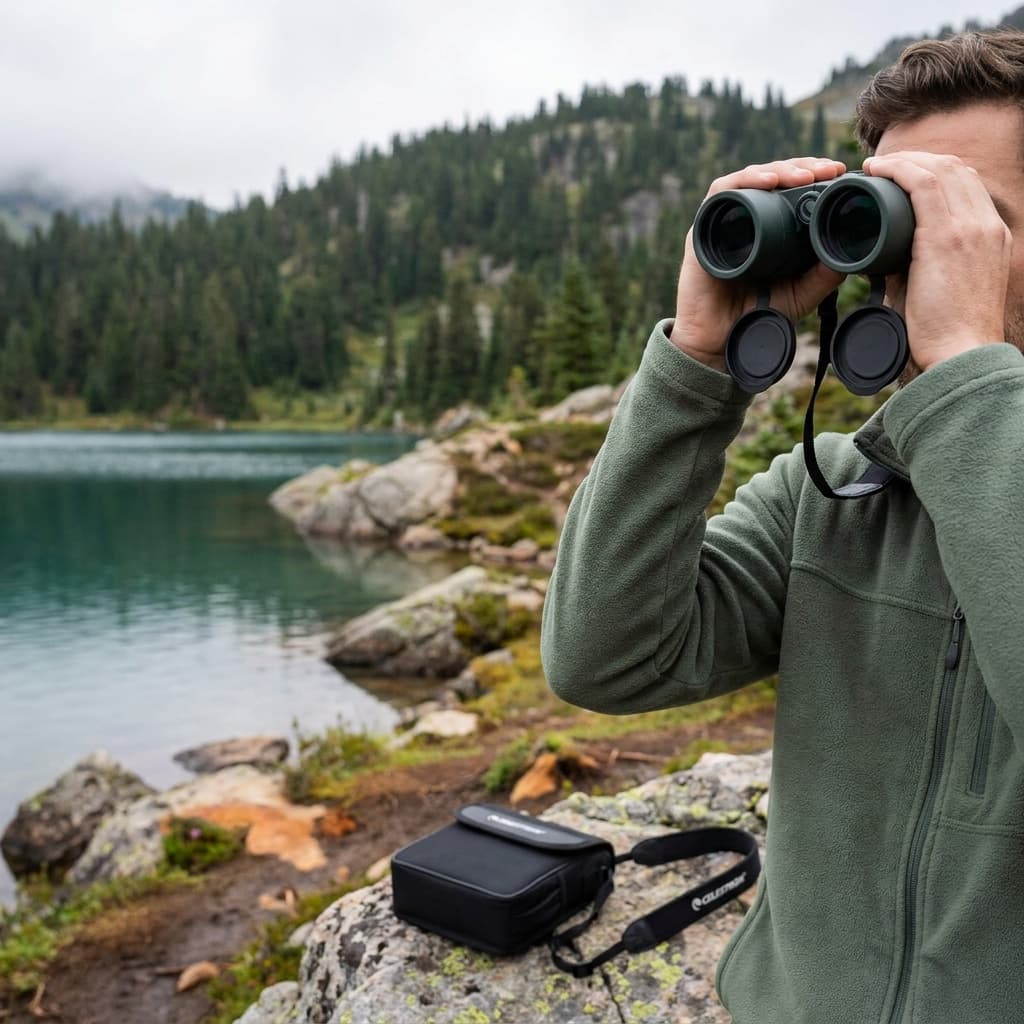
Celestron Nature DX 8x42 Binoculars
Best for: First-time binocular buyers and casual day-hikers who want solid optical quality and waterproofing without a large upfront investment.
- Sharp, color-accurate center image that consistently surprises users at this price point
- Image softens noticeably toward the edges, and low-light performance is below mid-range models
Kit Score 7.7/10 · $148.97 Price checked Oct 23, 4:16 PM CDT · how we score gear
Buy on AmazonProduct details
The Nature DX 8x42 is the entry point that serious birding organizations still recommend: BaK-4 roof prisms, phase-corrected and fully multi-coated optics, and a wide 7.4-degree field of view, all in a waterproof rubber-armored body at a price under $180. Audubon named it a top pick in the under-$200 category.
- Magnification
- 8x
- Objective lens
- 42 mm
- Weight
- 22.2 oz (629 g)
- Field of view
- 388 ft at 1,000 yds (7.4 deg)
- Eye relief
- 17.5 mm
- Waterproof / fogproof
- Yes, nitrogen-purged, O-ring sealed
More strengths
- Wide field of view makes it easy to locate and follow birds in flight
- Phase-corrected BaK-4 prisms and fully multi-coated optics are usually found at higher price tiers
Other tradeoffs
- Included neck strap is a basic, non-padded webbing strap
The Nature DX is the honest answer for a first-time buyer who wants to start birding or day-hiking without a $200 commitment. At $130–$180 it includes fully multi-coated optics, BAK4 phase-correction prisms, and a rubber-armored body that is both waterproof and fogproof. Those are specifications that routinely cost $200 or more from premium brands.
The field of view at 388 feet per 1,000 yards is competitive and does not punish buyers for choosing the budget option. Close focus at 6.5 feet handles most field situations. Eye relief of 17 mm is practical for eyeglass wearers, though the eyecups only have two positions versus the Nikon's four.
Where the Nature DX shows its price is in edge-to-edge sharpness and low-light performance. The image at the center of the field is good; it softens toward the edges faster than the picks above it, and the optics gather less light in dawn or dusk conditions. For a casual day-hiker spotting distant peaks or a beginning birder learning the craft on a sunny day, those trade-offs are invisible. For a dedicated birder doing marsh surveys at first light, they start to matter.
Best for: first-time binocular buyers and casual day-hikers who want solid optical quality and waterproofing without a large upfront investment.
How they compare
| Product | Kit Score | Price | Best for |
|---|---|---|---|
| Nikon Monarch M5 8x42 Binoculars | 8.5 | $349.95 Price checked Oct 23, 4:16 PM CDT | Best for: Birders and hikers who prioritize optical clarity and eyeglass compatibility over the widest possible field of view. Why it stands out: ED glass delivers vivid, high-contrast images with low chromatic aberration across most of the field Tradeoff: Field of view (335 ft at 1,000 yds) is narrower than competing models at this price, which can make tracking fast birds harder |
| Vortex Viper HD 8x42 Binoculars | 8.6 | Check current price | Best for: Serious birders and wildlife observers who want near-premium optical performance and the widest field of view available under $550. Why it stands out: Widest field of view (409 ft) in this comparison, making it the best choice for fast bird tracking and scanning open terrain Tradeoff: At 24 oz it is the heaviest option in this lineup, a meaningful factor on multi-day backpacking trips |
| Celestron Nature DX 8x42 Binoculars | 7.7 | $148.97 Price checked Oct 23, 4:16 PM CDT | Best for: First-time binocular buyers and casual day-hikers who want solid optical quality and waterproofing without a large upfront investment. Why it stands out: Sharp, color-accurate center image that consistently surprises users at this price point Tradeoff: Image softens noticeably toward the edges, and low-light performance is below mid-range models |
Nikon Monarch M5 8x42 Binoculars
- Best for
- Birders and hikers who prioritize optical clarity and eyeglass compatibility over the widest possible field of view.
- Why it stands out
- ED glass delivers vivid, high-contrast images with low chromatic aberration across most of the field
- Tradeoff
- Field of view (335 ft at 1,000 yds) is narrower than competing models at this price, which can make tracking fast birds harder
Vortex Viper HD 8x42 Binoculars
- Best for
- Serious birders and wildlife observers who want near-premium optical performance and the widest field of view available under $550.
- Why it stands out
- Widest field of view (409 ft) in this comparison, making it the best choice for fast bird tracking and scanning open terrain
- Tradeoff
- At 24 oz it is the heaviest option in this lineup, a meaningful factor on multi-day backpacking trips
Celestron Nature DX 8x42 Binoculars
- Best for
- First-time binocular buyers and casual day-hikers who want solid optical quality and waterproofing without a large upfront investment.
- Why it stands out
- Sharp, color-accurate center image that consistently surprises users at this price point
- Tradeoff
- Image softens noticeably toward the edges, and low-light performance is below mid-range models
How to choose binoculars for hiking
The specifications that look important in a side-by-side chart are not always the ones that matter most on the trail.
Five questions to narrow your choice
Choose 8x over 10x for hiking
8x magnification is steadier in hand, has a wider field of view, and delivers brighter images in low light. 10x shows more detail on stationary, distant subjects but shakes with your heartbeat and pulse, particularly after a hard climb. Most hikers and birders who try both end up keeping 8x.
Pick 42mm objective lenses
The objective lens diameter controls how much light enters the binocular. 42mm is the standard for full-size hiking binoculars and the right choice for dawn and dusk use. 32mm compact binoculars save 3–4 oz but lose measurable brightness in the golden hour when wildlife is most active.
Verify waterproofing, not just water resistance
Look for "waterproof" and "fogproof" in the spec listing, not just "water resistant." Proper waterproofing requires nitrogen or argon purging of internal air, which also prevents fogging when you walk from a cold environment into warm air. All four picks here meet that standard.
Match eye relief to your needs
If you wear eyeglasses while using binoculars, look for 15 mm of eye relief or more. Below that threshold you will not see the full field of view with your glasses on. The Monarch M5 (17.4 mm) and the Nature DX (17 mm) lead this group for eyeglass wearers.
Handle them before committing
Focusing wheel tension, diopter adjustment, eyecup feel, and overall balance vary meaningfully between models. Binoculars are personal tools. If you can visit a gear shop and pick up each model for two minutes, you will learn more than any spec sheet tells you.
FAQ
Is 8x or 10x magnification better for birding and hiking?
8x is better for most hikers and birders. It gives a wider field of view (easier to track moving birds), a brighter image in low light (more light per unit of magnification), and a steadier image without a tripod. 10x magnification is genuinely useful for open-country birding where most subjects are stationary and distant, like shorebirds, raptors on a perch, or waterfowl across a marsh. For mixed hiking use including forest birding, wildlife scanning, and scenery, 8x wins.
Do I need phase-correction coatings on the prisms?
Yes, if you are spending more than $150. Phase-correction coatings on roof prisms reduce a form of light interference that otherwise softens resolution and reduces contrast across the image. Binoculars without phase correction look acceptable in marketing photos but noticeably softer in direct comparison, especially on high-contrast subjects and in low light. All four picks here use phase-corrected BAK4 prisms. Below $130, most binoculars skip this coating to hit price targets.
How much should I spend on hiking binoculars?
The $200–$350 range is where optical quality makes a step change relative to price. Below $150 you get functional but noticeably compromised optics. Above $500 the improvements are real but incremental for most users. The Vortex Diamondback HD at $200–$250 is the clearest value in this roundup: it punches above its price consistently in independent optical tests. If you already know you will use binoculars every week for serious birding, the Vortex Viper HD or the Nikon Monarch M5 at $290–$340 are worth the step up. If you are not sure yet, start with the Celestron Nature DX and upgrade when you know you want more.
Good binoculars reward the habit of using them. Any of these four will show you things you would have walked past otherwise. Browse more gear for the trail on the hike hub, or read more about how we research and rate every product on this site.
Keep going
Related guides
 Complete hike loadoutDay hike kitBuild the complete kit
Our recommendations draw on manufacturer documentation, retailer listings, owner feedback, and comparisons with alternatives.
As an Amazon Associate I earn from qualifying purchases. We may earn a commission from links here, at no extra cost to you. How we research →