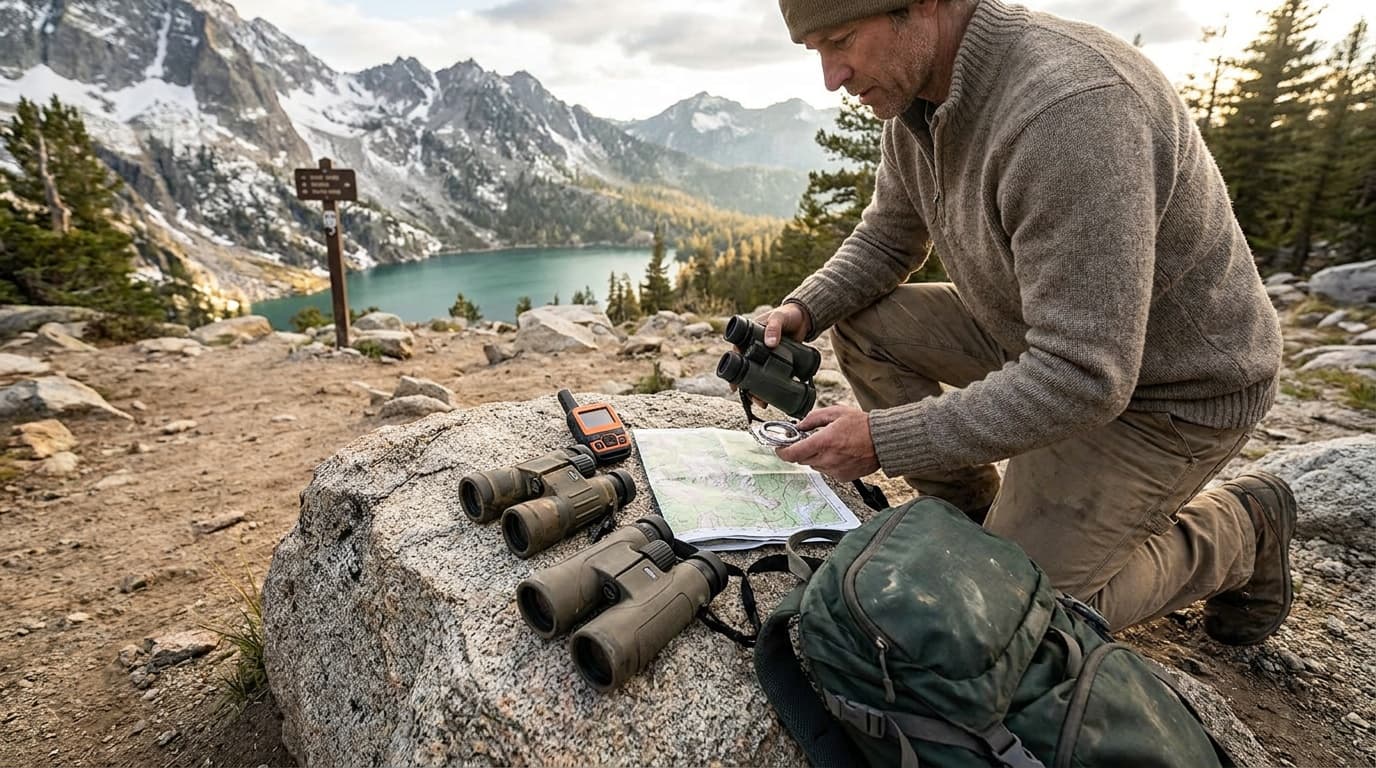
For most hikers and birders, 8x42 is the better pick: within the same product line it shows a wider field of view and a steadier image, and it gives up only 25 percent of the 10x's magnification. Vortex's Diamondback HD, for example, is rated 393 feet at 1,000 yards in 8x42 against 330 feet in 10x42. Pick the 10x42 when you glass open country from a braced position and reach matters more than shake.
8x42 vs 10x42 at a glance
| Spec | 8x42 | 10x42 |
|---|---|---|
| Magnification | 8x | 10x |
| Objective lens | 42 mm | 42 mm |
| Exit pupil | ~5.25 mm (brighter feel in low light) | ~4.2 mm |
| Field of view at 1,000 yds (Vortex Diamondback HD) | 393 ft | 330 ft |
| Hand-held stability | Easy for most people | Noticeable shake; bracing helps |
| Typical weight (roof prism) | 600–750 g | 600–750 g (often identical) |
| Best for | Forest birding, hiking, general use | Open country, distant wildlife, raptors |
The short version: same brightness class, same weight class. The 8x42 trades reach for a wider, steadier view; the 10x42 trades stability and field of view for 25 percent more magnification.
What the numbers actually mean
The two numbers on a binocular label tell you magnification and objective lens diameter in millimetres. An 8x42 magnifies 8 times and has a 42 mm front lens. A 10x42 magnifies 10 times with the same 42 mm lens.
The objective diameter controls how much light enters the optic. Because both formats share a 42 mm objective, they gather the same amount of light. The difference you feel in brightness at dusk comes almost entirely from glass quality and coatings, not the magnification number.
Exit pupil is the diameter of the light beam that reaches your eye. The 8x42 produces a 5.25 mm exit pupil versus 4.2 mm for the 10x42. In low light, a larger exit pupil is marginally easier to align with your dilated pupil, giving the 8x42 a slight practical edge at dawn and dusk.
Field of view and why it matters on trail
Higher magnification compresses your field of view. Vortex rates its Diamondback HD 8x42 at 393 feet of field at 1,000 yards, and the 10x42 version of the same binocular at 330 feet. That gap is significant in practice. Field of view also varies a lot between models: Cornell's All About Birds lists 8x42s ranging from about 5.9 to 8.3 degrees, and the Nikon Monarch M5 8x42 is rated 335 feet. Compare the spec, not just the magnification.
A wider field lets you find a bird faster, follow a moving animal through brush, or scan a ridge without constantly panning. When you are breathing hard after a climb, that wider window also makes it much easier to keep the image stable enough to read.
The biggest field advantage of 8x binoculars shows up not in a calm meadow but on a windy ridge with your heart rate still elevated from the ascent.
For casual day hikers and anyone who mostly watches birds in forest or mixed terrain, the wider field of the 8x42 makes spotting and tracking noticeably more comfortable.
Image shake and hand-holding stability
Every heartbeat and muscle tremor is magnified along with the image. At 8x, most people can hand-hold a steady view. At 10x, subtle shake becomes visible and distracting, especially after sustained exertion.
A common rule of thumb in the optics world is that 10x sits at the practical limit of comfortable hand-holding for most people without a tripod or bracing against a surface. That is not a hard ceiling, but it is a real one.
When to brace for a 10x42
Lean into terrain
Use a rock, tree, or trekking pole as a rest to cut shake.
Sit down
Elbows on knees gives a big stability improvement over standing.
Breathe out
Take the view on the exhale, when your chest is stillest.
Tripod adapter
Most quality 10x42s accept a tripod adapter; use one for prolonged scanning.
If you know you will be glassing open hillsides from a seated or rested position, 10x is workable. If you are raising the glass mid-stride or scanning quickly, 8x will reward you.
Low-light and dawn/dusk performance
Because exit pupil is roughly proportional to how well the binocular fills a dilated eye, the 8x42 has a slight theoretical edge in low light. In practice, the difference between a 5.25 mm and 4.2 mm exit pupil is small for most adults. The human pupil ranges from about 2 to 8 mm, and its maximum size shrinks with age, so many older eyes cannot use the full 5.25 mm anyway.
What matters far more is optical quality: glass type (ED or HD glass suppresses chromatic aberration), multi-coating on every air-to-glass surface, and prism type (Schmidt-Pechan vs. Abbe-Koenig). A well-coated 10x42 from a reputable optics brand will outperform a budget 8x42 in low light every time.
Weight and packability
Weight differences between 8x42 and 10x42 within the same product line are typically minimal. Vortex lists the Diamondback HD 8x42 at 21.8 oz and the 10x42 at 21.3 oz, about 14 g apart. The format number does not change the chassis size in the 42 mm class. Mid-range roof-prism 42s such as the Nikon Monarch M5 (22.2 oz, about 629 g) land in roughly the 600 to 750 g range.
If weight is your primary concern, the format to consider is 8x32 or 10x32. The Diamondback HD 8x32 is rated at 15.9 oz, about 167 g lighter than the 8x42, at the cost of some low-light performance.
Frequently asked questions
What does 8x42 mean on binoculars?
The first number is magnification: an 8x42 makes a subject appear 8 times closer than the naked eye. The second number is the diameter of the objective (front) lenses in millimetres: 42 mm. Together they define the two most important optical properties: how much the image is enlarged and how much light the binocular gathers. Dividing the second number by the first gives the exit pupil (42 ÷ 8 = 5.25 mm), which indicates how bright the view feels in dim light.
Which is better, 8x42 or 10x42 binoculars?
Neither is better in absolute terms; they optimize for different uses. Within the same product line, the 8x42 gives a wider field of view (393 ft vs 330 ft at 1,000 yards on the Vortex Diamondback HD), a steadier hand-held image, and a slightly brighter feel at dusk. The 10x42 resolves more detail on distant subjects. For forest birding, hiking, and general use, most people are better served by 8x42. For open-country wildlife watching, shorebirds, raptors, and long sightlines, 10x42 earns its narrower, shakier view. If you are buying one binocular with no specialty in mind, buy the 8x42.
Is 10x42 harder to hold steady than 8x42?
Yes, noticeably. Magnification amplifies every heartbeat and muscle tremor along with the image, so the same hand shake appears 25 percent larger through a 10x than an 8x. Most people can hold an 8x42 steady enough for extended viewing while standing; at 10x, fine detail starts to smear unless you brace against a tree, sit with elbows on knees, or mount the binocular on a tripod. The effect is worst right after exertion, which is exactly when hikers tend to raise their binoculars.
Is 8x42 or 10x42 better for hiking?
8x42 for most hikers. On trail you are usually glassing quickly, often standing, often with an elevated heart rate, and the 8x42's wider field and steadier image make those short viewing windows productive. The 10x42 makes sense for hikes in open terrain (desert, alpine ridges, coastal bluffs) where subjects sit far away and you can stop and brace to look at them. Weight is a wash: within the same product line the two formats are typically within a few dozen grams of each other.
Is 8x42 or 10x42 better for stargazing?
10x42, by a modest margin. Astronomical targets do not move like birds, you observe them braced or reclined, and the extra magnification darkens the sky background slightly and pulls in more detail on the Moon and star clusters. The 8x42's larger 5.25 mm exit pupil suits fully dark-adapted eyes well, so it remains a capable night-sky glass. But if stargazing is a primary use, dedicated astronomy formats like 10x50 or 15x70 gather meaningfully more light than either 42 mm option.
Is 10x42 better for birdwatching than 8x42?
For most birding, 8x42 is the more practical choice. The wider field helps you find and track birds in cover, and the steadier image means you lose less time fighting shake. Dedicated shorebird or raptor watchers who glass open flats or scan skies often prefer 10x for the extra reach, but the majority of birders, including many experienced ones, settle on an 8x42 like the Nikon Monarch M5 8x42 as their everyday optic.
Can you use 10x42 binoculars without a tripod?
Yes, and most people do. 10x42 is hand-holdable for shorter viewing sessions, especially when you can brace against something solid. The limitation shows up with sustained use, when you are tired, or when you need to track a moving subject quickly. A tripod adapter socket, which most mid-range and better 42 mm roof prisms have, makes it easy to switch to a tripod for extended glassing without buying a dedicated tripod mount.
Does magnification affect low-light performance in 42 mm binoculars?
Only marginally. The 8x42 produces a slightly larger exit pupil (5.25 mm vs. 4.2 mm), which can be a small advantage when your pupils are fully dilated. In real-world use the difference is minor compared to the effect of glass quality and lens coatings. Both formats perform well at dawn and dusk when optics quality is equal.
Where these numbers come from
| Claim | Source | Checked |
|---|---|---|
| Nikon Monarch M5 8x42: 335 ft field of view (6.4 degrees), 22.2 oz, 5.3 mm exit pupil, 19.5 mm eye relief | Nikon USA, Monarch M5 8x42 | Sep 2026 |
| Vortex Diamondback HD 8x42: 393 ft at 1,000 yds, 21.8 oz, tripod adaptable | Vortex, Diamondback HD 8x42 | Sep 2026 |
| Vortex Diamondback HD 10x42: 330 ft at 1,000 yds, 21.3 oz, tripod adaptable | Vortex, Diamondback HD 10x42 | Sep 2026 |
| Vortex Diamondback HD 8x32 weighs 15.9 oz | Vortex, Diamondback HD 8x32 | Sep 2026 |
| 8x42 fields of view span about 5.9 to 8.3 degrees; field of view is one reason many birders prefer 8x | Cornell Lab, All About Birds: field of view and close focus | Sep 2026 |
| Human pupil diameter ranges about 2 to 8 mm and shrinks with age | Watson and Yellott, Journal of Vision 2012 | Sep 2026 |
Exit pupil figures are simple arithmetic (objective diameter divided by magnification). Optical specs are the makers' ratings, not Kit Authority measurements.
For specific picks in both magnification classes, see our guide to the best binoculars for hiking. Browse all hike guides or read how we research and rate gear.
Recommended gear
Our current top picks from the Best binoculars for hiking: birding, wildlife, and trail scenery guide, if you are ready to buy.
VORTEX OPTICS
Vortex Diamondback HD 8x42 Binoculars
Best Value
Kit Score 9.0/10
$239.00 Price checked Oct 23, 4:16 PM CDT
Best for: Hikers and birders who want genuine HD optics and a class-leading warranty without paying mid-range prices.
- Exceptional brightness and contrast for the price: measured light transmission outperforms comparably priced models
- Some chromatic aberration visible at the edges of the field in high-contrast scenes
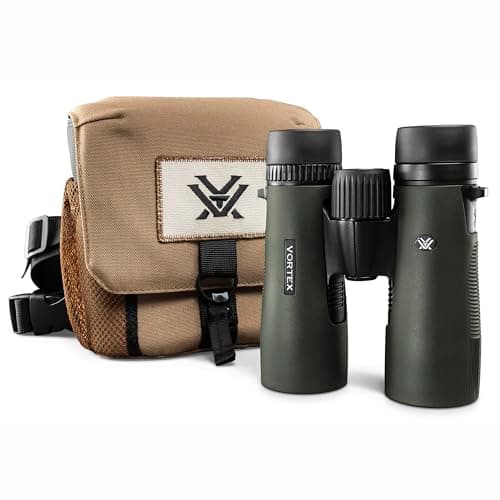
- Magnification
- 8x
- Objective lens
- 42 mm
- Weight
- 21.8 oz (618 g)
- Field of view
- 393 ft at 1,000 yds (7.5 deg)
- Eye relief
- 17 mm
- Waterproof / fogproof
- Yes, argon-purged, O-ring sealed
About this pick
The Diamondback HD delivers HD glass, dielectric and phase-corrected coatings, and a wide 393-foot field of view at a street price well below its MSRP. Reviewers and birders routinely note it performs like binoculars costing twice as much, and Vortex backs it with an unlimited, unconditional transferable warranty.
Strengths
- Exceptional brightness and contrast for the price: measured light transmission outperforms comparably priced models
- Wide field of view aids bird-finding and tracking fast-moving wildlife
- Vortex VIP warranty is unlimited and unconditional, no receipt required
Weaknesses
- Some chromatic aberration visible at the edges of the field in high-contrast scenes
- At 21.8 oz it is on the heavier end for ultralight backpackers
Kit Score breakdown

CELESTRON
Celestron Nature DX 8x42 Binoculars
Best Budget
Kit Score 7.7/10
$148.97 Price checked Oct 23, 4:16 PM CDT
Best for: First-time binocular buyers and casual day-hikers who want solid optical quality and waterproofing without a large upfront investment.
- Sharp, color-accurate center image that consistently surprises users at this price point
- Image softens noticeably toward the edges, and low-light performance is below mid-range models
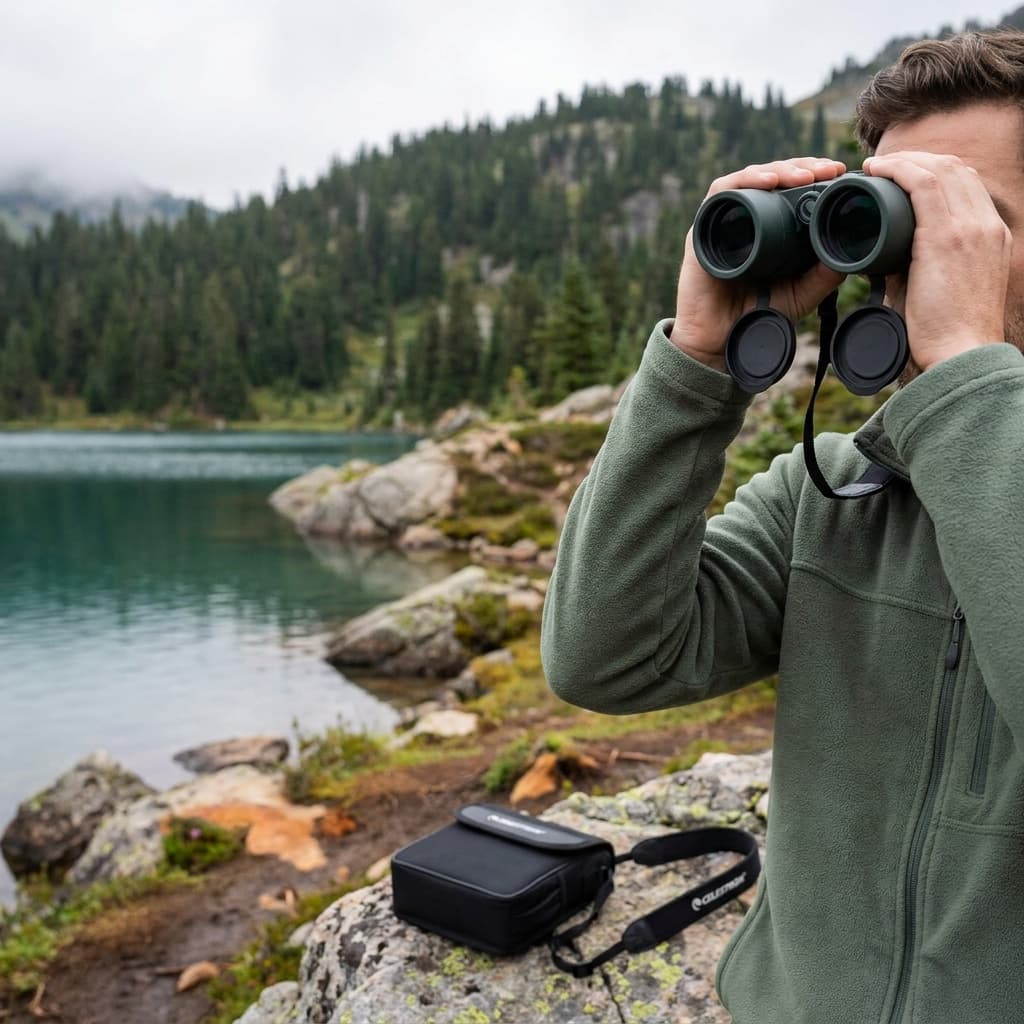
- Magnification
- 8x
- Objective lens
- 42 mm
- Weight
- 22.2 oz (629 g)
- Field of view
- 388 ft at 1,000 yds (7.4 deg)
- Eye relief
- 17.5 mm
- Waterproof / fogproof
- Yes, nitrogen-purged, O-ring sealed
About this pick
The Nature DX 8x42 is the entry point that serious birding organizations still recommend: BaK-4 roof prisms, phase-corrected and fully multi-coated optics, and a wide 7.4-degree field of view, all in a waterproof rubber-armored body at a price under $180. Audubon named it a top pick in the under-$200 category.
Strengths
- Sharp, color-accurate center image that consistently surprises users at this price point
- Wide field of view makes it easy to locate and follow birds in flight
- Phase-corrected BaK-4 prisms and fully multi-coated optics are usually found at higher price tiers
Weaknesses
- Image softens noticeably toward the edges, and low-light performance is below mid-range models
- Included neck strap is a basic, non-padded webbing strap
Kit Score breakdown
NIKON
Nikon Monarch M5 8x42 Binoculars
Best Overall
Kit Score 8.5/10
$349.95 Price checked Oct 23, 4:16 PM CDT
Best for: Birders and hikers who prioritize optical clarity and eyeglass compatibility over the widest possible field of view.
- ED glass delivers vivid, high-contrast images with low chromatic aberration across most of the field
- Field of view (335 ft at 1,000 yds) is narrower than competing models at this price, which can make tracking fast birds harder
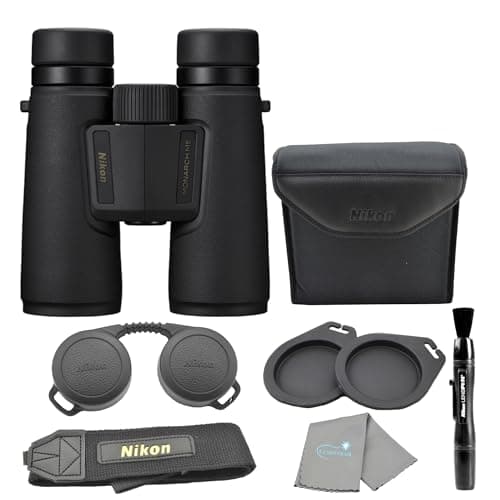
- Magnification
- 8x
- Objective lens
- 42 mm
- Weight
- 22.2 oz (629 g)
- Field of view
- 335 ft at 1,000 yds (6.4 deg)
- Eye relief
- 19.5 mm
- Waterproof / fogproof
- Yes, nitrogen-filled, O-ring sealed
About this pick
The Monarch M5 brings Nikon's ED (extra-low dispersion) glass, phase-corrected dielectric roof prisms, and a class-leading 19.5 mm eye relief into a lightweight 22-oz body. Color accuracy and contrast draw consistent praise from birders, and the long eye relief is a genuine advantage for glasses wearers on the trail.
Strengths
- ED glass delivers vivid, high-contrast images with low chromatic aberration across most of the field
- 19.5 mm eye relief is among the most generous at this price tier, comfortable for eyeglass wearers
- Lightweight at 22.2 oz for a full 42 mm objective optic with a premium glass package
Weaknesses
- Field of view (335 ft at 1,000 yds) is narrower than competing models at this price, which can make tracking fast birds harder
- Close focus distance of 8.2 ft limits close-range insect or butterfly observation
Kit Score breakdown
See all picks in Best binoculars for hiking: birding, wildlife, and trail scenery
Keep going
Related guides


 Complete hike loadoutDay hike kitBuild the complete kit
Researched, not hands-on tested
Updated Sep 25, 2026Our recommendations draw on manufacturer documentation, retailer listings, owner feedback, and comparisons with alternatives.
As an Amazon Associate I earn from qualifying purchases. We may earn a commission from links here, at no extra cost to you. How we research →