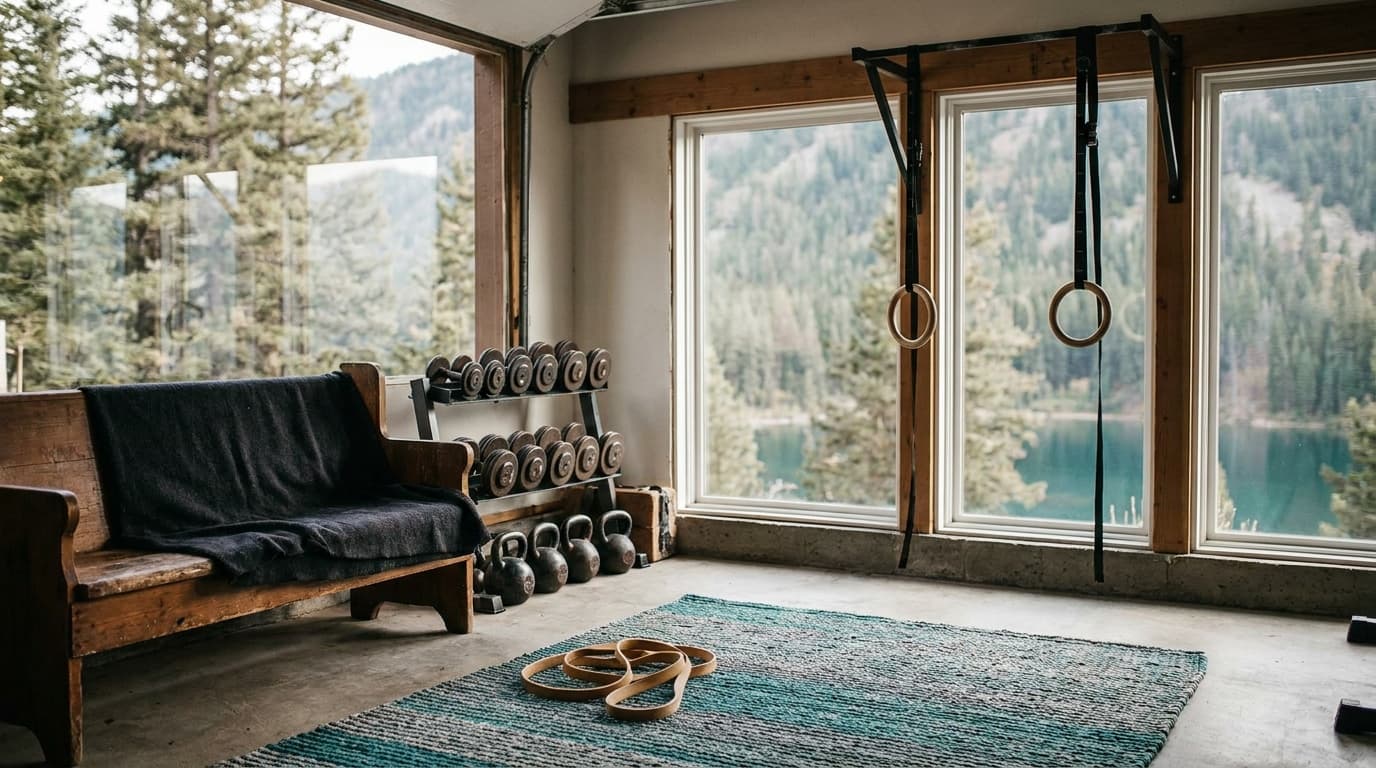
Build a budget home gym around what you'll use, then add equipment when you can name the job it will do. A pair of weights and bands may suit your plans; someone who wants to cycle indoors may get more value from a bike. Neither needs to buy the other's setup.
Our recommendation is to set a total spending limit, check the room, and buy in phases. If space is the harder limit, start with our guide to indoor fitness in small spaces, then use this page to decide what you can afford to add.
Phase 1: buy for the work you already intend to do
For a weights-based setup, compare the loads you need with the available adjustment increments, storage dimensions, and instructions. Adjustable dumbbells let one pair offer several loads, but the range and mechanism differ by model. A few fixed weights may be enough if those are the loads you intend to use. Our best adjustable dumbbells guide covers the product choices; use current listings to build your actual budget.
Add bands if you have a use for them and a setup that meets their instructions. Check the band's condition, attachments, and any required anchor before use. Buying new gives you a known starting point, but it doesn't replace the manufacturer's inspection and replacement guidance.
If you already own suitable weights or don't need bands, leave that money unspent. Choose the useful first purchase within your spending limit, rather than filling a room with a complete package.
If you're comparing the cost of guidance as well as gear, our Caliber Free vs Plus vs Coaching guide explains the service options. Include any subscription you choose in your own budget.
Used equipment: inspect the item, not just the price
Before buying secondhand, identify the exact model and check the CPSC recall and product-safety warning database and the manufacturer's notices. Read any applicable recall instructions; don't assume a seller's repair resolves a recall.
Ask for the manual and inspect for missing parts, damage, corrosion, and modifications. For adjustable dumbbells, follow the manual's checks for handles, plates, selectors, and locking mechanisms. For a bench, check its frame, fasteners, feet, and adjustment locks. The ACCC's secondhand buying guidance also recommends checking condition, parts, instructions, and recalls.
A visual check can't establish every item's history or safety. If you can't identify the product, verify its condition, or resolve a concern with the manufacturer, pass. Compare the purchase plus any approved replacement parts and transport with buying new; don't assume a fixed secondhand discount.
Phase 2: add a bench if you need its supported positions
Choose a flat or adjustable bench for the positions you intend to use. A flat bench doesn't become an incline bench by changing how you hold the weights. Don't prop it up or use it as a step platform unless the manufacturer expressly allows that use.
The Flybird WB5 Adjustable Weight Bench is one option to compare in our best weight benches guide. Check the exact model's instructions, load limits, adjustment locks, and operating and storage dimensions. Buy on Amazon.
Phase 3: fill a specific gap
Add a pulling station
A doorway option such as the Iron Gym Total Upper Body Workout Bar needs a doorway that meets its exact installation instructions. Check frame and trim requirements, permitted loads, and lease restrictions before buying. A doorway's width alone doesn't establish suitability. Buy on Amazon.
Add more resistance
Add weights or bands when the loads you need aren't available in your current setup. Compare compatibility, adjustment increments, condition, and the space needed to use and store them.
Choose a rack and barbell
Consider these if barbell work is part of your plans. Budget for the complete setup, including compatible supports, safety equipment, plates, and any required anchoring. There's no dumbbell-weight threshold that automatically makes a rack the next purchase.
Bring cardio indoors
Choose a machine if indoor walking, cycling, or rowing is the job you want done. Compare exact-model instructions, room fit, warranty, service options, and any recurring fees. Price alone doesn't establish durability.
Choose the addition that solves your particular gap. A rack or cardio machine needs a separate budget beyond the example's accessory allowance.
Check the floor and room before ordering
Choose any mat or flooring to suit both the equipment instructions and your floor finish. Check material compatibility, stability, and the intended use rather than treating one thickness as a universal standard. A mat isn't proof that a floor can support a heavy setup or that neighbors won't hear it.
- Operating space: mark the equipment dimensions and required clearances on the floor. Include space to get on, get off, adjust it and move around it. Folded dimensions only describe storage.
- Ceiling and obstacles: check equipment height and your intended movements, including overhead weights or your head above a pulling station. Account for fans, lights, doors and furniture.
- Delivery and storage: measure the route through doors, stairs and corners. Confirm assembly or disassembly requirements and choose storage that keeps access and exits clear.
- Structural suitability: if floor loading or an anchor's suitability is uncertain, ask an appropriately qualified professional before installing or using the equipment.
Build your own spending plan
Here is an illustrative $450 plan for a reader who wants weights, bands, and eventually a bench. The amounts are hypothetical planning allowances, not live prices, product quotations, or typical market costs.
Start by setting aside $150 for weights, $30 for bands and $40 for suitable floor protection if needed. That is $220 for Phase 1. In this example, the remaining $230 goes toward a bench ($120), one chosen accessory ($60) and a reserve for tax, delivery or other costs ($50).
The full allocation totals $450. The reserve may not cover your actual extra costs. Replace every allowance with a current quote; if suitable equipment costs more, buy fewer pieces or revise the budget. You don't have to spend an unused allowance.
Use your own membership fee if you're comparing home and gym costs. Savings depend on fees you actually stop paying, cancellation terms, and the costs of owning the equipment. Keeping both means the home setup is an additional expense, not a membership replacement.
Where these numbers come from
| Claim | Source | Checked |
|---|---|---|
| Check the exact model for recalls and product-safety warnings | U.S. Consumer Product Safety Commission: recalls and product-safety warnings | Oct 1, 2026 |
| Check secondhand condition, parts, instructions, and recalls before buying | Australian Competition and Consumer Commission: secondhand buying guidance | Oct 1, 2026 |
Frequently asked questions
How much does a basic home gym actually cost to set up?
Add the current cost of the equipment you need to tax, delivery, installation, floor protection, and any recurring fees. Use the example above as a worksheet, replacing each allowance with your actual quote. If the total exceeds your limit, buy fewer pieces or postpone the next phase.
Do I really need a power rack, or can I get by without one?
Buy a rack when your intended equipment and activities call for one, with the compatible supports, safety equipment, and installation it requires. A weights-and-bands setup doesn't automatically need a rack later. There isn't a universal dumbbell load at which you should switch.
What is the minimum space needed for a home gym?
There isn't one minimum area or ceiling height for every setup. Check the exact equipment's operating dimensions and required clearances against your room and intended movements. Include access, adjustment, and storage space. If the layout fails those checks, choose a different setup rather than squeezing it into a smaller area.
Browse all fitness gear for gear guides across training categories, or read how we research and rate every piece of kit on this site.
Recommended gear
Our current top picks from the Best adjustable dumbbells for home workouts (2026) guide, if you are ready to buy.
BOWFLEX
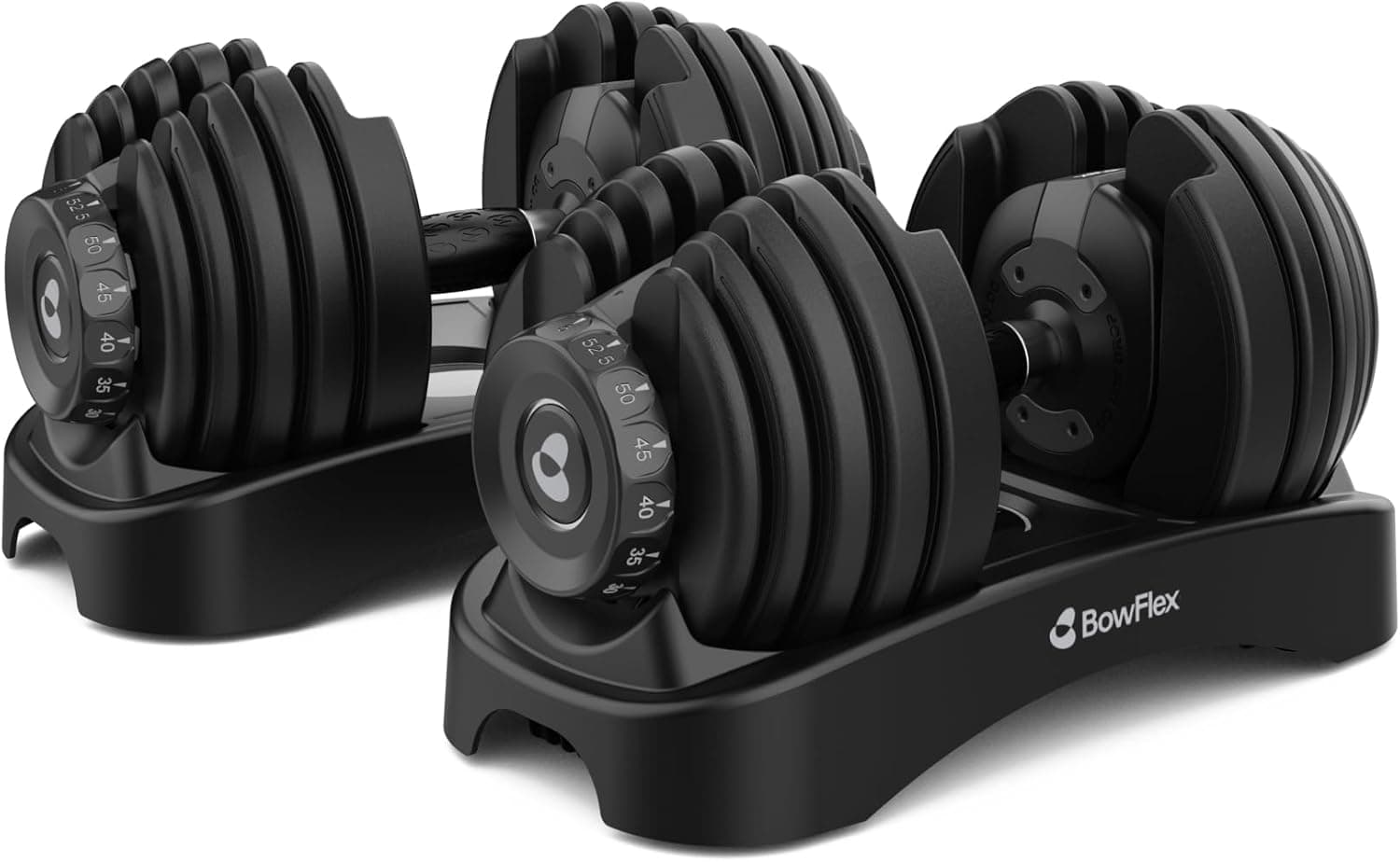
BowFlex Results Series 552 SelectTech Dumbbells (Pair)
BEST OVERALL
Kit Score 7.6/10
$399.99 Price checked Oct 23, 4:16 PM CDT
Best for: Home gym users who want the fastest possible weight changes, train in the 5 to 50 lb range, and prioritize a compact footprint with an included tray.
- Turn a dial at each end while the dumbbell sits in its tray; no pins or collars to handle
- 52.5 lb ceiling limits utility for intermediate and advanced lifters on squats, lunges, and Romanian deadlifts
- Weight range
- 5 – 52.5 lb per dumbbell
- Increments
- 2.5 lb (up to 25 lb), then 5 lb
- Adjustment mechanism
- Dual end-dials with metal locking tabs (post-recall redesign)
- Replaces
- 15 pairs of fixed dumbbells
- Warranty
- 2 years parts (BowFlex)
- Size per dumbbell
- 16.9" L x 8.3" W x 9" H; storage trays included
About this pick
The Results Series 552 replaces the original SelectTech 552, which was recalled in June 2025 because plates could dislodge from the handle. BowFlex says metal components now attach the plates to the handle, with a locking mechanism to keep them in place. It covers 5 to 52.5 lb per dumbbell in 15 settings (2.5 lb steps to 25 lb, then 5 lb steps), sold as a pair with storage trays.
Strengths
- Turn a dial at each end while the dumbbell sits in its tray; no pins or collars to handle
- Low 5 lb floor makes this usable for shoulder rehab, mobility work, and beginners alongside heavier compound lifts
- The post-recall redesign uses metal components and a locking mechanism to hold the plates, addressing the failure behind the June 2025 recall of the original 552
Weaknesses
- 52.5 lb ceiling limits utility for intermediate and advanced lifters on squats, lunges, and Romanian deadlifts
- Plastic dial housing remains a long-term durability question mark under daily high-rep use
Kit Score breakdown
CORE HOME FITNESS
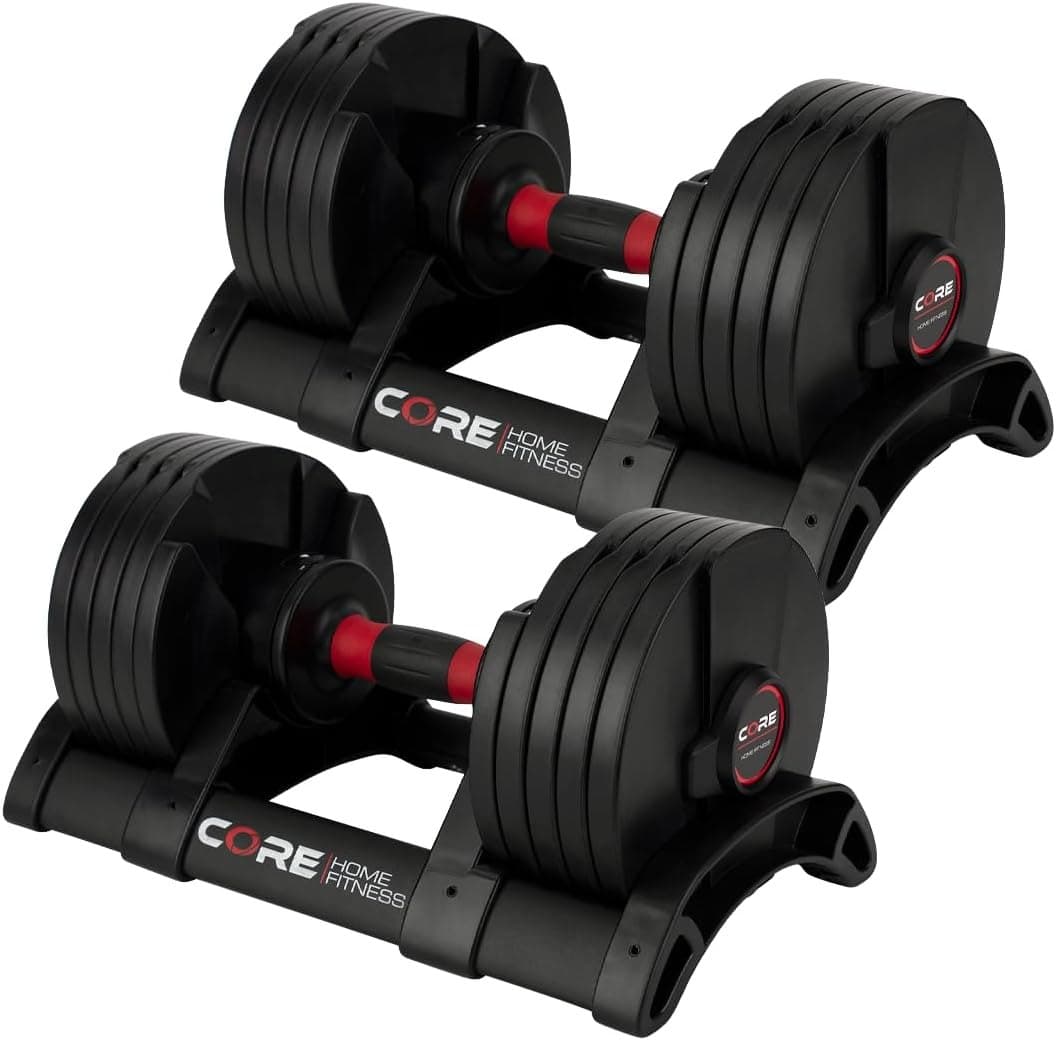
Core Home Fitness Adjustable Dumbbell Set, 5 to 50 lb (Pair)
FASTEST CHANGE
Kit Score 8.0/10
$349.99 Price checked Oct 23, 4:16 PM CDT
Best for: People who change weight often in circuits and supersets and want a compact 5 to 50 lb pair.
- One-handed twist change in the cradle, with no dials or pins to line up
- 5 lb steps only, coarser than the BowFlex or PowerBlock at light weights
- Weight range
- 5 to 50 lb per dumbbell
- Settings
- 10, in 5 lb steps
- Adjustment mechanism
- Twist the handle in the cradle (one hand)
- Length
- 9.3" at 5 lb to 14.5" at 50 lb (14.5" L x 7.9" W x 7.5" H at max)
- Warranty
- 2 years parts (Core Home Fitness)
- Sold as
- Pair, with two aluminum cradles
About this pick
Core Home Fitness uses a twist handle: set the dumbbell in its cradle, turn the handle, and lift. The dumbbell only carries the plates you selected, so it is 9.3 inches long at 5 lb and grows to 14.5 inches at 50 lb, which keeps light sets compact. It changes in 5 lb steps and comes as a pair with aluminum cradles.
Strengths
- One-handed twist change in the cradle, with no dials or pins to line up
- Dumbbell length shrinks at light weights, so curls and raises do not swing a full-length dumbbell
- Pair price is usually below the BowFlex 552
Weaknesses
- 5 lb steps only, coarser than the BowFlex or PowerBlock at light weights
- Stand is sold separately
Kit Score breakdown
NÜOBELL
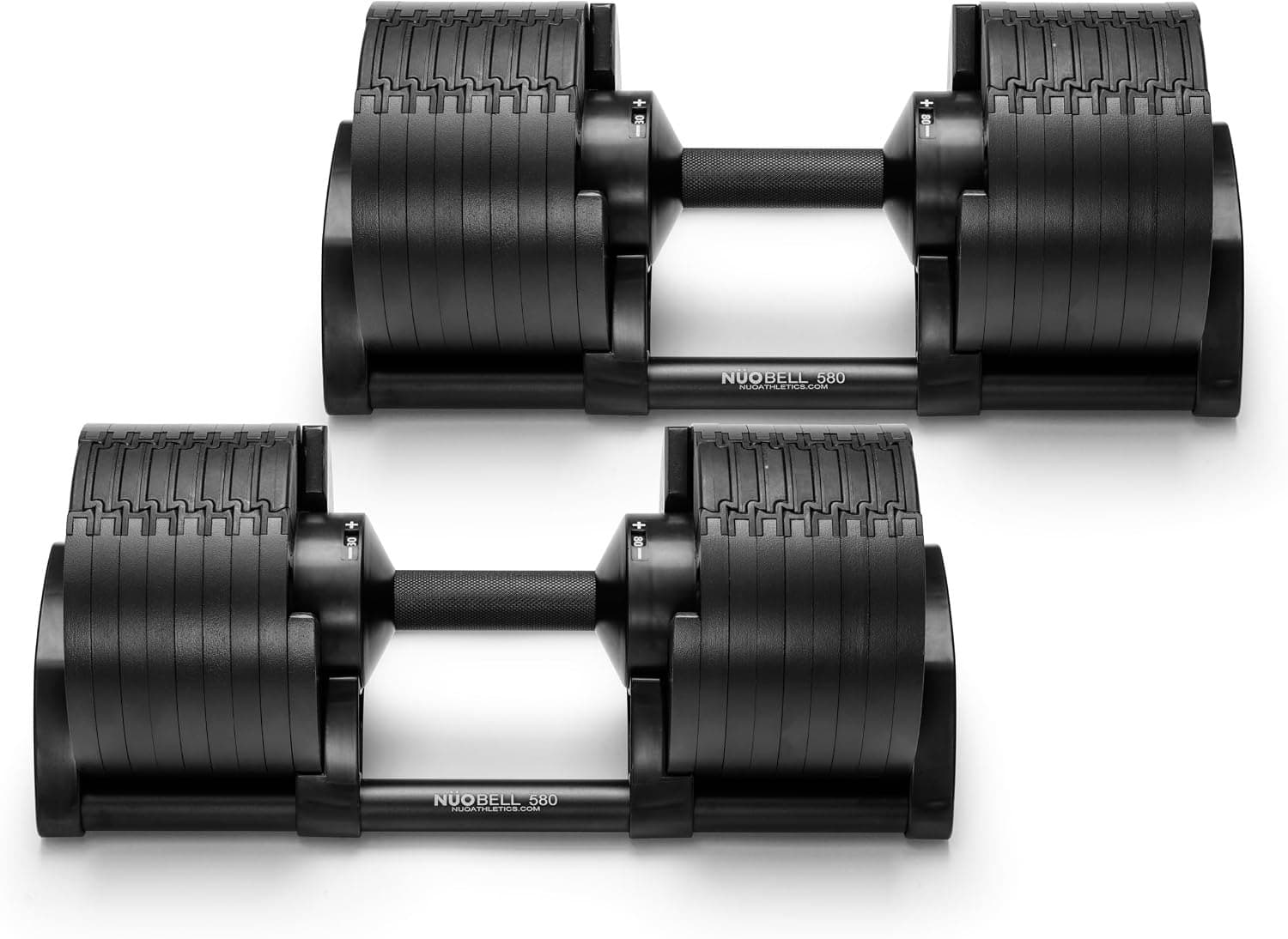
NÜOBELL Adjustable Dumbbells, 5 to 80 lb (Pair)
BEST PREMIUM
Kit Score 8.1/10
$730.55 Price checked Oct 23, 4:16 PM CDT
Best for: Strong lifters who want one pair that reaches 80 lb and still feels like a traditional round dumbbell.
- 80 lb per hand with a round, classic shape, the heaviest traditional-looking set here
- 5 lb steps only, with no 2.5 lb option for small lifts like lateral raises
- Weight range
- 5 to 80 lb per dumbbell
- Settings
- 16, in 5 lb steps
- Adjustment mechanism
- Twist the handle in the cradle to select
- Construction
- Powder-coated cast iron plates, knurled anodized aluminum handle
- Size per dumbbell
- 17" L x 7.5" W x 7.5" H
- Warranty
- 2 years (extendable to 5 through the maker's store)
About this pick
NÜOBELL's 80 lb set looks and handles like a round fixed dumbbell. You twist the handle while it sits in its cradle to pick any weight from 5 to 80 lb in 5 lb steps, and the plates are powder-coated cast iron on a knurled aluminum handle. It is the heaviest round, classic-shape adjustable dumbbell in this guide.
More specifications
- Sold as
- Pair, with cradles
Strengths
- 80 lb per hand with a round, classic shape, the heaviest traditional-looking set here
- Round, traditional shape with a knurled handle, so presses, rows, and goblet squats feel like a normal dumbbell
- Twist-to-select change happens in the cradle with one hand
Weaknesses
- 5 lb steps only, with no 2.5 lb option for small lifts like lateral raises
- 17 inches long, so it is bulkier than a PowerBlock and should be set down, not dropped
Kit Score breakdown
See all picks in Best adjustable dumbbells for home workouts (2026)
Keep going
Researched, not hands-on tested
Updated Oct 1, 2026Our recommendations draw on manufacturer documentation, retailer listings, owner feedback, and comparisons with alternatives.
As an Amazon Associate I earn from qualifying purchases. We may earn a commission from links here, at no extra cost to you. How we research →