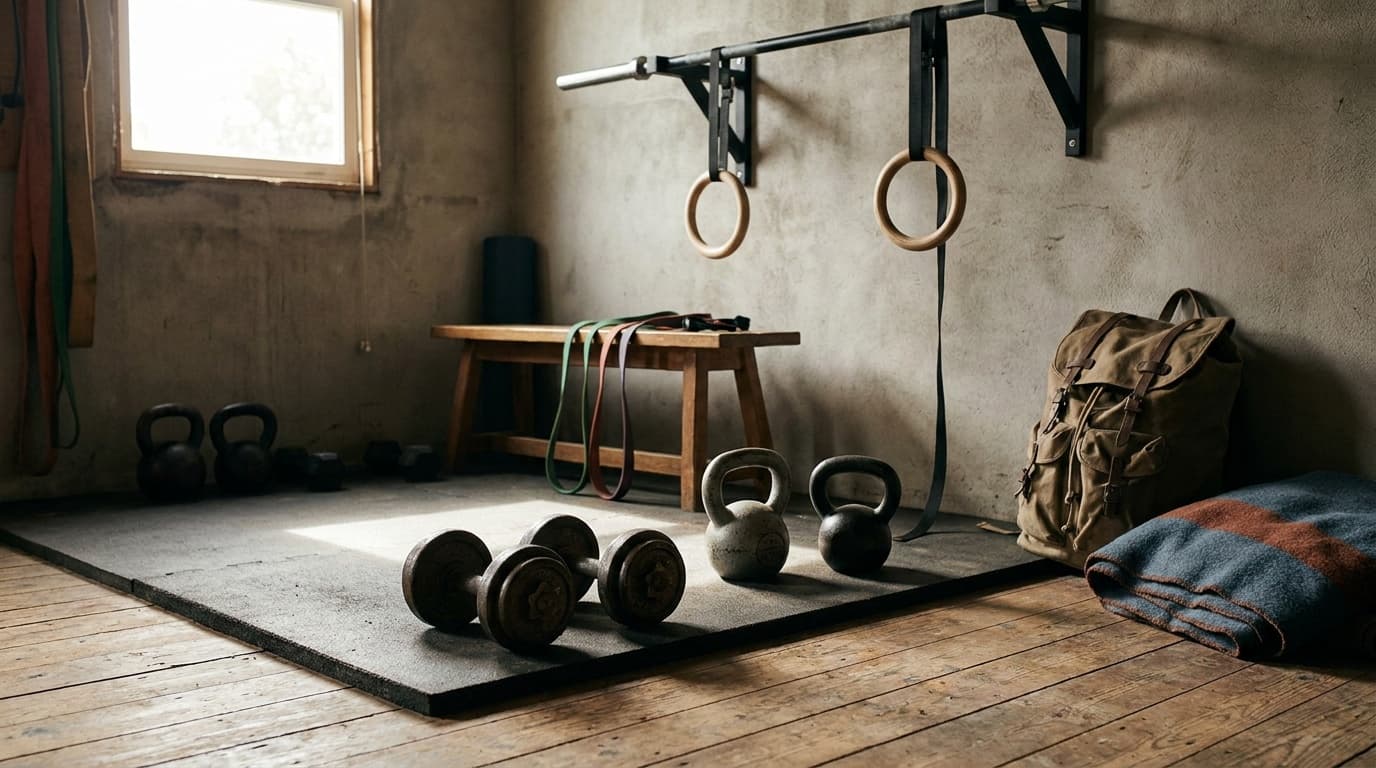
Dumbbells and kettlebells are not interchangeable. Each tool has a mechanical advantage that shapes which movements it does well, how it loads your body, and what kind of fitness goal it actually moves the needle on.
Movement types: where each tool has an edge
The geometry of each tool determines what it is built for.
A kettlebell's center of mass sits below the handle, offset from your grip. That offset creates a pendulum effect that makes ballistic, hip-hinge movements feel natural and loads the posterior chain efficiently. Swings, cleans, snatches, and Turkish get-ups all exploit this shape. The bell wants to swing; fighting that and redirecting it is the training stimulus.
A dumbbell's weight sits centered in your palm. That balance keeps your wrist stable through slow, controlled movements. Pressing, curling, lateral raises, and chest flyes all rely on that stability. The balanced load also means you can add weight in small steps without the movement pattern breaking down.
Grip mechanics and what they mean in practice
These tools feel different in the hand for a reason that matters beyond comfort.
Kettlebell handles are thicker, and the load hanging below them means your forearm and grip are working throughout every rep, not just at the top. That grip demand builds forearm endurance and wrist stability over time, and it is part of why ballistic sets challenge the whole system. On the downside, that same offset makes strict overhead pressing harder to maintain at heavier loads; the bell wants to drift.
Dumbbell handles sit centered in your palm, reducing wrist torque on pressing movements. That lets you control the path precisely and accumulate volume for hypertrophy work without grip fatigue becoming the limiting factor early in the set. For bicep curls, lateral raises, or any isolation move where form precision is the whole point, centered balance is the right tool.
Progressive overload: the case for dumbbells
If your primary goal is measurable strength gain, the weight increment gap matters more than most beginners expect.
Fixed dumbbells are commonly available in 2.5 lb increments. Kettlebells typically jump in 4 kg steps, which is roughly 9 lb per increment. For a beginner adding weight to a press or a row, a 9 lb jump can be the difference between a clean training set and a form breakdown. Fractional loading plates exist for kettlebells and can close that gap, but the added friction is real.
A 9 lb jump between kettlebell sizes is a feature for conditioning. For a beginner on a pressing program, it is a problem that needs a workaround.
Six weeks of kettlebell swing training improved half-squat one-rep max and vertical jump performance on par with a dedicated jump-squat power program, so the posterior-chain carry-over is genuine. But that is power development, not the slow, precise load accumulation that hypertrophy programs require.
Space and cost
Cost and floor space are where kettlebells have a real structural advantage.
A pair of cast iron kettlebells like the Yes4All Powder Coated Kettlebell (16 kg and 24 kg for most men starting out; 8 kg and 12 kg for most women) costs roughly $80–$160 and covers the majority of conditioning work. A comparable fixed dumbbell set spanning 5 lb to 50 lb pairs runs several hundred dollars and requires a rack.
A single adjustable dumbbell set (such as the FLYBIRD) can bring the cost down to around $389 for a compact option, but that is still two to four times the outlay for a starter kettlebell pair. If floor space is genuinely limited, two kettlebells stack in a corner; a dumbbell rack does not.
How to decide which to buy first
Identify your main goal
If it is cardiovascular conditioning, functional power, or efficient full-body work in short sessions, start with a kettlebell. If it is building muscle mass with measurable week-to-week strength gains, start with dumbbells such as the [BowFlex Results Series 552 SelectTech](/api/go?product=bowflex-results-series-552-selecttech&retailer=amazon&article=dumbbells-vs-kettlebells).
Check your starting weight
For kettlebells, a common starting point is 16 kg (35 lb) for men or 8–12 kg (18–26 lb) for women, based on widely used beginner progressions. Choose the lower end if you are new to resistance training entirely.
Count your floor space
Two kettlebells fit in a closet. A dumbbell set with rack needs dedicated wall space. Let your actual room constrain the answer before your wishlist does.
Budget for the progression
A single kettlebell gets you started. A second bell (one size up) doubles the programming options. For dumbbells, plan to cover at least three to four weight pairs before the investment starts paying off in variety.
Add the other tool when you hit its wall
Kettlebell users hit the wall when pressing and isolation work needs finer load increments. Dumbbell users hit the wall when they want conditioning density and posterior-chain power work without adding cardio equipment.
For strength vs conditioning: a direct answer
For building muscle mass, powerlifting accessories, and rehab work, start with dumbbells. The controlled range of motion, centered grip, and fine weight increments match what hypertrophy programming demands.
For cardiovascular conditioning, total-body power, and time-efficient training in a small space, start with kettlebells. The ACE-commissioned University of Wisconsin study (30 adults, 8 weeks) found kettlebell training improved VO2max by 13.8% and leg press one-rep max by 41.7 kg compared to negligible gains in the control group. A separate study in the Journal of Strength and Conditioning Research found 12 continuous minutes of kettlebell swings provided a metabolic challenge comparable to running at a six-minute mile pace, burning roughly 20 calories per minute.
For a general home gym covering both goals, the most practical first setup is a pair of kettlebells plus one or two dumbbell pairs for pressing and isolation work. That combination covers the full range of training demands without the cost or space of a full rack.
If you are looking at specific dumbbell options to pair with kettlebells, see our guide to the best adjustable dumbbells for picks across budgets and space constraints.
Can I replace dumbbells entirely with kettlebells?
For conditioning and posterior-chain work, yes. Kettlebells handle swings, cleans, presses, and carries well. Where they fall short is fine-grained progressive overload for isolation moves like bicep curls, chest flyes, or lateral raises. The 4 kg weight jumps make small strength increments awkward, and the offset handle makes strict pressing form harder to hold at heavier loads. Most people find kettlebells replace dumbbells for roughly 70% of home gym needs, but not all of them.
What weight kettlebell should a beginner buy first?
A common starting point is 16 kg (35 lb) for men and 8–12 kg (18–26 lb) for women, based on widely used beginner progressions from the StrongFirst community and multiple coaching resources. The right choice depends on your current fitness level. If you are new to resistance training, start at the lower end. The goal is a weight you can swing with good hip-hinge form for 10 reps without losing your lower back position.
Are kettlebells better than dumbbells for fat loss?
The ACE-commissioned study found kettlebell circuit training burned approximately 20 calories per minute, comparable to running a six-minute mile pace. That calorie burn comes from combining resistance load and cardiovascular demand in one tool, which dumbbells used in traditional sets do not match at the same duration. That said, fat loss is primarily driven by total caloric deficit over time, not by tool choice. Both tools support fat loss. Kettlebells tend to make high-intensity conditioning sessions more time-efficient, which helps people sustain the work over weeks and months.
Explore more at fitness gear or learn about how we research and rate the tools and studies behind every guide.
Recommended gear
Our current top picks from the Best adjustable dumbbells for home workouts (2026) guide, if you are ready to buy.
BOWFLEX
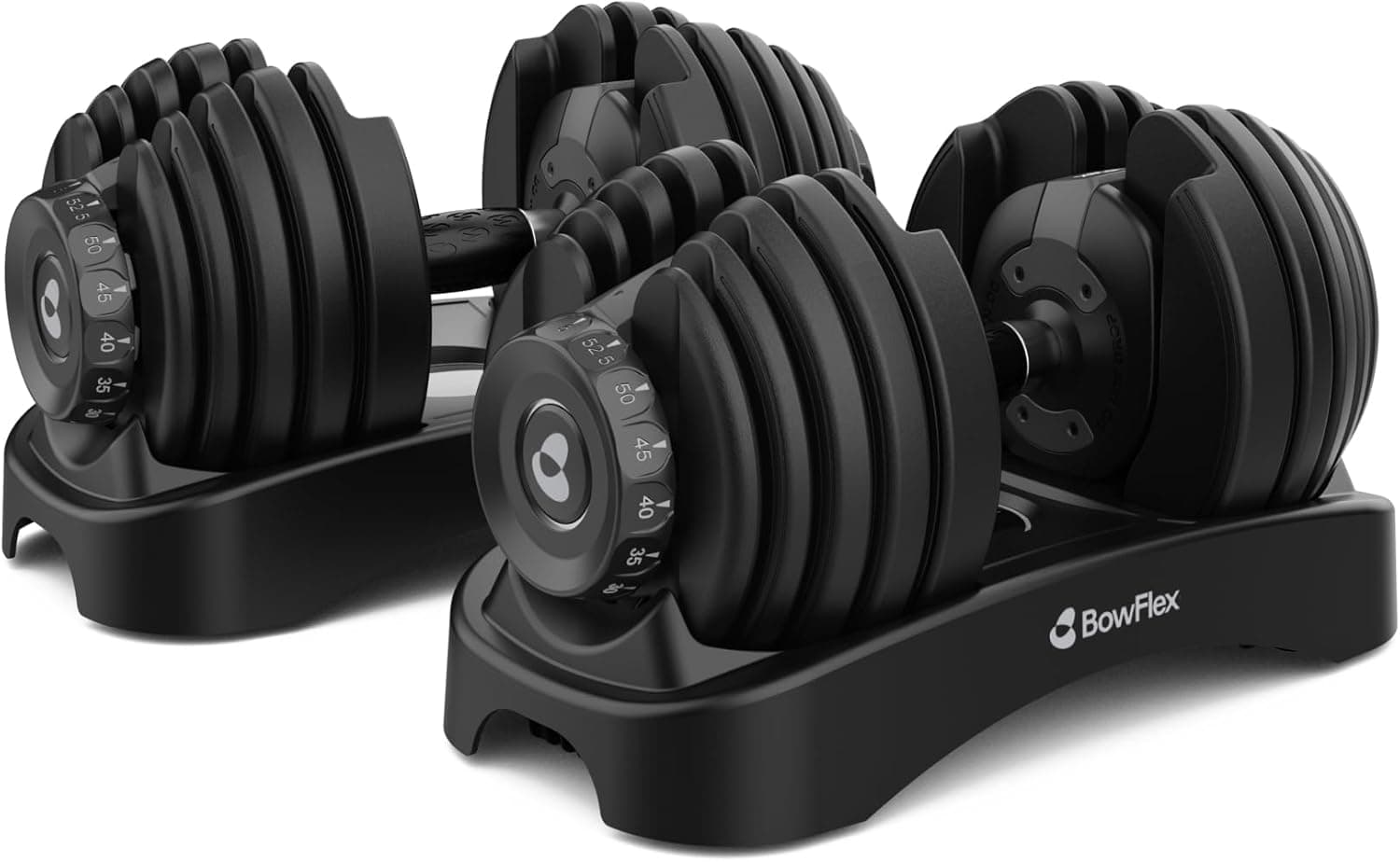
BowFlex Results Series 552 SelectTech Dumbbells (Pair)
BEST OVERALL
Kit Score 7.6/10
$399.99 Price checked Oct 23, 4:16 PM CDT
Best for: Home gym users who want the fastest possible weight changes, train in the 5 to 50 lb range, and prioritize a compact footprint with an included tray.
- Turn a dial at each end while the dumbbell sits in its tray; no pins or collars to handle
- 52.5 lb ceiling limits utility for intermediate and advanced lifters on squats, lunges, and Romanian deadlifts
- Weight range
- 5 – 52.5 lb per dumbbell
- Increments
- 2.5 lb (up to 25 lb), then 5 lb
- Adjustment mechanism
- Dual end-dials with metal locking tabs (post-recall redesign)
- Replaces
- 15 pairs of fixed dumbbells
- Warranty
- 2 years parts (BowFlex)
- Size per dumbbell
- 16.9" L x 8.3" W x 9" H; storage trays included
About this pick
The Results Series 552 replaces the original SelectTech 552, which was recalled in June 2025 because plates could dislodge from the handle. BowFlex says metal components now attach the plates to the handle, with a locking mechanism to keep them in place. It covers 5 to 52.5 lb per dumbbell in 15 settings (2.5 lb steps to 25 lb, then 5 lb steps), sold as a pair with storage trays.
Strengths
- Turn a dial at each end while the dumbbell sits in its tray; no pins or collars to handle
- Low 5 lb floor makes this usable for shoulder rehab, mobility work, and beginners alongside heavier compound lifts
- The post-recall redesign uses metal components and a locking mechanism to hold the plates, addressing the failure behind the June 2025 recall of the original 552
Weaknesses
- 52.5 lb ceiling limits utility for intermediate and advanced lifters on squats, lunges, and Romanian deadlifts
- Plastic dial housing remains a long-term durability question mark under daily high-rep use
Kit Score breakdown
CORE HOME FITNESS
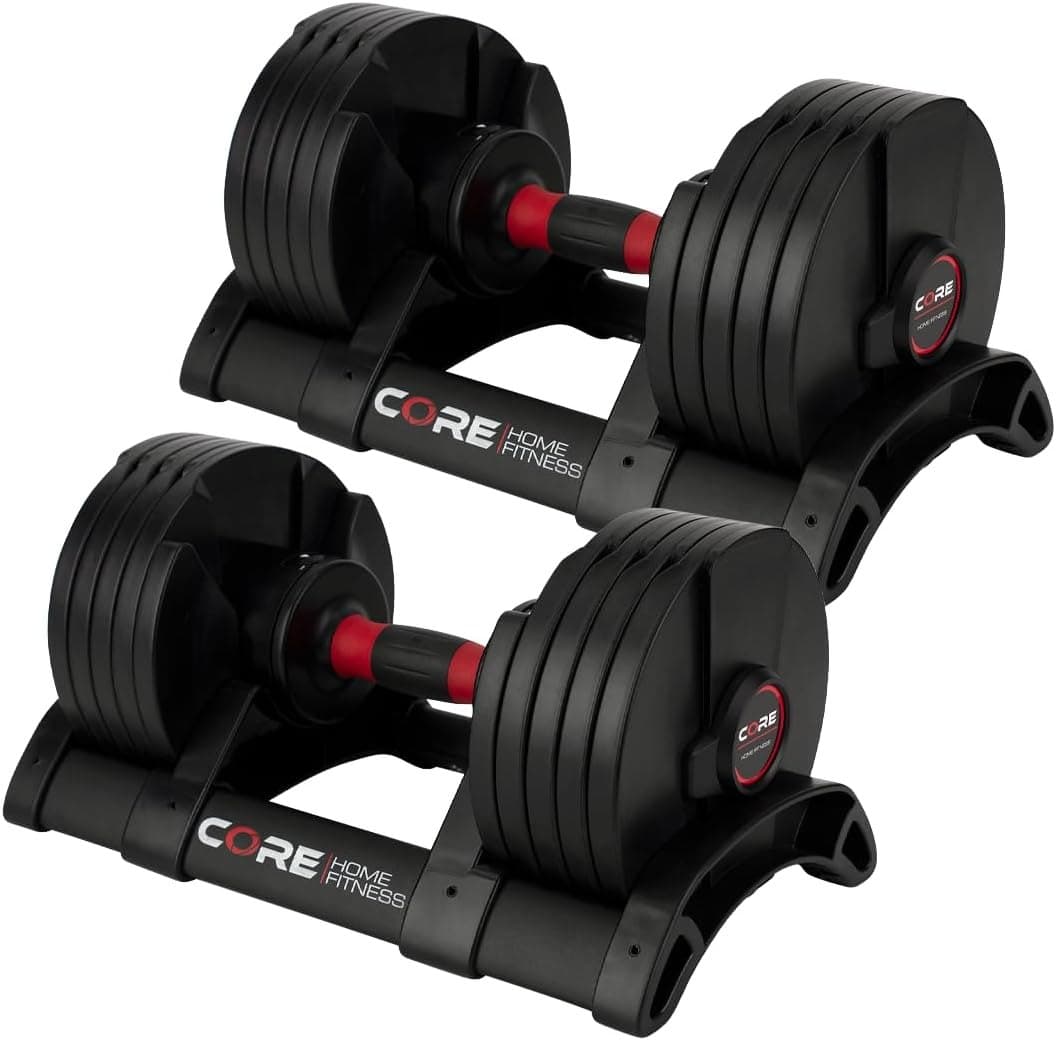
Core Home Fitness Adjustable Dumbbell Set, 5 to 50 lb (Pair)
FASTEST CHANGE
Kit Score 8.0/10
$349.99 Price checked Oct 23, 4:16 PM CDT
Best for: People who change weight often in circuits and supersets and want a compact 5 to 50 lb pair.
- One-handed twist change in the cradle, with no dials or pins to line up
- 5 lb steps only, coarser than the BowFlex or PowerBlock at light weights
- Weight range
- 5 to 50 lb per dumbbell
- Settings
- 10, in 5 lb steps
- Adjustment mechanism
- Twist the handle in the cradle (one hand)
- Length
- 9.3" at 5 lb to 14.5" at 50 lb (14.5" L x 7.9" W x 7.5" H at max)
- Warranty
- 2 years parts (Core Home Fitness)
- Sold as
- Pair, with two aluminum cradles
About this pick
Core Home Fitness uses a twist handle: set the dumbbell in its cradle, turn the handle, and lift. The dumbbell only carries the plates you selected, so it is 9.3 inches long at 5 lb and grows to 14.5 inches at 50 lb, which keeps light sets compact. It changes in 5 lb steps and comes as a pair with aluminum cradles.
Strengths
- One-handed twist change in the cradle, with no dials or pins to line up
- Dumbbell length shrinks at light weights, so curls and raises do not swing a full-length dumbbell
- Pair price is usually below the BowFlex 552
Weaknesses
- 5 lb steps only, coarser than the BowFlex or PowerBlock at light weights
- Stand is sold separately
Kit Score breakdown
NÜOBELL
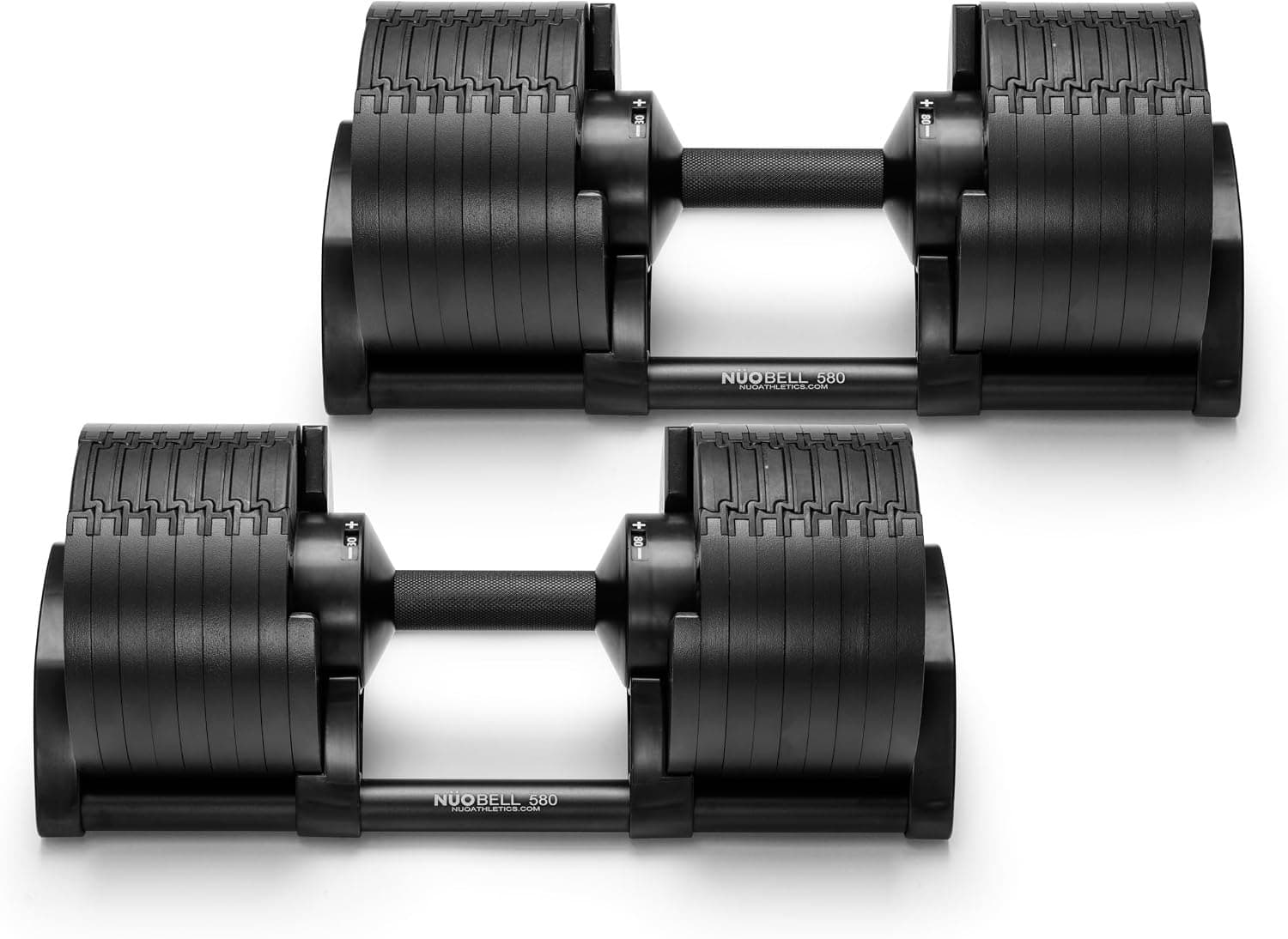
NÜOBELL Adjustable Dumbbells, 5 to 80 lb (Pair)
BEST PREMIUM
Kit Score 8.1/10
$730.55 Price checked Oct 23, 4:16 PM CDT
Best for: Strong lifters who want one pair that reaches 80 lb and still feels like a traditional round dumbbell.
- 80 lb per hand with a round, classic shape, the heaviest traditional-looking set here
- 5 lb steps only, with no 2.5 lb option for small lifts like lateral raises
- Weight range
- 5 to 80 lb per dumbbell
- Settings
- 16, in 5 lb steps
- Adjustment mechanism
- Twist the handle in the cradle to select
- Construction
- Powder-coated cast iron plates, knurled anodized aluminum handle
- Size per dumbbell
- 17" L x 7.5" W x 7.5" H
- Warranty
- 2 years (extendable to 5 through the maker's store)
About this pick
NÜOBELL's 80 lb set looks and handles like a round fixed dumbbell. You twist the handle while it sits in its cradle to pick any weight from 5 to 80 lb in 5 lb steps, and the plates are powder-coated cast iron on a knurled aluminum handle. It is the heaviest round, classic-shape adjustable dumbbell in this guide.
More specifications
- Sold as
- Pair, with cradles
Strengths
- 80 lb per hand with a round, classic shape, the heaviest traditional-looking set here
- Round, traditional shape with a knurled handle, so presses, rows, and goblet squats feel like a normal dumbbell
- Twist-to-select change happens in the cradle with one hand
Weaknesses
- 5 lb steps only, with no 2.5 lb option for small lifts like lateral raises
- 17 inches long, so it is bulkier than a PowerBlock and should be set down, not dropped
Kit Score breakdown
See all picks in Best adjustable dumbbells for home workouts (2026)
Keep going
Researched, not hands-on tested
Updated Jun 4, 2026Our recommendations draw on manufacturer documentation, retailer listings, owner feedback, and comparisons with alternatives.
As an Amazon Associate I earn from qualifying purchases. We may earn a commission from links here, at no extra cost to you. How we research →