The BowFlex Results Series 552 is the best adjustable dumbbell for most home gyms: it covers 5 to 52.5 lb in 15 settings, changes with a dial at each end, and is the redesign BowFlex released after the June 2025 CPSC recall of the original 552 and 1090. If you want the fastest change, Wirecutter's top pick, the Core Home Fitness set, twists to a new weight in the cradle. For heavier lifting, the PowerBlock Elite USA 90 reaches 90 lb per hand, and the NÜOBELL set goes to 80 lb in a classic round shape.
Our quick picks
How we picked
Every pick is scored against the Kit Score: weight range and step size, how quickly and securely the weight changes, length and storage, build and warranty, and price against sets with the same range. We started from the picks of Wirecutter, Garage Gym Reviews, BarBend, Verywell Fit, CNN Underscored, and Tom's Guide, checked every spec against the maker's own page, and confirmed each set is in stock from Amazon or the brand's own Amazon store. Kit Authority has not lifted these dumbbells; the sources table at the end lists where each number comes from.
The picks
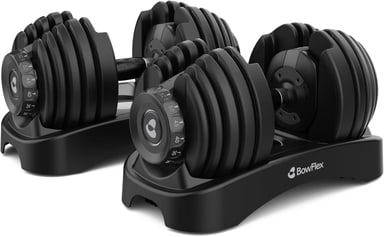
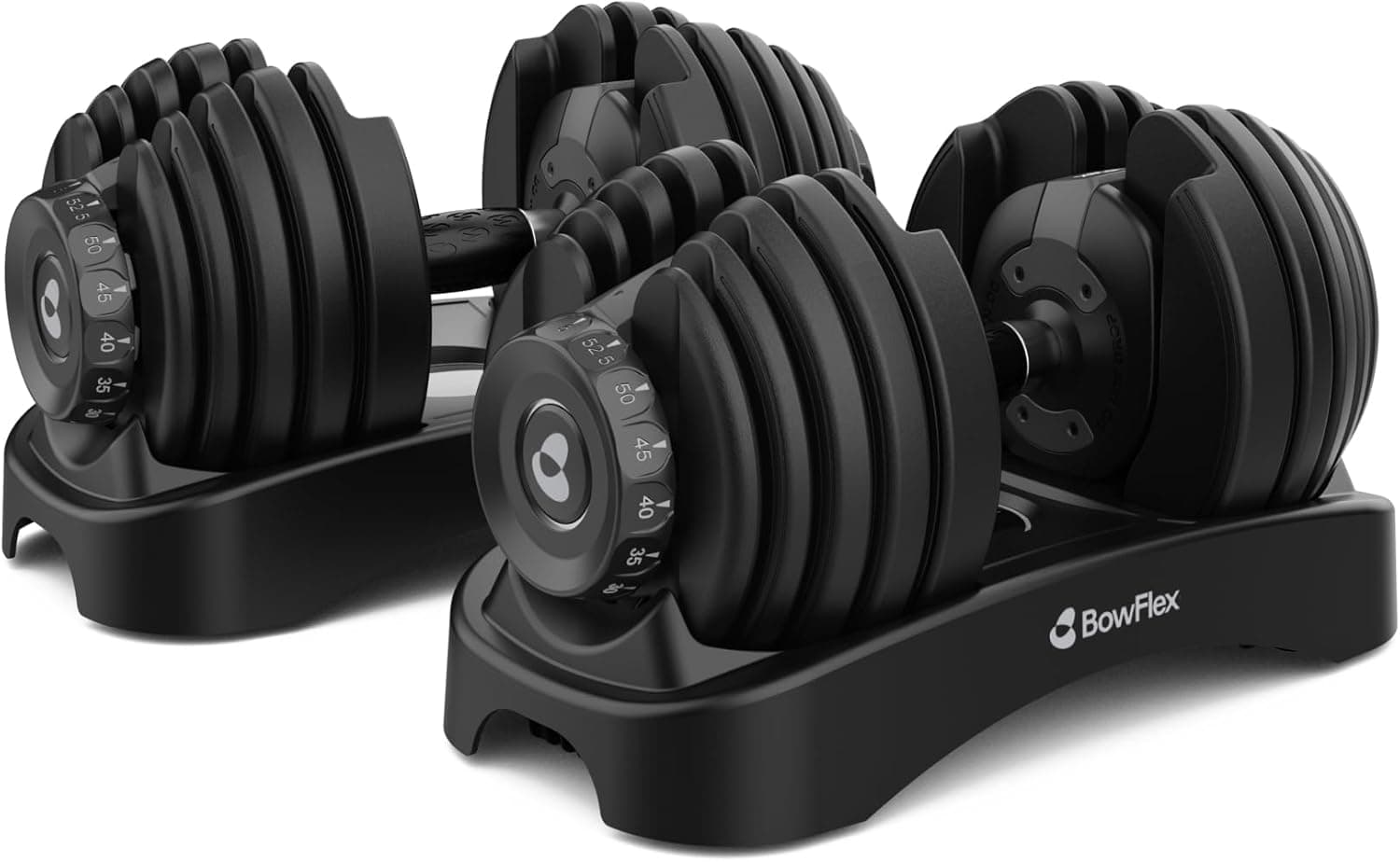
Best overall: BowFlex Results Series 552
BEST OVERALL
BowFlex Results Series 552 SelectTech Dumbbells (Pair)
Best for: Home gym users who want the fastest possible weight changes, train in the 5 to 50 lb range, and prioritize a compact footprint with an included tray.
- Turn a dial at each end while the dumbbell sits in its tray; no pins or collars to handle
- 52.5 lb ceiling limits utility for intermediate and advanced lifters on squats, lunges, and Romanian deadlifts
Kit Score 7.6/10 · $399.99 Price checked Oct 23, 4:16 PM CDT · how we score gear
Buy on AmazonProduct details
The Results Series 552 replaces the original SelectTech 552, which was recalled in June 2025 because plates could dislodge from the handle. BowFlex says metal components now attach the plates to the handle, with a locking mechanism to keep them in place. It covers 5 to 52.5 lb per dumbbell in 15 settings (2.5 lb steps to 25 lb, then 5 lb steps), sold as a pair with storage trays.
- Weight range
- 5 – 52.5 lb per dumbbell
- Increments
- 2.5 lb (up to 25 lb), then 5 lb
- Adjustment mechanism
- Dual end-dials with metal locking tabs (post-recall redesign)
- Replaces
- 15 pairs of fixed dumbbells
- Warranty
- 2 years parts (BowFlex)
- Size per dumbbell
- 16.9" L x 8.3" W x 9" H; storage trays included
More strengths
- Low 5 lb floor makes this usable for shoulder rehab, mobility work, and beginners alongside heavier compound lifts
- The post-recall redesign uses metal components and a locking mechanism to hold the plates, addressing the failure behind the June 2025 recall of the original 552
Other tradeoffs
- Plastic dial housing remains a long-term durability question mark under daily high-rep use
The 552 is still the dumbbell most people picture when they think "adjustable," and the Results Series is the version to buy now. In June 2025 the CPSC announced a recall of about 3.8 million original BowFlex 552 and 1090 dumbbells because the plates could dislodge from the handle; Nautilus had 337 reports of that, including 111 injuries. BowFlex released the Results Series in August 2025 with what it describes as metal components and a locking mechanism to hold the plates on the handle.
The weight range is the reason it suits so many lifters. BowFlex lists 15 settings per dumbbell: 2.5 lb steps from 5 to 25 lb, then 5 lb steps to 52.5 lb. Small steps at the light end are what you want for shoulder raises and rehab work, and 50 lb covers presses and rows for most home lifters. Each dumbbell sits in its own storage tray and changes with a dial at each end. It is long, though: BowFlex lists 16.9 inches, which you notice on curls and close-grip presses. Garage Gym Reviews names it the best set for beginners, and our BowFlex 552 review covers the dial mechanism in more detail.
Range: 5 to 52.5 lb | Steps: 2.5 lb to 25 lb, then 5 lb | Length: 16.9 in | Warranty: 2 years parts
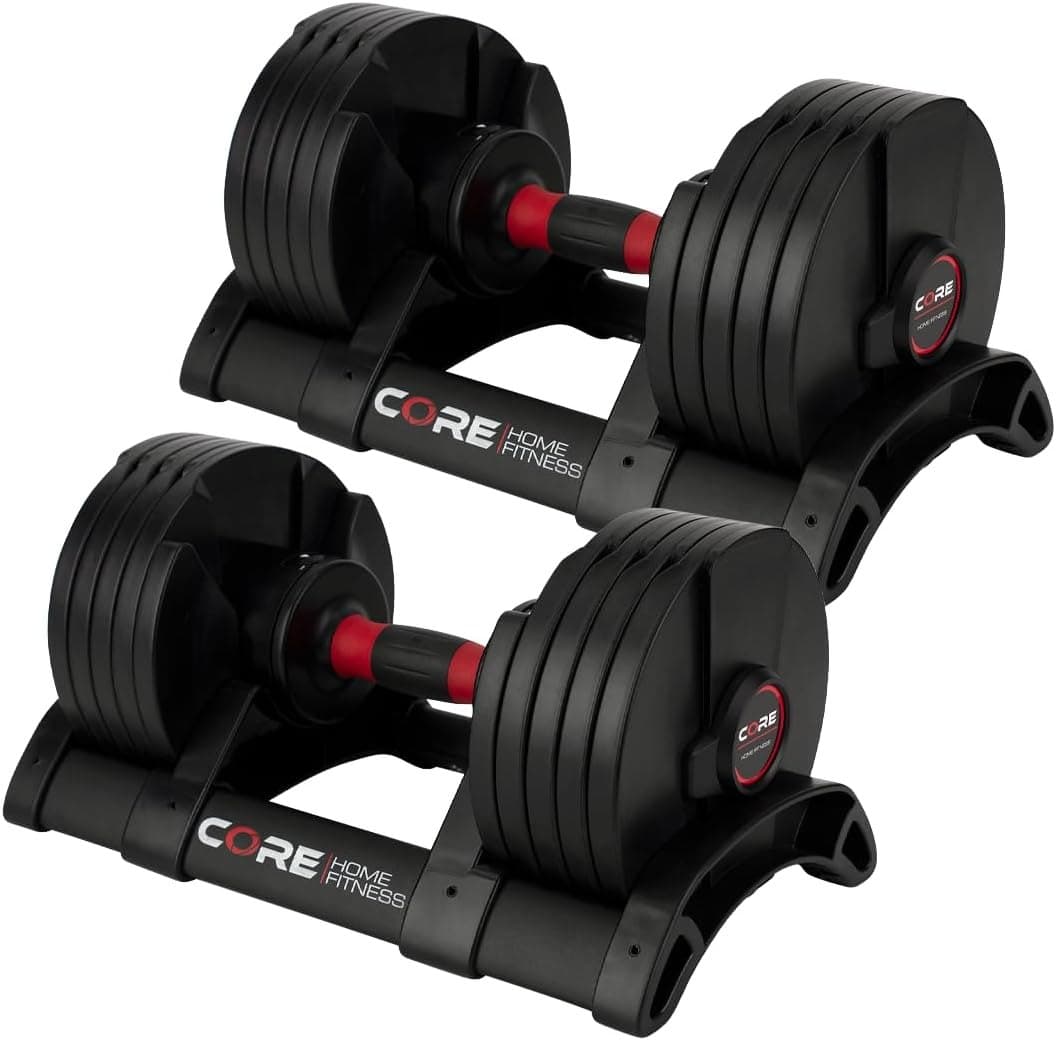
Fastest change: Core Home Fitness Adjustable Dumbbell Set
FASTEST CHANGE
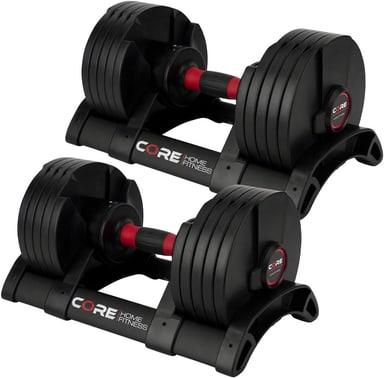
Core Home Fitness Adjustable Dumbbell Set, 5 to 50 lb (Pair)
Best for: People who change weight often in circuits and supersets and want a compact 5 to 50 lb pair.
- One-handed twist change in the cradle, with no dials or pins to line up
- 5 lb steps only, coarser than the BowFlex or PowerBlock at light weights
Kit Score 8.0/10 · $349.99 Price checked Oct 23, 4:16 PM CDT · how we score gear
Buy on AmazonProduct details
Core Home Fitness uses a twist handle: set the dumbbell in its cradle, turn the handle, and lift. The dumbbell only carries the plates you selected, so it is 9.3 inches long at 5 lb and grows to 14.5 inches at 50 lb, which keeps light sets compact. It changes in 5 lb steps and comes as a pair with aluminum cradles.
- Weight range
- 5 to 50 lb per dumbbell
- Settings
- 10, in 5 lb steps
- Adjustment mechanism
- Twist the handle in the cradle (one hand)
- Length
- 9.3" at 5 lb to 14.5" at 50 lb (14.5" L x 7.9" W x 7.5" H at max)
- Warranty
- 2 years parts (Core Home Fitness)
- Sold as
- Pair, with two aluminum cradles
More strengths
- Dumbbell length shrinks at light weights, so curls and raises do not swing a full-length dumbbell
- Pair price is usually below the BowFlex 552
Other tradeoffs
- Stand is sold separately
Wirecutter's top pick works differently from a dial: you set the dumbbell in its cradle, twist the handle, and lift. Wirecutter found it changes weight faster than the other sets it tested and is shorter than nearly all of them. The dumbbell only carries the plates you chose, so Core lists it at 9.3 inches long at 5 lb and 14.5 inches at the full 50 lb. That short length is the best thing about it for curls and raises in a small room.
The trade-off is step size. Core changes in 5 lb steps only, 10 settings from 5 to 50 lb, so the jump from 5 to 10 lb on a lateral raise is a big one. CNN Underscored names it its budget pick. The pair comes with aluminum cradles and a 2-year parts warranty; a stand is sold separately.
Range: 5 to 50 lb | Steps: 5 lb | Length: 9.3 to 14.5 in | Warranty: 2 years parts
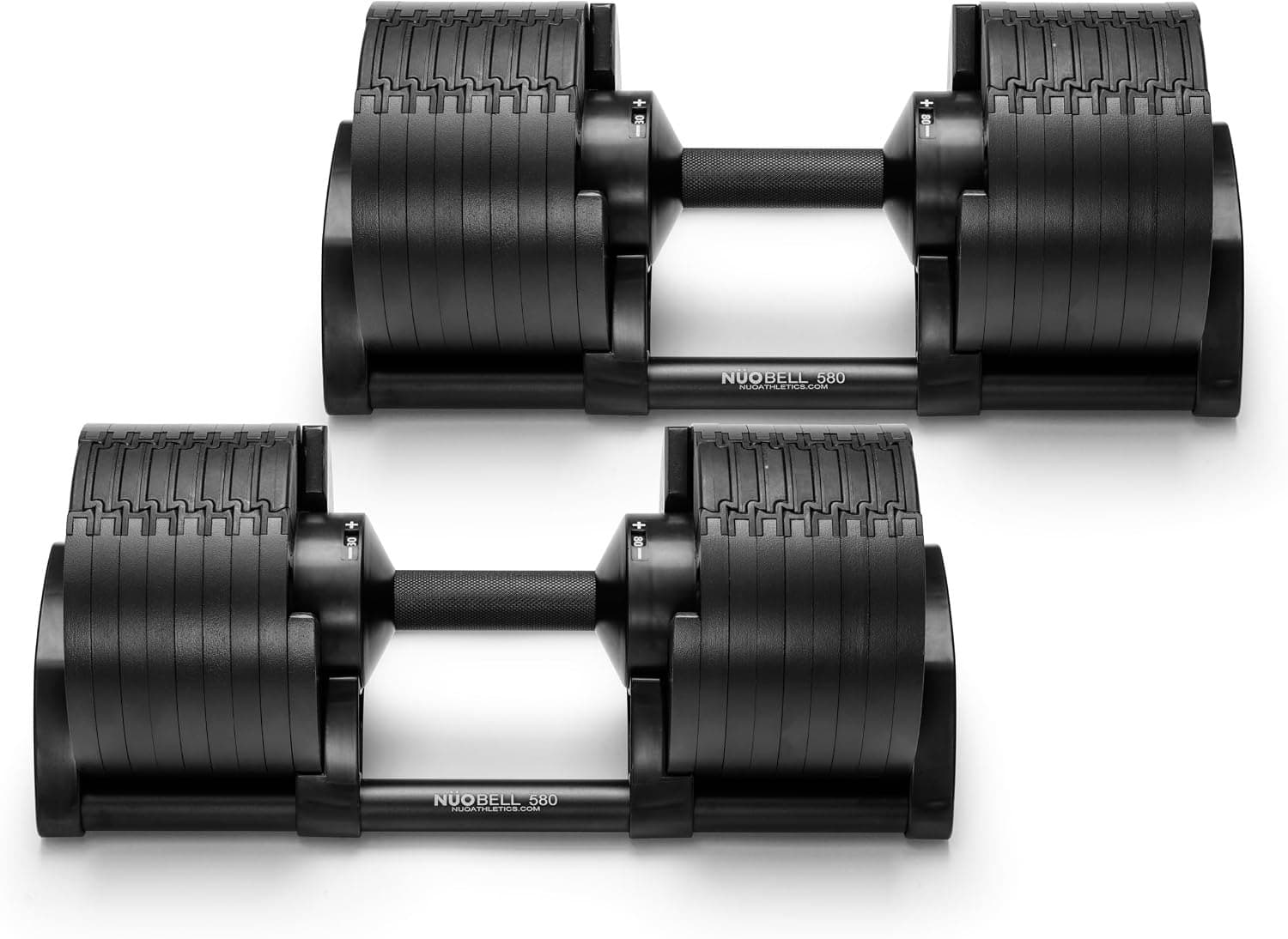
Best premium: NÜOBELL Adjustable Dumbbells, 5 to 80 lb
BEST PREMIUM
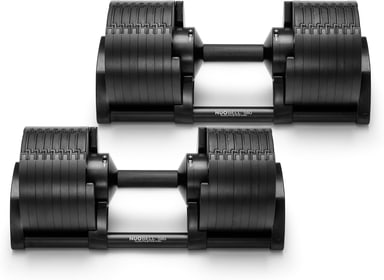
NÜOBELL Adjustable Dumbbells, 5 to 80 lb (Pair)
Best for: Strong lifters who want one pair that reaches 80 lb and still feels like a traditional round dumbbell.
- 80 lb per hand with a round, classic shape, the heaviest traditional-looking set here
- 5 lb steps only, with no 2.5 lb option for small lifts like lateral raises
Kit Score 8.1/10 · $730.55 Price checked Oct 23, 4:16 PM CDT · how we score gear
Buy on AmazonProduct details
NÜOBELL's 80 lb set looks and handles like a round fixed dumbbell. You twist the handle while it sits in its cradle to pick any weight from 5 to 80 lb in 5 lb steps, and the plates are powder-coated cast iron on a knurled aluminum handle. It is the heaviest round, classic-shape adjustable dumbbell in this guide.
- Weight range
- 5 to 80 lb per dumbbell
- Settings
- 16, in 5 lb steps
- Adjustment mechanism
- Twist the handle in the cradle to select
- Construction
- Powder-coated cast iron plates, knurled anodized aluminum handle
- Size per dumbbell
- 17" L x 7.5" W x 7.5" H
- Warranty
- 2 years (extendable to 5 through the maker's store)
- Sold as
- Pair, with cradles
More strengths
- Round, traditional shape with a knurled handle, so presses, rows, and goblet squats feel like a normal dumbbell
- Twist-to-select change happens in the cradle with one hand
Other tradeoffs
- 17 inches long, so it is bulkier than a PowerBlock and should be set down, not dropped
NÜOBELL is the set that looks and feels most like a fixed round dumbbell. You twist the handle in the cradle to choose any weight from 5 to 80 lb in 5 lb steps, 16 settings in all, and the plates are powder-coated cast iron on a knurled aluminum handle. Garage Gym Reviews names it its best overall adjustable dumbbell, BarBend its most user-friendly, and Verywell Fit its best investment.
At 17 by 7.5 by 7.5 inches it is longer than a PowerBlock, and the 5 lb steps rule out small jumps. The warranty is 2 years, extendable to 5 through NÜOBELL's own store. Buy it if you want 80 lb for rows and lunges and you dislike the boxy feel of a cage.
Range: 5 to 80 lb | Steps: 5 lb | Length: 17 in | Warranty: 2 years
Best for heavy lifting: PowerBlock Elite USA 90
BEST FOR HEAVY LIFTING
PowerBlock Elite USA 90 Adjustable Dumbbells (Pair)
Best for: Lifters who already press or row 50 lb dumbbells, or expect to, and want one set that reaches 90 lb.
- Highest ceiling in this guide: 90 lb per hand, with 2.5 lb steps at most weights
- The square cage around the handle feels different from a round dumbbell and can bump the forearms on curls and flyes
Kit Score 8.6/10 · $869.00 Price checked Oct 23, 4:16 PM CDT · how we score gear
Buy on AmazonProduct details
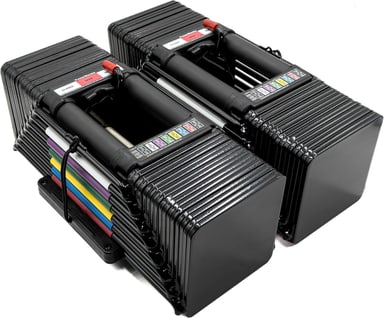
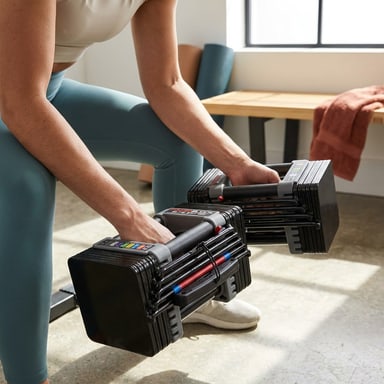
PowerBlock's Elite USA 90 is the heavy version of its block-style dumbbell: a magnetic pin in a steel weight stack sets anywhere from 5 to 90 lb per hand, in 27 settings that are mostly 2.5 lb apart. Each dumbbell is 16.25 by 6 by 6 inches, compact for a 90 lb dumbbell, and the set carries a 5-year warranty. PowerBlock also sells it as a 50 lb starter that expands to 70 and 90 lb.
- Weight range
- 5 to 90 lb per dumbbell (this listing includes Stages 1, 2, and 3)
- Settings
- 27, in 2.5 and 5 lb steps
- Adjustment mechanism
- Magnetic selector pin (rated for 500 lb) in a steel weight stack
- Size per dumbbell
- 16.25" L x 6" W x 6" H (PowerBlock)
- Warranty
- 5 years, residential use
- Compatibility
- Not compatible with Elite EXP accessories
More strengths
- Block shape stays compact even at 90 lb
- Steel stack and pin, no plastic dial, 5-year warranty
Other tradeoffs
- The full 90 lb set is the most expensive pick here; the 50 lb starter plus stage kits spreads the cost
The Elite USA 90 is the heaviest set here: 5 to 90 lb per hand, in 27 settings that are mostly 2.5 lb apart. A magnetic pin in a steel weight stack picks the load, and each dumbbell is 16.25 by 6 by 6 inches, compact for a 90 lb dumbbell. PowerBlock makes the weight plates in Owatonna, Minnesota, and covers the set with a 5-year residential warranty. Verywell Fit names the PowerBlock Elite its best overall adjustable dumbbell.
This listing is the full 90 lb set. If you are not there yet, PowerBlock also sells the Elite USA as a 50 lb starter that expands to 70 and then 90 lb with stage kits. It does not take Elite EXP accessories. The cage around the handle is the usual complaint: it feels different from a round dumbbell and can touch your forearms on curls.
Range: 5 to 90 lb | Steps: 2.5 and 5 lb | Length: 16.25 in | Warranty: 5 years
Most compact: PowerBlock Pro 50
MOST COMPACT
PowerBlock Pro 50 Adjustable Dumbbells (Pair)
Best for: Lifters who train consistently at home and want a set that will survive a decade of use without mechanical failure, particularly those working in the 5 to 50 lb range and willing to adapt to the cage grip.
- No dial or internal ratchet to fail: a steel weight stack and a magnetic pin
- Cage and rectangular block shape is polarizing: limits wrist rotation on movements like goblet squats and some pressing variations
Kit Score 8.3/10 · $549.00 Price checked Oct 23, 4:16 PM CDT · how we score gear
Buy on AmazonProduct details
PowerBlock's Pro 50 uses a magnetic selector pin in a steel weight stack to set anywhere from 5 to 50 lb per hand, in 2.5 and 5 lb steps. The block shape is unconventional but compact: PowerBlock lists each dumbbell at 13 by 7 by 7.25 inches, and says a pair replaces 16 pairs of fixed weights. It is a fixed 50 lb model with no expansion kits.
- Weight range
- 5 – 50 lb per dumbbell
- Increments
- 2.5 and 5 lb (2.5 lb steps use the built-in adder weights)
- Adjustment mechanism
- Magnetic selector pin, color-coded weight stack
- Dimensions
- 13" L x 7" W x 7.25" H (PowerBlock); not expandable past 50 lb
- Warranty
- 5 years residential
- Replaces
- 16 pairs of fixed dumbbells
More strengths
- At 13 inches long it is one of the shortest 50 lb dumbbells you can buy
- 19 settings in 2.5 lb steps from 5 to 50 lb, using the built-in adder weights
Other tradeoffs
- PowerBlock says the Pro 50 cannot be expanded past 50 lb per hand; the Elite EXP line takes add-on kits to 70 and 90 lb
The Pro 50 uses the same pin-and-weight-stack design in a 50 lb block that PowerBlock lists at 13 by 7 by 7.25 inches. That makes it the shortest fully loaded 50 lb dumbbell here, and it stays that size at every weight. PowerBlock lists 19 settings from 5 to 50 lb in 2.5 lb steps, using the adder weights built into the handle.
One correction to what you may read elsewhere, including an earlier version of this guide: PowerBlock says the Pro 50 is non-expandable. It cannot be upgraded past 50 lb per hand. If you might want more weight later, the Elite USA above is the expandable line. The Pro 50 carries a 5-year residential warranty.
Range: 5 to 50 lb | Steps: 2.5 lb | Length: 13 in | Warranty: 5 years
Most durable: REP Fitness QuickDraw
MOST DURABLE
REP Fitness QuickDraw Adjustable Dumbbells, 5 to 50 lb (Pair)
Best for: Lifters who want a mostly steel adjustable set with small steps and room to grow to 60 lb.
- Steel switches instead of internal plastic gearing; REP says they are cycle-tested over 100,000 times
- Flipping several switches is slower than a single dial when you jump a long way
Kit Score 8.4/10 · $495.99 Price checked Oct 23, 4:16 PM CDT · how we score gear
Buy on AmazonProduct details
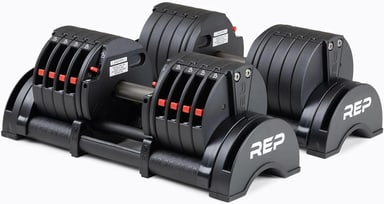
REP's QuickDraw swaps the dial for a row of steel switches, one per plate: flip a switch to lock a plate on or leave it in the cradle. The pair here runs 5 to 50 lb with included 2.5 lb micro plates, and REP sells add-on plates that take each dumbbell to 60 lb. The flat-bottom, mostly steel build sets down like a fixed metal dumbbell.
- Weight range
- 5 to 50 lb per dumbbell as sold; add-on plates take it to 60 lb
- Increments
- 5 lb steps; 2.5 lb steps with the included micro plates (slightly unbalanced); several switches at once for 10 lb jumps
- Adjustment mechanism
- Lock-N-Load steel switches, one per plate
- Handle
- 32 mm fully knurled, nickel-plated steel
- Length
- 12.2" at 30 lb up to 18.5" at 60 lb (REP)
- Warranty
- Lifetime (REP)
- Sold as
- Pair, in 30, 40, 50, or 60 lb versions
More strengths
- 2.5 lb steps with the included micro plates, and expandable to 60 lb per dumbbell
- 32 mm knurled handle and flat bottom that will not roll
Other tradeoffs
- Priced above the BowFlex 552 for a similar range
The QuickDraw replaces dials with a row of steel "Lock-N-Load" switches, one per plate, which REP says are cycle-tested over 100,000 times. The build is mostly steel with a 32 mm knurled handle and a flat bottom that will not roll, and REP backs it with a lifetime warranty. Garage Gym Reviews names it the best durable adjustable dumbbell, and BarBend its best budget set.
This listing is the 5 to 50 lb pair. It changes in 5 lb steps, or 2.5 lb with the included micro plates (which leaves the dumbbell slightly unbalanced), and REP sells add-on plates that take each dumbbell to 60 lb. Length grows with the load, from 12.2 inches at 30 lb to 18.5 inches at 60 lb. Wirecutter tested the 60 lb version and did not pick it, so if speed matters most, the Core or BowFlex is quicker.
Range: 5 to 50 lb (60 lb with add-ons) | Steps: 5 lb, 2.5 lb with micro plates | Warranty: lifetime
Most versatile: NordicTrack 55 lb Select-a-Weight
MOST VERSATILE
NordicTrack 55 lb Select-a-Weight Dumbbell Pair
Best for: Home gym users on a firm budget who train in the 10 to 55 lb range and want the most weight for the money without paying for premium mechanisms.
- 55 lb ceiling is the highest among the 50 lb class sets in this roundup
- 10 lb minimum is too heavy for some rehab and shoulder warm-up work
Kit Score 7.5/10 · $399.00 Price checked Oct 23, 4:16 PM CDT · how we score gear
Buy on AmazonProduct details
The Select-a-Weight moves through 15 settings from 10 to 55 lb per dumbbell in 2.5, 5, and 10 lb steps, and the 10 lb handle works on its own as a light dumbbell. The pair ships with fitted storage trays. It reaches a little higher than the BowFlex 552, which makes it the straightforward value pick for lifters who start at 10 lb or more.
- Weight range
- 10 – 55 lb per dumbbell
- Increments
- 2.5, 5, and 10 lb steps (15 settings)
- Adjustment mechanism
- Selector pins on the weight stack
- Construction
- Steel and hardened plastic; 10 lb handle; fitted storage trays (no stand included)
- Warranty
- 10-year frame, 2-year parts, 1-year labor (NordicTrack)
- Replaces
- 15 pairs of fixed dumbbells
More strengths
- 15 settings in 2.5, 5, and 10 lb steps, so small jumps are available for presses and raises
- The 10 lb handle doubles as a light dumbbell, and the trays mark each weight clearly
Other tradeoffs
- Long at about 16 inches or more, and the matching stand is sold separately
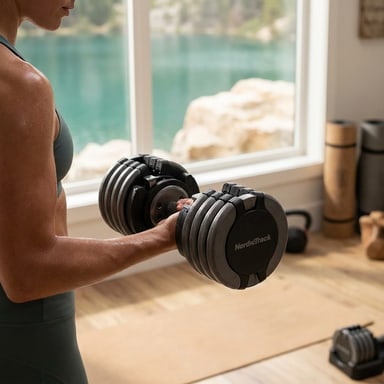
NordicTrack's set runs from 10 to 55 lb in 15 settings, in 2.5, 5, and 10 lb steps, and the 10 lb handle works on its own as a light dumbbell. Garage Gym Reviews calls it the most versatile set and BarBend the most ergonomic. NordicTrack lists a 10-year frame, 2-year parts, and 1-year labor warranty.
Two things an earlier version of this guide got wrong: the pair ships with fitted storage trays, not a stand (NordicTrack sells the stand separately), and it changes in 2.5 lb steps as well as 5 lb steps. The 10 lb floor is the real limit: it is too heavy for some rehab and warm-up work, where the BowFlex or PowerBlock starts at 5 lb.
Range: 10 to 55 lb | Steps: 2.5, 5, and 10 lb | Warranty: 10 years frame, 2 years parts
Best budget: Yes4All 50 lb spinlock set
BEST BUDGET
Yes4All Adjustable Weights Dumbbells Set, 50 lb
Best for: True beginners, light home trainers, or anyone starting a home gym on a tight budget who does not need fast weight changes and values simplicity over convenience.
- Lowest price in the category by a wide margin
- Star-lock collar adjustments take 30 to 60 seconds per weight change versus 2 to 5 seconds for pin or dial systems, making super-sets and circuit training impractical
Kit Score 7.3/10 · $70.60 Price checked Oct 23, 4:16 PM CDT · how we score gear
Buy on AmazonProduct details
Yes4All's 50 lb set is two 14-inch spinlock handles, four 3 lb and four 7.5 lb cast iron plates, four collars, and a connector that joins the handles into a short barbell. The 50 lb is the total weight of the set, so each dumbbell tops out around 25 lb. There are no mechanisms to jam and no proprietary parts: standard 1-inch plates fit if you want to add weight later.
- Weight range
- 50 lb total: about 25 lb per dumbbell with all plates loaded
- Adjustment mechanism
- Star-lock (spinlock) collars, standard 1" plate holes
- Handle dimensions
- 14" x 1" chrome steel handles
- Plate material
- Cast iron with powder-coated finish
- In the box
- Two 14" x 1" handles, four 3 lb and four 7.5 lb plates, four collars, one connector bar
- Compatibility
- Standard 1" plates from any manufacturer
More strengths
- No proprietary parts or mechanisms: standard 1" plates are universally compatible and star-lock collars are a commodity replacement part
- Cast iron plates should outlast most selectorized plastic mechanisms with normal use
Other tradeoffs
- Paint on the plates chips with regular use; round plate design causes rolling on uneven floors between sets
This is the old-school option: two 14-inch threaded handles, four 3 lb and four 7.5 lb cast iron plates, four collars, and a connector that joins the handles into a short barbell. The 50 lb on the box is the total for the whole set, so each dumbbell tops out around 25 lb. An earlier version of this guide listed it as 50 lb per dumbbell, which was wrong.
Changing weight means spinning off a collar, sliding plates, and spinning it back on, which is slow for supersets. In exchange you get the lowest price here and standard 1-inch plates, so you can add iron later from any brand. Wirecutter tested Yes4All's cast iron set and did not pick it; buy it for light, straight-set training on a tight budget.
Range: about 25 lb per dumbbell | Steps: depends on plates | Change: spin collars
Most of the price difference between these sets buys one of three things: a higher ceiling, smaller steps, or a shorter dumbbell. Decide which one you need before you compare brands.
Compare the picks
| Spec | BowFlex 552 | Core Home Fitness | NÜOBELL 80 | PowerBlock Elite USA 90 | PowerBlock Pro 50 | REP QuickDraw | NordicTrack 55 | Yes4All 50 lb |
|---|---|---|---|---|---|---|---|---|
| Kit Score | 7.6/10 | 8.0/10 | 8.1/10 | 8.6/10 | 8.3/10 | 8.4/10 | 7.5/10 | 7.3/10 |
| Price | $399.99 Price checked Oct 23, 4:16 PM CDT | $349.99 Price checked Oct 23, 4:16 PM CDT | $730.55 Price checked Oct 23, 4:16 PM CDT | $869.00 Price checked Oct 23, 4:16 PM CDT | $549.00 Price checked Oct 23, 4:16 PM CDT | $495.99 Price checked Oct 23, 4:16 PM CDT | $399.00 Price checked Oct 23, 4:16 PM CDT | $70.60 Price checked Oct 23, 4:16 PM CDT |
| Best for | Home gym users who want the fastest possible weight changes, train in the 5 to 50 lb range, and prioritize a compact footprint with an included tray. | People who change weight often in circuits and supersets and want a compact 5 to 50 lb pair. | Strong lifters who want one pair that reaches 80 lb and still feels like a traditional round dumbbell. | Lifters who already press or row 50 lb dumbbells, or expect to, and want one set that reaches 90 lb. | Lifters who train consistently at home and want a set that will survive a decade of use without mechanical failure, particularly those working in the 5 to 50 lb range and willing to adapt to the cage grip. | Lifters who want a mostly steel adjustable set with small steps and room to grow to 60 lb. | Home gym users on a firm budget who train in the 10 to 55 lb range and want the most weight for the money without paying for premium mechanisms. | True beginners, light home trainers, or anyone starting a home gym on a tight budget who does not need fast weight changes and values simplicity over convenience. |
| Why it stands out | Turn a dial at each end while the dumbbell sits in its tray; no pins or collars to handle | One-handed twist change in the cradle, with no dials or pins to line up | 80 lb per hand with a round, classic shape, the heaviest traditional-looking set here | Highest ceiling in this guide: 90 lb per hand, with 2.5 lb steps at most weights | No dial or internal ratchet to fail: a steel weight stack and a magnetic pin | Steel switches instead of internal plastic gearing; REP says they are cycle-tested over 100,000 times | 55 lb ceiling is the highest among the 50 lb class sets in this roundup | Lowest price in the category by a wide margin |
| Tradeoff | 52.5 lb ceiling limits utility for intermediate and advanced lifters on squats, lunges, and Romanian deadlifts | 5 lb steps only, coarser than the BowFlex or PowerBlock at light weights | 5 lb steps only, with no 2.5 lb option for small lifts like lateral raises | The square cage around the handle feels different from a round dumbbell and can bump the forearms on curls and flyes | Cage and rectangular block shape is polarizing: limits wrist rotation on movements like goblet squats and some pressing variations | Flipping several switches is slower than a single dial when you jump a long way | 10 lb minimum is too heavy for some rehab and shoulder warm-up work | Star-lock collar adjustments take 30 to 60 seconds per weight change versus 2 to 5 seconds for pin or dial systems, making super-sets and circuit training impractical |
| Range per dumbbell | 5 to 52.5 lb | 5 to 50 lb | 5 to 80 lb | 5 to 90 lb | 5 to 50 lb | 5 to 50 lb (60 with add-ons) | 10 to 55 lb | About 25 lb |
| Smallest step | 2.5 lb (to 25 lb) | 5 lb | 5 lb | 2.5 lb | 2.5 lb | 2.5 lb with micro plates | 2.5 lb | Plate sizes |
| Settings | 15 | 10 | 16 | 27 | 19 | Varies by plates | 15 | Varies |
| Length | 16.9 in | 9.3 to 14.5 in | 17 in | 16.25 in | 13 in | 12.2 to 18.5 in | Not published | 14 in handle |
| Change method | End dials | Twist handle | Twist handle | Magnetic pin | Magnetic pin | Steel switches | Selector pins | Spin collars |
| Warranty | 2 yr parts | 2 yr parts | 2 yr | 5 yr | 5 yr | Lifetime | 10 yr frame, 2 yr parts | Not published |
How to choose adjustable dumbbells
The numbers that matter
Top weight
Take the heaviest dumbbell you use for rows or presses today and add about 10 lb of room to progress. Most home lifters are covered by 50 lb. If you already row 50 lb, go to the PowerBlock Elite USA 90 or the NÜOBELL 80.
Smallest step
Shoulders and arms progress in small jumps. A 5 lb jump from 10 to 15 lb is a 50% increase, so sets with 2.5 lb steps (BowFlex, PowerBlock, NordicTrack, REP) make light work easier to progress.
Length
A long dumbbell hits your thighs on curls and your chest on close-grip presses. The PowerBlock Pro 50 (13 in) and the Core at light loads are the shortest; the NÜOBELL (17 in) and BowFlex (16.9 in) are the longest.
Change method
Dials and twist handles are fastest for circuits and supersets. Pins are quick but need two hands. Spinlock collars are slow and suit straight sets with rest between them.
Warranty and drops
Selector dumbbells are not made to be dropped, and some warranties exclude it. If you train hard, the REP lifetime warranty and PowerBlock 5-year warranty carry the most cover.
Still deciding between adjustable and a rack of fixed dumbbells? Our adjustable vs fixed dumbbells comparison covers cost, space, and change speed, and dumbbells vs kettlebells covers which tool suits which training. If you are building a full room, start with how to build a home gym on a budget and pair the dumbbells with one of the best weight benches.
Frequently asked questions
What are the best adjustable dumbbells in 2026?
The BowFlex Results Series 552 is the best pick for most people: 5 to 52.5 lb in 15 settings, 2.5 lb steps at the light end, and the post-recall redesign. The Core Home Fitness set is Wirecutter's top pick and the fastest to change. For heavier work, the PowerBlock Elite USA 90 reaches 90 lb and the NÜOBELL reaches 80 lb.
Is the BowFlex SelectTech 552 safe after the recall?
The recall covers the original BowFlex 552 and 1090 dumbbells sold before the Results Series. The CPSC notice dated June 5, 2025 says their plates can dislodge from the handle during use. The Results Series 552, released in August 2025, is the redesigned version BowFlex now sells and offers as a recall replacement. If you own an older pair, stop using it and follow the remedy steps in the CPSC notice.
What weight range of adjustable dumbbells do I need?
For most people starting a home gym, 5 to 50 lb per hand covers presses, rows, curls, raises, and light lower-body work. If you already use 45 to 50 lb dumbbells at the gym, choose a set that reaches at least 70 to 90 lb, such as the PowerBlock Elite USA 90 or the NÜOBELL 80. If you only need light weights for toning or rehab, a 50 lb spinlock set like the Yes4All (about 25 lb per dumbbell) is enough.
Can the PowerBlock Pro 50 be expanded?
No. PowerBlock lists the Pro 50 as a non-expandable model that cannot go past 50 lb per hand. PowerBlock's expandable line is the Elite USA, which starts at 50 lb and grows to 70 and 90 lb with stage kits.
Are adjustable dumbbells worth it over a fixed set?
For most home gyms, yes. The sets here cover 10 to 27 weight settings each in the space of two dumbbells, where a fixed rack needs one pair per weight. Fixed dumbbells still win on change speed between exercises and on durability when dropped, so they make sense if you have the floor space and only use a few weights.
Where these numbers come from
| Claim | Source | Checked |
|---|---|---|
| Recall of the original BowFlex 552 and 1090: June 5, 2025, about 3.8 million units (3.7 million sold by Nautilus), plates can dislodge, 337 Nautilus reports and 111 injuries | CPSC recall notice | 2026-10-03 |
| BowFlex Results Series 552: pair, 5 to 52.5 lb, 15 settings, 16.9 x 8.3 x 9 in, 2-year parts warranty, trays included; metal tabs secure the plates; released August 2025 | BowFlex Results Series 552 and BowFlex launch post | 2026-10-03 |
| Core Home Fitness: 5 to 50 lb in 5 lb steps, 9.3 in long at 5 lb and 14.5 x 7.9 x 7.5 in at 50 lb, twist handle, 2-year parts warranty, cradles included | Core Home Fitness | 2026-10-03 |
| Core is Wirecutter's top pick and changes weight faster than the other sets it tested; Wirecutter also tested the NordicTrack 55, PowerBlock Pro 50, REP QuickDraw, and Yes4All without picking them | Wirecutter, best adjustable dumbbells | 2026-10-03 |
| NÜOBELL 80: 5 to 80 lb in 5 lb steps, 16 settings, 17 x 7.5 x 7.5 in, pair with cradles, 2-year warranty extendable to 5 | NÜOBELL 80 lb (Smrtft) | 2026-10-03 |
| PowerBlock Elite USA 90: 5 to 90 lb, 2.5 and 5 lb steps, 16.25 x 6 x 6 in, 50 lb starter expands to 70 and 90 lb, plates made in Owatonna, Minnesota, 5-year warranty; 27 settings and the 500 lb pin rating are from PowerBlock's Amazon listing B0BSR6JN85 | PowerBlock Elite USA 90 | 2026-10-03 |
| PowerBlock Pro 50: 5 to 50 lb, 19 settings in 2.5 lb steps, 13 x 7 x 7.25 in, non-expandable, 5-year residential warranty | PowerBlock Pro 50 | 2026-10-03 |
| REP QuickDraw: 5 lb minimum, 60 lb maximum with add-ons, 5 lb steps or 2.5 lb with micro plates, 12.2 in at 30 lb to 18.5 in at 60 lb, lifetime warranty; switches cycle-tested over 100,000 times and 32 mm knurled handle per REP's Amazon listing B0CQ9PRSXP | REP QuickDraw | 2026-10-03 |
| NordicTrack 55 lb Select-a-Weight: 10 to 55 lb, 15 settings, tray included and stand sold separately, 10-year frame, 2-year parts, 1-year labor warranty; 10 lb handle per NordicTrack's Amazon listing B08BDD6GPC | NordicTrack Select-a-Weight | 2026-10-03 |
| Yes4All 50 lb set: two 14 x 1 in handles, four 3 lb and four 7.5 lb plates, four collars, one connector; 50 lb total for the pair | Amazon listing B0CSXYW71X | 2026-10-03 |
| Awards: Garage Gym Reviews (NÜOBELL best overall, REP best durable, NordicTrack most versatile, BowFlex 552 best for beginners); BarBend (NÜOBELL most user-friendly, REP best budget, NordicTrack most ergonomic); Verywell Fit (PowerBlock Elite best overall, NÜOBELL best investment); CNN Underscored (Core best budget) | Garage Gym Reviews, BarBend, Verywell Fit, CNN Underscored | 2026-10-03 |
Every figure is the maker's or a publication's number; none is a Kit Authority measurement.
For more home strength gear, browse the fitness hub, or read how we research and rate gear.
Keep going
Our recommendations draw on manufacturer documentation, retailer listings, owner feedback, and comparisons with alternatives.
As an Amazon Associate I earn from qualifying purchases. We may earn a commission from links here, at no extra cost to you. How we research →
Top picks
 Best OverallBowFlex Results Series 552 SelectTech Dumbbells (Pair)7.6/10
 Fastest ChangeCore Home Fitness Adjustable Dumbbell Set, 5 to 50 lb (Pair)8.0/10
 Best PremiumNÜOBELL Adjustable Dumbbells, 5 to 80 lb (Pair)8.1/10
 Best For Heavy LiftingPowerBlock Elite USA 90 Adjustable Dumbbells (Pair)8.6/10
 Most CompactPowerBlock Pro 50 Adjustable Dumbbells (Pair)8.3/10