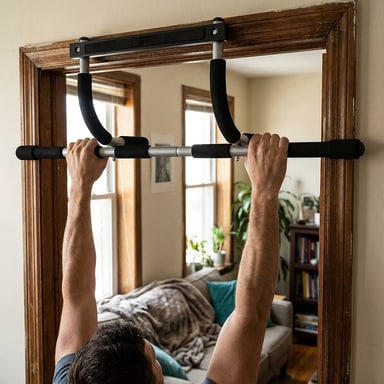
Yes, a doorway pull-up bar is safe for controlled pull-ups when your trim and frame can carry the load and you stay under the bar's static weight rating: 300 lb on the Iron Gym leverage bar, which is built for 24 to 32 in doorways. It is not the right tool for kipping, weighted, or swinging work, because movement multiplies the force on the bar; biomechanics researchers measured peak ring-cable tension above 9 times bodyweight in elite gymnastic swings (Brewin, Yeadon and Kerwin, 2000). The danger is almost never the bar itself. It is the mismatch between the bar, your trim, and how you set it up.
Buy for the frame you have
The highest advertised weight limit does not make an incompatible doorway safe. Match the mount to the structure before comparing grips or accessories.
- Solid wood trim that projects enough for a cradle, controlled pull-ups only: the Iron Gym leverage bar is the simplest removable option. Inspect the trim and test it close to the floor before every session.
- Thin, flush, flexible, or damaged trim: skip doorway models. A REP wall-mounted bar installed into suitable framing removes the trim from the load path.
- Kipping, weighted pull-ups, or explosive work: use a properly installed wall- or ceiling-mounted bar. A doorway rating is not a dynamic-load rating.
- You cannot confirm what is behind the trim: do not buy yet. The safe answer is an inspection, not a stronger-looking doorway bar.
Our quick picks
Iron Gym Total Upper Body Workout Bar for Doorway
Sub-$50 entry point with no permanent hardware required, ideal for renters
Best for: Renters and beginners who want zero-install pull-up access and can confirm a standard 24"–32" doorway with solid molding.
Buy on Amazon →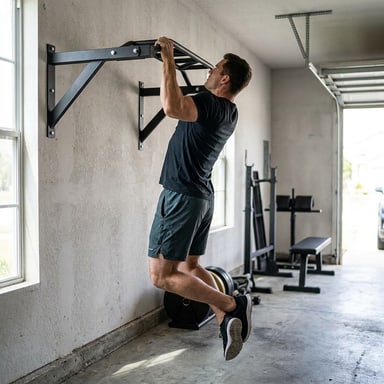
How the two types actually hold you up
Nearly every doorway bar sold today is one of two designs, and they fail in completely different ways.
A leverage-mount bar (sometimes called a doorway gym or cradle bar, with the Iron Gym Total Upper Body Workout Bar as the classic example) is the safer of the two. It uses leverage: the bar hooks over the top of the door trim with a cushioned cradle, and your bodyweight presses the long arm down against the wall above the door. The harder you pull, the more firmly it locks against the frame. It does not rely on friction, so it cannot suddenly slip the way a pressure bar can. The trade-off is that it needs trim or molding with enough projection (roughly 3.5 inches or more of usable depth) for the cradle to grab.
A telescoping pressure bar is a spring-loaded tube you twist to expand until it wedges between the two sides of the door jamb. It holds by friction and friction alone. There are no hooks and nothing mechanical capturing the frame. It is cheaper, leaves no marks, and is genuinely fine for light use, but it is also the design behind almost every viral pull-up bar failure video. If the friction is overcome, by a swing, a paint-slick jamb, or a slightly-too-narrow setup, it lets go instantly.
The leverage bar gets stronger the harder you pull. The pressure bar is only ever as strong as the friction holding it.
How much weight can a doorway pull-up bar hold?
Most doorway bars list a maximum user weight between 220 and 300 pounds; the Iron Gym Total Upper Body Workout Bar, the most-reviewed leverage bar on Amazon, is listed at 300 lb and a 24 to 32 in doorway. Treat that number as a static rating, not a license to thrash around.
The key point: a rating is a static number. Hanging dead still loads the bar at exactly your bodyweight. The moment you kip, swing, or drop into the hang, you add acceleration on top of gravity and the bar sees more than you weigh. How much more depends on how hard you swing. At the extreme end, sports biomechanists who instrumented the cables on gymnastics rings measured peak tension "typically in excess of 9 bodyweights" during elite backward longswings (Brewin, Yeadon and Kerwin, 2000). A kipping pull-up is nowhere near a ring longswing, but it is the same physics, and a 200 lb athlete does not need to get anywhere close to 9x to push past a 300 lb doorway rating. This is exactly why people under the rated weight still experience failures. Stay within the rating and keep your movement controlled, especially with a pressure bar.
What kind of doorframe does a pull-up bar need?
The bar can be rated for 300 pounds and still be unsafe if the frame behind it is not. Check the frame before you trust the bar.
Check before you mount
Width
Measure the opening. Check the bar's listed range; the Iron Gym, for example, is built for 24 to 32 inch doorways. Too narrow and a pressure bar may not extend enough to seat; too wide and it cannot reach.
Trim and molding
A leverage bar needs solid wood trim that projects far enough for the cradle to hook. Thin, flush, or decorative trim that flexes is a no.
Wall above the door
For leverage bars, the long arm presses here. Make sure it is solid wall, not hollow above the frame, and protect the paint with the included pads.
Jamb condition
For pressure bars, the jamb must be flat, painted (not glossy and slick), and structurally sound. Loose or hollow jambs will not hold friction reliably.
Wear and movement
Recheck every few weeks. Cushions compress, trim can dent, and a bar that was snug can loosen over time.
How to test before you trust it with full bodyweight
Never go from installation straight to a full set. Build trust in stages, and keep the floor close.
- Set the bar up exactly as the instructions specify, with all pads and the correct extension or cradle position.
- With both hands, press and pull on the bar from the floor to feel for any shift, twist, or trim flex.
- Hang with your feet still touching the ground, taking on maybe half your weight, and hold for several seconds while watching the mount points.
- Only then lift your feet for a brief dead hang, just an inch or two off the floor, so a slip means a small step down, not a fall.
- If anything moves, creaks abnormally, or the trim deflects, stop and reassess the frame or the bar choice.
Doing your first hangs an inch off the floor is the single cheapest safety habit there is. A pressure bar that is going to let go usually does it in the first few seconds of real load.
Who should skip the doorway bar entirely
Doorway bars are a great fit for many people, but some situations call for a mounted bar from the start. Choose a wall- or ceiling-mounted bar lagged into studs or joists if:
- You are near or above the weight rating, since a mounted bar with proper hardware can be rated far higher.
- You want to kip, do muscle-ups, or add a weight belt, all of which spike dynamic load well beyond what a doorway frame should absorb.
- Your trim is thin, flush, decorative, or laminate, or your jambs are hollow, glossy, or loose.
- You are mounting where a fall would be dangerous (over stairs, hard tile, near furniture) or where children might hang on it unsupervised.
If the doorway fails: use a wall-mounted bar
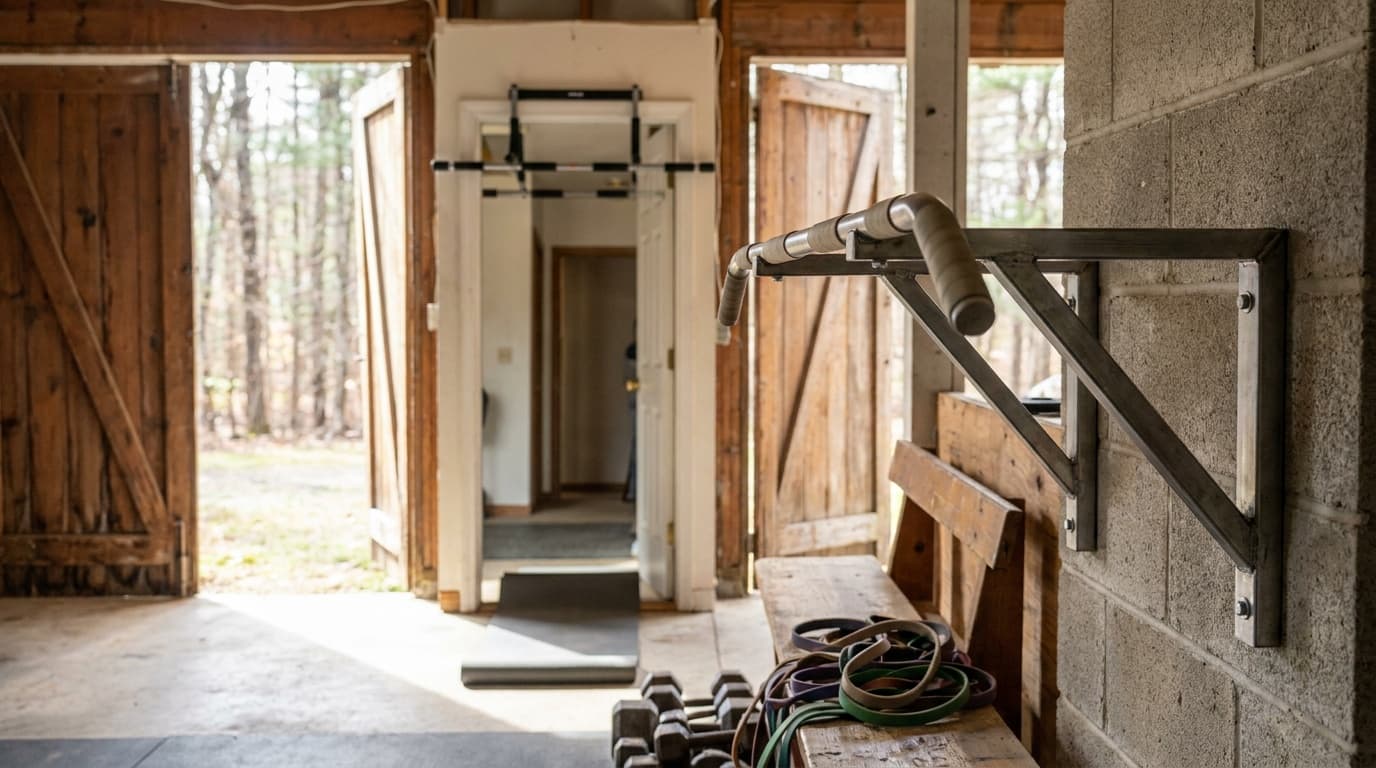
A wall-mounted bar transfers the load to structural studs instead of door trim. The REP Fitness Wall-Mounted Multi-Grip Pull-Up Bar uses 1.25 in steel bars with a nonslip powder coat, offers traditional, neutral, close, wide, and angled grips, and REP rates it to 700 lb when installed properly. It is the better path when the doorway fails any check above, but only if it is mounted correctly into suitable framing.
BEST PERMANENT OPTION
REP Fitness Heavy Duty Pull-Up Bar, Wall Mounted Multi-Grip
Best for: Serious home gym builders who want a permanent, rack-quality pull-up station with the highest capacity in the category and editorial recognition from major fitness publications.
- 700 lb capacity is the highest in this roundup, with REP Fitness known for rack-quality construction
- Smaller owner-review pool than mass-market bars (89 reviews on REP's store)
Kit Score 8.5/10 · Check current price · how we score gear
Buy at REP FitnessProduct details
REP Fitness built this bar to mirror the quality of their power racks: 700 lb rated, with multiple grip positions including neutral and angled handles. Priced at $139.99 direct from REP (list $164.99) and compatible with rings, straps, and bands. Named Best Pull-Up Bar Overall by BarBend.
- Type
- Wall mount
- Weight capacity
- 700 lb (REP spec, installed properly)
- Bar diameter
- 1.25" with nonslip finish
- Grip options
- 5+ positions (traditional, neutral, close, wide, angled)
- Material
- Steel, nonslip powder coat
- Wall-out depth
- 21.5 in
More strengths
- Five-plus distinct grip positions including angled handles, all with nonslip finish
- Compatible with bands, gymnastic rings, and suspension trainers, expanding training variety without extra hardware
Other tradeoffs
- Grip surfaces are not knurled, which some experienced lifters prefer for maximal grip security during heavy sets
- Needs two studs, drilling, and lag bolts; not an option for most renters
Frequently asked questions
Will a doorway pull-up bar damage my door frame?
Used correctly, leverage bars distribute load through padded contact points and rarely cause damage beyond minor paint compression where the cushions sit. Pressure bars can dent or scuff the jamb if over-tightened. The real risk is to thin or laminate trim under repeated leverage load, which can crack or peel. Use every pad the bar ships with, and inspect the contact points regularly.
Are telescoping pressure bars safe to use at all?
Yes, for controlled use within the weight rating on a sound, flat, non-glossy jamb of the right width. They hold purely by friction, so they are unforgiving of swinging, kipping, or a slightly-too-narrow fit. If you want explosive movements, are near the weight limit, or have any doubt about your jamb, a leverage-mount or wall-mounted bar is the safer choice.
How do I know if my doorway is wide enough?
Measure the inside opening of the frame and check it against the bar's listed range (the Iron Gym is 24 to 32 inches). A telescoping bar needs to extend enough to seat firmly without bottoming out its threads, and a leverage bar needs trim it can fully hook. If your opening falls outside the listed range, the bar will not seat safely, and a mounted option is the better path.
Where these numbers come from
| Claim | Source | Checked |
|---|---|---|
| Iron Gym Total Upper Body Workout Bar: heavy-duty steel, supports up to 300 lb, doorway should be 24 to 32 in wide, holds by leverage with no screws | Iron Gym listing, Amazon | Sep 2026 |
| REP Wall-Mounted Multi-Grip Pull-Up Bar: 700 lb capacity when installed properly, 1.25 in bars, nonslip powder coat, five grip positions | REP Fitness product page | Sep 2026 |
| Peak combined ring-cable tension during backward longswings is typically in excess of 9 bodyweights | Brewin, Yeadon and Kerwin, Minimising peak forces at the shoulders during backward longswings on rings, Human Movement Science 19 (2000), 717–736 | Sep 2026 |
The trim-depth and jamb guidance above is mechanical reasoning about how each mount type carries load, not a manufacturer spec. Iron Gym's own listing says the bar fits most doorways; it does not publish a minimum trim projection, so the safe test is the floor-level load check described above, every time.
For specific model picks, see our guide to the best pull-up bars. Browse all fitness guides or read how we research and rate gear.
Recommended gear
Our current top picks from the Best Pull-Up Bars for Home Gyms (2026): Doorway to Wall-Mounted guide, if you are ready to buy.
IRON GYM
Iron Gym Total Upper Body Workout Bar for Doorway
Best Budget
Kit Score 7.4/10
$47.99 Price checked Oct 23, 4:16 PM CDT
Best for: Renters and beginners who want zero-install pull-up access and can confirm a standard 24"–32" doorway with solid molding.
- Sub-$50 entry point with no permanent hardware required, ideal for renters
- Fits only 24"–32" doorways with solid trim, leaving many modern or non-standard frames incompatible
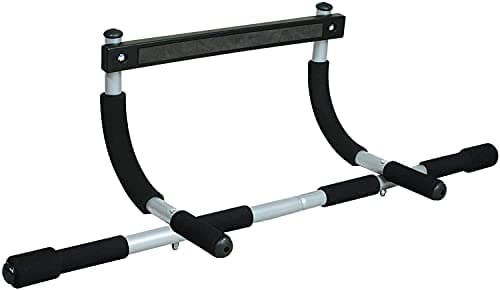
- Type
- Doorway leverage-mount
- Weight capacity
- 300 lb
- Door width
- 24"–32"
- Grip positions
- 3 (wide, neutral, narrow)
- Install
- No screws, no tools
- Doorway fit
- 24 to 32 in wide (per listing)
About this pick
The original leverage-style doorway bar: hook it over the frame, weight locks it in place, remove it in seconds. One of the longest-running pull-up bars on Amazon (listed since 2010), rated to 300 lb, with a very large owner-review base.
Strengths
- Sub-$50 entry point with no permanent hardware required, ideal for renters
- Three grip positions cover wide-overhand, neutral parallel, and narrow underhand variations
- Long sales history with verified owner reports of units lasting many years
Weaknesses
- Fits only 24"–32" doorways with solid trim, leaving many modern or non-standard frames incompatible
- Foam grips compress with daily heavy use, and door trim can show cosmetic marks over time
- Needs sturdy door trim to lever against; hollow or recently painted molding can mark
Kit Score breakdown
REP FITNESS
REP Fitness Heavy Duty Pull-Up Bar, Wall Mounted Multi-Grip
Editor's Choice
Kit Score 8.5/10
Best for: Serious home gym builders who want a permanent, rack-quality pull-up station with the highest capacity in the category and editorial recognition from major fitness publications.
- 700 lb capacity is the highest in this roundup, with REP Fitness known for rack-quality construction
- Smaller owner-review pool than mass-market bars (89 reviews on REP's store)
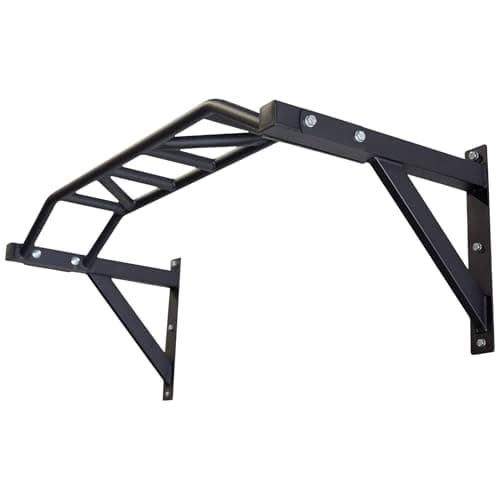
- Type
- Wall mount
- Weight capacity
- 700 lb (REP spec, installed properly)
- Bar diameter
- 1.25" with nonslip finish
- Grip options
- 5+ positions (traditional, neutral, close, wide, angled)
- Material
- Steel, nonslip powder coat
- Wall-out depth
- 21.5 in
About this pick
REP Fitness built this bar to mirror the quality of their power racks: 700 lb rated, with multiple grip positions including neutral and angled handles. Priced at $139.99 direct from REP (list $164.99) and compatible with rings, straps, and bands. Named Best Pull-Up Bar Overall by BarBend.
Strengths
- 700 lb capacity is the highest in this roundup, with REP Fitness known for rack-quality construction
- Five-plus distinct grip positions including angled handles, all with nonslip finish
- Compatible with bands, gymnastic rings, and suspension trainers, expanding training variety without extra hardware
Weaknesses
- Smaller owner-review pool than mass-market bars (89 reviews on REP's store)
- Grip surfaces are not knurled, which some experienced lifters prefer for maximal grip security during heavy sets
- Needs two studs, drilling, and lag bolts; not an option for most renters
Kit Score breakdown
See all picks in Best Pull-Up Bars for Home Gyms (2026): Doorway to Wall-Mounted
Keep going
Complete loadoutHome calisthenics kitA compact strength and conditioning setup built around five tools that cover pushing, pulling, assistance, cardio, and floor work.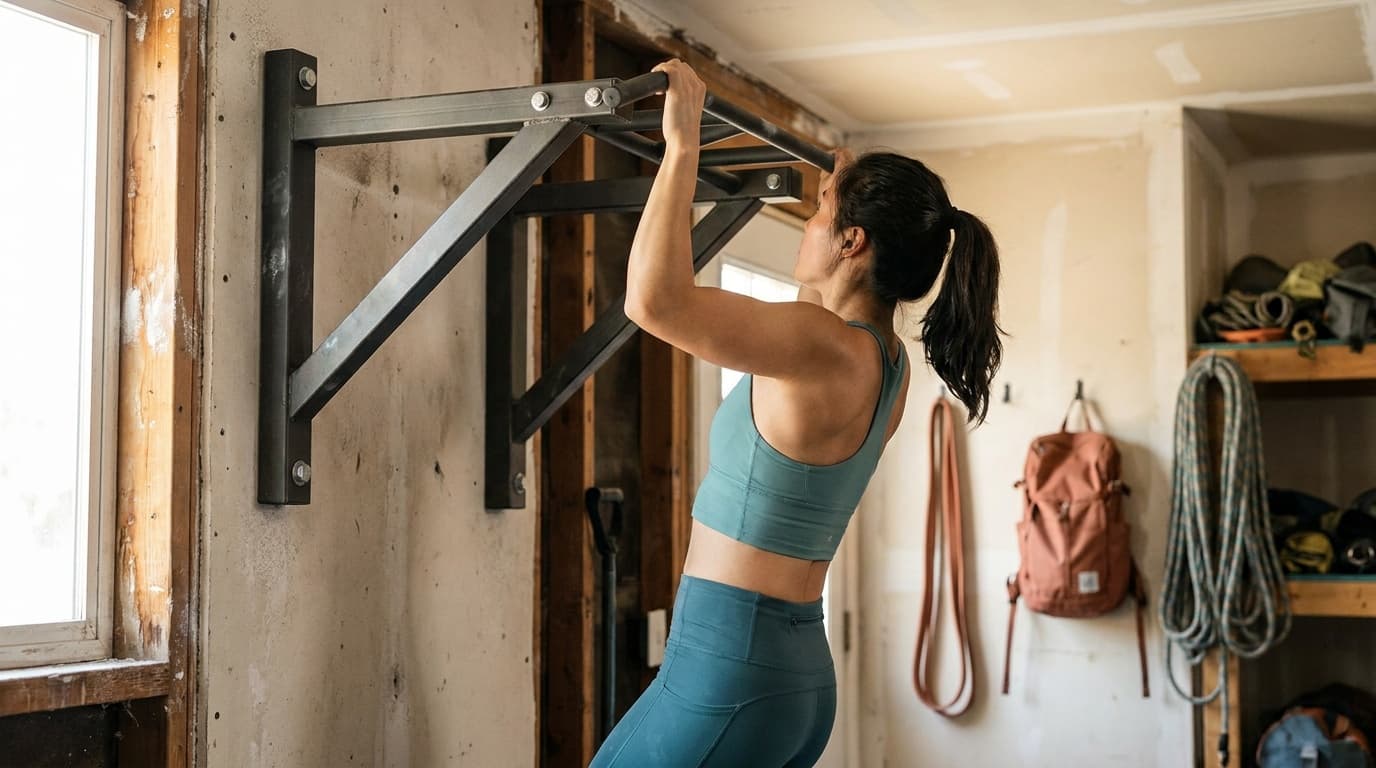

Researched, not hands-on tested
Updated Oct 7, 2026Our recommendations draw on manufacturer documentation, retailer listings, owner feedback, and comparisons with alternatives.
As an Amazon Associate I earn from qualifying purchases. We may earn a commission from links here, at no extra cost to you. How we research →