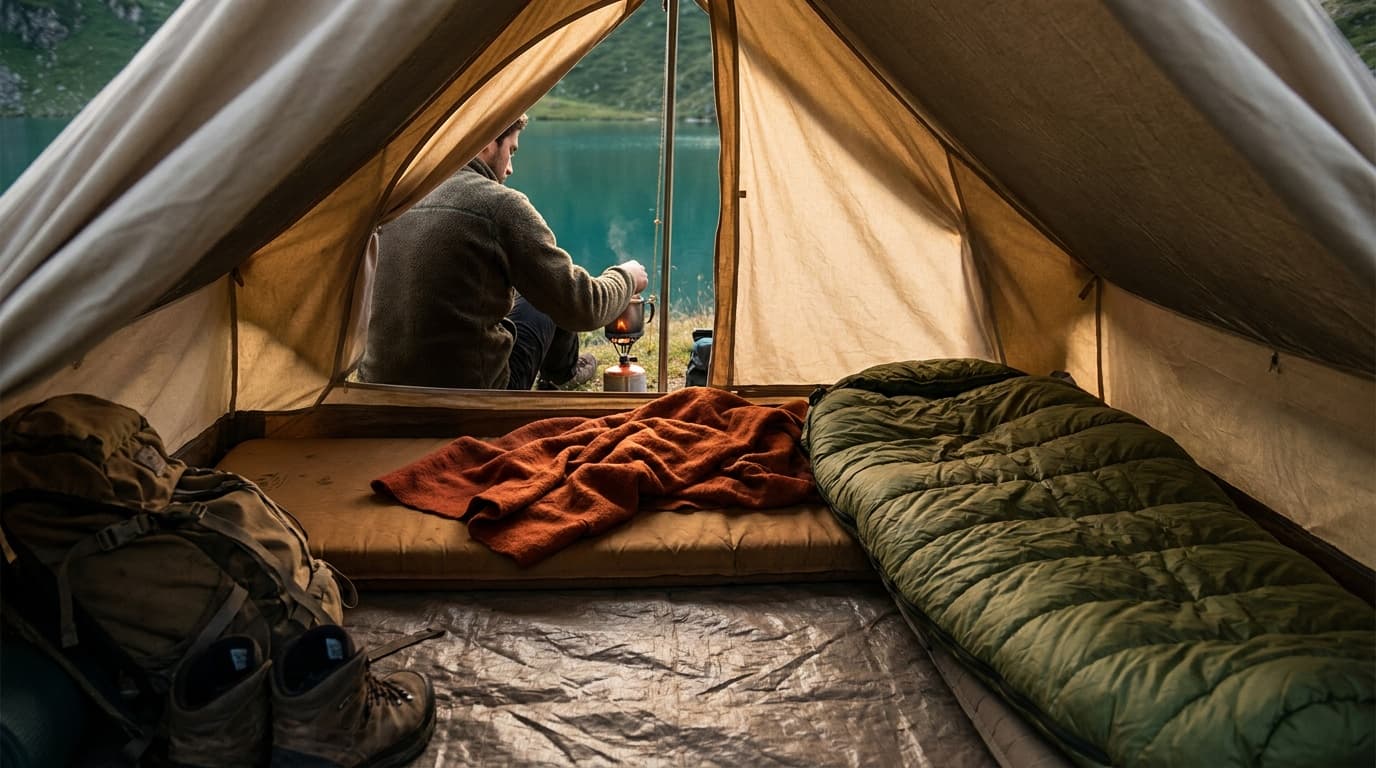
A tent is the safer choice for most campers because it works across more terrain, weather, sleep positions, and group setups. Choose a hammock when you regularly camp among suitable trees, value a smaller fair-weather pack, and already know suspended sleep works for you. The full hammock system needs a tarp, insulation, and suspension, so compare complete systems rather than a bare hammock against a complete tent.
Ready to choose a system? Compare the best camping hammocks or start with the best camping tents for beginners.
Weight and packability
A bare hammock is hard to beat. Mid-range doubles like the ENO DoubleNest and Kammok Roo Double weigh 19 and 17.1 ounces respectively before suspension or shelter components.
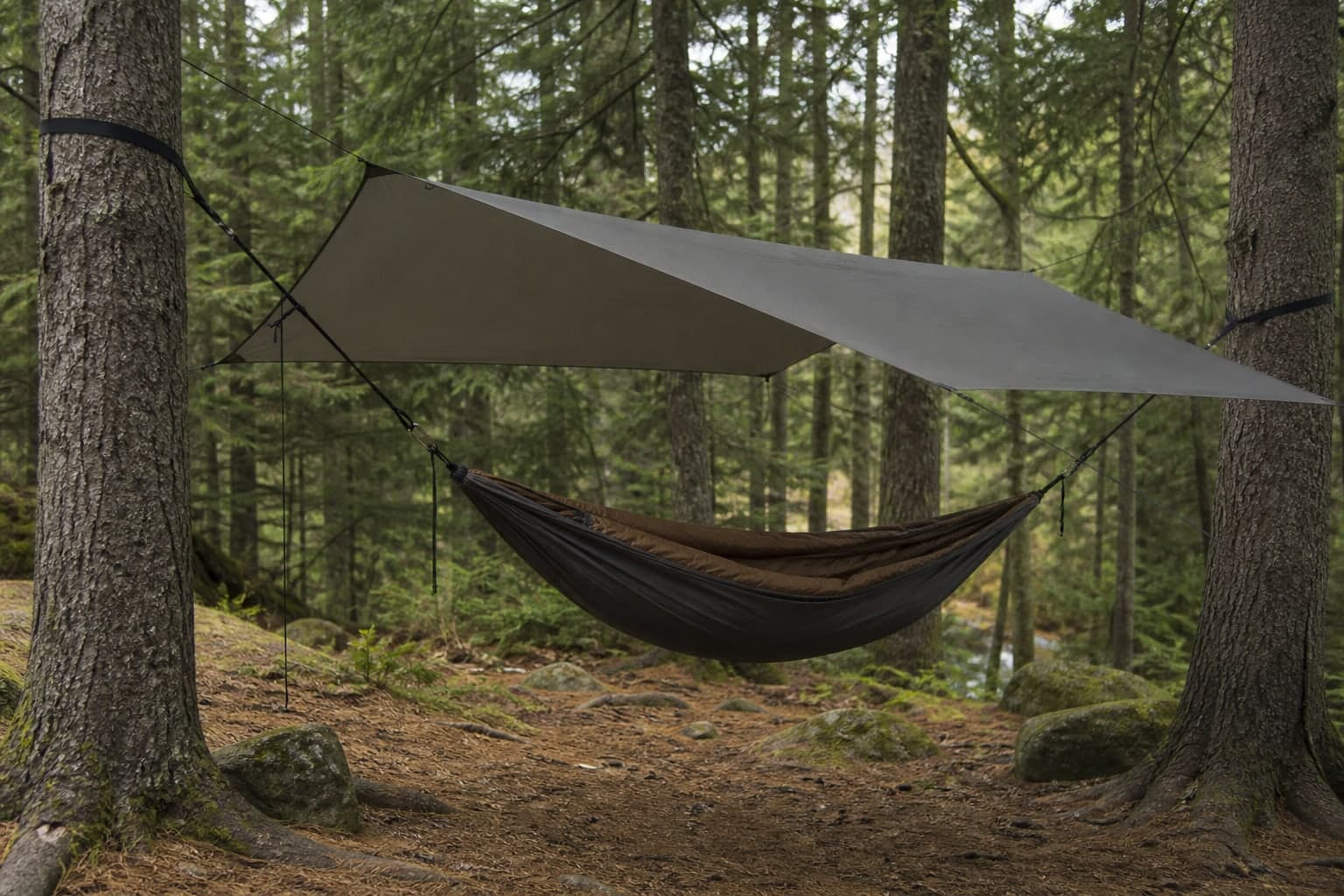
The catch: a hammock alone is a warm-weather-only tool. Add a rain tarp (8–20 oz) and an underquilt for temperatures below 60°F (another 12–28 oz depending on rating), and your sleep system total lands at 2–4 lbs. A solo three-season tent like the Big Agnes Copper Spool UL1 weighs about 2 lbs 3 oz all-in. The gap closes fast.
For fair-weather, tree-dense trips, a hammock system can still come out ahead. In cold or exposed weather, a tent provides a simpler weather shell, but it still needs a sleeping pad and bag because tent fabric itself provides little insulation.
Comfort and sleep quality
Hammock fans point to one real advantage: you're not sleeping on rocks, roots, or uneven ground. That's genuinely useful in rocky or root-heavy terrain where finding a flat site is a chore.
Back sleepers tend to adapt to hammocks quickly. The key is a low hang angle, roughly 30 degrees, which produces a flatter lay and reduces the banana curve that causes back strain. Most tension issues come from hanging too tight.
Side sleepers have a harder time. Some adjust with a structural ridgeline and diagonal lay; others never get comfortable. If you predominantly sleep on your side, try a hammock before committing for a multi-night trip.
Tents offer a predictable, flat platform. You can sleep in any position, share the space with a partner or a dog, and sit up fully without wrestling with suspension.
A 30-degree hang angle and a diagonal lay solve most hammock comfort problems before they start.
Weather protection
A properly rigged hammock with a full-coverage tarp handles rain well. The tarp needs to extend past the hammock ends and stake out low on the sides to block wind-driven rain. In steady downpours, this works; in sustained wind with horizontal rain, it requires more attention and staking skill than a tent's integrated rain fly.
Cold is the bigger challenge. Air circulates beneath a hammock, so you lose heat from below far faster than on the ground. An underquilt rated to the expected low temperature is non-negotiable once nights drop below 55°F. A sleeping pad inside the hammock is a cheaper but bulkier alternative.
Tents handle cold better by default. Ground insulation is simpler (a sleeping pad under you), and a double-wall tent traps warmth efficiently. For three-season alpine trips or anything with sustained cold, a tent is the more reliable system.
Site requirements
This is where hammocks lose the most ground. You need two healthy trees, 12–15 feet apart, each at least 8 inches in diameter. In dense eastern hardwood forests, Pacific Northwest old-growth, or the Appalachians, that's nearly everywhere. In the desert Southwest, the Great Plains, alpine tundra, or any above-treeline terrain, it's nowhere.
Always use wide tree straps to distribute load and protect bark. Leave No Trace guidance calls for at least 1 inch. Land managers can require wider straps or prohibit hammock attachment, so check the specific destination.
Tents go anywhere that's roughly flat: gravel bars, established tent pads, talus edges, beaches. If your trips cross terrain types, a tent is the versatile default.
Picking a hammock hang site
Tree diameter
Look for trunks at least 8 inches across, which hold your weight without stress
Spacing
12–15 feet apart lets you hang at the right angle without over-tightening
Health check
Avoid dead trees or heavy leaning trees that could fail under load
Strap width
Use straps at least 1 inch wide; 2 inches is better for bark protection
Overhead clearance
Scan for widow-makers (dead branches) directly above your hang
Bug protection and setup speed
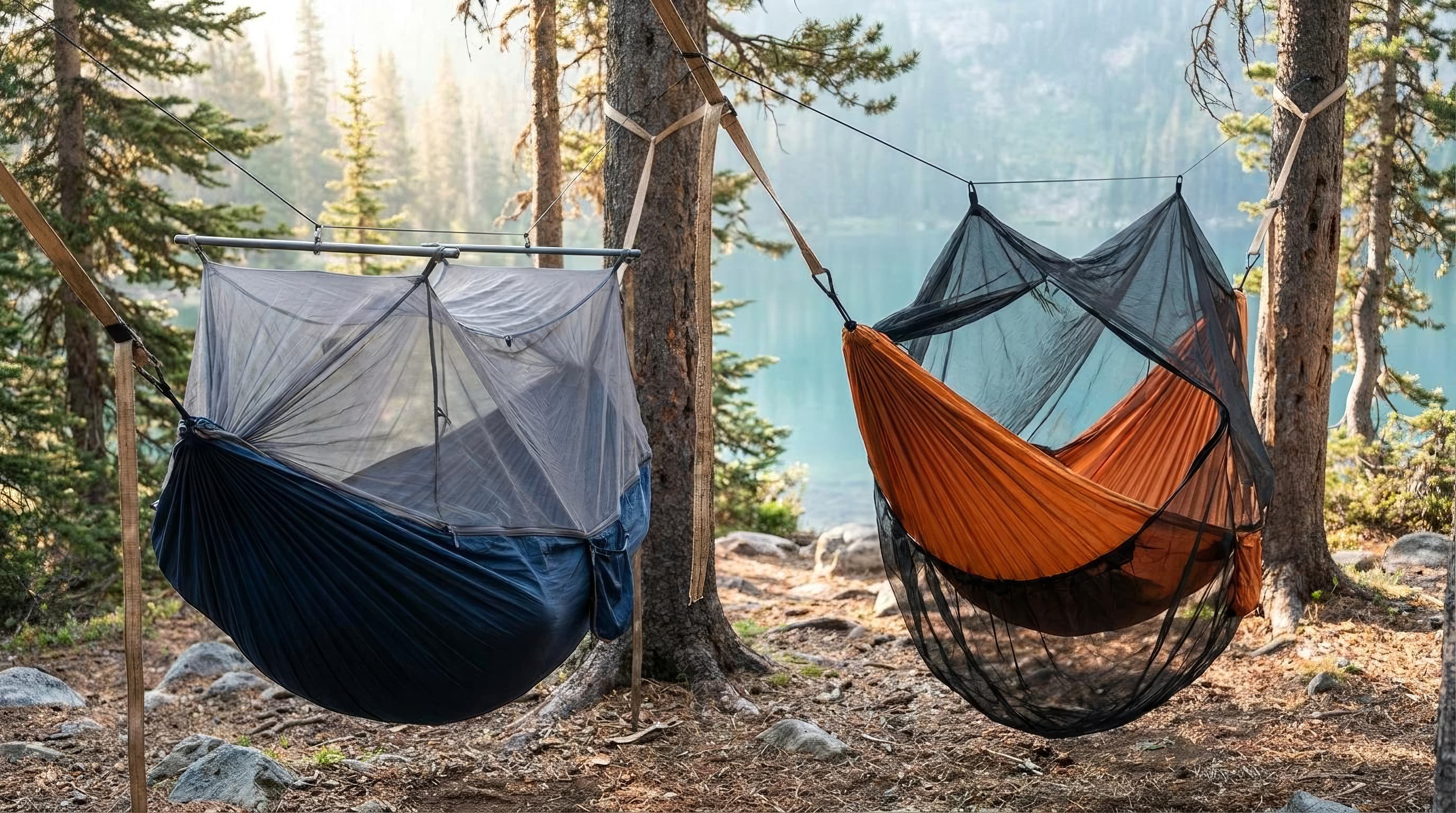
Most general-purpose hammocks are open. Netted models such as the Grand Trunk Skeeter Beeter XT integrate insect protection, while ENO and Kammok require a separate net. Our integrated vs separate bug-net guide compares those systems. A tarp remains a separate weather layer in either case.
Tents vary. A freestanding tent with color-coded poles goes up in 5–8 minutes once you've practiced. Non-freestanding tents require staking and take a few more minutes. Neither system has a clear speed advantage once you're familiar with it.
On bug protection, both systems can be equally effective. The hammock's net keeps insects off you fully; a tent's mesh inner does the same. The hammock has one edge: you're elevated off the ground, which matters in tick-heavy grass or damp undergrowth.
Cost
Entry-level hammocks start around $30–$60, which is tempting. But price the full system: hammock ($60–$150), structural ridgeline ($10–$20 or DIY), tarp ($50–$200), and underquilt if needed ($100–$350). A complete cold-capable hammock kit runs $220–$700.
A quality three-season solo tent spans $150–$500. Add a sleeping pad ($40–$200). Total: $190–$700. The ranges overlap almost completely.
If you already own a sleeping bag and pad, a hammock is a genuinely cheap warm-weather add-on. If you're outfitting from scratch for four-season use, the cost argument for hammocks largely disappears.
Frequently asked questions
Can I use a hammock without an underquilt?
In warm conditions (nights above 60°F) you can skip an underquilt and use your sleeping bag inside the hammock. Below that, air circulation under the hammock compresses your bag's insulation against your back, which kills its warmth rating. A sleeping pad laid inside the hammock is a workable budget alternative, though it shifts around more than a fitted underquilt.
Is hammock camping allowed everywhere?
Not always. Some high-use wilderness areas, fragile ecosystems, and specific campsites prohibit hammocks to protect tree bark and root systems. Always check land manager rules before your trip. Where allowed, use wide tree straps and avoid thin-barked species like aspens.
What's the best hammock camping setup for a beginner?
Start with a mainstream double hammock such as Kammok Roo or ENO DoubleNest, a simple hex tarp, and wide tree straps. Use only warm conditions while evaluating the sleep position, and include a pad or underquilt whenever the expected temperature requires bottom insulation.
For specific picks across all price points, see our guide to the best camping hammocks. Browse all camp guides or read how we research and rate gear.
Recommended gear
Our current top picks from the Best camping hammocks 2026: from $24, plus a treeless pick guide, if you are ready to buy.
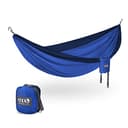
Best for: Backpackers and weekend campers who want a proven, durable double hammock that packs small and covers most conditions without fuss.
- Exceptionally compact and light at 19 oz for a double, making it a realistic backpacking add-on
- Suspension straps not included, adding $20 to $30 to the real-world cost
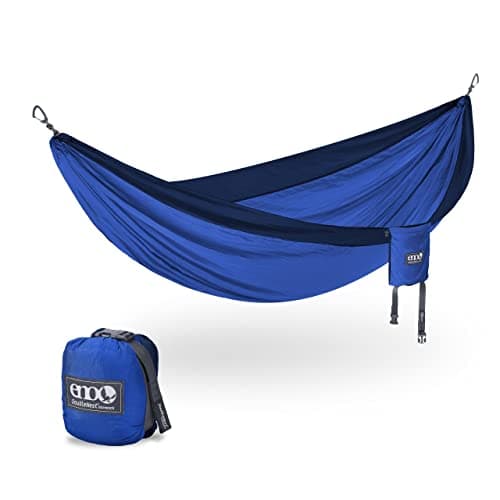
- Style
- Double (1 to 2 person)
- Weight
- 19 oz (hammock only)
- Dimensions
- 9'6" x 6'4"
- Material
- FreeWave 70D nylon taffeta, bluesign-approved
- Weight Capacity
- 400 lb
- Included
- Aluminum wiregate carabiners, attached stuff sack. Straps sold separately.
About this pick
The ENO DoubleNest is the go-to double hammock for a reason: it packs to the size of a grapefruit at 19 oz, gives one sleeper enough width for a diagonal lay, and supports two adults for lounging up to its 400 lb limit. The tradeoff is that Atlas tree straps are a separate purchase.
Strengths
- Exceptionally compact and light at 19 oz for a double, making it a realistic backpacking add-on
- Triple-stitched seams and 7 mm attachment cords inspire confidence, with owners reporting 9-plus years of use
- Massive color and print selection and a genuine environmental program (2 trees planted per purchase)
Weaknesses
- Suspension straps not included, adding $20 to $30 to the real-world cost
- 70D taffeta is functional but noticeably less soft than premium ripstop options like the Kammok Roo
Kit Score breakdown
Best for: Campers who prioritize comfort and fabric quality over price and are willing to pair the hammock with Kammok's Python straps for a complete system.
- Softest-feeling fabric in this field: 40D recycled diamond ripstop nylon with DWR treatment dries fast and feels smooth next to skin
- Tree straps sold separately, pushing the complete setup cost noticeably above the $95 hammock price
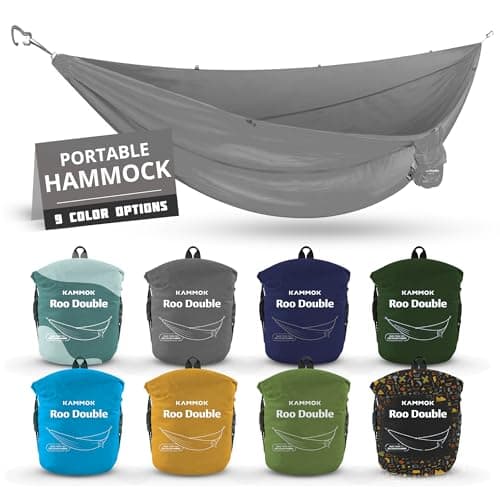
- Style
- Double (1 to 2 person)
- Weight
- 17 oz hammock only
- Dimensions
- 10' x 5'9"
- Material
- GravitasX 40D diamond ripstop nylon, 100% recycled, bluesign-approved, DWR treated
- Weight Capacity
- 500 lb
- Included
- Kanga Claw climbing-grade carabiners, Dyneema Racer Slings, roll-top stuff sack. Tree straps sold separately.
About this pick
The Kammok Roo Double uses GravitasX 40D recycled ripstop nylon that reviewers consistently describe as noticeably softer and more breathable than standard taffeta hammocks, with a 500 lb climbing-rated system and a lifetime warranty behind it. It packs smaller than a Nalgene bottle.
Strengths
- Softest-feeling fabric in this field: 40D recycled diamond ripstop nylon with DWR treatment dries fast and feels smooth next to skin
- 500 lb capacity with climbing-grade Kanga Claw carabiners provides a genuine two-person safety margin
- Lifetime adventure-grade warranty and 100% recycled, bluesign-approved construction
Weaknesses
- Tree straps sold separately, pushing the complete setup cost noticeably above the $95 hammock price
- Softer fabric draws some durability concerns from heavy repeated-use reviewers compared to harder-wearing taffeta options
Kit Score breakdown
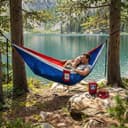
WISE OWL OUTFITTERS
Wise Owl Outfitters Camping Hammock (Double)
Best Budget
Kit Score 7.6/10
$33.41 Price checked Oct 23, 4:16 PM CDT
Best for: Car campers, backyard users, and first-time hammock buyers who want a complete, zero-fuss setup at the lowest possible outlay.
- Complete ready-to-hang kit at a fraction of the cost of name-brand rivals, including tree straps and carabiners
- 210T parachute nylon is heavier and less packable than 40D or 70D outdoor fabrics; at 26 oz it is not an ultralight choice
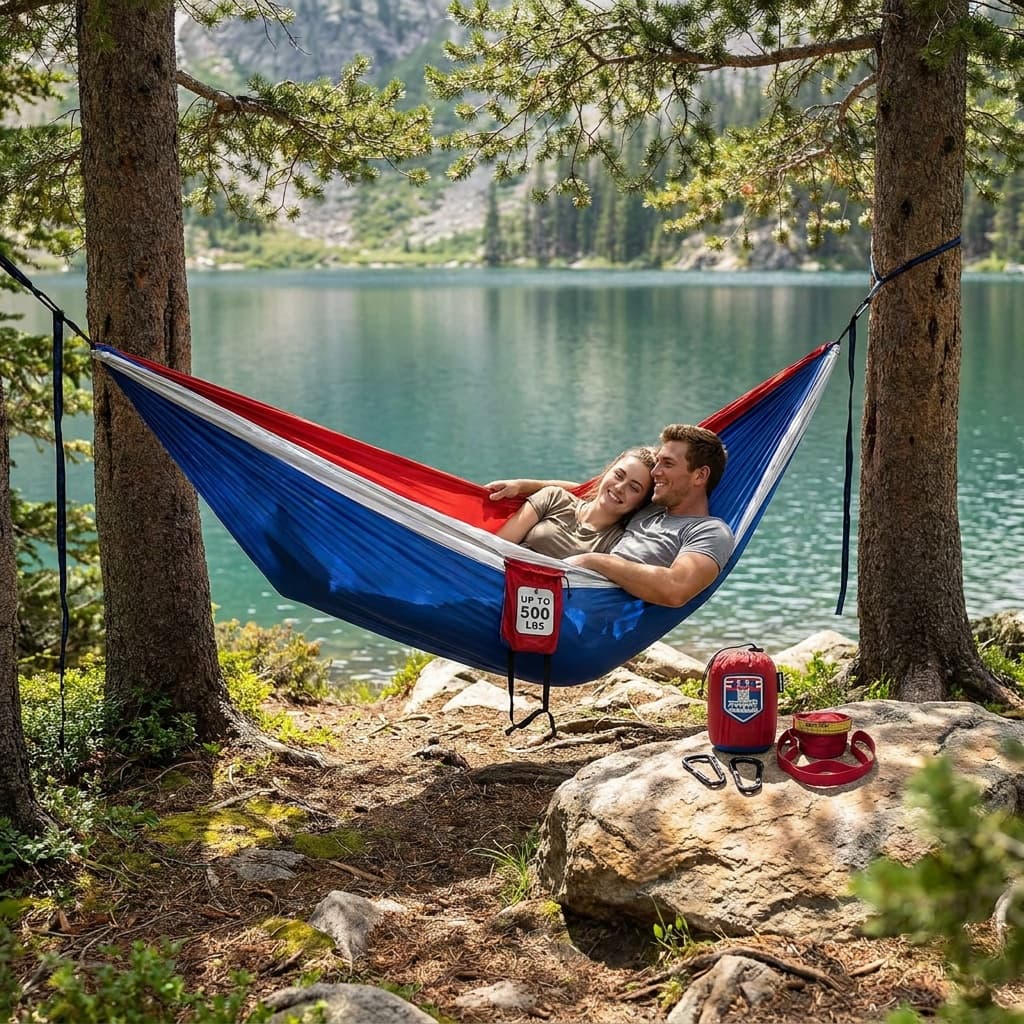
- Style
- Double (1 to 2 person)
- Weight
- 24 oz
- Dimensions
- 10' x 6'6"
- Material
- 210T parachute-grade breathable nylon, triple interlock stitching
- Weight Capacity
- 500 lb
- Included
- Two tree straps with adjustable loops, two O-ring carabiners, attached stuff sack
About this pick
The Wise Owl DoubleOwl ships complete: 9 ft straps, O-shaped carabiners, and storage bag are all in the box, with a 500 lb limit backed by triple-stitched 210T nylon. At 24 oz it is not an ultralight system, but it removes the add-on cost and compatibility work from a first hammock purchase.
Strengths
- Complete ready-to-hang kit at a fraction of the cost of name-brand rivals, including tree straps and carabiners
- 10' x 6.5' body is generously wide for a budget option, comfortable for solo lounging or two people on a casual hang
- 500 lb capacity and triple interlock stitching provide a meaningful safety margin for the price point
Weaknesses
- 210T parachute nylon is heavier and less packable than 40D or 70D outdoor fabrics; at 26 oz it is not an ultralight choice
- Included straps and D-shaped carabiners are functional but less refined than premium suspension systems
Kit Score breakdown
See all picks in Best camping hammocks 2026: from $24, plus a treeless pick
Keep going
Complete loadoutCamp sleep systemFive coordinated pieces that solve shelter, insulation, cushioning, head support, and light for nights outside.Free tool: Sleeping-Bag Warmth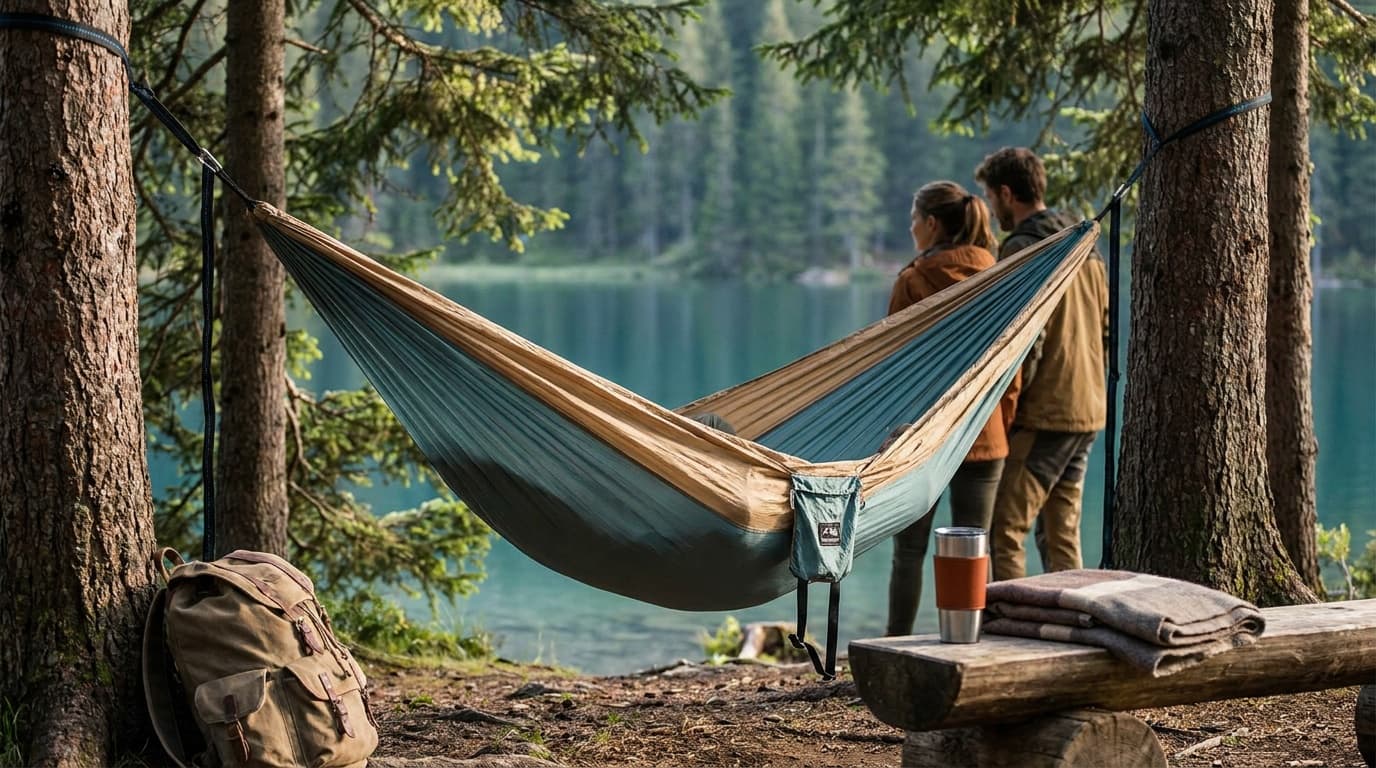
Researched, not hands-on tested
Updated Aug 14, 2026Our recommendations draw on manufacturer documentation, retailer listings, owner feedback, and comparisons with alternatives.
As an Amazon Associate I earn from qualifying purchases. We may earn a commission from links here, at no extra cost to you. How we research →