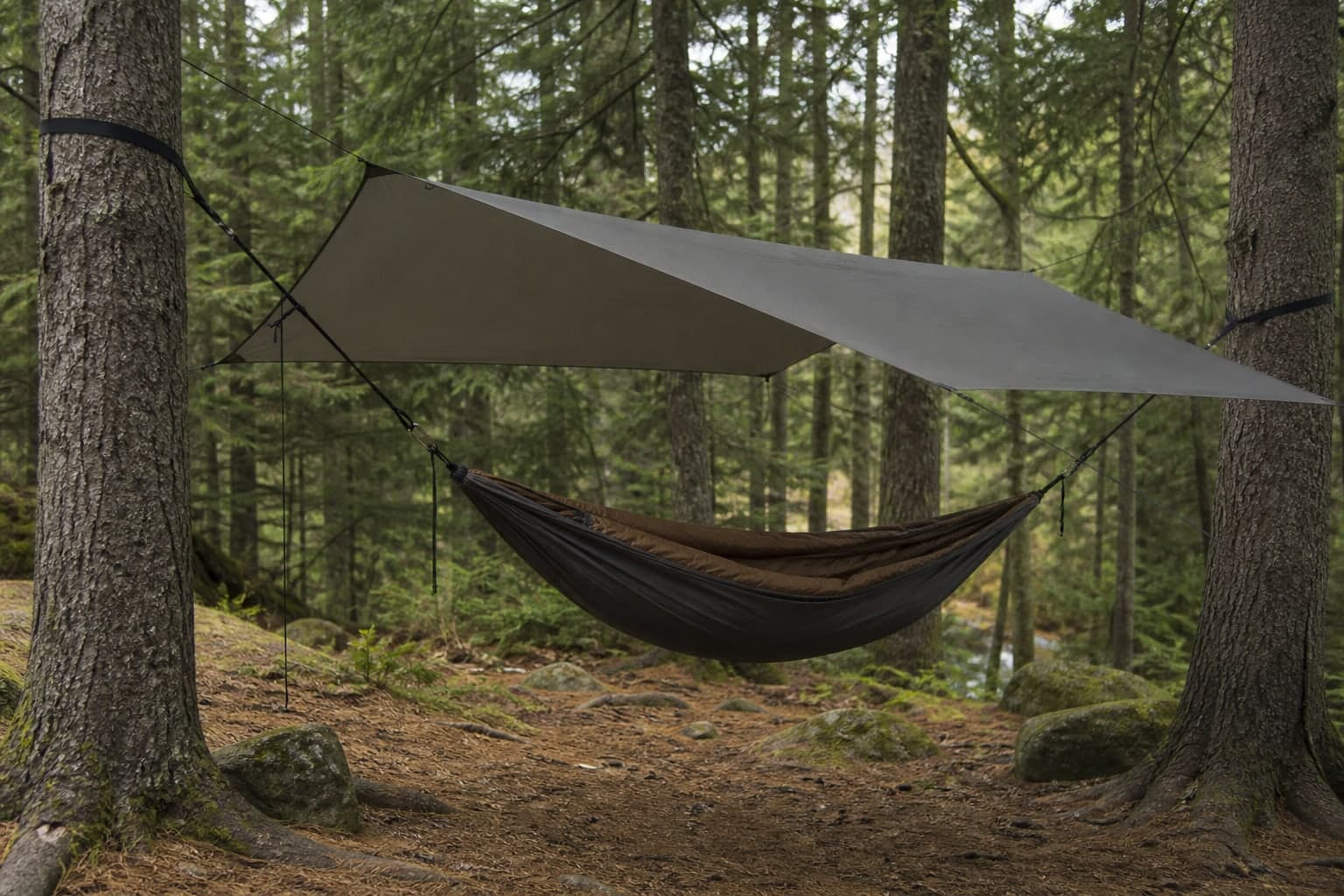
Getting your hammock hang wrong by even a few inches means a night curled into a banana, but get it right and you will sleep flatter than most tent campers. The numbers matter more than the gear.
Why the 30-degree angle changes everything
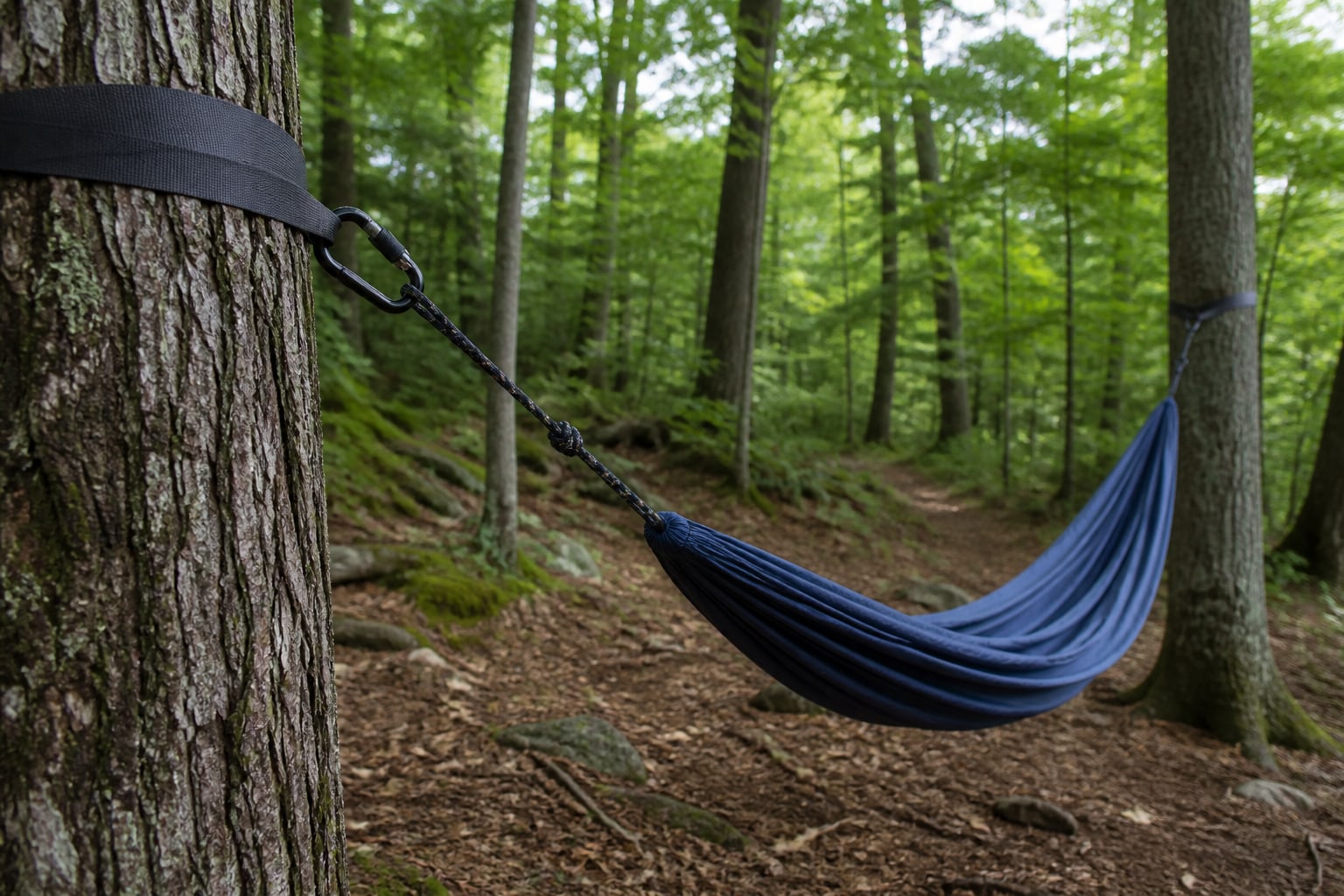
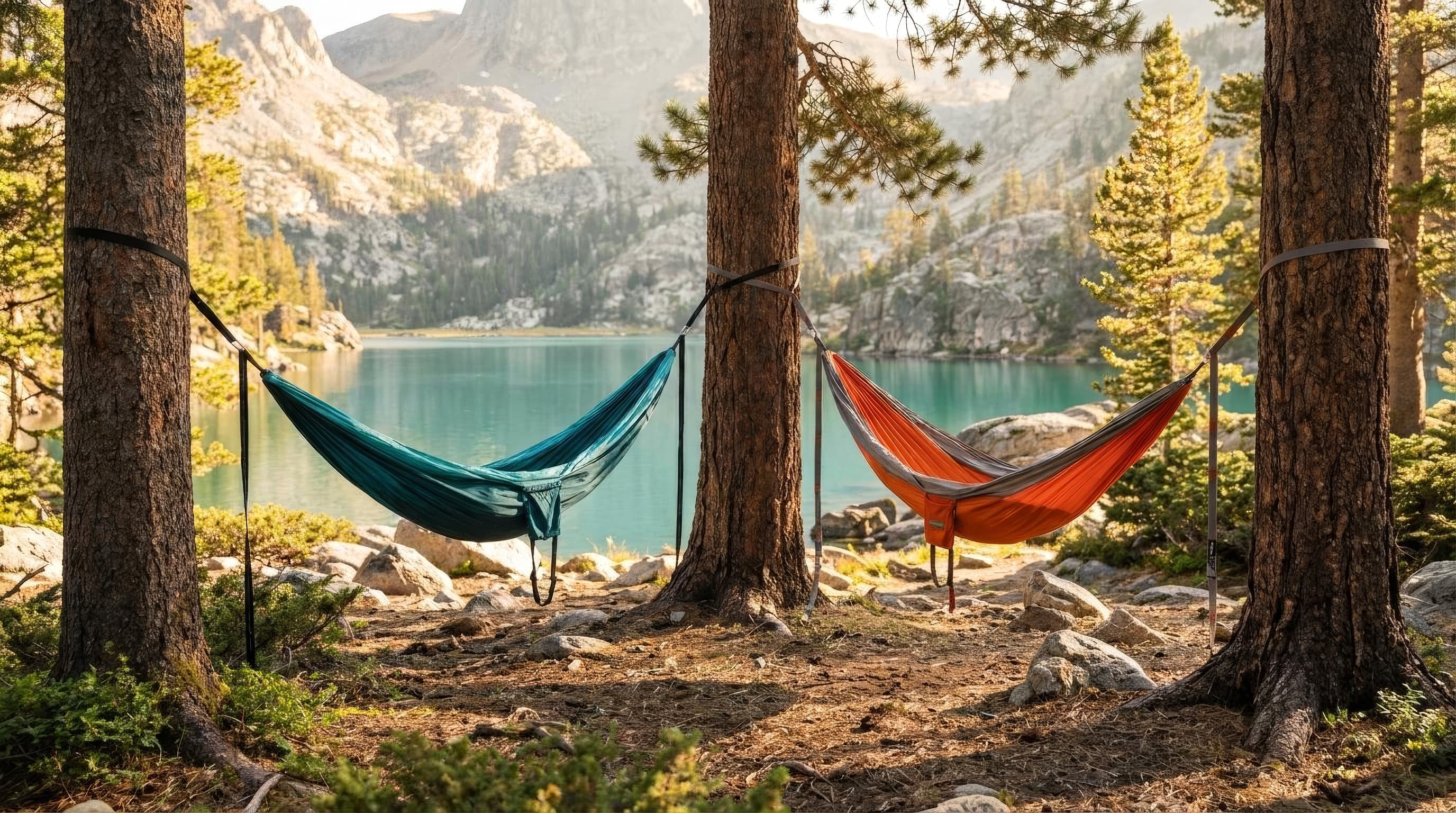
The strap angle is the foundation. A strap angled 30 degrees below horizontal puts the right amount of tension on the system: enough to keep you off the ground with a comfortable sag, not so much that the hammock pulls taut and cocoons you.
A steeper angle creates more sag and can place the sleeper too low. A shallower angle, close to horizontal, creates the dangerous force spike: tension rises quickly as the strap flattens, loading the suspension and trees far beyond the sleeper's body weight.
A practical field test: hold your arm out flat, then drop it one-third of the way down. That is roughly 30 degrees. When your straps match that angle, the physics are working for you.
Finding the right trees and spacing
Not every grove gives you what you need. Start with two healthy, living trees around 12 to 15 feet apart, measured trunk to trunk, and at least 6 inches in diameter. Smaller trees flex under load; dead or damaged trees create a serious fall risk.
12–15 feet is a range, not a hard rule, but it is where most hammock lengths land naturally at the right angle. Go tighter and your straps angle too steeply. Go wider and you need more strap length and the sag often becomes uncontrollable.
Look up before you commit. Widow-makers (dead branches overhead) are a real hazard. Check that nothing large is hanging above your sleep zone.
Strap height and sag
Strap height depends on the distance between trees. Longer spans require higher attachment points to preserve a 30-degree angle. Adjust both ends until the loaded hammock sits no more than 18 inches above the ground, then verify that the straps still slope visibly downward toward the hammock.
The target sag at the center of the hammock is 8–12 inches below the straight line between your attachment points. Too little sag and the fabric pulls tight across your shoulders. Too much and you sink into a deep U and cannot rotate to the diagonal lie.
A tight, flat hammock is a common beginner mistake. It looks tidy but it fights you all night. The sag is not a flaw; it is the design.
Hang calculator: how much suspension each tree gap needs
Three numbers set a good hang: the ridgeline length, the suspension length at each end, and the angle between the suspension and the ground. The Ultimate Hang's hammock calculator recommends starting a gathered-end hammock's ridgeline at 83% of the hammock's length and hanging at 20 to 30 degrees. Omni Calculator's hammock tool uses 30 degrees as its default and gives the same 83% rule of thumb. Suspension length follows from those inputs by simple geometry:
- Ridgeline (R) = 0.83 × hammock length
- Suspension per side (S) = (tree gap − R) ÷ (2 × cos 30°), which is (tree gap − R) ÷ 1.73
- Load on each strap = body weight ÷ (2 × sin of the hang angle)
The suspension formula is our own trigonometry, not a quote from either calculator. It reproduces Omni's worked example exactly: a 14 ft gap with a 9 ft ridgeline at 30 degrees needs 34.64 in of suspension per side. S is measured from the end of the hammock to the point where the strap meets the tree, so add the length used wrapping the trunk.
The table applies the formula to hammocks in our catalog, using each maker's listed length.
| Hammock (listed length) | Ridgeline at 83% | Suspension per side, 12 ft gap | 15 ft gap | 18 ft gap | Straps in the box? |
|---|---|---|---|---|---|
| ENO DoubleNest (9 ft 6 in) | 7 ft 11 in | 29 in | 49 in | 70 in | No straps listed; carabiners only. ENO sells 9 ft Atlas straps separately |
| Kammok Roo Double (10 ft) | 8 ft 4 in | 26 in | 46 in | 67 in | No; Dyneema slings and carabiners |
| Kammok Roo Single UL (8 ft 4 in) | 6 ft 11 in | 35 in | 56 in | 77 in | No; toggle suspension only |
| Wise Owl Double (10 ft) | 8 ft 4 in | 26 in | 46 in | 67 in | Yes; two 9 ft straps and two carabiners |
| Grand Trunk Skeeter Beeter XT (10 ft 6 in) | 8 ft 9 in | 23 in | 44 in | 64 in | No; carabiners and suspension cord |
The Sunyear and Vivere are not in the table. The Vivere comes with its own stand, as our best camping hammocks roundup explains, so tree gap does not apply. We could not read the Sunyear's dimensions from a maker page, so it has no row.
Treat the 83% figure as a starting point, not a law. ENO lists a hanging distance of 9 ft 2 in, plus or minus 10 in, for the DoubleNest. That is longer than the 7 ft 11 in the rule gives, so use the maker's figure where one exists and adjust until the sag looks right. That calculator counts attached end cords as part of the hammock length but not the suspension, so measure yours the same way. Keep both ends at about the same height. At these gaps the tree attachment points land around 5 to 6 ft up (Omni's 14 ft example gives 5.54 ft, and Trek Light Gear suggests 5 to 6 ft), while the hammock itself stays under Leave No Trace's 5 ft limit.
Why the angle changes the load on your straps
The 30-degree rule is also a load rule. Omni notes that the vertical part of the cord tension is always about half the sleeper's weight, which makes the load on each strap body weight ÷ (2 × sin of the angle). Its 30-degree example agrees: a 175 lb sleeper puts about 175 lb on each cord.
| Hang angle | Load on each strap, as a multiple of body weight |
|---|---|
| 45° | 0.71 |
| 30° | 1.00 |
| 20° | 1.46 |
| 15° | 1.93 |
Flattening the hang from 30 to 15 degrees nearly doubles the load on the straps and the trees. That is why a tight, tidy-looking hang is the one to avoid. Omni notes that taller sleepers often prefer smaller angles, so treat 30 degrees as the starting point and stay inside the Ultimate Hang's 20 to 30 degree range for a gathered-end hammock. Straps are one line item in the full system cost; hammock vs tent camping works through the rest.
The diagonal lie: how to actually sleep flat
A hammock hung correctly still requires one more adjustment to sleep flat: lie diagonally.
Instead of positioning yourself straight along the centerline (head at one end, feet at the other), shift your body 20–30 degrees off-axis. Move your head toward one side of the hammock and your feet toward the opposite side. The fabric spreads wider under your torso and the banana curve flattens out.
The diagonal lie is the move almost no one teaches beginners, and it is the difference between waking up stiff and waking up rested.
This works because a gathered-end hammock is essentially a tube of fabric. When you lie straight down the tube, the sides curve up around you. When you lie across it at an angle, you use a flatter section of the fabric plane. Most experienced hammock campers settle between 15 and 30 degrees off-axis. A roomy double like the Wise Owl DoubleOwl provides more fabric for that position.
Tree-friendly straps and Leave No Trace
Straps 1 inch wide are the minimum; 1.5–2 inches are better. Thin cord or rope (paracord included) concentrates force on a narrow band of bark and cambium layer, which can kill a tree over time or across repeat visits.
Set up with minimal impact
Choose living trees
At least 6 inches diameter, no visible damage or rot
Use wide straps
1.5–2 inch nylon tree straps, no knots directly on bark
Wrap without knots
Loop the strap around the trunk and clip to itself or a carabiner
Leave no marks
Check the bark before and after; if the strap bit in, go wider
Pack out everything
Straps, hardware, and any gear that dropped
Land-manager rules vary. Check the park or campground before departure because some locations specify strap widths, restrict trees, or prohibit hammocks entirely.
Safety checks before you sleep
A five-second check before you commit full weight is worth the habit. Tug each strap hard by hand. Verify the carabiners or whoopie slings are fully seated. Sit in the hammock with your feet still on the ground and put weight on it gradually before lifting off. Look at the strap wrap on each tree and confirm it has not slipped up toward a narrow point.
The biggest single-point failure is a carabiner gate that was not fully closed. A twist-lock or screw-gate carabiner eliminates that risk entirely.
Frequently asked questions
Can I hang a hammock between two trees that are only 8 feet apart?
You may be able to with a short hammock, but the geometry is cramped. A typical 9.5 to 10.5-foot gathered-end hammock cannot establish normal sag between trunks only 8 feet apart. Choose a different site or a purpose-built shorter hammock rather than forcing the suspension.
How do I know if my sag is correct without measuring?
Sit in the hammock and let your full weight settle. Your hips should be at roughly the same height as your knees, or just slightly lower. If your knees are noticeably higher than your hips, the sag is too deep. If your back arches and you feel the fabric pulling tight across your shoulders, the sag is too shallow. Adjust strap height on both trees equally until the seated position feels neutral.
Do wider straps actually protect trees better, or is that just a Leave No Trace talking point?
Wider straps spread the load across more bark, which lowers the pressure on the cambium layer. Leave No Trace's hammock guide sets 1 inch as the minimum width, says never to use anything thinner, and asks for a loose hang with the strap wrapped once around the trunk, because a tight hang can twist and squash the bark. Treat 1 inch as the floor rather than the target, and check your land manager's rules, since some parks require wider straps or prohibit hammocks.
Where these numbers come from
The suspension lengths, ridgeline lengths, and strap loads in the tables are our arithmetic from the sourced inputs below. The Wise Owl row rests on a retailer listing because we could not read a maker page.
| Claim | Source | Checked |
|---|---|---|
| Ridgeline starting point of 83% of hammock length for gathered-end hammocks; 20 to 30 degree hang angle for gathered-end hammocks; hammock length counts attached strings but not suspension | The Ultimate Hang, Hammock Hang Calculator | 2026-10-16 |
| 30 degrees as the default angle; ridgeline about 83% of hammock length; vertical tension about half the sleeper's weight; suspension measured from hammock end to hang point; worked example of a 14 ft gap, 9 ft ridgeline, 175 lb sleeper giving 34.64 in of suspension, 5.54 ft anchor height, and 175 lb cord tension | Omni Calculator, Hammock hang calculator | 2026-10-16 |
| About 30 degrees as the ideal angle; straps around 5 to 6 ft up at typical distances; wide tree-friendly straps | Trek Light Gear, How to hang your hammock | 2026-10-16 |
| ENO DoubleNest: 9 ft 6 in x 6 ft 4 in, hanging distance 9 ft 2 in plus or minus 10 in, aluminum carabiners, compatible with ENO straps | ENO, DoubleNest Hammock | 2026-10-16 |
| ENO Atlas straps: 9 ft long, 30 combined adjustment points, sold as a separate product | ENO, Atlas Hammock Straps | 2026-10-16 |
| Kammok Roo Double: 120 x 69.3 in; Dyneema slings and Kanga Claw carabiners included; straps not included | Kammok, Roo Double | 2026-10-16 |
| Kammok Roo Single UL: 100 x 50 in; toggle suspension included; straps not included | Kammok, Roo Single UL | 2026-10-16 |
| Grand Trunk Skeeter Beeter XT: 10 ft 6 in x 5 ft; carabiners, spreader bars, and suspension cord included; straps not included | Grand Trunk, Skeeter Beeter XT | 2026-10-16 |
| Wise Owl Double: 10 ft x 6.5 ft; two 9 ft talon straps and two O-shaped carabiners (retailer listing, not the maker) | Overtons, Wise Owl Outfitters Double Camping Hammock | 2026-10-16 |
| Straps 1 inch or wider and never thinner; loose hang with the strap wrapped once around the trunk; living trees at least 6 inches in diameter; hang less than 5 feet off the ground; check local rules | Leave No Trace, Hammock Camping Guide (PDF) | 2026-10-16 |
We have not hung or slept in these hammocks. Check your own hammock's length and your trees before relying on any calculated number.
For specific picks once your setup is dialed, see our guide to the best camping hammocks. Browse all camp guides or read how we research and rate gear.
Recommended gear
Our current top picks from the Best camping hammocks 2026: from $24, plus a treeless pick guide, if you are ready to buy.
Best for: Backpackers and weekend campers who want a proven, durable double hammock that packs small and covers most conditions without fuss.
- Exceptionally compact and light at 19 oz for a double, making it a realistic backpacking add-on
- Suspension straps not included, adding $20 to $30 to the real-world cost
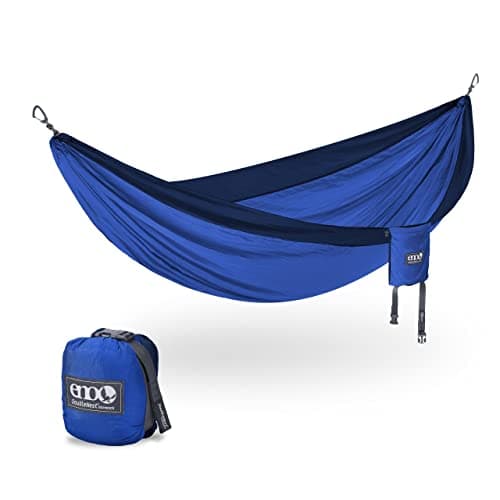
- Style
- Double (1 to 2 person)
- Weight
- 19 oz (hammock only)
- Dimensions
- 9'6" x 6'4"
- Material
- FreeWave 70D nylon taffeta, bluesign-approved
- Weight Capacity
- 400 lb
- Included
- Aluminum wiregate carabiners, attached stuff sack. Straps sold separately.
About this pick
The ENO DoubleNest is the go-to double hammock for a reason: it packs to the size of a grapefruit at 19 oz, gives one sleeper enough width for a diagonal lay, and supports two adults for lounging up to its 400 lb limit. The tradeoff is that Atlas tree straps are a separate purchase.
Strengths
- Exceptionally compact and light at 19 oz for a double, making it a realistic backpacking add-on
- Triple-stitched seams and 7 mm attachment cords inspire confidence, with owners reporting 9-plus years of use
- Massive color and print selection and a genuine environmental program (2 trees planted per purchase)
Weaknesses
- Suspension straps not included, adding $20 to $30 to the real-world cost
- 70D taffeta is functional but noticeably less soft than premium ripstop options like the Kammok Roo
Kit Score breakdown
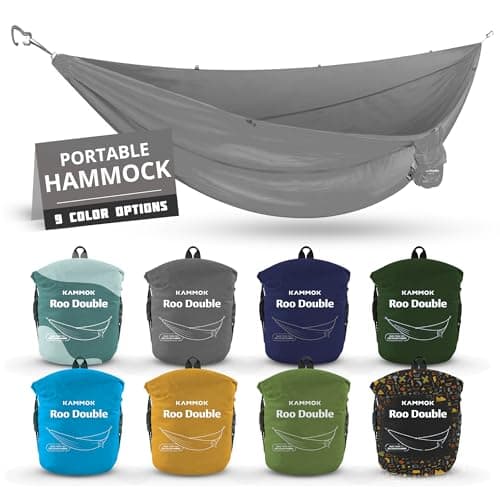
Best for: Campers who prioritize comfort and fabric quality over price and are willing to pair the hammock with Kammok's Python straps for a complete system.
- Softest-feeling fabric in this field: 40D recycled diamond ripstop nylon with DWR treatment dries fast and feels smooth next to skin
- Tree straps sold separately, pushing the complete setup cost noticeably above the $95 hammock price
- Style
- Double (1 to 2 person)
- Weight
- 17 oz hammock only
- Dimensions
- 10' x 5'9"
- Material
- GravitasX 40D diamond ripstop nylon, 100% recycled, bluesign-approved, DWR treated
- Weight Capacity
- 500 lb
- Included
- Kanga Claw climbing-grade carabiners, Dyneema Racer Slings, roll-top stuff sack. Tree straps sold separately.
About this pick
The Kammok Roo Double uses GravitasX 40D recycled ripstop nylon that reviewers consistently describe as noticeably softer and more breathable than standard taffeta hammocks, with a 500 lb climbing-rated system and a lifetime warranty behind it. It packs smaller than a Nalgene bottle.
Strengths
- Softest-feeling fabric in this field: 40D recycled diamond ripstop nylon with DWR treatment dries fast and feels smooth next to skin
- 500 lb capacity with climbing-grade Kanga Claw carabiners provides a genuine two-person safety margin
- Lifetime adventure-grade warranty and 100% recycled, bluesign-approved construction
Weaknesses
- Tree straps sold separately, pushing the complete setup cost noticeably above the $95 hammock price
- Softer fabric draws some durability concerns from heavy repeated-use reviewers compared to harder-wearing taffeta options
Kit Score breakdown
WISE OWL OUTFITTERS
Wise Owl Outfitters Camping Hammock (Double)
Best Budget
Kit Score 7.6/10
$33.41 Price checked Oct 23, 4:16 PM CDT
Best for: Car campers, backyard users, and first-time hammock buyers who want a complete, zero-fuss setup at the lowest possible outlay.
- Complete ready-to-hang kit at a fraction of the cost of name-brand rivals, including tree straps and carabiners
- 210T parachute nylon is heavier and less packable than 40D or 70D outdoor fabrics; at 26 oz it is not an ultralight choice
- Style
- Double (1 to 2 person)
- Weight
- 24 oz
- Dimensions
- 10' x 6'6"
- Material
- 210T parachute-grade breathable nylon, triple interlock stitching
- Weight Capacity
- 500 lb
- Included
- Two tree straps with adjustable loops, two O-ring carabiners, attached stuff sack
About this pick
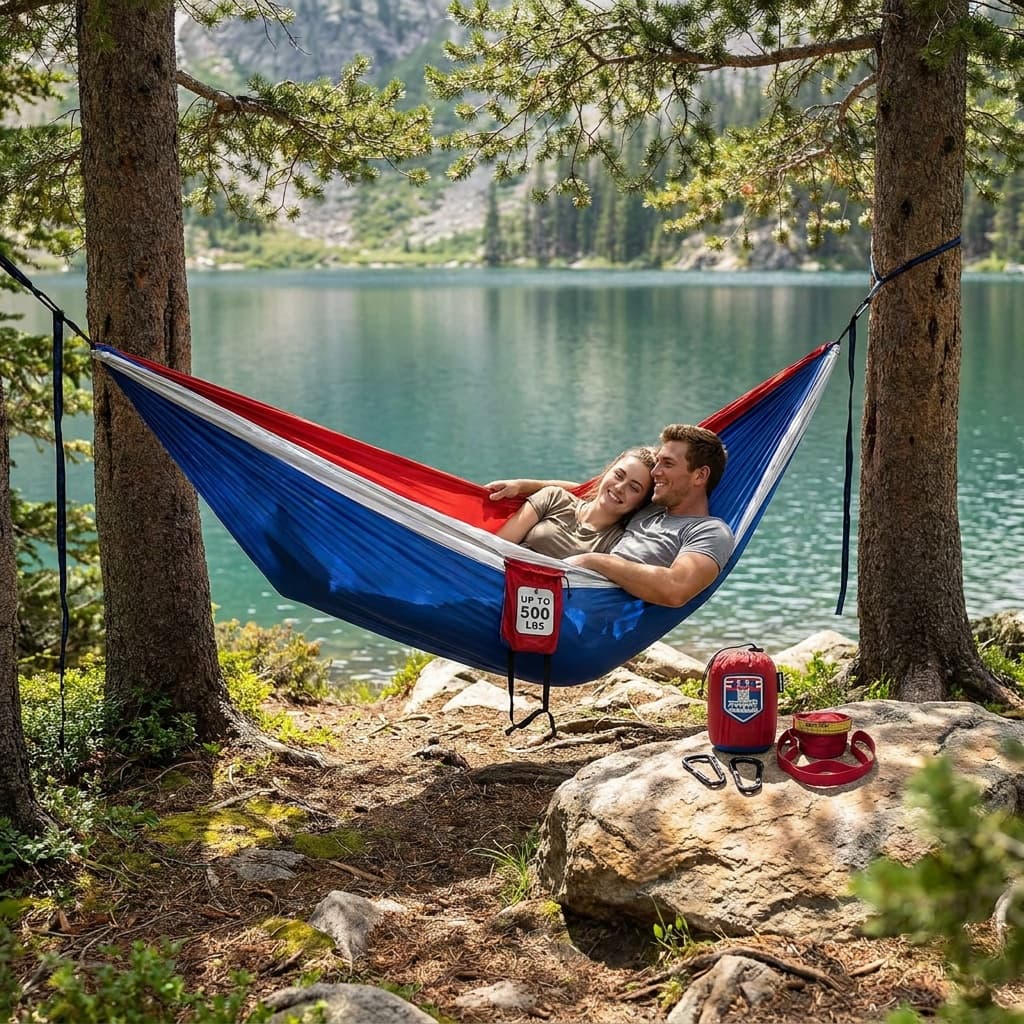
The Wise Owl DoubleOwl ships complete: 9 ft straps, O-shaped carabiners, and storage bag are all in the box, with a 500 lb limit backed by triple-stitched 210T nylon. At 24 oz it is not an ultralight system, but it removes the add-on cost and compatibility work from a first hammock purchase.
Strengths
- Complete ready-to-hang kit at a fraction of the cost of name-brand rivals, including tree straps and carabiners
- 10' x 6.5' body is generously wide for a budget option, comfortable for solo lounging or two people on a casual hang
- 500 lb capacity and triple interlock stitching provide a meaningful safety margin for the price point
Weaknesses
- 210T parachute nylon is heavier and less packable than 40D or 70D outdoor fabrics; at 26 oz it is not an ultralight choice
- Included straps and D-shaped carabiners are functional but less refined than premium suspension systems
Kit Score breakdown
See all picks in Best camping hammocks 2026: from $24, plus a treeless pick
Keep going
Complete loadoutCamp sleep systemFive coordinated pieces that solve shelter, insulation, cushioning, head support, and light for nights outside.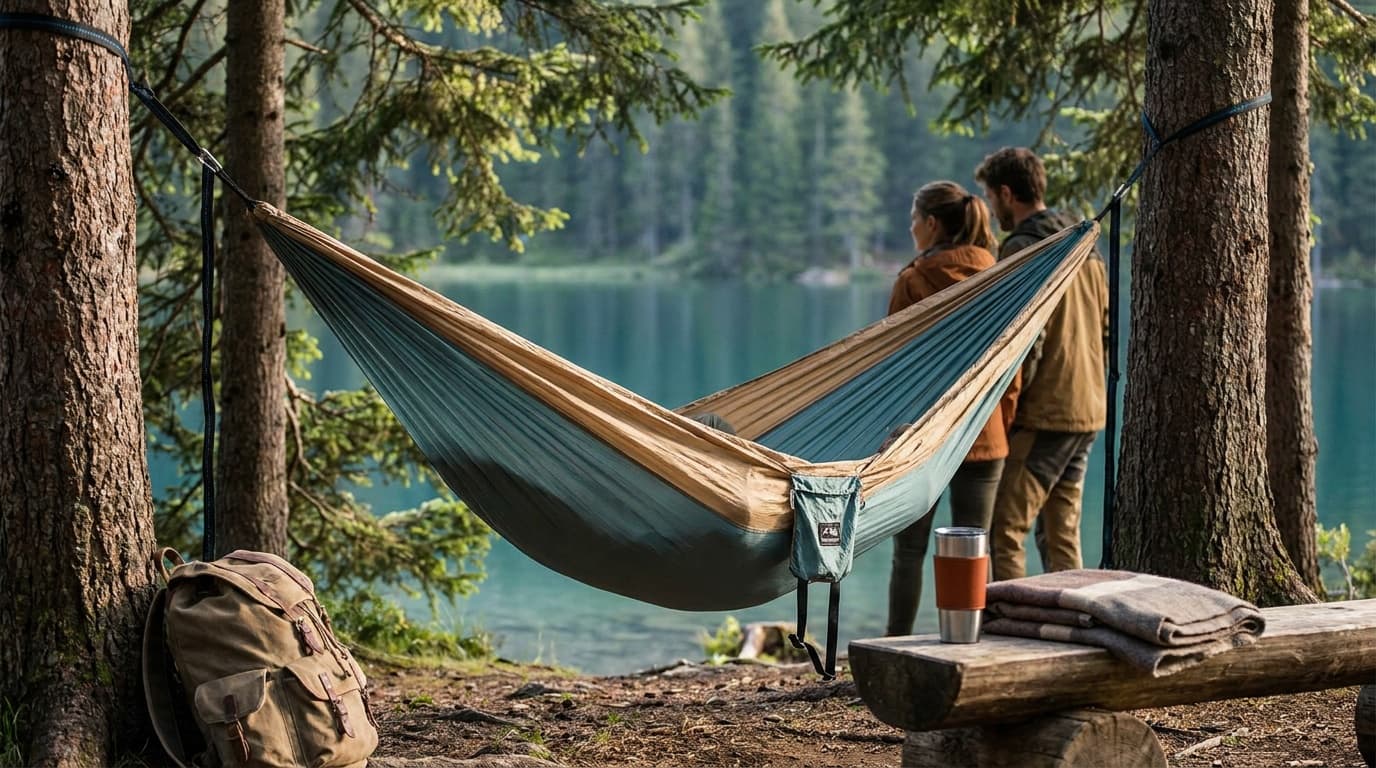
Researched, not hands-on tested
Updated Oct 16, 2026Our recommendations draw on manufacturer documentation, retailer listings, owner feedback, and comparisons with alternatives.
As an Amazon Associate I earn from qualifying purchases. We may earn a commission from links here, at no extra cost to you. How we research →