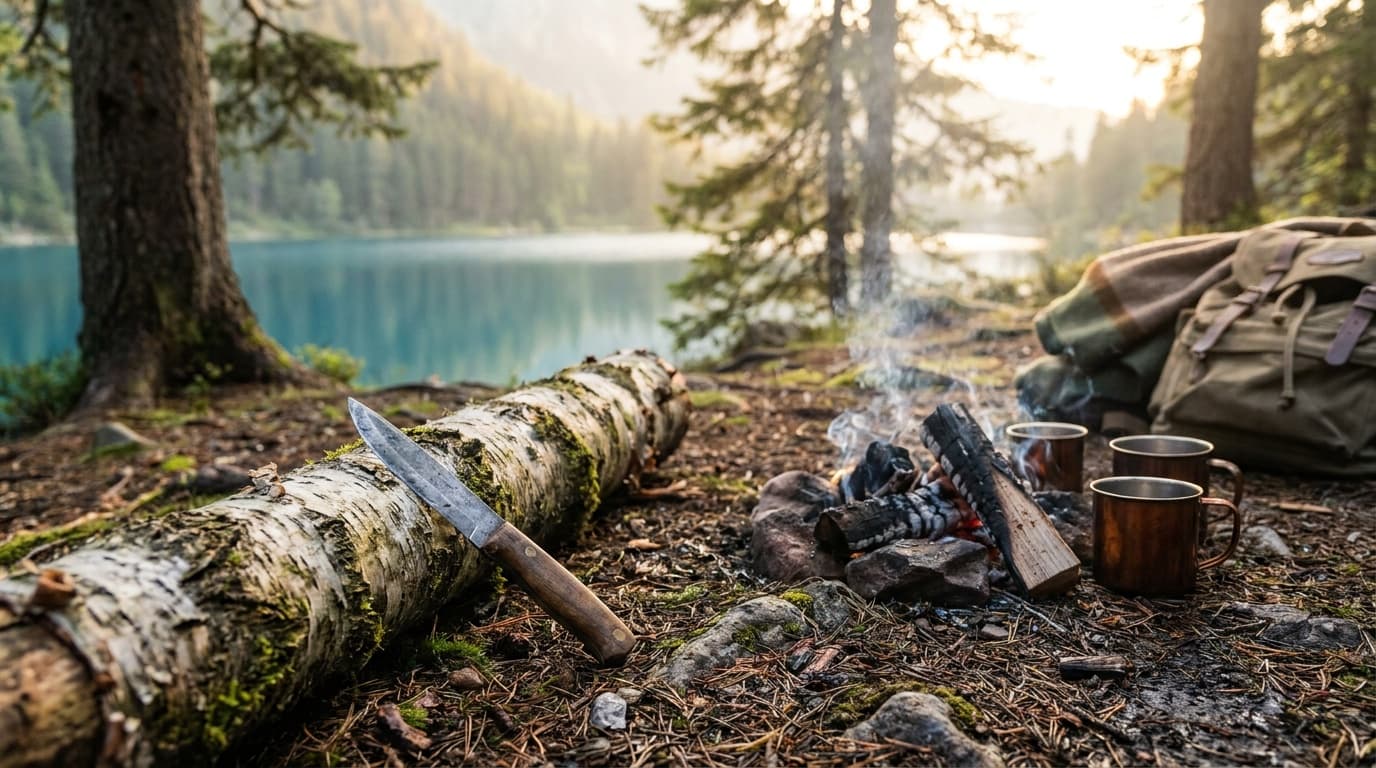
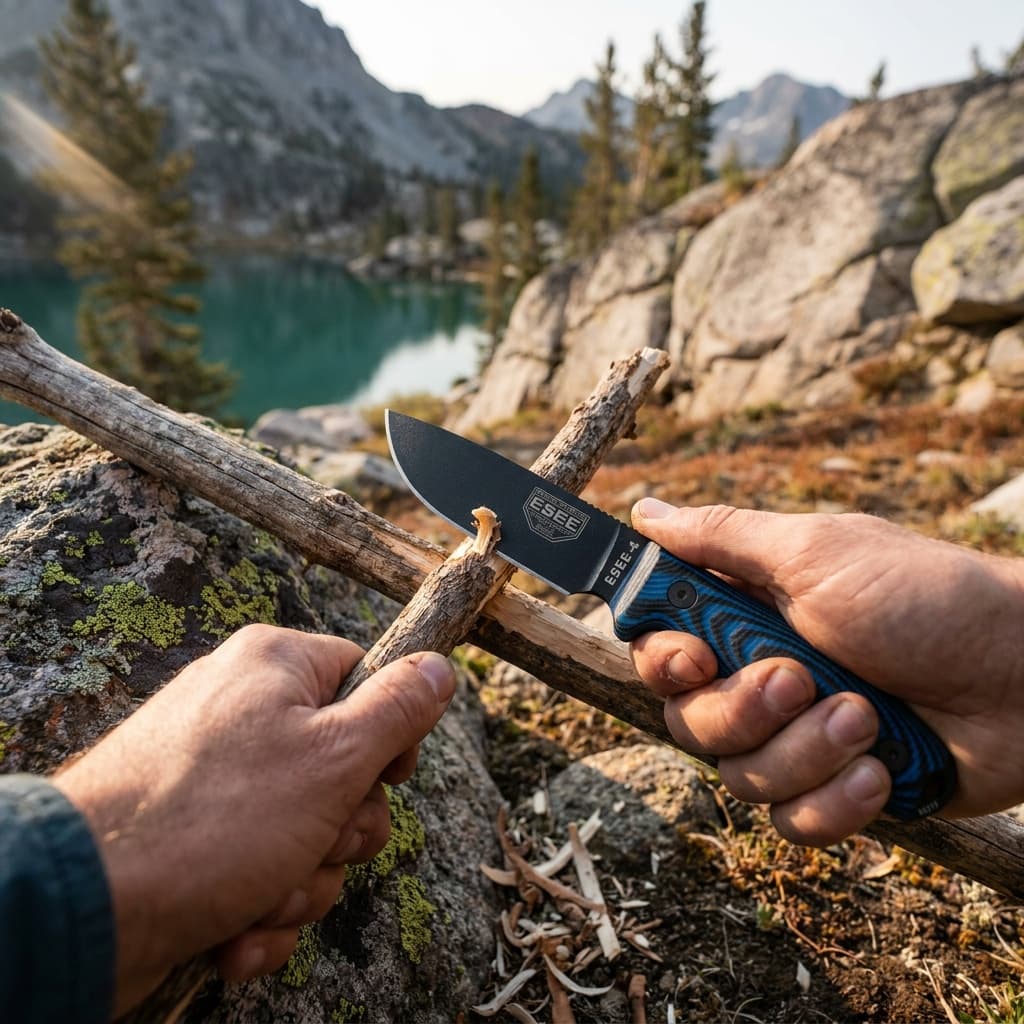
The best camping knife for most campers is the ESEE-4: a US-made, full-tang fixed blade in 1095 carbon steel at 55–57 HRC, with a 4.5-inch blade on 3/16-inch stock (ESEE). If you break it, ESEE repairs or replaces it with no receipt required (ESEE warranty). The full-tang Morakniv Garberg is the value pick, and the Morakniv Companion Heavy Duty covers first-timers on a tight budget.
Our quick picks
How we picked
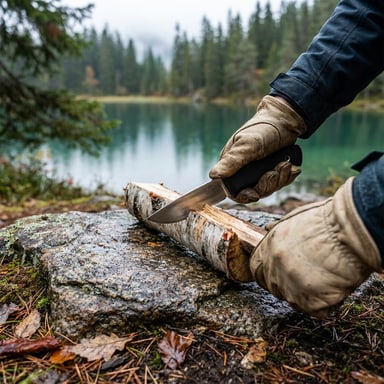
Every knife here is scored using our Kit Score: a weighted framework built on aggregated spec data, verified long-term owner reviews, and independent steel-testing sources. We weight blade steel and heat treat, tang construction, grind geometry, handle grip in wet conditions, sheath quality and retention, and price-to-performance ratio. No pick earns a spot on spec alone.
The picks
Best overall
BEST OVERALL
ESEE-4 Fixed Blade Knife with Sheath, 1095 Carbon Steel, Outdoor Knife with 3D Contoured Handle, Made in USA
Best for: Campers and bushcrafters who prioritize field-sharpenable carbon steel, full-tang durability, and a US-made lifetime-warranty knife for serious wilderness work.
- 1095 carbon steel resharpens quickly on a basic stone or strop, a real field advantage on longer trips
- 1095 steel requires consistent oiling and drying to prevent rust wherever the powder coat wears through
Kit Score 8.6/10 · $122.48 Price checked Oct 23, 4:16 PM CDT · how we score gear
Buy on AmazonProduct details
The ESEE-4 is a proven full-tang fixed blade built around 1095 carbon steel at 55-57 HRC, a steel prized for its ease of sharpening in the field and its toughness under hard use. Made in the USA and backed by a transferable lifetime warranty: if you break it, ESEE repairs or replaces it.
- Blade length
- 4.5 in (4.1 in cutting edge)
- Blade steel
- 1095 high carbon steel, 55-57 HRC
- Blade thickness
- 0.188 in (4.8 mm)
- Grind
- Flat grind, drop point
- Handle
- 3D contoured Blue/Black G10
- Sheath
- Ambidextrous polymer sheath with clip plate
More strengths
- Full tang with 3D contoured G10 handle provides confident grip during batoning and wood processing
- Lifetime, transferable breakage warranty with no proof-of-purchase requirement is among the strongest in the category (rust, wear, and loss excluded)
Other tradeoffs
- Factory edge ships softer than premium-steel competitors (55-57 HRC) and needs refreshing sooner under heavy use
The ESEE-4 is built around a single decision that everything else follows from: 1095 high-carbon steel, heat-treated to 55–57 HRC. That is on the softer end of the hardness range for carbon steel, which sounds like a compromise until you understand the trade-off. A blade at 55–57 HRC is tougher and more impact-resistant than a harder blade, which matters when you are batoning through a knot or prying a stuck stake. It sharpens quickly on a flat stone or a ceramic rod, which matters when you are 40 miles from the nearest gear shop.
The full flat grind on 0.188-inch (4.8 mm) stock gives you a geometry that handles both fine food-prep cuts and heavier wood-processing work without needing a dedicated tool for each. The version linked here has a 3D contoured G10 handle that fills the hand; ESEE also sells canvas Micarta handles. The ambidextrous polymer sheath comes with a clip plate, and the knife weighs 8 oz, or 11 oz with the sheath.
ESEE's warranty is the headline: if you break it, ESEE will repair or replace it without questioning the claim, no receipt is needed, and the warranty transfers with the knife. It does not cover rust, normal wear, or loss. At $115 to $150, the ESEE-4 is not cheap, but it is the kind of tool you buy once.
Best for: Campers and bushcrafters who prioritize field-sharpenable carbon steel, full-tang durability, and a US-made lifetime-warranty knife for serious wilderness work.
Best value
BEST VALUE
Morakniv Garberg Full Tang Fixed Blade Knife with Carbon Steel Blade, 4.3 Inch
Best for: Campers and bushcrafters who want full-tang durability and firesteel-compatible carry at a mid-range price, without spending premium money.
- Full tang construction handles batoning and hard camp tasks that partial-tang knives cannot
- Carbon steel demands consistent maintenance; neglect leads to surface rust quickly in humid conditions
Kit Score 8.5/10 · $84.99 Price checked Oct 23, 4:16 PM CDT · how we score gear
Buy on AmazonProduct details
The Garberg is Morakniv's full-tang answer to campers who need more than a partial-tang knife can offer. The 3.2 mm C100S carbon steel blade carries a black DLC coating and a spine ground to strike a ferro rod, and the ambidextrous polymer sheath works for left- or right-handed carry.
- Blade length
- 4.3 in (109 mm)
- Blade steel
- C100S carbon steel, 57.5 HRC, Scandi grind, DLC coating
- Blade thickness
- 3.2 mm (0.125 in)
- Construction
- Full tang
- Handle
- Polyamide with Dala-pattern friction grip
- Overall length
- 9.0 in (229 mm)
- Sheath
- Ambidextrous polymer sheath with belt loop
More strengths
- Square spine works reliably with a firesteel for fire starting
- Black DLC coating cuts glare and adds some corrosion protection over bare carbon steel
Other tradeoffs
- Basic polymer sheath; the multi-mount and leather sheath versions are separate, pricier listings
The Morakniv Garberg is Mora's full-tang knife, and it closes the gap between the brand's budget reputation and the performance demands of dedicated bushcraft use. Full tang means the steel runs the full length of the handle, here inside a molded polyamide handle with a Dala-pattern friction grip and finger guard. That construction stands up better to lateral stress, batoning, and prying than a partial tang.
The blade is 4.3 inches of C100S carbon steel, 3.2 mm thick, hardened to 57.5 HRC, with a black DLC coating and a Scandi grind. Scandi grind is the standard for bushcraft because it is easy to reprofile on a flat stone in the field: lay the bevel flat and stroke. No guessing the angle. The spine is ground to strike a ferro rod, and the ambidextrous polymer sheath has a belt loop (Mora sells separate multi-mount and leather sheath versions).
At $100 to $125 the Garberg costs more than Mora's partial-tang models but delivers a meaningfully more capable platform. Owner reviews consistently note a very sharp out-of-box edge and a Scandi bevel that is easy to maintain on a budget sharpening setup.
Best for: Campers and bushcrafters who want full-tang durability and firesteel-compatible carry at a mid-range price, without spending premium money.
Best budget
BEST BUDGET
Morakniv Companion Heavy-Duty Carbon Steel Fixed-Blade Knife with Sheath, 4.1 Inch
Best for: First-time bushcrafters and budget-conscious campers who want a sharp, capable fixed blade without the premium price tag.
- Remarkable quality-to-price ratio: owners consistently report it performs far above its cost
- Carbon steel requires wiping and oiling after use to prevent rust, especially in wet conditions
Kit Score 8.4/10 · $20.00 Price checked Oct 23, 4:16 PM CDT · how we score gear
Buy on AmazonProduct details
A widely recommended entry-level bushcraft knife, the Companion Heavy Duty ups the standard Companion's blade thickness from 2.0 mm to 3.2 mm for serious camp work. The thicker spine takes ferro rod sparks poorly, but the carbon steel edge sharpens faster in the field than almost any knife at this price.
- Blade length
- 4.1 in
- Blade steel
- C100S carbon steel, 57.5 HRC
- Blade thickness
- 3.2 mm (heavy duty)
- Grind
- Scandi, 26-28 degree total angle
- Handle
- TPE rubber friction grip with finger guard
- Sheath
- Polypropene with belt clip
More strengths
- Carbon steel (C100S) sharpens quickly on a flat stone or strop, a real advantage in the field
- Lightweight and slim enough to carry daily without adding noticeable pack weight
Other tradeoffs
- Plastic sheath can loosen over time and the beveled spine limits ferro rod sparking
The Morakniv Companion Heavy Duty Carbon is the easiest recommendation in outdoor knives. The 4.1-inch blade is the same C100S carbon steel at 57.5 HRC as the Garberg, 3.2 mm thick (the standard Companion is 2.0 mm), and the Scandi grind makes sharpening straightforward for beginners. The extra-large TPE rubber handle has a friction grip and finger guard, and the whole knife weighs about 4.8 oz. The sheath is polypropylene with a belt clip: not a premium product, but it does not add unnecessary bulk.
The honest limitation is the partial tang (Mora calls it a standard tang) encased in the handle. For typical camp use, including food prep, carving, whittling, and light wood processing, the construction is entirely adequate. For sustained heavy batoning or lateral pry loads, a full-tang knife like the Garberg or ESEE-4 is the safer choice. The Companion is the right starting point for a first bushcraft knife or a dedicated food-prep knife carried alongside a hatchet for splitting duties.
Carbon steel does rust faster than stainless, particularly in humid or marine environments, and Mora says the blade should always be wiped clean and oiled after use. A dry sheath between trips completes the routine. For a $20 to $30 knife that introduces the full scandi-grind workflow, that trade-off is easy to accept.
Best for: First-time bushcrafters and budget-conscious campers who want a sharp, capable fixed blade without the premium price tag.
Best premium
BEST PREMIUM
Fallkniven F1 (Laminated VG7, Zytel Sheath)
Best for: Experienced bushcrafters and backcountry travelers who want a compact, precision-ground premium blade that handles fine carving and heavy wood processing with the same tool.
- Laminated blade construction absorbs lateral shock better than mono-steel blades, reducing chipping risk under hard camp use
- Convex edge requires a leather strop or diamond stone to maintain properly; a basic flat stone alone leaves the edge less sharp than the geometry allows
Kit Score 8.4/10 · $163.99 Price checked Oct 23, 4:16 PM CDT · how we score gear
Buy on AmazonProduct details
The official survival knife for Swedish Air Force pilots since 1995, the F1 now uses Fallkniven's laminated VG7 steel (420J2 outer layers around a VG7 core, 59 HRC). VG7's high tungsten content keeps it sharp longer, per Fallkniven, and the convex grind moves through wood with minimal resistance. The Thermorun handle stays grippy in cold, wet hands.
- Blade length
- 3.9 in (98 mm)
- Blade steel
- Laminated VG7 core with 420J2 outer layers, 59 HRC
- Blade thickness
- 4.5 mm (0.18 in)
- Grind
- Convex
- Handle
- Thermorun, protruding broad tang
- Weight
- 5.3 oz (149 g) knife only
- Sheath
- Zytel (this listing)
More strengths
- Convex grind slices and carves wood with noticeably less drag than flat or Scandi grinds
- Thermorun handle material maintains grip in cold, wet, or gloved conditions where harder handles become slippery
Other tradeoffs
- This listing ships with the Zytel sheath; Fallkniven's leather sheath is a separate option
The Fallkniven F1 has been the official survival knife for Swedish Air Force pilots since 1995. The current version, linked here, uses Fallkniven's laminated VG7 steel: a VG7 core between 420J2 stainless outer layers, hardened to 59 HRC, on 4.5 mm stock with a convex grind. VG7 carries about five times the tungsten of the VG10 used in earlier F1s, which Fallkniven says helps it hold an edge.
The convex grind is what distinguishes the F1 from every other knife in this guide. It leaves more steel behind the edge than a flat or hollow grind, which helps it stand up to hard use. It is also harder to reprofile on a flat stone without technique, so the F1 rewards a camper who has some sharpening background or is willing to learn convex sharpening on a leather strop.
The blade runs 3.9 inches (98 mm) and the knife weighs about 149 g (5.3 oz), which keeps it compact enough to ride in a pack. The Thermorun handle is a grippy elastomer that owners like in cold, wet hands. The listing we link comes with Fallkniven's Zytel plastic sheath, which shrugs off wet weather better than the leather option some owners replace. At $145 to $175, the F1 is a genuine premium purchase, and the build quality is visible and verifiable on first handling.
Best for: Experienced bushcrafters and backcountry travelers who want a compact, precision-ground premium blade that handles fine carving and heavy wood processing with the same tool.
Head-to-head comparison
| Product | Kit Score | Price | Best for |
|---|---|---|---|
| ESEE-4 Fixed Blade Knife with Sheath, 1095 Carbon Steel, Outdoor Knife with 3D Contoured Handle, Made in USA | 8.6 | $122.48 Price checked Oct 23, 4:16 PM CDT | Best for: Campers and bushcrafters who prioritize field-sharpenable carbon steel, full-tang durability, and a US-made lifetime-warranty knife for serious wilderness work. Why it stands out: 1095 carbon steel resharpens quickly on a basic stone or strop, a real field advantage on longer trips Tradeoff: 1095 steel requires consistent oiling and drying to prevent rust wherever the powder coat wears through |
| Morakniv Garberg Full Tang Fixed Blade Knife with Carbon Steel Blade, 4.3 Inch | 8.5 | $84.99 Price checked Oct 23, 4:16 PM CDT | Best for: Campers and bushcrafters who want full-tang durability and firesteel-compatible carry at a mid-range price, without spending premium money. Why it stands out: Full tang construction handles batoning and hard camp tasks that partial-tang knives cannot Tradeoff: Carbon steel demands consistent maintenance; neglect leads to surface rust quickly in humid conditions |
| Morakniv Companion Heavy-Duty Carbon Steel Fixed-Blade Knife with Sheath, 4.1 Inch | 8.4 | $20.00 Price checked Oct 23, 4:16 PM CDT | Best for: First-time bushcrafters and budget-conscious campers who want a sharp, capable fixed blade without the premium price tag. Why it stands out: Remarkable quality-to-price ratio: owners consistently report it performs far above its cost Tradeoff: Carbon steel requires wiping and oiling after use to prevent rust, especially in wet conditions |
| Fallkniven F1 (Laminated VG7, Zytel Sheath) | 8.4 | $163.99 Price checked Oct 23, 4:16 PM CDT | Best for: Experienced bushcrafters and backcountry travelers who want a compact, precision-ground premium blade that handles fine carving and heavy wood processing with the same tool. Why it stands out: Laminated blade construction absorbs lateral shock better than mono-steel blades, reducing chipping risk under hard camp use Tradeoff: Convex edge requires a leather strop or diamond stone to maintain properly; a basic flat stone alone leaves the edge less sharp than the geometry allows |
ESEE-4 Fixed Blade Knife with Sheath, 1095 Carbon Steel, Outdoor Knife with 3D Contoured Handle, Made in USA
- Best for
- Campers and bushcrafters who prioritize field-sharpenable carbon steel, full-tang durability, and a US-made lifetime-warranty knife for serious wilderness work.
- Why it stands out
- 1095 carbon steel resharpens quickly on a basic stone or strop, a real field advantage on longer trips
- Tradeoff
- 1095 steel requires consistent oiling and drying to prevent rust wherever the powder coat wears through
Morakniv Garberg Full Tang Fixed Blade Knife with Carbon Steel Blade, 4.3 Inch
- Best for
- Campers and bushcrafters who want full-tang durability and firesteel-compatible carry at a mid-range price, without spending premium money.
- Why it stands out
- Full tang construction handles batoning and hard camp tasks that partial-tang knives cannot
- Tradeoff
- Carbon steel demands consistent maintenance; neglect leads to surface rust quickly in humid conditions
Morakniv Companion Heavy-Duty Carbon Steel Fixed-Blade Knife with Sheath, 4.1 Inch
- Best for
- First-time bushcrafters and budget-conscious campers who want a sharp, capable fixed blade without the premium price tag.
- Why it stands out
- Remarkable quality-to-price ratio: owners consistently report it performs far above its cost
- Tradeoff
- Carbon steel requires wiping and oiling after use to prevent rust, especially in wet conditions
Fallkniven F1 (Laminated VG7, Zytel Sheath)
- Best for
- Experienced bushcrafters and backcountry travelers who want a compact, precision-ground premium blade that handles fine carving and heavy wood processing with the same tool.
- Why it stands out
- Laminated blade construction absorbs lateral shock better than mono-steel blades, reducing chipping risk under hard camp use
- Tradeoff
- Convex edge requires a leather strop or diamond stone to maintain properly; a basic flat stone alone leaves the edge less sharp than the geometry allows
How to choose a camping knife
Narrow your choice in four steps
Fixed blade or folding
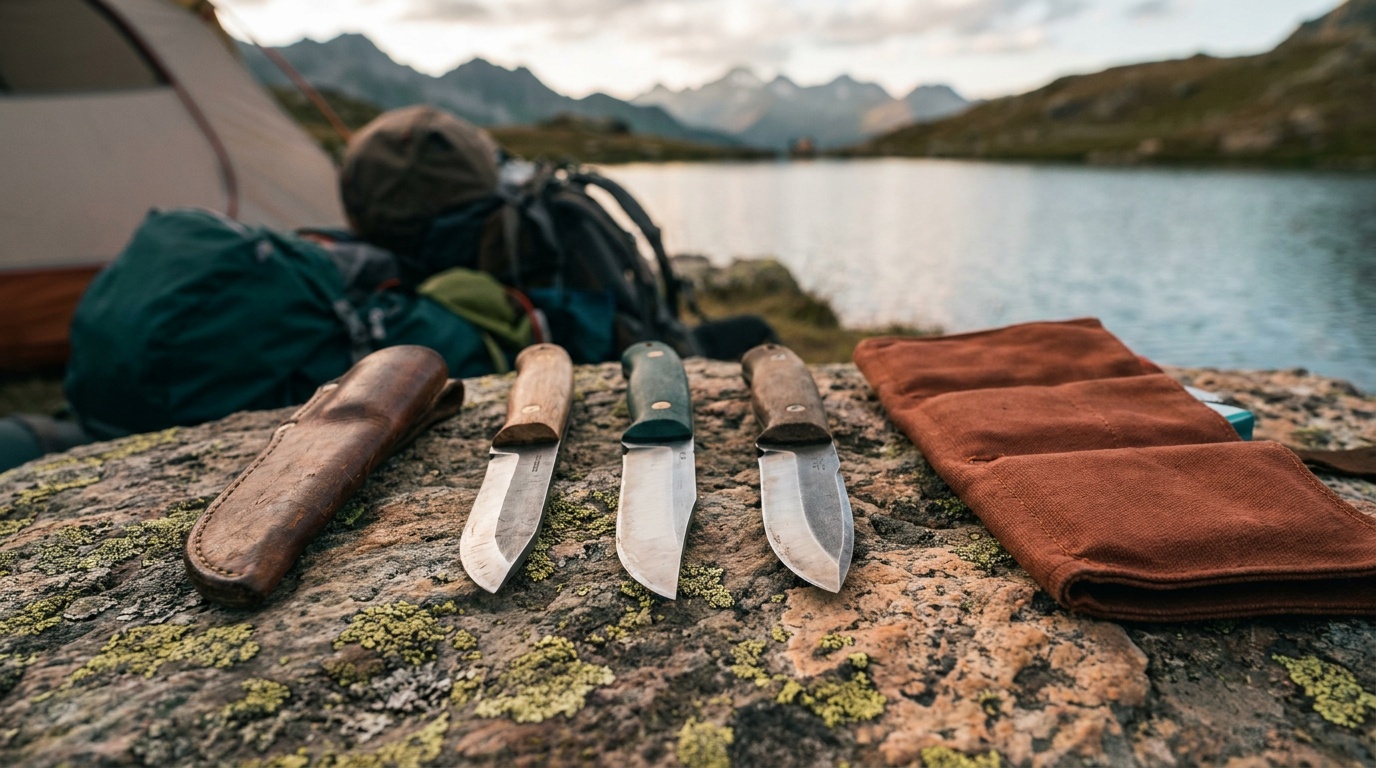
Fixed blades are stronger, easier to clean, and more reliable under load. For bushcraft, batoning, and any sustained camp work, fixed blade is the correct choice. Folding knives make sense as a secondary tool or for day trips where you want something lighter and more packable. Every knife in this guide is fixed blade for that reason.
Decide on tang first
A full-tang knife (steel running the full length of the handle) handles batoning and pry loads better than a partial-tang construction. If you plan to use your knife for splitting kindling or processing larger wood, choose the Garberg or ESEE-4. If your use is primarily food prep and carving, the Companion's partial tang is adequate.
Match the grind to your sharpening skill
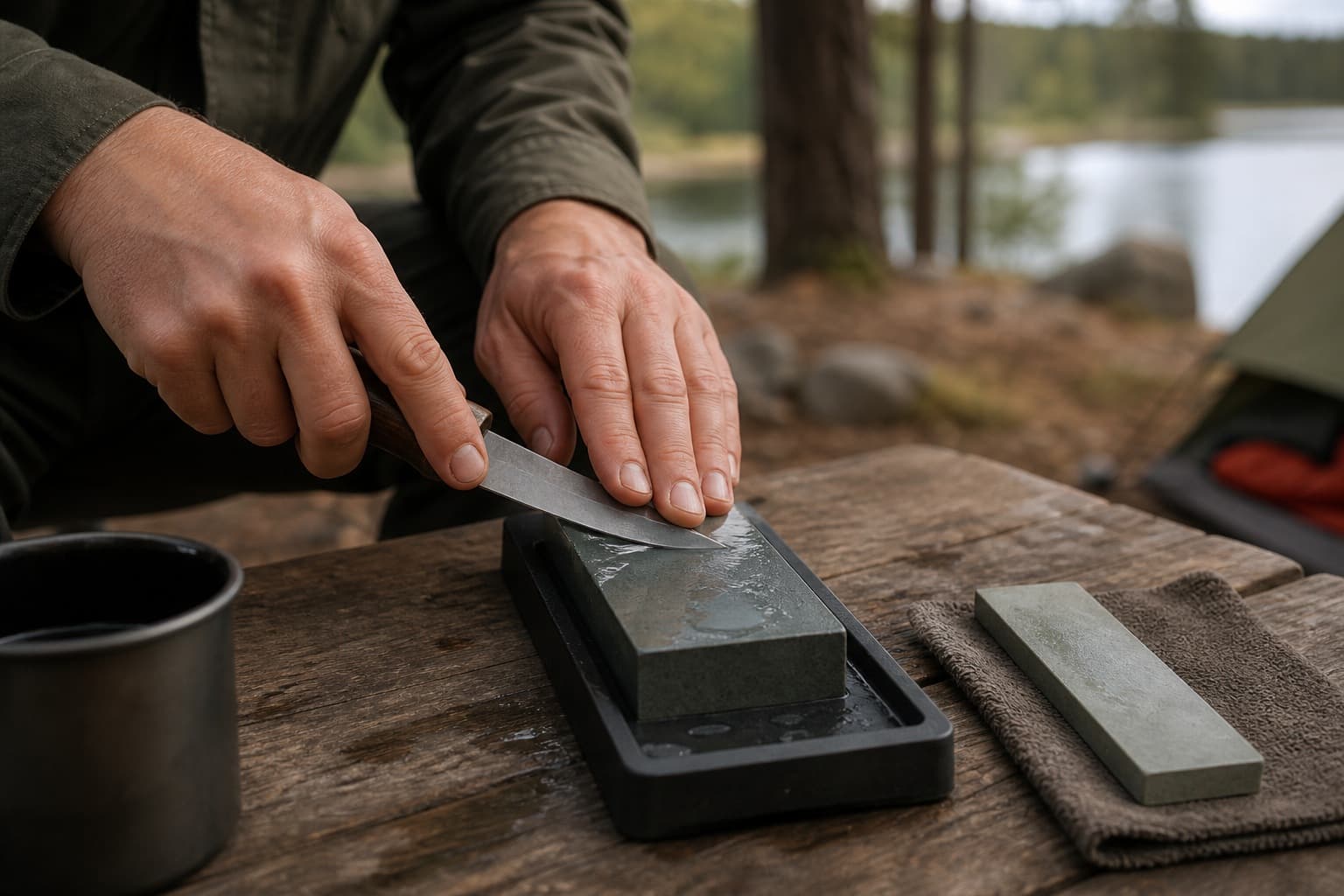
Scandi grind (Mora knives) is the easiest to reprofile in the field on a flat stone. Flat grind (ESEE-4) requires knowing your target angle but is still learnable quickly. Convex grind (Fallkniven F1) performs best but benefits from strop technique. Pick the grind you will actually maintain, because a sharp basic knife outperforms a dull premium one.
Choose blade steel for your environment
High-carbon steel (ESEE-4, Morakniv Carbon models) sharpens faster and often holds a keener working edge than stainless, but requires a light oil coat after exposure to moisture or acidic foods. Stainless and laminate steel (Fallkniven F1's outer cladding) require less active rust prevention. For humid or coastal camping, stainless or stainless laminate (the F1's VG10 and 420J2 are both stainless) makes maintenance simpler.
The best camp knife is the sharpest one in your kit, not the most expensive one.
Where these numbers come from
| Claim | Source | Checked |
|---|---|---|
| ESEE-4: 9.0 in overall, 4.5 in blade (4.1 in cutting edge), 3/16 in stock, 8.0 oz, 1095 carbon at 55–57 Rc, drop point, made in the USA | ESEE Knives, ESEE-4 | 2026-09-26 |
| ESEE-4 (this listing): 0.188 in thick, full flat grind, textured powder coat, 11 oz with sheath, 3D contoured G10 handle, ambidextrous polymer sheath with clip plate | ESEE-4 listing on Amazon, ASIN B0848RXQ1W | 2026-09-26 |
| ESEE warranty: repair or replace a broken knife without questioning the claim, lifetime and transferable, no receipt needed; excludes rust, normal wear, and loss | ESEE Knives, warranty | 2026-09-26 |
| Morakniv Garberg BlackBlade (C): 109 mm (4.3 in) blade, 3.2 mm thick, 229 mm overall, 209 g, C100S carbon at 57.5 HRC, Scandi grind, full tang, DLC coating, polyamide handle, spine works with a ferro rod, ambidextrous polymer sheath | Morakniv, Garberg BlackBlade (C) | 2026-09-26 |
| Morakniv Companion HeavyDuty (C): 104 mm (4.1 in) blade, 3.2 mm thick, 224 mm overall, 135.3 g, C100S at 57.5 HRC, Scandi grind, standard tang, TPE rubber handle, polypropene sheath with belt clip, wipe and oil after use | Morakniv, Companion HeavyDuty (C) | 2026-09-26 |
| Standard Companion (C) blade thickness: 2.0 mm | Morakniv, Companion (C) | 2026-09-26 |
| Fallkniven F1 (laminated VG7): 98 mm (3.9 in) blade, 213 mm overall, 4.5 mm thick, 149 g, 59 HRC, convex edge, Thermorun handle, protruding broad tang, leather or Zytel sheath; the high tungsten content keeps it sharp longer | Fallkniven, F1 (Lam. VG7 steel) | 2026-09-26 |
| Laminated VG7 structure is 420J2, VG7, 420J2 at 59 HRC; VG7 carries 1.25% tungsten against 0.25% in VG10W | Fallkniven, steel information | 2026-09-26 |
| F1: Swedish Air Force pilots' survival knife since 1995 | Fallkniven, F1 (Lam. VG7 steel) | 2026-10-10 |
| Linked listing is the F1 in laminated VG7 with a Zytel sheath (model F1nzWolf) | Fallkniven listing on Amazon, ASIN B0D9459XLV | 2026-09-26 |
We have not used these knives ourselves. Dimensions, steels, and hardness are the makers' figures; edge, grip, and sheath notes summarize owner reviews. Knife carry rules vary by state, park, and country, so check local regulations before you carry a fixed blade away from camp.
Frequently asked questions
Is carbon steel or stainless steel better for a camping knife?
Both work well for camping. Carbon steel (1095, high-carbon Mora steel) typically sharpens faster and achieves a keener edge, but oxidizes without care: wipe the blade dry after contact with food, water, or wood resin, and apply a thin coat of mineral oil or food-safe oil for storage. Stainless steel requires less active maintenance and resists rust in humid and wet environments. The practical answer depends on your habits: if you will take care of the blade consistently, carbon steel rewards that effort. If you want to rinse, dry, and pack, stainless is lower maintenance.
What blade length should I look for in a camping knife?
For general camping and bushcraft tasks, 3.5 to 4.5 inches covers the practical range. Shorter blades (3 to 3.5 in) are better for detail carving and food prep but limit reach on larger batoning or camp tasks. Longer blades (5 in and above) add chopping utility but become awkward for precise carving. The four knives in this guide range from 3.8 to 4.5 inches, which is the sweet spot where one tool handles most tasks without compromise.
Can I use a camp knife for batoning (splitting wood)?
Yes, with the right knife. Full-tang construction is the safer choice: a partial-tang knife is more likely to fail at the handle junction under sustained baton force. Choose a blade with enough spine thickness to handle impact, typically 3 mm or more. The ESEE-4 (4.8 mm, full tang) and the Morakniv Garberg (3.2 mm, full tang) are the batoning picks here. The Fallkniven F1 is thick (4.5 mm), but its harder 59 HRC edge is less forgiving, and some owners report chipping when batoning aggressively, so save it for lighter splitting and carry a hatchet or saw for big rounds.
A camp knife is the one piece of gear that earns its weight on every trip. Any of these four will serve you well; the right one depends on your budget, your intended use, and how willing you are to maintain a carbon steel edge. Browse the full camp gear hub for shelter, sleep, and cook reviews, or read more about how we research and rate every product we recommend.
Keep going
Related guides
 Complete camp loadoutCar-camping starter kitBuild the complete kit
Our recommendations draw on manufacturer documentation, retailer listings, owner feedback, and comparisons with alternatives.
As an Amazon Associate I earn from qualifying purchases. We may earn a commission from links here, at no extra cost to you. How we research →
Top picks
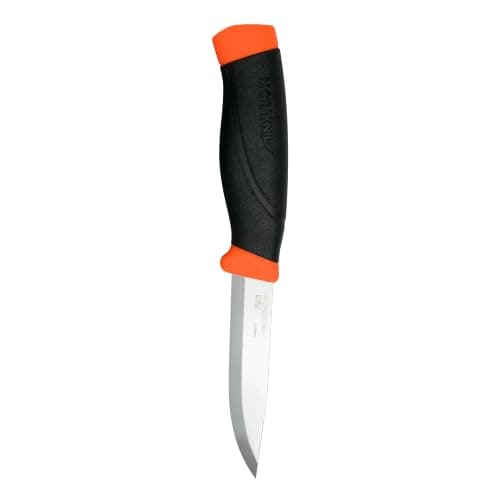 Best BudgetMorakniv Companion Heavy-Duty Carbon Steel Fixed-Blade Knife with Sheath, 4.1 Inch8.4/10
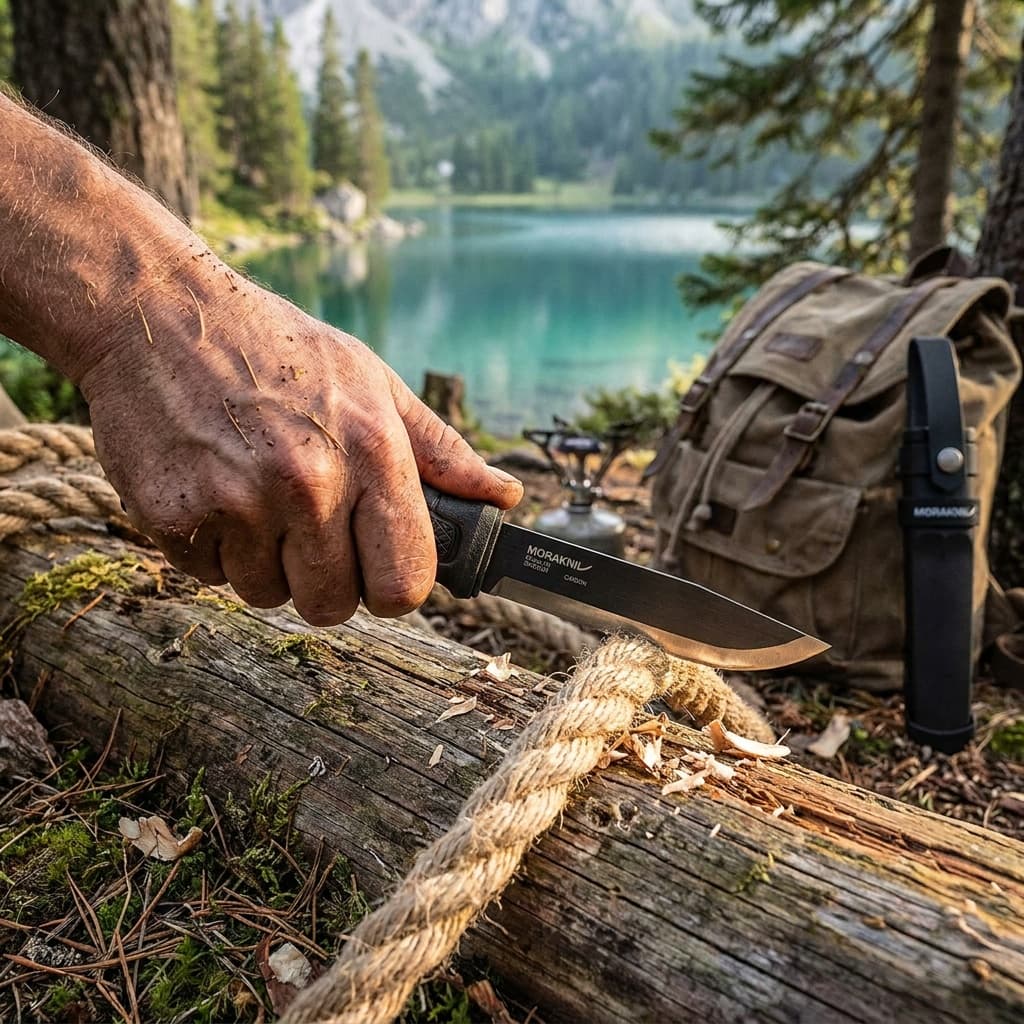 Best ValueMorakniv Garberg Full Tang Fixed Blade Knife with Carbon Steel Blade, 4.3 Inch8.5/10
 Best OverallESEE-4 Fixed Blade Knife with Sheath, 1095 Carbon Steel, Outdoor Knife with 3D Contoured Handle, Made in USA8.6/10
 Best PremiumFallkniven F1 (Laminated VG7, Zytel Sheath)8.4/10