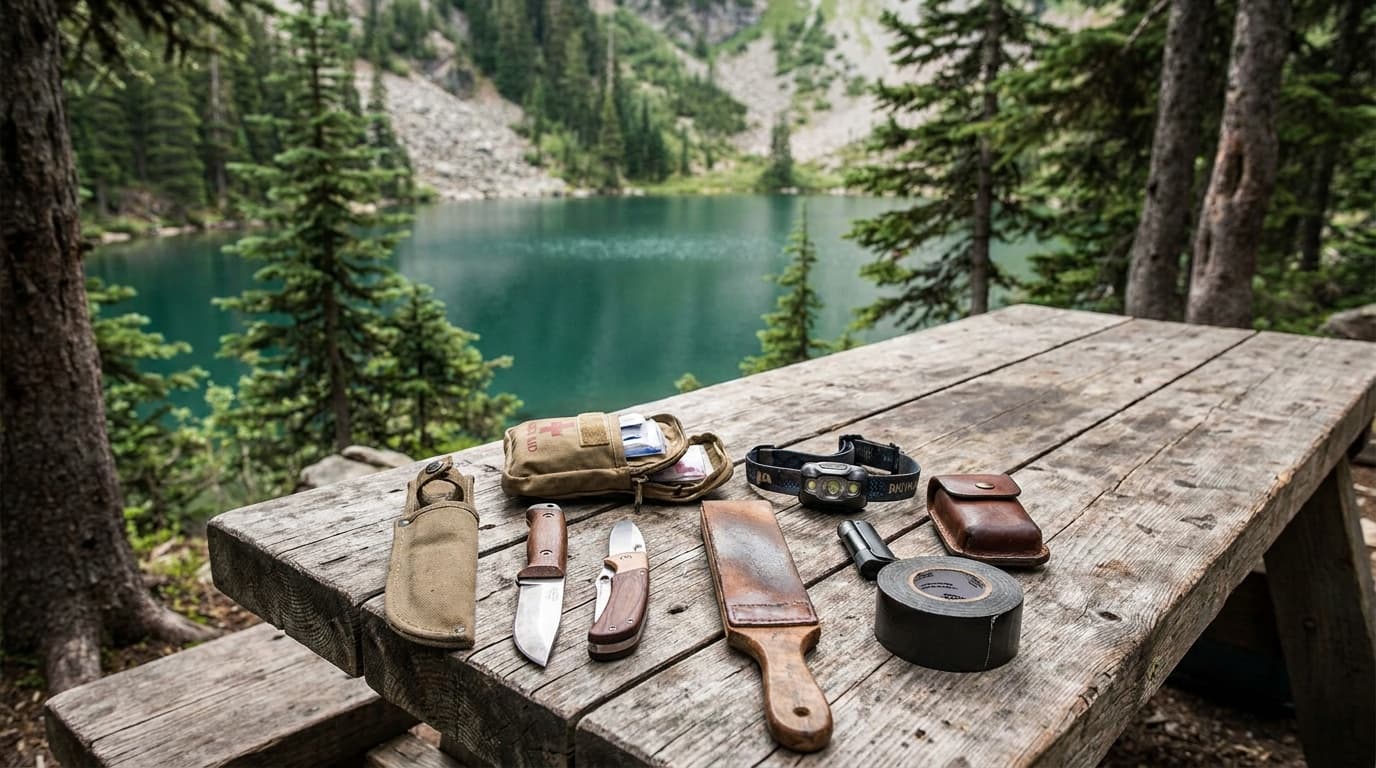
Choosing between a fixed-blade and a folding knife for camp comes down to one honest question: what hard work are you actually asking your knife to do?
Strength and the batoning question
Batoning is the technique of driving a knife blade through a log with a baton to split kindling. It is hard on a knife. The pivot pin of a folding knife is not engineered for that lateral stress, and forcing it risks cracking the handle scales, bending the blade, or snapping the pivot entirely. Fixed blades, especially those with a full tang (where the steel runs the full length and width of the handle, not just a narrow "rat-tail" stub), distribute impact load through the entire blade-handle assembly. That is why survival and bushcraft knives, from the budget Morakniv Companion on up, are almost always fixed blades.
For other demanding tasks like skinning game, splitting small green branches, or driving stakes, the same logic applies. A folder is a cutting tool. A fixed blade is a cutting tool that can also take abuse.
Portability and pocket carry
A folding knife collapses to roughly half its open length and clips flat in a pants pocket. You can walk into a gas station, a permit office, or a trailhead parking lot without a second glance. Most US states permit folding knives with blades under 3–4 inches with no permit required, though limits vary and a few municipalities are stricter.
A sheathed fixed blade is legal in most outdoor and rural contexts in the US, but it is not pocket carry. You wear it on a belt, which means you either have it on or you have left it in the tent. For a day hike that starts at camp, that is not a trivial distinction.
If your camping is primarily car camping and day hiking, a quality folder handles 90 percent of what you will actually do: opening packages, cutting cord, prepping food, slicing fruit.
Cleaning, reliability, and hygiene
Fixed blades are easier to clean thoroughly. Hot soapy water, a brush, done. No pivot channel to trap food debris, no spring mechanism to corrode, no G-10 scale gaps to harbor bacteria. For food prep in camp, particularly anything involving raw meat or fish, this is a real advantage.
Folding knives require periodic disassembly or at least a vigorous flush with soapy water at the pivot to stay truly clean. Many knife makers provide Torx screws precisely so you can take the knife apart for deep cleaning. If you are using your folder for cooking tasks, build that habit in.
Lock failure is the folder's reliability risk. A worn liner lock can fold under lateral load. Quality brands (Benchmade, Spyderco, CRKT) engineer for this, but the risk is not zero. A fixed blade with a full tang has no moving parts to fail.
A fixed blade with a full tang has exactly one way to fail: the steel itself, which takes serious abuse to reach.
Full tang: what it means and why it matters
Full tang means the blade steel extends through the entire handle, visible on the top and bottom edges between the handle scales. When you baton, pry, or use a firesteel against the spine, force transfers through a continuous piece of steel rather than through a glued or pinned junction.
Partial tang and hidden tang knives are lighter and cheaper to manufacture. They are fine for light cutting tasks. For hard camp use, full tang designs like the Morakniv Garberg are the spec to look for. Check the product listing or the manufacturer's page; it is almost always specified.
How to read a knife spec for camp use
Tang type
Look for "full tang"; partial or hidden tang is a downgrade for hard tasks.
Blade steel
1095 carbon and D2 are tough and easy to field-sharpen; 440C and AUS-8 resist rust better.
Handle material
G-10 and Micarta hold up wet; rubber and rubberized grips are comfortable but can degrade.
Blade length
4–5 inches covers camp tasks without running into legal issues in most jurisdictions.
Sheath quality
Kydex retains the knife positively; leather looks great but softens wet.
Legal carry: what to know before you go
Knife laws in the US vary by state and city. Fixed blades are broadly legal in wilderness and rural areas; the complications arise in urban transit, national parks with specific rules, and a handful of states that restrict blade length or open carry of fixed blades regardless of setting.
General practical rules: a folding knife with a blade under 3 inches clears almost every US jurisdiction. A fixed blade under 5 inches is legal for outdoor recreation in most states but check local ordinances before driving through cities. California, New York City, and a few other places have specific restrictions worth researching before your trip.
For international travel, neither type belongs in carry-on luggage. Check destination country laws if camping abroad.
Who should pick which
Pick a fixed blade if you are doing backcountry camping, bushcraft, hunting, or any trip where you will process wood, prep game, or need a tool that holds up to sustained hard use. Full tang, 4–5 inch blade, Kydex sheath (the ESEE-4 is the textbook version of that spec).
Pick a folder if you are car camping, weekend camping at a developed site, or doing multi-use everyday carry where the knife does light camp tasks and general daily use. Quality liner lock or frame lock, 3–4 inch blade, steel rated for hard use.
For many campers, the answer is both: a compact folder on the person at all times and a fixed blade at camp for the jobs that actually need it.
Frequently asked questions
Can I use a folding knife for batoning firewood?
It is not recommended. The pivot pin is not designed for the lateral impact stress of batoning, and forcing it risks cracking the handle, bending the blade, or breaking the lock. If splitting kindling is part of your camp routine, carry a fixed blade for that task specifically.
Are fixed-blade knives legal to carry camping in the US?
In most US wilderness and rural camping contexts, yes. Fixed blades are broadly legal for outdoor recreation. Complications arise in specific cities, on some transit systems, and occasionally in national park visitor centers. Check state law and any local ordinances for your specific destination before the trip.
What blade length is most useful for camp?
A 4–5 inch blade on a fixed blade covers batoning, food prep, and camp tasks without running into the most common legal thresholds. For a folder, 3–4 inches handles food prep and utility tasks while staying within most legal limits. Longer is not always better; a 6-inch blade adds weight and draw length without adding much practical capability for typical camp work.
For specific picks in both categories, see our guide to the best camping knives. Browse all camp guides or read how we research and rate gear.
Recommended gear
Our current top picks from the Best camping knives for bushcraft and camp tasks (2026) guide, if you are ready to buy.
MORAKNIV
Morakniv Companion Heavy-Duty Carbon Steel Fixed-Blade Knife with Sheath, 4.1 Inch
Best Budget
Kit Score 8.4/10
$20.00 Price checked Oct 23, 4:16 PM CDT
Best for: First-time bushcrafters and budget-conscious campers who want a sharp, capable fixed blade without the premium price tag.
- Remarkable quality-to-price ratio: owners consistently report it performs far above its cost
- Carbon steel requires wiping and oiling after use to prevent rust, especially in wet conditions
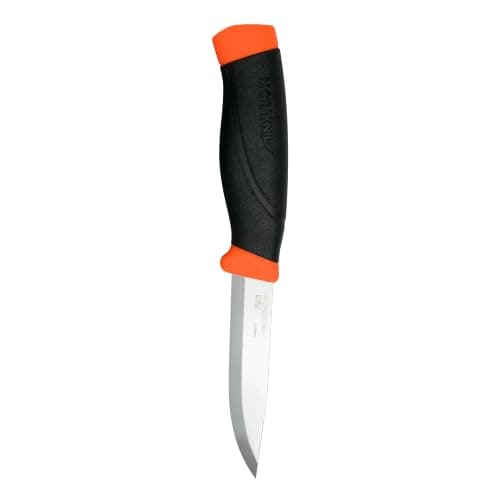
- Blade length
- 4.1 in
- Blade steel
- C100S carbon steel, 57.5 HRC
- Blade thickness
- 3.2 mm (heavy duty)
- Grind
- Scandi, 26-28 degree total angle
- Handle
- TPE rubber friction grip with finger guard
- Sheath
- Polypropene with belt clip
About this pick
A widely recommended entry-level bushcraft knife, the Companion Heavy Duty ups the standard Companion's blade thickness from 2.0 mm to 3.2 mm for serious camp work. The thicker spine takes ferro rod sparks poorly, but the carbon steel edge sharpens faster in the field than almost any knife at this price.
Strengths
- Remarkable quality-to-price ratio: owners consistently report it performs far above its cost
- Carbon steel (C100S) sharpens quickly on a flat stone or strop, a real advantage in the field
- Lightweight and slim enough to carry daily without adding noticeable pack weight
Weaknesses
- Carbon steel requires wiping and oiling after use to prevent rust, especially in wet conditions
- Plastic sheath can loosen over time and the beveled spine limits ferro rod sparking
Kit Score breakdown
MORAKNIV
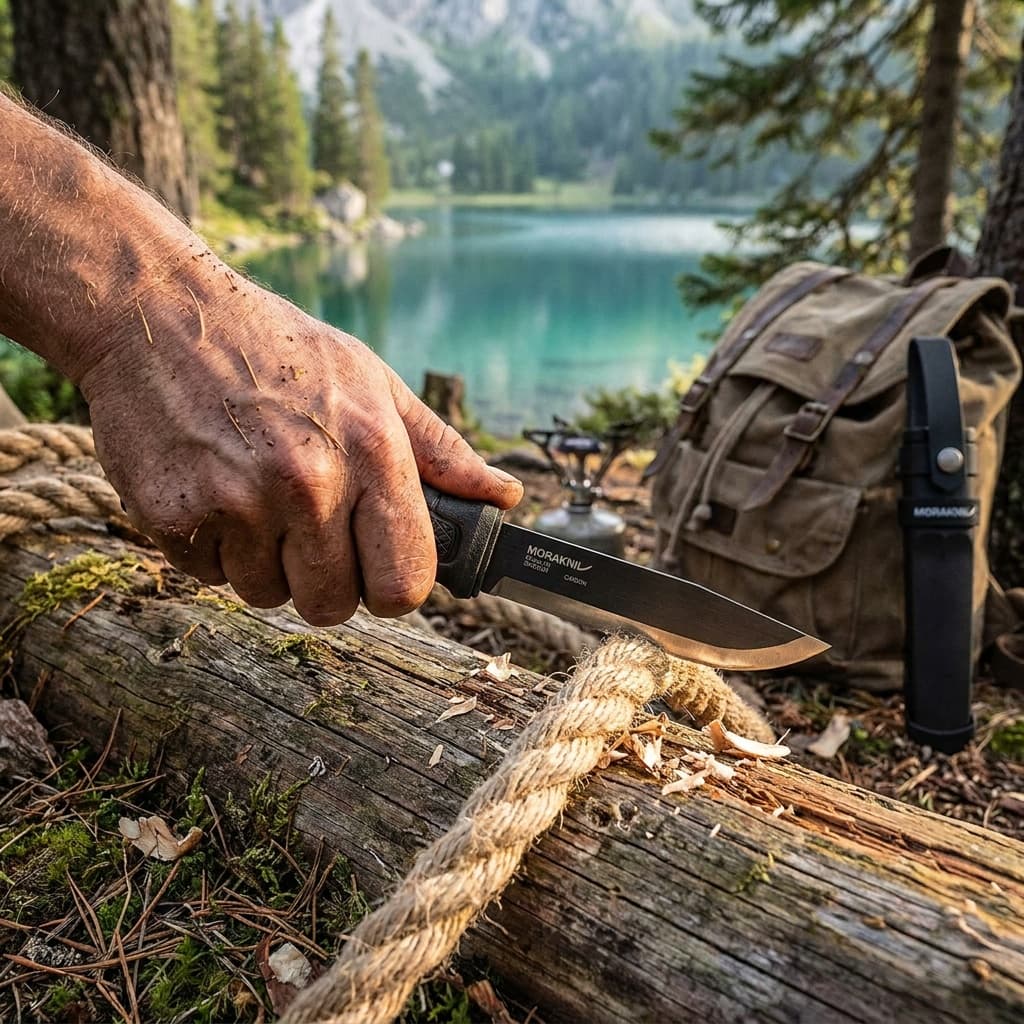
Morakniv Garberg Full Tang Fixed Blade Knife with Carbon Steel Blade, 4.3 Inch
Best Value
Kit Score 8.5/10
$84.99 Price checked Oct 23, 4:16 PM CDT
Best for: Campers and bushcrafters who want full-tang durability and firesteel-compatible carry at a mid-range price, without spending premium money.
- Full tang construction handles batoning and hard camp tasks that partial-tang knives cannot
- Carbon steel demands consistent maintenance; neglect leads to surface rust quickly in humid conditions
- Blade length
- 4.3 in (109 mm)
- Blade steel
- C100S carbon steel, 57.5 HRC, Scandi grind, DLC coating
- Blade thickness
- 3.2 mm (0.125 in)
- Construction
- Full tang
- Handle
- Polyamide with Dala-pattern friction grip
- Overall length
- 9.0 in (229 mm)
About this pick
The Garberg is Morakniv's full-tang answer to campers who need more than a partial-tang knife can offer. The 3.2 mm C100S carbon steel blade carries a black DLC coating and a spine ground to strike a ferro rod, and the ambidextrous polymer sheath works for left- or right-handed carry.
More specifications
- Sheath
- Ambidextrous polymer sheath with belt loop
Strengths
- Full tang construction handles batoning and hard camp tasks that partial-tang knives cannot
- Square spine works reliably with a firesteel for fire starting
- Black DLC coating cuts glare and adds some corrosion protection over bare carbon steel
Weaknesses
- Carbon steel demands consistent maintenance; neglect leads to surface rust quickly in humid conditions
- Basic polymer sheath; the multi-mount and leather sheath versions are separate, pricier listings
Kit Score breakdown
ESEE KNIVES
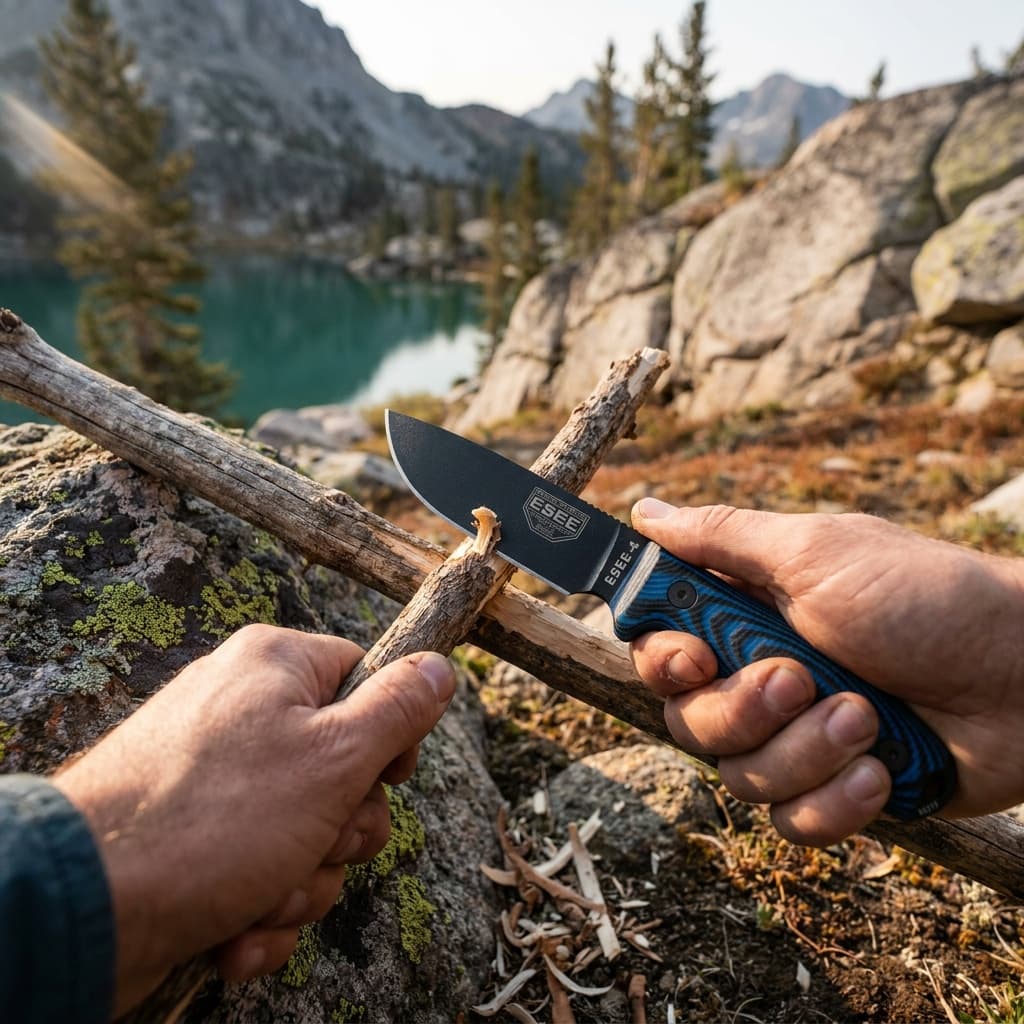
ESEE-4 Fixed Blade Knife with Sheath, 1095 Carbon Steel, Outdoor Knife with 3D Contoured Handle, Made in USA
Best Overall
Kit Score 8.6/10
$122.48 Price checked Oct 23, 4:16 PM CDT
Best for: Campers and bushcrafters who prioritize field-sharpenable carbon steel, full-tang durability, and a US-made lifetime-warranty knife for serious wilderness work.
- 1095 carbon steel resharpens quickly on a basic stone or strop, a real field advantage on longer trips
- 1095 steel requires consistent oiling and drying to prevent rust wherever the powder coat wears through
- Blade length
- 4.5 in (4.1 in cutting edge)
- Blade steel
- 1095 high carbon steel, 55-57 HRC
- Blade thickness
- 0.188 in (4.8 mm)
- Grind
- Flat grind, drop point
- Handle
- 3D contoured Blue/Black G10
- Sheath
- Ambidextrous polymer sheath with clip plate
About this pick
The ESEE-4 is a proven full-tang fixed blade built around 1095 carbon steel at 55-57 HRC, a steel prized for its ease of sharpening in the field and its toughness under hard use. Made in the USA and backed by a transferable lifetime warranty: if you break it, ESEE repairs or replaces it.
Strengths
- 1095 carbon steel resharpens quickly on a basic stone or strop, a real field advantage on longer trips
- Full tang with 3D contoured G10 handle provides confident grip during batoning and wood processing
- Lifetime, transferable breakage warranty with no proof-of-purchase requirement is among the strongest in the category (rust, wear, and loss excluded)
Weaknesses
- 1095 steel requires consistent oiling and drying to prevent rust wherever the powder coat wears through
- Factory edge ships softer than premium-steel competitors (55-57 HRC) and needs refreshing sooner under heavy use
Kit Score breakdown
See all picks in Best camping knives for bushcraft and camp tasks (2026)
Keep going
Related guides
 Complete camp loadoutCar-camping starter kitBuild the complete kit
Researched, not hands-on tested
Updated Jun 4, 2026Our recommendations draw on manufacturer documentation, retailer listings, owner feedback, and comparisons with alternatives.
As an Amazon Associate I earn from qualifying purchases. We may earn a commission from links here, at no extra cost to you. How we research →