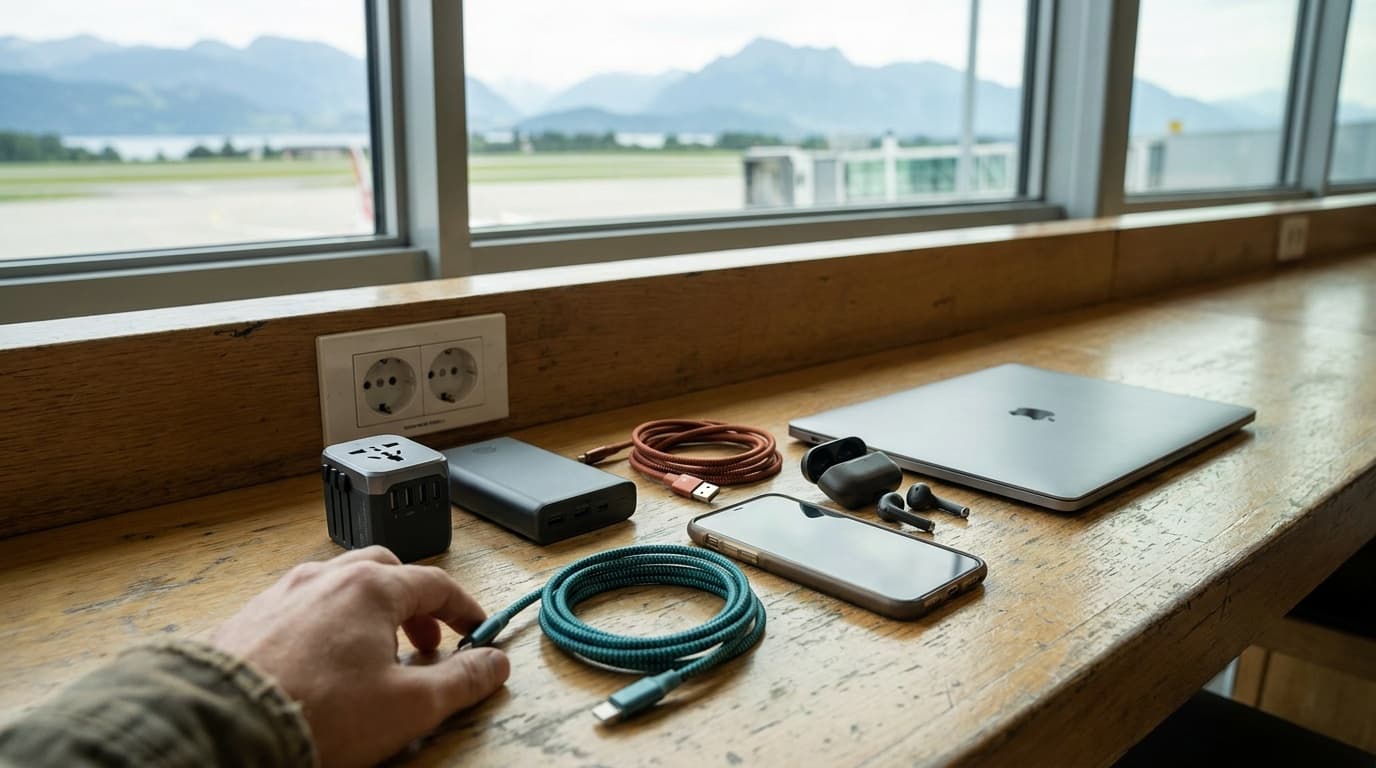
Digging through a tangled nest of cables at the bottom of your bag is a slow, frustrating way to start any trip. One simple system, set up before you leave home, eliminates that entirely.
The one-pouch system
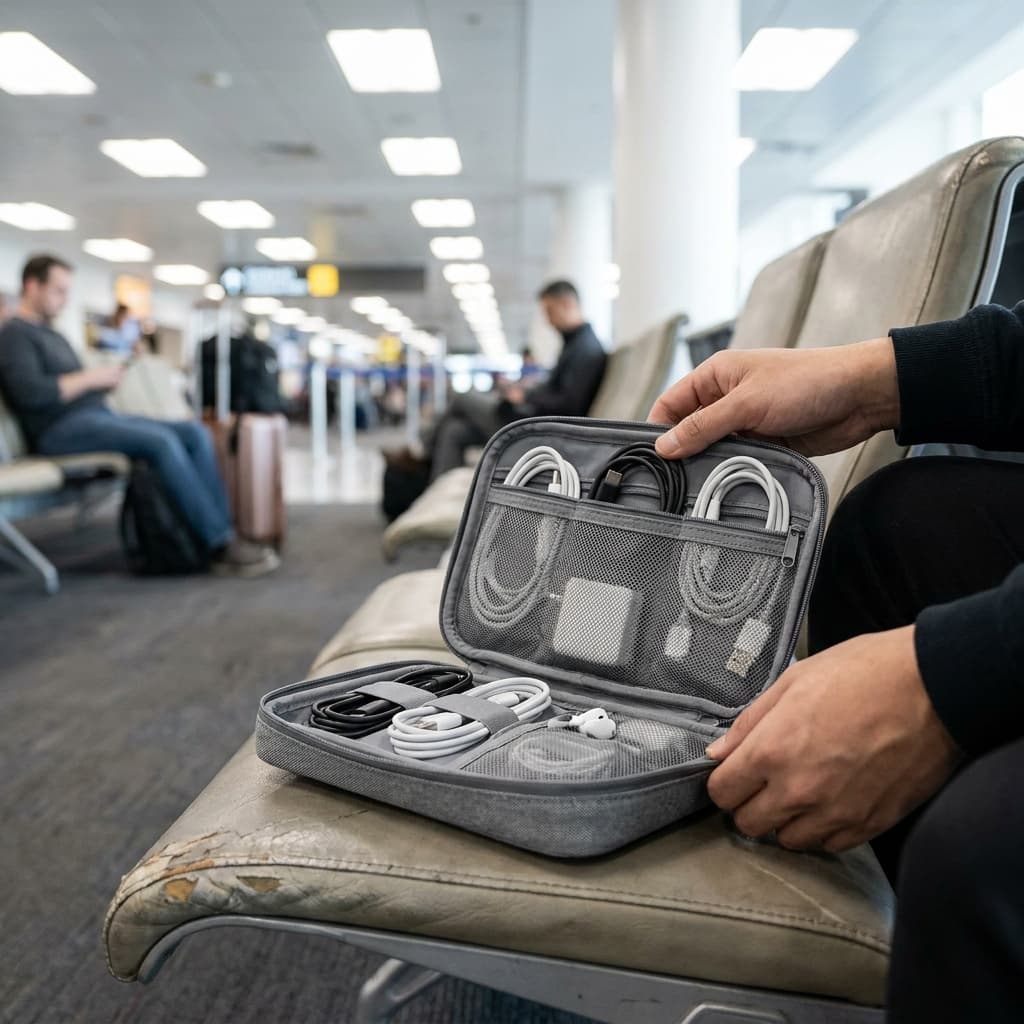
The core idea is simple: every cable, adapter, and small tech item lives in one pouch that moves as a unit. When you unpack at a hotel, the pouch comes out. When you repack, everything goes back in. You never hunt through pockets or wonder which bag something ended up in.
Choose a pouch with elastic loops or mesh pockets, like the BAGSMART Electronics Organizer, rather than a single open cavity. Loops hold cables and adapters in fixed spots, so the pouch stays organized after day one instead of collapsing into a pile. A good size is roughly 18 cm x 12 cm for a one-week trip. Go larger only if you carry camera gear or a laptop that needs its own dedicated accessories.
Keep the pouch consistent. The same items, in the same slots, every trip. That muscle memory is what makes the system feel effortless after a few uses.
Labeling and color-coding
Even with a tidy pouch, identical black cables are indistinguishable in low light. Solve this with two approaches used together.
First, use colored cable ties or small adhesive dot labels near each cable end. Assign a color per device: blue for your phone, green for your laptop, red for your camera. Consistent colors mean a two-second visual scan replaces a five-minute untangle session.
Second, write the device name on a small strip of masking tape wrapped around the cable and then covered with clear tape to protect it. This is low-tech and completely reliable. Label tape at both ends of each cable so you know what you are picking up regardless of which end you grab.
If you use a pouch with fixed elastic loops, assign each loop to a specific cable and keep it that way. After a few trips the layout becomes automatic.
Coiling techniques that prevent tangles
Most cable knots come from one habit: wrapping a cable tightly around your hand in the same direction every time. This creates memory coiling, where the cable wants to spring back into loops and catch on everything nearby.
Over-under coiling method
First loop
make one loop in the natural direction the cable wants to curve
Second loop
flip your wrist and lay the next loop in the opposite direction
Repeat
alternate every loop; the cable stays flat and relaxed
Secure
use a velcro cable tie, never a twist tie that bites into the insulation
Store
lay flat in your pouch rather than folding in half again
The over-under method is used by audio technicians and film crews because it genuinely works. A properly coiled cable uncoils in seconds with no knots.
For short travel cables this matters less, which is another reason to use short cables. A 0.3 m USB-C cable that connects your phone to a power bank barely has room to tangle.
What tech to actually bring
The most effective cable organization is owning fewer cables to begin with. For most travelers, this kit covers everything:
- One multi-port USB-C charger with at least two USB-C ports and one USB-A port. A 65 W charger can run a laptop, phone, and tablet simultaneously from one outlet.
- One 0.3 m USB-C to USB-C cable for phone charging overnight.
- One 0.6 m USB-C to USB-C cable for desk use or connecting to a laptop.
- One USB-C to USB-A adapter (small, lives permanently in the pouch) for legacy cables and hotel alarm clocks.
- A universal travel adapter if you are leaving the country.
One multi-port charger plus two cables of different lengths handles 95 percent of travelers on any trip.
Leave the full-length cables at home. A standard 1.8 m cable is convenient at your desk and a tangle liability in a bag. Shorter cables pack smaller, weigh less, and coil in a fraction of the time.
Keeping small items findable
SD cards, SIM ejector pins, USB-A adapters, and earbuds are the items most likely to vanish. Treat them as a separate category within the pouch.
Use a small zippered mesh pocket or a dedicated small pouch like the tomtoc Light-T12 inside the main pouch for anything smaller than your thumb. All small items go here, always, without exception. This single rule eliminates the "I know it's in here somewhere" problem.
For earbuds, keep them in their case rather than loose. A case takes up defined space in the pouch and prevents the earbud-and-cable tangle that costs five minutes to sort out.
Label your SD cards with a permanent marker on the side. If you shoot with multiple cards, a two-letter code (the destination or project) tells you exactly what is on each card before you plug it in.
Frequently asked questions
Do cables need to be in a separate bag for TSA screening?
No. TSA does not require cables or chargers to be removed from your bag for screening, unlike laptops and liquids. However, a tightly packed or messy electronics bag can trigger a manual bag check. A tidy pouch where items are visible and separated tends to clear screening faster with less friction.
How do I stop cables from falling out of elastic loops mid-trip?
Elastic loops should hold items snugly when new but can stretch over time. If a loop no longer grips a cable, loop the cable twice before inserting it, or add a velcro cable tie as a secondary holder. Some travelers also use binder clips clipped to the pouch edge as a quick anchor for cables that keep escaping.
Is it worth buying a dedicated electronics organizer or will a zip pouch work?
A plain zip pouch works and costs almost nothing. A dedicated organizer with elastic loops, mesh pockets, and a rigid backing is genuinely more convenient if you travel more than a few times a year, because it maintains its structure and keeps items in fixed spots rather than pooling at the bottom. Either approach beats no system at all by a large margin.
For specific pouch and organizer picks based on our research, see our guide to the best electronics travel organizers. Browse all travel guides or read how we research and rate gear.
Recommended gear
Our current top picks from the Best electronics and cable organizers for travel ($8-$45) guide, if you are ready to buy.
TOMTOC
tomtoc Light-T12 Electronics Organizer Travel Case
Best Overall
Kit Score 8.5/10
$18.89 Price checked Oct 23, 4:16 PM CDT
Best for: Travelers who carry a compact daily kit (a couple of cables, earphones, a small charger) and want a well-built, lightweight pouch with a strong owner-verified track record.
- RPET 600D polyester shell is PFAS-free and more durable than standard Oxford nylon at this price point
- 1L capacity limits how much gear fits: not suited for a full cable kit plus a power bank
- Dimensions
- 9.25 x 4.72 x 2.56 in
- Weight
- 300 g (0.66 lb)
- Capacity
- 1 L
- Material
- RPET 600D polyester, PFAS-free
- Compartments
- Zippered mesh pocket, lining pockets, sleeve, pen loop
- Handle
- Wrist strap
About this pick
The tomtoc Light-T12 is a compact 1-liter accessory pouch built from sustainable RPET 600D polyester with a compact clamshell layout. It keeps cables, adapters, earphones, and small chargers sorted in a zippered mesh pocket, lining pockets, and a sleeve, stands upright on a desk, and fits easily into a carry-on pocket or tote.
Strengths
- RPET 600D polyester shell is PFAS-free and more durable than standard Oxford nylon at this price point
- Compact 1L footprint and wrist strap make it practical as a daily grab-and-go pouch or travel insert
- 4.8 stars from 3,800+ verified Amazon buyers, one of the highest ratings in this category
Weaknesses
- 1L capacity limits how much gear fits: not suited for a full cable kit plus a power bank
- Few dedicated loops, so users with complex cable sets may find it less structured than folder-style organizers
Kit Score breakdown
BAGSMART
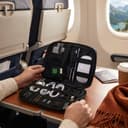
BAGSMART Large Electronics Travel Organizer Case
Best Value
Kit Score 8.4/10
$14.99 Price checked Oct 23, 4:16 PM CDT
Best for: Budget-focused travelers who carry a predictable cable set, a couple of adapters, and a slim charger and want a well-reviewed, flat organizer under $15.
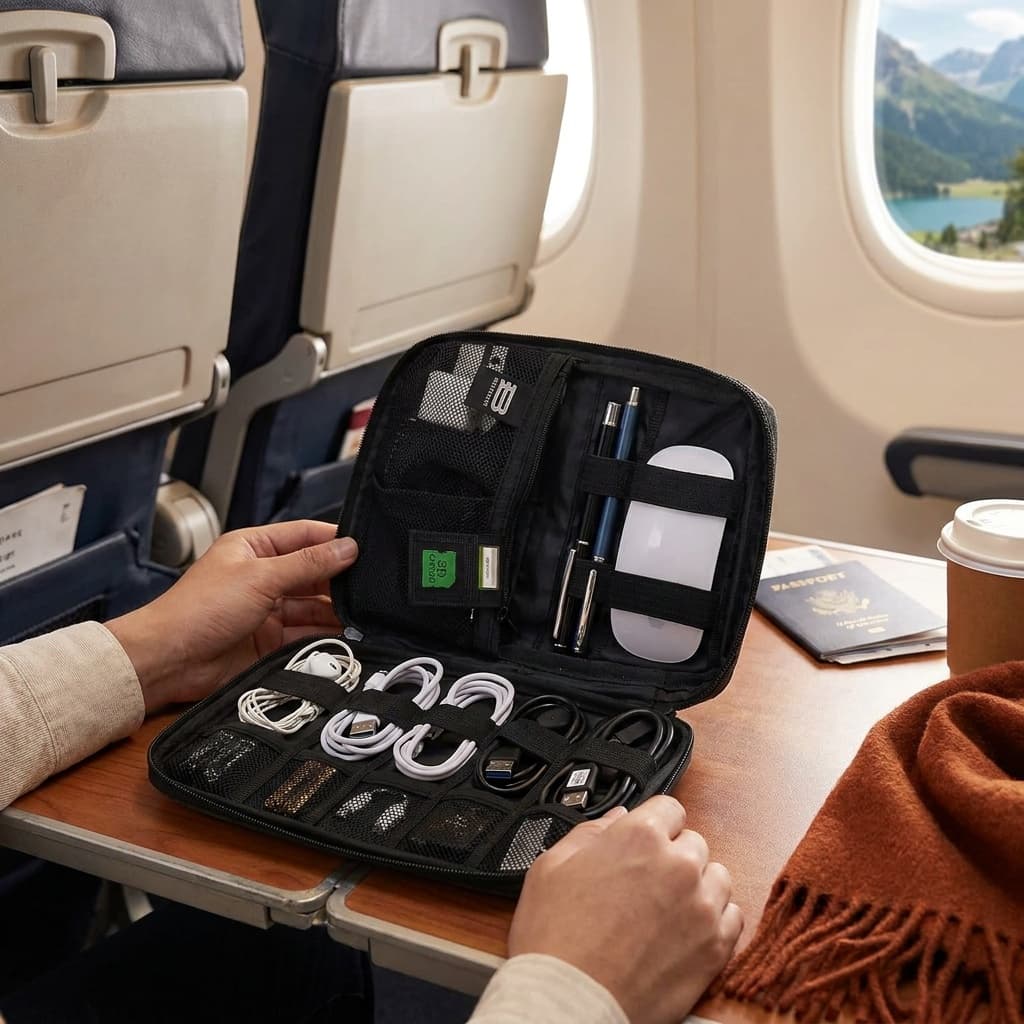
- Elastic loops across multiple sizes handle everything from USB-A cables to bulkier GaN chargers without doubling up
- The 1.2-inch depth is too shallow for thicker power banks, which need to go in a separate pouch or carry-on pocket
- Dimensions
- 10.6 x 7.5 x 1.2 in
- Weight
- Light (flat profile, under 0.5 lb loaded)
- Material
- Water-resistant nylon
- Elastic loops
- Multiple sizes: small item loops, headphone loops, cable loop
- Pockets
- 2 zippered mesh pockets for phones or power banks
- Card slots
- Dedicated SD card slots
About this pick
BAGSMART's flat-lay organizer unfolds like a folder to expose multiple sized elastic loops, dedicated SD card slots, and zippered mesh pockets across a 10.6-inch span. The slim 1.2-inch profile slides flat into any carry-on or laptop bag without adding noticeable bulk.
Strengths
- Elastic loops across multiple sizes handle everything from USB-A cables to bulkier GaN chargers without doubling up
- Flat-lay layout means you can see the entire contents at a glance at airport security or on a hotel desk
- 4.6 stars from over 9,600 Amazon buyers at under $15 represents genuinely strong value for the price
Weaknesses
- The 1.2-inch depth is too shallow for thicker power banks, which need to go in a separate pouch or carry-on pocket
- A newer model is now available; this version has fewer compartment options than current BAGSMART organizers
Kit Score breakdown
FYY
FYY Travel Cable Organizer Pouch
Best Budget
Kit Score 8.1/10
$9.85 Price checked Oct 23, 4:16 PM CDT
Best for: Light packers or day-trip travelers who carry one cable, earphones, a flash drive, and a small charger and want a sub-$12 splash-resistant pouch with a strong track record.
- At 91 g (3.2 oz), it adds almost no weight to a carry-on and fits inside a jacket pocket or personal item bag
- The compact footprint means it cannot fit a full travel cable set plus a power bank at the same time
- Dimensions
- 7.5 x 4.3 x 2.2 in
- Weight
- 91 g (3.2 oz)
- Material
- Water-resistant Oxford fabric with sponge lining
- Compartments
- Double-layer: 6 mesh pockets + 2 large pockets
- Capacity
- Cables, earphones, flash drives, compact charger
- Colors
- Multiple available
About this pick
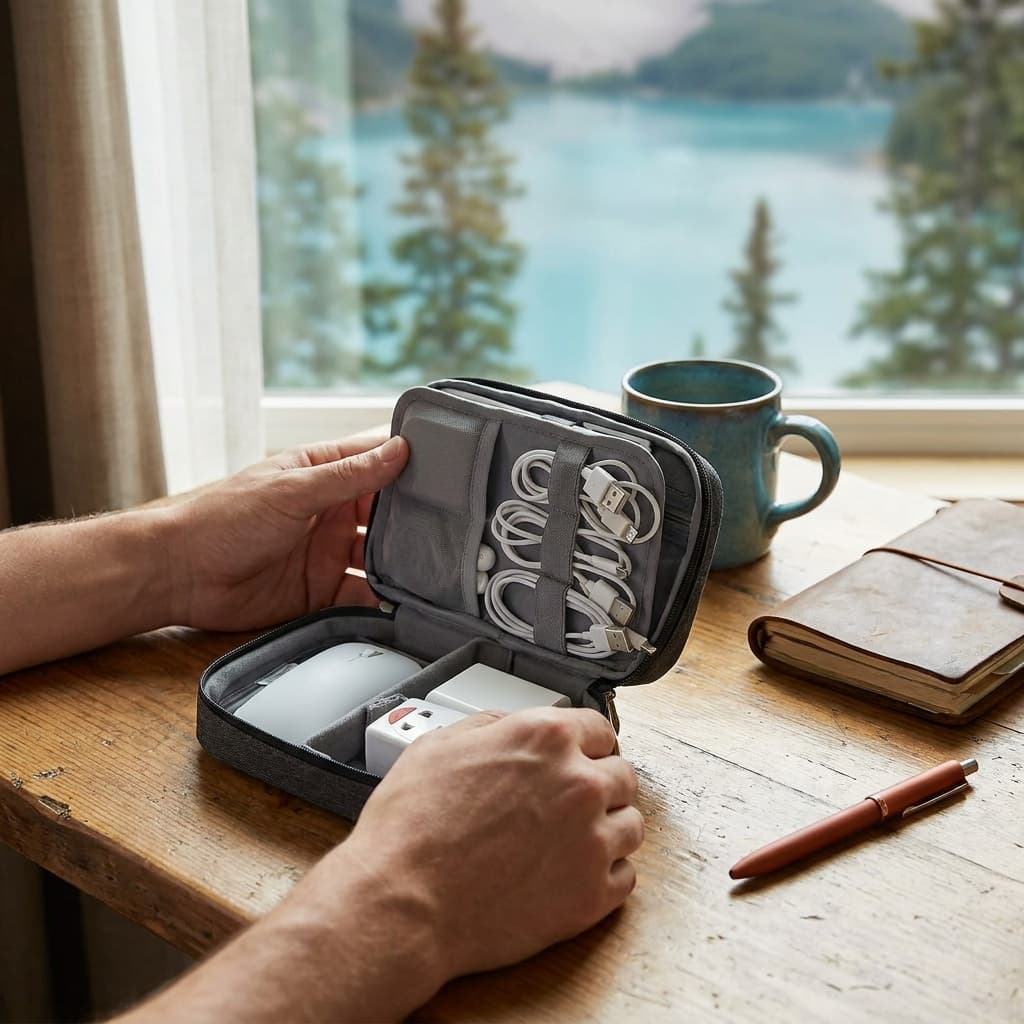
The FYY cable pouch is a 91-gram double-layer clamshell that fits roughly the footprint of a large phone, with six mesh pockets on one side for small items and two open pockets on the other for a compact charger or power bank. It has one of the largest owner review bases in the category.
Strengths
- At 91 g (3.2 oz), it adds almost no weight to a carry-on and fits inside a jacket pocket or personal item bag
- Water-resistant Oxford fabric with a soft sponge lining shrugs off splashes and cushions small gadgets
- Over 38,000 Amazon ratings at 4.6 stars make it the most owner-validated option in this roundup
Weaknesses
- The compact footprint means it cannot fit a full travel cable set plus a power bank at the same time
- No dedicated elastic loops or SD card slots, so smaller items can shift inside mesh pockets
Kit Score breakdown
See all picks in Best electronics and cable organizers for travel ($8-$45)
Keep going
Researched, not hands-on tested
Updated Jun 4, 2026Our recommendations draw on manufacturer documentation, retailer listings, owner feedback, and comparisons with alternatives.
As an Amazon Associate I earn from qualifying purchases. We may earn a commission from links here, at no extra cost to you. How we research →