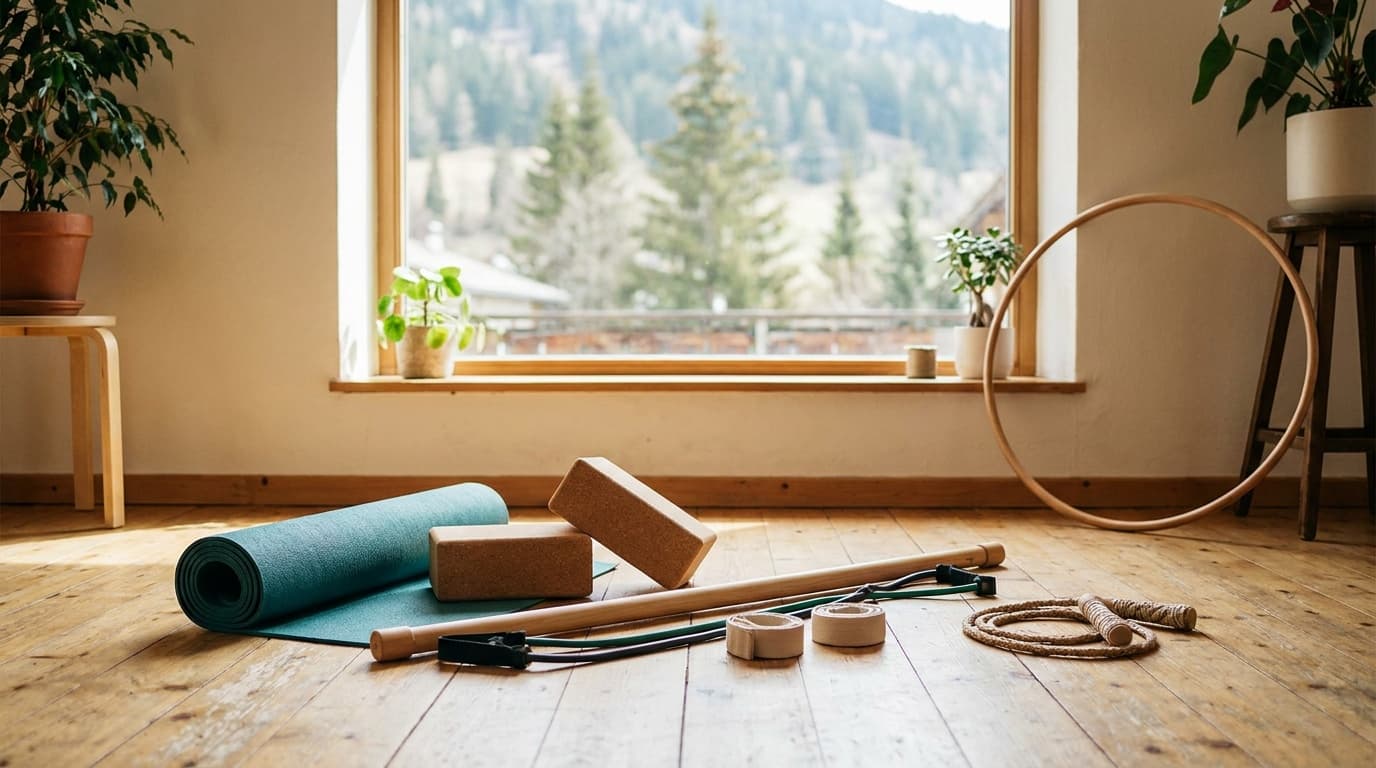
A pilates bar packs a full-body resistance workout into a portable, low-cost package, and with the right setup and a handful of foundational moves you can build real strength from your first session.
Setup and resistance selection
A pilates bar is a lightweight aluminum or fiberglass stick, roughly 36–40 inches long, with resistance bands looped through each end. Most kits, like the COFOF Pilates Bar Kit, ship with two or three interchangeable bands rated by weight: light (15–20 lb), medium (25–35 lb), and heavy (40–50 lb). Those ratings reflect the band's peak resistance at full stretch, not a constant load, so a "30 lb" band feels closer to 10–15 lb through most of the range of motion.
For your first session, attach one light band to each end. If the movement feels completely effortless after a warm-up set, step out slightly to increase tension. If your form breaks down before the rep target, step in or drop a band level.
Anchor the foot loops around the arch of your foot, not the toe or heel. A loop sitting at mid-arch stays secure through leg-press and kickback patterns without cutting off circulation.
Foundational moves
Learn these five exercises and you have a complete movement vocabulary for the bar.
Five foundational pilates bar moves
Banded row
Stand on the band center, hinge to 45 degrees, pull the bar to your lower ribs, elbows tracking back close to your sides. Builds upper back and postural strength.
Squat to overhead press
Feet shoulder-width on the band, bar at collar height. Squat until thighs approach parallel, drive up, and press the bar overhead at the top. Combines leg drive with shoulder stability.
Foot-loop leg press
Lie on your back, loops around arches, knees bent to 90 degrees. Press the bar away until legs are nearly straight, control the return. The closest home equivalent to a machine leg press.
Chest press
Lie on your back, bar across lower chest, bands running under your upper arms. Press straight up, lower with control. Engages chest and triceps without a bench.
Standing oblique crunch
Stand with light tension, bar held at chest height, feet hip-width. Crunch the bar diagonally toward one hip, return, alternate sides. Trains lateral core stability.
Form cues and breathing
The single most common error on a pilates bar is using momentum to snap through reps. The band stores elastic energy and will want to spring back; your job is to resist that return.
A simple rule: count two seconds on the working phase, pause one second at peak tension, count three seconds on the return. That cadence eliminates momentum and keeps the target muscle loaded through the full range.
Breathing follows effort: exhale as you pull, press, or extend; inhale as you return. This is not just a habit cue. Exhaling on effort naturally braces your deep core (the transversus abdominis), which stabilizes your spine before load arrives. For the leg press and chest press in particular, skipping this brace shifts load onto your lumbar spine.
For standing moves, keep a soft bend in your knees. Locked knees under band tension push load into the joint rather than the surrounding muscle.
Controlling the return is where pilates bar training actually builds strength.
A simple full-body routine
This routine takes 25–35 minutes and works through all major groups. Rest 30–45 seconds between sets.
Order matters slightly: start with the compound moves (squat-to-press, row, chest press) while your neuromuscular system is fresh, then finish with the isolation and core work (leg press, oblique crunch). Compound lifts demand more coordination; doing them fatigued increases the chance of compensating with the wrong muscles.
If 36 total sets across five exercises feels like too much in week one, drop to two sets per move and build to three over the first three sessions.
Progression: when and how to advance
Beginner programs fail most often for one of two reasons: progressing too fast, or never progressing at all. The bar gives you four clear levers.
- Increase reps from 12 to 15 within the same band and foot position.
- Increase range by stepping out 2–3 inches to add band tension.
- Swap band level from light to medium once you complete two full sessions at the current setting with clean form; kits with several band weights, like the Bbtops Pilates Bar Kit, are built for exactly this step.
- Add a set from three to four sets on any move that feels too easy before the session is over.
Change only one variable at a time. Jumping band level and adding reps in the same session doubles the load increase and makes it impossible to know what's causing any soreness or form breakdown you experience afterward.
A realistic eight-week arc: weeks 1–2 on light bands, weeks 3–4 stepping out for more tension, weeks 5–6 moving to medium bands on lower-body work, weeks 7–8 using medium on all moves. By week eight you will notice measurably better posture, hip stability, and shoulder endurance.
Frequently asked questions
How many days a week should a beginner use a pilates bar?
Three non-consecutive days per week is the standard starting point. Resistance training creates small amounts of muscle damage that repairs during rest; training the same muscles two days in a row before that repair is complete slows progress and raises injury risk. On off days, light walking or stretching is fine.
Can a pilates bar replace a gym membership for strength training?
For beginners and intermediate exercisers, yes, a pilates bar can build meaningful functional strength, particularly in the posterior chain, shoulders, and core. It has real limits at higher strength levels because band resistance plateaus and you cannot load the bar with additional weight. If your goal is progressive heavy lifting or significant muscle mass, free weights or machines will serve you better as you advance.
Why do my arms fatigue before my legs on the squat-to-press?
The overhead press is the weak link for most beginners because shoulder pressing strength lags far behind leg strength. Scale the two movements independently: use a heavier band for the squat phase alone (stand on it with a wider stance for more tension) and a lighter setup for the press. Alternatively, split the squat and the press into separate exercises until your shoulder endurance catches up.
For specific product picks and resistance specs, see our guide to the best pilates bars. Browse all fitness guides or read how we research and rate gear.
Recommended gear
Our current top picks from the Best Pilates bar kits: 2 exact picks for home workouts guide, if you are ready to buy.
BBTOPS
Bbtops Pilates Bar Kit with Resistance Bands
Best Overall
Kit Score 8.0/10
$23.93 Price checked Oct 23, 4:16 PM CDT
Best for: Home users who want a top-selling combination of steel-bar stability, dual-level resistance, and a price that does not require a second thought.
- Screw-thread steel construction is noticeably sturdier than cheaper clip-on designs, and owners consistently call out the stable, wobble-free feel during leg and core work
- Designed for users roughly 5'2"–5'8"; taller users may find the strap length limiting for full-range standing exercises
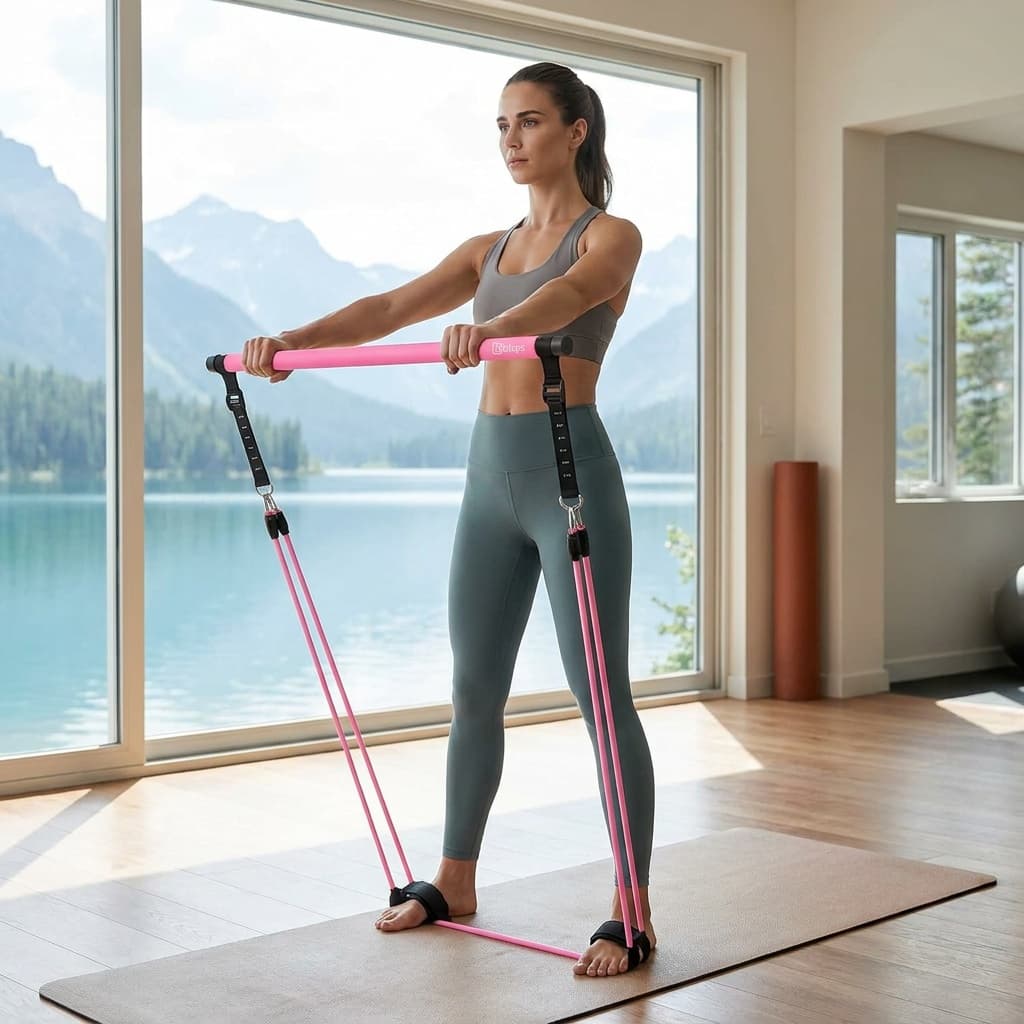
- Bar material
- 3-section steel with foam grip
- Bar
- 3-section screw-together steel; assembled length not published
- Resistance bands
- 6 natural latex bands: 20, 30, and 50 lb (two each, stackable)
- Resistance range
- 20–200 lb via stacking
- Foot loops
- Included (padded, sweat-absorbent)
- Kit weight
- About 3 lb
About this pick
The Bbtops kit pairs a three-section screw-together steel bar with a quick-adjust buckle and six natural latex bands in three resistance levels, so beginners and intermediate users can stack up as they progress.
Strengths
- Screw-thread steel construction is noticeably sturdier than cheaper clip-on designs, and owners consistently call out the stable, wobble-free feel during leg and core work
- Three band levels (20, 30, and 50 lb) stack up to 200 lb, so you can progress without buying more bands
- Compact carry bag and quick 10-second assembly make it practical for apartment living or travel
Weaknesses
- Designed for users roughly 5'2"–5'8"; taller users may find the strap length limiting for full-range standing exercises
- Foam grip wears over several months of daily use, a common pattern across this product category
Kit Score breakdown
COFOF
COFOF Pilates Bar Kit with Resistance Bands
Best Value
Kit Score 8.5/10
$39.99 Price checked Oct 23, 4:16 PM CDT
Best for: Anyone who wants a well-accessorized kit with fine-grained resistance options and a fast, precise adjustment system, without stepping up to a premium price.
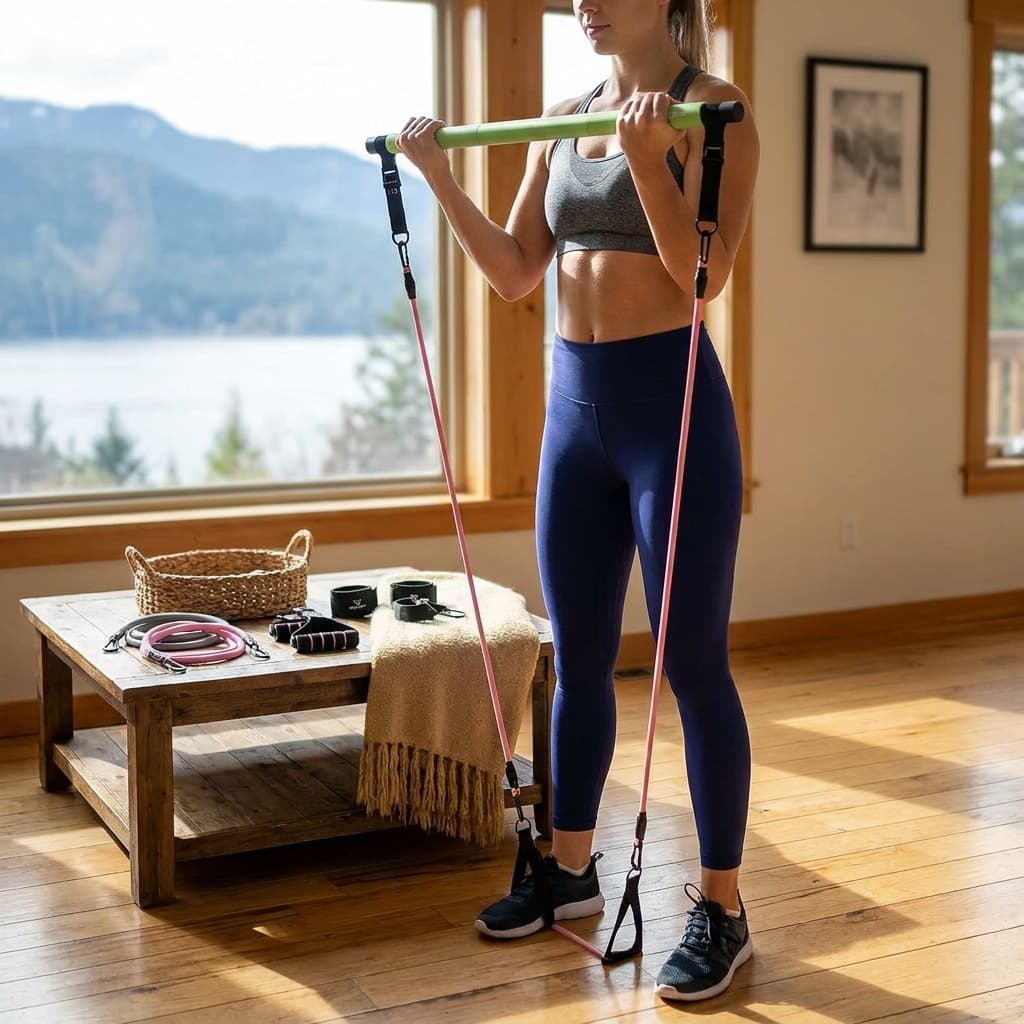
- The upgraded metal buckle with clear nylon-rope graduations makes length adjustments faster and more precise than the cord-and-hook systems on cheaper kits
- Best fit for users in the 5'2"–5'8" height range; users above 5'9" report reduced range of motion on standing exercises
- Bar material
- 3-section steel with foam grip
- Strap adjustment
- Heavy-duty metal buckle, 4.3–18 in. nylon rope with clear graduations
- Resistance bands
- 6 natural latex bands: 20, 25, and 30 lb (two each)
- Resistance range
- 20–150 lb via stacking
- Extras included
- Door anchor, 2 padded handles, 2 ankle straps, carry bag
- Kit weight
- 2.87 lb (all accessories, per listing)
About this pick
COFOF stands out for its heavy-duty metal adjustment buckle and the widest accessory spread at this price point. Six bands in three resistance levels stack up to 150 lb, covering everything from beginner mobility work to intermediate toning circuits.
Strengths
- The upgraded metal buckle with clear nylon-rope graduations makes length adjustments faster and more precise than the cord-and-hook systems on cheaper kits
- Six stackable bands (20, 25, 30 lb) give more resistance granularity than most competitors, which matters when progressing from beginner to intermediate exercises
- Door anchor and ankle straps turn one kit into a versatile cable-style setup beyond the bar itself
Weaknesses
- Best fit for users in the 5'2"–5'8" height range; users above 5'9" report reduced range of motion on standing exercises
- Latex bands show wear after several months of near-daily high-tension use, consistent with the broader category
Kit Score breakdown
See all picks in Best Pilates bar kits: 2 exact picks for home workouts
Keep going
Researched, not hands-on tested
Updated Jun 4, 2026Our recommendations draw on manufacturer documentation, retailer listings, owner feedback, and comparisons with alternatives.
As an Amazon Associate I earn from qualifying purchases. We may earn a commission from links here, at no extra cost to you. How we research →