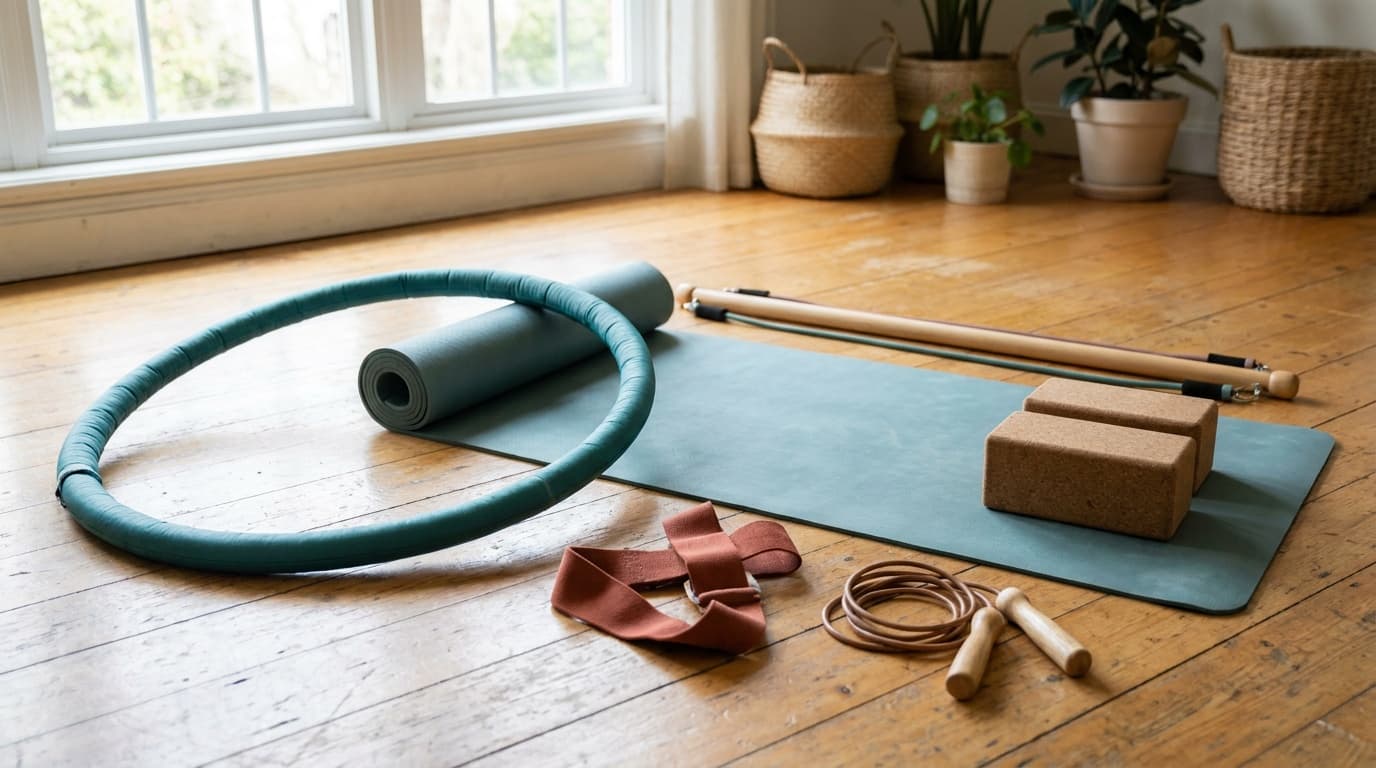
To use a weighted hula hoop, pick one that reaches between your waist and mid-chest when stood on the floor, start with a light hoop of about 1 to 2 lb, and rock your hips forward and back rather than in a circle. Keep the first sessions short, no more than 5 to 10 minutes total split between both directions, and build up gradually; if you are new to core work or bruise easily, hoop maker Powerhoop suggests starting at 2 to 3 minutes a day.
Sizing to your waist
A hoop that is too small will spin too fast and fall before you can build momentum. Too large and it is unwieldy and hard to control. The standard fit guide: stand the hoop upright on the floor next to you. The top edge should land somewhere between your navel and the middle of your chest. Taller people and beginners both benefit from erring toward the larger end of that range.
Weight is the other variable. Healthline suggests most beginners start with a hoop of around 1 to 2 lb (0.5–0.9 kg). The JKSHMYT Weighted Hula Hoop, a light link-style smart hoop listed at about 1.6 lb, sits in that range. Larger, heavier hoops rotate more slowly, which makes them easier to keep up, but more weight also means more pressure on your hips. Start lighter if you are sensitive or new to core work.
The hip-thrust motion (not a circle)
This is the single most important thing to understand. Your hips do not move in a circle. They move forward and backward in a piston-like thrust, keeping the hoop's momentum going by nudging it each time it comes around. Think of pressing your belly button forward, then your lower back back, repeatedly. Your weight shifts between your front foot and back foot slightly with each beat.
Staggering your feet helps. Put one foot about half a step ahead of the other rather than standing with feet parallel. This gives your hips the front-back range they need.
Starting your first spin
Position
Stand with feet hip-width apart, one foot a half-step forward.
Launch
Hold the hoop at your waist, give it a firm spin to one side, and release.
Thrust
Drive your hips forward as the hoop passes your front, backward as it passes your back.
Find the beat
Keep your upper body upright and let your hips do the work. Shoulders stay relaxed.
Build
Once you have 20–30 seconds of continuous spin, try gradually increasing your pace.
The hoop teaches you to feel your core, not just flex it.
Smart-hoop assembly and the gravity ball
Smart hoops like the Dumoyi Smart Weighted Hoop (also called infinity hoops or detachable hoops) are made of interlocking sections so they pack flat. They have a weighted segment, usually a padded or ridged piece, and inside that segment sits a gravity ball: a small weighted ball in a track that adds rotational momentum as it travels.
Assembly note: before you start, orient the hoop so the weighted segment sits at the bottom, at the 6 o'clock position. The gravity ball then starts with gravity on its side, which makes the first few rotations easier to sustain. If you launch with the weight at the top or side, the ball has to work against gravity initially and the hoop drops faster.
Snap each section firmly until you hear the click. A loose joint will catch on clothing or skin mid-session.
Building duration and training both directions
The common mistake is going too long on day one. Ten minutes feels easy until you wake up the next morning with a sore lateral hip and a visible bruise ring. Keep your first sessions to 5–10 minutes total at most, split between both directions: roughly half your time spinning clockwise, half counter-clockwise. If you are new to core work, start at 2 to 3 minutes a day, which is what hoop maker Powerhoop recommends.
Training both directions is not optional. One direction will feel natural; the other will feel awkward and will drop constantly. That asymmetry reflects an imbalance in hip mobility and core coordination. Working the weaker direction corrects it.
Add a couple of minutes a week as long as you are not bruising. For reference, participants in a 2019 randomized trial averaged about 13 minutes of weighted hooping a day over six weeks, so there is no need to rush to half-hour sessions. Three to four sessions per week is sufficient for conditioning benefits. Daily use is fine if you listen to your body, but rest days help the bruised tissue adapt.
Managing early bruising and when to add a sweat belt
Mild bruising in the first week is common. The weighted hoop repeatedly contacts your hip bones and the soft tissue above them. Powerhoop's advice is that bruising means you overdid it: back off, wait a few days, and start again gradually. Hooping is not recommended if you have a bleeding disorder, take blood thinners, or bruise easily for medical reasons; check with a doctor first.
To reduce early discomfort: wear thick leggings or sweatpants (not thin shorts), keep sessions short, and avoid the same contact point two days in a row if the bruise is tender.
A sweat belt or neoprene waist trimmer is a separate item some people add. It adds padding, increases local temperature, and can reduce early soreness. Add it once you are hooping consistently (week two or three), not on day one. Layering too much padding early on reduces the tactile feedback you need to feel the hoop's rhythm, which makes learning harder.
Frequently asked questions
How many calories does a weighted hula hoop burn?
Research is limited. A 2011 study sponsored by the American Council on Exercise, run at the University of Wisconsin-La Crosse, found 16 experienced female hoopers burned about 7 calories per minute during a 30-minute routine, similar to boot camp, step aerobics, or cardio kickboxing classes. Beginners moving less vigorously will likely burn less. On waist size, a 2019 randomized trial found six weeks of weighted hooping (about 13 minutes a day) reduced waist circumference and abdominal fat more than energy-matched walking, and a 2015 study found a 3.4 cm waist reduction but no gain in torso muscle endurance. It is a real workout, not a spot-reduction shortcut.
Why does the hoop keep falling?
Most of the time it is the motion: you are circling your hips instead of thrusting them forward and back. Stand with one foot staggered forward, slow the hoop down mentally, and focus on the two-beat rhythm (forward, back). If you have the motion right and it still falls, the hoop may be too small or too light for your height. Try a larger diameter before blaming technique.
Is a weighted hula hoop safe for people with lower back pain?
For mild, chronic lower back issues, gentle core-engagement exercises are often beneficial, but check with a physio or doctor before starting. The repetitive rotational loading of a hula hoop is not appropriate if you have a disc herniation, acute back pain, or have been advised to avoid rotational movements. If cleared to try it, start with very short sessions (2–3 minutes), prioritize the forward-back hip motion over big swinging movements, and stop if you feel any spine-centered pain (as distinct from normal muscle fatigue). Powerhoop advises seeing a professional for any worsening back pain or neurological symptoms.
Where these numbers come from
| Claim | Source | Checked |
|---|---|---|
| Hoop should reach between your waist and mid-chest; most beginners start around 1 to 2 lb | Healthline, weighted hula hoop | Sep 2026 |
| Forward-back hip motion; larger, heavier hoops rotate more slowly | PhysioRoom, how to use a weighted hula hoop | Sep 2026 |
| Start at 2 to 3 minutes a day; back off if bruising appears; not for bleeding disorders or blood thinners | Powerhoop, safety | Sep 2026 |
| About 7 calories per minute in 16 experienced female hoopers, comparable to boot camp, step, and kickboxing classes | ACE, findings on hula hooping workouts (2011) | Sep 2026 |
| Six weeks of weighted hooping: waist down 3.4 cm, no torso endurance gain | McGill et al., J Strength Cond Res 2015 | Sep 2026 |
| Weighted hooping (about 13 min/day) vs walking: larger drop in waist and abdominal fat | Lahelma et al., Obesity Facts 2019 | Sep 2026 |
| JKSHMYT: 24 detachable links, 0.7 lb gravity ball, fits 26 to 47 in waists, about 1.6 lb | JKSHMYT listing on Amazon, ASIN B0BGLP6JJC | Sep 2026 |
| Dumoyi: detachable links, ABS, about 3.5 lb | Dumoyi listing on Amazon, ASIN B0924TRVH5 | Sep 2026 |
For specific picks, see our guide to the best weighted hula hoops. Browse all fitness guides or read how we research and rate gear.
Recommended gear
Our current top picks from the Best weighted hula hoops for core and cardio at home guide, if you are ready to buy.
DUMOYI
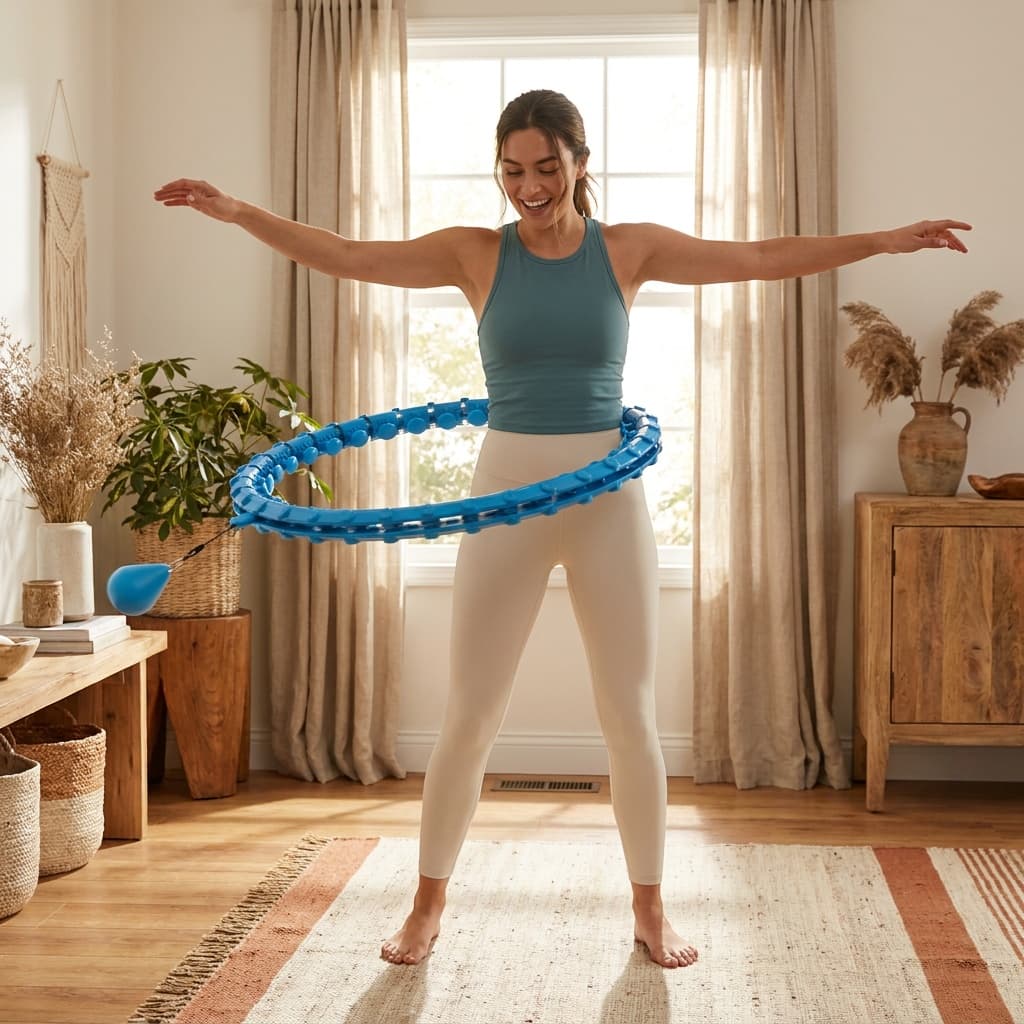
Dumoyi Smart Weighted Hoop for Adults
Best Overall
Kit Score 8.2/10
$16.99 Price checked Oct 23, 6:22 AM CDT
Best for: Anyone new to weighted hoop training who wants a proven gravity-ball design with a large owner community and room to adjust as their waist measurement changes.
- Large owner review base points to a consistent real-world experience and an easy learning curve for beginners
- Gravity ball can occasionally stick in its track mid-workout, especially in the first few uses before the channel breaks in
- Weight
- ~3.5 lb (1.6 kg)
- Segments
- 24 detachable links
- Waist range
- Adjustable (detachable links)
- Resistance type
- Gravity ball on 360-degree silent rollers
- Material
- Eco-friendly ABS plastic
- Colors
- Multiple color options
About this pick
Dumoyi's 24-link infinity hoop uses a 360-degree gravity ball in an inner channel to generate resistance as you move your hips, no traditional spinning technique required. The links click apart and reconnect in seconds, so you can drop a segment as your waist measurement changes over weeks of use.
Strengths
- Large owner review base points to a consistent real-world experience and an easy learning curve for beginners
- Gravity ball keeps momentum going without the skill wall of a traditional fixed hoop, making daily 20-30 minute sessions achievable
- Detachable link system lets you shorten the diameter as fitness improves, extending the useful life of one purchase
Weaknesses
- Gravity ball can occasionally stick in its track mid-workout, especially in the first few uses before the channel breaks in
- Users above the maximum assembled waist fit should look at a higher-link option
Kit Score breakdown
JKSHMYT
JKSHMYT Weighted Hula Circle Hoops
Best Budget
Kit Score 7.4/10
$14.99 Price checked Oct 23, 6:22 AM CDT
Best for: Curious beginners on a tight budget who want a functional gravity-ball hoop to evaluate whether the format fits their workout routine before spending more.
- Sub-$20 entry price removes the financial barrier for users who want to test the format before committing to a premium model
- Gravity ball can stick in its track more often than pricier options with machined channels; requires patience during the break-in period
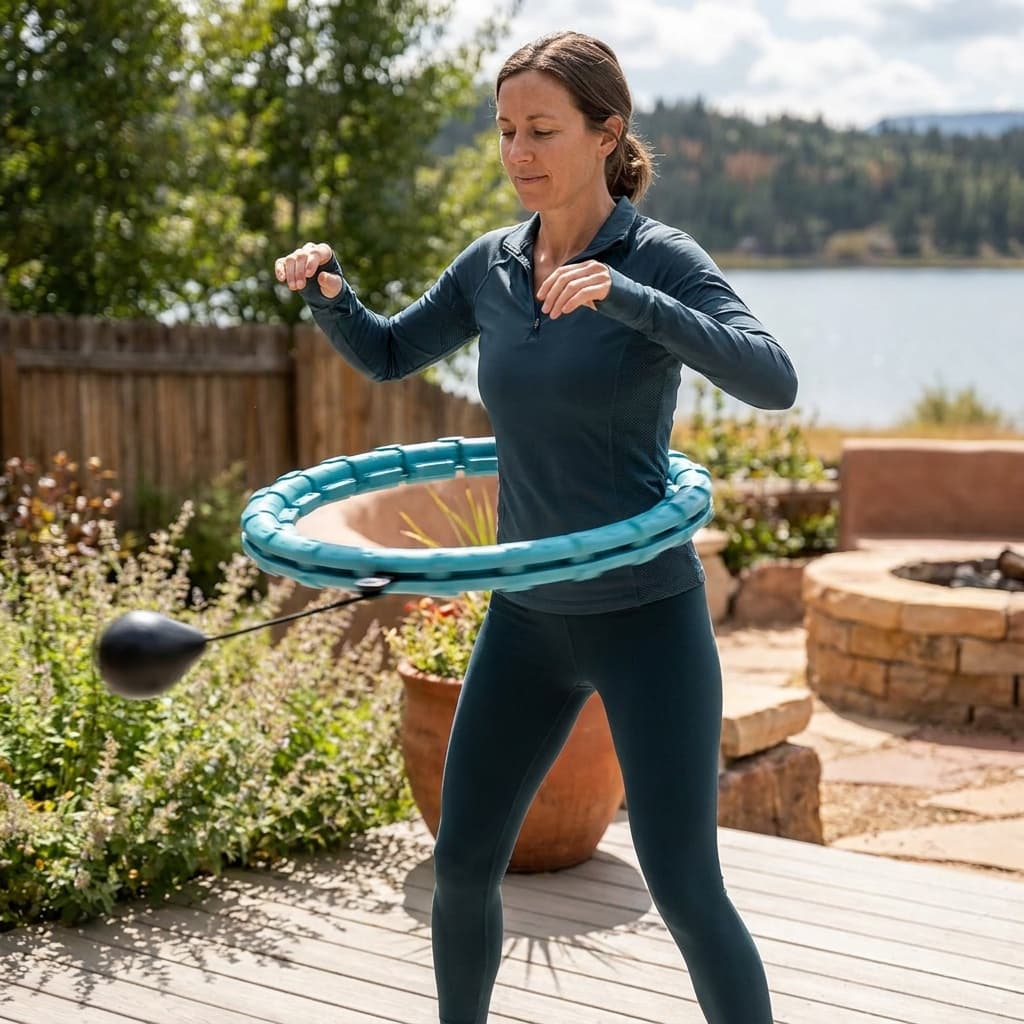
- Segments
- 24 detachable links
- Waist range
- 26 – 47 in
- Total hoop weight
- 720 g (~1.6 lb)
- Gravity ball
- 0.7 lb
- Material
- ABS plastic
About this pick
JKSHMYT's 24-link circle hoop uses a 0.7 lb gravity ball on a simplified ABS track and fits waists in the 26-47 inch range.
Strengths
- Sub-$20 entry price removes the financial barrier for users who want to test the format before committing to a premium model
- Snap-lock segment assembly holds together during use
- 24 links and a listed 26 to 47 inch waist fit cover most adults without extension links
Weaknesses
- Gravity ball can stick in its track more often than pricier options with machined channels; requires patience during the break-in period
- The ball track clicks during use; apartment and early-morning users may find it disruptive
Kit Score breakdown
Best for: Users who have tried and dropped traditional hoops because of the constant fall problem, and larger-waisted users who need more links than standard hoops include.
- Non-fall smart-track design is the most consistent feature owners highlight, especially for beginners who have failed with traditional fixed hoops
- Current price is significantly lower than many roundup comparisons show, which may reflect a repositioning or promotional period; verify price before purchase
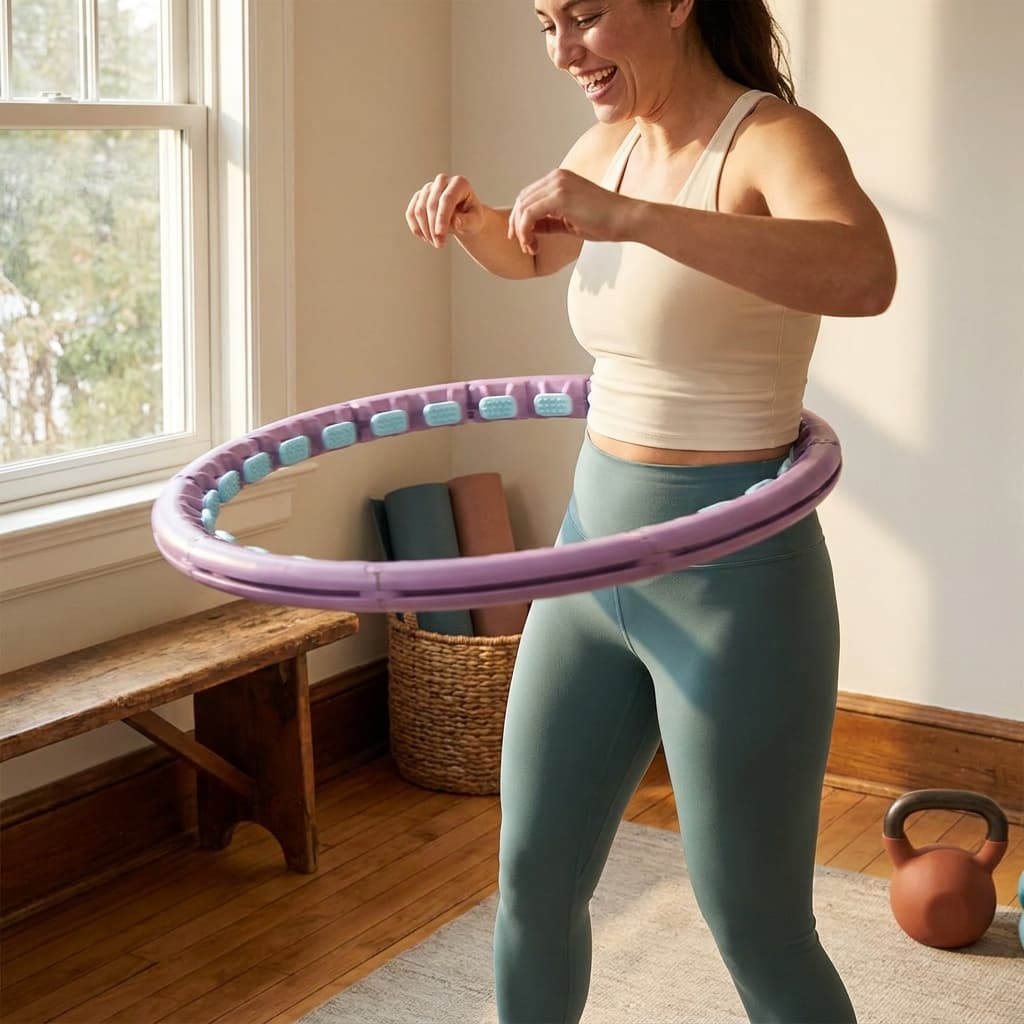
- Waist range
- Up to 65 in (165 cm) with 34 links
- Resistance type
- Integrated 360-degree massaging knobs
- Smart track
- Non-fall design keeps hoop on waist
- Warranty
- Lifetime exchange on broken links or worn parts (per listing)
- Includes
- 1 year of access to Swiss Activa+ training videos
About this pick
Swiss Activa+ built its S2 XXL around a smart-track system that keeps the hoop seated on your waist throughout a session, solving the single biggest reason beginners quit: the hoop falling to the floor every few rotations. The 34 included links fit waists up to 65 inches without an extension kit. Internal massaging knobs stimulate circulation along the waist during use.
Strengths
- Non-fall smart-track design is the most consistent feature owners highlight, especially for beginners who have failed with traditional fixed hoops
- 34 links fit waists up to 65 inches with no extension kit, and Swiss Activa+ replaces broken links for free
- Massaging knobs add a circulation benefit during workouts and make longer sessions more comfortable on the waist
Weaknesses
- Current price is significantly lower than many roundup comparisons show, which may reflect a repositioning or promotional period; verify price before purchase
- Weight ball requires a short learning curve to keep spinning; new users may need a few sessions before the motion becomes self-sustaining
Kit Score breakdown
See all picks in Best weighted hula hoops for core and cardio at home
Keep going

Researched, not hands-on tested
Updated Sep 25, 2026Our recommendations draw on manufacturer documentation, retailer listings, owner feedback, and comparisons with alternatives.
As an Amazon Associate I earn from qualifying purchases. We may earn a commission from links here, at no extra cost to you. How we research →