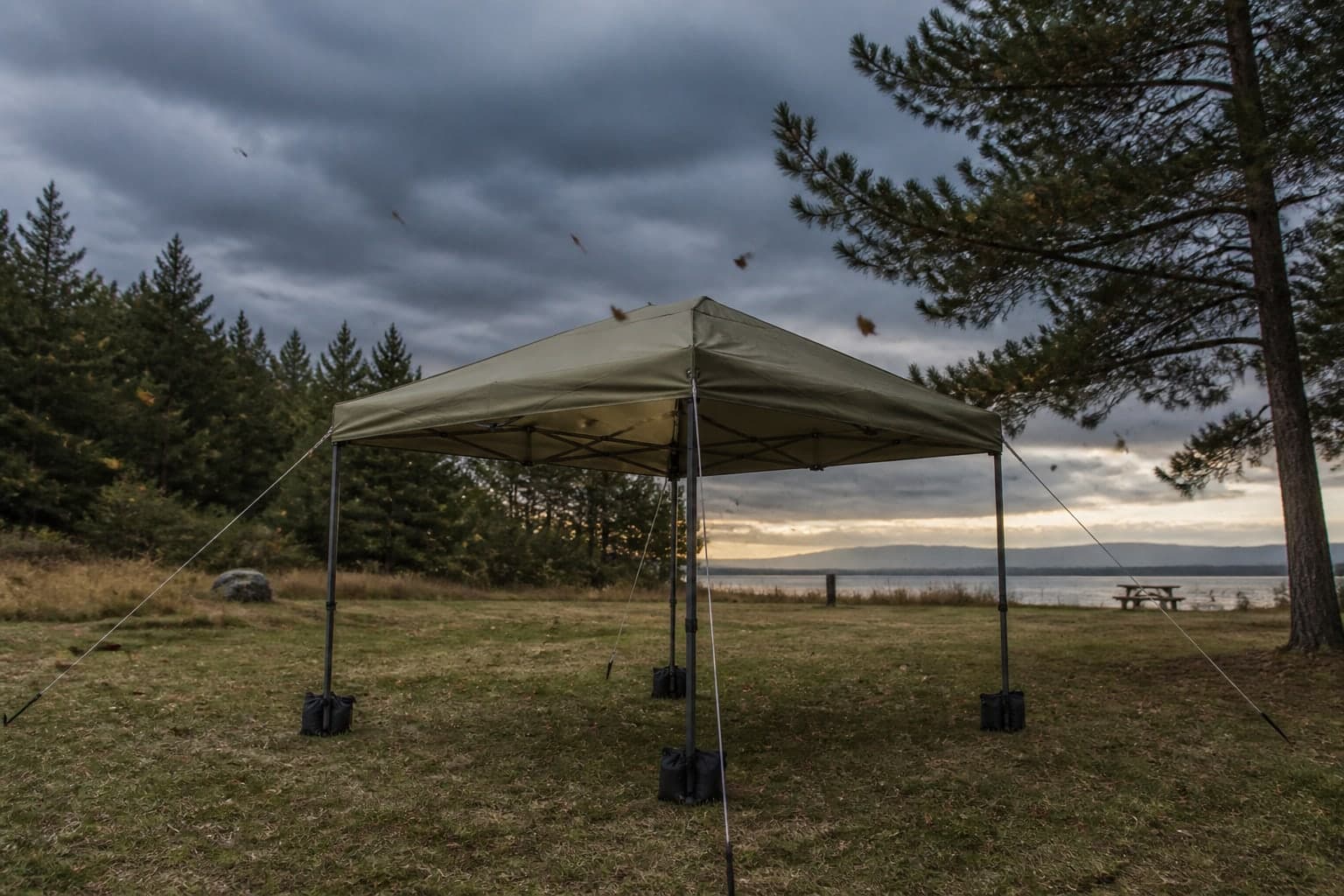
A pop-up canopy catches wind like a sail, and when it goes airborne it becomes a serious hazard to people and property nearby. Get the anchoring right before the wind arrives, and know the one rule that overrides every other: when conditions get severe enough, the only safe move is to take it down.
Why pop-up canopies fail in wind
Most pop-up canopies are rated by manufacturers for winds in the 15–25 mph range under ideal anchoring conditions. Real-world setups rarely hit that standard. Parking lots, open fields, and beach sites have hard surfaces that prevent staking, and most people underestimate how much weight is required to hold a structure down when a gust hits a fully closed canopy top.
The physics are straightforward: a standard 10x10 canopy presents roughly 100 square feet of surface to the wind. At 20 mph, that surface generates significant upward and lateral force. At 30 mph, wind pressure roughly doubles. Add a slight angle of attack and the whole structure can rotate, tip, and launch in seconds.
Weight ballast: the first line of defense
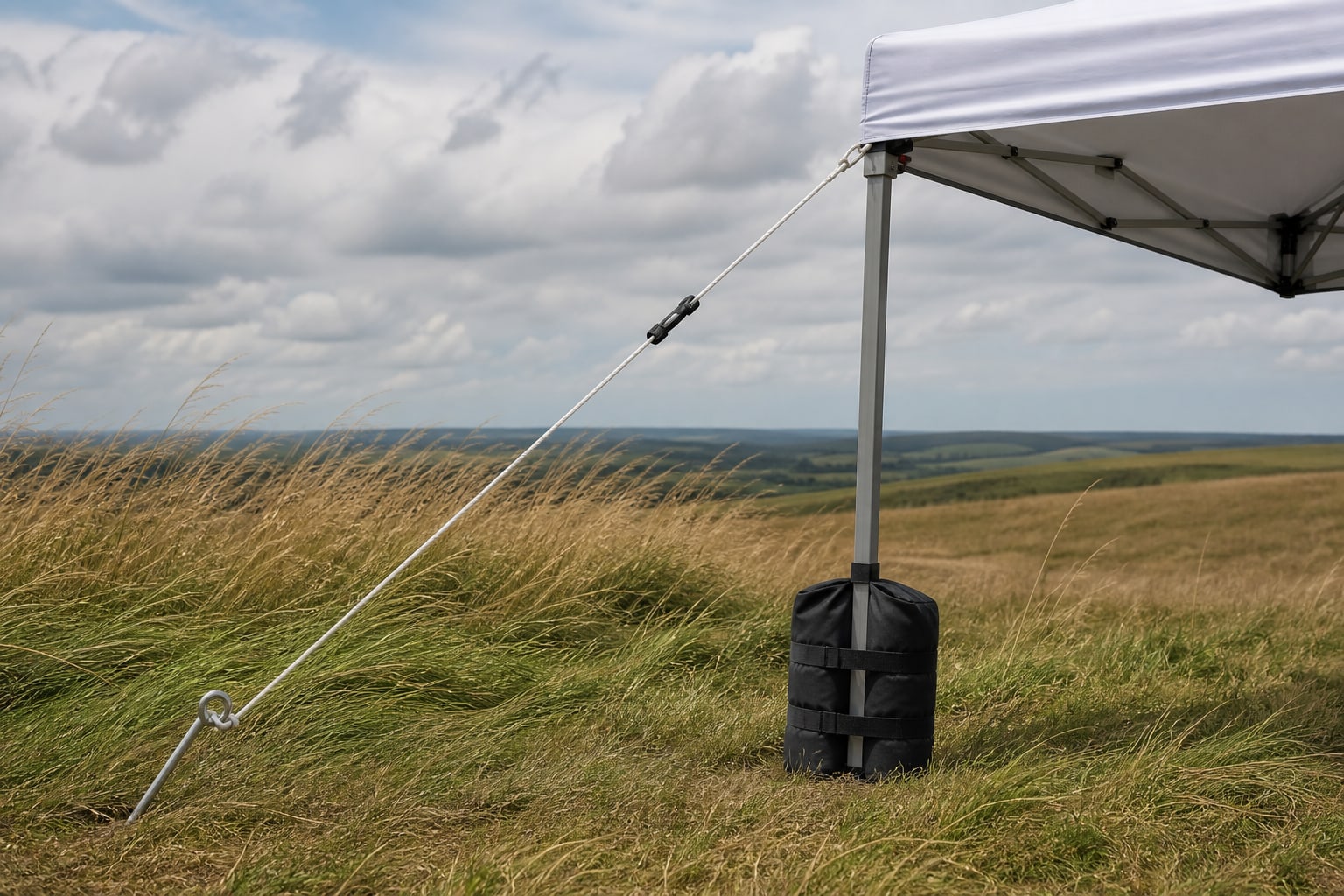
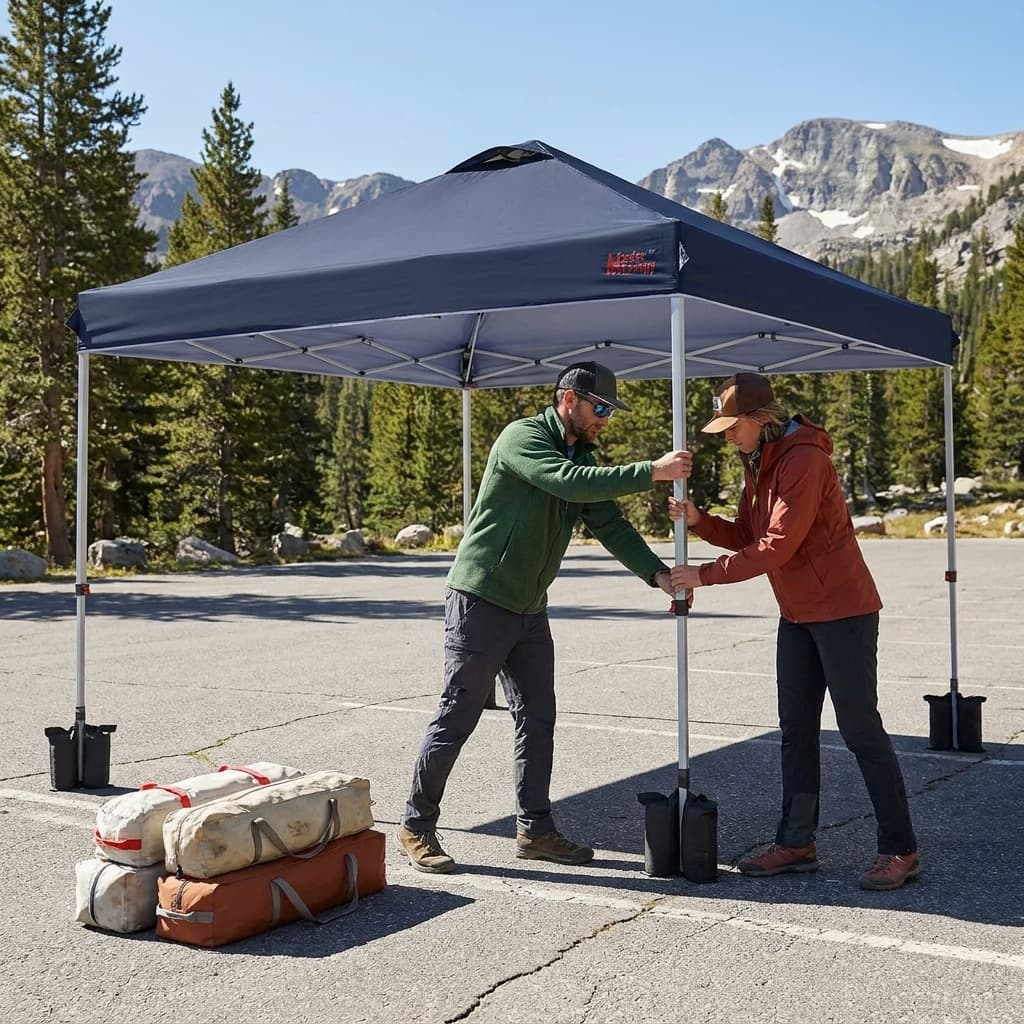
Dedicated weight plates (sold as canopy leg weights) or sandbags are the most reliable ballast because they attach directly to the legs. Water jugs and improvised weights tend to slide, tip, or detach in a gust.
Forty pounds per leg is the floor, not the ceiling. Many event professionals and canopy manufacturers recommend 50–75 lbs per leg in exposed locations. Four legs at 40 lbs each gives you 160 lbs of total ballast, which sounds like a lot until a gust hits the broadside of a closed top.
Use ballast even when you are also staking. The two systems work together: stakes resist lateral force; ballast resists uplift and keeps the base from skipping sideways on hard surfaces.
Stakes and guy lines: how to do it right
A stake driven straight down resists mostly downward force. Drive it at a 45-degree angle pointing away from the canopy, and it resists the outward pull of a taut guy line far more effectively. That outward and upward pull is exactly what wind creates.
Staking step by step
Choose the stake
Use 12-inch or longer steel tent stakes for soft ground; screw-in auger stakes hold better in loose soil or grass.
Angle away from the canopy
Drive each stake at roughly 45 degrees, leaning away from the leg it will anchor.
Attach the guy line
Run a guy line from the canopy corner or top rail to the stake; keep it taut but not so tight it distorts the frame.
Test the tension
Pull firmly on each guy line after setup. It should feel rigid, not springy.
Repeat on all four corners
Every corner needs a staked guy line. Two-corner staking is only marginally better than none.
Guy line length matters too. A longer line at 45 degrees creates a gentler angle that handles uplift better than a short, steep line. Aim for a line length roughly equal to the height of the attachment point.
Venting and removing the top in gusts
Many canopies, including the MASTERCANOPY Durable 10x10 Pop-Up Canopy, include a vented top panel, a mesh section near the peak that allows air to pass through instead of building pressure underneath. If your canopy has a vent, position it to face the prevailing wind.
When gusts climb above 25 mph and you cannot take the canopy down immediately, removing the fabric top entirely is the single most effective thing you can do to reduce wind load. The bare frame has a fraction of the surface area and is far more survivable in a brief strong gust. The top removes in minutes on most pop-up frames and can be reattached once conditions settle.
A bare frame in a gust is an inconvenience; a canopy top turned into a kite in a parking lot is a genuine emergency.
When to take it down: the real threshold
Sustained winds of 30–35 mph are the hard stop. At that point, no combination of weights and stakes reliably holds a consumer-grade pop-up canopy, and the consequences of a failure are serious. A canopy top that gets airborne can travel considerable distances and strike people, vehicles, or other structures.
Watch the forecast and set a personal threshold before the event. If the day's forecast includes gusts above 35 mph, build takedown time into your schedule rather than reacting to conditions after they deteriorate. Takedown takes less than ten minutes; injury prevention is worth every one of them.
The unattended rule is absolute: if you leave the site for any reason and wind is a possibility, take the canopy down or collapse and secure it flat to the ground. A canopy left unattended for twenty minutes in shifting conditions can fail with no one around to respond.
Frequently asked questions
Can I use water jugs instead of dedicated weight plates?
Water jugs can work in calm conditions but are not reliable wind anchors. A one-gallon jug weighs roughly 8 lbs and tips easily. If you use jugs, fill them completely, use wide-base designs, and attach them to the leg with a strap rather than just setting them nearby. Even then, treat them as a temporary supplement to proper ballast, not a replacement.
What is the best stake type for soft or sandy soil?
Auger-style screw stakes hold significantly better in loose or sandy soil than straight tent stakes because the helical thread grips a larger column of soil. Spiral stakes 10–12 inches long are a practical choice for grass and compacted earth. For beach sand, oversized sand anchors or deadman anchors (a stake or plate buried horizontally) outperform any vertical-drive stake.
My venue does not allow staking. What are my options?
When staking is prohibited, your only real anchoring option is weight ballast, and you need to increase per-leg weight significantly: 60–75 lbs per leg as a minimum. You can also reduce wind load by choosing a canopy with a vented top, orienting the canopy so the open sides face the wind rather than the solid top edge, and planning for a lower threshold to remove the top or collapse the frame if gusts pick up.
For specific gear recommendations, see our guide to the best pop-up canopies. Browse all camp guides or read how we research and rate gear.
Recommended gear
Our current top picks from the Best pop-up canopies for camping, tailgating, and markets guide, if you are ready to buy.
Best for: Farmers-market vendors, craft-fair regulars, and tailgaters who set up and tear down every week and need a shelter that keeps performing season after season.
- Steel frame delivers strong wind and load resistance at this price tier
- At roughly 51 lbs and a packed length of 64 inches, it is difficult to lift solo from a truck bed or fit in a compact car
- Frame
- Powder-coated alloy steel
- Canopy fabric
- 500D PU-coated polyester, UV-resistant (approx. 99% UV blocked), fire-rated
- Weight
- 53.9 lb (Amazon listing)
- Peak height
- 10.4 ft to 11 ft (3 leg settings, per listing)
- UV protection
- Blocks approx. 99% UV
- Carry bag
- Patented L-shaped roller bag, 2.7-inch all-terrain wheels, 1680D polyester shell
About this pick
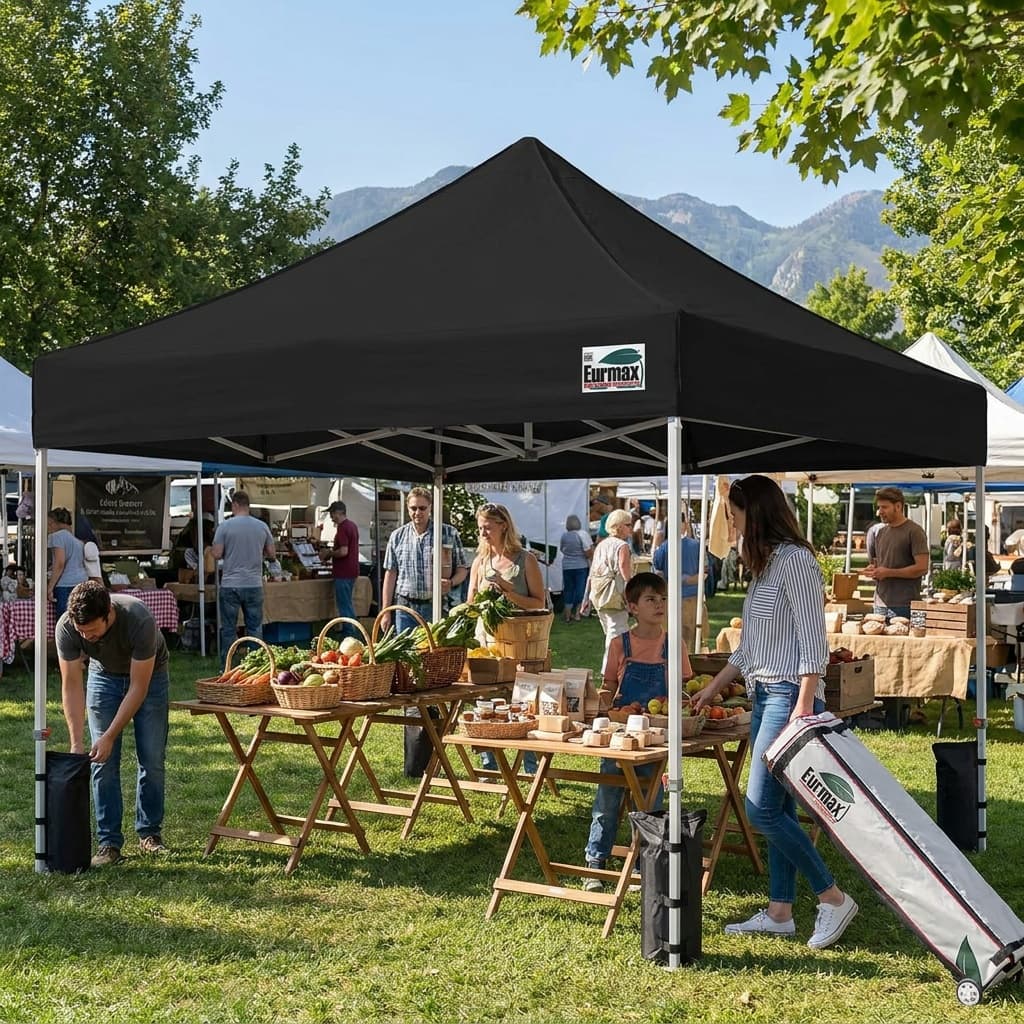
The Eurmax USA 10x10 is a commercial-grade shelter built around a powder-coated steel frame and 500-denier PU-coated polyester, earning top marks in independent testing for its combination of weather protection, structural rigidity, and a genuinely excellent roller bag. It weighs more than most recreational options but rewards that trade-off with a peak height up to 11 feet, strong wind resistance when staked, and a reputation for lasting through seasons of heavy use.
Strengths
- Steel frame delivers strong wind and load resistance at this price tier
- Peak height up to 11 feet gives genuine walk-around clearance at all three leg settings
- Roller bag is outstanding: corrosion-resistant plate, full-length zipper, interior pocket, and 2.7-inch wheels that roll on gravel and grass
Weaknesses
- At roughly 51 lbs and a packed length of 64 inches, it is difficult to lift solo from a truck bed or fit in a compact car
- Stakes are not included; the sandbag anchors supplied work on pavement but stakes are needed for soft ground
Kit Score breakdown
Best for: Buyers who want a proven, well-supplied 10x10 shelter for weekend markets, youth sports, or casual outdoor events and need a complete kit without sourcing sandbags separately.
- Over 8,400 Amazon ratings at 4.2 stars reflects a broad, verified ownership base, not a thin review set
- 150D polyester fabric is lighter than the 300D material used on MASTERCANOPY commercial-grade models, so extended heavy-rain or high-UV use will degrade the canopy top faster
- Coverage
- 10 x 10 ft (100 sq ft)
- Frame
- Corrosion-resistant steel, 1.2mm thick poles (30% thicker than standard)
- Canopy fabric
- 150D silver-coated polyester, UPF 50+, water-resistant
- Weight
- 37 lbs
- Packed size
- 49 x 9 x 8 in (roller bag)
- Includes
- 4 sandbags (20 lbs capacity each), 8 galvanized stakes, 4 wind ropes, wheeled roller bag
About this pick
The MASTERCANOPY Durable series is one of the most-reviewed 10x10 pop-up canopies on Amazon, carrying over 8,400 ratings and ranking consistently in the top 5 of the outdoor canopy category. The frame uses 1.2mm thick steel poles, which MASTERCANOPY notes is 30% thicker than standard budget frames, and the design allows a solo setup in under a minute: pull the assembled frame from the roller bag, push open, lay the canopy top over, and extend the legs to one of three height settings. The package is notably complete for the price bracket: four 20-lb sandbags, eight galvanized stakes, four wind ropes, and a wheeled carry bag all ship in the box. The 150D silver-coated polyester provides UPF 50+ protection and sheds light rain. At 37 lbs it fits in most car trunks and can be carried by one person, making it a practical pick for farmers markets, youth sports sidelines, beach days, and casual backyard gatherings.
Strengths
- Over 8,400 Amazon ratings at 4.2 stars reflects a broad, verified ownership base, not a thin review set
- Complete kit out of the box: roller bag, four sandbags, eight stakes, and wind ropes included at no extra cost
- 1.2mm thick steel poles and three adjustable height positions give the frame more substance than entry-level competitors at this price point
Weaknesses
- 150D polyester fabric is lighter than the 300D material used on MASTERCANOPY commercial-grade models, so extended heavy-rain or high-UV use will degrade the canopy top faster
- Frame weight and size require a roller bag rather than a backpack-style carry, which can be awkward on soft ground or stairs
Kit Score breakdown

CROWN SHADES
Crown Shades 10x10 CenterLok Pop Up Canopy
BEST BUDGET
Kit Score 8.0/10
$149.99 Price checked Oct 23, 4:16 PM CDT
Best for: Occasional-use campers, tailgaters, and anyone setting up once or twice a season who wants a fast, lightweight shelter without spending over $150.
- Patented CenterLok hub locks all corners in one push, making solo setup realistic in under five minutes
- Carry bag zipper failures appear frequently in owner reviews, especially after repeated pack-unpack cycles
- Frame
- Corrosion-resistant alloy steel, 1-inch legs, pre-assembled
- Canopy fabric
- 150D silver-coated polyester, UPF 50+, water-resistant, CPAI-84 flame-rated
- Weight
- 36 lbs
- Peak height
- 9 ft (3 settings: 104 / 108 / 112 in center height)
- Stability aids
- Drain grommets, integrated wheel footpads, 8 stakes and 4 guy ropes included
- Carry bag
- Sto-N-Go bag with built-in wheels on leg footpads; collapses with top attached
About this pick
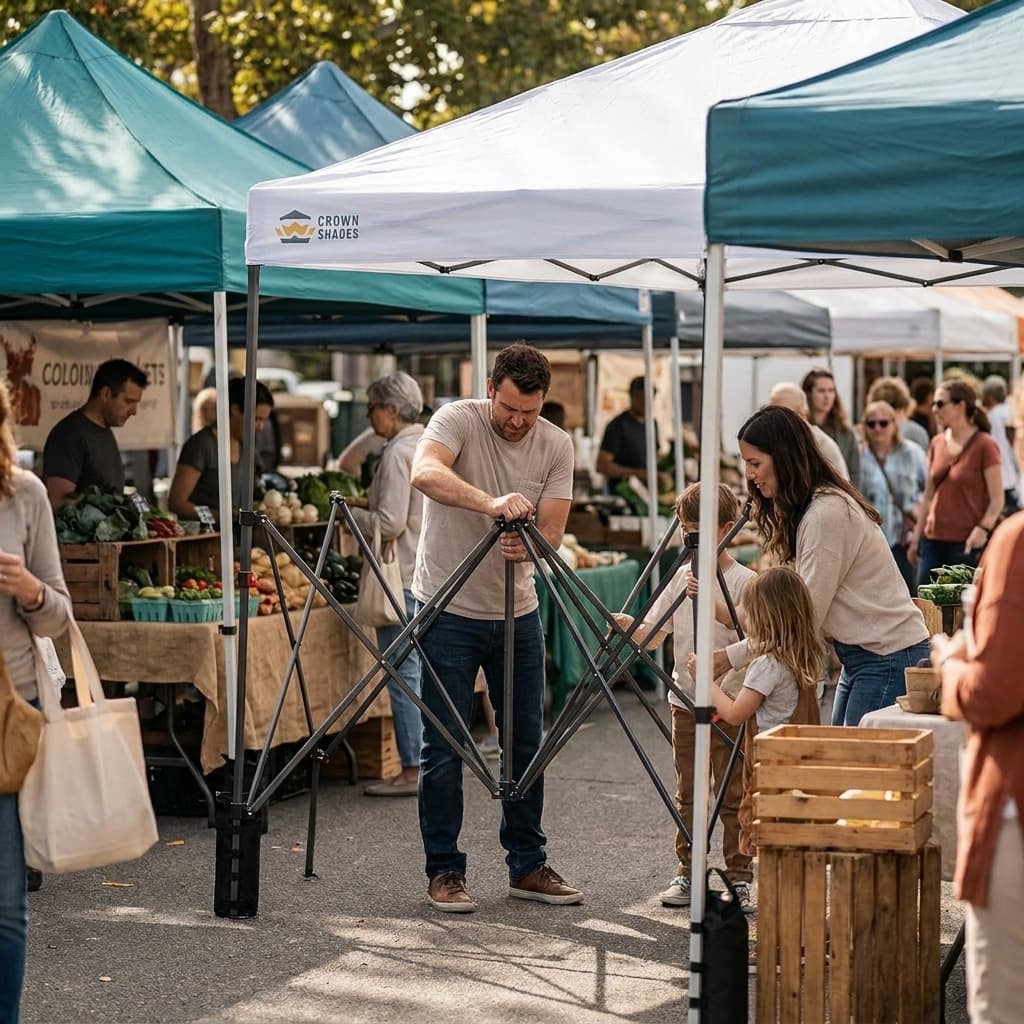
Crown Shades built the CenterLok around a patented single-push center hub that locks all four corners simultaneously, making it one of the genuinely easiest-to-deploy 10x10 canopies available. The 150D silver-coated polyester delivers UPF 50+ protection, drain grommets prevent pooling, and the Sto-N-Go storage system collapses with the fabric attached so teardown does not require removing the canopy top separately.
Strengths
- Patented CenterLok hub locks all corners in one push, making solo setup realistic in under five minutes
- At 36 lbs it is one of the lightest steel-frame 10x10 options, and the leg-integrated wheels reduce handling effort
- Drain grommets and silver-coated interior are thoughtful details that reduce pooling and reflect heat
Weaknesses
- Carry bag zipper failures appear frequently in owner reviews, especially after repeated pack-unpack cycles
- Peak height tops out at 9 ft with roughly 6 ft 2 in of standing clearance, which is limiting for taller users or display signage
Kit Score breakdown
See all picks in Best pop-up canopies for camping, tailgating, and markets
Keep going
Related guides
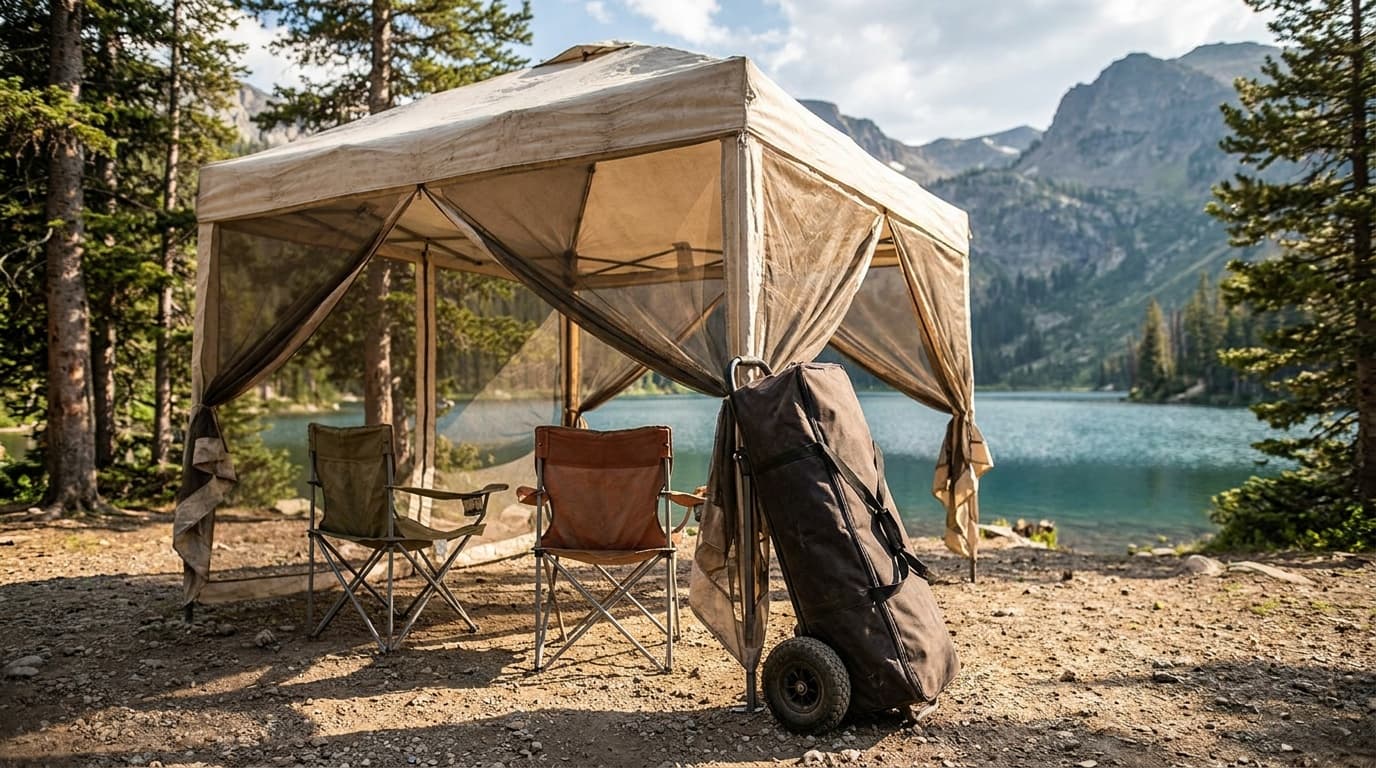
 Complete camp loadoutCar-camping starter kitBuild the complete kit
Researched, not hands-on tested
Updated Jun 4, 2026Our recommendations draw on manufacturer documentation, retailer listings, owner feedback, and comparisons with alternatives.
As an Amazon Associate I earn from qualifying purchases. We may earn a commission from links here, at no extra cost to you. How we research →