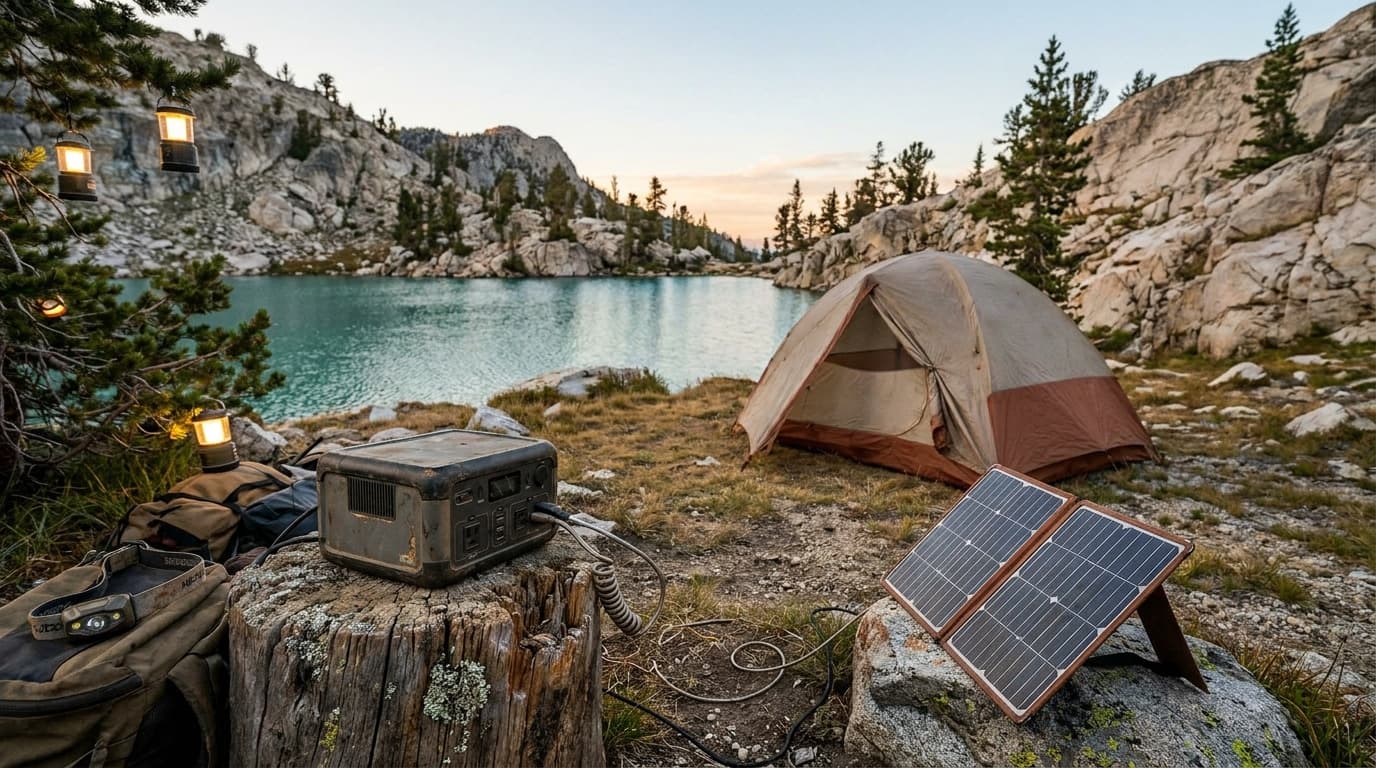
A portable solar panel is one of the most useful pieces of camp gear you can own, and one of the most confusing to buy. The wattage number on the box tells you almost nothing without context.
How much wattage do you actually need
Start with your daily watt-hour draw, then work backward from there.
A rough framework by use case:
- 60–100W covers phones, a headlamp, and small electronics with a 200–300Wh station.
- 120–160W handles a laptop, camera, and drone without feeling stretched.
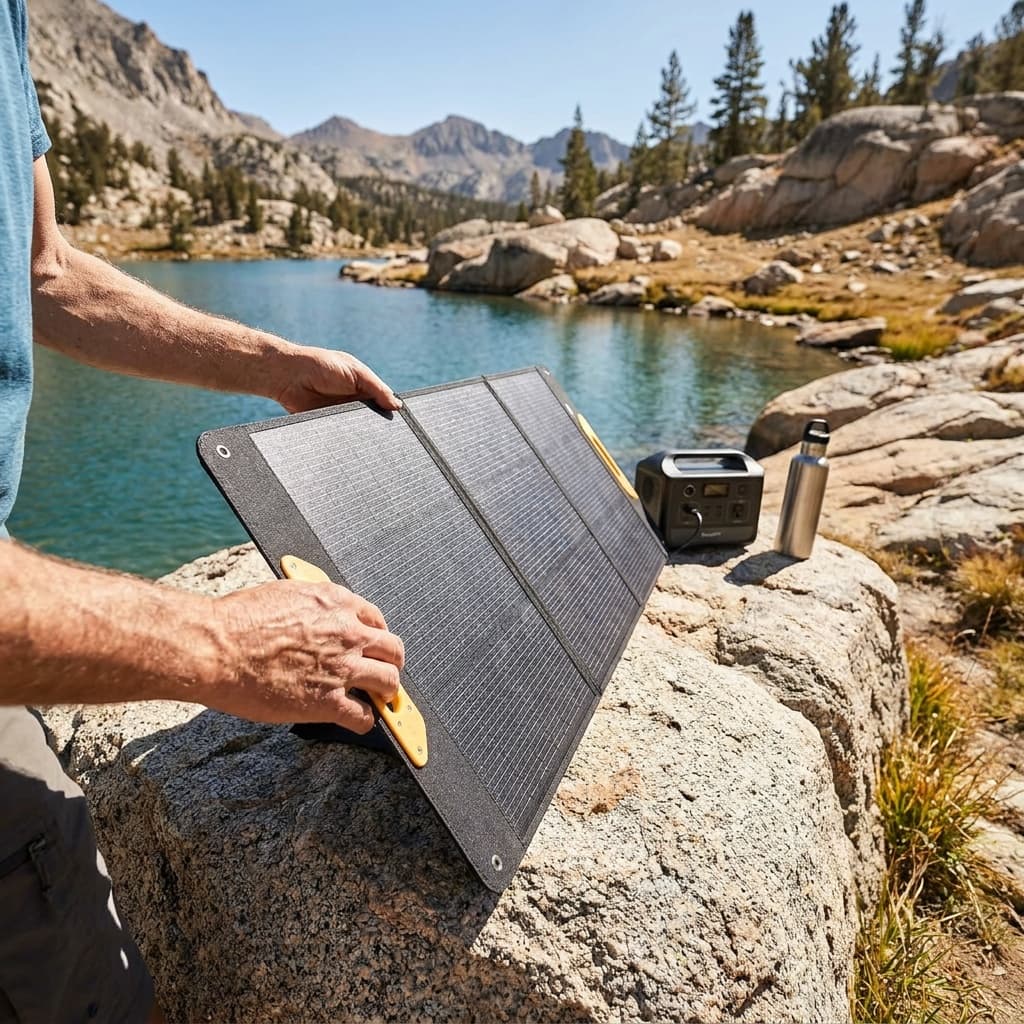
- 180–240W, like the BougeRV 200W 9BB Portable Solar Panel, supports a 12V car fridge or fast-charges a mid-to-large power station.
A 240W panel charges a 1,000Wh power station in roughly 4–5 hours under good sun. But that assumes optimal conditions, which brings up the most important concept in solar sizing.
Rated output vs real-world output
Manufacturers test panels under Standard Test Conditions: 77°F (25°C), 1,000 W/m² irradiance, no wind. You will never replicate those conditions on a campsite.
A 100W panel like the Jackery SolarSaga 100W realistically generates 300–600Wh per day under excellent conditions, assuming 5–6 peak sun hours. On cloudy or winter days, output drops to roughly 20–25% of rated capacity.
Solar cell efficiency also drops approximately 0.3–0.5% per degree Celsius above 25°C. A foldable panel lying flat on dark fabric in summer heat loses measurable output compared to a rigid panel with airflow underneath.
The practical rule: size up by at least 20% beyond your calculated need, and assume you will get 60% of rated wattage on a typical day.
Matching your panel to your power station
This is where most buyers go wrong. You need to match the panel to your station's maximum PV input spec, not just its battery size.
The Jackery Explorer 300, for example, accepts 100W max solar input. The Explorer 2000 Pro accepts up to 1,400W. If you connect a 200W panel to a 300W station, the station clips the excess current but nothing breaks. If you exceed the station's Voc (open-circuit voltage) limit, especially in cold weather when Voc climbs, you risk damaging the battery management system and voiding the warranty.
How to confirm panel-to-station compatibility
Check the panel's Voc
Find the open-circuit voltage on the spec sheet, not the nominal figure. Use the cold-weather value, since Voc rises as temperature drops.
Check the station's max PV voltage
This is listed in the specs as "max PV input voltage" or "solar input voltage." Your panel's Voc must stay below this ceiling.
Match or adapt the connector
Most panels output via MC4 plugs. Stations use XT60 or XT60i (EcoFlow RIVER and DELTA, Anker, Zendure), DC7909 barrel (Jackery legacy and newer), DC5521 (ALLPOWERS, VTOMAN), or AP30A Anderson (Goal Zero Yeti X). Adapter cables handle the mechanical mismatch.
Confirm total wattage headroom
If you chain multiple panels, their combined Voc must still fall below the station's ceiling. Wattage above the max input rating is clipped, not dangerous, within voltage limits.
Adapter cables solve the mechanical connector mismatch. Voltage limits are non-negotiable. Always verify Voc before connecting a new panel to a station you haven't used together before.
Foldable vs rigid panels
For most campers, foldable panels are the right call. Packability matters when you're loading a tent, sleeping bag, and cook kit into the same vehicle or pack.
The efficiency trade-off is real but modest. Rigid panels typically have airflow underneath them, which keeps cells cooler and closer to rated output. Foldable panels on dark fabric retain more heat, reducing output slightly. Multi-segment foldable designs can also lose efficiency if not all segments face the sun at the same angle.
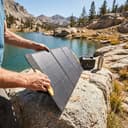
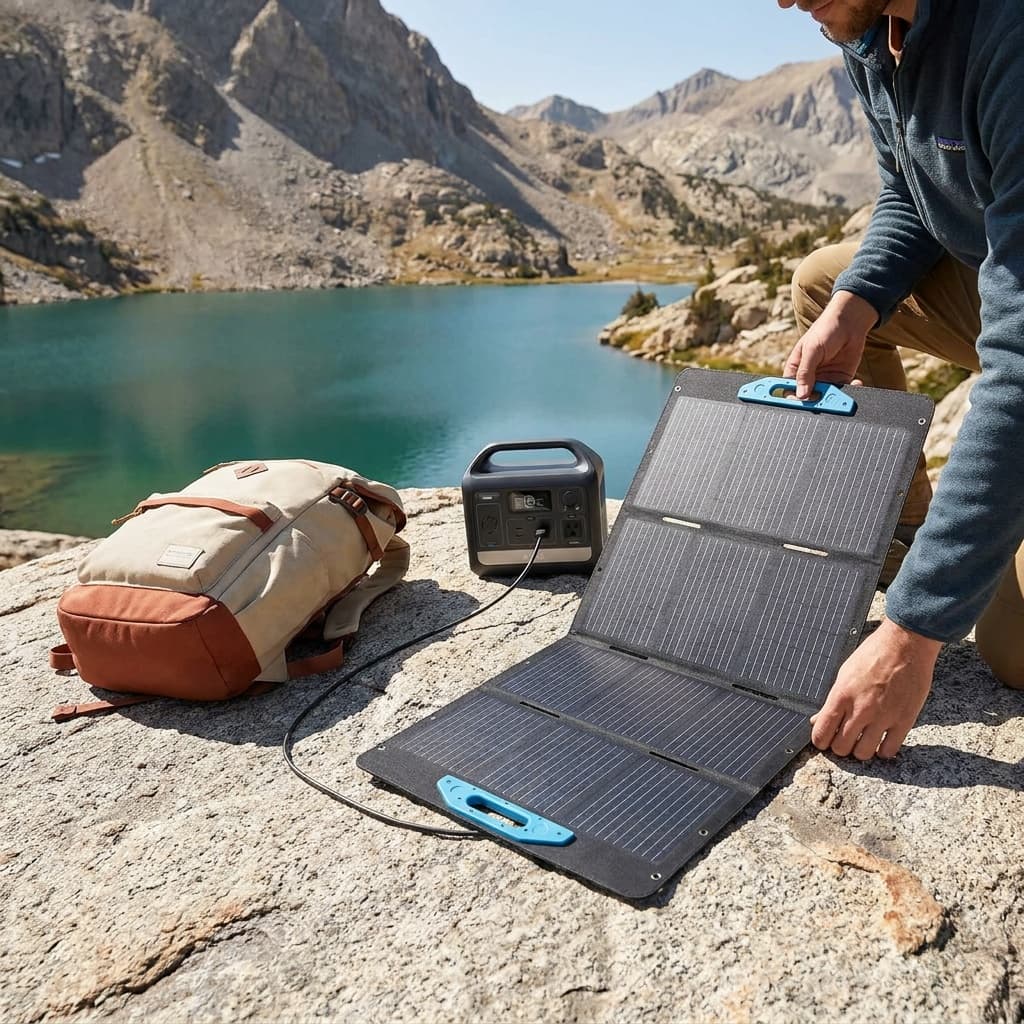
The practical fix: use the built-in kickstand (standard on panels like the Anker SOLIX PS200) to prop the panel up rather than laying it flat on the ground. It improves both airflow and sun angle.
Quality monocrystalline cells, whether foldable or rigid, run 18–23% conversion efficiency. The difference between a well-built foldable and a rigid panel of the same wattage is smaller than the difference between a well-placed and a poorly placed panel of any type.
Placement and angle: the highest-leverage variable
Angle matters, but it doesn't require precision. The reliable all-season rule of thumb is to tilt the panel to match your latitude. In summer, subtract about 15 degrees. In winter, add 15 degrees. For most of the continental US, that puts you in the 30–45 degree range.
South-facing orientation (in the Northern Hemisphere) gives you the longest sun window. Repositioning the panel once mid-day as the sun moves can meaningfully increase your daily harvest without any additional hardware.
A well-placed 100W panel consistently outperforms a poorly placed 200W panel. If you can only do one thing, eliminate shade entirely before optimizing angle.
FAQ
How do I know if my solar panel will work with my power station?
Check two things. First, the connector type: most panels output via MC4 plugs, while stations accept XT60, DC7909, DC5521, or Anderson ports depending on the brand. Adapter cables handle the physical mismatch and are widely available. Second, the voltage ceiling: find your panel's Voc on the spec sheet and confirm it stays below your station's maximum PV input voltage. Voc climbs in cold weather, so use the cold-weather number rather than the nominal figure. Exceed that ceiling and you risk damaging the battery management system.
How many watts do I actually need for a weekend camping trip?
Add up your real daily usage in watt-hours (device wattage multiplied by hours of use), then plan for your solar setup to deliver roughly 60–70% of its rated capacity per day. A rough starting framework: 100W covers a phone, headlamp, and small camera with a sunny day and a 200–300Wh station. Add a laptop or a camera drone and you want 160W or more. Running a 12V car fridge pushes the need to 200W-plus, paired with a 500–1,000Wh station.
Does panel angle actually matter that much at a campsite?
Yes, though perfection is not required. Flat on the ground is noticeably worse than angled toward the sun. A rough target: tilt the panel to match your latitude, roughly 30–45 degrees for most of the continental US. The bigger gain often comes from avoiding shade entirely. If you can only do one thing, choose the sunniest open spot over obsessing over the exact tilt angle.
For specific panel recommendations once you know your wattage target, see our guide to the best solar panels for camping.
Browse more camp gear or read how we research and rate the products we recommend.
Recommended gear
Our current top picks from the Best solar panels for camping: portable picks for any setup guide, if you are ready to buy.
ECOFLOW
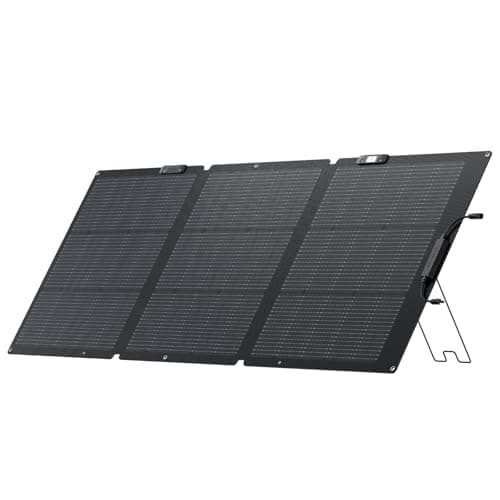
EF EcoFlow 160W Foldable Portable Solar Panel
Best Premium
Kit Score 8.8/10
$344.88 Price checked Oct 23, 4:16 PM CDT
Best for: Car campers and overlanders who want the most reliable all-weather panel at the 160W tier and plan to pair it with an EcoFlow RIVER or DELTA series station.
- IP68 waterproofing is the best in its price range: owners report leaving it out through unexpected rain showers with no damage
- At 15.4 lbs it is too heavy for backpacking and adds meaningful weight to a car-camping kit
- Wattage
- 160W
- Efficiency
- Up to 22% monocrystalline
- Weight
- 15.4 lbs (7 kg)
- Folded size
- 26.8 x 16.5 x 1.0 in
- Output connector
- MC4 solar connectors (2.5 m cable included)
- Water resistance
- IP68 fully waterproof
About this pick
The EcoFlow 160W punches above its weight class with real-world outputs of 120 to 150W under ideal conditions, an IP68 waterproof rating that survives heavy rain without complaint, and a carrying case that doubles as an adjustable stand. Owner data from the River 2 Max pairing shows 134W in full sun and a steady 90W through light cloud cover.
Strengths
- IP68 waterproofing is the best in its price range: owners report leaving it out through unexpected rain showers with no damage
- 160W sweet spot charges mid-size power stations (500Wh) roughly 60 percent faster than a single 100W panel
- Integrated carrying case unfolds into a 30 to 60-degree adjustable kickstand, no separate hardware needed
Weaknesses
- At 15.4 lbs it is too heavy for backpacking and adds meaningful weight to a car-camping kit
- MC4 adapters for non-EcoFlow power stations are not included and must be purchased separately
Kit Score breakdown
BOUGERV
BougeRV 200W 9BB Foldable Portable Solar Panel
Best Value
Kit Score 8.4/10
$179.99 Price checked Oct 23, 4:16 PM CDT
Best for: Drive-in and base-camp setups where weight is not a constraint and you want to charge a large power station (500Wh to 1kWh) as fast as possible for the least money.
- 200W at this price point is the clearest watts-per-dollar value in the foldable panel category
- 18 lbs is the heaviest panel in this group, which limits its appeal for anything beyond base-camp or drive-in camping
- Wattage
- 200W
- Efficiency
- 23% monocrystalline 9BB cells
- Weight
- 18 lbs (8.2 kg)
- Folded size
- 25.5 x 21.9 x 2.75 in
- Output connector
- MC4 (compatible with most power stations)
- Water resistance
- IP67 waterproof
About this pick
BougeRV's 200W foldable panel delivers the most raw wattage per dollar in this roundup, using 9-busbar monocrystalline cells at 23 percent efficiency and an IP67 rating that handles rain and dust. It charges at the same rate as panels costing two to three times as much, making it the practical pick for campers who care more about results than brand prestige.
Strengths
- 200W at this price point is the clearest watts-per-dollar value in the foldable panel category
- 23% efficiency with 9BB cell architecture squeezes more power out of partial shade or low-angle morning light than older 5BB designs
- IP67 waterproofing and ETFE pressure-bearing shell hold up well in dusty and wet conditions per owner reports
Weaknesses
- 18 lbs is the heaviest panel in this group, which limits its appeal for anything beyond base-camp or drive-in camping
- MC4 connector requires an adapter for power stations that use XT60 or proprietary inputs (adapters are inexpensive but sold separately)
Kit Score breakdown
ANKER
Anker SOLIX PS200 200W Foldable Portable Solar Panel
Editor's Choice
Kit Score 8.4/10
$499.99 Price checked Oct 23, 4:16 PM CDT
Best for: Campers who set up the same base camp repeatedly and want a 200W panel built to last several seasons without worrying about frame flex or kickstand failures.
- Kickstand system with fixed angle positions holds position in gusting wind where softer-frame competitors tip over
- At 20.3 lbs it is the heaviest panel in this group, so placement and repositioning takes more effort across a day
- Wattage
- 200W
- Efficiency
- 23% monocrystalline
- Weight
- 20.3 lbs (9.2 kg)
- Folded size
- 22.4 x 23.7 x 2.4 in
- Output connector
- MC4 with XT60 adapter cable included
- Water resistance
- IP67 waterproof
About this pick
The Anker SOLIX PS200 is the most durably built 200W foldable panel in this group, with a rigid frame, a kickstand system that stays put in wind, and 23 percent efficiency cells that hold output through hazy Pacific Northwest skies where cheaper panels fall off faster. It costs more than the BougeRV, but the construction and 2-year warranty justify the gap for regular-use campers.
Strengths
- Kickstand system with fixed angle positions holds position in gusting wind where softer-frame competitors tip over
- 23% efficiency sustains meaningful output in overcast and hazy conditions, not just ideal full-sun scenarios
- Broad compatibility: works with EcoFlow, Jackery, BLUETTI, and Anker power stations via the included MC4 and XT60 cables
Weaknesses
- At 20.3 lbs it is the heaviest panel in this group, so placement and repositioning takes more effort across a day
- Price premium over the BougeRV 200W is substantial; primarily justified by build quality and warranty, not raw wattage
Kit Score breakdown
See all picks in Best solar panels for camping: portable picks for any setup
Keep going
Related guides
 Complete camp loadoutCar-camping starter kitBuild the complete kit
Researched, not hands-on tested
Updated Jun 4, 2026Our recommendations draw on manufacturer documentation, retailer listings, owner feedback, and comparisons with alternatives.
As an Amazon Associate I earn from qualifying purchases. We may earn a commission from links here, at no extra cost to you. How we research →