
Your luggage tag is a small card doing a surprisingly important job: it needs to get your bag back to you without handing a stranger your home address.
What airlines actually need from a luggage tag
Airlines attach their own barcode tag at check-in, which does all the routing work. Your personal tag is only needed if theirs falls off or becomes unreadable. In that case, an airline agent is looking for one thing: a way to contact you quickly.
Name and phone number are the fastest path back to you. Email works too, especially for international trips where a text might not reach a foreign number instantly. You do not need a routing code, a loyalty number, or your itinerary on the outside.
The home address problem
Putting your full home address on the outside of a luggage tag tells anyone who reads it two things: where you live, and that you are currently away from home. That combination is a real privacy exposure, not a theoretical one.
The fix is simple. Use one of these alternatives:
Address alternatives for your luggage tag
Work address
A business address works fine; it identifies you without revealing where you sleep.
Phone number only
Most airlines and handlers will call or text if they find the bag.
Email only
Useful if you have international roaming issues; handlers can reach you across time zones.
First name plus phone
Minimal but functional; first name only reduces searchability.
If you travel for work and do not have a permanent office, a P.O. box or the city and country of your destination hotel are both acceptable. Some travelers simply write their name, cell number, and nothing else.
The interior ID card: your real safety net
The outside tag is the first-pass check. The interior ID card is what solves the case when the outside tag is gone, damaged, or unreadable.
Slip a card inside the bag, tucked into an interior pocket or zip compartment, with:
- Full name
- Phone number (include country code for international travel)
- Email address
- Destination hotel name and city for the first leg of the trip
The destination hotel address is particularly useful. If your bag misses a connection in Rome but you have the Grand Hotel listed inside, an airline agent knows exactly where to send it before you even file a claim. This is one of the highest-leverage moves frequent travelers make.
An interior card with your destination hotel address gives airline staff a place to send your bag before you even know it is missing.
Some travelers print a small card for each trip with the specific hotel and dates. A laminated card with just the permanent contact info works for every trip. Both approaches cost almost nothing.
Privacy covers and flip-style tags
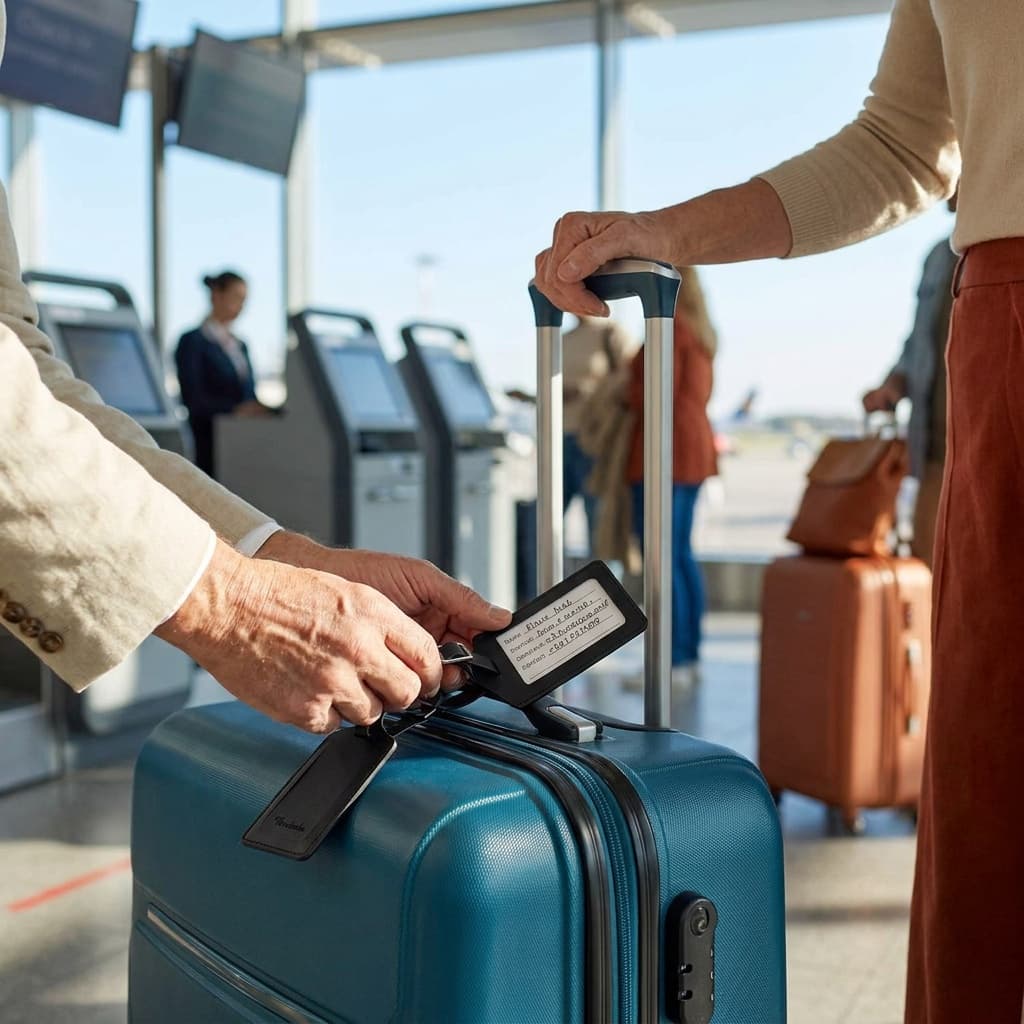
A privacy cover, like the one on the Fintie Luggage Tags, is a luggage tag with an opaque flap or sleeve that hides the label from casual view. To read the info, someone has to physically open or flip the cover. For most travelers, this is the right balance: your contact info is there when it is needed (by a handler, a fellow passenger helping you at baggage claim) but not visible to every person who walks past the belt.
Look for tags with:
- A rigid or semi-rigid flip cover that stays closed in transit
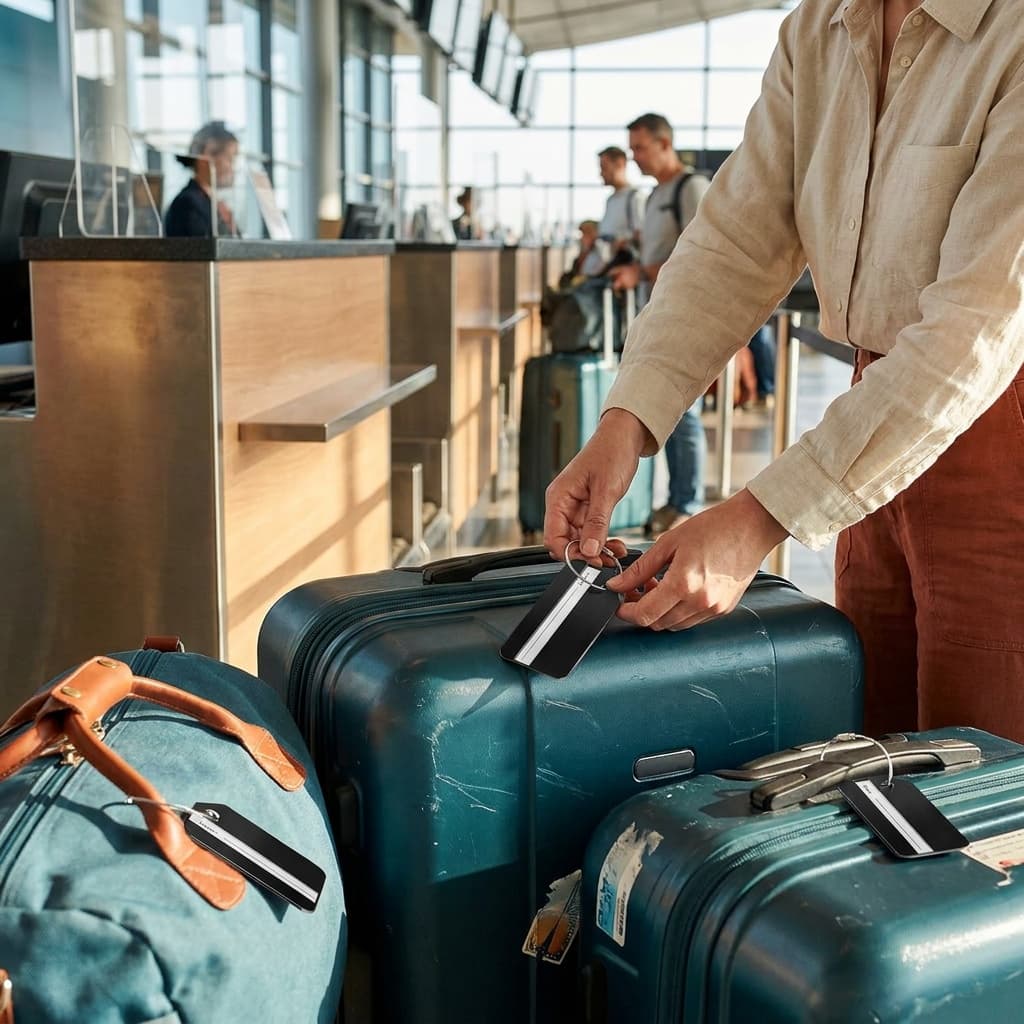
- A secure attachment loop (a steel cable, as on the Travelambo Aluminum Luggage Tags, or a thick leather strap holds better than thin plastic loops)
- A window large enough to read without removing the card
Quick checklist before you fly
Luggage tag checklist
Outside tag
Name plus phone or email; no home address; privacy cover closed.
Interior card
Name, phone with country code, email, destination hotel for first stop.
Attachment check
Pull the loop firmly; replace any cracked or thin plastic loops before travel.
Readability check
Hold the tag at arm's length; if you cannot read it, the font is too small.
Backup bag
If you have a second bag, tag it separately with the same contact method.
Frequently asked questions
Do I need to put my address on a luggage tag?
No. Airlines do not require an address on a personal luggage tag. A name and phone number or email address are sufficient. An address can be useful as a last resort if no one can reach you by phone or email, but use a work address or destination hotel rather than your home address.
What if I am traveling internationally and my phone will not work?
Write an email address on the outside tag and add a note like "WhatsApp: +1-XXX-XXX-XXXX" if you use it. Inside the bag, include your destination hotel name and city. Airlines operating international routes are experienced at routing bags to hotels, and a hotel address inside the bag gives handlers a concrete delivery target.
Does an airline luggage tag replace a personal tag?
For the flight itself, the airline barcode tag handles routing. But airline tags are designed to be removed after the trip and frequently fall off on long hauls or during transfers. A personal tag stays on the bag permanently and provides contact information when the airline tag is gone. Always use both.
For specific picks, see our guide to the best luggage tags. Browse all travel guides or read how we research and rate gear.
Recommended gear
Our current top picks from the Best luggage tags in 2026 guide, if you are ready to buy.

TRAVELAMBO
Travelambo Faux Leather Luggage Tag 2-Pack
BEST OVERALL
Kit Score 8.7/10
$5.99 Price checked Oct 23, 6:22 AM CDT
Best for: Travelers who want a clean, polished look and full privacy protection at a price low enough to outfit the whole family.
- Over 15,200 owner ratings with consistently positive feedback on build quality and color accuracy
- PU leather can scuff or peel after years of heavy checked-bag use
- Material
- Polyurethane (faux) leather, 304 stainless steel buckle
- Card size
- 3.5 in x 2.05 in
- Pack size
- 2 tags
- Attachment
- Extended adjustable leather strap with steel buckle
- Privacy cover
- Fold-over flap conceals full contact card
- Colors available
- 30+
About this pick
A faux-leather tag with a fold-over privacy flap, a two-sided contact card, and a stainless-steel buckle strap that threads through any luggage handle. It hits the requirements at a price that makes buying two sets feel like nothing.
Strengths
- Over 15,200 owner ratings with consistently positive feedback on build quality and color accuracy
- Privacy flap covers the entire contact card without any loose hardware to snag or lose
- 30-plus color options make bag spotting on a carousel genuinely fast
Weaknesses
- PU leather can scuff or peel after years of heavy checked-bag use
- Strap buckle is smaller than a metal cable loop, so some owners replace it with a zip-tie for extra security
Kit Score breakdown

GOSTWO
Gostwo Silicone Luggage Tag 5-Pack
BEST VALUE
Kit Score 8.7/10
$7.99 Price checked Oct 23, 6:22 AM CDT
Best for: Families or frequent flyers who need to tag multiple bags at once and want maximum visibility at baggage claim.
- Silicone flexes under baggage-handling abuse without cracking or tearing the way hard plastic does
- Half-cover leaves the name field visible, which some travelers prefer to keep fully hidden

- Material
- Flexible silicone body, stainless steel loop
- Dimensions
- 3.6 in x 2.0 in x 0.25 in
- Pack size
- 5 tags
- Attachment
- Stainless steel cable loop
- Privacy cover
- Half-cover conceals phone and email; name visible at top
- Note
- No TSA approval exists for luggage tags
About this pick
Thick, fully flexible silicone tags with stainless steel cable loops, a half-privacy cover, and available in high-visibility neon colors. Five tags per pack means you can kit out a whole set of bags in one order.
Strengths
- Silicone flexes under baggage-handling abuse without cracking or tearing the way hard plastic does
- Bright neon colors show up clearly on a baggage carousel even when bags are stacked
- Stainless steel loop is significantly more secure than a simple snap ring
Weaknesses
- Half-cover leaves the name field visible, which some travelers prefer to keep fully hidden
- Silicone can pick up lint and surface grime in tight cargo holds over time
Kit Score breakdown

TRAVELAMBO
Travelambo Aluminum Luggage Tag 3-Pack
BEST PREMIUM
Kit Score 9.0/10
$5.99 Price checked Oct 23, 6:22 AM CDT
Best for: Heavy travelers and frequent checked-bag flyers who want a tag that outlasts the suitcase itself.
- Aluminum body resists denting, fading, and deformation across years of checked-bag use
- Smaller footprint than faux-leather or silicone tags, so the contact card is compact
- Material
- Aluminum alloy shell, stainless steel cable loop
- Dimensions
- 3.2 in x 1.6 in
- Pack size
- 3 tags
- Attachment
- Stainless steel cable loop
- Privacy cover
- Half-cover with transparent ID window conceals contact info
- Rating
- 4.6 stars, 2,900+ reviews
About this pick
An aluminum alloy tag with a stainless steel cable attachment and a half-cover with transparent ID window. The metal shell survives the kind of baggage-handling punishment that cracks or deforms plastic and rubber alternatives.
Strengths
- Aluminum body resists denting, fading, and deformation across years of checked-bag use
- Stainless steel cable loop is harder to rip off than any strap or ring attachment
- Pack of 3 tags means you can cover a full set of luggage in one order
Weaknesses
- Smaller footprint than faux-leather or silicone tags, so the contact card is compact
- Metal edges can scratch soft-sided luggage fabric if the tag shifts during transport
Kit Score breakdown
Keep going
Complete loadoutCarry-on travel kitA one-week suitcase system with the bag, organization, laundry, toiletries, security, scale, and power.


Researched, not hands-on tested
Updated Jun 4, 2026Our recommendations draw on manufacturer documentation, retailer listings, owner feedback, and comparisons with alternatives.
As an Amazon Associate I earn from qualifying purchases. We may earn a commission from links here, at no extra cost to you. How we research →