
Airlines mishandled 6 mishandled bags per 1,000 passengers in 2023 according to the DOT Air Travel Consumer Report, and most of those bags were eventually reunited with their owners, but "eventually" can mean three days into a beach trip. A few minutes of prep before you leave home cuts that risk sharply.
Make your bag impossible to confuse
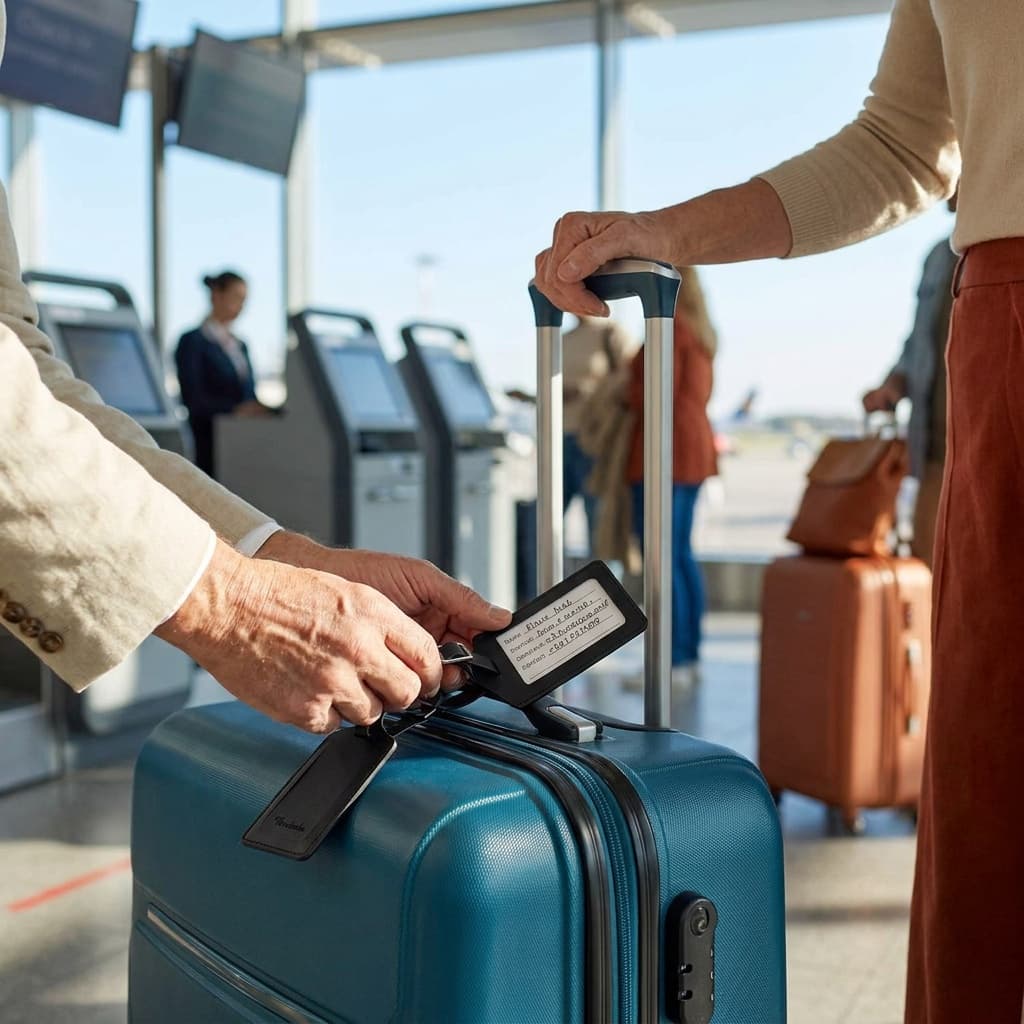
Most roller bags look identical on a baggage carousel. A bright, distinctive tag is the cheapest upgrade you can make. Choose luggage tags in a color that stands out against black fabric, like the Gostwo Silicone Luggage Tags, and consider adding a ribbon or strap in a contrasting color around the handle. This is not just about aesthetics: handlers sorting a pile of bags at 2 a.m. will pick out the hot-orange-tagged bag instantly.
Beyond color, make sure the tag shows your name, phone number, and email address. Skip your home address on the exterior tag if you prefer, or use a privacy-cover tag like the Fintie Luggage Tags that keeps those details out of casual view, but include it on the interior card (more on that below).
Remove every old tag from previous trips
This step is overlooked constantly. Airlines use barcodes on bag tags to route checked luggage through automated sorting systems. An old tag from a previous flight is still readable by those scanners. If your bag has two barcodes and a handler or scanner reads the wrong one, your bag goes to the wrong city.
Before every trip, peel off or tear off every airline-issued tag from previous journeys. Run your hand around the handles and under the retractable handle housing, where tags often get tucked. The tags the airline prints at check-in are the only ones that should be on your bag.
Put ID inside and outside
External tags get torn off. It happens. An interior card takes thirty seconds to add and survives the entire bag's journey even if it loses every external tag.
Slip a business card or a small handwritten card into an interior pocket with your name, phone number, email, and destination address. Include a note with the dates of your trip so the airline knows where to forward the bag if they find it after you've moved on.
Some travelers also write their contact info on a piece of tape stuck to the inside of the lid. Redundancy here is free.
Slip in a Bluetooth tracker
AirTags (Apple) and Tile trackers both work well in luggage. An AirTag uses the Find My network, which is dense in airports and cities worldwide. Tile uses its own network. Both will give you a last-known location that you can share directly with the airline's baggage team, cutting the search time significantly.
How to use a tracker effectively
Place it in a zip pocket
Put it inside an interior zip pocket rather than loose, so it does not migrate to the bottom and muddle the location signal.
Charge or replace the battery before a long trip
AirTags last about a year on a CR2032 battery; check it a week before departure.
Note the tracker ID
Save a screenshot of the tracker's serial number so you can reference it quickly if you need to involve airline staff or airport security.
Share location, not just coordinates
Most tracking apps let you share a live link; send that link directly to the baggage-claim desk rather than trying to describe coordinates verbally.
Know the limitations
Bluetooth trackers require another device in range to update location. In a remote airport or cargo hold with no nearby phones, the last ping may be hours old.
Book smart: direct flights and connection time
The single biggest controllable risk factor for lost luggage is a tight connection. Bags have to physically travel from one plane to another, and if your connection is under 45 minutes, your bag may not make it even if you do. The standard minimum connection time most airlines use for domestic flights is 30–45 minutes, but that is a minimum under ideal conditions, not a comfortable target.
Every connection is a chance for your bag to go a different direction than you do.
When you can, book direct. When a connection is unavoidable, aim for at least 60–90 minutes on domestic routes and 90–120 minutes internationally. If you are checking a bag on a first leg with a separate ticket for the second leg, the bag almost certainly will not transfer automatically. You will need to collect it, clear customs if applicable, and recheck it.
If a flight delay shortens your connection to under 30 minutes, speak to a gate agent before boarding and ask them to flag your bag. It is not always possible, but sometimes the ramp crew can manually prioritize a transfer. If the delay becomes a cancellation, switch to our flight disruption checklist before leaving the airport.
Photograph your bag and its contents
Before you zip up, take a quick photo of the open bag and its contents. Then take a photo of the closed bag from all four sides. This takes under two minutes and does several things. It gives you documentation of what was in the bag for a damage or loss claim. It gives you a clear description to give the airline ("black hardshell, 26 inch, silver spinner wheels, orange ribbon on the left handle" is far more useful than "a black suitcase"). It also helps you identify your bag on a carousel full of similar bags.
Store the photos in cloud storage so you can access them from your phone even if you are abroad.
What to do if your bag is lost
Act immediately, before you leave the airport. The steps below work.
If your bag does not arrive
File a claim at the baggage desk
Do this before leaving the airport. You need a Property Irregularity Report (PIR) with a reference number to track the claim.
Provide your tracker location
If you have an AirTag or Tile, share the live location link with the baggage agent right there at the desk.
Ask for an interim expenses form
Most airlines will reimburse reasonable expenses (toiletries, one change of clothes) for delayed bags. Get the form number and the process in writing.
Call the airline's direct baggage line
The desk at the airport is often overwhelmed. The phone line or online portal for your specific claim is usually faster for updates after you leave.
File with your travel insurance or card benefits
If the bag is not returned within 24–48 hours, contact your travel insurance provider or the benefits line for the credit card you used to buy the ticket. Many cards include delayed-baggage reimbursement.
Bags are found and returned the majority of the time. Having the PIR number, tracker data, and photos makes the process move faster and gives you recourse if the airline drags its feet.
Frequently asked questions
Do Bluetooth trackers really help airlines find a lost bag faster?
Yes, in practice. A tracker gives you a specific location to hand to baggage staff, which is more useful than a description of your bag. Airline baggage teams can search a specific area of the airport or cargo facility rather than sorting through all undelivered bags. The caveat is that tracker accuracy depends on network density: AirTags work best in large airports with heavy iPhone traffic, while smaller regional airports may show stale data.
Should I put my home address on my luggage tag?
You do not have to. A phone number and email address are enough for the airline to reach you, and many security-conscious travelers skip the home address on the exterior tag to avoid advertising that they are away from home. Put the full address on your interior ID card instead, where it is visible to airline staff but not to anyone glancing at your bag on a carousel.
What is the airline actually required to pay if my bag is permanently lost?
For domestic U.S. flights, the DOT caps airline liability at $3,800 per passenger for checked baggage (2024 figure, adjusted periodically). For international flights governed by the Montreal Convention, the cap is approximately 1,288 Special Drawing Rights, which works out to roughly $1,700 depending on exchange rates. These are caps, not automatic payouts: you need to document what was in the bag and its approximate value. Travel insurance or your credit card's travel benefits can fill the gap above the airline's limit.
For specific picks on tags and trackers, see our guide to the best luggage tags. Browse all travel guides or read how we research and rate gear.
Recommended gear
Our current top picks from the Best luggage tags in 2026 guide, if you are ready to buy.

TRAVELAMBO
Travelambo Faux Leather Luggage Tag 2-Pack
BEST OVERALL
Kit Score 8.7/10
$5.99 Price checked Oct 23, 6:22 AM CDT
Best for: Travelers who want a clean, polished look and full privacy protection at a price low enough to outfit the whole family.
- Over 15,200 owner ratings with consistently positive feedback on build quality and color accuracy
- PU leather can scuff or peel after years of heavy checked-bag use
- Material
- Polyurethane (faux) leather, 304 stainless steel buckle
- Card size
- 3.5 in x 2.05 in
- Pack size
- 2 tags
- Attachment
- Extended adjustable leather strap with steel buckle
- Privacy cover
- Fold-over flap conceals full contact card
- Colors available
- 30+
About this pick
A faux-leather tag with a fold-over privacy flap, a two-sided contact card, and a stainless-steel buckle strap that threads through any luggage handle. It hits the requirements at a price that makes buying two sets feel like nothing.
Strengths
- Over 15,200 owner ratings with consistently positive feedback on build quality and color accuracy
- Privacy flap covers the entire contact card without any loose hardware to snag or lose
- 30-plus color options make bag spotting on a carousel genuinely fast
Weaknesses
- PU leather can scuff or peel after years of heavy checked-bag use
- Strap buckle is smaller than a metal cable loop, so some owners replace it with a zip-tie for extra security
Kit Score breakdown

GOSTWO
Gostwo Silicone Luggage Tag 5-Pack
BEST VALUE
Kit Score 8.7/10
$7.99 Price checked Oct 23, 6:22 AM CDT
Best for: Families or frequent flyers who need to tag multiple bags at once and want maximum visibility at baggage claim.
- Silicone flexes under baggage-handling abuse without cracking or tearing the way hard plastic does
- Half-cover leaves the name field visible, which some travelers prefer to keep fully hidden

- Material
- Flexible silicone body, stainless steel loop
- Dimensions
- 3.6 in x 2.0 in x 0.25 in
- Pack size
- 5 tags
- Attachment
- Stainless steel cable loop
- Privacy cover
- Half-cover conceals phone and email; name visible at top
- Note
- No TSA approval exists for luggage tags
About this pick
Thick, fully flexible silicone tags with stainless steel cable loops, a half-privacy cover, and available in high-visibility neon colors. Five tags per pack means you can kit out a whole set of bags in one order.
Strengths
- Silicone flexes under baggage-handling abuse without cracking or tearing the way hard plastic does
- Bright neon colors show up clearly on a baggage carousel even when bags are stacked
- Stainless steel loop is significantly more secure than a simple snap ring
Weaknesses
- Half-cover leaves the name field visible, which some travelers prefer to keep fully hidden
- Silicone can pick up lint and surface grime in tight cargo holds over time
Kit Score breakdown

TRAVELAMBO
Travelambo Aluminum Luggage Tag 3-Pack
BEST PREMIUM
Kit Score 9.0/10
$5.99 Price checked Oct 23, 6:22 AM CDT
Best for: Heavy travelers and frequent checked-bag flyers who want a tag that outlasts the suitcase itself.
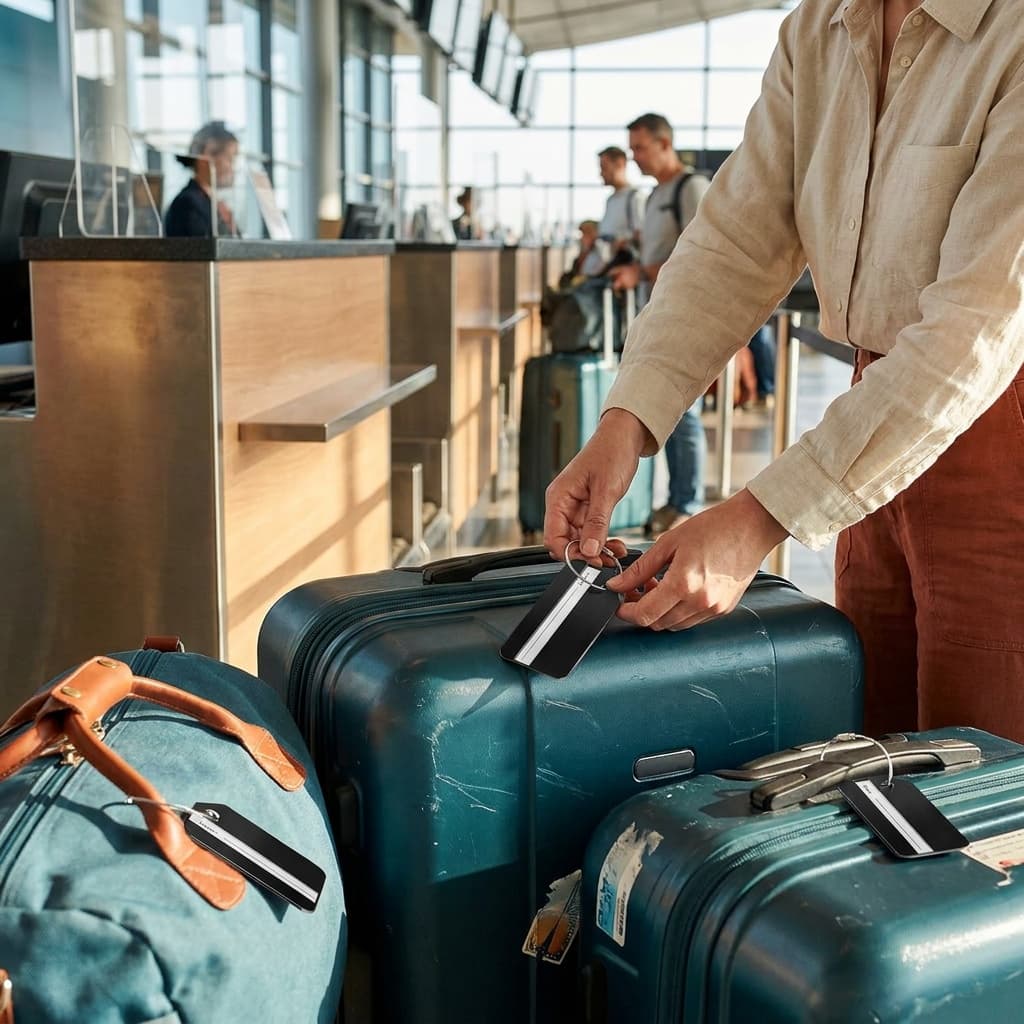
- Aluminum body resists denting, fading, and deformation across years of checked-bag use
- Smaller footprint than faux-leather or silicone tags, so the contact card is compact
- Material
- Aluminum alloy shell, stainless steel cable loop
- Dimensions
- 3.2 in x 1.6 in
- Pack size
- 3 tags
- Attachment
- Stainless steel cable loop
- Privacy cover
- Half-cover with transparent ID window conceals contact info
- Rating
- 4.6 stars, 2,900+ reviews
About this pick
An aluminum alloy tag with a stainless steel cable attachment and a half-cover with transparent ID window. The metal shell survives the kind of baggage-handling punishment that cracks or deforms plastic and rubber alternatives.
Strengths
- Aluminum body resists denting, fading, and deformation across years of checked-bag use
- Stainless steel cable loop is harder to rip off than any strap or ring attachment
- Pack of 3 tags means you can cover a full set of luggage in one order
Weaknesses
- Smaller footprint than faux-leather or silicone tags, so the contact card is compact
- Metal edges can scratch soft-sided luggage fabric if the tag shifts during transport
Kit Score breakdown
Keep going
Complete loadoutCarry-on travel kitA one-week suitcase system with the bag, organization, laundry, toiletries, security, scale, and power.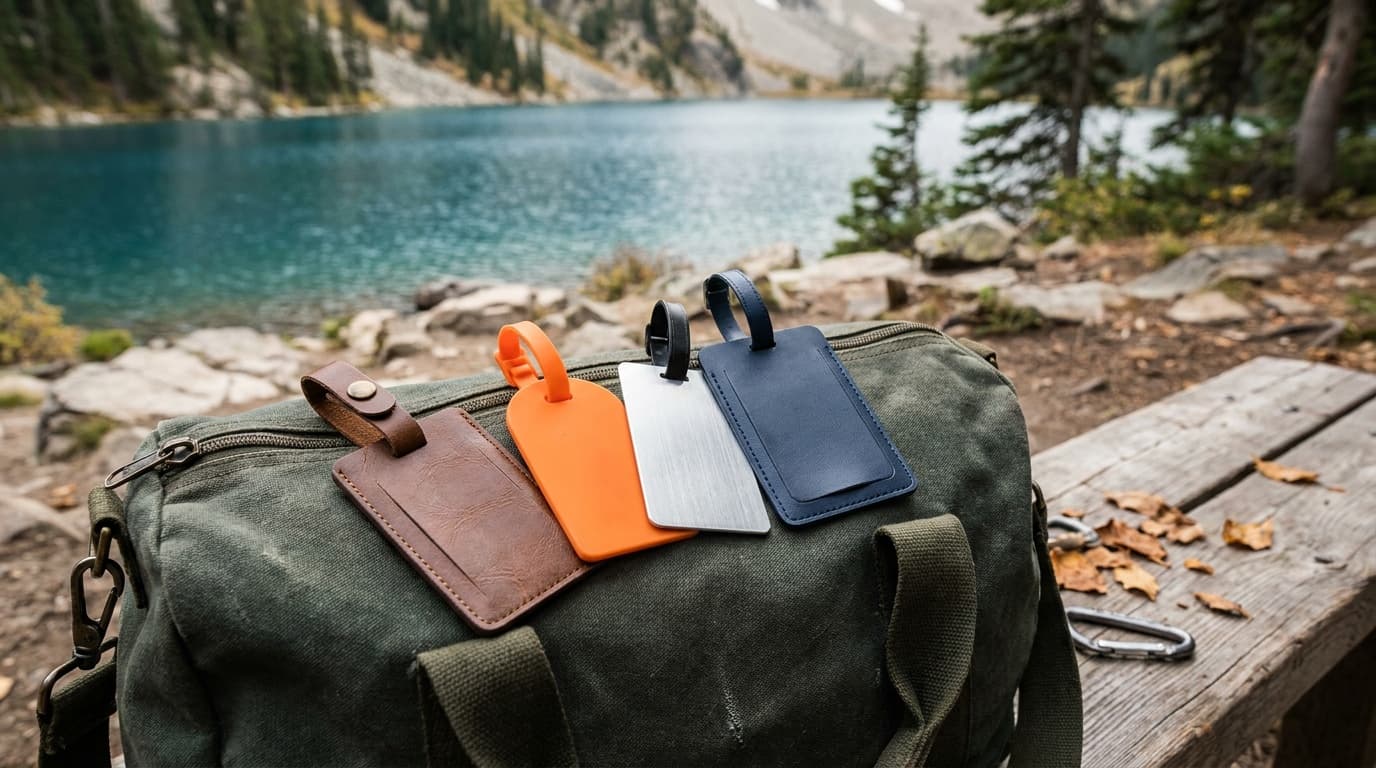


Researched, not hands-on tested
Updated Sep 2, 2026Our recommendations draw on manufacturer documentation, retailer listings, owner feedback, and comparisons with alternatives.
As an Amazon Associate I earn from qualifying purchases. We may earn a commission from links here, at no extra cost to you. How we research →