
Most umbrellas don't fail in the rain; they fail in the wind. Understanding why tells you exactly what to look for before you buy.
Why cheap umbrellas invert
A standard single-layer canopy acts like a sail. Wind hits the underside, pressure builds, and if the force exceeds what the ribs and stretchers can resist, the canopy flips inside-out. Cheap umbrellas use thin steel ribs with no flex tolerance: they resist up to a point, then invert or break with no warning. The fabric attachment points are often glued or heat-welded rather than stitched, so even a single inversion can separate the canopy from the frame permanently.
The physics is straightforward. Lift force on a domed surface increases with wind speed squared, which is why a 40 mph gust applies roughly four times the force of a 20 mph gust. A $10 umbrella engineered for 20 mph simply cannot handle 40 mph, regardless of how firmly you grip it.
The vented double canopy: how it actually works
The most reliable wind-resistance feature is a gap between two canopy layers, the design used on the totes Ultimate Compact Windproof Umbrella. Wind that strikes the outer canopy is partially redirected upward through the vent gap rather than being trapped underneath. This pressure relief reduces the net lift force on the frame by a meaningful margin; independent testing by umbrella manufacturers consistently shows vented designs surviving 20–30% higher wind speeds than equivalent single-layer canopies before failure.
The vent also creates a stabilizing downforce effect: escaping air over the outer canopy produces a low-pressure zone that pulls the canopy down rather than letting it billow up. You can see the same principle in race car rear wings.
Not every "vented" umbrella uses a true separate outer canopy. Some use mesh panels or slits cut into a single layer. These help, but they don't match the pressure-relief performance of a full floating outer canopy with a genuine air gap.
The double canopy doesn't just survive wind better; it actively uses wind pressure to stay stable.
Fiberglass ribs vs. steel ribs
The rib material determines whether your umbrella bends or breaks.
Fiberglass ribs flex under load and return to shape. The flex is the feature: it dissipates energy that would otherwise stress the joint where the rib meets the frame. Fiberglass also resists corrosion, which matters for salt air and frequent travel. The trade-off is that fiberglass ribs are slightly heavier than thin steel ribs at equivalent length, and they add cost.
Steel ribs in budget umbrellas are rigid, which sounds like strength but is actually a liability in dynamic wind loads. A gust is an impulse load, not steady pressure. Rigid ribs transmit the full impulse to the frame joints, which are the weakest points. High-quality steel (like the tempered steel used by Blunt or Davek) can hold up well, but it requires thicker cross-sections that add weight.
Fiberglass or a fiberglass-steel hybrid is the right call for a travel umbrella you plan to use in coastal cities, mountain towns, or anywhere weather is unpredictable.
Rib count and canopy shape
More ribs mean more support points around the canopy circumference, which reduces the unsupported span of fabric between ribs. Smaller unsupported spans mean less fabric flutter and less surface area for wind to grab at any one point.
How rib count affects performance
Below 6 ribs
Canopy geometry is unstable; large unsupported panels flutter and invert easily. Avoid.
8 ribs
Solid baseline. Most quality compact umbrellas use this count.
10–12 ribs
Noticeably more stable; common in full-size windproof models.
16+ ribs
Found in premium golf and city umbrellas; marginal gain over 12 for everyday use.
Canopy shape also matters. A flatter canopy profile presents less frontal area to wind but sheds water less efficiently. A more domed profile sheds rain better and the curvature adds structural stiffness, but it catches more wind. Most travel umbrellas split the difference with a moderate dome. Golf umbrellas use a very shallow profile optimized for crosswinds at the cost of rain-shedding angle.
Realistic wind limits and how to use one in gusts
No umbrella survives unlimited wind. The Blunt Metro, one of the most-cited windproof umbrellas, is rated to sustained winds around 55 mph in manufacturer testing. Knirps, the Repel Windproof Travel Umbrella, and EuroSCHIRM windproof lines are typically rated in the 30–45 mph range. At sustained 60 mph, the physics of a handheld fabric canopy on a shaft puts you past the engineering limits of any practical umbrella.
Technique extends that limit significantly:
- Angle the umbrella into the wind, not perpendicular to it. A tilted canopy presents less surface area and redirects pressure instead of absorbing it.
- Use a shorter shaft extension on telescoping models when gusts are heavy. Less lever arm means less torque on the joint where the shaft meets the frame.
- Don't fight a gust. When a strong gust hits, let the umbrella rotate slightly in your hand rather than gripping rigid. Rigid grip transfers the load to the ribs; a slight give lets the canopy rotate and reduce the effective angle of attack.
- Walk with the wind at your side or back where possible, and tilt accordingly.
Frequently asked questions
Can a windproof umbrella handle hurricane-force winds?
No. Hurricane-force winds begin at 74 mph sustained, well above the tested limits of any handheld umbrella. In those conditions, an umbrella becomes a liability: the canopy can act as a sail and pull you off balance. Wind-resistant engineering extends the practical useful range, it doesn't remove the upper limit. In a severe storm, shelter is the right tool.
Does a heavier umbrella mean a stronger umbrella?
Not necessarily. Weight is the result of rib count, rib material, shaft material, and canopy size, not strength alone. A fiberglass-ribbed compact umbrella at 280 g can outperform a heavier steel-ribbed umbrella in dynamic wind because the ribs flex rather than snap. Evaluate rib material and construction before using weight as a quality signal.
Are vented umbrellas noticeably worse at keeping you dry?
Slightly, in heavy rain with wind. The vent gap between canopy layers allows a small amount of rain to enter if driven horizontally, and the vent itself can let in fine mist. In practice, the trade-off strongly favors the vented design: the scenario where you most need wind resistance (gusts during rain) is exactly when a non-vented umbrella is most likely to invert and leave you completely exposed. Most travelers find the minor mist trade-off well worth it.
For specific picks, see our guide to the best travel umbrellas. Browse all travel guides or read how we research and rate gear.
Recommended gear
Our current top picks from the Best travel umbrellas: compact, windproof picks guide, if you are ready to buy.
REPEL
Repel Windproof Travel Umbrella
Best Overall
Kit Score 8.8/10
$37.99 Price checked Oct 23, 4:16 PM CDT
Best for: Commuters and frequent travelers who want a proven, widely reviewed umbrella that handles everyday wind and rain without babying.
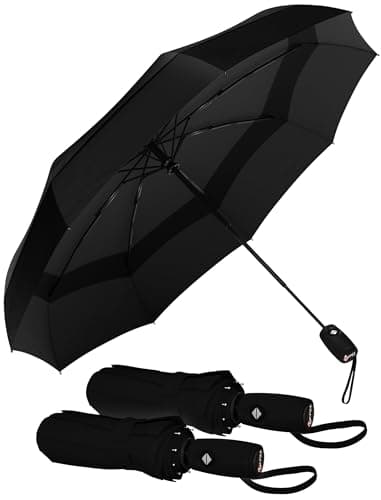
- Nine fiberglass ribs and vented double canopy resist wind inversion reliably
- Closing requires a firm two-handed push, which is awkward one-handed on busy commutes
- Packed length
- 11.5 in
- Weight
- 15 oz (426 g)
- Canopy diameter
- 42 in open
- Ribs
- 9 fiberglass
- Canopy material
- Polyester/nylon, vented double canopy
- Open/close
- Auto open, auto close
About this pick
The Repel Windproof Travel Umbrella is the benchmark compact: nine fiberglass ribs, a vented double canopy rated to 100 mph, and auto open/close in a package that slips into a side pocket. With more than 109,000 Amazon ratings at 4.5 stars and a lifetime replacement guarantee, it is the default recommendation across nearly every travel-gear publication.
Strengths
- Nine fiberglass ribs and vented double canopy resist wind inversion reliably
- Quick-dry canopy sheds water fast and packs away without soaking your bag
- 11.5-inch packed length fits a daypack side pocket or coat pocket with room to spare
Weaknesses
- Closing requires a firm two-handed push, which is awkward one-handed on busy commutes
- At 15 oz, it is on the heavier end for a three-fold compact
Kit Score breakdown

TOTES
totes Titan Portable Travel Umbrella
Best Value
Kit Score 8.0/10
$28.96 Price checked Oct 23, 4:16 PM CDT
Best for: Budget-focused buyers who need real canopy coverage and reliable everyday wind resistance without paying for premium materials.
- Generous 43-inch canopy provides noticeably more coverage than most compacts at this price
- Aluminum frame is stiffer than fiberglass and can be more prone to permanent bending in extreme gusts rather than flexing and recovering

- Packed length
- 11 in
- Canopy diameter
- 43 in
- Frame
- Aluminum, wind-tested to 70 mph
- Coating
- Water-repellent invisible coating
- Open/close
- Auto open, auto close
About this pick
The totes Titan Portable packs a 43-inch canopy into an 11-inch sleeve at a street price well under $35. Its aluminum Titan frame is wind-tested to 70 mph, and the water-repellent coating beads rain off the canopy on contact. totes has sold this platform for years, and it shows in the consistent owner feedback.
Strengths
- Generous 43-inch canopy provides noticeably more coverage than most compacts at this price
- 11-inch packed length is easy to live in a daypack or coat pocket
- totes lifetime limited warranty backs a proven, widely available product
Weaknesses
- Aluminum frame is stiffer than fiberglass and can be more prone to permanent bending in extreme gusts rather than flexing and recovering
- No UV-protection rating and no double-vented canopy on this variant
Kit Score breakdown

TOTES
totes Auto Open/Close Windproof Ultimate Compact Umbrella
Editor's Choice
Kit Score 8.1/10
$36.00 Price checked Oct 23, 4:16 PM CDT
Best for: Travelers who want a single umbrella for both rainy commutes and sunny city days, and prefer a tested brand with a vented canopy and UV coverage.
- Reinforced vented canopy lets wind pass through at up to 75 mph, reducing inversion risk more than a standard single canopy
- Roughly $10-15 more than the standard Titan without a dramatic size or weight improvement in the 43-in variant

- Canopy options
- 43 in, 47 in, or 55 in variants
- Ribs
- 9-rib reinforced frame
- Wind rating
- 75 mph (Titan vented canopy)
- UV protection
- SunGuard UPF 50+, blocks 98% UV
- Coating
- Invisible water-repellent finish, up to 4x drier
- Open/close
- Auto open, auto close
About this pick
The totes Ultimate Compact steps up from the standard Titan with a true reinforced vented double canopy, a 75 mph Titan wind rating, and full SunGuard UPF 50+ UV blocking. Available in 43-, 47-, and 55-inch canopy sizes, it is one of the few umbrellas genuinely useful as both a rain and sun shield without adding excessive bulk.
Strengths
- Reinforced vented canopy lets wind pass through at up to 75 mph, reducing inversion risk more than a standard single canopy
- SunGuard UPF 50+ blocks 98% of UV rays, so it doubles as a sun umbrella on hot days
- Multiple canopy sizes let buyers choose individual or two-person coverage from the same model
Weaknesses
- Roughly $10-15 more than the standard Titan without a dramatic size or weight improvement in the 43-in variant
- Fewer long-term owner reviews than the Repel or standard totes Titan (97 ratings as of verification)
Kit Score breakdown
See all picks in Best travel umbrellas: compact, windproof picks
Keep going



Researched, not hands-on tested
Updated Jun 4, 2026Our recommendations draw on manufacturer documentation, retailer listings, owner feedback, and comparisons with alternatives.
As an Amazon Associate I earn from qualifying purchases. We may earn a commission from links here, at no extra cost to you. How we research →