
A good travel umbrella disappears into your bag until you need it, then holds up in real weather without folding inside out at the first gust. Knowing which specs actually matter makes the difference between a tool you trust and one you abandon at the airport.
Packed size and weight: the real trade-off
Travel umbrellas compress down to two main size classes. A three-fold compact collapses to roughly 23–28 cm and weighs 220–300 g. A two-fold (or "slim") collapses to 33–38 cm but opens to a larger canopy and feels sturdier in the hand. Neither is wrong; the choice is about where you carry it.
For a daypack side pocket or a small crossbody, the three-fold compact is the practical choice. For a tote, briefcase, or roller carry-on, the two-fold's extra coverage is worth the bulk.
Canopy diameter matters more than people expect. A 90 cm canopy shelters one person's shoulders in a straight rain. A 100–105 cm canopy keeps your bag dry too, which matters when you're traveling with a daypack on your front. If you travel with a partner or frequently carry camera gear, size up.
Windproofing: vented double canopy vs rib count
Most umbrella marketing leans on rib count (eight ribs, ten ribs, sixteen ribs) as a proxy for strength. More ribs do distribute stress more evenly, but the bigger factor is whether the canopy has a vent.
A vented double-canopy design, like the one on the totes Ultimate Compact Windproof Umbrella, uses two fabric layers with a gap between them. When a gust hits, air escapes through the vent instead of inverting the canopy. This is the same principle used in architectural wind design and it genuinely works in the 40–60 km/h (25–40 mph) gusts you encounter walking across an exposed plaza or exiting a subway station.
A vented double canopy lets the wind through instead of fighting it, which is why it survives conditions that fold a standard umbrella inside out.
Fiberglass ribs, like the nine on the Repel Windproof Travel Umbrella, flex through a gust and spring back to shape. They add a few grams compared to hollow aluminum, but aluminum ribs can develop permanent creases after one hard inversion. For travel in exposed or variable conditions, fiberglass ribs are worth the slight weight penalty.
A realistic windproof spec for a quality compact travel umbrella is 8 fiberglass ribs plus a vented double canopy. Marketing claims of "windproof to 100 km/h" are usually not independently verified; the construction tells you more than the number.
Auto open/close vs manual: matching to how you actually use it
Auto open/close (one button deploys the canopy, a second click collapses it) costs roughly 30–60 g and adds a small motor mechanism that can fail over years of use. For a daily commuter who opens and closes an umbrella dozens of times a week in a bus door or taxi, that convenience is real.
For a traveler who uses an umbrella a handful of times per trip, a manual compact is lighter, simpler, and typically cheaper. The collapse takes two seconds longer. That is the entire trade-off.
How to match umbrella type to your use case
Daily commuter
Choose auto open/close with a wrist strap; you open it fast in a doorway without shifting your bag.
Minimalist packer
Choose a manual three-fold; save 40–60 g and skip the motor mechanism.
Adventure or hiking travel
Prioritize vented double canopy and fiberglass ribs over auto features; wind matters more than one-button operation.
Urban weekend trips
A two-fold with auto open, like the [Weatherman Travel Umbrella](/api/go?product=weatherman-premium-travel-umbrella&retailer=amazon&article=how-to-choose-a-travel-umbrella), gives coverage and convenience without going full golf-umbrella.
Backpack traveler
Confirm packed length fits your pack's exterior pocket before buying; 23–25 cm is safest.
Canopy coatings: Teflon and water repellency
Many quality travel umbrellas treat the canopy fabric with a fluoropolymer coating marketed as Teflon or a similar DWR (durable water repellency) finish. The practical effect is that water beads and rolls off rather than saturating the fabric. This matters when you fold a wet umbrella into your bag: a coated canopy sheds most of the water before it goes in; an uncoated one transfers a wet patch to everything it touches.
Coatings wear over time. Washing an umbrella with detergent degrades DWR faster than rain does. Most manufacturers recommend rinsing with clean water only if the canopy gets dirty.
Packing and airline considerations
A compact travel umbrella (folded under 32 cm) fits easily in a carry-on bag and is not restricted by TSA. Standard umbrellas are allowed in both carry-on and checked luggage under US TSA rules. Sword-style umbrellas with a pointed metal tip occasionally draw secondary screening, but standard compact travel umbrellas clear security without issue.
For packing efficiency, a slim profile matters more than a stuff sack. Look for a flat, slip-style sleeve rather than a bulky zipper case; the sleeve keeps the umbrella organized without adding unnecessary structure.
Frequently asked questions
What packed length fits in a jacket pocket?
Aim for 23–26 cm (9–10 in) packed length. Most interior jacket pockets are 25–28 cm deep, so a compact in that range fits without bulging the pocket. Check the packed dimension in the spec sheet before buying; "compact" is a marketing term with no standard size.
Are windproof umbrellas actually windproof?
No umbrella is truly windproof in severe conditions. The meaningful distinction is between umbrellas that invert and stay broken versus umbrellas that flex, vent the gust, and spring back to shape. A vented double-canopy umbrella with fiberglass ribs handles urban wind gusts (30–60 km/h) reliably. In a sustained 80+ km/h storm, find shelter instead.
Is a heavier umbrella always more durable?
Not reliably. Weight often reflects frame material and canopy size rather than build quality. A 260 g umbrella with fiberglass ribs and a vented canopy will outperform a 380 g aluminum-rib umbrella in a crosswind. Focus on rib material and canopy construction over raw weight when evaluating durability.
For specific picks across these categories, see our guide to the best travel umbrellas. Browse all travel guides or read how we research and rate gear.
Recommended gear
Our current top picks from the Best travel umbrellas: compact, windproof picks guide, if you are ready to buy.
REPEL
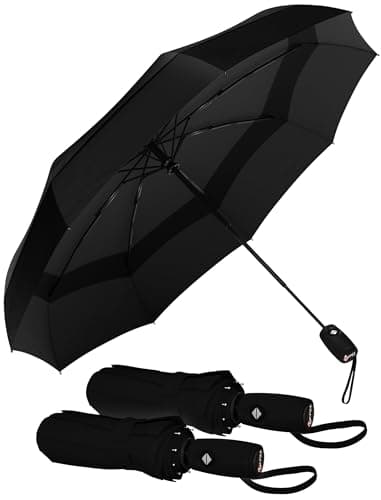
Repel Windproof Travel Umbrella
Best Overall
Kit Score 8.8/10
$37.99 Price checked Oct 23, 4:16 PM CDT
Best for: Commuters and frequent travelers who want a proven, widely reviewed umbrella that handles everyday wind and rain without babying.
- Nine fiberglass ribs and vented double canopy resist wind inversion reliably
- Closing requires a firm two-handed push, which is awkward one-handed on busy commutes
- Packed length
- 11.5 in
- Weight
- 15 oz (426 g)
- Canopy diameter
- 42 in open
- Ribs
- 9 fiberglass
- Canopy material
- Polyester/nylon, vented double canopy
- Open/close
- Auto open, auto close
About this pick
The Repel Windproof Travel Umbrella is the benchmark compact: nine fiberglass ribs, a vented double canopy rated to 100 mph, and auto open/close in a package that slips into a side pocket. With more than 109,000 Amazon ratings at 4.5 stars and a lifetime replacement guarantee, it is the default recommendation across nearly every travel-gear publication.
Strengths
- Nine fiberglass ribs and vented double canopy resist wind inversion reliably
- Quick-dry canopy sheds water fast and packs away without soaking your bag
- 11.5-inch packed length fits a daypack side pocket or coat pocket with room to spare
Weaknesses
- Closing requires a firm two-handed push, which is awkward one-handed on busy commutes
- At 15 oz, it is on the heavier end for a three-fold compact
Kit Score breakdown

TOTES
totes Titan Portable Travel Umbrella
Best Value
Kit Score 8.0/10
$28.96 Price checked Oct 23, 4:16 PM CDT
Best for: Budget-focused buyers who need real canopy coverage and reliable everyday wind resistance without paying for premium materials.
- Generous 43-inch canopy provides noticeably more coverage than most compacts at this price
- Aluminum frame is stiffer than fiberglass and can be more prone to permanent bending in extreme gusts rather than flexing and recovering

- Packed length
- 11 in
- Canopy diameter
- 43 in
- Frame
- Aluminum, wind-tested to 70 mph
- Coating
- Water-repellent invisible coating
- Open/close
- Auto open, auto close
About this pick
The totes Titan Portable packs a 43-inch canopy into an 11-inch sleeve at a street price well under $35. Its aluminum Titan frame is wind-tested to 70 mph, and the water-repellent coating beads rain off the canopy on contact. totes has sold this platform for years, and it shows in the consistent owner feedback.
Strengths
- Generous 43-inch canopy provides noticeably more coverage than most compacts at this price
- 11-inch packed length is easy to live in a daypack or coat pocket
- totes lifetime limited warranty backs a proven, widely available product
Weaknesses
- Aluminum frame is stiffer than fiberglass and can be more prone to permanent bending in extreme gusts rather than flexing and recovering
- No UV-protection rating and no double-vented canopy on this variant
Kit Score breakdown

TOTES
totes Auto Open/Close Windproof Ultimate Compact Umbrella
Editor's Choice
Kit Score 8.1/10
$36.00 Price checked Oct 23, 4:16 PM CDT
Best for: Travelers who want a single umbrella for both rainy commutes and sunny city days, and prefer a tested brand with a vented canopy and UV coverage.
- Reinforced vented canopy lets wind pass through at up to 75 mph, reducing inversion risk more than a standard single canopy
- Roughly $10-15 more than the standard Titan without a dramatic size or weight improvement in the 43-in variant

- Canopy options
- 43 in, 47 in, or 55 in variants
- Ribs
- 9-rib reinforced frame
- Wind rating
- 75 mph (Titan vented canopy)
- UV protection
- SunGuard UPF 50+, blocks 98% UV
- Coating
- Invisible water-repellent finish, up to 4x drier
- Open/close
- Auto open, auto close
About this pick
The totes Ultimate Compact steps up from the standard Titan with a true reinforced vented double canopy, a 75 mph Titan wind rating, and full SunGuard UPF 50+ UV blocking. Available in 43-, 47-, and 55-inch canopy sizes, it is one of the few umbrellas genuinely useful as both a rain and sun shield without adding excessive bulk.
Strengths
- Reinforced vented canopy lets wind pass through at up to 75 mph, reducing inversion risk more than a standard single canopy
- SunGuard UPF 50+ blocks 98% of UV rays, so it doubles as a sun umbrella on hot days
- Multiple canopy sizes let buyers choose individual or two-person coverage from the same model
Weaknesses
- Roughly $10-15 more than the standard Titan without a dramatic size or weight improvement in the 43-in variant
- Fewer long-term owner reviews than the Repel or standard totes Titan (97 ratings as of verification)
Kit Score breakdown
See all picks in Best travel umbrellas: compact, windproof picks
Keep going


Researched, not hands-on tested
Updated Jun 4, 2026Our recommendations draw on manufacturer documentation, retailer listings, owner feedback, and comparisons with alternatives.
As an Amazon Associate I earn from qualifying purchases. We may earn a commission from links here, at no extra cost to you. How we research →