Jet lag is a circadian mismatch, not a travel mystery. According to the CDC Yellow Book, average adaptation is about one hour per day after eastward travel and 1.5 hours per day after westward travel. A six-hour eastward crossing can therefore take close to a week without deliberate timing changes.
Why east is harder than west
Your circadian clock defaults to a cycle slightly longer than 24 hours, which makes it easier to delay (stay up later) than to advance (go to bed earlier). Westward travel asks you to delay; eastward travel asks you to advance. That asymmetry is why the same six-hour shift feels worse coming home from Europe than it did flying out.
Symptoms become more likely as the number of time zones increases, and eastward travel is generally harder because advancing the body clock is slower than delaying it westward. Individual response varies with sleep loss, timing, age, and the travel schedule.
Light is the strongest reset tool you have
Bright light suppresses melatonin and directly resets the suprachiasmatic nucleus, the brain's master clock. Timing determines whether it advances or delays your rhythm.
- Morning light can advance the clock when it falls in the correct biological window. For eastward travel, use an individualized schedule from the CDC Yellow Book, a reputable jet-lag calculator, or a sleep clinician rather than assuming every morning exposure has the same effect.
- Evening light delays the clock (useful for westward travel): seek outdoor light in the late afternoon and early evening at your destination.
- Avoid the wrong light at the wrong time. Aircraft cabin lighting is often set for the crew's convenience, not your destination time zone. A quality sleep mask is the simplest way to cut that signal when you need darkness.
At the destination, outdoor light is usually the most practical source when it falls in the recommended window. If sunlight is unavailable, follow a light-therapy lamp's specified distance and duration; rated lux falls sharply as you move farther from the device.
Pre-trip sleep shifting: the practical protocol
For eastward flights crossing three or more time zones:
Pre-trip shifting protocol (eastward)
Day 3 before departure
Move your bedtime and wake time 1 hour earlier if your schedule and health allow. Pair the shift with light exposure during the recommended advance window.
Day 2 before departure
Move bedtime and wake time another hour earlier if the first shift was tolerable. Repeat the individualized light schedule.
Day 1 before departure
Shift one more hour if your schedule allows. Avoid bright screens or overhead lighting in the 2 hours before this earlier bedtime.
Travel day
Align your sleep and eating to destination time as closely as the flight schedule allows. Use a sleep mask during any in-flight sleep that falls outside destination nighttime hours.
For westward flights, pre-trip shifting matters less. Delaying your clock is easier, and staying up a few hours later once you land typically does the job.
Melatonin: a clock-shifter, not a sleeping pill
Melatonin's job in your body is to signal darkness to the circadian system. The CDC notes that 0.5-1 mg is often sufficient and discourages doses above 5 mg. The intended timing depends on direction, time zones crossed, and biological time; a clock time that helps one itinerary can be mistimed for another.
The critical variable is timing relative to your destination clock, not your home clock.
- Eastward travel: an appropriately timed low dose may help advance the clock, but do not use a universal 10 pm rule across every route.
- Westward travel: melatonin is less commonly needed, and a delay schedule differs from an advance schedule.
- Timing is itinerary-specific. Use the CDC phase-response guidance, a reputable jet-lag calculator, or clinician advice rather than guessing from destination bedtime alone.
Hydration and alcohol on the plane
Cabin air on most commercial aircraft is typically 10-20% relative humidity. The UK Civil Aviation Authority explains that this mainly causes dryness of the skin and mucous membranes; normal fluid intake generally prevents core dehydration in healthy travelers.
Drink normally according to thirst rather than treating 250 ml per hour as a requirement. Limit alcohol, which can worsen sleep quality and judgment even when it seems to make falling asleep easier.
Caffeine: small and timed, not large and frequent
Caffeine can protect alertness, but it should serve the intended sleep schedule rather than delay it.
Use caffeine strategically and stop early enough to protect the sleep window you are trying to establish. Sensitivity and clearance vary substantially, so this guide does not prescribe a fixed 40-50 mg dose every two hours.
Sleeping on the plane: only when it counts
This is the part most travelers get wrong. Sleep signals darkness to your circadian system. Sleeping at the wrong time relative to your destination can shift your clock in the wrong direction, making adaptation harder, not easier.
The rule is simple: aim to sleep only during hours that correspond to nighttime at your destination. If your destination is six hours ahead and it is currently 3 pm there, sleep is counterproductive. Stay awake, move around, and use light exposure to signal daytime to your clock.
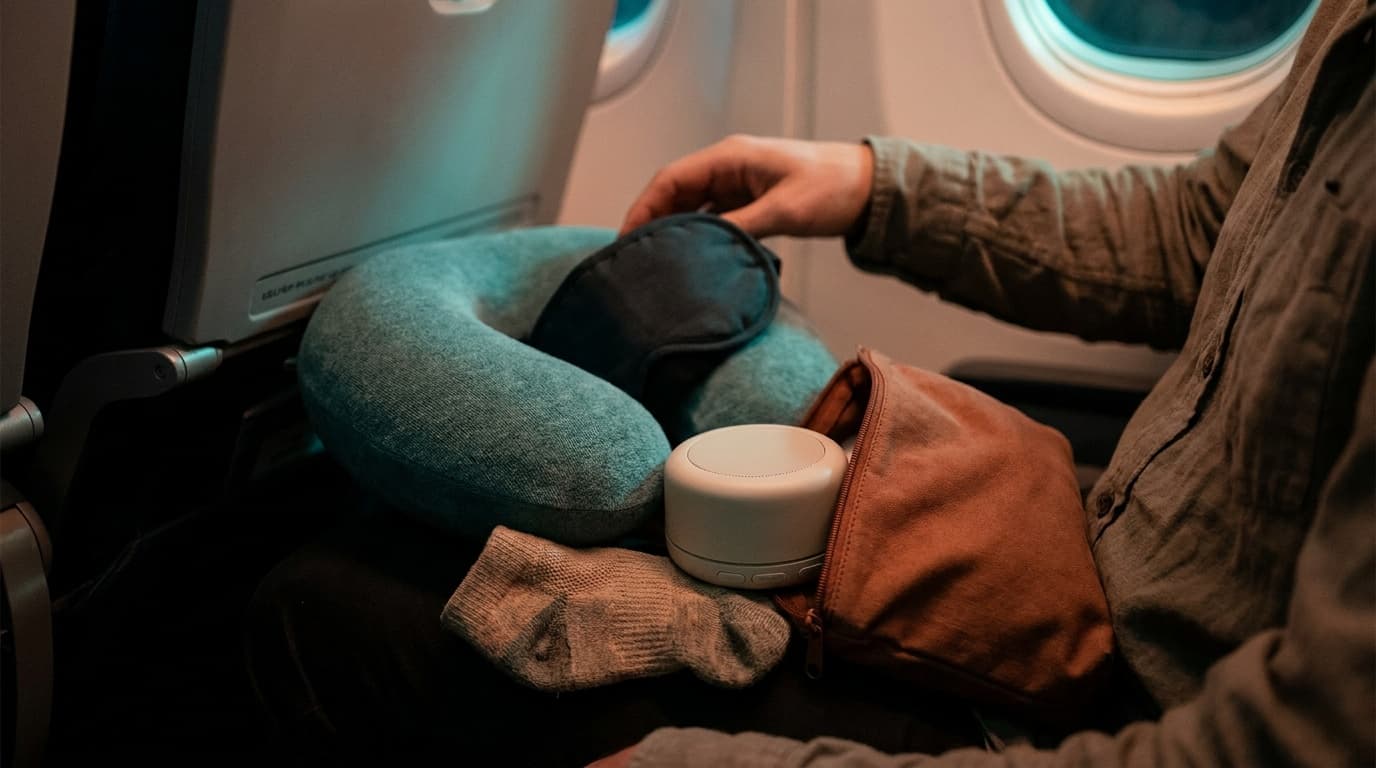
When you do sleep on the plane, the gear that protects that sleep is worth using:
- A sleep mask that seals out cabin light. Overhead lights, screen glow from neighboring seats and the gradual brightening before meal service all deliver light cues that can disrupt your adaptation. Contoured masks like the MZOO Luxury Sleep Eye Mask that do not press on the eyelids are generally more comfortable for longer sleep.
- Ear plugs or noise-canceling headphones. Cabin noise sits around 85 dB at cruising altitude. That level of background noise degrades sleep depth even when it does not fully wake you. Active noise-canceling headphones like the Sony WH-1000XM5 are more effective for the low-frequency engine rumble; foam ear plugs work better for higher-pitched voices and cabin sounds nearby.
- A neck pillow that keeps your head from falling forward. Positional waking from a dropped head is one of the most common reasons sleep on a plane stays shallow. See our guide to the best travel pillows for options that actually hold your head upright rather than just cushioning it.
For short trips: consider not adapting at all
If your trip is two days or fewer, a full circadian adaptation is probably not worth attempting. You will spend the first day shifting in one direction and the last day starting the shift back. Staying on your home schedule, sleeping at your home bedtime (even if that means going to bed very early or very late at the destination), and relying on strategic caffeine during local daytime hours is often less disruptive than a partial adaptation that leaves you stranded between two clocks.
Longer stays give adaptation more time to pay off, but the transition time depends on direction, zones crossed, sleep loss, age, and individual circadian response.
The gear that helps
None of these items change the underlying biology. What they do is reduce the variables that undermine the strategy above.
- Sleep mask: the single highest-impact item for controlling light exposure in-flight. Look for a contoured design that blocks peripheral light and does not compress the eyes.
- Noise-canceling headphones or quality foam ear plugs: protects sleep depth during in-flight sleep windows and reduces the general fatigue load of sustained cabin noise.
- Supportive neck pillow: reduces positional waking. A pillow that collapses to small is more likely to come with you.
- Compact light therapy lamp: useful when outdoor light is unavailable during the recommended window. Follow the device's specified distance and duration rather than equating a lamp with a clear sky.
- A reusable water bottle: a packable one like the HYDAWAY Collapsible Water Bottle takes no bag space and most aircraft will refill it. Removes the friction of waiting for a drinks trolley when you need consistent hydration.
How many time zones do you need to cross before jet lag becomes a real problem?
Jet lag can follow any rapid multi-zone trip, but symptoms generally become more likely and last longer as more zones are crossed. Eastward trips are often harder because the average body clock advances about one hour per day, versus roughly 1.5 hours of delay per day westward.
Does fasting on the plane actually reset your clock faster?
No good evidence supports this. Food is a relatively weak circadian time cue compared to light. The fasting-flight claim is widely repeated but has not been validated in peer-reviewed trials at a level that justifies skipping meals, which can amplify fatigue and irritability on arrival.
When exactly should I take melatonin for an eastward flight?
The CDC says 0.5-1 mg is often sufficient, but the correct time depends on travel direction, time zones crossed, and biological time. Use the CDC phase-response guidance, a reputable jet-lag calculator, or clinician advice instead of a universal 10 pm destination-time rule. Consult a clinician first if you take medication, are pregnant, or have a sleep disorder, and avoid doses above 5 mg.
For gear that supports better sleep and recovery in transit, browse our travel gear hub and see how we research and rate the products we cover.
Recommended gear
Our current top picks from the Best travel pillow 2026: 6 neck pillows for flights guide, if you are ready to buy.
CABEAU
Cabeau Evolution S3 Travel Pillow
Best Overall
Kit Score 8.6/10
$39.99 Price checked Oct 23, 4:16 PM CDT
Best for: Long-haul economy flyers whose seats have a usable headrest and who want support anchored to the seat rather than resting loosely around the neck.
- Seat straps create the most stable headrest connection in this comparison
- Straps cannot anchor usefully to every shell seat or headrest design
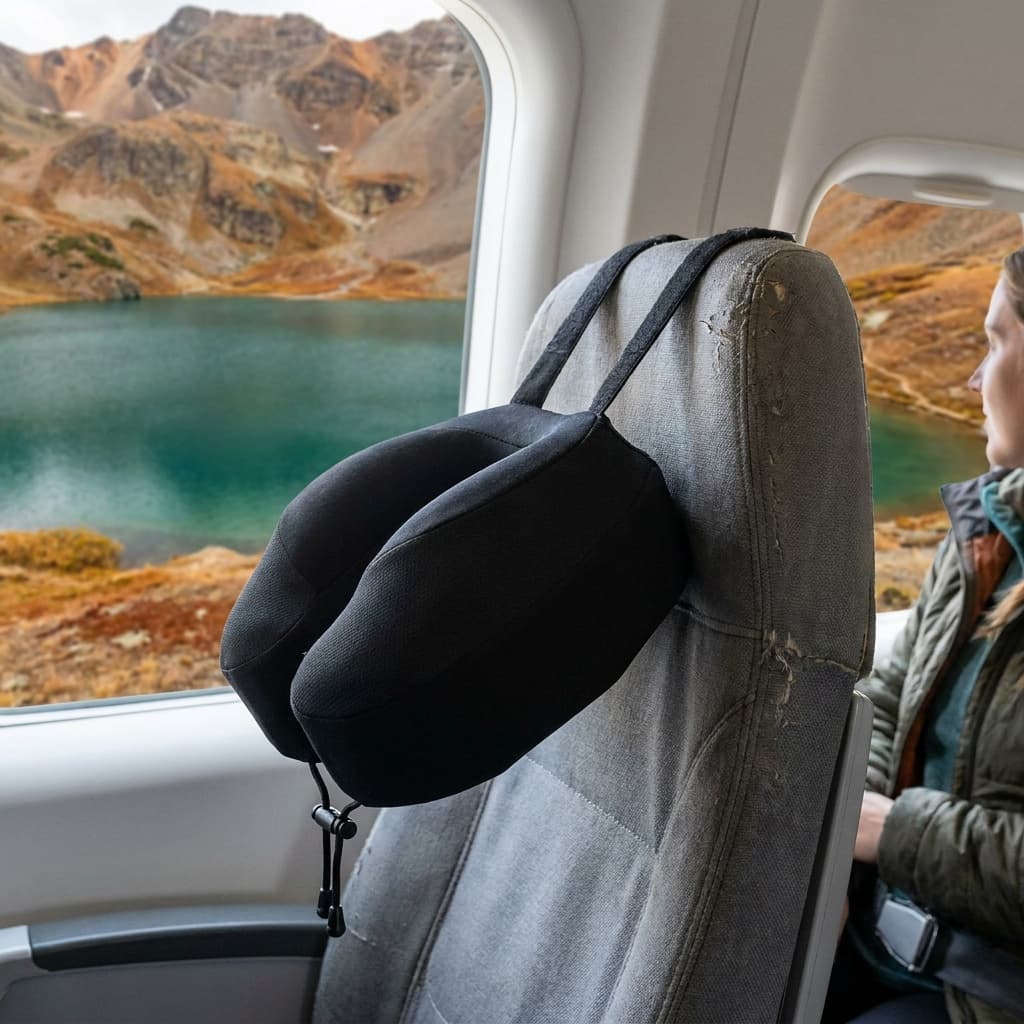
- Support type
- Memory foam with 360-degree side and chin support
- Seat connection
- Twin S3 straps wrap around compatible headrests
- Rear profile
- Thin, flat back
- Fit
- Adjustable sliding front clasp; fits neck sizes 12 to 18 in, per listing
- Cover
- Removable and machine-washable
- Packed volume
- Included bag compresses pillow to about one-third size
About this pick
The Cabeau Evolution S3 combines a flat-back memory-foam shape with raised side support, an adjustable front clasp, and twin straps that wrap around a compatible seat headrest. The anchor is its defining advantage: it reduces pillow and head movement instead of relying only on pressure around the neck.
Strengths
- Seat straps create the most stable headrest connection in this comparison
- Flat back avoids stacking a thick foam roll behind the neck
- Removable machine-washable cover and compression case support repeat travel
Weaknesses
- Straps cannot anchor usefully to every shell seat or headrest design
- High side walls can crowd over-ear headphones and may feel too tall on a short neck
Kit Score breakdown

TRTL
Trtl Travel Pillow Original
Best Compact Support
Kit Score 8.3/10
$59.99 Price checked Oct 23, 4:16 PM CDT
Best for: One-bag and frequent travelers who normally lean to one side, want structured support, and refuse to carry a large foam ring.
- Internal support holds one side of the head without adding bulk behind the neck
- It takes practice to place and tighten correctly before a flight
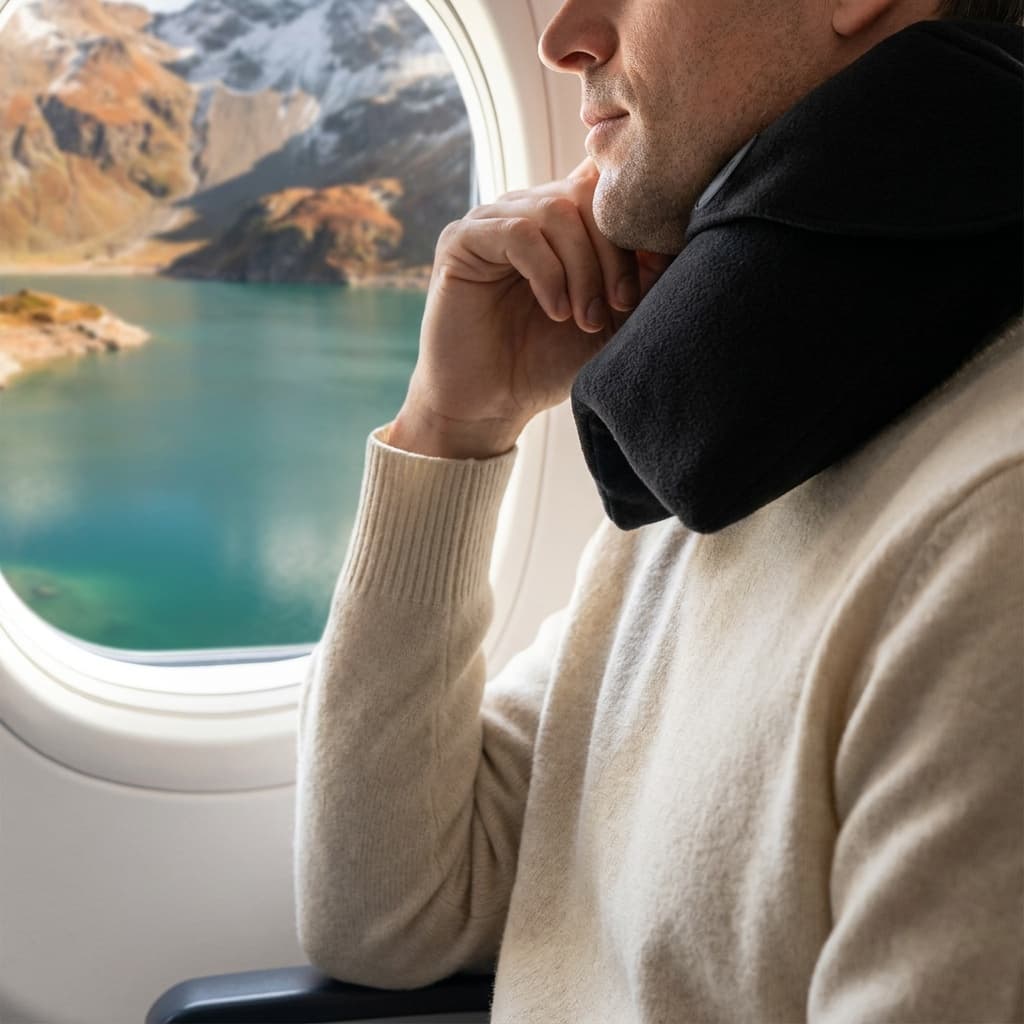
- Support type
- Internal side support inside a fleece wrap
- Weight
- 4.7 oz (133 g)
- Size
- 8.7 x 9.5 x 3.6 in
- Sizing
- Linked listing is Regular; Small recommended for about 5 ft 7 in (170 cm) and under
- Position
- Can be worn left, right, or toward the front
- Cleaning
- Remove support; machine wash shell cold at 30 C
About this pick
The Trtl Travel Pillow Original replaces a U-shaped cushion with an internal support wrapped in soft fleece. At 4.7 oz and roughly book size, it is dramatically easier to pack than memory foam while providing firmer one-sided support than an unstructured scarf.
More specifications
- Carry
- Water-resistant bag with carabiner
Strengths
- Internal support holds one side of the head without adding bulk behind the neck
- At 4.7 oz, it is much lighter than every foam pillow in this comparison
- The shell separates from the support for cold machine washing
Weaknesses
- It takes practice to place and tighten correctly before a flight
- The fleece wrap can feel warm, and one-sided support is not for travelers who change lean direction often
Kit Score breakdown

TRAVELREST
Travelrest Nest Ultimate Memory Foam Travel Pillow
Best Traditional Foam
Kit Score 8.3/10
$49.99 Price checked Oct 23, 4:16 PM CDT
Best for: Long-haul flyers who want substantial memory-foam support and a flatter rear profile, and who can spare more bag volume than an inflatable requires.
- Flat rear profile avoids adding a thick foam roll between the head and seat
- No seat strap, so the pillow can still move against a slick headrest
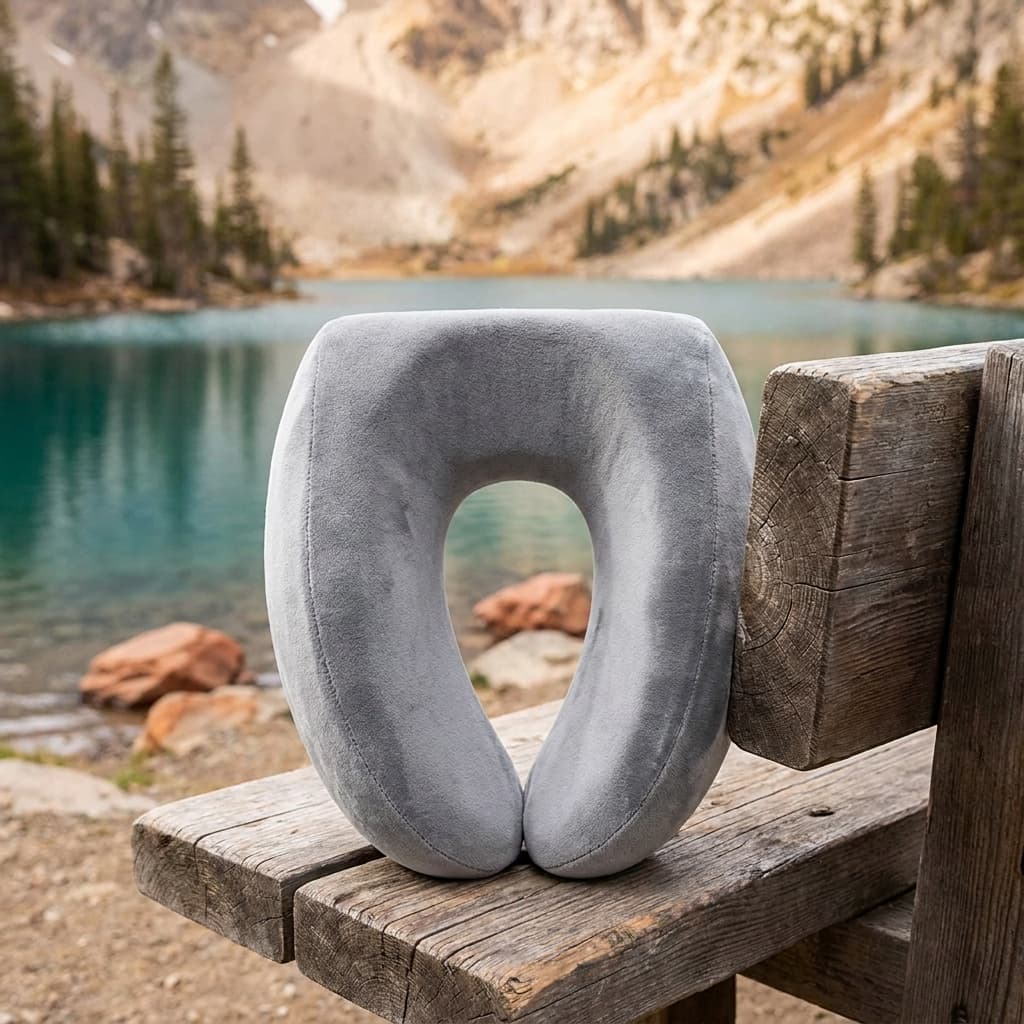
- Support type
- Memory foam
- Weight
- 13.6 oz (385 g)
- Packed volume
- Included stuff sack compresses pillow to about 1/4 size
- Cover
- Removable, hand-washable microfiber
- Backing
- Anti-slip silicone dots
- Included
- Compression stuff sack and foam earplugs
About this pick
The Travelrest Nest Ultimate combines thermo-sensitive memory foam, a flat rear profile, high side support, and non-slip backing. Its included stuff sack compresses the pillow to about one-quarter of its open volume, while the removable microfiber cover is hand-washable.
Strengths
- Flat rear profile avoids adding a thick foam roll between the head and seat
- High side walls and non-slip backing create steadier support than a loose horseshoe pillow
- Compression sack attaches to a luggage handle and includes a pair of foam earplugs
Weaknesses
- No seat strap, so the pillow can still move against a slick headrest
- Foam remains heavier and bulkier than Trtl or an inflatable even after compression
Kit Score breakdown
See all picks in Best travel pillow 2026: 6 neck pillows for flights
Keep going
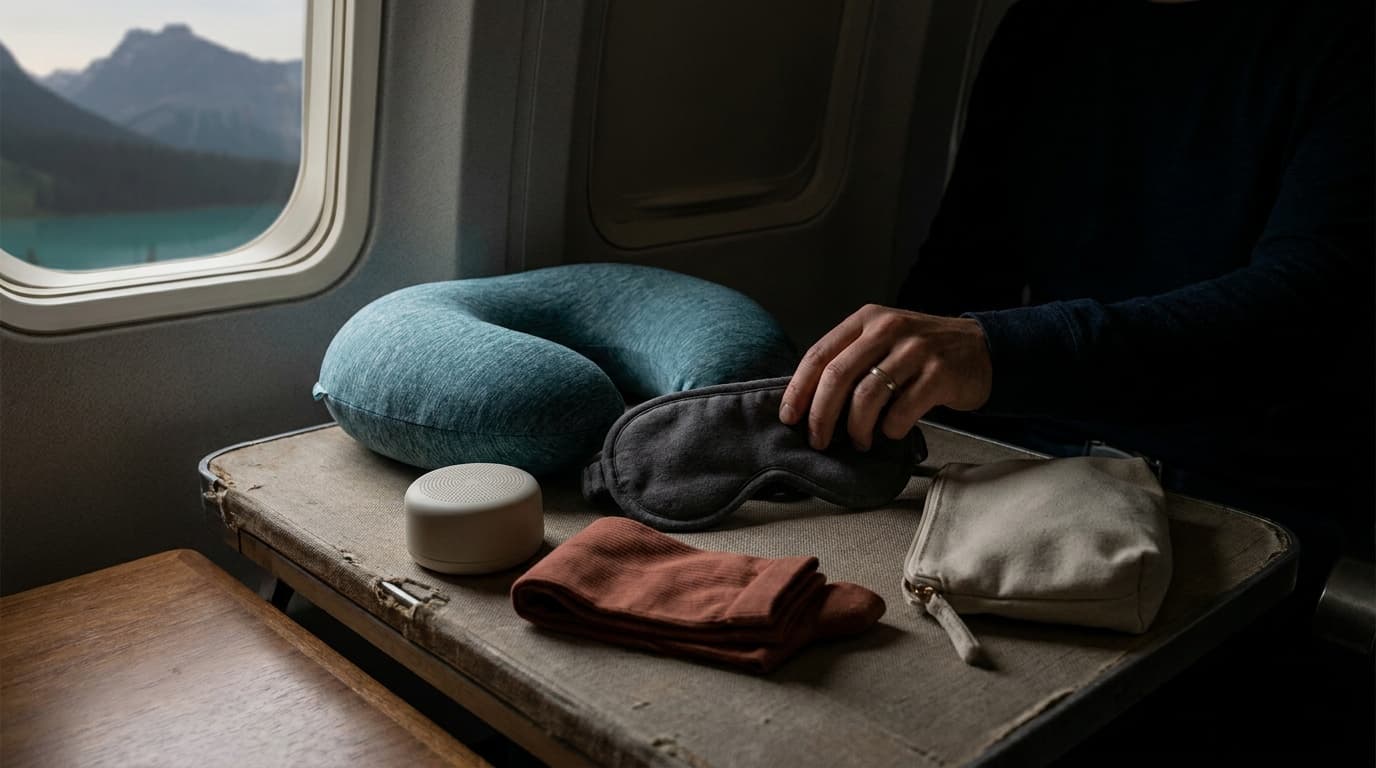
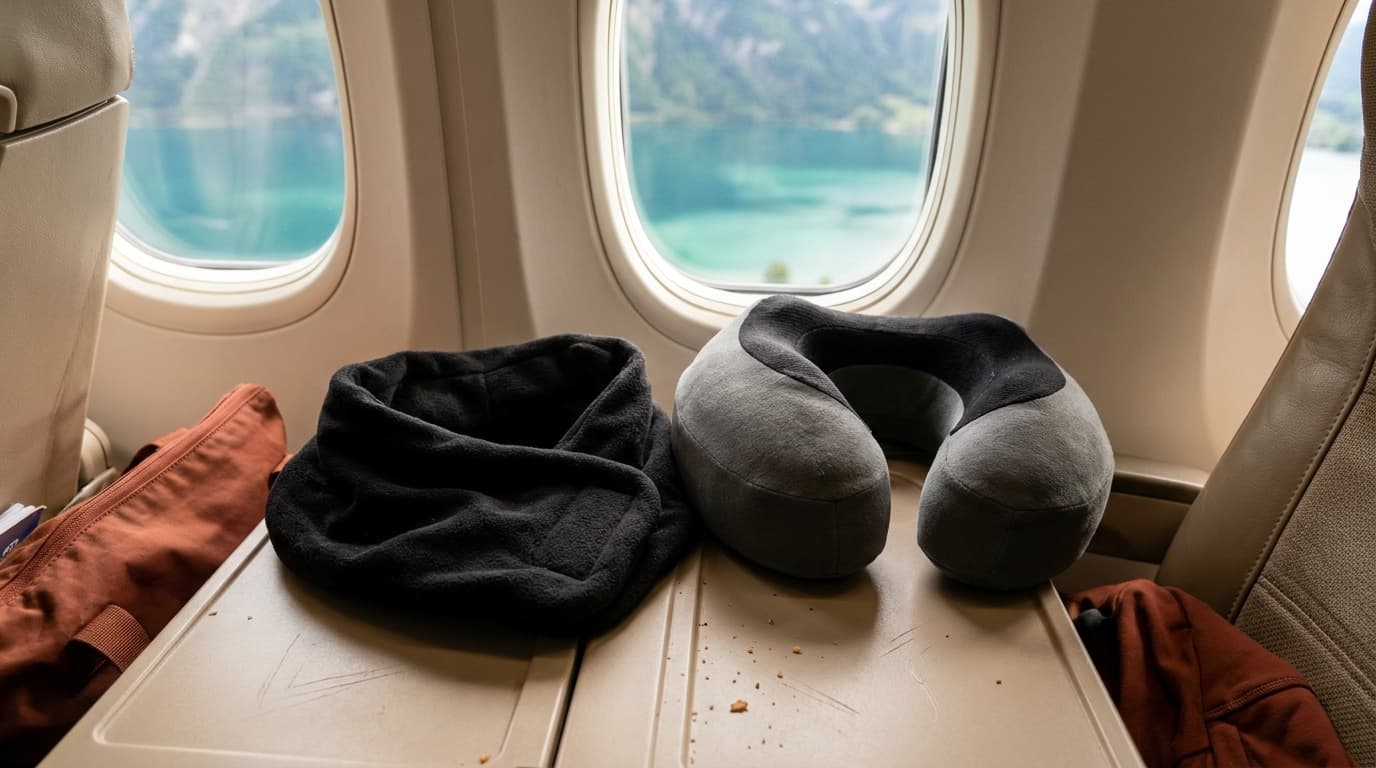
Complete loadoutLong-flight comfort kitFive packable pieces for neck support, darkness, quieter cabins, leg comfort, and more consistent sleep away from home.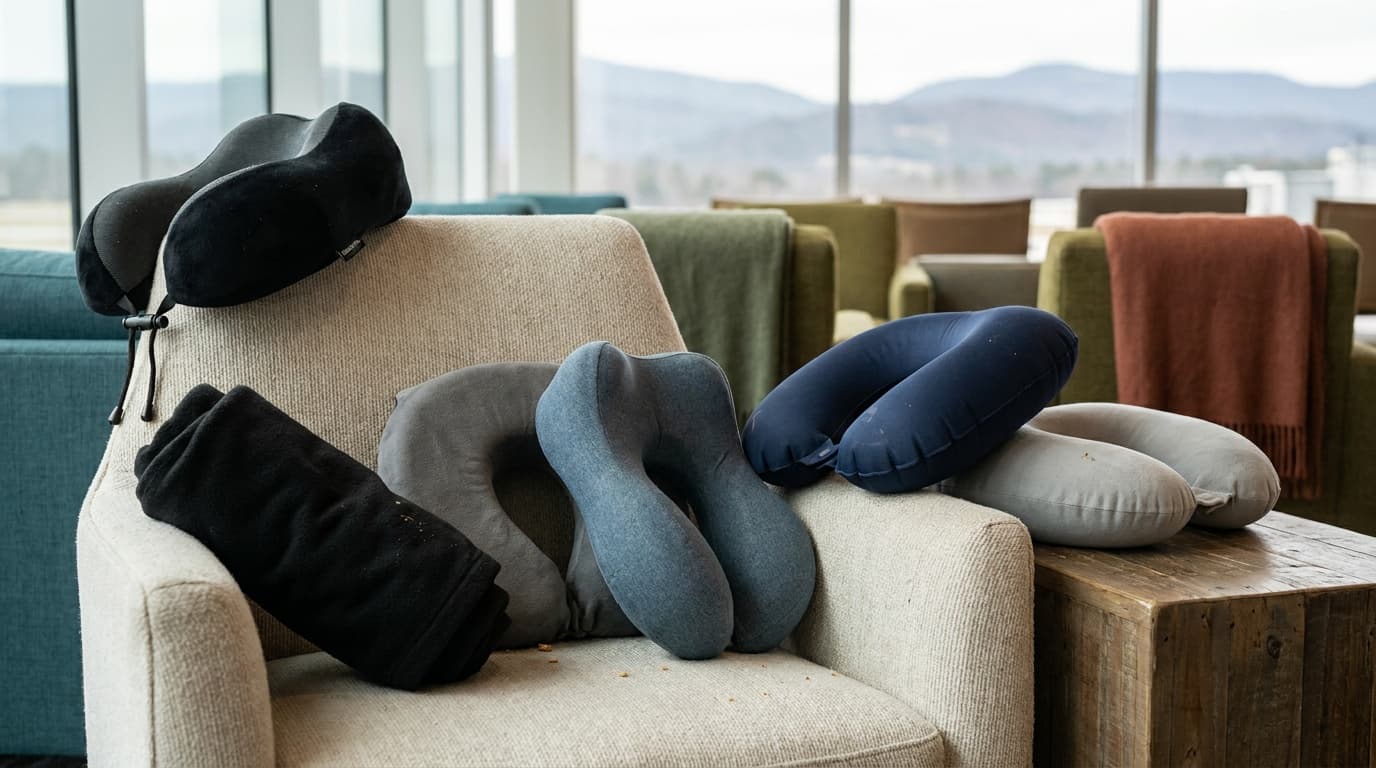
Researched, not hands-on tested
Updated Jul 9, 2026Our recommendations draw on manufacturer documentation, retailer listings, owner feedback, and comparisons with alternatives.
As an Amazon Associate I earn from qualifying purchases. We may earn a commission from links here, at no extra cost to you. How we research →