For most flyers, the right pick is an over-ear pair with hybrid ANC and at least 30 hours of battery with noise cancelling on, the rating Sony publishes for its WH-1000XM5 and XM6; choose flagship ANC earbuds instead if you sleep on your side on overnight flights or pack light. Active noise cancelling works best on steady low-frequency sound like engine drone, while passive sealing handles higher frequencies, research on cabin noise and ANC notes. This guide covers the mechanics, the key specs, and the tradeoffs so you can match the right pair to your trips.
How active noise cancellation actually works
ANC is not a filter applied to your audio after the fact. It is a real-time signal generated by the headphones to cancel incoming sound before it reaches your ears.
The process: a microphone samples ambient noise, a digital signal processor calculates the inverse waveform, and the drivers play that anti-noise signal alongside your music. The two signals meet and largely cancel each other out.
The design that matters most for buyers is hybrid ANC, which uses microphones on both the outside and inside of the earcup. External (feedforward) microphones catch high-frequency noise before it reaches your ear. Internal (feedback) microphones catch whatever slips through at lower frequencies. Hybrid covers a wider frequency range than single-mic designs, and at this point it is the floor to look for even at mid-range price points.
ANC is not omnidirectional magic. It targets steady, predictable, low-frequency noise: jet engine drone, train rumble, HVAC hum. In one example cited in the cabin-noise research above, an ANC motorcycle helmet cut engine noise by about 40 dB below 200 Hz but only about 15 dB between 200 and 600 Hz. It reduces but does not erase human speech, which sits mostly in the mid frequencies (roughly 500 Hz to 4 kHz) where cancellation is weaker and your brain is already tuned to listen. Sharp, sudden sounds (a door slamming, a child crying) mostly pass through.
A good pair of hybrid ANC headphones can cut perceived engine noise dramatically on a long-haul flight. What it cannot do is silence the person talking loudly across the aisle.
Over-ear headphones vs. ANC earbuds for travel
Both form factors work. The right choice depends on what your trips actually look like.
Matching form factor to trip type
Long-haul flights
Over-ear headphones give stronger combined passive and active isolation. The physical seal over the ear adds attenuation before ANC even switches on, and wearing comfort over many consecutive hours favors a well-padded over-ear. The Sony WH-1000XM6 (up to 30 hours with noise cancelling on) and the long-running JBL Live 780NC (about 50 hours with ANC on, up to 80 off, per JBL's launch figures) are strong models for this use case in 2026.
Overnight flights
Earbuds win here. Sleeping against a window or on a shoulder is difficult or impossible in over-ear headphones. A compact earbud case also avoids the neck-pillow geometry problem entirely.
Multi-stop and light-pack trips
Earbuds. A small charging case is far easier to manage across transit hops than a folded over-ear case in a backpack or personal item.
Daily commute that doubles as travel gear
ANC earbuds with adaptive mode. The current flagships (Sony WF-1000XM6, Samsung Galaxy Buds 4 Pro, AirPods Pro 3) are strong enough that comfort and portability can drive the choice, though a good over-ear seal still adds passive isolation that earbuds cannot fully match.
Battery life: what the numbers mean in practice
ANC costs battery, which is why manufacturers list two figures: ANC on and ANC off. On the Sony WH-1000XM5, Sony rates 30 hours with noise cancelling on and 40 hours off (AAC), so ANC trims about a quarter of the runtime. Always use the ANC-on number for planning.
A 30-hour ANC-on rating covers most long-haul routes with margin. For trips longer than that, focus on quick-charge capability rather than headline capacity. Sony says the XM5 gets about 5 hours of playback from a 10-minute charge, and JBL quotes up to 4 hours from 5 minutes on the Live 780NC, so a brief layover stop can top you up meaningfully.
What to ignore: total hours when ANC is off. Useful for knowing absolute ceiling, not useful for flight planning.
Transparency mode: the underrated feature
Transparency mode reuses the ANC microphones but feeds captured ambient sound into the drivers instead of cancelling it. The result: you can hear boarding announcements, order from a flight attendant, or navigate an airport without removing your headphones.
It is an active feature and draws battery power. It also varies more between models than ANC performance does. Flagship implementations from Sony, Apple, and Bose (the Bose QuietComfort Ultra is the reference point) sound nearly natural: the ambient audio is clean and spatially convincing. Budget implementations often sound hollow or telephone-like, which makes conversations awkward rather than easier.
If you use headphones through airports and not just on the plane, treat transparency mode quality as a first-class spec, not an afterthought. Read reviews that describe the sound of transparency specifically, not just whether the feature exists.
Sound quality and the ANC tradeoff
Early ANC headphones had a real problem: the cancellation signal introduced audible hiss, and the processing colored the bass or treble in ways that were hard to ignore. That tradeoff still exists on budget hardware. On current flagship models, it is largely resolved.
What to expect by price tier:
- Budget ANC (under $100): Often single-mic ANC targeting a narrower frequency range. Muddy bass and harsh treble with ANC on are common. Useful for occasional travel if you cannot stretch the budget, not ideal if headphones are a regular part of your kit.
- Mid-range ANC ($100–$200): Hybrid ANC increasingly available at this tier. Sound quality with ANC on is acceptably neutral on the better models like the Soundcore Space 2. Read reviews that test ANC-on sound specifically.
- Flagship ANC ($300+): Hybrid ANC, strong transparency mode, clean sound with ANC on, quick-charge. This is where the Sony XM6, Bose QuietComfort Ultra, and Apple AirPods Pro 3 compete.
What adaptive ANC actually means
"Adaptive ANC" means the headphones continuously measure the ambient noise around you and adjust cancellation strength in real time, rather than applying a fixed level. This is genuinely useful if you move between environments without wanting to manually change settings: office to street to subway to plane.
The catch: budget headphones sometimes label a simple three-step toggle (strong/medium/off) as "adaptive." True adaptive ANC is continuous, scene-aware processing. Rely on reviews rather than spec-sheet language to tell the difference.
How to prioritize before you buy
Matching specs to your use case
Long-haul flights (primary use)
Prioritize over-ear form factor, hybrid ANC, and 30+ hours of battery with ANC on. Transparency mode quality matters here because airports are part of the trip.
Daily commute plus occasional travel
ANC earbuds with adaptive mode and strong transparency. Portability and all-day wear comfort count as much as peak ANC performance.
Overnight flights with side sleeping
Earbuds only. Over-ear headphones are not compatible with sleeping on your side comfortably.
Budget constrained
Look specifically for hybrid ANC (not single-mic) even at lower price points. It is the single spec most predictive of whether ANC will be useful or disappointing in practice.
For specific model recommendations across these use cases, see our guide to the best noise cancelling headphones.
Where these numbers come from
| Claim | Source | Checked |
|---|---|---|
| Turboprop cabin noise 83 to 92 dB(A), higher than jets; passive protection works best above 500 Hz, ANC on low frequencies; ANC helmet example of about 40 dB below 200 Hz and 15 dB at 200 to 600 Hz; ANC headphones improved comfort at 84 to 86 dB(A) | Work (2025), earplugs and ANC headphones in turboprop noise (PMC12769926) | 2026-09-25 |
| Sony WH-1000XM5: 30 hr NC on and 40 hr off (AAC), 26/36 hr (LDAC); 10 min charge gives about 5 hr | Sony Help Guide, WH-1000XM5 operating time | 2026-09-25 |
| Sony WH-1000XM6: max 30 hr NC on and 40 hr off (AAC); 3 min charge gives about 1 hr (about 3 hr with USB PD) | Sony Help Guide, WH-1000XM6 operating time | 2026-09-25 |
| Soundcore Space 2: balanced sound profile with good audio reproduction accuracy | RTINGS, Anker Soundcore Space 2 review | 2026-09-26 |
| JBL Live 780NC: about 50 hr with ANC, up to 80 hr without; 5 min charge gives up to 4 hr | SoundGuys, JBL Live 780NC launch | 2026-09-25 |
Does ANC actually work on planes, or is it mostly marketing?
It works well for the specific noise planes produce. Engine drone and cabin rumble sit in the low-frequency range (below about 500 Hz) where ANC is most effective, and a good pair running hybrid ANC can cut perceived engine noise dramatically. In a 2025 study in a grounded Boeing 737 cabin playing turboprop noise at about 84 to 86 dB(A), ANC headphones significantly improved passenger comfort scores. What it will not do is silence the baby two rows back or the person talking loudly across the aisle. Speech falls mostly in the mid frequencies (roughly 500 Hz to 4 kHz) where cancellation is harder and your brain is already tuned to pay attention.
Should I get ANC over-ear headphones or ANC earbuds for travel?
It depends on the trip. Over-ear headphones give stronger combined passive and active isolation, making them the better pick for long-haul flights where you want maximum noise reduction for many consecutive hours. Earbuds are better for trips involving lots of transit switching, overnight flights where you want to sleep on your side, or travelers who prefer to pack light. The best current earbuds are strong enough that comfort and portability preferences can reasonably drive the decision.
What does 'adaptive ANC' mean and do I need it?
Adaptive ANC means the headphones continuously measure the noise around you and adjust cancellation strength in real time, rather than applying a fixed level. Useful if you move between environments (office, street, subway, plane) without wanting to manually change settings. True adaptive ANC does continuous, scene-aware processing. Budget headphones sometimes label a simple strong/medium/off toggle as "adaptive," so check reviews rather than relying on spec-sheet language.
For more gear built around life on the move, browse our travel gear hub and see how we research and rate every product we cover.
Recommended gear
Our current top picks from the Best noise cancelling headphones for travel in 2026 guide, if you are ready to buy.
SONY
Sony WH-1000XM6 Wireless Noise Canceling Headphones
Best Overall
Kit Score 8.5/10
$458.00 Price checked Oct 23, 4:16 PM CDT
Best for: Travelers who want the strongest all-around noise cancelling and a headphone that folds into a small case.
- Top noise isolation in RTINGS' testing, ahead of the Bose QuietComfort Ultra on overall noise suppression
- Thin, shallow earpads that RTINGS and SoundGuys both say are less comfortable over long wear than the Bose
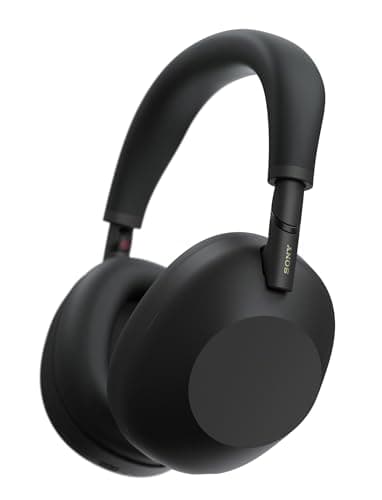
- Battery life (ANC on)
- 30 hours NC on with AAC (26 hours LDAC); 40 hours NC off (Sony)
- Weight
- Approx. 254 g (9 oz)
- Microphones
- 12 in total; 6 used for calls
- Bluetooth
- 5.3 with SBC, AAC, LDAC, LC3; 2-device multipoint
- Charging
- USB-C, approx. 3.5 hr full charge; 3 min = about 3 hr with a USB PD charger (about 1 hr otherwise)
- Design
- Folds, with a compact case that closes magnetically
About this pick
Sony's current flagship adds a folding design, a magnetic-closure case, and 12 microphones run by the new QN3 processor. RTINGS names it the best travel headphone it has tested, with 31.75 hours of measured playback with ANC on, and Sony rates it at 30 hours on AAC.
Strengths
- Top noise isolation in RTINGS' testing, ahead of the Bose QuietComfort Ultra on overall noise suppression
- Folds into a compact case with a magnetic closure, fixing the XM5's biggest packing complaint
- 30 hours rated with ANC on (AAC), and a 3-minute charge on a USB PD charger gives about 3 hours
Weaknesses
- Thin, shallow earpads that RTINGS and SoundGuys both say are less comfortable over long wear than the Bose
- The priciest Sony model here, and no USB-C audio or water resistance rating
Kit Score breakdown
Best for: Travelers who want near-flagship Sony noise cancelling and call quality for less than the XM6.
- Noise cancelling that RTINGS rates only slightly behind the XM6, strongest on low-frequency engine rumble
- Does not fold flat, which limits packing efficiency compared to rivals like the Sennheiser Momentum 4 (and the newer XM6, which does fold)
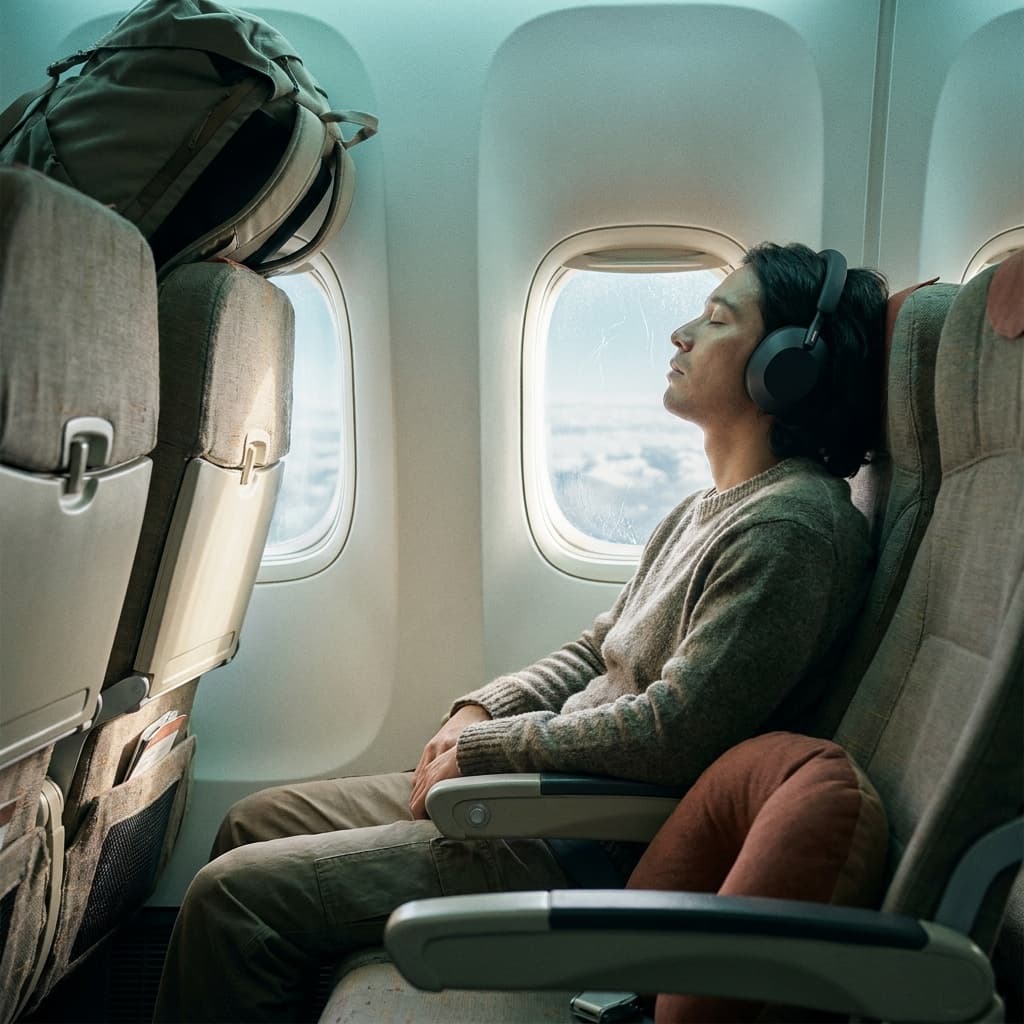
- Battery life (ANC on)
- 30 hours NC on with AAC (26 hours LDAC); 40 hours NC off
- Weight
- 250 g (8.8 oz)
- Microphones
- 8-unit array
- Bluetooth
- 5.2 with LDAC, AAC, SBC
- Charging
- USB-C, approx. 3.5 hr full charge; 3 min = about 1 hr (about 3 hr only with a USB PD charger); 10 min = about 5 hr
- Design
- Over-ear, closed-back; earcups swivel flat but the headband does not fold
About this pick
Sony's 2022 flagship pairs 8 microphones with strong low-frequency noise cancelling for engine hum, weighs about 250 g, and is rated for 30 hours with ANC on. Since the WH-1000XM6 replaced it in May 2025, it sells for well under the newer model, and RTINGS rates its cancelling only slightly behind the XM6.
Strengths
- Noise cancelling that RTINGS rates only slightly behind the XM6, strongest on low-frequency engine rumble
- 8-microphone system with strong owner marks for call clarity
- 30-hour rated battery with ANC on (AAC) covers most long-haul round trips, with a 3-minute quick charge as backup
- Sells for noticeably less than the XM6 now that it is the previous generation
Weaknesses
- Does not fold flat, which limits packing efficiency compared to rivals like the Sennheiser Momentum 4 (and the newer XM6, which does fold)
- Default sound tuning is bass-heavy and benefits from EQ adjustment in the Sony app
Kit Score breakdown
BOSE
Bose QuietComfort Ultra Headphones (2nd Gen)
Best Premium
Kit Score 8.4/10
$449.00 Price checked Oct 23, 4:16 PM CDT
Best for: Frequent flyers who want the most consistent, fatigue-free ANC on the market and are willing to pay a premium for it.
- Noise cancelling that RTINGS places just behind the Sony XM6, with a longer battery in its testing
- List price of $449 is the highest in this roundup, and SoundGuys finds the in-app EQ too basic for precise sound shaping
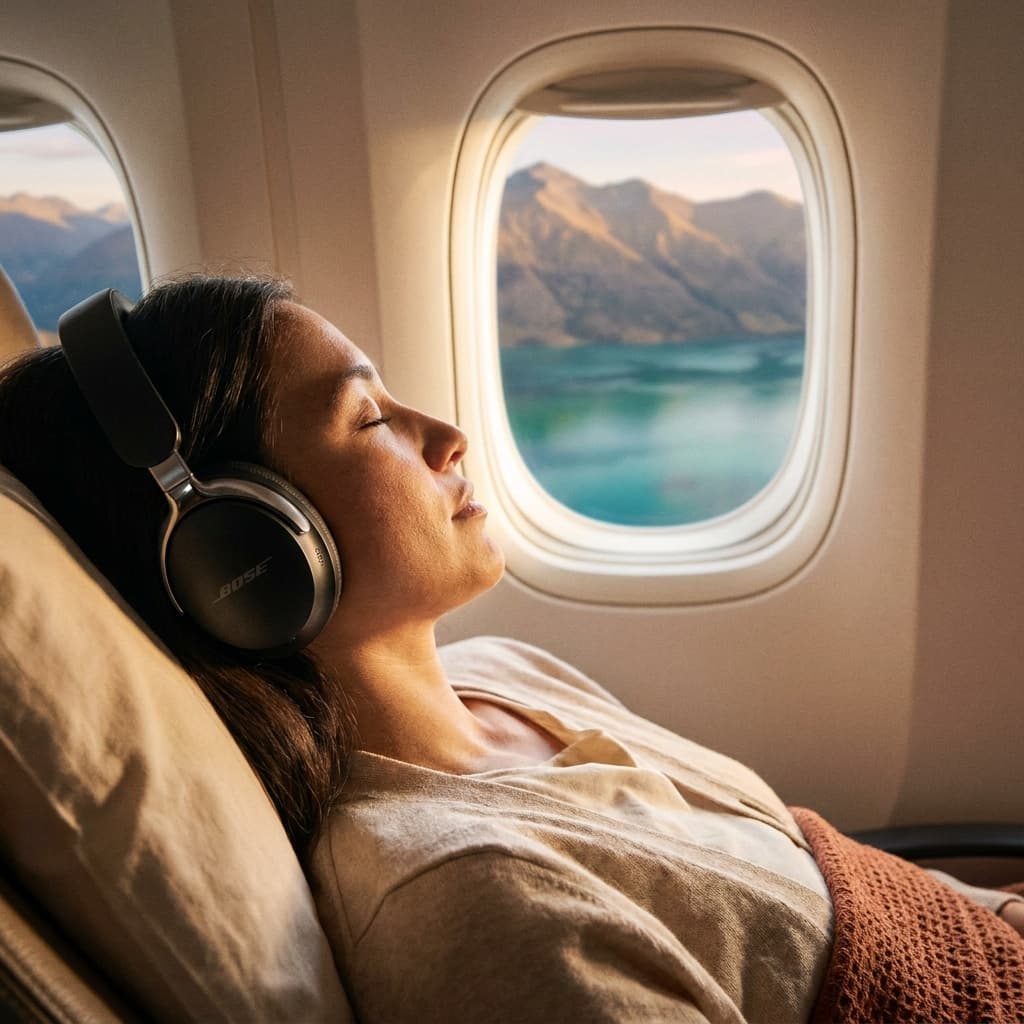
- Battery life (ANC on)
- 30 hours (Quiet/Aware modes); 23 hours with Immersive Audio
- Weight
- 0.583 lb (about 264 g) headphone only, per Bose product page
- Microphones
- Multi-mic system with Echo Reduction
- Bluetooth
- 5.4; aptX Adaptive on Snapdragon Sound devices; USB-C lossless wired audio
- Charging
- USB-C, 3 hr full charge; 15 min = 3 hrs
- ANC modes
- Quiet, Aware, Immersion
About this pick
The QC Ultra 2nd Gen builds on Bose's benchmark noise cancellation with up to 30 hours of rated battery (23 with Immersive Audio), Bluetooth 5.4, listen-while-charging, and USB-C lossless playback, all in a 0.583 lb (about 264 g) frame that reviewers consistently call one of the most comfortable in the category.
Strengths
- Noise cancelling that RTINGS places just behind the Sony XM6, with a longer battery in its testing
- The most comfortable pick here: RTINGS credits deeper ear cups that fit a wider range of head and ear shapes
- USB-C lossless wired audio and Bluetooth 5.4, plus Cinema mode and automatic on/off when you put them on or take them off
Weaknesses
- List price of $449 is the highest in this roundup, and SoundGuys finds the in-app EQ too basic for precise sound shaping
- No IP water resistance rating limits versatility outside controlled travel environments
Kit Score breakdown
See all picks in Best noise cancelling headphones for travel in 2026
Keep going
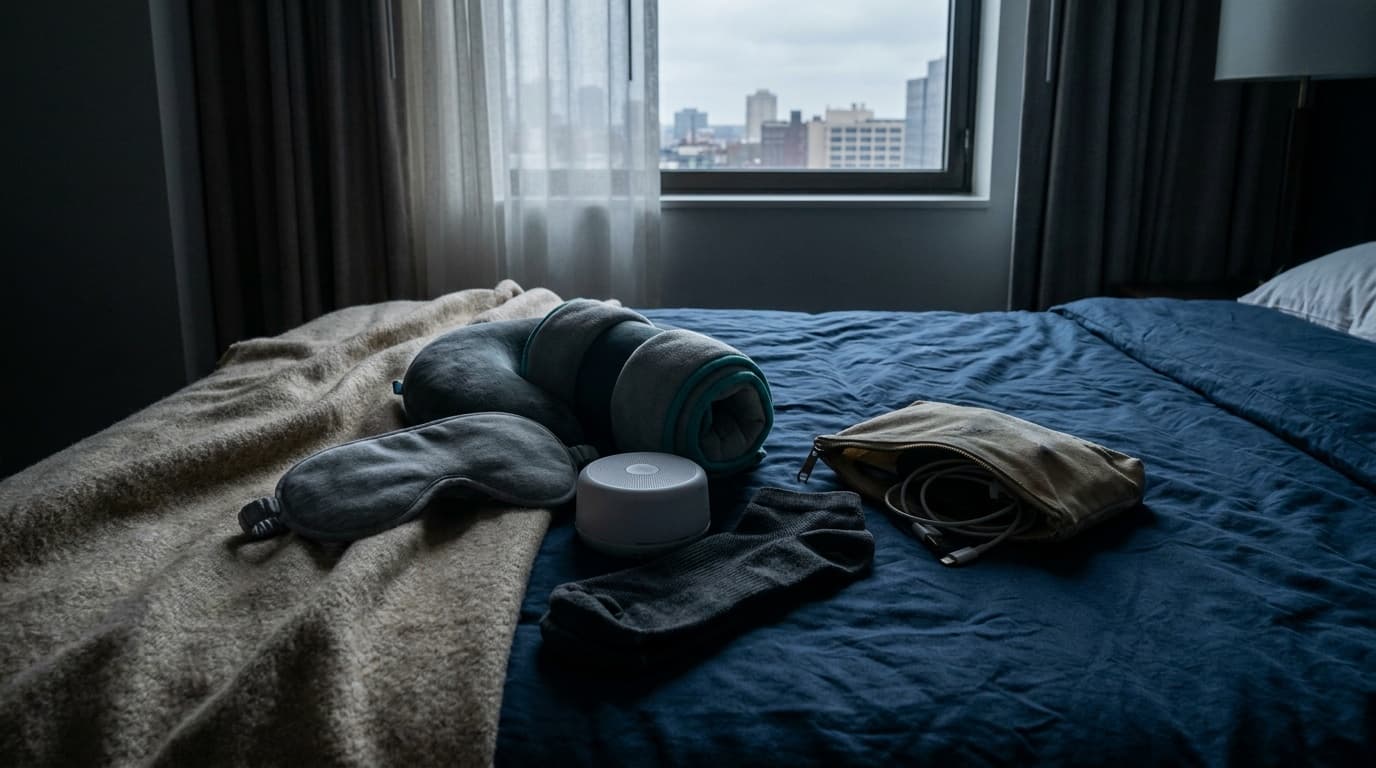
Complete loadoutLong-flight comfort kitFive packable pieces for neck support, darkness, quieter cabins, leg comfort, and more consistent sleep away from home.
Researched, not hands-on tested
Updated Sep 25, 2026Our recommendations draw on manufacturer documentation, retailer listings, owner feedback, and comparisons with alternatives.
As an Amazon Associate I earn from qualifying purchases. We may earn a commission from links here, at no extra cost to you. How we research →